




The Esquimalt and Nanaimo Railway had its beginnings in the negotiations over British Columbia (hereafter called "B.C.") becoming part of Canada. When B.C. joined Confederation in 1871, the distant province was promised a railway connecting it to the provinces in the east. Although it was not explicitly stated, Victoria, as the capital city and located on southern Vancouver Island, was seen as the terminus of the great transcontinental railway that was envisioned. This was confirmed in 1873 by Prime Minister Sir John A. MacDonald, but the enduring difficulty was that the promise was easier to deliver than the railway was to survey and construct, let alone finance. No one knew how the proposed railway, that was to become the Canadian Pacific Railway, was to cross the great barriers of the Rockies, Selkirks and Coast Ranges that separated the Pacific Coast of B.C. from the endless prairies to the east.
Building a railway along the east coast of Vancouver Island was never seen as easy, but it was far less of a challenge than building through the Rockies. Construction of the E&N began in 1884 and completion occurred on August 13, 1886 at Cliffside, above Shawnigan Lake. The E&N was extended, first northwards from Nanaimo to Wellington in 1887 then to Victoria across the harbour by a swing bridge in 1888.
The railway operated at a loss for some years before beginning to show modest profits by the turn of the century. At that time, James Dunsmuir, son of E&N's owner, was the sole owner and heavily involved in provincial politics. since the railway was in need of substantial modernization and expansion, he was ready to sell the railway and it was sold to Canadian Pacific in 1905.
Freight traffic increased substantially under Canadian Pacific control. The facilities at Victoria were completely inadequate and in the last six months of 1907, yard tracks were continually blocked by cars and as many as sixty cars were on sidetracks between Victoria and Ladysmith, waiting to move into Victoria. To add to the E&N woes at this time, the one-stall engine house in Victoria burned down in 1907, however, it was replaced by the unused engine house from Ladysmith, which was dismantled and rebuilt in Victoria at modest cost. Canadian Pacific did install more trackage in Victoria and along the line.
By this time, the Victoria Board of Trade was pressuring Canadian Pacific to build a yard on the city side of the harbour that would allow the merchants of Victoria quick and easy access to cars and express consigned to them. In response, the CPR proposed that it would run a railway from the present terminus on Store Street in a northerly direction along that street to connect with the Albion Iron Works. The CPR had purchased the iron works property and planned to demolish the buildings to make way for a new yard and freight shed in the block bounded by Store, Discovery, Government and Chatham Streets.
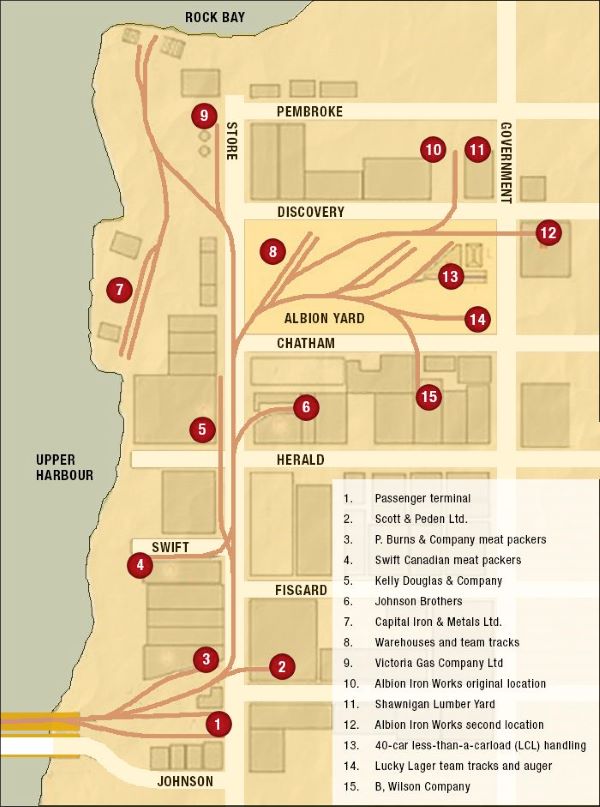
The City agreed to the Store Street extension and granted the E&N permission to lay spurs from the railway line to the former Albion property or into businesses that might require it, with the stipulation that "the Railway must do all necessary excavations, alterations and to grade the street, provided that the existing grade would not be altered without consent, in writing, of the city engineer".
On March 26, 1908, construction crews began grading and laying the track from the station to the new yard. Meanwhile, the demolition of the old Albion Iron Works was well underway. Once the tracks were complete, B.C. Electric Railway crews installed overhead wires for electric railway operation and on May 21st, the first six freight cars were shunted into the yard by a B.C. Electric freight motor and unloading began immediately.
There was a marked improvement in the speed of delivery of freight cars destined for Victoria's merchants once the yard was completed. A year later, the CPR installed a spur off the Albion Yard and across Chatham Street to service a new warehouse being built by Wilson Brothers, a wholesale grocery firm. This was the first business in Victoria to have a direct connection with the railway, which allowed it to ship and receive goods in carload lots at the warehouse.
Victoria's waterfront to the north of Johnson Street Bridge was a prosperous industrial area with sawmills, shipyards, logging and industrial suppliers, including foundries and machine shops, the Albion Iron Works (which manufactured a wide range of goods including stoves and cast building components) and wholesale and warehouse establishments, as well as retail businesses. Some of the business in later years with direct rail service access were Shawnigan Lake Lumber, Scott & Peden (later Buckerfield's), Swift Canadian Company, P. Burns & Company, Macdonald's Consolidated, Dowell's Cartage, Wilson Brothers and W.H. Malkin Company. Many other business were served by deliveries to the freight shed or by using cars spotted at the loading platforms. The Victoria Phoenix Brewery (later the Lucky Lager Brewery and finally the Labatt Brewery), was just across Government Street from the yard, and installed an auger system under the street to take grain into the brewery from railway cars in the yard.
Immediately north of the Albion Yard were the car barns and yards for the B.C. Electric Railway streetcar system. However, in 1948, streetcar service was discontinued and the street railway system was dismantled. The Albion Yard and surrounding businesses served by the railway made up one of the main distribution centres for Victoria and the surrounding areas of southern Vancouver Island. Also of importance to the region were the industries serviced by the railway on the Songhees lands to the west of the Johnson Street Bridge. These included Sidney Roofing, cordwood distributors, Esso and Shell Oil, shingle mills and in earlier years, shipyards.
As late as the 1960's, this area was still receiving many carloads of goods from the mainland and tracks extended as far as the south side of Rock Bay. Only with the de-industrialization of Victoria and southern Vancouver Island, which gained force in the 1960's and later decades, did this railway service fade away. Canadian Pacific itself, diverted its less-than-carload shipments away from the railway to its trucking subsidiary, Canadian Pacific Transport, on August 1, 1959. Increasingly, merchandise of all sorts destined for Vancouver Island, that was once transported by the E&N, was trucked to outlets on the Island, bypassing the railway completely. Moreover, the nature of rail traffic was changing as containerization and specialty freight cars, using modern terminals or intermodal facilities, replaced the once commonplace box car and intricate spur lines through city streets to individual commercial customers.
The E&N freight shed was destroyed by fire on May 6, 1976. In the mid-1980's, declining freight traffic on Vancouver Island caused closures and downgrades and one by one, the freight customers along the E&N were closing, re-locating to the mainland or shifting to trucks for their transport need. Swift Canadian Company, P. Burns & Company and grocery wholesaler Kelly Douglas all stopped receiving rail shipments and closed or re-located, as did Scott & Peden, by then sold to the long-established firm of Buckerfield's. This firm later closed and the building was modernized, becoming Swan's brewpub and hotel.
The reduction of E&N traffic to and from Victoria meant the frequency of train service also declined to one freight every second day. On November 1, 1981, Train No. 51, originating in Victoria, was abolished and replaced by a crew working out of Wellcox in Nanaimo. With very little switching required in Victoria, the yard crew assignment was cancelled on May 1, 1982 since it was reasoned that the road switcher could do any necessary Victoria switching and then run to Malahat, where it could exchange cars with a train run down from Wellcox. That was soon changed and the road switcher ran to Duncan, where it exchanged cars with the Wellcox crew and returned to Victoria.
The railway built a loading ramp near the roundhouse in Victoria West to take cars that previously had to be unloaded at Albion Yard. This permitted the sale of Albion Yard-Block D property in the 1980's, as well as more efficient switching of freight cars. The street trackage along Store Street to the Albion Yard was removed in 1992. The last customers were B.C. Hydro for propane and Garden City, a wholesale grocery store that was located across from the Albion Yard. Both warehouses had limited track space and the CPR purchased a small strip of land and added a second track for the gas shipments. For the E&N, this meant fewer calls for trains and fewer cars to be stored in the yards pending delivery.
Those changes, implemented in 1986, meant the E&N could eliminate the Victoria-based crew and operate a train from Wellcox to Victoria and return three days a week. A diesel switcher was retained in Victoria because of the sharp curvature of the track into Garden City warehouse across from Albion Yard. By the spring of 1993, the Garden City warehouse and B.C. Hydro were no longer needing rail service over the trackage along Store Street and in April, the rails were removed, ending eight decades of E&N trains threading their way along the city street to the yard.
The yard that once had been so happily received as an essential facility for the commercial growth of Victoria was a thing of the past. It became a parking lot for Capital Iron and other local businesses, and a number of new buildings were constructed on the site. The end of track on the city side of the harbour was just past the VIA Rail station, east of the Johnson Street bridge, and the only service into the city was VIA's E&N Dayliner with its morning departure and early evening arrival.
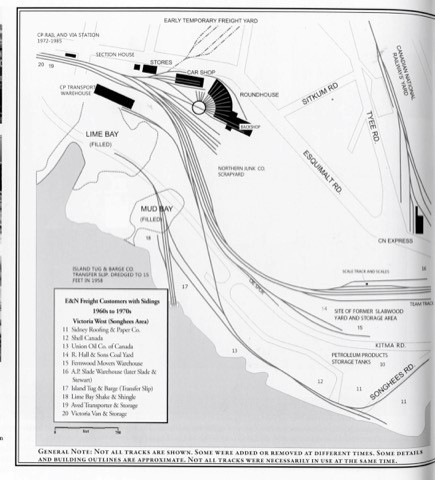
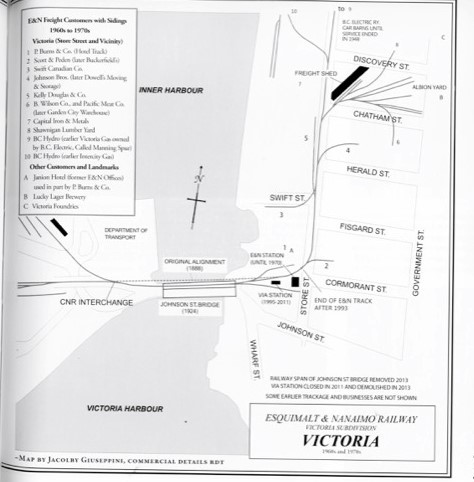
Esquimalt and Nanaimo Railway Victoria Subdivision, courtesy Robert D. Turner, from his book "Vancouver Island's Esquimalt and Nanaimo Railway". The above paragraphs also from the same source.
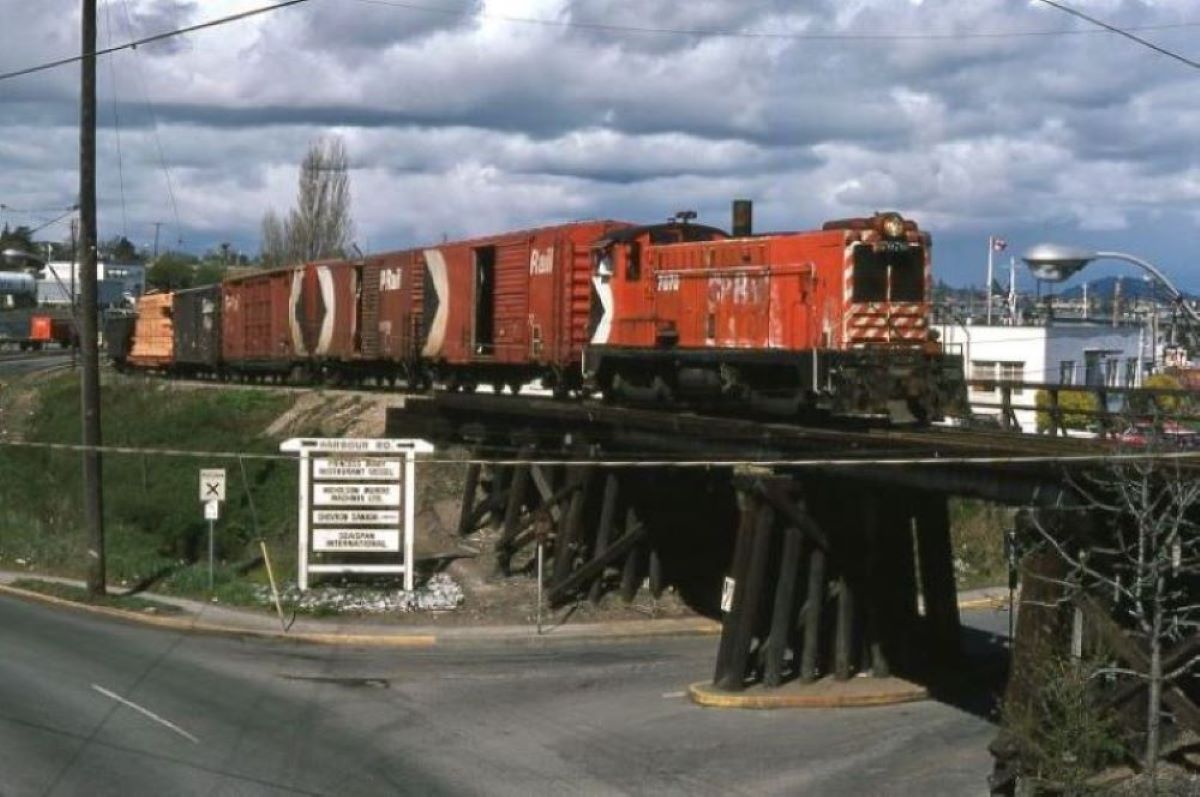
CP Rail 7070 switching E&N/Canadian National interchange over Harbour Road, Milepost 0.15 of the Victoria Subdivision, on April 9, 1979, as seen from
the 0.2 mile bridge over Esquimalt Road.
CP DS4-4-1000 7070 was built by Baldwin in 1948 then retired and scrapped in 1982.
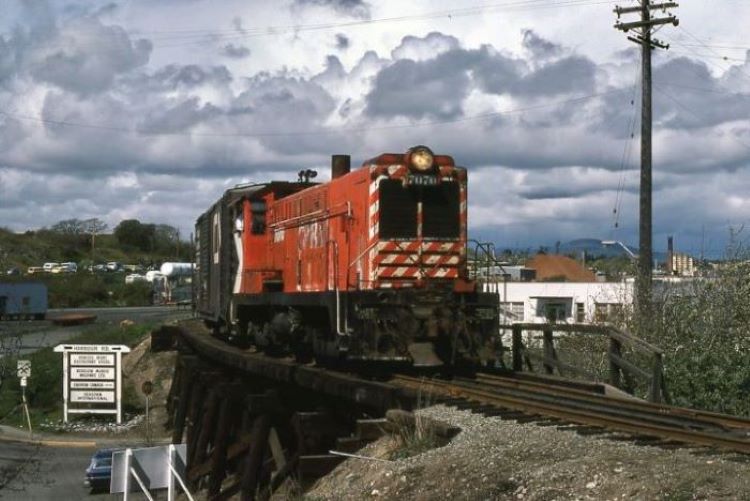
CP Rail 7070 switching E&N/Canadian National interchange over Harbour Road, Milepost 0.15 of the Victoria Subdivision, on April 9, 1979., as seen from
the 0.2 mile bridge over Esquimalt Road.
CP DS4-4-1000 7070 was built by Baldwin in 1948 then retired and scrapped in 1982.
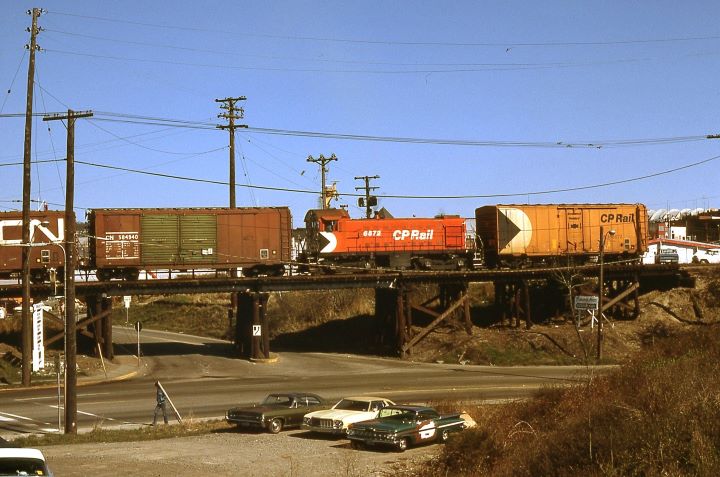
CP Rail 6572 switching the E&N/Canadian National interchange above Harbour Road on January 14, 1979. This is up from the CN interchange, just west (by
compass) of the Johnson Street rail and road bridges.
CP S-3 6572, built by Montreal Locomotive Works in 1957, was in service on the E&N from 1974 to 1981, when it was retired and scrapped.
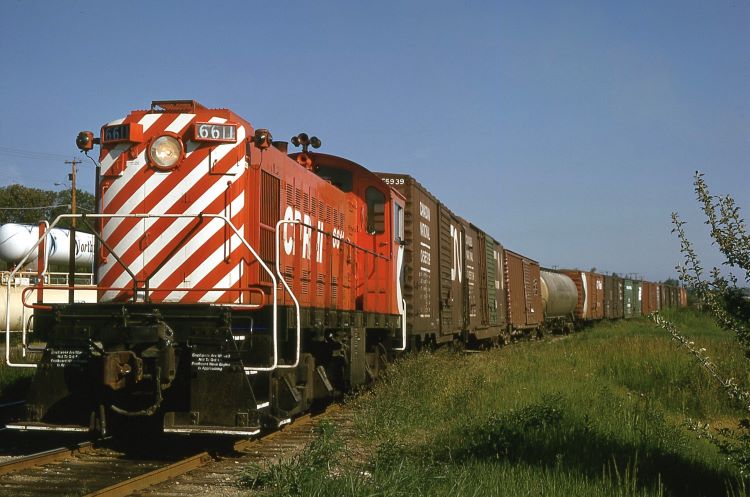
CP Rail 6611 leading a mixture of CP and CN freight cars at the interchange on May 31, 1975.
CP S-10 6611 was built by Montreal Locomotive Works in 1958, then retired in 1979 and scrapped.
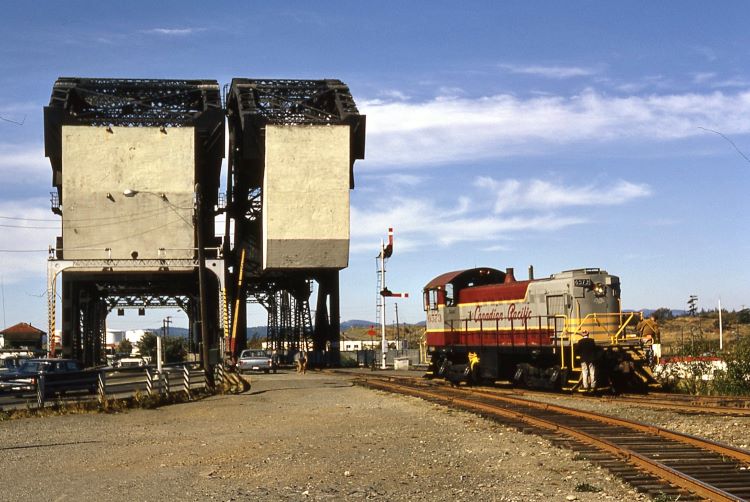
Canadian Pacific 6573 approaching Johnson Street Bridge on September 12, 1970.
CP S-3 6573 was built by Montreal Locomotive Works in 1957 and retired in the early 1980's.
Victoria’s pronounced Inner Harbour was one of the reasons the site was chosen by James Douglas for the establishment of Fort Victoria in 1843, long before anyone
through railways and bridges would be needed. The upper reaches of the harbour had become an important industrial area and were considered navigable waters. A
swing bridge was constructed in 1888 but by 1920, it needed replacement.
A bascule type of drawbridge which eliminated the centre pier and raised the spans from the east side using counterweights was proposed. Three lanes of road
traffic were planned on one span and a single line of railway track on the other. Designed by Strauss Bascule Bridge Company of Chicago, it was a variation of the
Strauss trunnion pattern first used in 1902. With the steel work fabricated by the Canadian Bridge Company of Walkerville, Ontario, the bridges were opened to much
fanfare on January 11, 1924.
The bridge alignment required additional negotiations and compromises. It was not on the line of Johnson Street, as the City and Province would have preferred,
in order to accommodate the curvature of the railway tracks leading from the station. The City would also have preferred the two spans to have been in separate
locations, but the federal government would not allow the additional obstruction to the waterway that such a scheme would have entailed.
The original wood deck absorbed rainwater and became heavier (as well as slippery) when wet. This affected the balance and put a strain on the lift mechanism.
In 1966 it was replaced with open steel grid decking, which drained water and maintained its weight. In 1979 extensive repairs were made to the superstructure, which
had become severely corroded. The steel was painted blue after the repairs.
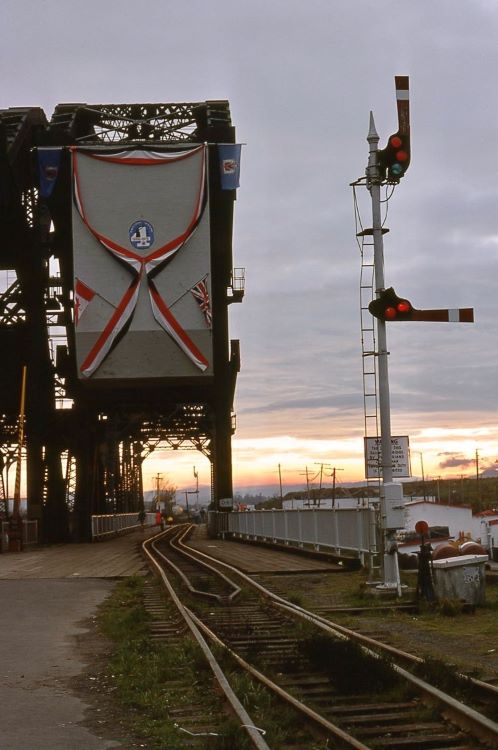
The east end of the Johnson Street Bridge, with the semaphore signal showing clear on March 29, 1978.
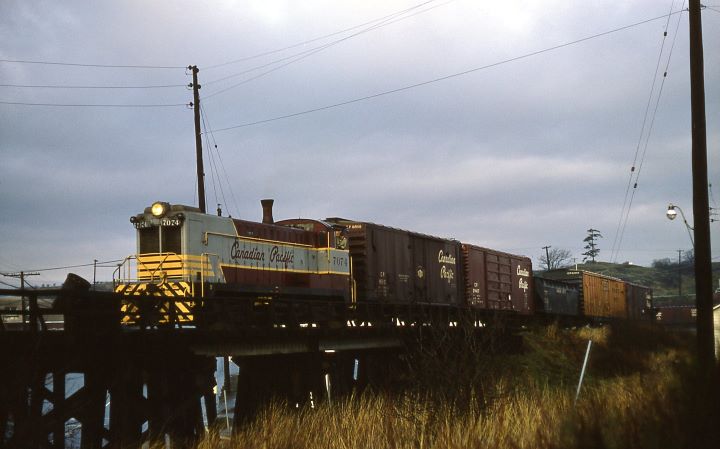
Canadian Pacific 7074 switching the interchange just after crossing the Johnson Street bridge on December 23, 1967.
CPR DS4-4-1000 7074 was built by Baldwin in 1948 then retired and scrapped in 1977.
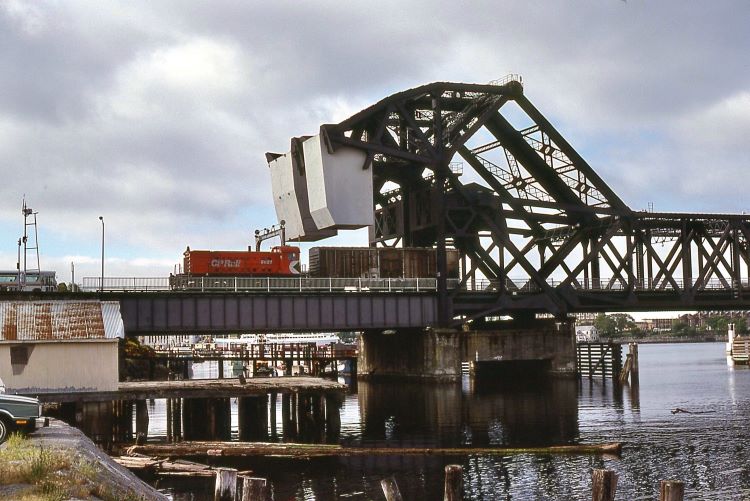
CP Rail 6621 and a lone boxcar cross the Johnson Street bridge on May 7, 1979.
CP S-11 6621 was built by Montreal Locomotive Works in 1959. It was retired in 1989 and rebuilt to remote-controlled switcher 3783-01 then re-numbered
3779 and sold to Minnesota Commercial Railway in 1999 as CTM-1 and later scrapped.
Victoria’s pronounced Inner Harbour was one of the reasons the site was chosen by James Douglas for the establishment of Fort Victoria in 1843, long before
anyone thought railways and bridges would be needed. The upper reaches of the harbour had become an important industrial area and were considered navigable waters.
A swing bridge was constructed in 1888 but by 1920, it needed replacement.
A bascule type of drawbridge which eliminated the centre pier and raised the spans from the east side using counterweights was proposed. Three lanes of road
traffic were planned on one span and a single line of railway track on the other. Designed by Strauss Bascule Bridge Company of Chicago, it was a variation of the
Strauss trunnion pattern first used in 1902. With the steel work fabricated by the Canadian Bridge Company of Walkerville, Ontario, the bridges were opened to much
fanfare on January 11, 1924.
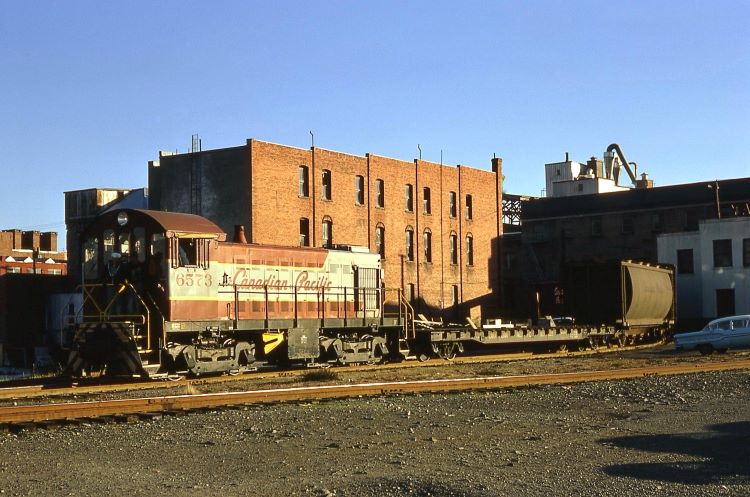
Canadian Pacific 6573 coming off Store Street on a transfer on November 3, 1970.
CP S-3 6573 was built by Montreal Locomotive Works in 1957 and retired in the early 1980's.
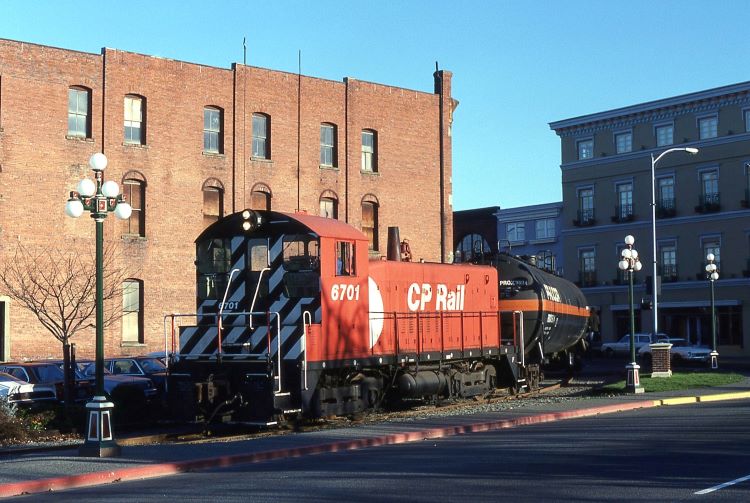
CP Rail 6701 switching Store Street on December 30, 1988.
CP SW8 6701 was built by General Motors Diesel in 1950. It was converted to slug 6701 in 1994 then re-numbered to 1011 in 1996 and paired with "mother"
unit St. Lawrence and Hudson GP7u 1502. Retirement occurred in 2013.
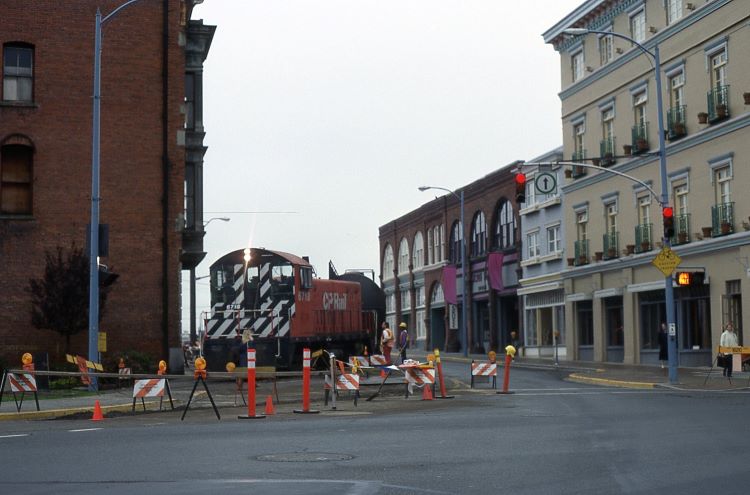
CP Rail 6718 switching Store Street on October 21, 1988.
CP SW900 6718 was built by General Motors Diesel in 1955 then upon retirement, sold to M4 Holdings in 1989. It was later sold to Ellis and Eastern Railroad in
Ellis, South Dakota and re-numbered EERR 17.
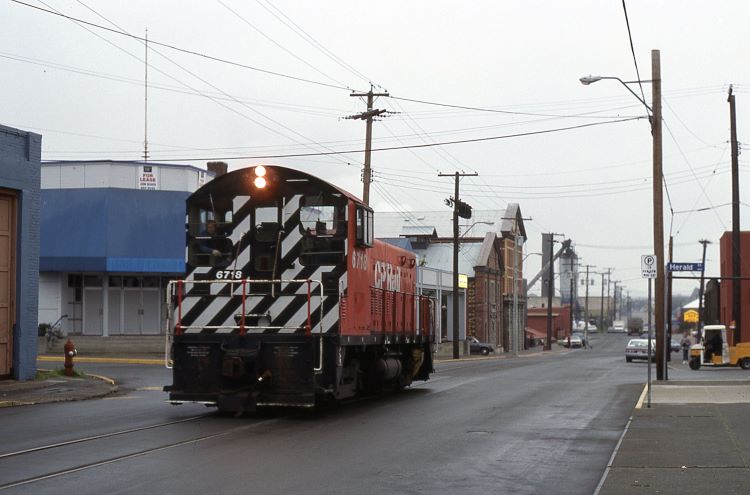
CP Rail 6718 switching Store Street at Herald Street on October 21, 1988.
CP SW900 6718 was built by General Motors Diesel in 1955 then upon retirement, sold to M4 Holdings in 1989. It was later sold to Ellis and Eastern Railroad in
Ellis, South Dakota and re-numbered EERR 17.
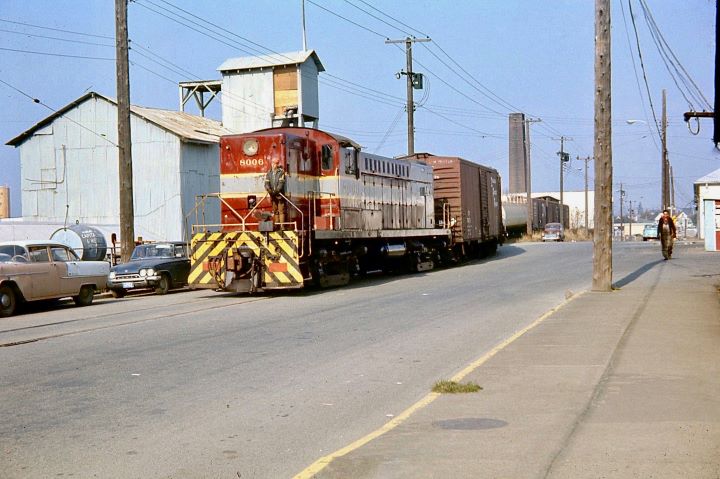
Canadian Pacific 8006 working along Store Street on October 18, 1969.
This DRS4-4-1000 was built by Baldwin in 1948 and was wrecked near South Wellington on June 12, 1973. While the 8000's did venture onto the street trackage
when heavy tonnage was moved, they were too long in their wheelbase for easy working on the tight curves.
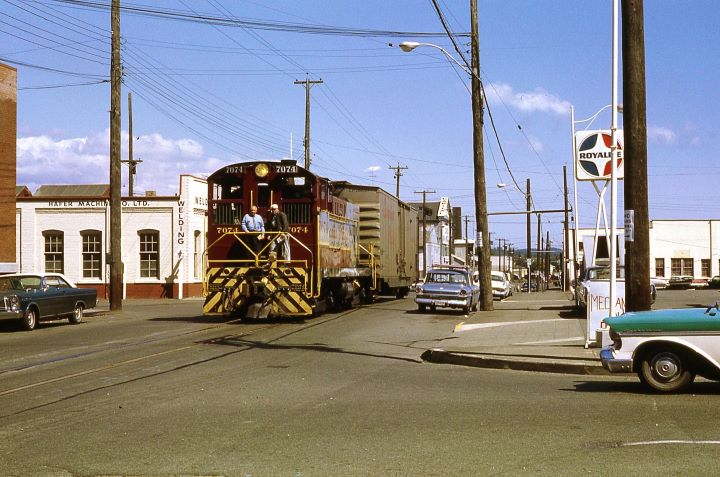
Canadian Pacific 7074 passing the Hafer Machinery Company on Store Street at Fisgard Street on July 13, 1969. Trainman Jimmy Jordan is riding on the engine with
an official.
This DS4-4-1000 was built by Baldwin in 1948 and served the E&N until it was retired and scrapped in 1977.
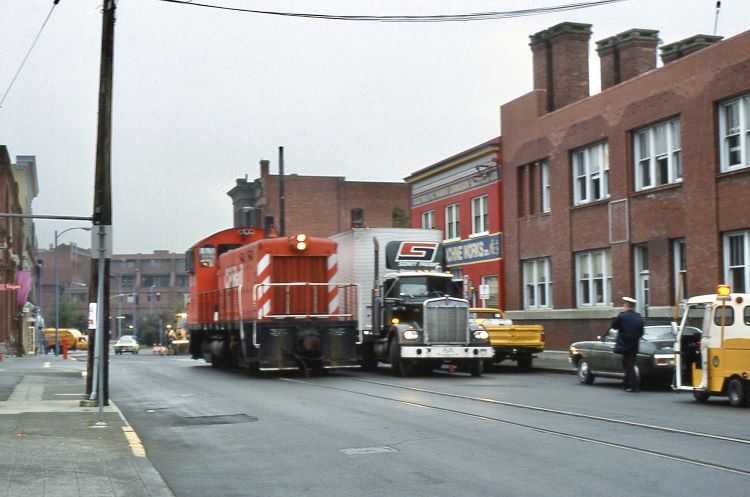
CP Rail 6701 switching Store Street on March 24, 1988.
CP SW8 6701 was built by General Motors Diesel in 1950. It was converted to slug 6701 in 1994 then re-numbered to 1011 in 1996 and paired with "mother" unit St.
Lawrence and Hudson GP7u 1502. Retirement occurred in 2013.
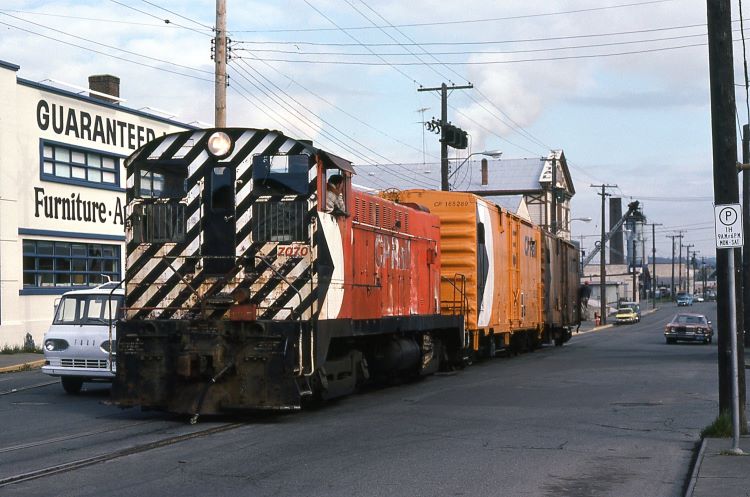
CP Rail 7070 switching Store Street on April 10, 1979.
This DS4-4-1000 was built by Baldwin in 1948 and served the E&N until it was retired and scrapped in 1982.
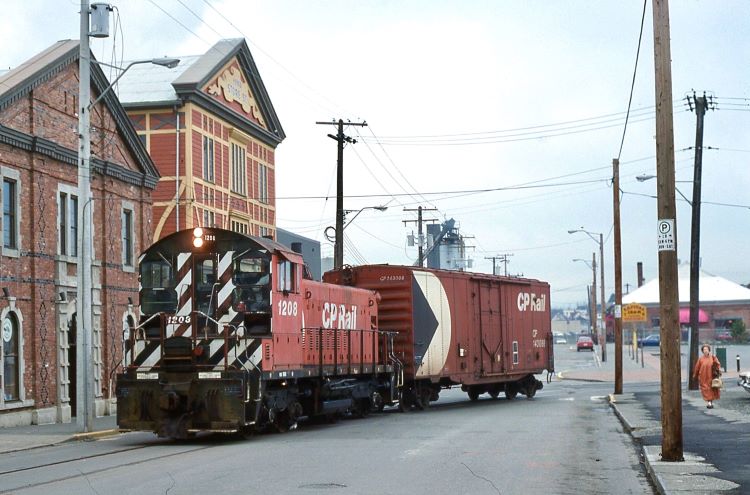
CP Rail 1208 switching Store Street on March 17, 1989.
CP SW1200 1208 was built by General Motors Diesel in 1958 as 8117. It was rebuilt and re-numbered 1208 in 1981, then sold to Kazco Enterprises in 2004 and is
currently Lake Michigan and Indiana 1208.
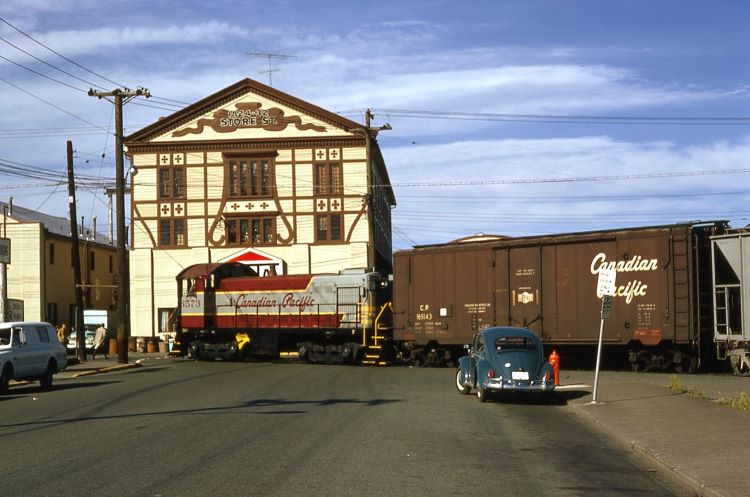
Canadian Pacific 6573 passing Capital Iron and Metals on September 12, 1970.
CP S-3 6573 was built in 1957 and retired in the early 1980's.
Capital Iron got its name from its history in the scrap business. Founded in 1934 by Morris L. Greene, the location on Victoria’s harbour was an ideal spot to
dismantle ships. And by 1971, Capital Iron and Metals took apart nearly 100 ships of various sizes for salvaged parts and scraps. The ship-breaking businesses morphed
into sales of ship parts. And over the years, tools, paint, clothing and just about everything you can think of was being put on shelves for sale. The company started
buying military surplus items after the Second World War and machinery parts from dismantled cranes — even aircraft landing mats. The Greene family expanded with
goods of all sorts acquired in government auctions, distress sales and fire and flood insurance claims.
The Capital Iron store is in two buildings on Store Street — the original stone warehouse was built in 1863 for Dickson Campbell & Co., an importer and commissions
agent and consisted of two floors: a lower wharf-level floor and an upper street-level floor. The building was one of the first along Store Street after the removal
of the first Johnson Street bridge, which permitted ships to enter the upper harbour.
Few of the original stones have survived after more than a century, but several are still visible in the store. The longitudinal beams that span 120 feet with only
one joint are also still in place, as are the cast iron columns in the basement and the iron shutters visible partway up the main staircase to the second floor.
In 1885, the property housed the Mount Royals Milling Company, which added a two-storey addition to allow for rice-milling machinery. Morris L. Greene rented the
buildings in 1934 and opened Capital Iron & Metal Ltd. In 1980, under the guidance of Morris’s son and company president Ronald Greene, the facades of both older
buildings were restored to their 1890s appearance. The restoration was recognized with the 1981 Award of Merit of the Hallmark Society and the 1982 Regional Award of
Heritage Canada.
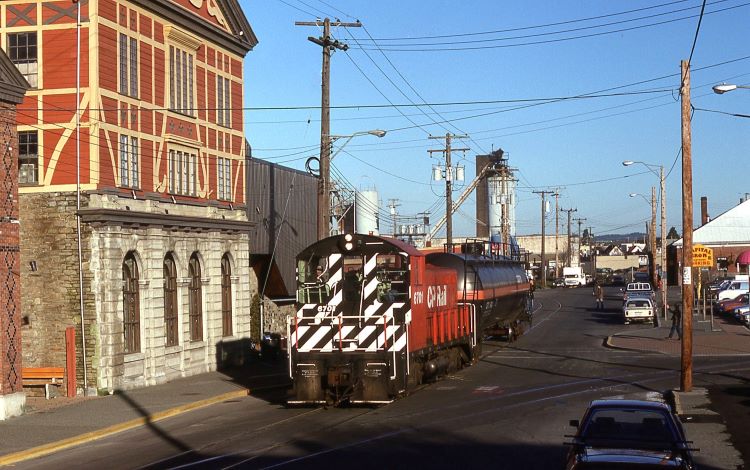
CP Rail 6701 switching a tank car on December 30, 1988.
CP SW8 6701 was built by General Motors Diesel in 1950. It was converted to slug 6701 in 1994 then re-numbered to 1011 in 1996 and paired with "mother"
unit St. Lawrence and Hudson GP7u 1502. Retirement occurred in 2013.
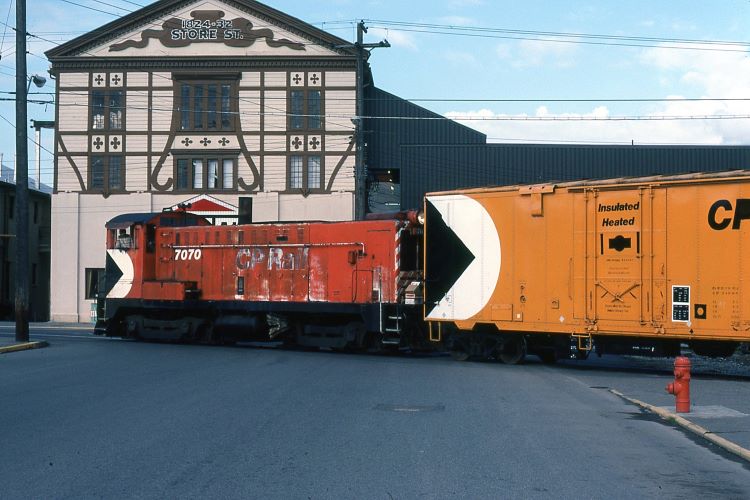
CP Rail 7070 reversing into Albion Yard on April 10, 1979.
This DS4-4-1000 was built by Baldwin in 1948 and served the E&N until it was retired and scrapped in 1982.
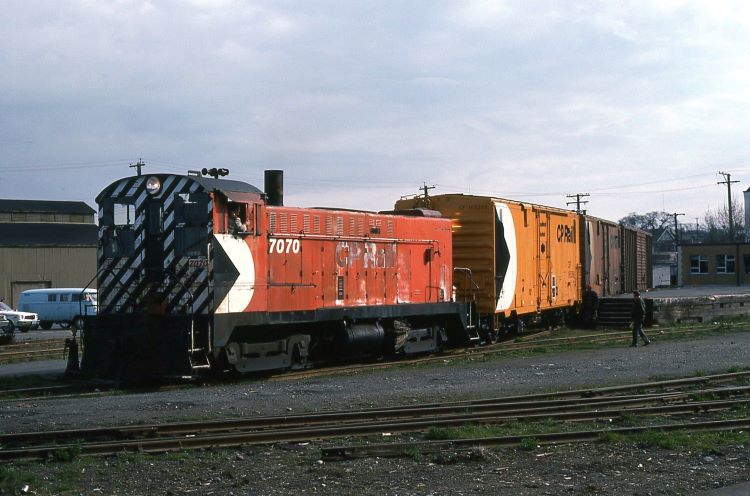
CP Rail 7070 entering Albion Yard on April 10, 1979.
This DS4-4-1000 was built by Baldwin in 1948 and served the E&N until it was retired and scrapped in 1982.
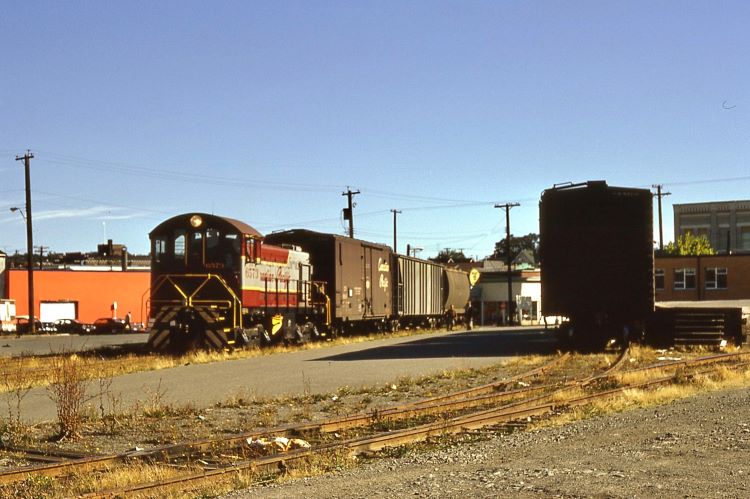
Canadian Pacific 6573 switching in Albion Yard on September 12, 1970.
CP S-3 6573 was built by Montreal Locomotive Works in 1957 and retired in the early 1980's.
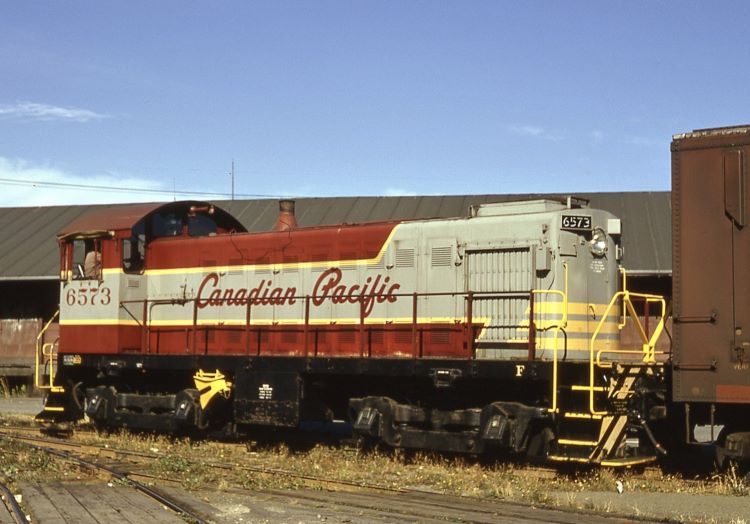
Canadian Pacific 6573 at the Albion Yard freight shed on September 12, 1970.
CP S-3 6573 was built by Montreal Locomotive Works in 1957 and retired in the early 1980's.
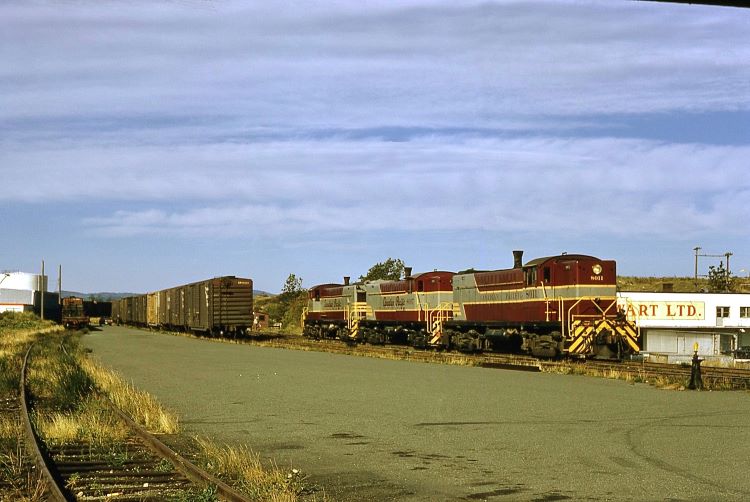
Canadian Pacific 8011, 8007 and 8012 coming off southbound Train 52 on September 12, 1970.
CP DRS4-4-1000 8011 and 8007 were built by Baldwin in 1948. They were wrecked near South Wellington on June 12, 1973 and scrapped at Wellcox yard.
CP DRS4-4-1000 8012 was built by Baldwin in 1948 then damaged by fire on the Port Alberni Subdivision on February 19, 1973 and scrapped. This happened to
be the thirteenth and youngest of the fleet and in addition, was one of only four in script lettering.
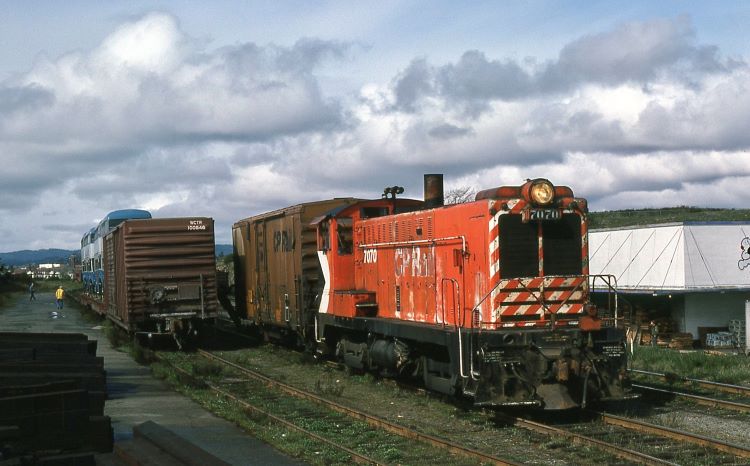
CP Rail 7070 switching the yard on April 9, 1979.
This DS4-4-1000 was built by Baldwin in 1948 and served the E&N until it was retired and scrapped in 1982.
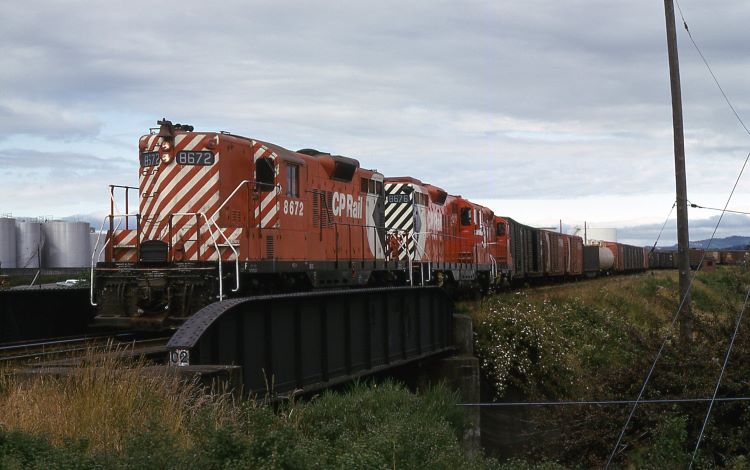
CP Rail 8672, 8676 and 8831 arriving at MP 0.2 on southbound Train 52 on June 21, 1975.
CP GP9 8672 was built by General Motors Diesel in 1957, then re-built into a GP9u and re-numbered 8209 in 1988. Declared surplus in 2015, it was sold to
Rail Switching Services.
CP GP9 8676 was built by General Motors Diesel in 1957, then rebuilt into a GP9u and re-numbered 8224 in 1988. It was retired in 2011 and traded to
EMD for the GP20C-ECO rebuild program.
CP GP9 8631 was built by General Motors Diesel in 1956, then rebuilt into a GP9u and re-numbered 8210 in 1988. It was retired in 2014, sold to Cando
Rail Services and became 4024, assigned to Sturgeon Terminal in Sturgeon County, Alberta.
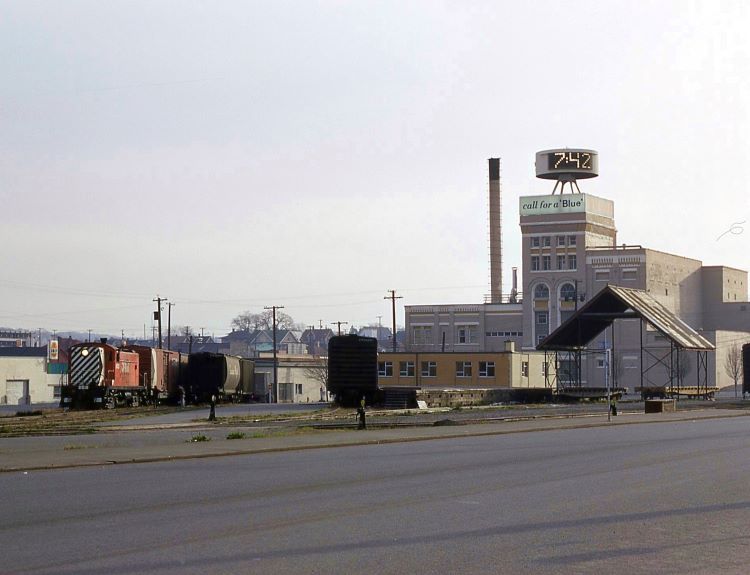
CP Rail 8002 switching the yard on March 24, 1973.
CP DRS4-4-1000 8002 was built by Baldwin in 1948, was retired in 1975 then scrapped. During its life, it lacked a rear hood number.
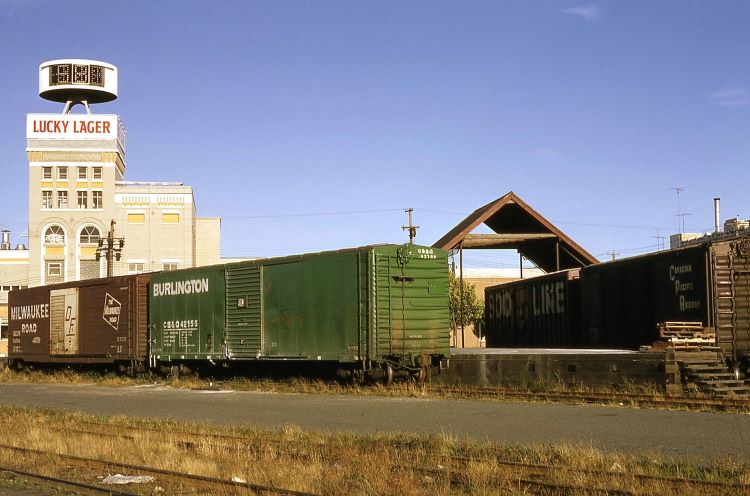
Boxcars of Milwaukee Road, SOO Line, Chicago, Burlington and Quincy and Canadian Pacific Railway at Lucky Lager Brewing Company on September 13, 1969.
The Lucky Lager Brewery on Government Street was an important customer for the E&N for many years, receiving carloads of barley, hops and fuel. An auger from
the unloading truck passed under Government Street to deliver the grain to the brewery. The "modernized" brewery was restored in 1974, along with its original
lines, not long before it was closed in 1982 and then dismantled.
Lucky Lager, which had begun brewing in 1858 as Victoria Brewery, had occupied the space at Government and Discovery since 1860 and operated under the names
Victoria Brewing and then Victoria-Phoenix Brewing until 1954, when it took the name Lucky Lager Brewing Company. Labatt Brewing bought the plant in 1958. When the
Ingraham Hotel beer parlour opened in 1960, it became the biggest by-the-glass seller of Labatt products in the province.
In the late 1970's, Labatt decided to consolidate its British Columbia operations: in 1981, it closed the brewery on Government Street, moved operations to New
Westminster, and soon after razed the Government Street building. Lucky is now brewed in the Labatt facilities in Creston, in the Interior of British Columbia, and
in Edmonton, Alberta, although the advertising on the package proclaims the use of the “Original Vancouver Island Recipe.
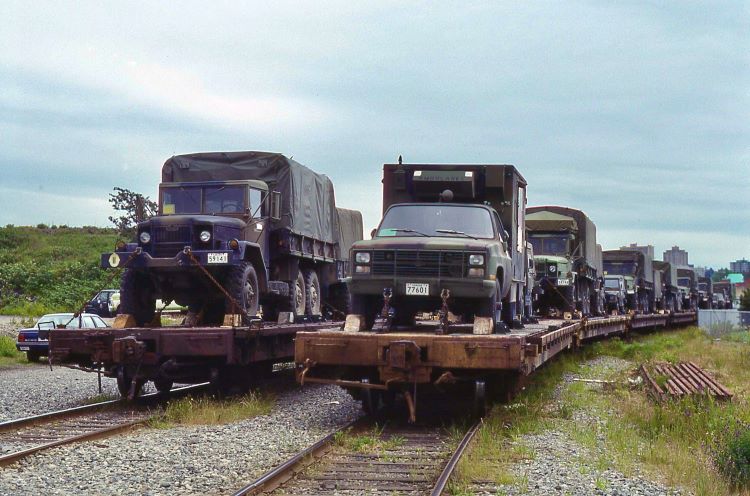
Princess Patricia's Canadian Light Infantry, or PPCLI, for many years was based in Victoria. They moved large numbers of vehicles over the E&N and CPR for training exercises in Alberta. Here they are being loaded onto flat cars on June 13, 1990, on the siding that had once been used for coaches.
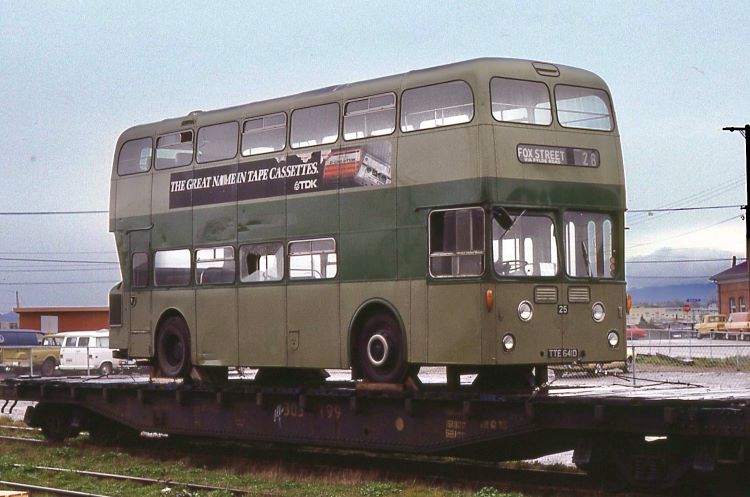
Leyland bus 25 on Canadian Pacific flat car 305199 on April 3, 1981.
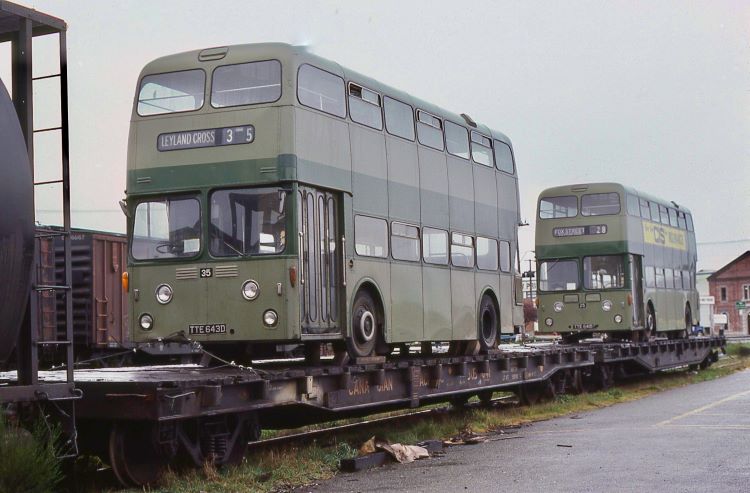
Leyland buses 35 and 25 on Canadian Pacific flat car 308041 on April 3, 1981.
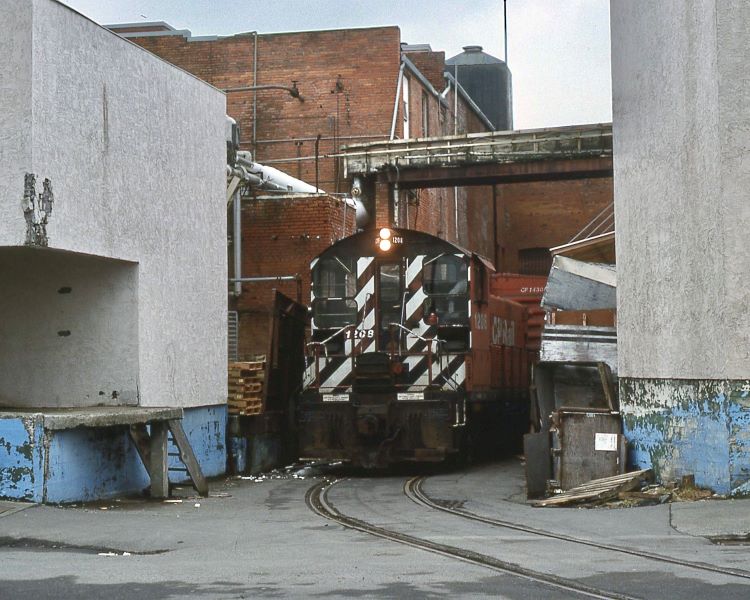
CP Rail 1208 switching Garden City warehouse on March 17, 1989.
CP SW1200 1208 was built by General Motors Diesel in 1958 as 8117. It was rebuilt and re-numbered 1208 in 1981, then sold to Kazco Enterprises in 2004 and is
currently Lake Michigan and Indiana 1208.
Garden City, a wholesale grocery store, was one of the two last businesses requiring E&N rail services along Store Street. With limited track space, CPR
purchased a small strip of land and added a second track for BC Hydro, and paid to have a second loading door added to Garden City’s loading dock, making it possible
for them to receive more than one car at a time.
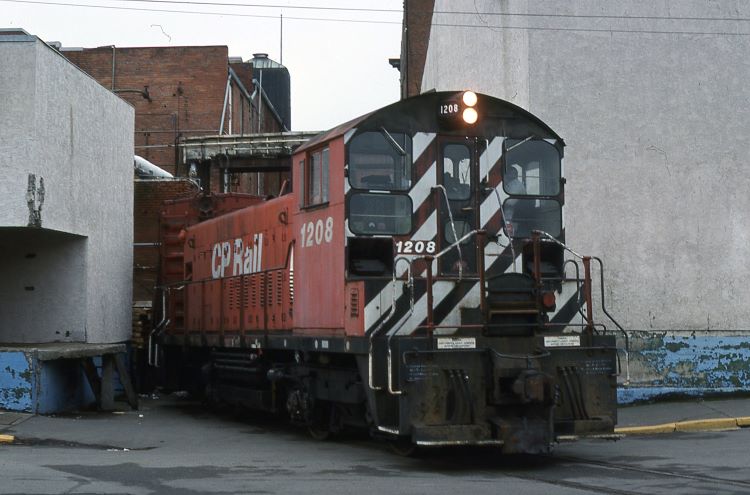
CP Rail 1208 switching Garden City warehouse on March 17, 1989.
CP SW1200 1208 was built by General Motors Diesel in 1958 as 8117. It was rebuilt and re-numbered 1208 in 1981, then sold to Kazco Enterprises in 2004 and is
currently Lake Michigan and Indiana 1208.
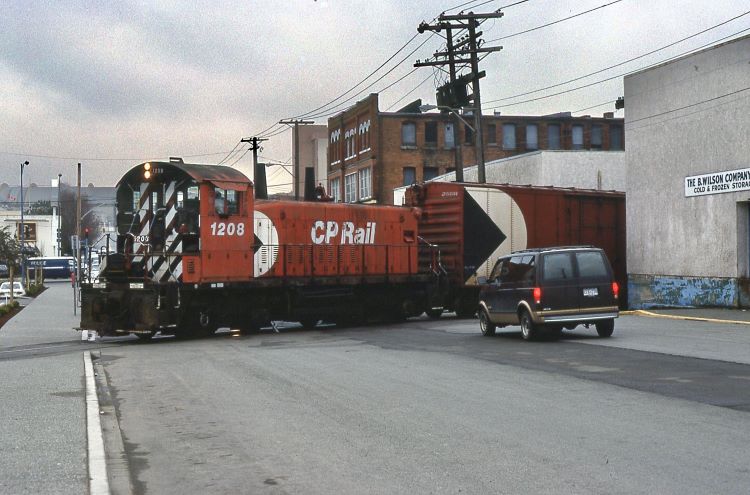
CP Rail 1208 switching Garden City warehouse on March 17, 1989.
CP SW1200 1208 was built by General Motors Diesel in 1958 as 8117. It was rebuilt and re-numbered 1208 in 1981, then sold to Kazco Enterprises in 2004 and is
currently Lake Michigan and Indiana 1208.
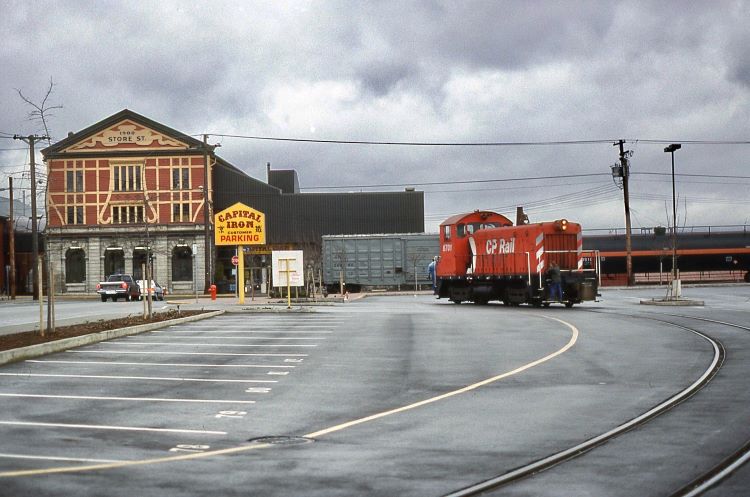
CP Rail 6701 switching what remains of Albion Yard on March 24, 1989.
CP SW8 6701 was built by General Motors Diesel in 1950. It was converted to slug 6701 in 1994 then re-numbered to 1011 in 1996 and paired with "mother"
unit St. Lawrence and Hudson GP7u 1502. Retirement occurred in 2013.
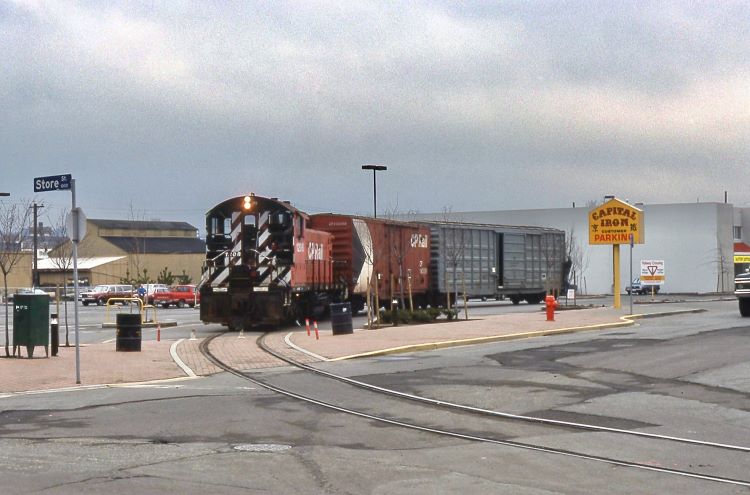
CP Rail 1208 switching what remains of Albion Yard on March 17, 1989.
CP SW1200 1208 was built by General Motors Diesel in 1958 as 8117. It was rebuilt and re-numbered 1208 in 1981, then sold to Kazco Enterprises in 2004 and is
currently Lake Michigan and Indiana 1208.
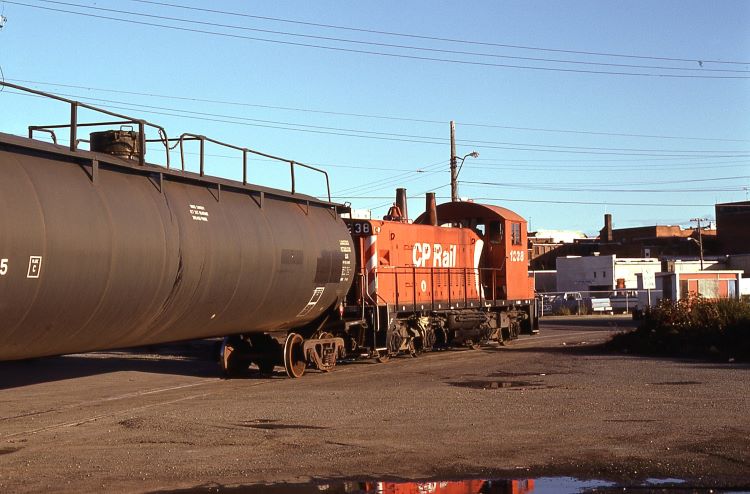
CP Rail 1238 switching the B.C. Hydro plant on November 14, 1985.
CP SW1200 1238 was built by General Motors Diesel as CP 8141 in 1959. It was rebuilt and re-numbered 1238 in 1981, then retired in 2011 and scrapped.
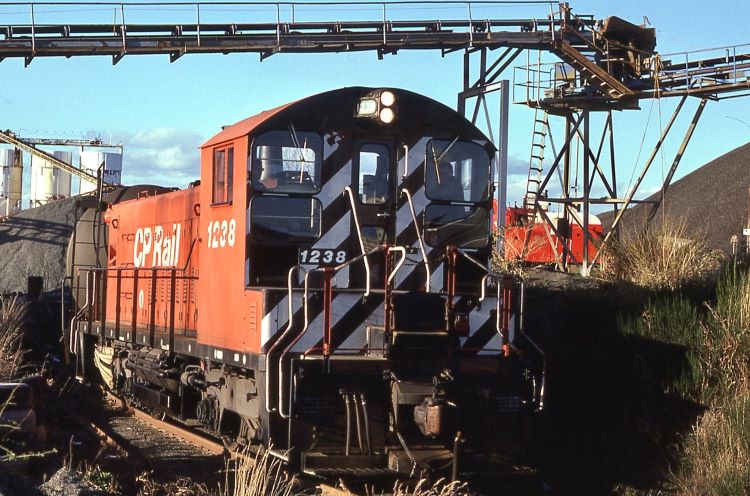
CP Rail 1238 switching the B.C. Hydro plant on November 14, 1985.
CP SW1200 1238 was built by General Motors Diesel as CP 8141 in 1959. It was rebuilt and re-numbered 1238 in 1981, then retired in 2011 and scrapped.
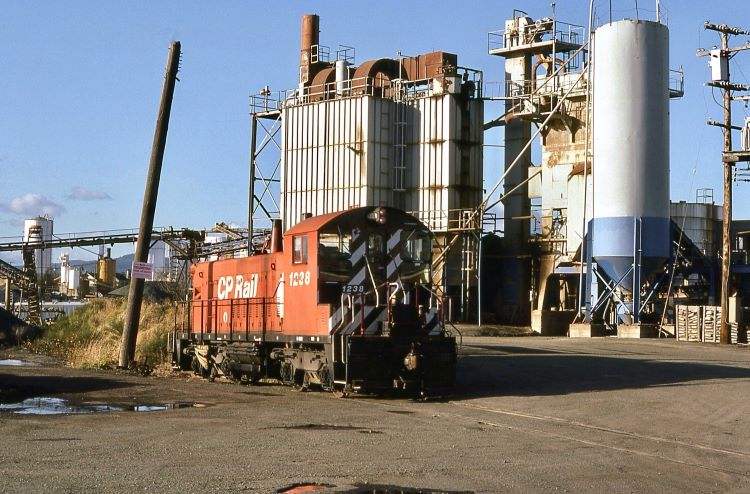
CP Rail 1238 switching the B.C. Hydro plant on November 12, 1993.
CP SW1200 1238 was built by General Motors Diesel as CP 8141 in 1959. It was rebuilt and re-numbered 1238 in 1981, then retired in 2011 and scrapped.
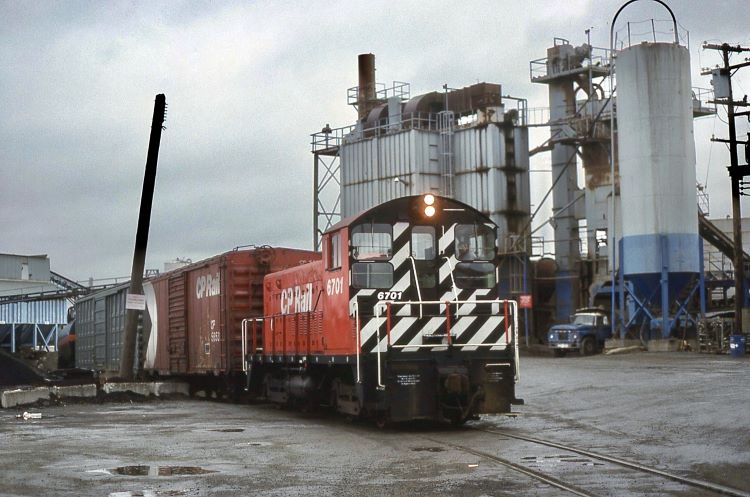
CP Rail 6701 switching on the spur to BC Hydro, which took the crew north past Albion Yard and Island Asphalt on March 24, 1989.
CP SW8 6701 was built by General Motors Diesel in 1950 and converted to slug 6704 in 1991, then re-numbered 1011 in 1996 and retired in 2013.
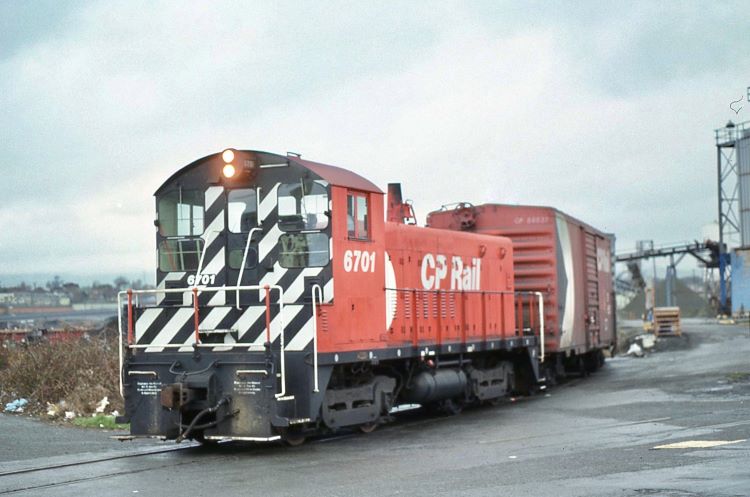
CP Rail 6701 switching Store Street on March 24, 1989.
CP SW8 6701 was built by General Motors Diesel in 1950. It was converted to slug 6701 in 1994 then re-numbered to 1011 in 1996 and paired with "mother"
unit St. Lawrence and Hudson GP7u 1502. Retirement occurred in 2013.
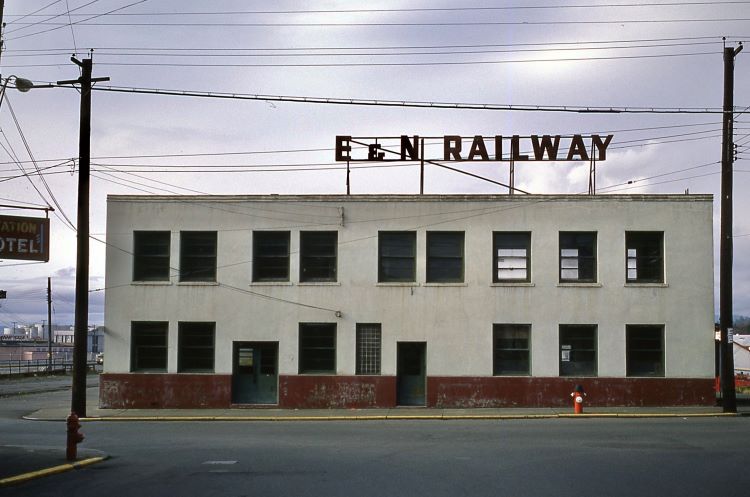
The Esquimalt and Nanaimo station on October 14, 1972. The railway was extended across the Inner Harbour of Victoria to reach within two blocks of the city hall
in 1888. In the late 1940’s, the station was rebuilt as a boxy, concrete structure that included company offices for dispatchers, operators, clerks and other
staff. Later, road expansion led to the demolition of the station and other elderly buildings nearby.
In 1971, Victoria’s city council, which wanted the land where the E&N’s Store Street station was located, in order to extend Pandora Street westward over
the Johnson Street Bridge to improve traffic flow, requested that the station be moved to Catherine Street in Victoria West, across the harbour for the downtown
business district. What may have been a necessary steps to improve traffic in the city was certainly a step backwards for the railway. Almost 90 years before,
in 1887, E&N trains arrived at, and left from, Russell’s station on Catherine Street, but the Victoria city council and business community petitioned Robert Dunsmuir
to extend his railway across the harbour into downtown Victoria.
The old Store Street station was demolished and the area became a simplified section converging on the Johnson Street bridge. The move did not affect
freight traffic because the track down Store Street remained operational to service commercial business spurs and Albion Yard.
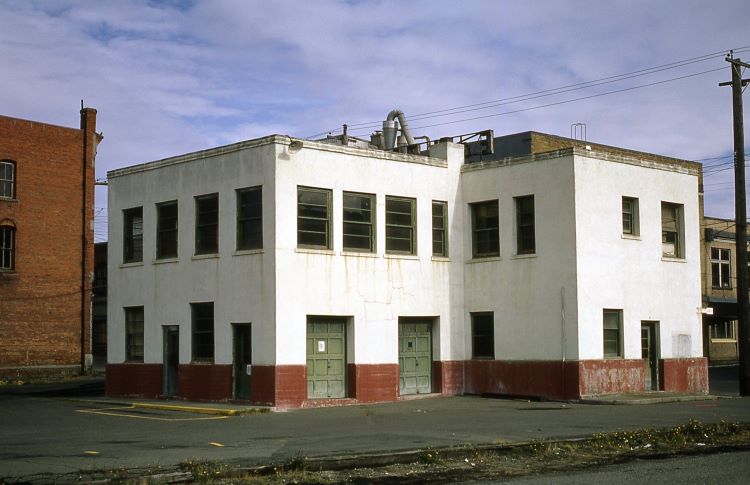
The Esquimalt and Nanaimo station on October 14, 1972. The railway was extended across the Inner Harbour of Victoria to reach within two blocks of the city hall
in 1888. In the late 1940’s, the station was rebuilt as a boxy, concrete structure that included company offices for dispatchers, operators, clerks and other
staff. Later, road expansion led to the demolition of the station and other elderly buildings nearby.
In 1971, Victoria’s city council, which wanted the land where the E&N’s Store Street station was located, in order to extend Pandora Street westward over
the Johnson Street Bridge to improve traffic flow, requested that the station be moved to Catherine Street in Victoria West, across the harbour for the downtown
business district. What may have been a necessary steps to improve traffic in the city was certainly a step backwards for the railway. Almost 90 years before,
in 1887, E&N trains arrived at, and left from, Russell’s station on Catherine Street, but the Victoria city council and business community petitioned Robert Dunsmuir
to extend his railway across the harbour into downtown Victoria.
The old Store Street station was demolished and the area became a simplified section converging on the Johnson Street bridge. The move did not affect
freight traffic because the track down Store Street remained operational to service commercial business spurs and Albion Yard.
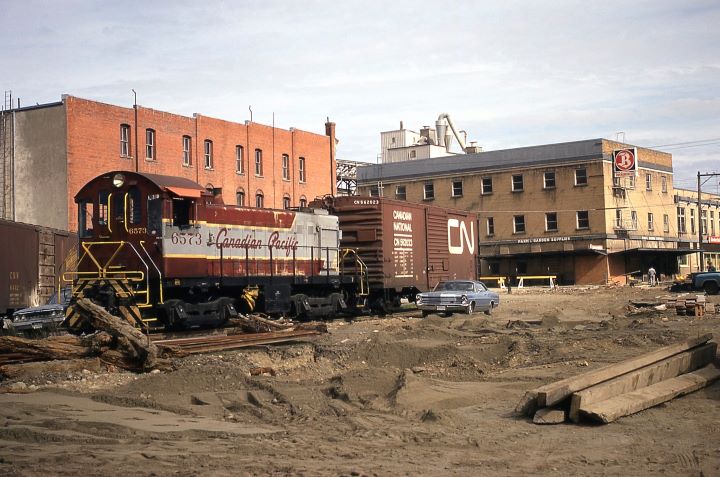
Canadian Pacific 6573 switching at the site of the Victoria station on March 8, 1973.
CP S-3 6573 was built by Montreal Locomotive Works in 1957 and retired in the early 1980's.
The area became a simplified section converging on the Johnson Street bridge but the move did not affect freight traffic because the track down Store Street
remained operational to service commercial business spurs and Albion Yard.
Note the Buckerfield’s building and sign, which was purchased in 1953 from Scott and Peden Company. In 1987, it was purchased by Michael Williams and two
years later, became Swans Brew Pub.
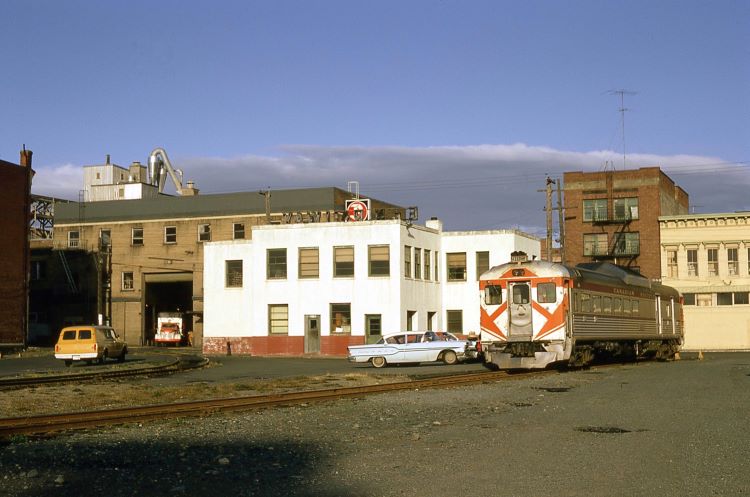
Canadian Pacific 9023 after arrival as Train 2 from Courtenay on September 22, 1970.
CP RDC-3 9023 was built by Budd Company in 1955. It was sold to VIA Rail in 1978 and became VIA 9023. Wrecked at Lacombe, Alberta on April 1, 1980, it was
repaired in Winnipeg and re-numbered VIA 6357. It was Wrecked again at Balzac, Alberta on August 20, 1981 and repaired in Winnipeg, being converted to RDC-2
configuration and re-numbered VIA 6224. In 2000, it was sold to Industrial Rail Services in Moncton and scrapped in 2016.
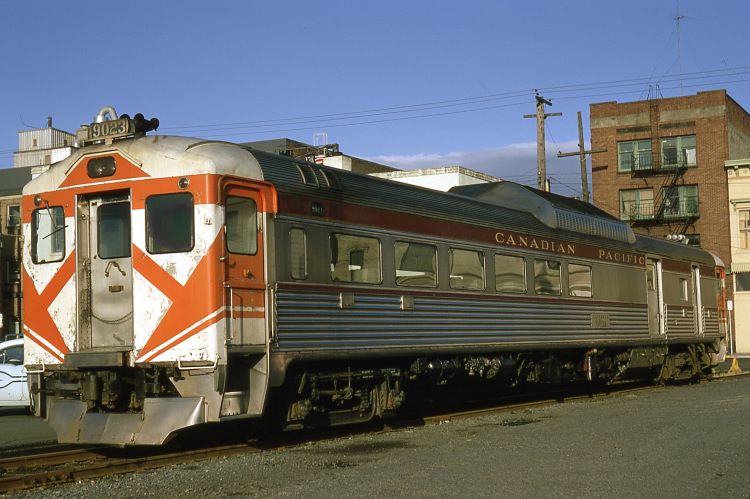
Canadian Pacific 9023 on September 22, 1970.
CP RDC-3 9023 was built by Budd Company in 1955. It was sold to VIA Rail in 1978 and became VIA 9023. Wrecked at Lacombe, Alberta on April 1, 1980, it was
repaired in Winnipeg and re-numbered VIA 6357. It was Wrecked again at Balzac, Alberta on August 20, 1981 and repaired in Winnipeg, being converted to RDC-2
configuration and re-numbered VIA 6224. In 2000, it was sold to Industrial Rail Services in Moncton and scrapped in 2016.
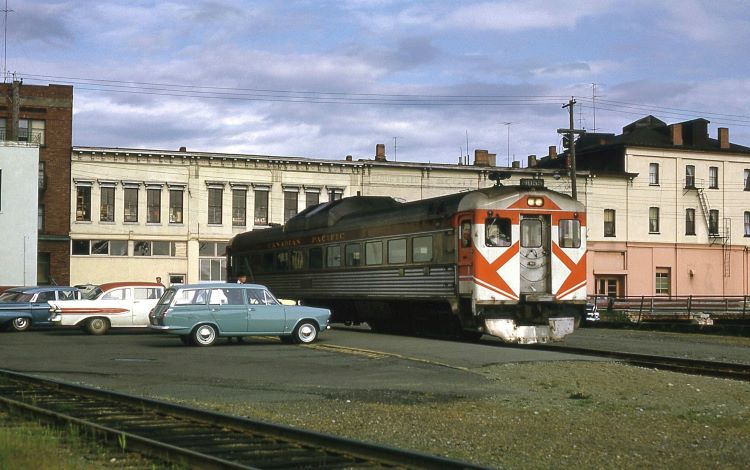
Canadian Pacific 9055 arriving in Victoria as Train 2 from Courtenay in April 1967.
CP RDC-1 9055 was built by Budd in 1953. It was sold to VIA Rail in 1978, becoming VIA 9055, then wrecked at Milepost 47.23 of CP’s Trois Rivieres
Subdivision on September 26, 1979. Rebuilt in April 1980, it became VIA 6132 then was sold to Regor in Cuba in 1998 and re-numbered Ferrocarriles de Cuba 2305.
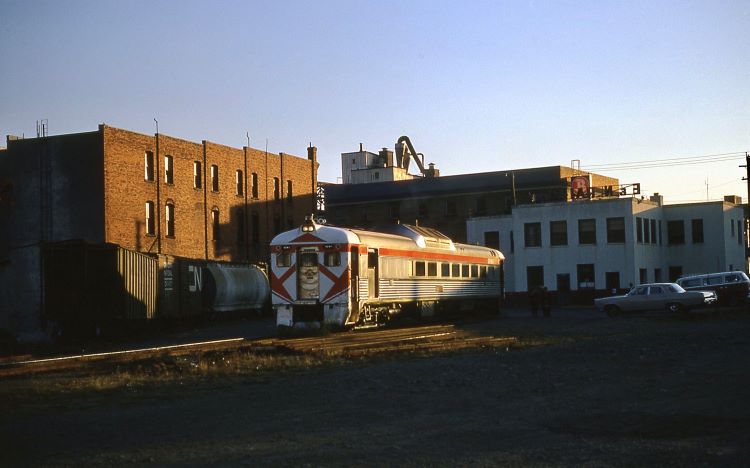
Canadian Pacific 9199 at the station on October 14, 1972.
CP RDC-2 9199 was built by Canadian Car and Foundry in 1958. It was converted to an RDC-5 in 1975 and re-numbered 9302 then sold to VIA Rail in 1978 and
became 9302 before being converted to RDC-1 configuration in Montreal and re-numbered VIA 6125. In 1994, it was sold to Quebec, North Shore & Labrador and became
QNS&L 6125, then was acquired by Chemin de Fer des Cantons de L'est, keeping the same number. The railway was re-named Trains Touristiques des Canton de L'est Inc.
in 2006, and is currently Orford Express "Thompson".
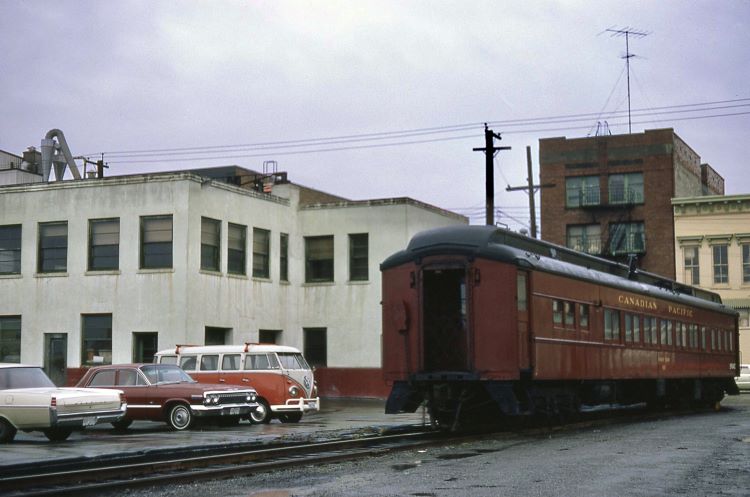
Canadian Pacific vision test car 65 at the station in March 1971. It visited annually for employee vision testing.
Built by Barney and Smith in 1913 as 12-1 sleeper "Hungerford", it was converted to CP Vision Test Car 65 in 1940. When retired circa 1975, it was moved to
Ontario and became part the Leaside Station Restaurant until 1982. Four years later, it was moved to Orillia and became part of the Ossawippi Express Dining Cars
(the North dining car). Between 2009 and 2010, that establishment closed and the car was moved to Skyline Heritage Park in Port McNicoll. It was scrapped in 2017
as it was deemed too costly to repair.
For information, brochure and details, visit
Ossawippi Express Dining Cars
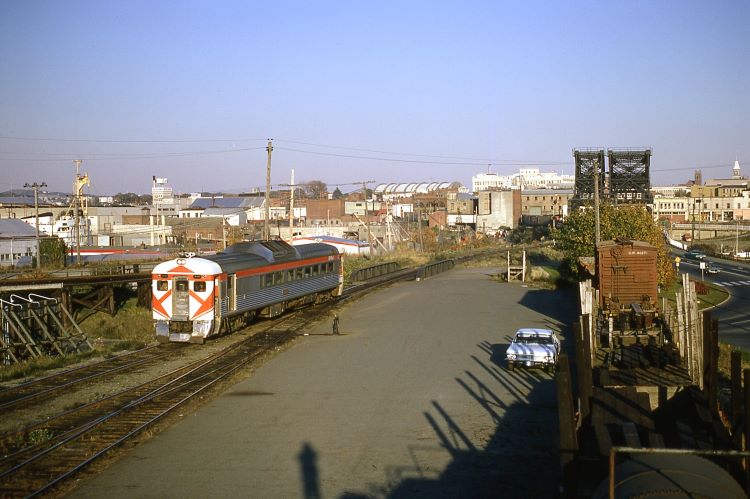
Canadian Pacific 9199 departing Victoria at MP 0.25 on Train 1 on October 14, 1972.
This was the last day of regular passenger operation to the mile 0 depot on Store Street, as the mileage 0.8 depot at Catherine Street and Esquimalt Road
had been completed in earlier months.
CP RDC-2 9199 was built by Canadian Car and Foundry in 1958. It was converted to an RDC-5 in 1975 and re-numbered 9302 then sold to VIA Rail in 1978 and
became 9302 before being converted to RDC-1 configuration in Montreal and re-numbered VIA 6125. In 1994, it was sold to Quebec, North Shore & Labrador and became
QNS&L 6125, then was acquired by Chemin de Fer des Cantons de L'est, keeping the same number. The railway was re-named Trains Touristiques des Canton de L'est Inc.
in 2006, and is currently Orford Express "Thompson".
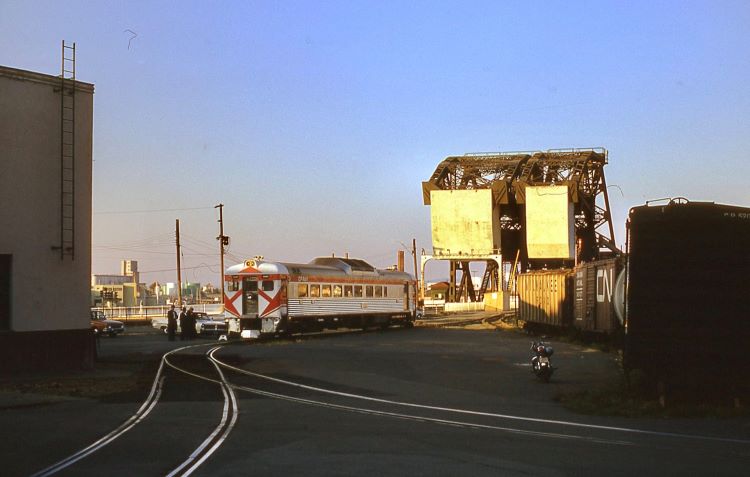
Canadian Pacific 9199 departing Victoria on Train 1 on October 14, 1972.
This was the last day of regular passenger operation to the mile 0 depot on Store Street, as the mileage 0.8 depot at Catherine Street and Esquimalt Road
had been completed in earlier months.
CP RDC-2 9199 was built by Canadian Car and Foundry in 1958. It was converted to an RDC-5 in 1975 and re-numbered 9302 then sold to VIA Rail in 1978 and
became 9302 before being converted to RDC-1 configuration in Montreal and re-numbered VIA 6125. In 1994, it was sold to Quebec, North Shore & Labrador and became
QNS&L 6125, then was acquired by Chemin de Fer des Cantons de L'est, keeping the same number. The railway was re-named Trains Touristiques des Canton de L'est Inc.
in 2006, and is currently Orford Express "Thompson".
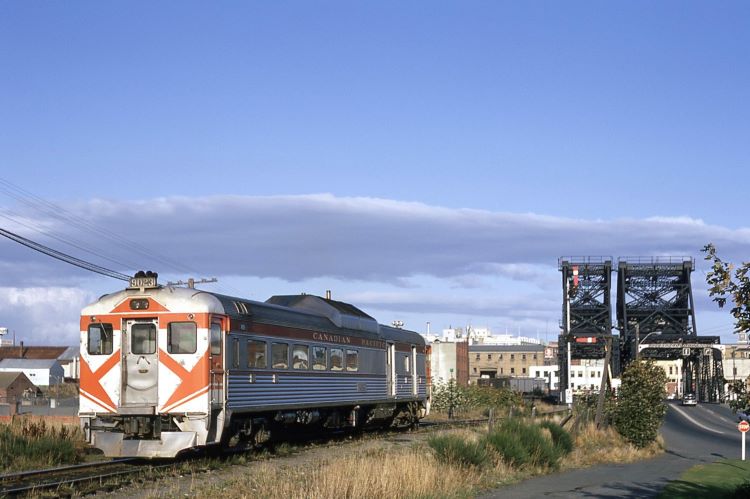
Canadian Pacific 9023 arriving Victoria on Train 2 on September 22, 1970.
CP RDC-3 9023 was built by Budd Company in 1955. It was sold to VIA Rail in 1978 and became VIA 9023. Wrecked at Lacombe, Alberta on April 1, 1980, it was
repaired in Winnipeg and re-numbered VIA 6357. It was Wrecked again at Balzac, Alberta on August 20, 1981 and repaired in Winnipeg, being converted to RDC-2
configuration and re-numbered VIA 6224. In 2000, it was sold to Industrial Rail Services in Moncton and scrapped in 2016.
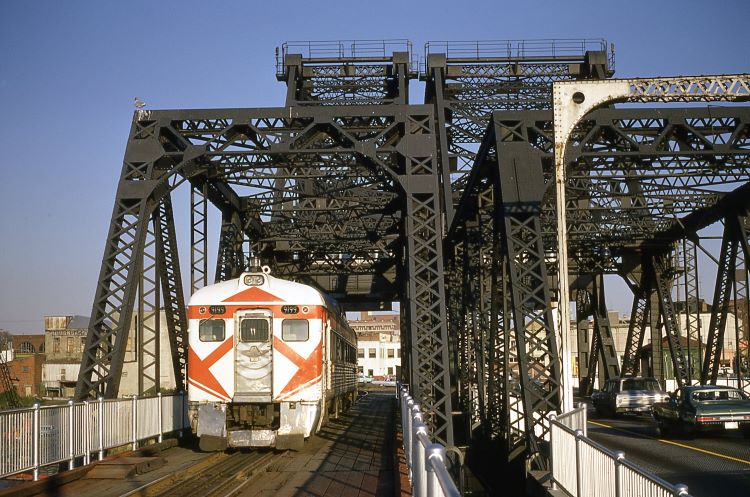
Canadian Pacific 9199 arriving in Victoria as Train 2 crossing the Johnson Street bridge on October 14, 1972.
This was the last day of regular passenger operation to the mile 0 depot on Store Street, as the mileage 0.8 depot at Catherine Street and Esquimalt Road
had been completed in earlier months. Conductor Ab Stenberg (visible in rear centre window) and engineer Herb Evans were the crew.
CP RDC-2 9199 was built by Canadian Car and Foundry in 1958. It was converted to an RDC-5 in 1975 and re-numbered 9302 then sold to VIA Rail in 1978 and
became 9302 before being converted to RDC-1 configuration in Montreal and re-numbered VIA 6125. In 1994, it was sold to Quebec, North Shore & Labrador and became
QNS&L 6125, then was acquired by Chemin de Fer des Cantons de L'est, keeping the same number. The railway was re-named Trains Touristiques des Canton de L'est Inc.
in 2006, and is currently Orford Express "Thompson".
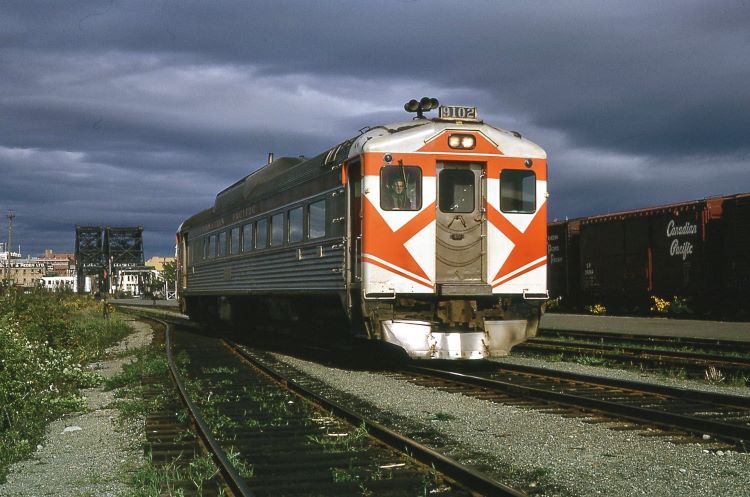
Canadian Pacific 9102 returning to the roundhouse in April 1967.
CP RDC-2 9102 was built by Budd Company in 1955. It was converted to RDC-5 in 1974 and re-numbered 9300. Sold to VIA Rail in 1982, it became 9300 then was
re-configured to an RDC-1 the same year to become 6146. It was ultimately wrecked at Carseland, Alberta on March 23, 1983 and retired.
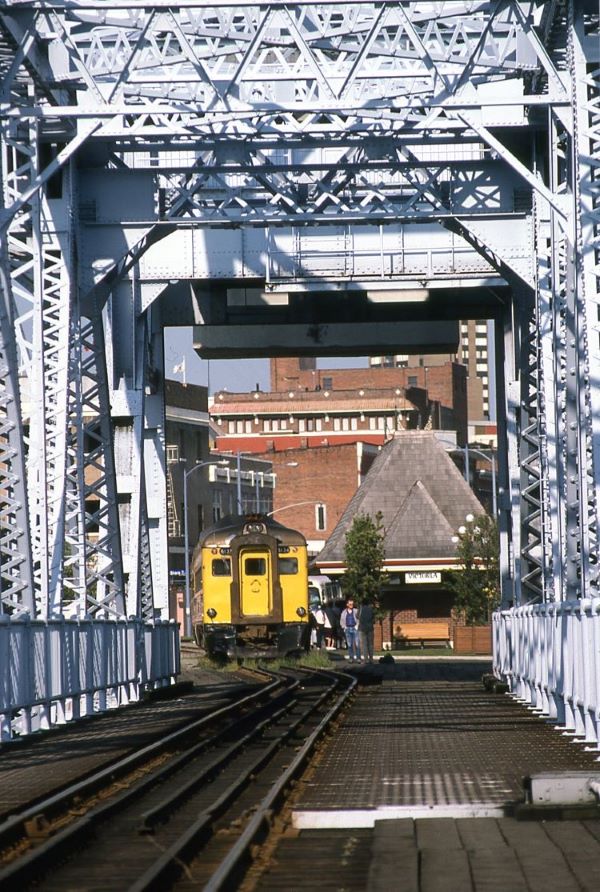
VIA Rail 6134 and 6133 arriving on Train 198 on April 27, 1987.
VIA Rail RDC-1 6134 was built by Budd Company in 1957 as Canadian Pacific 9065. It was wrecked in an accident in Nanaimo in 1992 and retired.
VIA Rail RDC-1 6133 was built by Budd Company in 1956 and assigned to the CP subsidiary Dominion Atlantic as 9058, then became Canadian Pacific 9058.
Once retired, it was traded to Industrial Rail Services for rebuild program units in early 2010. It was then sold to Rapido Trains as RPDX 6133 and later to the
VIA Historical Association.
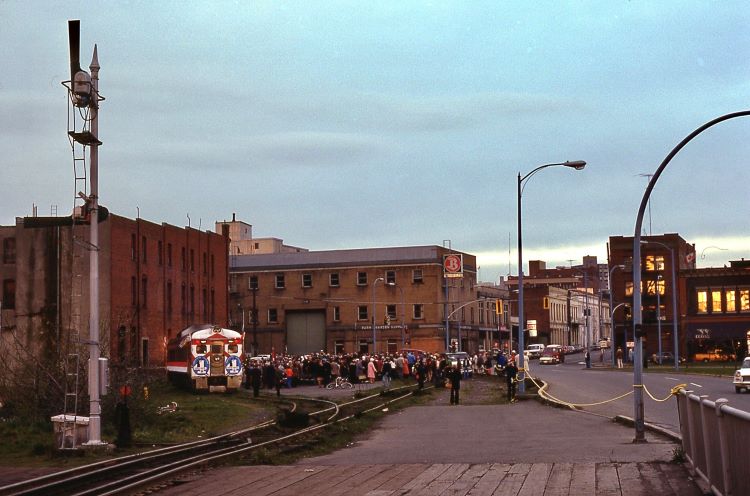
To focus public attention on the plight and potential of the Dayliner, Victoria Alderman Murray Glazier, the British Columbia Railway Historical Association and
others organized a 90th anniversary re-enactment of the first train's arrival in downtown Victoria in 1988. This occurred on March 29, 1978, which brought out a
large crowd to celebrate, including Premier Bill Bennett, in the grey suit near the front of the Dayliner, and many civic dignitaries.
After stoppping at the new Victoria West station, it made a special run over the Johnson Street bridge to the foot of Pandora Street; the first occurence
since October 14, 1972.
CP RDC-2 9103 was built by Budd in 1956 then sold to VIA Rail in 1978, becoming VIA 9103. It was wrecked at Did-sbury, Alberta on August 16, 1979 and rebuilt
and re-numbered VIA 6213. In 2000, it was sold to Industrial Rail Services in Moncton.
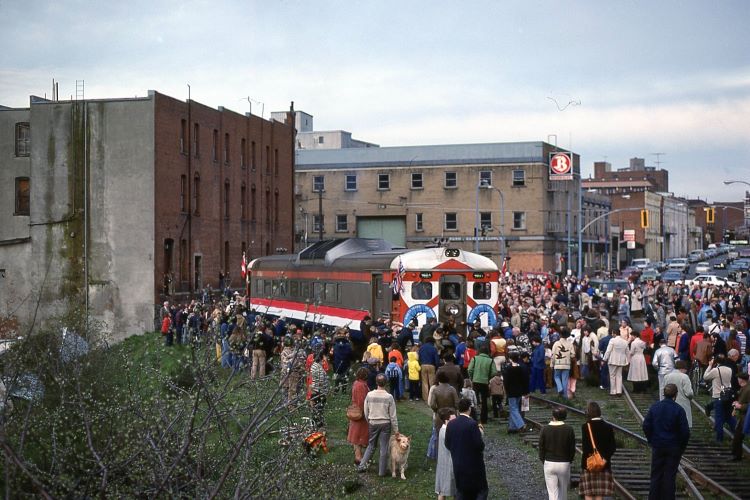
Canadian Pacific 9103 at the site of the former station during the 90th anniversary of the E&N, which was celebrated on March 29, 1978. The event brought out a
large crowd to celebrate, including Premier Bill Bennett, in the grey suit near the front of the Dayliner, and many civic dignitaries.
CP RDC-2 9103 was built by Budd in 1956 then sold to VIA Rail in 1978, becoming VIA 9103. It was wrecked at Didsbury, Alberta on August 16, 1979 and rebuilt
and re-numbered VIA 6213. In 2000, it was sold to Industrial Rail Services in Moncton.
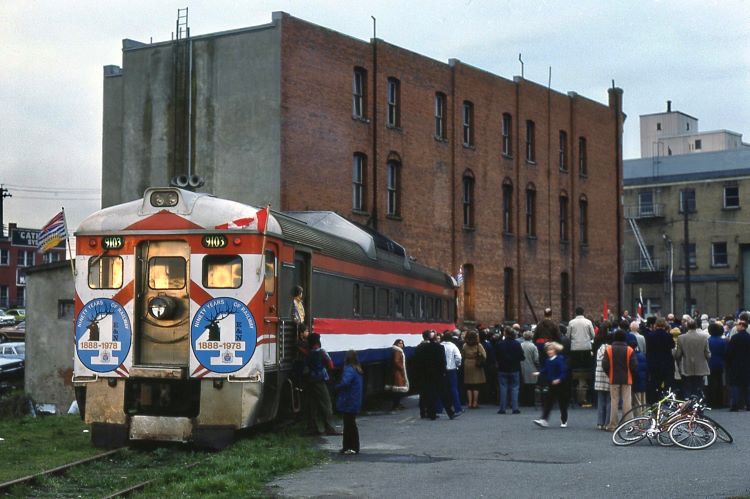
Canadian Pacific 9103 at the site of the former station during the 90th anniversary of the E&N, which was celebrated on March 29, 1978.
CP RDC-2 9103 was built by Budd in 1956 then sold to VIA Rail in 1978, becoming VIA 9103. It was wrecked at Didsbury, Alberta on August 16, 1979 and
rebuilt and re-numbered VIA 6213. In 2000, it was sold to Industrial Rail Services in Moncton.
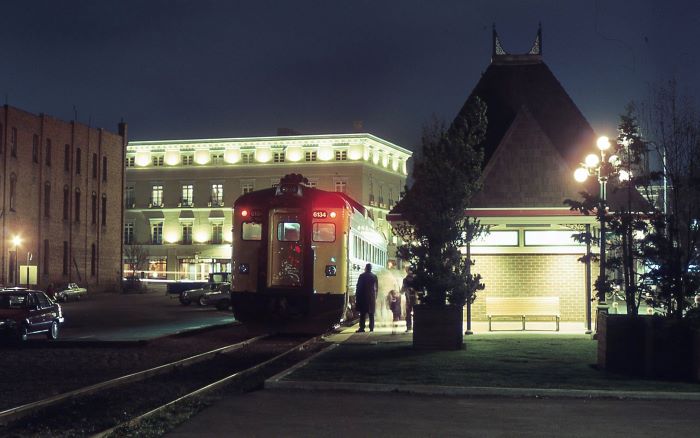
VIA Rail 6134 arriving on Train 198 on January 7, 1990.
VIA RDC-1 6134 was built by Budd Company in 1957 as Canadian Pacific 9065. It was wrecked in an accident in Nanaimo in 1992 and retired.
The stylish brick and glass structure that served as the Victoria station was built in 1985, designed by Yves Roy and had its official opening on November
10. It was in a far less convenient location for travellers than the previous terminal had been.
When VIA Rail service on Vancouver Island ceased in 2011, in a reversal of fortunes, the station site was once again allocated for road expansion just as
happened in the 1970's. It was demolished, with some elements saved for re-use, early in 2013 after the City of Victoria decided not to replace the Johnson Street
railway span and opted for a new bridge that provided only motor vehicle, bicycle and pedestrian lanes.
Posted 11/28/2025
free html Counter| RETURN TO THE MAIN PAGE |