



I had waited years for this service to start as I really did not like always having to take the bus from Stockton to Sacramento and vice versa. As you probably realize, I am not the world's greatest fan of buses. When the new service was announced, I called my brother Bruce to see if I visit and once that was arranged went to my ever-friendly Amtrak agent in Santa Ana to purchase a round trip ticket. My plan was to go up two days before the new service commenced, take a day off work and depart on the after-midnight Thruway bus to Bakersfield and take the train to Stockton before bussing to Sacramento the usual way. I spent two nights with my brother's family and early that Sunday morning, Bruce drove me to the Amtrak station where I would be on the first revenue run out of Sacramento.
San Joaquin Description and BackgroundThe San Joaquins are a state-supported passenger train service operated by Amtrak in California's San Joaquin Valley. The service is notable for its extensive network of dedicated Amtrak Thruway bus routes, which are integral to its overall performance and more than 55 percent of riders use a Thruway bus for at least one segment of their journey. These routes are timed to connect with train arrivals and departures and offer service to destinations across the state, including Southern California (notably Los Angeles Union Station, where passengers can transfer to the Pacific Surfliner or Amtrak's long-distance services), San Francisco, the Central Coast, the North Coast, the High Desert (including Las Vegas), Redding, Reno and the Yosemite Valley.
As with other intercity rail services in California, the San Joaquins are managed by a joint powers authority: the San Joaquin Joint Powers Authority (SJJPA). Its board includes two elected representatives from each of the eight counties served by the route. The SJJPA contracts the San Joaquin Regional Rail Commission to oversee daily operations, Amtrak to operate the trains, and Transit Services America for maintenance of locomotives and passenger cars. The California Department of Transportation (Caltrans) funds the service and owns the rolling stock.
The San Joaquins service uses several routes which once hosted a variety of daily passenger trains. Chiefly, those trains were the Golden Gate of the Santa Fe and the San Joaquin Daylight of the Southern Pacific. Other named passenger trains which served the Central Valley corridor included Southern Pacific's Owl Limited and Santa Fe's San Francisco Chief and Valley Flyer. Like the modern San Joaquins, the Santa Fe's Golden Gate service ran from Oakland to Bakersfield, with motor coach connections to Los Angeles. However, the Southern Pacific's San Joaquin Daylight continued beyond Bakersfield, directly to Los Angeles via the Tehachapi and Newhall mountain passes; in 1958, the complete journey took just over twelve hours — six hours and fifty-four minutes between the railroad's Oakland 16th Street and Bakersfield depots, and a further five hours and eight minutes to Los Angeles.
In April 1965, as ridership on passenger trains continued to drop, Santa Fe received permission from the Interstate Commerce Commission to severely curtail Golden Gate operations and the service was entirely discontinued in 1968. The Southern Pacific's San Joaquin Daylight was discontinued with the start-up of Amtrak in May 1971. Amtrak routed all Los Angeles-San Francisco service over the Southern Pacific's Coast Line in its initial 1971 route structure, leaving the San Joaquin Valley without service. In 1972, Amtrak began to revisit the decision at the urging of area congressmen, notably Bernice F. Sisk, who favoured service from Barstow to either Oakland or Sacramento.
The inaugural run occurred on March 5, 1974 and revenue service began the following day, with one daily round-trip between Bakersfield and Oakland and bus connections from Bakersfield to Los Angeles, and Oakland to San Francisco. The San Joaquin could not continue south of Bakersfield due to capacity limits over the Tehachapi Loop, the only line between Bakersfield and points south and one of the world's busiest single-track freight rail lines. Amtrak chose the Santa Fe route over the Southern Pacific, citing the higher speed of the Santa Fe – 79 miles per hour versus 70 miles per hour – and freight congestion on the Southern Pacific. The decision was not without controversy, with Sisk alleging that the Southern Pacific lobbied the Nixon administration to influence the decision.
Madera station and Richmond station were added on October 30, 1977, along with a Stockton–Sacramento connecting bus. The schedule was changed on July 19, 1979 with an earlier northbound and later southbound departure, allowing single-day round trips to the Bay Area. In 1979, Amtrak proposed discontinuing the San Joaquin as part of system-wide reductions ordered by the Carter administration. The state of California stepped in to provide a yearly subsidy of $700,000 to cover the train's operating losses and it was retained. The state asked Amtrak to add a second round-trip between Oakland and Bakersfield and to extend the service south over the Tehachapi Pass to Los Angeles and Amtrak added the second train on February 4, 1980, but attempts to extend the train over the Tehachapi Loop failed due to Southern Pacific's opposition.
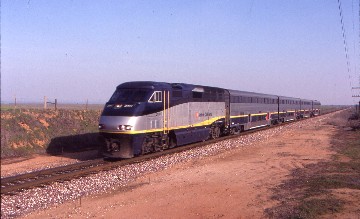
San Joaquin 702 2/21/1999
The train was out on the far station track ready to board and the locomotives was on the Oakland end of the train, where it had originated, with a cab car on the other end. The train was of course all California Cars with one of each of the type on our first run. At 6:20 AM, the train pulled west passed the switch before it reversed all the way to Elvas Tower, where once the signals cleared, we proceeded south starting my new mileage that would end once we returned to the usual San Joaquin route at Stockton.
I walked back to the rear door and noted the train was not crowded but had a good number of passengers for a first run so early on a Sunday morning. We went under the Sacramento Light Rail line and past the junction with the Placerville Line before making our way south through the industrial area of southeast Sacramento, also passing the Siemens Plant where commuter and transit cars were built. I was excited as we passed Calvine Road which was the grade crossing I use to get to my brother's house. Every time I crossed those tracks, I always wondered when I would be riding across the rails. Today was the day! The train went through Elk Grove before passing under and over Highway 99 and we crossed the Consumnes River followed by the Mokelumne River then sped through Galt where the branch to Ione took off from the former Southern Pacific Valley main line, now Union Pacific.
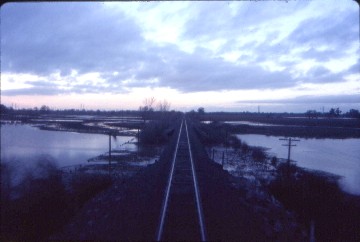
We travelled through Acampo before entering Lodi with its restored station and the Lodi Arch over Pine Street; this would be a future stop once all the track upgrades to this line are done by Caltrans. We bridged Dry Creek before going into Stockton and stopping in the middle of the street at the Altamont Commuter Express station located on a stub track with the former Southern Pacific Stockton depot at its north end. We were here for ten minutes which was used as a smoking stop as well as one to stretch one's legs.
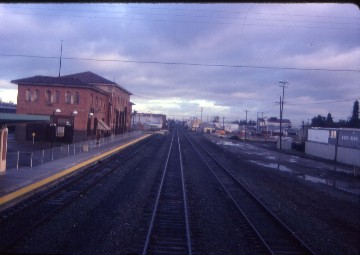
Once on the move again, we went underneath the Highway 4 bridge before rounding the new connector back onto the old Santa Fe Valley route, thus ending my new mileage.
To say that the remainder of this journey was just the usual San Joaquin trip would be wrong. As I walked back to my seat, I ran into Ray Burns and Steve Grande, co-founders of Trainweb.com, who invited me to sit with them for a while. It was my first real opportunity to just sit and chat with these two very interesting rail travellers and I also finally had an opportunity to meet Gene Poon, who writes for Rail Travel News and I always love reading his articles. Kirk Schneider of the Orange County Railway Historical Society, of which I am a member, and editor of "California By Train, Bus and Ferry" also stopped by for a visit, as did Cindy Ray of Amtrak West Marketing. There were many State of California Transportation representatives on this inaugural run and I was able to talk with the head of the Caltrans Rail program and this was one of the times I wished a particular person was not on the train. As I was having a very nice conversation with this extremely knowledgeable person, none other than Peter Warner walked up and started babbling information about the Amtrak's Ethan Allen schedules which goes to Rutland, Vermont. Talk about being embarrassed by a railfan. We both walked away from Peter and continued our discussions back in the cab car.
While Peter is very knowledgeable regarding train schedules, he goes a little too far most of the time. One night in Solana Beach, he started talking to me and I walked outside the station with him babbling and following me like a puppy to the west entrance. I walked back through the station with him still following and Julie, the Amtrak agent, was having a good time laughing at this ridiculous spectacle. I walked around the outside of the other side and this time when I walked in to the building, I told Julie to call the San Diego Sheriff as I was being stalked, after which Peter took off and that was the last time I saw him. Julie and I had a good laugh about that whole situation.
The rest of the journey down the San Joaquin Valley was typical and we arrived in Bakersfield early then I walked over to the Thruway Bus for the ride over the Grapevine to Los Angeles, arriving at 1:58 PM and I quickly made my way to the ready-to-leave San Diegan 578. Once I was seated, the train departed and it was a quick trip back home to Santa Ana, ending an interesting new way to get to and from Sacramento.
| RETURN TO THE MAIN PAGE |