



The Chicago, Milwaukee, St. Paul and Pacific Railroad, often referred to as the Milwaukee Road, was a Class I railroad that operated in the Midwest and Northwest of the United States from 1847 until 1980. The company went through several official names and faced bankruptcy on multiple occasions throughout the 1970s and 1980s. Finally, in 1980, it abandoned its Pacific Extension (Montana, Idaho and Washington) as a cost-cutting measure following a 1977 bankruptcy. What remained of the system operated for another six years until it merged into the Soo Line Railroad, a subsidiary of Canadian Pacific Railway, on January 1, 1986. Although the "Milwaukee Road" as such ceased to exist, much of its trackage continues to be used by multiple railroads. It is also commemorated in buildings such as the historic Milwaukee Road depot in Minneapolis and in railroad hardware still maintained by railfans.
Chicago, Milwaukee, St. Paul and Minneapolis RailroadThe railroad that became the Milwaukee Road began as the Milwaukee and Waukesha Railroad in Wisconsin, whose goal was to link the developing Lake Michigan port city of Milwaukee with the Mississippi River. The company incorporated in 1847, but changed its name to the Milwaukee and Mississippi Railroad in 1850 before construction began. Its first line, five miles long, opened between Milwaukee and Wauwatosa, on November 20, 1850. Extensions followed to Waukesha in February 1851, then Madison and finally the Mississippi River at Prairie du Chien in 1857.
As a result of the financial panic of 1857, the M&M went into receivership in 1859, and was purchased by the Milwaukee and Prairie du Chien in 1861. In 1867, Alexander Mitchell combined the M&PdC with the Milwaukee and St. Paul (formerly the LaCrosse & Milwaukee Railroad Company) under the name Milwaukee and St. Paul. Critical to the development and financing of the railroad was the acquisition of significant land grants. Prominent individual investors in the line included Alexander Mitchell, Russell Sage, Jeremiah Milbank and William Rockefeller.
In 1874, the name was changed to Chicago, Milwaukee, and St. Paul after absorbing the Chicago & Pacific Railroad Company, the railroad that built the Bloomingdale Line as part of the 36 mile Elgin Subdivision from Halsted Street (Chicago) to the suburb of Elgin, Illinois. By 1887, the railroad had lines running through Wisconsin, Minnesota, Iowa, South Dakota and the Upper Peninsula of Michigan. The corporate headquarters were moved from Milwaukee to the Rand McNally Building in Chicago, America's first all-steel framed skyscraper, in 1889 and 1890, with the car and locomotive shops staying in Milwaukee. The company's General Offices were later located in Chicago's Railway Exchange building (built 1904) until 1924, at which time they moved to Chicago Union Station.
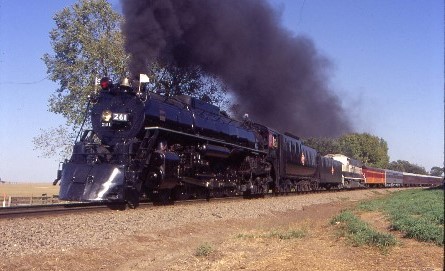
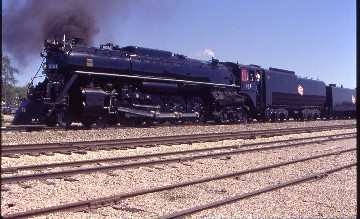
Milwaukee Road 261Milwaukee Road 261 is a 4-8-4 "Northern" type steam locomotive built by the American Locomotive Company in Schenectady, New York in July 1944 for the Chicago, Milwaukee, St. Paul & Pacific Railroad. The coal-fired locomotive, weighing 460,000 pounds, is rated at 4,500 hp and a maximum speed of 100 mph and had a three-chime whistle and airhorn mounted on it. It was used for heavy mainline freight work until being retired by the railroad in 1954. Instead of being cut up for scrap, 261 was preserved and donated to the National Railroad Museum in Green Bay, Wisconsin in 1958. Today the locomotive is owned, operated and maintained by Minneapolis-based nonprofit organization Friends of the 261, which runs seasonal excursion trains. Restored in 1993, it has logged more than 25,000 miles under its own power since that time.
As the new museum's first acquisition, 261 was moved to the museum site in 1958. In 1991, the newly formed "North Star Rail" selected 261 for restoration for mainline excursions for a variety of reasons. The engine was large enough to handle the expected trains at track speed, it featured several modern features, including easier-to-maintain roller bearings and already had its asbestos lagging removed, which was very expensive to remove for environmental and safety reasons. Finally, 261's relatively short ten-year service life meant that the engine's boiler was more pristine, meaning it would take less work to rebuild the engine.
North Star Rail and the National Railroad Museum came to an agreement in November 1991 for a ten-year lease. 261 was moved from Green Bay to Minneapolis to the GE shops at Humboldt Yard in September 1992 where a full-time staff rebuilt the engine. Work progressed quickly, allowing for a hydrostatic test in June 1993, a test fireup in July, and the eventual restoration completion in September. After passing the FRA inspection on September 14, the engine dead-headed over Wisconsin Central in time for its first public excursions on September 18 and 19, 1993 then later returned to its new home at the leased Burlington Northern's Minneapolis Junction.
The following year, 261 had an extensive season including excursions on the Wisconsin Central Railroad and the Twin Cities and Western Railroad. Notable events included "Chocolate City Days" excursions, campaign trains, a movie shoot painted as "Lackawanna 1661", running over CSX tracks for the famed "New River Train", and a wrap-up celebrating the engine's 50th birthday. The engine participated in the Steamtown National Historic Site's grand opening in July 1995 when, over five days, 261 dead-headed from Minneapolis to Scranton, Pennsylvania then stayed in Scranton for the next year pulling numerous excursions, including rare mileage trips, a rare snow plough run, and the engine's first steam doubleheader with Susquehanna 142. A Hancock three-chime whistle was temporarily added to the locomotive and then replaced with an Santa Fe six-chime whistle, which it remains with today, but still also keeping its original non-Hancock three-chime whistle and airhorn. 261 returned to the Midwest after almost a year at Steamtown and on its way home, ran for the first time over the newly-formed Burlington Northern Santa Fe Railway then pulled a few sets of excursions in 1997 and 1998 over BNSF and Twin Cities and Western trackage.
San Diegan 583 9/8/1998I drove to the Santa Ana station and was waiting for San Diegan 583 when I heard its whistle which did not sound quite normal. As it came around the corner, I saw that today's version was a set of California Cars and when I went upstairs, was surprised to find Lead Service Attendant Linda Paul behind the bar and each of us wondered what the other was doing here. As it turned out, there had been a problem and all the trainsets were out of their cycles but we were still both very happy to see each other. At Los Angeles, we each went our separate ways, Linda down to San Diego on San Diegan 586 later this evening and me on Train 4 for Kansas City.
The Southwest Chief 4 9/8/1998Another unexpected familiar face was my car attendant, Michael, whom I had seen just three days ago on the Coast Starlight. We departed Los Angeles ten minutes late due to large passenger numbers, adding the mail cars and waiting at San Diego Junction for five minutes for San Diegan 585 before we finally attained the mainline. Fullerton came and went, while at San Bernardino, we lost ten minutes for an injured passenger. I went to sleep after the summit of Cajon Pass and slept so soundly that the thirty-seven minute stop for the removal of a drunken passenger at Needles did not awaken me. Being sober, I do not have to worry about that happening to me again and after all, what would I have done in Needles?
9/9/1998 I awoke just before Williams Junction in Arizona and waking up in the forest of northern Arizona has always been one of my favourite ways to start a day as it means I was on another train adventure. I went to the lounge car to enjoy the early morning sunshine then at our station stop in Flagstaff, I bought a newspaper, as is my custom here, and learning that Mark McGwire broke the Major League home run record last night, was in a very good mood. I sat at my coach seat listening to another set of tapes, which I was keeping well-hidden after the incident in Tomah, Wisconsin. I met several other people who were also riding the steam excursion and Robert Proctor, a member of the Orange County Railway Historical Society, was on his way to three tours of Great Lakes lighthouses.
If that was not enough, later that afternoon, I met the parents of one of my best friends, Bruce Fenton, on their way to Goshen, Indiana. It was truly a small world, or as Billy Joel once said in concert, "Everybody in the whole wide world I know is here!" The former Santa Fe mainline was very busy and it was not until we got to Dalies, the junction of the line to Albuquerque, that we stopped sliding in and out between mainline freight trains. I spent the rest of the afternoon in conversation with various people in the lounge car as we passed through Apache Canyon and made the grade of Glorieta Pass. I had a delightful dinner with Robert before I enjoyed Raton Pass and the rest of the daylight then fell asleep after La Junta and slept through the stop-and-go actions of eight red signals and the wait to proceed past each one, all of which took place just east of La Junta.
9/10/1998 I awoke outside Topeka and enjoyed the morning ride into Kansas City in the lounge car, arriving thirty-seven minutes late.
Kansas City 9/10/1998I taxied out to the Budgetel Inn in North Kansas City and while waiting in the lobby for four hours for my room to be made up, I met several other people on the same excursion who were staying here because it was close to the train's boarding site. Following check-in, I walked with one of the future passengers down to where the steam train was then for the remainder of the day, studied my Burlington Northern timetables of the route that we would be taking over the next three days from North Kansas City to Minneapolis. The hotel was right across the street from the Norfolk Southern yard so I could watch their action through the window. I had a nice dinner and watched some television before having a good night's sleep.
9/11/1998 Waking up the next morning, I was excited for a long-distance steam trip and the new routes. After checking out, the taxis that were requested never came, so I led the way on the three-quarters-of-a-mile walk from the hotel to the train and walking through North Kansas City, I felt as though I was the Pied Piper, but unlike the one in the Jethro Tull song, would not fool you. Everyone boarded their assigned cars and waited for departure.
Milwaukee Road 261 Day 1 9/11/1998There was an excitement aboard as the whistle blew and the train started its journey over the 202.2 mile St. Joseph Subdivision of the BNSF. The reason for this excursion was to get the steam engine back to its home base in Minneapolis after BNSF's Employee Recognition Specials had used the engine over the summer across the northeastern part of the BNSF system, it had been part of Galesburg Railroad Days and following the engine's duties on more employee specials, attended Topeka Railroad Days the week. As a way of saying thank you to the Friends of the 261, BNSF decided to let the group run a public excursion to get the engine home. That was why I was aboard, as well as to ride new routes and mileage, along with the opportunity to ride a train in and out of South Dakota, the most elusive of all the lower 48 states in which to ride a train into. There was a BN SD70MAC tucked in behind the tender for protection in case anything went wrong with the steam engine.
I had photographed along this line with Bill Compton, my good and baseball-loving friend, so was familiar with the route as far as Weston; the main BNSF coal route from the Powder River Basin to Texas and the south and it would be interesting to see how the dispatcher handled our train through this coal funnel. Once on the move, we slowed towards the end of double track for a coal train to clear the main but never stopped and near the airport, were at track speed proceeding north along the Missouri River to the west and the bluffs to the east as we travelled the river bottom lands. Since this trip was also operated by the Camerail Club of Nebraska, all passengers had access to the two domes, so I rode in the former Union Pacific dome for a few miles before switching to the former Northern Pacific dome, the same dome car I had ridden east on the Capitol Limited on my first cross-country trip. It felt so good to be back in my old friend.
It was a beautiful clear September morning as we marched north, passing two coal trains tucked away in sidings then made really good time to our first servicing stop at St. Joseph, Missouri. We then proceeded northwest to Rulo, Nebraska and the crossing of the Missouri River, also known as the Big Muddy, into that state; an impressive crossing as the train stretched out of Missouri into Nebraska.
We ran unimpeded to Falls City where the train was serviced and passengers allowed to detrain. It was here that a group of school children, who had been riding the train since Kansas City, switched with those from Lincoln, Nebraska, many for their first train ride. We then made it to the first siding to the west at New Salem, where we went into the 10,210 foot siding for an hour-and-a-half to let six coal trains and one piggyback train proceed east. The funny thing was there was not one person complaining about this delay as everyone, including me, was enjoying the show that BNSF was putting on. Once on the move again, I was back up in the former Northern Pacific dome where I met the owner of the car. We were climbing up the new grade alignment over Firth Hill as BNSF opened this new second mainline to eliminate a bottleneck on this important route. After passing the massive grain elevator, we arrived at Lincoln thirty minutes early, thus ending the first day of the excursion.
Lincoln 9/11/1998Shuttle vans were waiting for to take us to the hotel and after check-in, went to KFC and pointed others in that direction before spending a restful night.
9/12/1998 The next morning, I had breakfast at the hotel then rode the first shuttle back to the station and watched a two-hour late California Zephyr pass through on its way east before boarding the steam excursion.
Milwaukee Road 261 Day 2 9/12/1998For the first 24.3 miles of today's journey, the train would follow the same route as the California Zephyr as far as Ashland, which allowed 261 to stretch her legs while doing the only seventy-miles-an-hour sprint during the three-day trip. 261 pulled the train effortlessly as the miles to Ashland passed quickly before we made our passenger stop there, then we turned north onto the Sioux City Subdivision for the 109.3 mile ride to our next watering stop at Sioux City.
I returned to the former Northern Pacific dome car to enjoy the forty miles-an-hour speed through dark territory (no signals) over the new route. Everyone was discussing how 261 would be handled by Union Pacific at Fremont, the crossing of its main east/west mainline and I was the only one who thought that Union Pacific would take the train without stopping us and several people wanted to bet me about it. As we neared, the approach signal to the crossing showed green, with everyone wondering how I knew, but it was a lucky guess. After crossing at Fremont, 261 paralleled the Fremont and Elkhorn Valley, a short line which operated a dinner train over its route, which we crossed six miles later then crossed the eastern end of the Sand Hills of Nebraska before reaching the Missouri River Valley at Dakota City. The route turned east prior to crossing the Missouri River and entered Iowa, where high up on the bluff to the east was the Lewis and Clark Monument, before we turned north to reach our watering and passenger stop at Sioux City, Iowa.
We departed there on the Marshall Subdivision for the next 94.9 miles to Garretson, South Dakota, continuing our trek in dark territory and paralleled a former Rock Island line which kept my interest, then made our way into the very southwestern corner of Minnesota, passing through Sioux Center on the way.
Once in Minnesota, at Hills siding, we were treated to a triple photo runby where Milwaukee Road 261 put on a great show of steam and smoke. Once we were on the move again, crew members of the Friends of the 261 walked through the train selling a steam cab ride into Sioux Falls for $50 or a cab ride in the trailing diesel for $20. Since I was about to enter South Dakota for my first and maybe only time on a train, I paid for the diesel as it was over ninety degrees out and the steam engine's cab would have been much hotter, and the diesel was air-conditioned. The crew member took me into the crew car and I crossed into South Dakota, my forty-seventh state in which I had ridden a train.
Garretson, South Dakota was where the train would be pulled backwards into Sioux Falls since there was no turning facility there, and I boarded the SD70MAC for my grand entrance. The BNSF crew left me alone, telling me only, "Chris, you can blow the horn and ring the bell anytime 261 does. Have a really good time and we want to really hear it in Sioux Falls." Once the local's power had coupled onto the rear, we were pulled backwards down BNSF's Corson Subdivision and arrived after dark, with me adding to the noise of the Celebration of Milwaukee Road 261 arrival's in town, and were pulled past the station where we were supposed to stop and went into the yard where there was room to hold our train.
That brought an end to another excellent day of train riding and after a longer walk to the hotel, I went to bed knowing that I had completed the goal of riding a train into South Dakota.
Milwaukee Road 261 Day 3 9/13/1998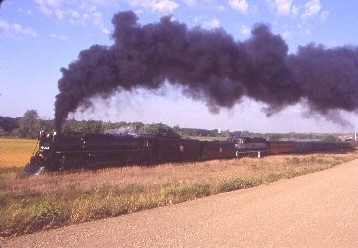
The final day of the excursion dawned bright, clear and warm with everyone who had been aboard all three days ready for our last day together. 261 left Sioux Falls on time and near Corson, performed a double photo runby then once we returned to the Marshall Subdivision at Garretson, we made our exit from South Dakota back into Minnesota a few miles later. The train proceeded northeast along Minnesota Highway 23 from Jasper to Willmar, providing some entertainment watching people trying to drive and watch the train at the same time, then passed through Camden State Park, a really beautiful area and a complete surprise. We made a servicing stop at Marshall before going to Granite Falls where we crossed the Minnesota River and reached Willmar after running 127.3 miles from Garretson. From here, Milwaukee Road 261 and the train travelled east down the former Great Northern line toward Minneapolis paralleling US Highway 12 for most of the way. We passed many lakes, including the most famous Lake Minnetonka, before entering the suburbs of Minneapolis then made our way through the west side of the city before approaching the steam engine's home base, where we all detrained, thus ending the longest steam excursion of this year, with not one videographer covering the trip.
Minneapolis 9/13/1998As I waited for a taxi to take me to the Amtrak station, I thought how lucky I was to be sober and standing this moment in the Twin Cities, as well as the fact I reached South Dakota, along with all the new miles and memories I now have from this fantastic journey, and felt quite special. I shared a taxi with two people going to a hotel before I had a free ride to the Amtrak station then stored my bags and walked over to the Minnesota Commercial Railroad shops then found something to eat and returned to Midway Station to wait for the Empire Builder.
The Empire Builder 7/27 9/13/1998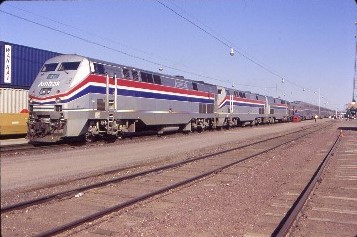
After waiting all evening, I was really glad when the Empire Builder arrived in Minneapolis and I boarded for a good night's sleep.
9/14/1998 I was up ready for another full day of train riding in North Dakota, but this time with an assortment of tapes to listen to. We were an hour late when we entered Montana and other than that, this trip was identical to the one ten days ago. As we approached the Rockies, there was another great plume of smoke rising into the Big Sky of Montana and I could tell it was in the Flathead National Forest, south of Glacier National Park. Being an hour late, it was completely dark before the Izaak Walton Inn and after passing this historic hotel, I turned in for the night.
9/15/1998
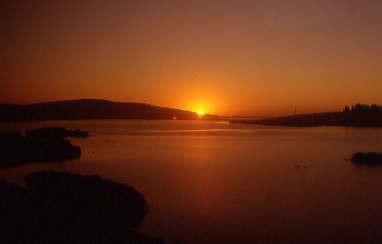
The next morning, I awoke just as we were leaving Pasco and made my way to the Sightseer lounge car with my camera for the trip down the Columbia River Gorge. The brilliant sunrise started the picture-taking and I spent a delightful morning all the way down the Columbia River then at Vancouver, I detrained and bought and mailed postcards on this fine September morning.
The Coast Starlight 11 9/15/1998Boarding the Starlight, I was my "I just want to get home mood", so settled into my coach seat and enjoyed the crossing of the Columbia River into Oregon and Portland. After Portland, I napped for a couple of hours, awakening to get the earliest seating for dinner and my now-usual Starlight dinner was excellent and following the climb up Cascade Summit, I watched "The Odd Couple II" and tried again to watch "Major League II", and for the record, it did not work this time either, so as we pulled into Klamath Falls, I decided to call it a night.
9/16/1998 I awoke north of Roseville and went to the dining car for breakfast. For some reason, I was very tired so after passing the Carquinez Straits, Oakland and San Jose, I slept from there until we passed Salinas, and were about thirty minutes late, but made up five minutes of that by the time we reached Paso Robles, before we stopped for what could only be called a phantom slow order. No workers, no authority, no nothing, just red boards stopping us dead in our tracks. The Coast Starlight sat for over an hour while the head-end crew attempted to receive permission to pass, which the dispatcher finally gave. It was a full hour that never could be made up, as at San Luis Obispo, a longer-than-normal stop was made. The only saving grace was the excellent dinner the Starlight's dining car staff served. At Santa Barbara, Peter McNamara told me I had a 50/50 chance of making my San Diegan if nothing else happened. At Oxnard, we lost twenty more minutes and a few minutes later, it was announced that San Diegan passengers would be bussed to their destinations. The Starlight rolled into Los Angeles at 10:20 PM and I was put on a bus that stopped in Fullerton and Anaheim and I had to provide the driver with directions on how to get to there before arriving in Santa Ana. This set of two circle trips had come to an end, which only left Alaska, Oklahoma and Hawaii in which to ride trains.
Note: Conductor and friend Peter McNamara passed away suddenly on Wednesday, October 31st, 2001.A few comments about Peter: I started to know Peter really well when he was my night-time conductor on Amtrak San Diegan 587 which I rode five nights a week. He was a true New Yorker and had that authentic New York accent. While Peter loved railroading, his greatest love was the game of tennis and his enthusiasm for the game caused me to become interested in it once more. When he talked about tennis, his eyes would light up and he had a special glow about him. Anytime I see tennis being played, either live or on television, I will always think of Peter. He would also share with me special things about New York before I travelled there and gave me ideas of where to go and places to eat. Thanks to Peter, I discovered Boar's Head Deli and their great roast beef sandwiches and my opinion of New York City changed from one of dislike to one of a love for the Big Apple. For that, Peter, I will always be in your debt. Peter was a true and dear friend whom I will miss most dearly.
| RETURN TO THE MAIN PAGE |