




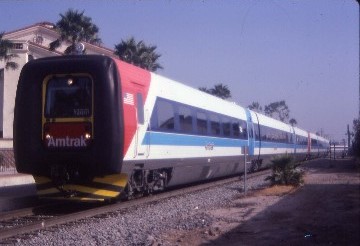
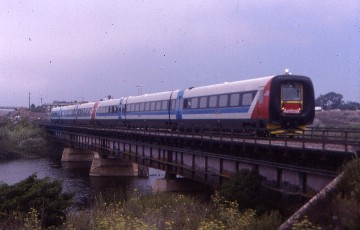
The IC3 medium/long-distance diesel multiple unit (DMU) trains were built between 1989 and 1998 by ABB Scandia (later purchased by Adtranz) in Randers, Denmark. IC3 is an abbreviation for a three-carriage Intercity trainset. Operating in Denmark and Sweden since 1990, Israel Railways introduced them to the commuting public in 1992 and were a key part of the country's passenger rail infrastructure.
The IC3 is a wide articulated train made of light alloy with Jacobs bogies shared between carriages. There are two 400 hp engines in each end of the front and rear carriages, central car has none, giving a total of 1,598 bhp. The efficient mechanical transmissions with multiple gear ratios and high power give the IC3 good acceleration capabilities and the short distances between stations on inter-city routes in Denmark made acceleration more important than high top speed.
The front and cab-design is the most significant feature and when viewed from the outside, there is a large rubber diaphragm surrounding a flat cab. The cab is a separate section of the train, but the table with the controls is mounted on a large door, to which the seat is also mounted. When two or more trainsets are coupled together in a single train, the entire front door folds away to give a wide passage, and the rubber diaphragms at the ends form a flush aerodynamic seal. Up to five trainsets can be coupled together.
In 1997, an Israel Railways IC3 was tested in North America under the name ‘Flexliner’. Amtrak used it on the Hiawatha, St. Louis and Kansas City Mules, San Diegan, and between Eugene and Portland, Oregon; VIA Rail Canada tested it for services on the Windsor–Quebec corridor.
North American TourThe Flexliner train was in their paint scheme of red, white and blue and consisted of two sets of three articulated cars. The first control car had 16 first class seats, a kitchen compartment and 20 second class seats. The middle car of each set had 64 second class seats and the rear control unit had 44 second class seats as built. For its North American Tour, the seating was changed to 32 first class seats and 109 second class seats. Power for the cars was provided by an auxiliary power unit located under each car and the cars had large windows centered between the seats which reclined slightly.
During its two weeks in San Diegan service, I rode the Flexliner at least one round trip a day and this commentary is from Train 585, on which I had ridden to San Diego and was now ready to come home to Santa Ana. Since this run was in the height of the Del Mar race season, a second regular Amfleet section of 585 followed our train to pick up the racing crowd.
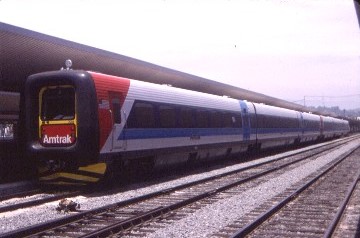
The train's power gave it the fastest acceleration of any train I had ridden and caused us to dwell, waiting on departure time at all stations. It climbed the grades on the Surfline extremely well and braked equally efficiently. The completely unique feature of these trains being able to separate on the fly would come in handy if two IC3 sets came up from San Diego and at Orange, the front set goes to Los Angeles and the second set could go to San Bernardino. When they came back to Orange, the sets would be coupled standing still.
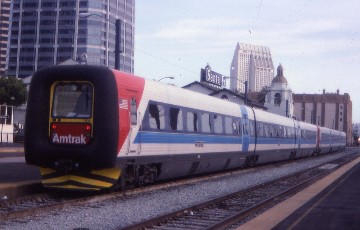
We departed San Diego on time and I walked up to where engineer Jim Hatton was running the IC3 to watch him operate it. After the running air test, we quickly gained speed and were at Old Town faster than ever, then crossed the San Diego River before proceeding to Rose Canyon, where the IC3 had no trouble ascending the grade. Descending Miramar Hill was an easy chore and at Sorrento, I had never experienced such rapid acceleration to 90 mph. We slowed for the bluff-running along the Pacific Ocean in the twilight before running through Del Mar, passing the emptying Del Mar race track, to our first stop at Solana Beach, arriving there six minutes early. The IC3 had really showed its prowess on the toughest part of the Surf Line.
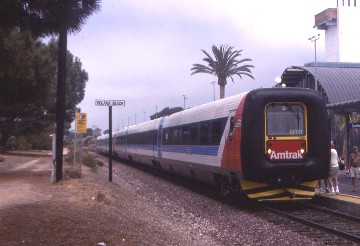
Only a few passengers boarded as the second section was behind us to pick up the Del Mar passengers. We departed on time and were off like a bullet, racing to Oceanside in ten minutes, rather than the normal twelve, where the waiting passengers boarded.
An on-time departure was followed by flying across Camp Pendleton to San Onofre, where we descended off the bluff for some beach-running through San Clemente. Even though it was dark, our train undoubtedly had some people staring as we passed the evening beach bonfires. We arrived at San Juan Capistrano and were greeted by the border patrol, who did not know what to make of our train since they had never seen anything like it before and just quickly walked through. The IC3 made quick work of the grade out of San Juan and eleven minutes later, we stopped at Irvine and sat for four minutes waiting on the schedule. The timetable gave nine minutes to go the 9.8 miles to Santa Ana and the IC3 performed it in six.
I detrained and talked with our conductor Larry Wheeler until departure time when I watched the train speed off into the night. What a fantastic train the IC3 was and I felt luck to have had so many opportunities in the last two weeks to ride it.
| RETURN TO THE MAIN PAGE |