




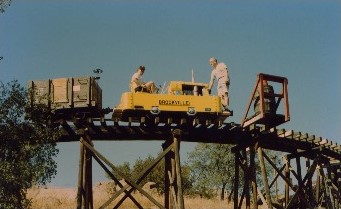
Jethro Tull was on tour with Emerson, Lake and Palmer and I really wanted to see that double billing of my favourite two bands more than once. I had tickets to a Saturday night show at Irvine Meadows then learnt that the Pacific Southwest Railway Museum in Campo was planning to operate Southern Pacific 4-6-0 2353 on the Miller Creek excursion the same day that Tull was playing. As it turned out, the Tull/ELP concert was at the Open Air Theatre at the University of San Diego the day before, which would be perfect.
I asked my long-time friend Jeff Hartmann if he wanted to go and he wondered if we could visit the Descanso, Alpine & Pacific Railway in Alpine. That was fine with me so I bought the Tull tickets for San Diego and called Roy Athey, the owner of the DA&P, who was happy to have his operation up and running at 8:00 AM on Saturday for Jeff and I.
9/20/1996 We drove down to San Diego Friday afternoon, rode the Trolley to Santee then checked into the Motel 6 near the University and drove to the open air theater for the concert.
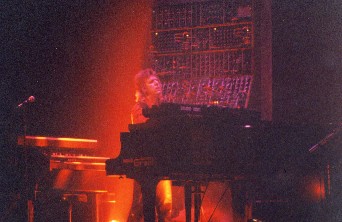
Keith Emerson at the keyboards during the Emerson, Lake and Palmer portion. The set included the very seldom-played "Bitches Crystal" song from their 1971 album "Tarkus.
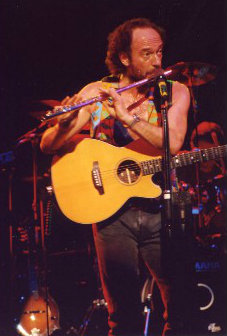
Ian Anderson, the lead of Jethro Tull, performing songs from over the years. We both enjoyed the spectacle and returned to motel for the night.
9/21/1996
The next morning Jeff and I were up early and drove east on Interstate 8 to Alpine then south to the Descanso, Alpine and Pacific. Descanso, Alpine & Pacific RailwayRoy Athey, known as "The Train Man" was born in San Diego on August 3, 1931. When he was a young boy, his father ordered a second-hand Lionel train set from the Madison Hardware Company in New York City. It was a passenger train with a locomotive, tender, two coaches and an observation car. It was an 027 set. That means it was "O" gauge and the circle track was 27 inches in diameter.
A few years later, Roy's father bought him a second Lionel train; no locomotive - just four freight cars and a caboose. He also ordered a circle of 072 track. "Oh what a difference it made," said Mr. Athey. "The track was longer and you could go so much faster around the curves."
His love for trains continued and when he was about 15 years old he traded in the Lionel sets for HO gauge scale equipment. After he married and had a son, he started collecting Lionel O gauge trains with his son. When Roy retired in 1988, he decided to build a real railroad on his property in Alpine. He needed a locomotive and found one in Hemstead, Texas and had been used for hauling limestone in a quarry at Carthage, Missouri. It can haul 62 tons.
With the help of his good friend, Casey Derengowski, Roy started laying track and restoring the old locomotive. On February 11, 1992 the old locomotive ran for the first time in many years. Then in June 1993, the trestle at High Pass was completed. They also built a depot, freight shed, engine house, blacksmith shop, section house and three other trestles. The last spike went in on September 22, 2000. Five years later the "Two Foot Gauge Owners Association" indicated that they believed it is the longest operating two foot gauge trestle in the United States.
The railway has three stations, Shade, El Pozo and High Pass and offers free train rides and historical narration to the public on most Sundays.
This two foot gauge railway is typical of many industrial and mining operations and is full-size and not a scale model. The track is constructed of used light rail number 12 to 20, tight curves - 10 foot minimum radius and steep grades of 6.5 percent. The rail came from a number of now abandoned operations: the Warlock Mine in Mojave, California, "a mine in Utah", the Rand Mining District in California, the Poway-Midland Railroad (too light for their use), the Warlock and Blue Mount Mines in Julian, California and Border Field in Imperial Beach.
The rolling stock was made in their shop using an 18" gauge timber car from a mine in Bisbee, Arizona and two-foot gauge brick yard cars from Oklahoma. The locomotive is a 2.5 ton Brookville, outshopped October 14, 1935 for the Carthage Crushed Limestone Company in Missouri and is powered by a McCormick-Deering P-12, 22.5 horse gasoline engine. This is the same engine that International Harvester Company of Chicago powered their Farmall 12 series tractor with. The locomotive stood idle for 13 years on the two foot gauge Hempstead & Northern Railroad Company in Houston, Texas, before it was obtained and moved to Alpine for restoration on October 14, 1990, its 55th birthday. It was restored to service on February 27, 1992.
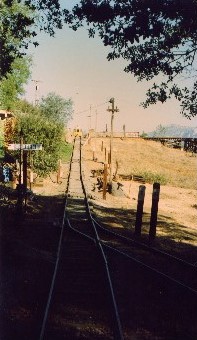
Jeff and I arrived, parked and met Roy, who gave as a tour of the depot before taking us to see the equipment.
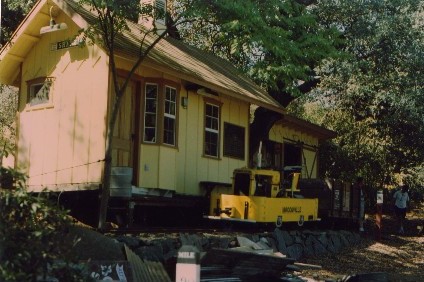
We boarded the train with Roy working the engine and Jeff and I riding in the open air car. He reversed the train from the depot east along Railway Drive on the Thomas Dyke fill to the end of the track by the front of his property then reversed the engine and pulled forward past the depot at Shade to the junction switch to travel the opposite way and to the Garden. We went up the grade to a loop track and a cut at High Pass then curved out onto a circular trestle with an outstanding view of the valley below. We stopped to enjoy the view and Roy explained the history of the railway then returned down the grade, past the garden locomotive and car shop with its outdoor inspection pit.
We travelled back through garden to the switch and ran to the lower level, crossed a trestle then turned left through a cut, making a 180 degree turn down the grade. We came to the switch, stayed straight and wound down the grade through another cut before curving to the lowest point on the property at Howe, named for the man who designed the truss bridge, where we went over a wooden through-truss trestle installed at a later time. We reached El Pozo and started up the grade before crossing a trestle back to the switch, thus completing the lower loop. We returned to the garden then went around the upper loop, this time in the reverse direction before making our way up the line to Shade Depot to complete our round trip over the Descanso, Alpine & Pacific.
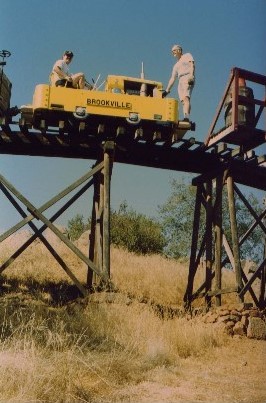
Roy asked me if I wanted to operate his train and I of course said yes! Jeff rode along and we stopped at several locations, including the high bridge at High Pass. Operating the engine was easy, a lot of fun and an incredible experience which I will never forget. A special thank you to Roy for taking the time to give a tour of his unique railway and all the information he provided.
Southern Pacific 2353 9/21/1996After that fantastic visit, Jeff and I drove about an hour southeast to Campo, where we spotted Southern Pacific 2353 steaming away as we approached. Since I had just rejoined the museum as a member, our excursion behind this newly-restored locomotive was complimentary. I was surprised to find Bill Wallace, owner of Bananafish Tours, here and we discussed his next Copper Canyon excursion in December.
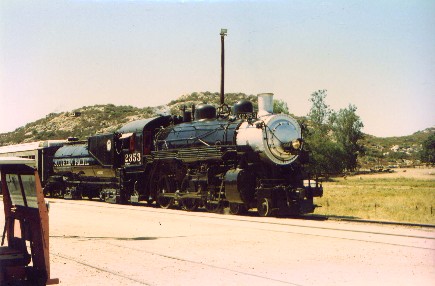
Southern Pacific 4-6-0 2353 built by Baldwin October 1912. It started work on San Joaquin/Fresno-Los Angeles Express trains then was leased in 1927 to the San Diego & Arizona, which became the SP-owned San Diego & Arizona Eastern in 1932. It hauled passenger trains on the San Diego-Campo-El Centro mainline, as well as racetrack specials from San Diego to Agua Caliente in Tijuana, Mexico. After returning to the Southern Pacific in 1939, the locomotive moved to the San Francisco area to work in freight service. It then served as a switcher at the Bayshore Yards in Brisbane, California in the 1950s, as well as hauling San Mateo-Watsonville, California, gravel trains and switching at a San Mateo lumber mill.
2353 retired in January 1957 and the following month, was moved using compressed air into the California Mid-Winter Fairgrounds in Imperial, California where it remained on static display for the next twenty-nine years. In 1984 the fair operator donated the locomotive to the museum as they were looking for a steam engine to restore. On November 25th, 1988, the formal transfer from the 45th District Agricultural Association to the Pacific Southwest Railway Museum took place and it was moved to Campo over November 8-11, followed by the task of restoring the engine to operation. It was returned to active steam service on March 19, 1996 and a little over five months later, Jeff and I were viewing this great engine.
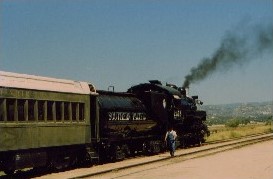
We looked at the museum's collection before starting a queue to board the train to Miller Creek, choosing the coach behind the engine to enjoy the smell and sounds of steam. With four toots of the whistle, 2353 started to pull forward with its huffing and puffing and we were in railroad heaven, especially as we were riding behind a Southern Pacific steam engine on the old San Diego and Arizona Eastern tracks that it used to run over. We departed the museum site and minutes later, crossed Campo Creek then at the Highway 94 crossing, there were photographers waiting for our passage before their chase began. The engine's sounds echoing through the rock cuts were stellar and our train stopped briefly at the La Posta Road crossing since it had to be flagged.
The steam train then pulled across the crossing and we continued east before turned left into Clover Flats then paralleled Miller Creek to the head of the canyon where we turned right, running to the siding at Miller Creek. Here a photo runby was performed and anyone who wanted to detrain was allowed. The crew reversed around the last curve before passing the photographers at speed.
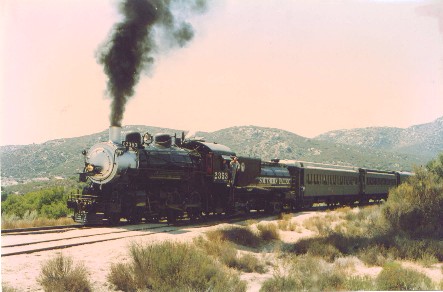
After we re-boarded, 2353 was run around the train which ran backwards to Campo. Jeff and I enjoyed our trip before we returned to Santa Ana and that night, I saw Emerson, Lake and Palmer and Jethro Tull at Irvine Meadows.
| RETURN TO THE MAIN PAGE |