



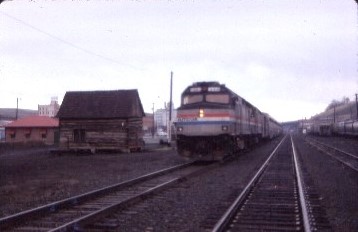
After being sober for a month and riding trains locally, it was time to plan a long-distance train trip, which would be the perfect test to see if I was capable of riding trains while maintaining my newly-found sobriety. But where should I go and what location should my sobriety find? Suddenly I realized it had to be New Orleans, the only place I was ever asked to leave a train. That destination would also give me an opportunity to ride the re-routed City of New Orleans through Yazoo City, Mississippi so that would take me to Chicago. Now, which way to the West Coast? I decided upon the Pioneer to Seattle so I could ride the new Mount Baker International with its Spanish Talgo cars, then the Coast Starlight to home.
One phone call to Amtrak reserved my seats on all trains then I paid and picked them up at Santa Ana. Friday night finally arrived and I was on the station platform to start this journey, the commencement of my goal to travel by train through every state in which I had drunk.
San Diegan 583 4/6/1995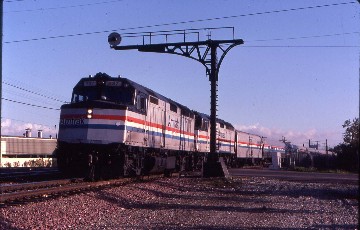
I boarded the northbound San Diegan, sat in the lounge car and reflected on the enormous difference in how I was feeling and my outlook on life and it was almost akin being on a train for the first time. It was really a powerful emotion and something I had not felt since my early days of riding. Anaheim and Fullerton were stopped at then we arrived at Los Angeles Union Station on time, where I disembarked, walked down the long tunnel to the waiting room and sat in front of the gate that read "Sunset Limited." I walked over to station services to obtain my boarding pass then sat patiently, listening to music and doing word search puzzles until the gate was opened and it was back up to Track 11 and my next train.
Sunset Limited 2 4/6/1995I was boarded in the coach in front of the lounge car and found a large full window seat on the right. The Sunset section of the train was not too fall this evening but the Texas Eagle coach seats were all occupied. We departed on schedule and made our way out of the station and to the middle of Interstate 10. I went to the lounge car and Art, the bartender who was on the train that fateful day in New Orleans, was working the counter downstairs and I ordered a 7-Up and told him the complete story of my last trip. He replied that he was very happy to see me back aboard in my new sober life. I returned upstairs to enjoy the passing through the Southern Pacific's City of Industry yard, the Walnut Valley and our first stop at Pomona. A twenty minute sprint brought the train to its next stop of Ontario, which was new to me, and one passenger boarded our coach to make twenty-six people upstairs. The Sunset continued its dash into the night passing through Southern Pacific's West Colton yard before starting the climb up San Timiteo Canyon, where I watched the countryside pass under a nearly full moon. We climbed to Apex before descending into the desert and by West Palm Springs, I returned to my coach, stretched out across both seats and fell fast asleep. During the night, the train passed the Salton Sea, the Glamis Sand Dunes, Yuma, the junction at Welton and proceeded up the line to Phoenix.
4/7/1995 Waking up sober on a long-distance train for the first time in years, I went to the dining car to enjoy my breakfast and was served at the spot of the sabotage of the Sunset Limited a month earlier. We passed through the area at restricted speed and the breakfast conversation turned to railroad safety, with all agreeing that even with this single event where only one person was killed, trains are still the safest mode of transportation. Breakfast lasted through the desert and into the irrigated area of the Valley of the Sun. After travelling for another hour, the train arrived at Arizona's capital city of Phoenix and stopped for about twenty minutes on this sunny Saturday morning. I was back in the lounge car as we crossed the Salt River and saw the Arizona State University's Sun Bowl Stadium before we stopped at Tempe.
My morning drink was no longer a screwdriver, but instead several cups of tea. We crossed the Gila River before stopping in Chandler then continued south to the Southern Pacific main line at Picacho, passing Picacho Peak and running forty-five minutes to our next servicing stop of Tucson, where I enjoyed a morning walk and a chance to be in that dry desert air. Upon our departure, we passed through Southern Pacific's yard where four trains were waiting for us to clear then we climbed the grade to Mescal by travelling on the faster westbound track passing over the eastbound track on a high bridge before they rejoined at Mescal near the coaling tower. We descended the grade into the Santa Cruz River valley and our next station stop at Benson. From here, the Sunset Limited snaked its way up the grade to Dragoon before descending to the Wilcox Playa and its dry environment.
We flew through Wilcox and it was up and over another grade before we created dust through Bowie prior to climbing another grade to Steins and entering New Mexico. We stopped at Lordsburg before racing across the Continental Divide, with its location only given away by the highway sign, before arriving at Deming. East of town, we lost Interstate 10, which we had been in sight almost all the way since Picacho, and made our way straight across the desert. We descended into the Rio Grande valley and were within fifty feet of the Mexican border before we crossed the Rio Grande River into Texas and our next station stop at El Paso. This was another servicing stop and allowed me another opportunity for a long walk. We departed on time and I had dinner from menu number three then as the night rolled on, the film was "The Firm" which I had never seen before; it was nice and relaxing to watch a film on a moving train. Afterwards, it was back to my seat for night number two and I reflected on my new way of riding trains then fell asleep as we travelled east though West Texas to our early morning connection with the Texas Eagle in San Antonio.
So far, my goal as mentioned above had been reduced by four: California, Arizona, New Mexico and now Texas, which left thirty-eight as Amtrak does not serve every state.
Sunday 4/8/1995 The next morning I awoke in San Antonio with the train at rest, so I went to stretch my legs and realized we were an hour-and-a-half late. The through cars for the Texas Eagle had been disconnected, but were still behind us and our train crew was no place to be found. I walked into the depot and out to the street for a newspaper then enjoyed the morning. After about twenty minutes, our new crew arrived, an 'all aboard' was sounded and off to the east the Sunset Limited went.
We pulled through Southern Pacific's Kirby yard with its engine facility before making our way into the rolling hills and the almost scrub-looking trees in this part of the state. We passed Randolph Air Base when a woman named Joann, who was travelling to Houston, sat beside me as I drank my morning tea. We started talking about my mileage, travels and sobriety and a little while later, I went to get another cup of tea for me and a cup of coffee for Joann. Freight trains were passed in almost every siding and our conversation switched to tornadoes, earthquakes and other natural disasters. She then wanted to hear some of my rail stories and we both had some good laughs then discussed my alcoholism and it was almost like attending an AA meeting.
The Cotton Belt Route left the Sunset Route at Flatonia and we crossed the Colorado River of Texas. There were not many scenic highlights in this part of the Lone Star State, so passing through a small town and briefly observing the surrounding helped pass the morning. We crossed the Bravos River and minutes later, passed the Imperial Sugar Company of Sugarland and I wondered if the sugar in my tea was processed there, but no such luck. The Santa Fe mainline ran beside ours and a westbound freight train passed. We approached Houston with its skyline rising above the plain as I looked for the Astrodome and finally spotted it. Joann left me to prepare to detrain while I enjoyed the final miles to Houston. For three-and-a-half hours, Joann helped me pass the time of crossing Texas, so when we arrived there, I detrained to look for her and she slipped a note into my pocket, then turned and never looked back. I re-boarded and read her note: "Thanks for helping me get to Houston. I never had so much fun on this train. If you are ever in Houston look me up. I will show you a good time! Joann"
We departed an hour and forty minutes late and minutes later, passed through Southern Pacific's vast Houston yards before we left the city limit. I went to the lounge car and watched the southeastern Texas countryside pass then we crossed the San Jacinto River, followed by farmland and small towns before the Sunset Limited crossed the Trinity River. More rice fields were passed, since Texas is one of six rice-producing states. We arrived at Beaumont, our last stop in the Lone Star State, with no further delays then passed the ships and the harbour facilities before we crossed the Sabine River and entered Louisiana, adding that state to my sober list.
Louisiana is well-known for its bayous and the passengers in the lounge car were on alligator watch, although I did not expect to see any as it had become very cool. We made our way east over bridges and bayous passing the rice and sugar cane fields along with small towns before our next stop at St. Charles. Daylight was waning as we continued through more lowland scenery before crossing the Mermentau River and arrived at Lafayette in the twilight, then crossed the Vermilion River and arrived at New Iberia as darkness took its hold. From here to New Orleans, I had dinner in the dining car from menu number three again and watched the lights of the small towns and communities go by as the train continued its trek east. We stopped at Schriever and I knew we were within an hour of my destination.
There was the one scenic highlight that I had been waiting for, which I was not able to see on my previous trip, namely the view of New Orleans from the Huey P. Long Bridge. I sat patiently and in silence just waiting for that moment then we entered Southern Pacific's Avondale yard, where the train began its ascent up the grade to the bridge, turned left high above the roundabout below, and continued to climb, getting ever higher until finally we had the waters of the Mississippi River far below and the city lit up to the right. With the grand sight of the Crescent City in the April night, this had to be one of the most spectacular entrances to a city anywhere in the country. We reversed into New Orleans Union Station, since the train would continue to Miami, Florida, and I stepped off the Sunset Limited sober in New Orleans.
New Orleans 4/8/1995I walked into the station and was met by one of the guards who had escorted me out of Union Station two years ago and we chatted for a few minutes and he remembered me. As I made my way to the taxi, his parting words were: "Stay sober my AA brother, for the rest of your life if you choose!", a statement that touched me. I changed my mind on hotel locations so I had the driver take me to the Days Inn on St. Charles Street to give easy access to the St. Charles Streetcar line. I received a room, called the other hotel to cancel that room, freshened up and called it a night.
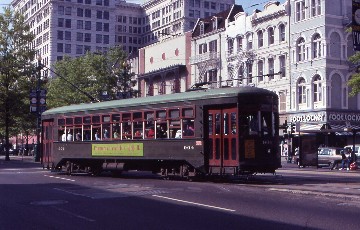
4/9/1995 The next morning, I rode the streetcar line, walked down Canal Street to Riverwalk and visited the train store in the mall then returned to the hotel, freshened up, relaxed and went for breakfast across the street then checked out and taxied back to New Orleans Union Station to wait for my next train's departure.
The City of New Orleans 58 4/9/1995I was back aboard the City of New Orleans with a Superliner consist for my first trip from Jackson to Memphis via Yazoo City. This was a low-level train, which had a dome car the last time I rode. We departed on time and I went to the lounge car for the journey north, observing the Huey P. Long bridge, the City of the Dead Cemetery and New Orleans International Airport.
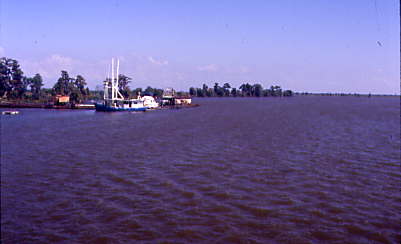
We paralleled the west side of Lake Pontchartrain before crossing the Pass-Manchac Waterway and ventured into the swamplands with Spanish moss hanging from the trees, then passed our southbound counterpart in a siding waiting for us before we arrived at our first stop at Hammond. We then entered the Louisiana Woodlands and passed the above-ground cemetery and elevated houses due to the high water table. We sped by several beautiful Southern estates and some Northern Louisiana small towns before entering Mississippi, which I crossed off my sober state list.
We crossed the Tangipahoa River before stopping at McComb, where the dining car steward came by handing out dinner reservations and I took the earliest seating. We continued our trek up the Illinois Central's rails through the forest with the occasional lumber industry located on spur tracks before arriving at Brookhaven. I went to the dining car and was seated at a table by myself with that dreaded menu number three for the third straight night. Tonight was a different train and railroad, so I ordered the chicken, which was nothing to write home about. While I was eating, we stopped at Hazelhurst and following that, as I was eating my ice cream for dessert, the conductor came through the car asking if anyone was going to Yazoo City. A couple across from me responded in the affirmative, to which the conductor informed them that due to an Illinois Central freight train derailment, the train would be re-routed the old way and they would be bussed to Yazoo City. So much for Yazoo City on this trip. The good news was that I would be riding over the old route of the City of New Orleans sober and could therefore reclaim it for my sobriety, so everything worked out if you let it.
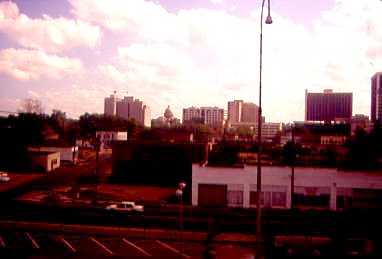
We arrived at Jackson, the capital of Mississippi, after dark and I detrained during the smoking stop as the City of New Orleans was a non-smoking train. As I stretched out on the platform while most everyone else smoked, a lady reporter approached me and asked me why I was off the train if I was not smoking. I responded that the smokers need their air to smoke in and I need my fresh air to breathe! She wrote my comments down, took my address and told me she would send me a copy of her article on "Smoking on public transportation." I reboarded and returned to the lounge car where I found four railfans all wearing buttons, badges and pins and were talking about how excited they were to be riding the City of New Orleans tonight as it was being re-routed onto its original route.
Tonight's film was "Batman Forever", which I enjoyed while the train was being detoured. At Durant, we switched crews and had to wait for a freight train before we continued north then after the film ended, I sat upstairs enjoying the night-time views of the passing countryside as we entered Tennessee, which I crossed off, and later tonight as I sleep, Kentucky and Illinois will also be crossed off. I returned to my seat and found a motherly-looking black woman sharing my seat with me. After introducing myself and talking for a few minutes, I decided to call it a night then curled up on my seat and leg rest under my Amtrak blanket and fell fast asleep.
4/10/1995 I awoke and crossed over my companion without waking her and walked back to the dining car for a breakfast of French Toast, sausage and juice. It was a nice morning meal followed by a great cup of tea as I watched the low clouds in the Illinois sky and the land being used in an agricultural manner. While I was in the dining car, the train had stopped in Rantoul and Gilman then crossed the Kankakee River before arriving at Kankakee. The wind was howling and I knew it was going to be a cold windy day when I reached Chicago.
From Kankakee to Chicago Union Station, the landscape changed from rural to urban in nature then upon our arrival at Homewood, Metra Electric trains shared the right-of-way with us. We passed Illinois Central's large Markham yard then crossed the Calumet River, went by abandoned industries before travelling underneath the Conrail main line, the same one I was on my first cross-country trip. We passed the Museum of Science and Industry and I could see Lake Michigan to the right then we paralleled Lakeshore Drive, passed Soldier Field, home of the Chicago Bears, before the City of New Orleans turned onto the St. Charles Air Line, giving an excellent view of the Chicago skyline by train. We crossed over the Amtrak maintenance facility that leads to Union Station and the Metra coach yard then descended to the end of the Air Line before reversing into Chicago Union Station on time.
Metra 2213/2236 4/10/1995During the planning for this trip, I had sent off to Metra for a complete set of route timetables so I could plan in advance the options during my layover. Today's target route was the Milwaukee District West route out to Big Timber Road so I walked to the north platform and boarded Metra Train 2213. We departed on time and curved under the Chicago and North Western station leads before straightening and providing a northern view of the skyline then curved off the former Milwaukee Road main line to Omaha and passed the Metra coach yards and proceeded northwest off the main line to the Milwaukee Road's namesake city. Stops were made every few minutes and once out of Chicago's north side, the distance between them increased. Some of their names were quite interesting, such as Galewood, Mars (we did not stop there), Elmwood Park and River Grove. We passed through the Soo Line yard at Bensenville before continuing through Itasca, Roselle, Schaumburg and Hanover Park prior to Elgin, where we made our final sprint to our the terminus at the park and ride station of Big Timber Road. As I was about to detrain, the conductor asked if someone was picking me up and I responded that I was just riding a Metra train in between Amtrak. He said I could stay on the train as it pulled forward about a quarter of a mile so the engineer could change ends in Metra's push/pull mode. The journey back to Chicago was uneventful with many passengers boarding and travelling back through snow flurries along the way. Upon my arrival at Union Station, I mailed a few postcards and had a couple of Gold Coast Char Dogs before I went downstairs to the south waiting room.
California Zephyr/Pioneer 5/25 4/10/1995As I walked to board one of the rear five cars of this fourteen-car train, the conductor asked me where I was going and I replied with Seattle. He said that I was the only passenger going there, besides the on-board crew, so if there was anything he could do to make my trip better to let him know. I always like to hear that when I board a train as it makes me feel special. I found my full window seat on the right and waited for departure, which occurred on schedule. We exited Union Station on a mostly cloudy afternoon, passed Metra's (former Burlington Northern) coach yards, then sped down the Burlington Northern triple track mainline to our first stop at Naperville and continued through Metra commuter territory until we passed Aurora. We made our way out into the Illinois agricultural countryside and I returned to my seat to word search puzzles and music.
The Pioneer's dining car steward came through taking dinner reservations and was armed with menu number three. I made a comment about the same menu for the fourth straight night and he asked me what I would like to have. When I mentioned steak, he asked for my name and that he would ask the chef to prepare it in a different way, so when you order, ask your waiter to write your name across the top of the meal check so I would receive a special meal. I thanked him and took the first evening seating. Later in the dining car, I had the waiter write my name on the check and as we entered Galesburg station, here came my meal, a marinated steak which was so tasty that it was the best steak on my train travels to date. About halfway through my meal, the chef came to my table to ask how the meal was and I replied that it was excellent and thanked him wholeheartedly. He asked where I was going and when I responded all the way to Seattle, he promised he would make my meal special tomorrow.
I went to the lounge car to wait for the film which was "The Firm" again, but I watched it for a second time and was able to remember some of the dialogue, although I noted several small details that had escaped me the first time. We crossed the Mississippi River and entered Iowa, another state crossed off the list, and stopped at Burlington then continued into the night as the film went on. We travelled to Mount Pleasant and Ottumwa then arrived in Osceola, a smoking stop, where I detrained into the cold Iowa night air before returning to my seat and curled up in the same manner as I did last night, even though I had the extra seat to myself, and fell asleep as we sped across western Iowa. I woke up later and upon looking out of the window, realized I was in Omaha, so crossed Nebraska off the list then returned to my night of slumber in a Superliner coach.
4/11/1995 I awoke to the western Nebraska countryside and decided to have breakfast in the Zephyr's dining car because I was curious to see who was working. I had a pancake and sausage breakfast as the train passed through McCook where I went to the Zephyr's lounge car for my morning tea ritual until Denver. We crossed into Colorado and made our first stop at Fort Morgan then I crossed Colorado off the list and anticipated three more states that would have the same treatment later today. I saw the Front Range of the Rocky Mountains which would normally excite me, but today I was going around them, not through them. As we approached Denver, we passed several empty coal trains returning to the Powder River Basin for more coal and I saw the Union Pacific line coming in from the north, which would be my route later this morning before we passed the stock yards followed by Burlington Northern's yards. The train was then wyed and we reversed by Coors Field, home of the Colorado Rockies, and arrived at Denver thirty-five minutes early.
The Pioneer 25 4/11/1995I detrained to mail a few postcards and telephone some people then returned track side and enjoyed the morning air while the California Zephyr was being serviced for its journey west. Passengers boarded and off they went towards the Rockies, Salt Lake City, Reno and the West Coast, leaving just our five cars on the platform, as well as three dead-heading cars for Seattle. Two locomotives and a baggage car were added to the front and we departed on time and would travel over the rails of the Union Pacific all the way to Portland. Our departure took us north towards Wyoming and the Union Pacific mainline across that state so we proceeded through the Union Pacific yard then an industrial area of northwest Denver before the scenery turned agricultural with small towns, followed by our crossing of the South Platte River and our arrival in Greeley, which brought the famous phrase "Go West, Young Man" to mind.
That phrase usually been credited to influential New York Tribune editor Horace Greeley. A New Englander, Greeley was one of the most vocal opponents of slavery and in 1872, the famously eccentric man ran for President against Ulysses S. Grant, lost, and died before the electoral vote officially came in. Greeley won just three electoral votes but was a widely admired man. Though Greeley was always interested in Western emigration, he only went out west once, in 1859 during the Colorado Gold Rush. Originally a utopian experimental community, Greeley, Colorado, fifty miles north of Denver, was named after him in 1869. The newspaperman often published advice urging Americans to shout "Westward, ho!" if they could not make it on the East Coast. Yet his own trip through Kansas and over the Rockies to California showed him not just the glories of the West (like Yosemite) but some of the darker side of settlement.
We made our way past the last of the grain elevators for quite a while and started climbing the foothills to reach the Wyoming border right before Speer, where I drew a line through that state's name. We rounded the wye at Speer prior to taking the Borie Cutoff to reach Borie, the stop for Cheyenne. The wind was really howling as people struggled to get from the downtown bus to the train and a piece of paper fell out of a boarding passenger's pocket and within a second, it was gone with only God knowing where it would land.
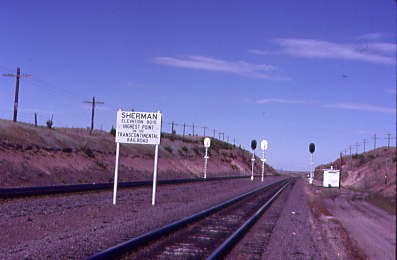
The train started to ascend Sherman Hill on the old line which stirred up memories of the 1992 Union Pacific Historical Society's Cheyenne-to-Laramie excursion behind Union Pacific Challenger 4-6-6-4 3985, which was an afternoon trip up the new line and a night trip back over the old one. I will never forget the Challenger's whistle through the night but I was brought back to reality as our lead locomotive blew for an unprotected grade crossing. I love Sherman Hill with its rocks and trees and it is a unique landscape in North America. At Burford, we met an eastbound double stack train then passed Sherman, the highest point on the Union Pacific's main line, before descending to Dale, where the new line rejoined ours, prior to our passage through Hermosa Tunnel, the only tunnel on Sherman Hill. We descended west on the old line through Colores to Laramie, our next station, which also was a smoking stop, where I detrained for some clean fresh Wyoming air and we sat here for twenty minutes waiting to catch up to the schedule.
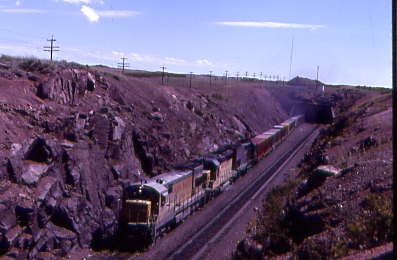
Departing Laramie on Union Pacific's double track mainline, the dispatcher crossed us over and by Rock River, we had passed three eastbound trains. We were then crossed over to the other mainline to pass four more eastbound freights without the need for us to slow down. Following that, at Sinclair, we crossed over again and just before Rawlins, passed two more westbound freights before re-crossing once more to reach the station, where an eastbound was waiting for us to clear. While the route was not all that scenic, the dispatching was very impressive and since Union Pacific sends its freight trains in fleets, running them one railroad signal block, one after the other, I was completely amazed by how our Amtrak train was handled. Now if only the other freight railroads could be as good.
We departed Rawlins on time to cross the Continental Divide at both Creston and Tipton, with the railroad crossing the basin between those two points where water had no exit, instead it was low grass with an occasional herd of cattle being fed from a truck and by the way the grasses were moving, the wind must have been really blowing. I timed my tape of Trevor Rabin (the guitar player from the band Yes) to play "Red Desert" as we passed through the locale of the same name, then started to follow Bitter Root Creek to our next stop of Green River. I met a couple of ladies from Minnesota and over the next hour, taught them how to use Amtrak's All Aboard America fare as we continued to follow the creek through a small canyon to Green River, with a butte overlooking the town and the Union Pacific yard. This was another smoking stop so I enjoyed more fresh air.
On on-time departure was made, after which we crossed the low point of our Wyoming crossing of the Green River and started to ascend out of the Green River Valley onto the plateau while I made my way to the dining car. The waiter wrote my name on my check then asked me to move to the other end of the dining car so no one else would see my meal and I waited patiently, watching the scenic Wyoming countryside. After twenty minutes out came my meal and on one plate was my baked potato and rolls while the other was full of beef sliced into strips, cooked medium rare with the juices lining the bottom of the plate and it melted in my mouth. The steward and chef joined me and asked my opinion and the only words I could think of were "Absolutely excellent! I have never had a meal anywhere in all of my travels like this!" They both showed smiles of appreciation and after finishing, it ranked as one of the best meals. A special thank you to the Amtrak's Pioneer dining car crew.
While I was eating, the train passed through Granger where the Union Pacific line to the Pacific Northwest takes off, then we travelled through a series of washes to the Altamont Tunnel before arriving at our next stop in Evanston. We started to climb the Wasatch Mountains and crossed into Utah, which I crossed off my list and since we were riding through the Wasatch Range after dark, other than the cars' lights on Interstate 84, it was completed darkness outside. After passing Devil's Slide, the lights of the Great Salt Lake Valley appeared before we went through Union Pacific's Ogden yards and arrived in Ogden thirty-three minutes early, which gave me an opportunity to call home. Once on the move, we proceeded north along the base of the Wasatch Mountains into the night and I decided to stay up since I wanted to be awake when we arrived in Idaho and see the station where my brother Bruce used to work in Pocatello.
4/12/1995 Sitting in the lounge section of the dining car, we passed through Brigham City then entered the scenic Bear River Canyon, which I had seen in twilight on a previous trip and it was absolutely beautiful. We approached the well-lit Cutler Dam then slowed to twelve miles an hour for the curved bridge and tunnel above the reservoir before making our way through the canyon to Cache Junction then travelling north into Idaho, where I crossed that state off. We passed through the small farming towns of Trenton, Weston, Dayton, Downey and Arimo and between Dayton and Downey, passed through Red Rock Canyon before arriving at McCammon, where we swung onto Union Pacific's mainline from Granger, the mainline to the Pacific Northwest.
We travelled through the little ballast rock canyon which I liked so much and passed through Inkom where there was a rule, "Watch out. Do not fall into coal pit!" and within fifteen minutes, we were at the east end of Union Pacific's Pocatello hump yard. The conductor walked by me and remarked that I looked familiar and asked my name. I told him and added that I was the brother of the Amtrak agent who had worked their for six years. We chatted for a few minutes before he asked me to open the coach door here and at Boise as they were short-handed tonight and I readily agreed to help as the train passed the hump. I went downstairs and waited for the train to stop before opening the door and putting out the foot stool. It was a clear cold night, just as I remembered it, and walked into the station and nothing had changed. I returned to my door, helped four passengers board with luggage before we received the highball, when I closed the door and off we went west. I then stayed up long enough to say good night to our crew and pass Simplot before returning to my seat to sleep.
Later that morning, I awoke as we were travelling on the Boise Cutoff passing Morrison-Knudsen, the locomotive rebuilding company. As I agreed to do last night, I opened the door at Idaho's capital city of Boise and the outbound crew thanked me and introduced me to our new crew. We departed Boise on time and I freshened up as we arrived at Nampa, the last stop in Idaho, where we regained the Union Pacific main line once more. I enjoyed pancakes and bacon for breakfast as we made our way through the fields of southwest Idaho before crossing the Snake River and entering Oregon, crossing its name off the list. I returned to the lounge section of the car and was drinking tea as we crossed the Snake River back into Idaho as we passed through Payette, then ran along sand dunes which seemed out of place before entering a canyon with high steep walls then left Idaho for good on this journey and traversed the Snake River one last time into Oregon.
We started our ascent of another canyon and stopped at Huntington to switch crews again then resumed the climb of the Brunt River Canyon passing a cement plant and going through a tunnel before a second cement plant. We then proceeded up a side canyon and rounded a horseshoe curve at Oxman then finished our long climb from the Snake River, topping the grade at 3,998 feet. We descended into the Baker Valley then stopped at Baker City which brought back memories of detraining here before working a day on the Sumpter Valley Railroad in 1984. Departing Baker City, we started our next climb and snaked up to the summit at Telocaset before we descended to the City of Union then crossed the valley to our next passenger and smoking stop at La Grande, where I enjoyed the clear and cool Oregon mountain air; the twenty minute layover allowed me to look around the station's interior.
Leaving La Grande, we shared the tight narrow canyon with Interstate 84 starting its ascent on the Blue Mountains. Union Pacific had double-tracked the eastern side of the grade so we snaked our way up it and met three freight trains with helpers descending the east flank of the mountains, which were heavily forested and there was snow on the ground, something I had not encountered so far. We reached the apex, Kamela, at 4,205 feet and started our descent down a 2.2 percent grade to a canyon far away from any paved roads then snaked our way to the bottom of the canyon, where we crossed the Umatilla River before arriving at Pendleton thirty-five minutes early since we did not have to go into any of the sidings, thus had no delays. I used my station time to call home to Santa Ana before returning to the Pioneer under a now-cloudy Oregon sky.
We departed Pendleton on time and followed the Umatilla River down its meandering course to the Columbia River then travelled by the ranches and farms before passing through a lone tunnel and entered a siding to meet a long stack train. These connect with ships acting as a land bridge to bring goods from the Far East to eastern markets and sometimes Europe. With a five-to-seven day journey across North America, it is a lot quicker than going from the Far East around Africa then back up to Europe. As we entered Union Pacific's Hinkle yard, we passed a westbound double stack train before stopping at the station in the middle of the yard; the closest town of Hermiston is 4.6 miles away.
After an on-time departure, we continued through the agricultural landscape before we paralleled the Umatilla Army Ordnance Depot and reached the waters of the Columbia River, which we would follow all the way to Portland. Spanning the width of the river was the John Day Dam, which produces electricity for the western states and we entered the Columbia River Gorge, where across the water is Washington with its bluffs of basalt rock rising above. It made for a very beautiful scene. We were suddenly in a rainstorm as the train sped west down Union Pacific's excellently-maintained tracks and were now travelling along the shore of the river as the rain became harder, then ducked underneath the US Highway 97 bridge across the river and passed a grain barge terminal.
Next on my westbound journey was the crossing of the Deschutes River with the Inside Gateway rail line built by the Great Northern to compete with Southern Pacific for California traffic and following that, we went through a few tunnels then that line crossed over us and the Columbia River to Wishram. The rain stopped as we passed The Dalles Dam and arrived at The Dalles, where the gorge's vegetation changed from the arid, almost desert-like to a wet forested environment. The river made several huge bends before we arrived at Hood River, where I saw the passenger cars of the Mount Hood Railroad and the sky was still overcast which hid the Cascade Mountains from view. We then proceeded into the deepest part of the gorge, which was the same point where the peaks of the Cascades are almost in a straight line north to south and stopped at Cascade Locks, a small town located between the river and the cliffs. That was followed by going under the Bridge of the Gods then passing Bonneville Dam, the last dam on the Columbia River before plunging into one of the longer tunnels and across the river was Beacon Rock, the second largest monolith in the world.
We entered the section of the Gorge where waterfalls are commonplace. The first major one was Horsethief Falls, followed by the highest and most visited area by tourists in the State of Oregon, the 620 foot Multnomah Falls. The Pioneer passed Rooster Rock and entered the last tunnel before exiting out of the Columbia River Gorge, where it opened up and the land returned to dairy farming and agriculture. We reached Troutdale, where Union Pacific has a cutoff which bypasses Portland, and were stopped at a red signal for twenty minutes due to an eastbound double stack train. Once on the move again, we shared the right-of-way with Interstate 84 and Portland light rail system, MAX, for a few miles before stopping underneath a freeway interchange and watched the Coast Starlight pull by us so they could enter Portland Union Station first. We then received the signal to proceed but stopped short of the Steel Bridge, which was open to let a boat through. Once it was closed and after a thirty-five minute delay, we arrived at Union Station fifty-five minutes late.
During the servicing stop, I went into the station and called home then reboarded to learn that there would be no dinner service tonight and felt sad, wondering what our great chef would have prepared for me. Our departure was an hour late and followed the Coast Starlight, so after passing through the yards, we crossed the Willamette River, the Columbia Slough and finally the Columbia River. After seeing Washington across the river for over five hours, I entered that state and at our next stop of Vancouver, I crossed it off my list, the final state of this trip. I returned to my seat and since we were now a night train, decided to have a nap and slept until Olympia-Lacey then awoke and returned to the lounge section for the journey along Puget Sound. I saw the lights of Ketron, McNeil and Fox Islands in the sound, then we passed Steilacoom before entering the Ruston and Nelson Bennett tunnels and paralleled Tacoma's waterfront with its docks and grain elevators with ships ready to be loaded. We then passed the former Tacoma Union Station before arriving at Amtrak's station where I returned to my seat to pack up as we sped through the night, crossing the Puyallup River and twenty minutes later, passed through Auburn, followed by Kent and Boeing Field. We travelled past Union Pacific's Argo yard, Amtrak's Seattle facilities and the Kingdome before arriving at Seattle's King Street Station, thirty-two minutes late, which ended my first complete trip on the Pioneer.
Seattle 4/12/1995My hotel for the next two nights was the Sixth Avenue Inn so after a ten dollar taxi ride, I checked in and received a room on the second floor, freshened up and went to bed, naturally having a lot more room than in the coach seat but the bed did not rock and roll you to sleep.
4/13/1995 The next morning after a McDonald's hot cakes and sausage breakfast, I took a taxi back to King Street Station and on one of the tracks was on old friend of mine, the Mount Baker International with its Spanish Talgo consist. Talgo (officially Patentes Talgo, SAU) is a Spanish manufacturer of intercity, standard and high-speed passenger trains and the company name is an abbreviation of Tren Articulado Ligero Goicoechea Oriol (English: Lightweight articulated train Goicoechea Oriol). The company was founded by Alejandro Goicoechea and José Luis Oriol and was first incorporated in 1942.
Mount Baker International 760 4/13/1995I boarded, was assigned a single seat on the left side and we departed on time, plunging into the tunnel under downtown Seattle. Once back in daylight, we passed the Waterfront Trolley and freight cars as I recalled just how low the Talgo rides. We travelled through Burlington Northern's Interbay yard then crossed the Hiram Chittenden locks at Ballard before paralleling the shore of Puget Sound. I did not notice any of the curves as I gazed over the watery scenery with the Olympic Peninsula hidden under a blanket of clouds. We stopped at Edmonds, with the ferry terminal to Kingston out in the Sound then upon departure, we continued winding along the empty miles of shoreline and just for a brief minute, the clouds parted to show a snow-capped Mount Olympus on the Olympia Peninsula. With industries encroaching on the shoreline, we entered Everett then went through another tunnel to take us under that city's downtown before turning off the Burlington Northern mainline at PA Junction to proceed north to Canada and new trackage for me. We passed the edge of Burlington Northern's Everett yard with the city on the hill behind and ran along the Snohomish River before crossing Union Slough on another draw span then traversed the estuaries before picking up speed. Due to poor track conditions, we bounced along the tracks and I had not experienced that before in a Talgo consist; it felt more as though this were an Amfleet train going through a crossover than the normal smooth ride of a Talgo. The Talgo representative came through the train selling headphones before the film "The Santa Claus" with Tim Allen was shown, which I watched as the tracks smoothed out and we proceeded up the Skagit Valley with its farms and forested hills on each side, leading to our next stop in Mount Vernon.
The sky was becoming overcast again and I suspected rain would be the order of the day later. We crossed the Skagit River and followed it to Puget Sound with great views of the San Juan Islands then paralleled the shore of Bellingham Bay before entering the most scenic area of the journey. We passed through Tunnel 18, then ran thirty-five feet above the shoreline before passing through Tunnels 19 and 20 and around Pleasant Bay in Chuckanut. The Talgo tilted around another curve before we entered Tunnel 21, which bought us to our next stop in Bellingham after we passed the Alaska ferry terminal in Fairhaven. The depot was a nice brick construction and once back on the move, we passed the large Georgia Pacific plant then downtown Bellingham, climbed the bluff to Ferndale, travelled through the low hills with trees or farms and crossed the Nooksack River before returning to the shores of Puget Sound. We then passed through our last town in the United States, Blaine.
Entering Canada, the Peace Arch was on the right which read "Children of a Common Mother." We skirted the edge of White Rock, British Columbia, with the namesake large white rock along the shore and as we travelled through Surrey, the rain started and I knew I should have brought an umbrella. The Mount Baker International crossed the Nickomekl River on Bridge 69 and a bit further, crossed Bridge 70. We passed through Townsend at Milepost 136.9 of Burlington Northern's New Westminster Subdivision then crossed the lowlands with the bluffs to the east. We paralleled the Fraser River until we crossed under the Skytrain bridge and the Trans-Canada Highway before we crossed the Fraser River at Milepost 141.3 on the lowest of the three bridges in a driving rainstorm. We were then in New Westminster and the Labatt's Brewery as Canadian Customs forms were distributed, then went by Burlington Northern's Braid Yard and the former Great Northern station; I was now on the same route that I had been three years ago when I travelled across Canada. We proceeded through the woody gap in the low-lying hills before the urban world took over as we passed through the Burnaby then descended through a deep cut with bridges passing high overhead. We exited the cut onto the flat lands, passed Burlington Northern's Vancouver facilities and VIA Rail's maintenance facilities before entering the fenced-off area of Pacific Central Station on time. We were detrained in small groups so as not to overwhelm Canadian Customs officials and as I detrained, I realized I had made my first international train trip on Amtrak. After answering a few questions, I was off to spend the afternoon in Vancouver.
Vancouver, British Columbia 4/13/1995I walked out across the street and went to the IMAX Theater at Science World and saw two films, one called "Stormchasers", which was excellent. It started to rain as I exited so dashed across the street to Skytrain's Main Street- Science World station and bought a one-day pass then rode to the end of the line at King George in Surrey. It was a great way to see Vancouver's eastern suburbs and the route crossed the cable-stayed Skybridge over the Fraser River, although it continued to pour which obscured the ever-present mountains to the north. At King George, I detrained while the train went down to switch tracks, then reboarded and sat on the jump seat in the front of the car and rode to the western terminus of the Expo Line at Waterfront. This system is completely automated, so there is no one on board controlling the train but it is a clean, efficient system, mostly elevated and very-well patronized which was introduced for Expo '86. As I returned to Vancouver, Science World, BC Place Stadium and GM Place (home of the Vancouver Canucks) were passed before entered a tunnel under downtown Vancouver for the reminder of the trip to Waterfront, the connection to the Seabus to North Vancouver and North America's newest commuter train service, Westcoast Express to Mission City.
I managed to get a handful of schedules for my fellow members of the Orange County Railway Historical Society then returned to the Main Street-Science World stop and transferred to a BC Transit trolley bus to a Kentucky Fried Chicken for some dinner. I returned to Pacific Central Station in a heavy rainstorm and once off the bus, made a run for the station between rainshowers and visited the gift shop prior to going upstairs to the Rocky Mountaineer offices and bought a T-shirt. I later filled out my US Customs form and went through pre-Customs inspection before boarding the Mount Baker International for my return to the United States.
Mount Baker International 761 4/13/1995We departed under the guise of darkness and the ride was so quiet and smooth that it is easy to forget you are on board a train with the first noticeable point of reference being the lit Skybridge. The conductor came through the coach and explained the Customs process. The miles to the border came quickly and the next thing I knew we were passing the Peace Arch and stopped at Blaine, Washington, where United States Customs agents boarded to inspect the train as it rolled down the mainline towards Bellingham.
The inspectors came into my coach and after a few minutes, one of them came over to me and out of the corner of my eye, I saw another agent standing at the back watching. The first one asked how long I had been in Canada and I replied that it was just this afternoon. He then asked the purpose of my visit and I answered that it was to ride this new Amtrak route. His next question was where I lived and when I responded, he became rather ornery and wanted me to prove that I had a job in Santa Ana. Even though I showed him my McFadden Intermediate identification card, he was not satisfied and walked off. The other agent then walked up to me and remarked that he had seen the way I was treated, which was against the policy for dealing with a American citizen, adding that he was his supervisor and asked me to sign a form stating that I was harassed by this agent and promised that he would never bother me again. I duly signed it, thanked him, and that was the end of that.
I went to the bistro car to buy a Talgo T-shirt and a coffee mug before tonight's showing of "Apollo 13" and it was an uneventful trip to Seattle, but the crew in the film was still in space when I detrained at King Street Station on time and rode a taxi back to the hotel for another good night's sleep.
Seattle 4/14/1995The next morning, it was another McDonald's breakfast and another ten dollar cab ride back to the station. Since I knew where the conductor distributed the boarding passes, I was at the front of the line then led the queue at the door to go trackside.
Coast Starlight 11 4/14/1995The Starlight departed on time this Friday morning and once I had my ticket taken, it turned into an uneventful journey south. The passing countryside felt like an old friend so once I made my way to the lounge car by Boeing Field, I was settled in and ready to look for differences from my other trips on this route. With the construction boom in the Northwest, man had altered the landscape considerably, although it was just not man who has caused change, nature played with its own set of rules. Fields were now turning green and being worked from their dormant state, trees were just beginning to get their leaves and even the levels of the streams were always in a constant state of flux. These changes are some of the best reasons I keep riding trains and why it is always interesting, no matter how many times I have ridden a route. After a brief glimpse of Mount Rainier through the clouds, then passing through Puyallup, the game was over as the train entered Tacoma.
Puget Sound south of Tacoma was as beautiful as ever with the islands standing out against the blue clear sky, then we left the Sound behind as we cut through the forest to our next stop at Olympia-Lacey before continuing south and speeding down the Burlington Northern mainline, over which Union Pacific has trackage rights from Tacoma to Portland. Wee met a northbound Union Pacific double stack train before our next stop at Centralia, where we stopped for quite a long time before the train climbed Vader Hill then descended and crossed the Cowlitz River. The river and the area was really amazing after the destruction caused by the eruption of Mount St. Helens in 1982 with the torrent of mud and logs that came down the river. Man redid the river channel and nature did the rest.
Our next stop was Kelso-Longview before we paralleled the Columbia River and across it was the Trojan Nuclear Power Plant, Oregon's only such plant, with its cooling tower standing out against the bluff, something I had not noticed before then espied totem poles in a park along the river. Marshes and small lakes appeared on the right then we passed through Burlington Northern's Vancouver yard before stopping at the station which overlooks the Columbia River drawbridge. We then crossed that bridge into Oregon, then the Columbia Slough and minutes later the Willamette River, before paralleling the waterfront industries prior to reaching Portland Union Station. During our brief layover, I mailed postcards to some of my friends.
We departed on schedule and crossed the Steel Bridge and basically followed the river south, passing through Southern Pacific's Brooklyn yard and down their rails past the Oregon Falls of the Willamette River. The dining car steward walked through the train taking dinner reservations and I chose the first seating, after which we stopped at Salem, the state capital, before we met our northbound sister train before Albany. About halfway to Eugene, we crossed the Willamette River, now much smaller, with the former Oregon Electric Railway, now Burlington Northern, drawbridge just to the west. We then skirted Southern Pacific's yard before stopping in Eugene and I thought of my friend Carol who lived thirty miles away in Cottage Grove. Upon resumption of our journey, my dinner time was called, the menu was number three again and I had the steak, not expecting anything special, and was not disappointed. I guess I was spoiled by that great Pioneer dining car crew.
During my meal, the train passed the Lookout Reservoir and at Westfir, we started to travel over Cascade Summit in the dark so I returned to the lounge car and it was no surprise that the film was "The Firm", although this time, I had more fun with it as I could mouth most of the dialogue to the amusement of my fellow passengers. As the Starlight climbed the grade on this full moon night, the snow became more visible and grew deeper as we gained elevation; it is always a unique sight seeing snow at night from the train. The film ended by Chemult and I returned to my coach seat, curled up and slept the night away.
4/15/1995 The next morning, I awoke west of Davis and prepared myself for the day then went to the lounge car for my breakfast of orange juice and cookies and started a new practice when travelling that the last day of a trip would now be a relaxing day. The train passed through Fairfield, proceeded into the marshy lowlands of Suisan Bay, passing the United States Navy's mothballed fleet then stopped at the drawbridge for a ship to pass through before crossed that bridge to our next stop at Martinez. We continued west through the Carquinez Straits and in low light of morning, this was my favourite part of the journey. The State was scheduled to improve this section of track and install Centralized Traffic Control and new ties, along with welded rail, which will really speed up this section. We passed under the Interstate 80 bridge then through a tunnel before winding our way along the shore of San Pablo Bay then went through Pinole before we cut inland to Richmond, our next station, although that was about to change since Amtrak was changing stops in favour of Emeryville.
We made the quick trip through Berkeley and passed Golden Gate Fields, the last major horse-racing track left in California, with views of San Francisco beyond San Francisco Bay before stopping at Emeryville, where we arrived fifteen minutes early. This was a new stop, replacing the earthquake-damaged 16th Street Station in Oakland. I had time to go inside and look around, noting southbound buses to San Francisco depart from here and northbound buses arrive. As depots go, this one was clean, nice and well-designed. We left on time and passed the 16th Street station, as well as the freeway construction, for the replacement of the collapsed Nimitz Freeway from the Loma Prieta earthquake in 1989. We arrived at the West Oakland coach yards where a coach and the private car "Silver Lariat" were added to the rear of the Coast Starlight then travelled in the middle of the street through Jack London Square to the new Oakland Jack London Square station. Again we were early, so I ran across the street for a newspaper while the passengers boarded who had mostly arrived by bus from San Francisco, whereas northbound passengers to San Francisco were bussed to the City from here.
We departed on time and slipped out of town by way of the Oakland-Alameda County Stadium, home of the National Football League's Oakland Raiders and Major League Baseball's Oakland Athletics. Further past Newark, we ran by the Morton and Leslie Salt Companies, the ghost town of Alviso and the San Francisco 49'ers training facility. As I was sitting in the lounge car, the window was paint-balled and the conductor, who was standing nearby, received a message on the radio that the train was under attack from three individuals firing at the train. Two windows were hit in the lounge car, one in the dining car and three in the coaches but we would not know exactly how many paint balls had hit us until had a station platform on the left, either at San Jose or Santa Barbara. We arrived at San Jose on time, but it was a right side platform, then upon departure, we proceeded south, following Highway 101 to Gilroy, the garlic capital of the world, then travelled through the Pajora Gap and passed the sand and gravel plant to Watsonville. We skirted the estuaries, passed Moss Landing, then flew through Castorville, the artichoke capital of the world, before arriving at Salinas, the lettuce capital of the world. With that, I had travelled through seven state capitals, as well as three vegetable capitals, on this entire journey.
Now the continued south along the Salinas Valley, which had a new-found interest for me because of my sobriety and I was enjoying the passing landscape for the first time. We followed the Salinas River and went through a tunnel, an oil field at San Ardo, Camp Roberts and then sped through Paso Robles, a future stop, before climbing to the top of the grade at Santa Margarita and entering the summit tunnel of Cuesta Grade. We started our descent through two more tunnels as we were high on the side of the slope then twisted and wound our way down to the Goldtree Horseshoe Curve before crossing the Steiner Trestle and entering San Luis Obispo, where we met our sister northbound Coast Starlight and were twenty-three minutes early, so it was postcard time with a fresh air break. We left and went through a gap in the Santa Lucia Mountains to near the coastline and behind the sand dunes of Grover City then crossed the Santa Maria River followed by passing through Guadalupe. That was followed by cutting through the coastal hills to Casmalia before we reached the Pacific Ocean as we entered Vandenberg Air Force Base and passed the Minutemen launching pads, built for the space shuttle had the Challenger disaster not occurred. We then traversed the Santa Ynez River and the public area called Surf, after which the first call for dinner was announced and I had the steak from menu three again. While I was enjoying the meal, we passed Jalama Beach, Point Conception, Gaviota, Refugio and El Capitan State Beaches before I returned to the lounge car for the rest of the ride to Santa Barbara.
We arrived there and I walked the train from front to back and found we had been hit by twenty-one paint balls, but thankfully "Silver Lariat" escaped damage. During our twenty minute stop, the sun set on the last day of my first sober long-distance train trip and the rest of it would be made under the cover of darkness. We departed on time and made it to Seacliff siding, where we stopped on the mainline and learnt that San Diegan Train 779 was shot at with a weapon and while there were no injuries, it was being held due to a police investigation. My connecting San Diegan Train 786 pulled in next to us and there we both waited. One of the passengers was a folk singer who wandered into the lounge car and after asking if we would like to hear some songs, all joined in with "I've Been Working on the Railroad" and by the second chorus, we were on the move again to a chorus of cheers. She provided an excellent service to all and publicly said that I had one of the best voices that she had had heard.
We arrived at Oxnard an hour and forty-two minutes late, then travelled through Camarillo and Moorpark before stopping at Simi Valley then proceeded into the Santa Susana Mountains and I could tell when the train was in a tunnel due to its sound. It burst out of the second tunnel to a sea of lights from the San Fernando Valley then we passed through the last of the tunnels and travelled through the lights all the way across the valley to our penultimate stop at Glendale before we made the final sprint to Los Angeles, one hour and twenty minutes late.
San Diegan 586 4/15/1995I stood on the platform on Track 9 awaiting that same San Diegan that was next to us at Seacliff. The crew unloaded the Coast Starlight's baggage car and a man with two baggage carts filled to the brim came down the platform and several of us noticed the wheels of the last wagon were getting a little too close to the edge and we shouted at him to stop. He gave us all a 'no problem wave' and continued to drive along then seconds later, the wheel of the rear wagon went off the edge and both tumbled off the platform spilling their contents onto Track 9. The quick thinking by the outbound crew of San Diegan 786 to call Terminal Tower telling the operator not to put any train on Track 9 since there was a problem. The operator switched Train 786 to Track 8, so everyone waiting to board had to move to over and minutes later, Train 786. The San Diego-based crew did a fast job of boarding the passengers and off we went down the Surf Line towards home. We made the usual stops at Fullerton and Anaheim before arriving at Santa Ana thirty-two minutes late, thus ending another Amtrak trip which I started and finished sober.
| RETURN TO THE MAIN PAGE |