



Union Pacific 4-6-6-4 3985, commonly referred to as The Challenger, was going to be the star of this year's Union Pacific Historical Society convention in Ontario, California. Designed by Union Pacific and built in 1943 by the American Locomotive Company, it is one of 105 Challengers built for Union Pacific between 1936 and 1943 and was the only operating engine of its class in the world – the largest and most powerful operating steam locomotive. 3985 last operated in "regular" train service in 1957. It was retired in 1962 and stored in the roundhouse in Cheyenne, Wyoming, until 1975 when it was placed on display near the Cheyenne depot. A group of Union Pacific employees volunteered their services to restore the locomotive to running condition in 1981.
The name Challenger was given to steam locomotives with a 4-6-6-4 wheel arrangement. This means that they have four wheels in the leading "pilot" truck, which helps guide the locomotive into curves; two sets of six "driving" wheels, and finally, four "trailing" wheels, which support the rear of the engine and its massive firebox. Each set of driving wheels has its own steam cylinder. In essence, the result is two engines under one boiler. The frame of the locomotive is "articulated," or hinged, to allow it to go through curves. When watching the approaching locomotive go through a curve, you can see the boiler swing out left or right independently of the lower half of the engine, as the rear half of the locomotive remains in a straight direction until its wheels and frame are halfway through the curve.
Union Pacific at one time owned 105 Challenger locomotives. Built between 1936 and 1943, the Challengers were nearly 122 feet long and weighed more than one million pounds. They operated over most of the Union Pacific system, primarily in freight service, but a few were assigned to passenger trains operating through mountain territory to California and Oregon. The Challengers were designed for fast freight service, but occasionally pulled passenger trains. 3985 originally burned coal and pulled a tender with a 32-ton capacity then in 1990, it was converted to use No. 5 oil. The top speed of 3985 is about 70 miles an hour. The only other remaining Challenger, No. 3977, is on display in North Platte, Nebraska.
I learned the schedule from Flimsies and made plans to capture it on film again. My friend Bill Compton and I decided to go out to Cima Hill the day before to do some photography.
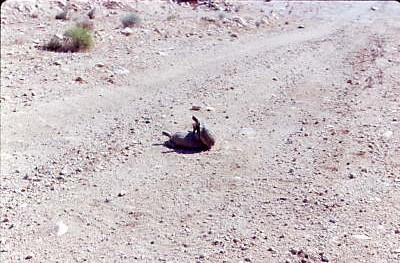
When we arrived at Cima Hill, we saw a pair of desert tortoises mating.
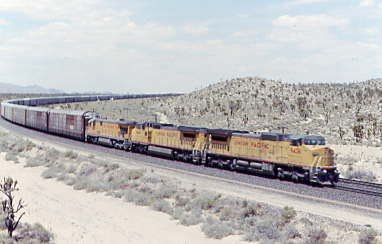
A westbound freight.
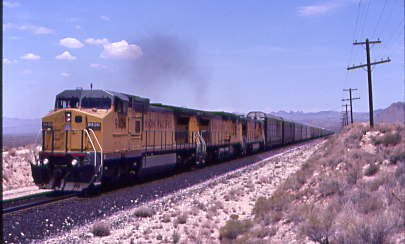
Later we caught a second westbound then camped out at Hole in the Rock in Mitchell Caverns State Park for the night.
5/15/1994 The next morning, we photographed several Union Pacific freights and the westbound Desert Wind before the steam train arrived.
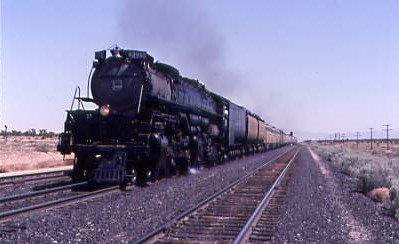
Bill and I started our chase proceeding down Cima Hill to Elora.
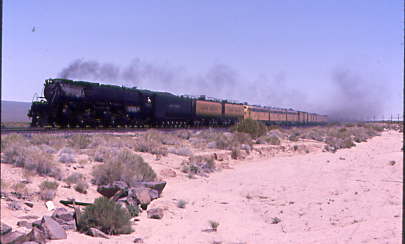
Back on the move again, we managed to get ahead of the excursion train to Hayden.
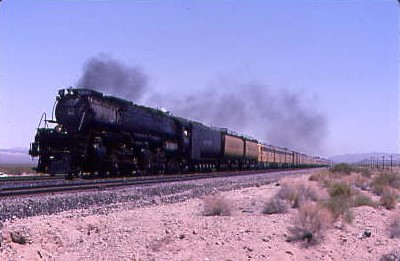
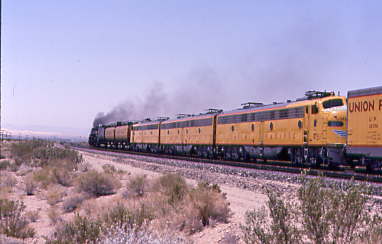
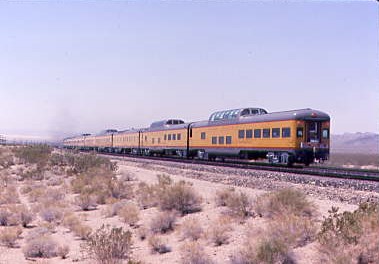
We followed Union Pacific 3985 to Kelso, where the steam engine would take water, allowing Bill and I to return to Interstate 15, taking it to Afton Road and the west end of Afton Canyon.
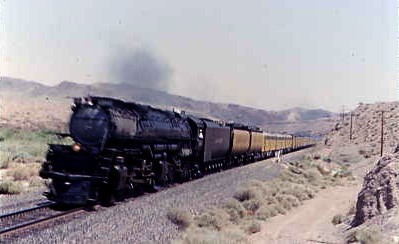
After a wait, the train rolled through then we caught it at Dunn as it had slowed for an eastbound stack train, and later crossing the Mojave River after Yermo.
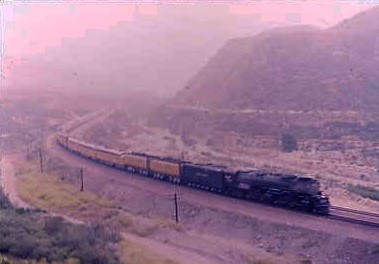
From there, we high-tailed it to Cajon Pass and climbed above Blu Cut on the Forest Service Road for our last picture of the day in the haze.
Union Pacific 3985 Trip 1 Ontario to Barstow 5/21/1994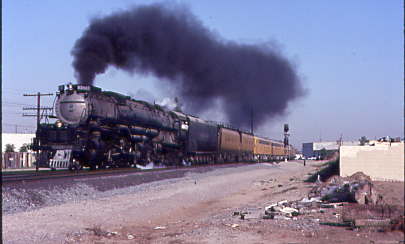
Six days later found me in east Ontario, catching Union Pacific 3985 travelling from its storage area in Montclair to its passenger pick-up point at the East Ontario Metrolink station.
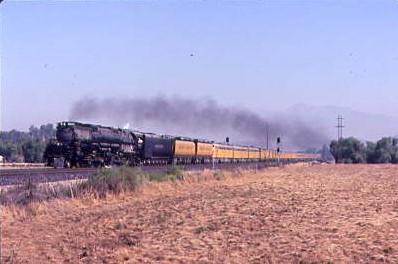
I drove to Pedley and found a dead-end road that led to the tracks just west of Pedley station.
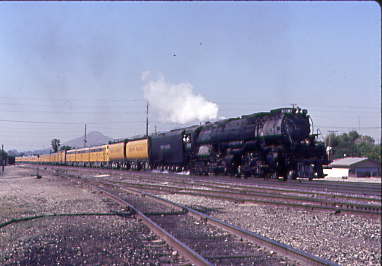
A red signal that delayed the train in Riverside allowed me to get back ahead of Union Pacific 3985 to Colton Crossing, after which I drove Interstate 215, exiting at Interstate 15 and taking that to California Highway 138, then the US Forestry Road back into Sullivan's Curve.
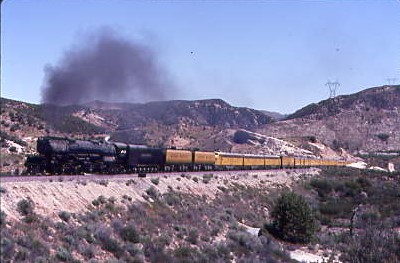
Union Pacific 3985 came up the grade and once it passed, I returned to Santa Ana very satisfied.
Union Pacific 3985 Trip 2 Ontario to Barstow 5/22/1994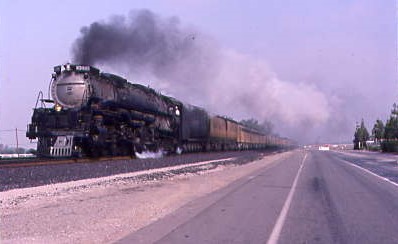
On this day, my friend Jeff Hartmann joined me and we went to Ontario and found a road along the south side of the airport for the shuttle move to East Ontario.
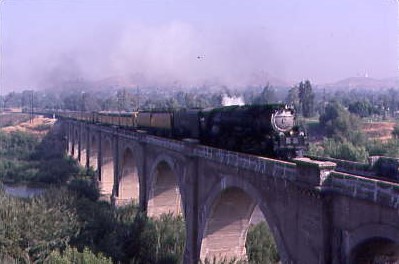
Crossing the Santa Ana River bridge.
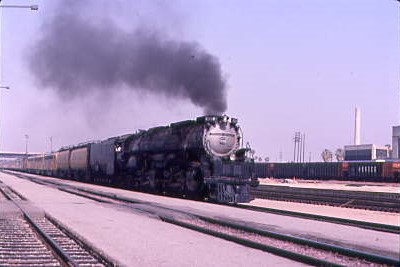
Returning to Interstate 215 to San Bernardino, we caught Union Pacific 3985 in front of the station.
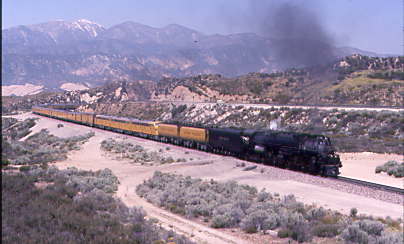
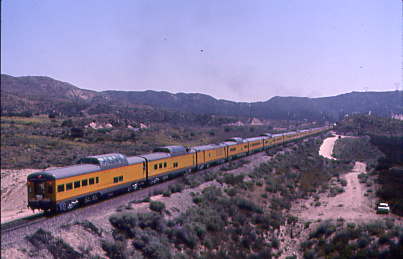
From there, we proceeded to Cajon Pass and one of my favourite photographic location. Once Union Pacific 3985 went through on its eastbound journey, we returned to Santa Ana.
Union Pacific 3985 Ontario to Las Vegas 5/24/1994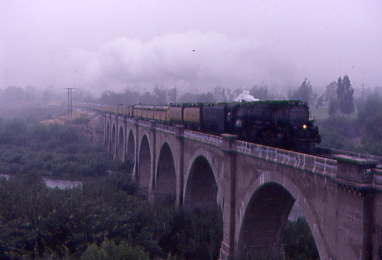
I went straight to the Santa Ana River bridge again.
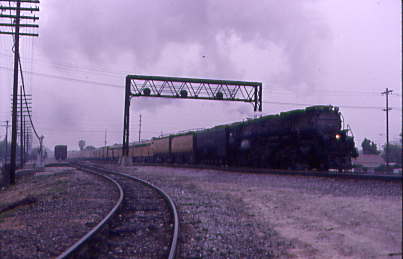
It was then over to Colton on this very cloudy day and I returned home a very happy photographer.
| RETURN TO THE MAIN PAGE |