



The inaugural trip of the first Transcontinental Sunset Limited eastbound out of Los Angeles was to occur on April 4th. Amtrak assumed operation of most inter-city passenger routes on May 1, 1971, including those of the Southern Pacific. Amtrak retained the Sunset Limited and initially left its route unchanged but on October 2, 1981, Amtrak began operating the Chicago-bound Eagle (known as the Texas Eagle since 1988) in conjunction with the Sunset Limited and routes operate as one train between Los Angeles and San Antonio, Texas.
The Louisville and Nashville Railroad had operated the Gulf Wind between New Orleans and Jacksonville, Florida from 1949 to 1971, when Amtrak dropped the route. This corridor saw limited service over the next two decades: in 1984–1985, the Gulf Coast Limited ran between New Orleans and Mobile, Alabama, and from 1989 to 1995, the Gulf Breeze served the segment from Mobile to Atmore, Alabama. Now, Amtrak extended the Sunset Limited eastward to Miami and would follow the former route of the Gulf Wind between New Orleans and Jacksonville, restoring service on that corridor, and would use the route of Amtrak's Silver Meteor south of Jacksonville. It was to be serviced at Amtrak's Hialeah yards for the return trip and was only the second direct rail link between Orlando and Miami, following local trains by the Atlantic Coast Line and Seaboard Coast Line in the mid-1960s.
I talked my friend Bill Compton into joining me and he also wanted to go to Kansas City to photograph trains and attend a baseball game at Kauffman Stadium since he had a goal to attend a game in every major league ballpark. I always wanted to see a game there because of its fountains and the fact that Anaheim Stadium, where the California Angels play, was designed by the same person. That was the goal of the trip but my drinking behaviour nearly destroyed a friendship as well as my transcontinental goal.
San Diegan 583 4/4/1993We departed Santa Ana on time on my usual San Diegan for Los Angeles and I had a drink on the train since I had a practice of having one drink on every train on which I travel. It was a quick journey we went down into Los Angeles Union Station to wait to board our Friday night Sunset Limited.
The Sunset Limited 2 4/4/1993We boarded and chose the second set of seats behind the bulkhead by the stairs then after an on-time departure, tickets were taken and I went off to the lounge car for a couple more nightcaps. I watched the train pass out of the Los Angeles Basin on its usual route down the middle of Interstate 10 and Bill joined me on the climb over Beaumont Hill as we watched the night-time scenery go by before calling it a night as the Sunset Limited proceeded east.
4/5/93 Saturday morning arrived with the train nearing Phoenix and I detrained to stretch my legs and enjoy the morning air. Reboarding, I was off to the lounge car and rode there until Tucson, watching the Saguaro Cacti stand guard along the tracks. At Tucson, I stepped off for more fresh air then returned to the lounge car then leaving Tucson, there is a grade so our train took the lower track following the wash before we crossed under the westbound line. The train was making good progress and after Benson, I had a couple more drinks then we continued our eastward journey while I enjoyed the climb over the Dragoon Mountains and our trip across the Wilcox Playa. The train sped through Bowie and near San Simeon, I bought my usual hot dog lunch with chips and a soda. We entered New Mexico and as was my custom, I drank across each state line then we stopped in Lordsburg and Deming and made a beeline straight for Texas then with our arrival in El Paso, I stepped off for some air. With the crew change and the inspection of the train completed, we made our way into the western part of the state and I called it a night.
4/6/1993 Sunday morning started with a hangover and I went to the lounge car and bought an orange juice then went upstairs to watch the Texas scenery pass, running two hours late at this point. Houston came into view and I had a beer when we pulled into the station then detrained for some fresh air and watched a private car being added to the rear. Upon our departure, we travelled for about half an hour before we stopping and it turned out that a freight train in front of us had hit a car and killed the passengers and their train could not move until the coroner released it. Needless to say, we sat for two more hours and I downed three more beers then we finally started moving and after a stop in Beaumont, crossed the Sabrine River leaving Texas behind for the first of my new states on this trip, Louisiana. Bill came into the lounge car, saw me and realized I was completely out of it and the attendant refused to serve me.
Much later I came to feeling very sick to my stomach and disoriented. I tried to stumble to the bathroom but did not make it in time and was not in a good way. Bill was told by the conductor that he was thinking about throwing me off the train in New Orleans so Bill took me back to the bathroom and tried to talk sense but I did not listen so he returned with a clean shirt from my suitcase and I went back up to my seat knowing what was about to happen.
New Orleans 4/6-10/1993The Sunset Limited arrived where two Amtrak police officers boarded to escort me off the train. At first they were going to remove Bill too, but he convinced them he was sober and I could take care of myself when I sobered up. Bill asked them if they could get me a taxi to the nearest hotel and they agreed and he asked me for his ticket back from Hollywood, Florida to New Orleans, which I gave him, then the four of us walked off the train through the station where they put me in a taxi cab and the driver drove me to the nearest hotel, which wanted nothing to do with me as it was the NCAA Final Four weekend. I did not know what to do but the bell boy came up to me wondering what was wrong and I told him my sad tale, to which he replied that he was once in a similar situation, so he offered to call around for a room. He made one call and told me there was a room at the Le Meridian waiting for me, but it would cost me a $156 a night. The taxi driver came in and I told him the new plan and he drove me to the Le Meridian and as we approached, out rushed a bell boy who took my bag and escorted me to the front desk. I introduced myself and they knew of my arrival so checked me in for a three-night stay, then a bellhop took me to my room and I excused myself for the evening, needing to sleep to recover from my drunkenness and my stupidity.
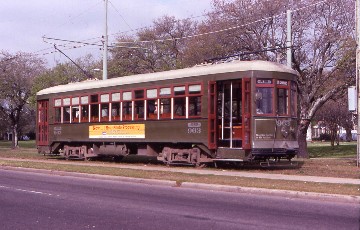
I awoke the next morning realizing where I was at, what I had done and wondering how I could change things. I needed to talk to someone so called a Lutheran church and asked to speak with a pastor and was told he would he would be at my room in about half an hour so I freshened up then we chatted for about twenty-five minutes. Our conversation ended with him stating that I clearly saw the mistake I made, to plan a change and go and enjoy New Orleans. I thanked him for his words and time before I resumed quiet contemplation. It was quiet but I was hearing bells, almost like trolley bells so went outside to investigate and around the corner on the next street was the St. Charles Streetcar Line, so I rode to the end and the motorman told me about the Riverfront Streetcar Line and sold me a day pass so I could ride both as often as I wanted.
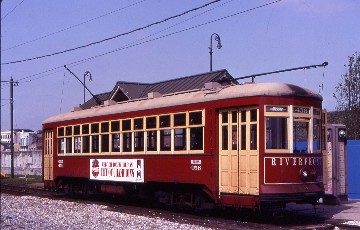
The Riverfront Streetcar Line opened on August 14, 1988, becoming the first new streetcar line in New Orleans since 1926. To equip the line, the Regional Transit Authority re-purchased and refurbished two former Perley Thomas streetcars, originally retired from the Canal line in 1964. That led me to discover the Aquarium and the Riverwalk with the shops along the Mississippi River and I was really enjoying the sunny weather on this surprise visit. On my walk back to the hotel, I witnessed Final Four madness with fans selling T-shirts and other souvenirs in support of their favourite teams. Tickets for the final game on the streets were cheap, since the people whose schools lost in the semifinals did not want to go see the team that beat their school, and I almost bought one but watched the final game in my room and just relaxed.
4/10/1993 Checking out that final morning, the Le Meridian staff thanked me for coming and all hoped I would return soon. The ironic thing is that I would have never experienced New Orleans at all had it not been for my bad behaviour. I went back to Union Station and waited for Bill to arrive on the Sunset Limited and he detrained and I flagged him down but could see he was very upset and we talked like two strangers who hardly knew each other, rather than friends. He told me about his trip to and from Hollywood with the eastbound train arriving very late and he had to walk to the Howard Johnson after 11:00 PM in a bad neighbourhood, then spent the next morning at the Hollywood Amtrak station watching TRI-Rail trains pass before the westbound Sunset arrived and sat in the exact two seats we had shared going east. He then left his luggage with me while he went to have a meal and returning, we sat quietly waiting to board.
The City of New Orleans/River Cities 58/358 4/10/1993This train was going to not only get us to Kansas City but would its entire route was new mileage. We boarded the last car, a heritage low-level coach which would be cut off at Carbondale, Illinois and run as a one-car train to St. Louis before being added to the Kansas City Mule for the rest of the journey to Kansas City. This coach was full as Kansas State University was one of the teams in the Final Four. The City of New Orleans is a low-level train with an Amdinette serving tray meals, a lounge car and three Amfleet cars with two dome cars in front of our coach. Behind the locomotives were a baggage car and two sleepers.
We departed on time and the conductor walked through collecting tickets and I went up into the dome to the front seat on the right. Looking out to the right, I saw the City of the Dead, the large above-ground open cemetery then once past the airport, we proceeded along Lake Pontchartrain with people out on the lake on this spring day and we crossed the north end of the lake before speeding to our first stop at Hammond. The tracks we were on were those of the famous Illinois Central, which operated the legendary City of New Orleans and Panama Limited. The line used to be double track from Chicago to New Orleans, but a cost-cutting measure by the Illinois Central resulted in the single- tracking of most of the main line; this was once a racetrack until the automatic train stop speeds were lowered.
Travelling north, we passed through forest, crossed many streams and a few fields since this is the lowland area adjacent to the Mississippi River which was off to the west by about sixty miles. Once in Mississippi, our first stop was McComb, so I could cross that state off my list of states to visit and noticed that McComb, Brookhaven and Hazlehurst all had very nice depots. The dome seat gave me advance views of upcoming signals and I took a short break to go to the lounge car to get dinner and returned to my dome seat with the meal in a box just in time to watch a southbound Illinois Central freight train pass on the left. Nearing Jackson, the sun was setting with the sky taking on a whitish gray texture caused by mid-level clouds and our next station stop was Jackson, the state capital, where we switched train crews. In the last light of day, we made our way out of town back into the forest and by the fields of Mississippi and stopped at Canton and Grenada.
The top of the dome was dark and provided a good view of passing homes and industries along the line which were all lit up. The signals were green before the train arrived then turned red as it passed, only to be proceeding toward another distant green signal. Travelling on jointed rail with the rocking motion and clicking sound was a perfect way to travel through the night, especially in a dome car and with Amtrak planning to make this a Superliner train in the near future, I was glad I was riding now. Since Jackson, we had been on Illinois Central's passenger line so had it all to ourselves, since their freight trains take the line that runs through Yazoo City between Jackson and Memphis. Illinois Central wanted to downgrade the line on which we were riding and if Amtrak paid for its upkeep, the train would continue to travel this route via Canton but I believe the train will be rerouted through Yazoo City in the near future, saving Amtrak that expense.
The evening moved right along and I was thoroughly enjoying my dome car experience as I watched the lights of Memphis come into view. Since I was now in Tennessee, that made the third new train-riding state of the trip since I had never been to Louisiana and Mississippi before. We arrived at the station on schedule and the train was serviced for fifteen minutes which gave me an opportunity to study the Memphis skyline and the view looking towards the Mississippi River. The area near the river had been redeveloped from factories and warehouses into hotels and other new developments and there were many neon lights.
Leaving Memphis on time, I watched the city's lights fade into the darkness of the country from the back of the dome as I continued my gazing. While I was tired, I was determined to make it through Kentucky and across the Ohio River into Illinois. The countryside had become hilly as we made our way to the state line and entered Kentucky, making our lone stop in the state at Fulton, where the streets were empty due to the lateness of the hour. With a few more miles, we crossed the Ohio River and passed through Cairo, Illinois, which I visited in 1971 after it was torn apart by race riots, although it did not seem much different to me on this night and with that thought, I returned to the darkened coach for some sleep.
The River Cities 358 4/11/1993At Carbondale, I was awoken by the sound of the train's uncoupling and the last car was dropped off the City of New Orleans and within minutes, a locomotive was attached and we were now the one-car River Cities and would remain this way until St. Louis. We left Carbondale ahead of the City of New Orleans then while we were stopped at Centralia waiting for a Norfolk Southern freight train to pass, the City of New Orleans flew by on it is way to Chicago. Leaving Centralia, I fell back asleep and stayed in that state only as far as Bellevue, where we stopped then descended onto the Mississippi River floodplain and slowly negotiated the maze of tracks which led us through the rail yards of East St. Louis.
I arose and walked the length of our one-car train and stood out on the rear vestibule platform. This would be most likely the only time I ride a one-car Amtrak train, but this route did give me new mileage over the former Southern Railway line. We proceeded up the grade to cross the Mississippi River and I had my first glimpse of the St. Louis skyline with the river, the Gateway Arch and downtown St. Louis; a most impressive sight. We were high above the Mississippi River when we crossed into Missouri then the train moved slowly downgrade, passing through several railroad junctions, glided past Busch Stadium, home of the St. Louis Cardinals, before arriving in front of something which resembles an elongated trailer with a sign reading "Welcome to St. Louis! Thanks for riding Amtrak."
Our one-car train trip was over as the locomotive cut off to retrieve four more cars and we now become the Kansas City Mule, with our car piggybacking to Kansas City. I detrained, bought a newspaper and looked around the very small station before reboarding for the journey west.
The Kansas City Mule 301 4/11/1993Departing St. Louis on time, within minutes we passed the former train sheds of St. Louis Union Station, which used to be a beehive of activity with the many passenger trains that called there since St Louis was the second most important railroad city in the country after Chicago, and was a major crossroads of the Midwest. The station's train shed was the largest in the world but only the north end is used nowadays and it is a hotel complex along with a small railroad museum.
We followed the almost-completed Metro Link Light Rail line before starting upgrade to leave the Mississippi River floodplain and near the top of the bluff was the elegant station at Kirkwood. About five miles west was the National Museum of Transportation and some of its collection could be seen to the right. We then proceeded through the hills and forests of eastern Missouri passing the occasional Union Pacific freight train as we made our way towards Kansas City. The next stop was in Hermann where two passengers detrained then we ran along the Missouri River beneath the bluff on the left of the train. This was my first time along the Missouri River on a train and it was not what I had thought it would since I saw the mighty Mississippi River and thought the Missouri River would be as grand.
As we paralleled it, birds flew out of the right-of-way from adjoining trees and we slowed for our next stop and I saw the capitol building of the State of Missouri at Jefferson City. When the Missouri Territory was organized in 1812, St. Louis was Missouri's seat of government for the territorial governor and territorial legislature. Later St. Charles would serve as the next capital town of the old Territory. However, Jefferson City was chosen as the new state capital in 1821, after Missouri was admitted to the Union as the 24th State. Leaving Jefferson City, we ran along the Missouri River for a few more miles before the river swung off on a more northerly trek and we were passing fields and farms. This was only my third trip to Missouri, having passed though the southern part of the state in the family camper in 1971 and across the northern part of the state at night on the Southwest Chief. This area was relatively flat in comparison to my camper memories of the rolling Ozarks so our train just zipped right along.
To the south, I saw the weed-grown tracks of the former Rock Island line, a railroad which once ran the Rockets is now just a memory, but one which will always have a fond spot in my heart. Near Sedalia, another station stop and the Union Pacific line, on which we had been riding, split from with the main freight line following the Missouri River to Kansas City, while we take the passenger line which has a grade from Independence to Kansas City. During the remainder of this morning's trip we stopped at Warrensburg, Lee's Summit and Independence and each town looked most interesting and I suddenly thought about small-town America and John Cougar Mellencamp's songs were echoing through my head.
Departing Independence, we travelled downgrade to Kansas City and for me, this is where the journey became really interesting as once we reached the river level of the Missouri River, we switched onto the tracks owned by the Kansas City Terminal Railroad, used by the Santa Fe and others then crossed Union Pacific, Kansas City Southern and Burlington Northern tracks all at major railroad junctions. Kansas City is the third largest railroad center in the United States and a very busy place. We passed the industries and neighbourhoods before reaching the Union Station ten minutes early.
Kansas City 4/11-15/1993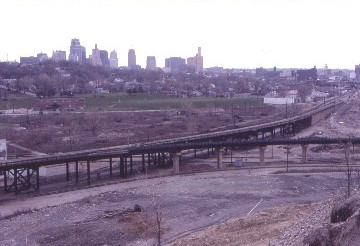
Amtrak uses a small station under a highway bridge in the shadow of the once mighty Kansas City Union. Bill and I arrived and he went to pick up the rental car while I watched the luggage then we made our way south to Grandview, Missouri, where we set up to catch our first train of the day along the Kansas City Southern.
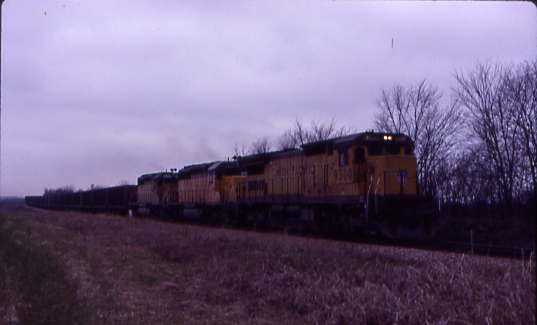
A KCS train with Union Pacific C40-8 9300 on the point.
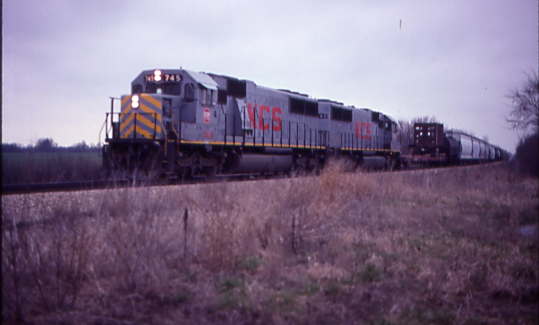
Next we caught Kansas City Southern 745 South at Belton.
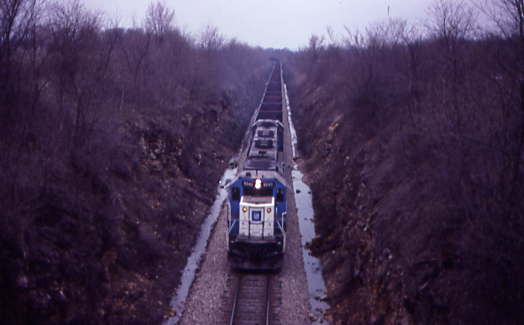
A Kansas City Southern freight led by Oakway SD60 9040 was our next northbound train at Cleveland.
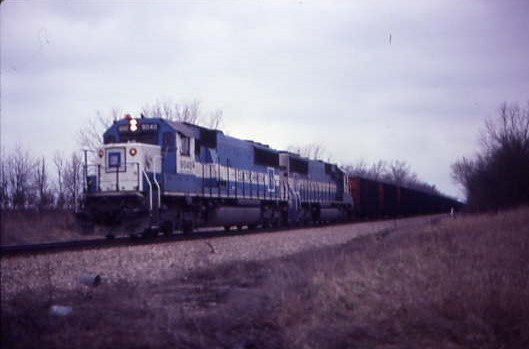
The same as above at Belton. We drove back into Kansas City and saw the Royals play the Minnesota Twins at Royals Stadium and they won 2-1. I really enjoyed the game, the ballpark with the fountains was everything I thought it would be and the children doing the Hokey Pokey between innings was a blast.
4/12/1993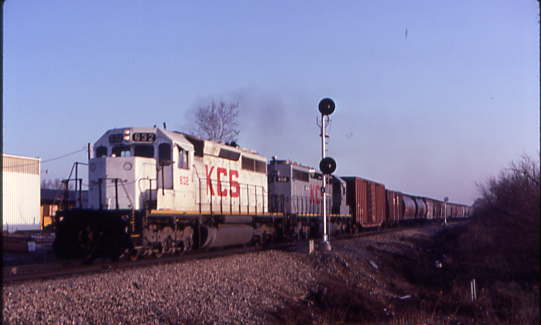
The next day, at Grandview, the first train was Kansas City Southern 632 South, led by an SD40-2. Next we went over to the joint Union Pacific/Southern Pacific, former Rock Island, main line for some action west of Kansas City on this beautiful April morning.
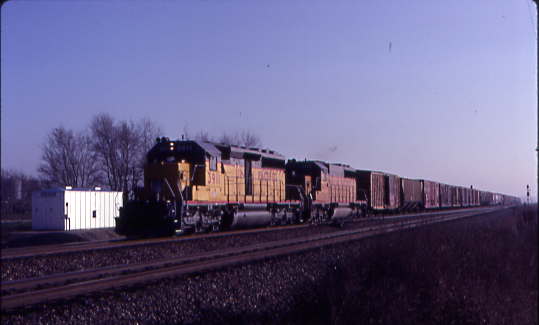
At Loring, Kansas was Union Pacific 3911 West, led by an SD40-2.
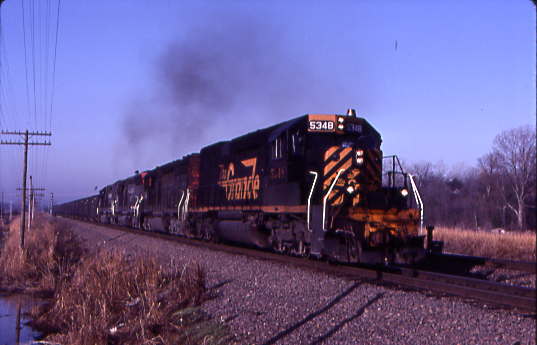
Denver and Rio Grande 5348 East.
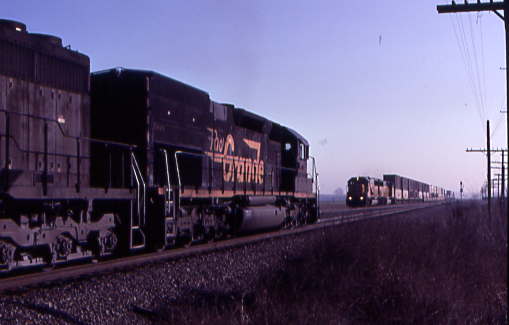
While Denver and Rio Grande 5348 was passing us, a Union Pacific train was fast approaching west.
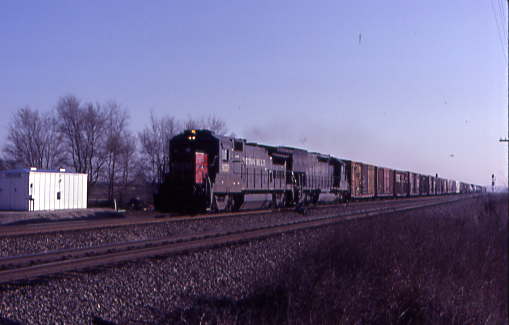
After that stack train came Southern Pacific 8058 West.
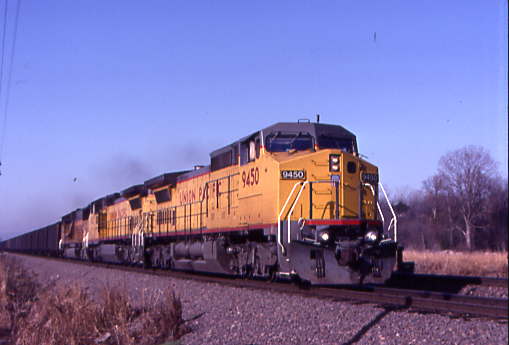
That was followed by Union Pacific 9450 East.
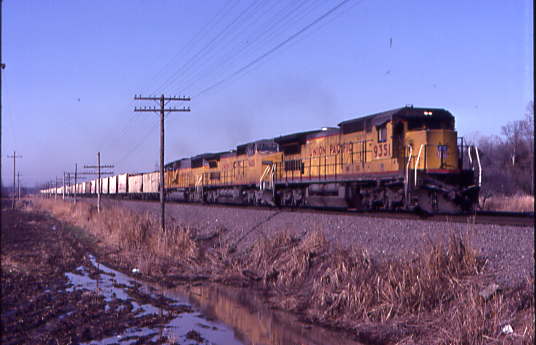
Right behind him was Union Pacific 9351 East.
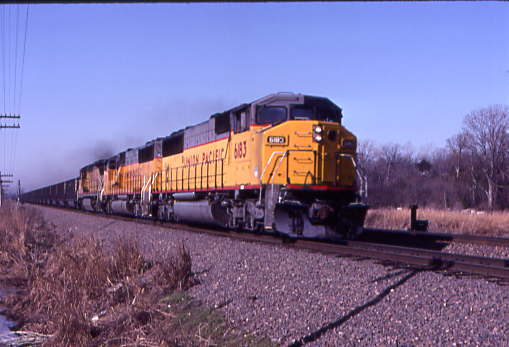
He was followed by Union Pacific 6183 East.
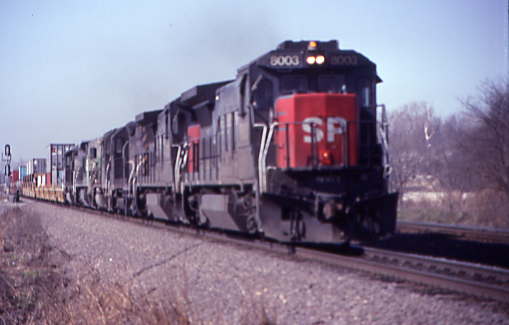
Southern Pacific 8003 East was our last train at Loring, which had produced much of interest. We then relocated to Bonner Springs, Kansas.
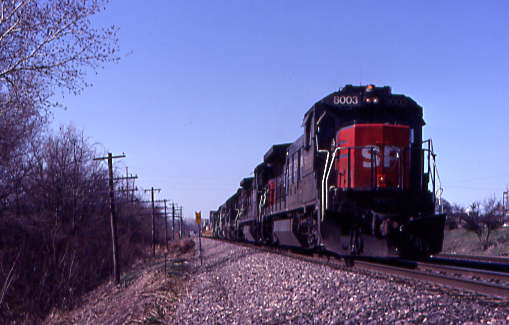
Southern Pacific 8003 East caught up to us here.
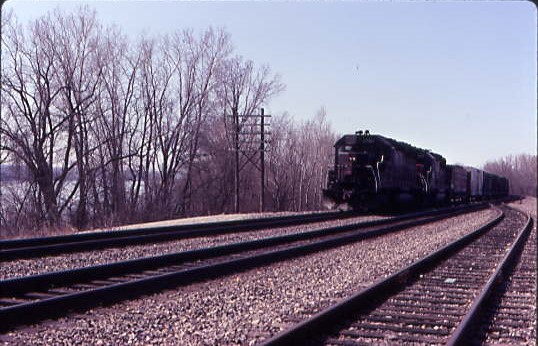
Southern Pacific 7516 East along the Kansas River.
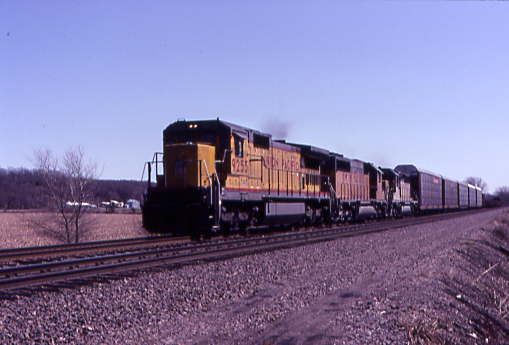
We moved to Lenape, to catch Union Pacific 9255 West.
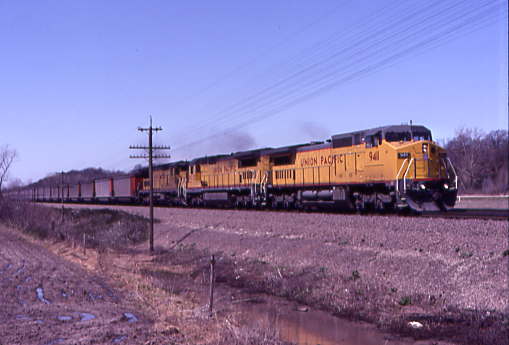
Union Pacific 9411 East. From here we left the Union Pacific for Holliday, Kansas and some Santa Fe action on their main line west of Kansas City.
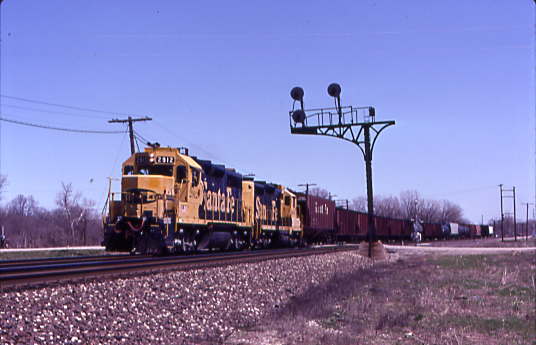
Santa Fe 2912 West.
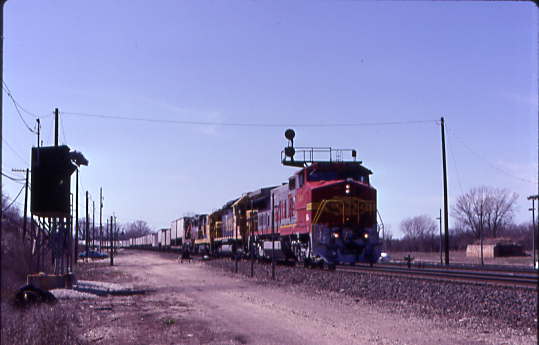
Santa Fe 540 East.
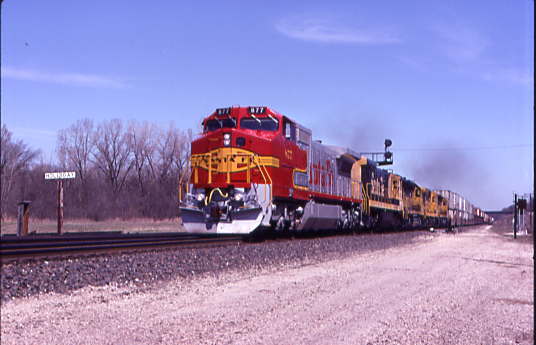
Santa Fe 877 West.
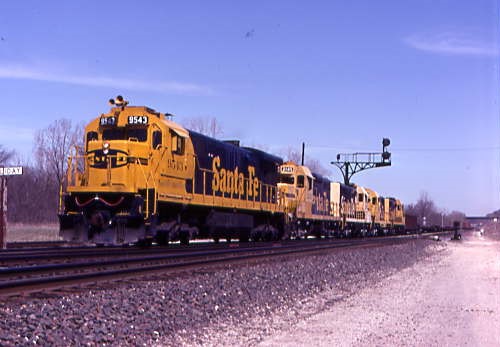
Santa Fe 9543 West. Satisfied, we moved to Olathe for our next train.
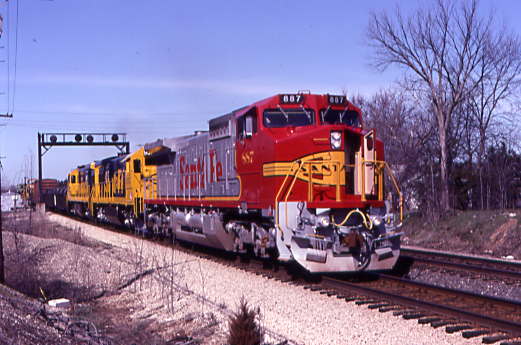
Santa Fe 887 West. Next we went south to Bonita for some Burlington Northern/Union Pacific freight train action on the former Missouri-Kansas-Texas/St. Louis-San Francisco main line.
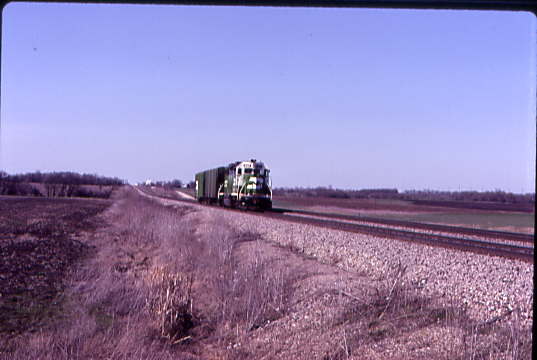
A southbound Burlington Northern local with Burlington Northern GP38AC 2137, nee St. Louis-San Francisco 661, built by Electro-Motive Division in 1971, in the siding there. He was passed by UP (CSX) 8478 North, which we followed to Charlie.
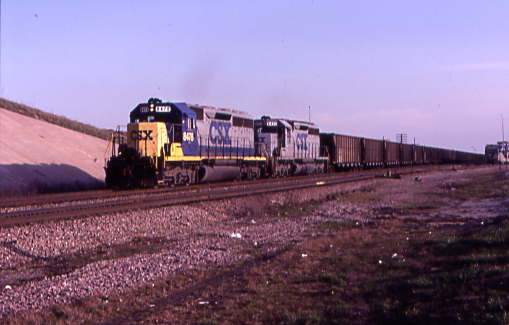
CSX 8478 North at Charlie. After a few more pictures of him, we called it a day.
4/13/1993 The next morning we went to Birmingham, Missouri to the Norfolk Southern/Burlington Northern crossing with the Soo Line/Chicago and North Western, former Rock Island Spine Line.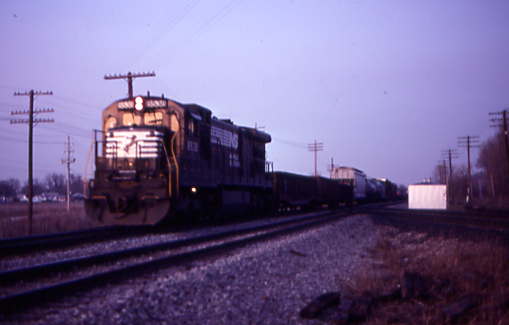
Norfolk Southern 8358 East was our first train of the day after sunrise.
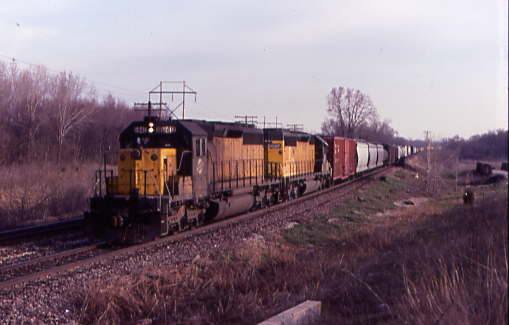
Next was Chicago and North Western 6640 West led by an SD40-2.
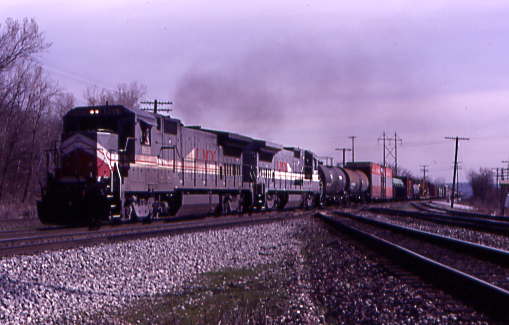
Burlington Northern 8551 West, led by two leased locomotives from Locomotive Management Services, was next.
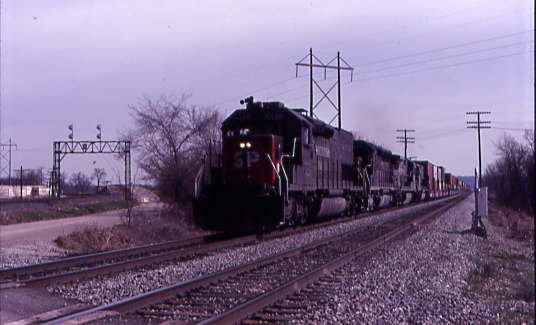
Behind him was Southern Pacific 8530 West.
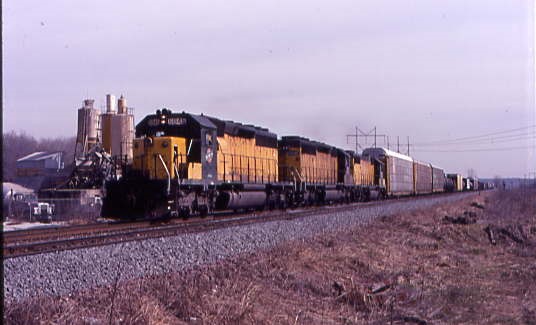
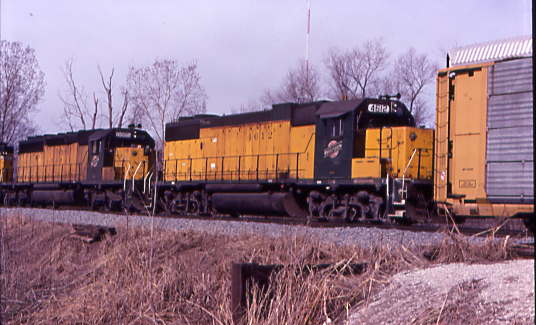
Chicago and North Western 6845 West.
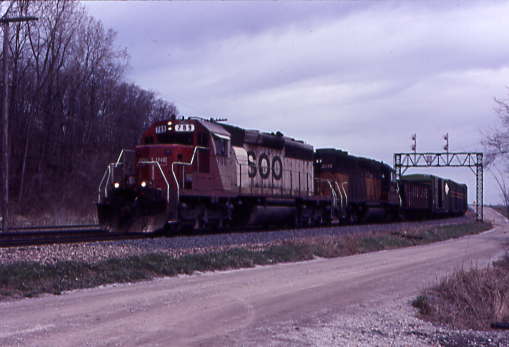
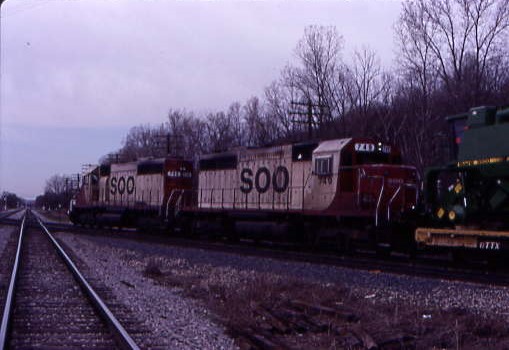
Next came Soo Line 789 West on this busy morning.
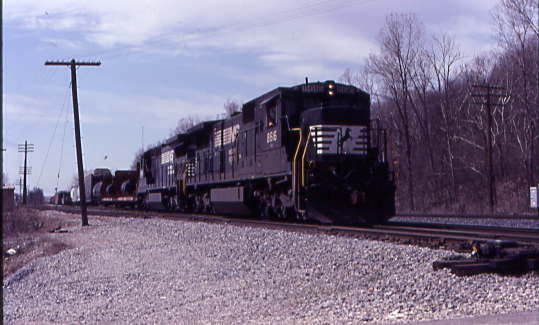
That was followed by Norfolk Southern 8516 East.
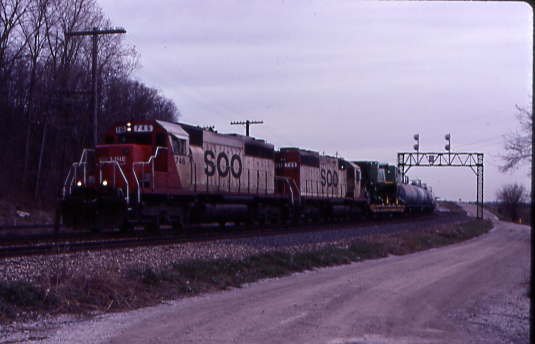
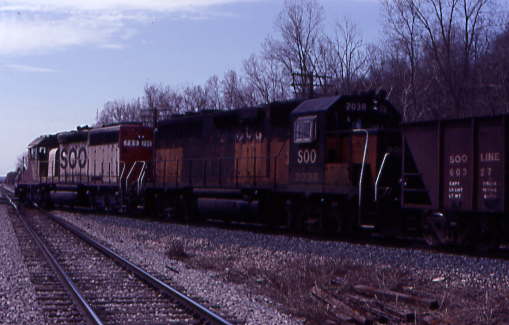
SOO Line 746 West with former Milwaukee Road 'bandit' GP40 2038 in the consist.
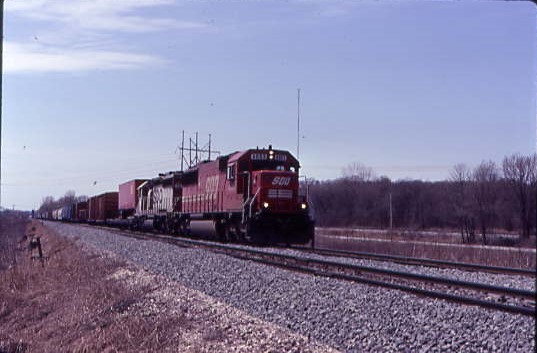
Soo line 6035 East next rolled through Birmingham.
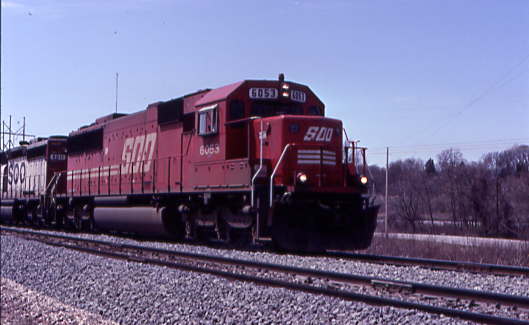
Soo Line SD60 6035 sported a new paint scheme.
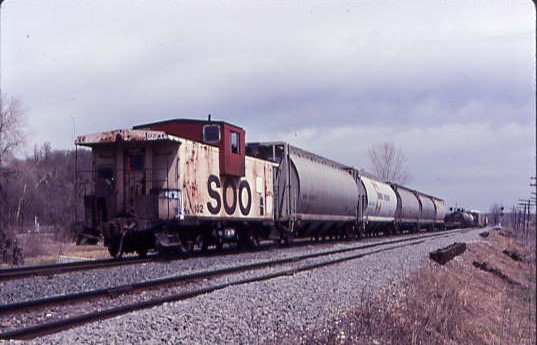
Soo Line 6035 East even had Soo Line caboose 102 bringing up the rear. After that, we followed the Norfolk Southern line east past the junction where the Burlington Northern line for Quincy diverged at Maxwell, Missouri and onto Camden, where the Norfolk Southern joined the Santa Fe main line.
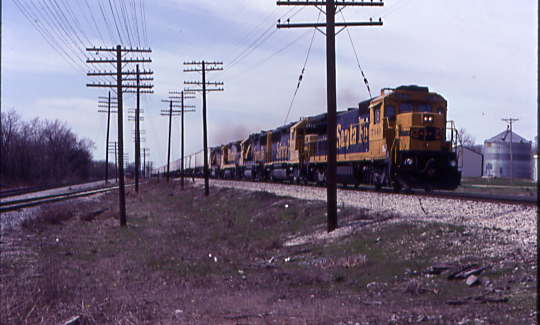
Santa Fe 7440 East through Fleming.
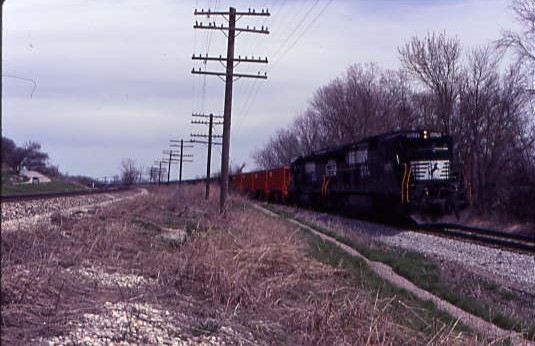
Norfolk Southern 8570 on a ballast train at Camden.
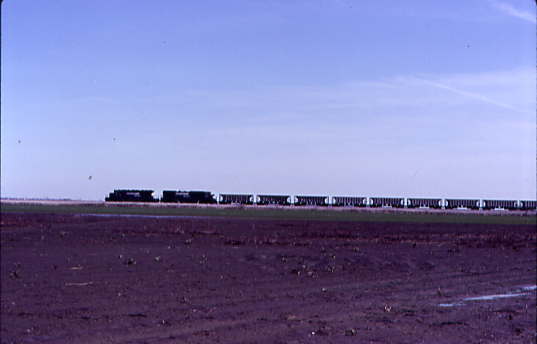
Norfolk Southern 1683 East at Henrietta, Missouri.
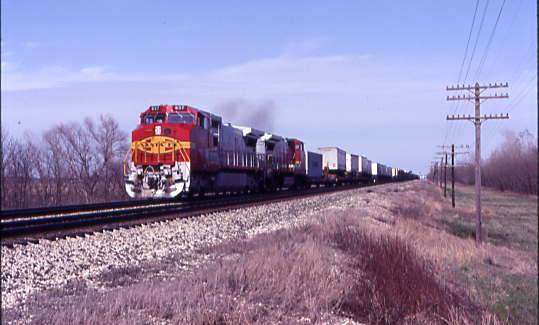
Santa Fe 837 West.
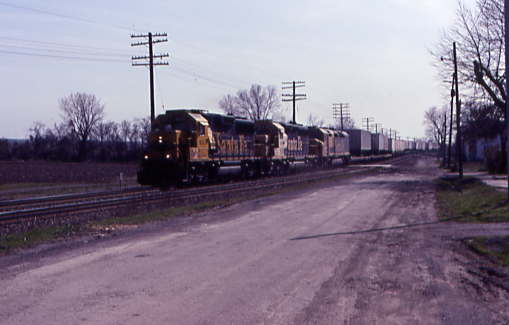
Santa Fe 4025 East at Camden.
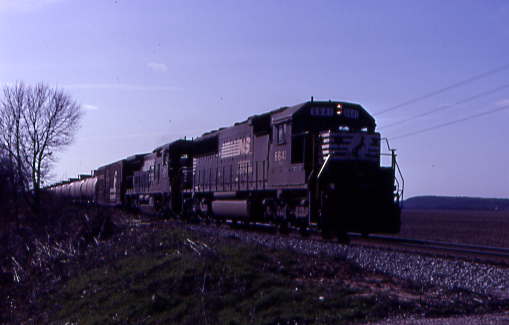
We went back to Orrick, Missouri to catch Norfolk Southern 6641 East.
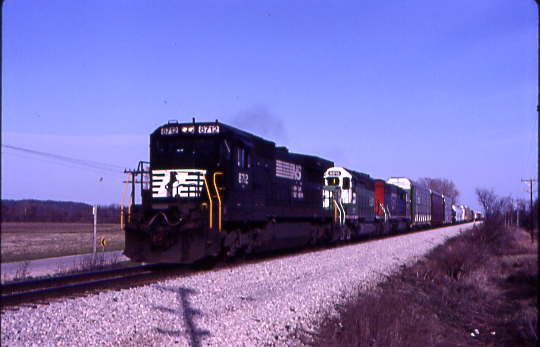
Next came Norfolk Southern 8712 West.
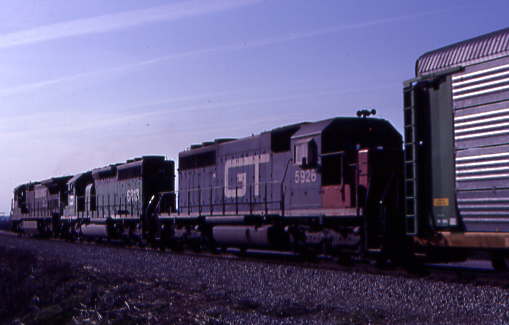
Norfolk Southern 8712 West had two surprises in the form of Burlington Northern 6813 and Grand Trunk Western SD40 5926.
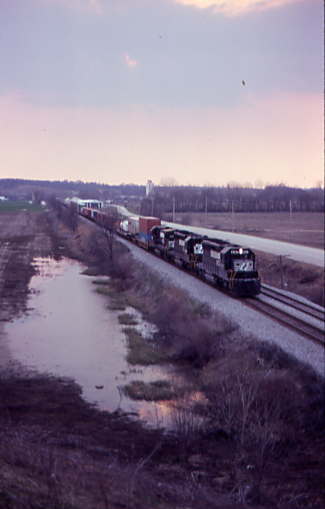
At South Liberty, we caught Norfolk Southern 6187 East.
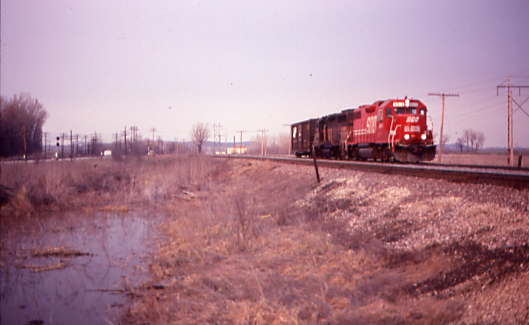
We returned to Birmingham to catch Soo Line 4515 West.
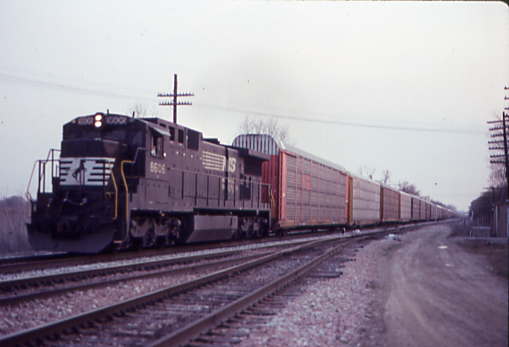
Norfolk Southern 8508 East was the last train of today at Birmingham.
4/14/1993 This morning we started by going north out of Kansas City to the Burlington Northern line that runs to Lincoln, Nebraska, one of BN's main coal lines from the Powder River Basin in Wyoming.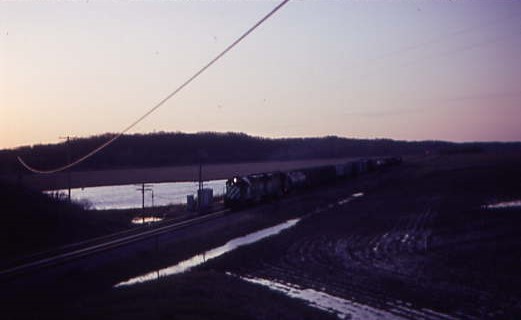
We caught Burlington Northern 2304 West at Rushville, Missouri right before sunrise.
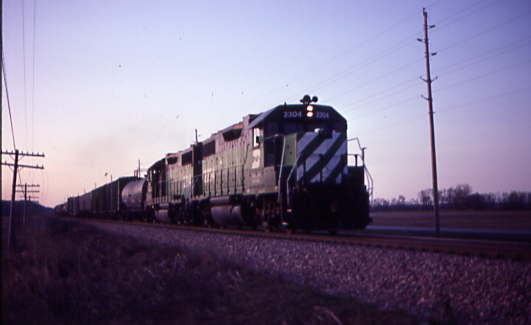
We caught up to that train north of Rushville then crossed the Missouri River to Atchison, Kansas.
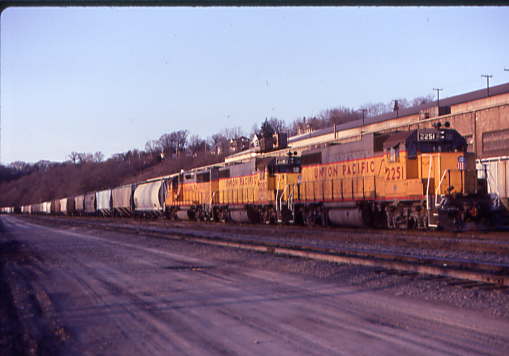
Union Pacific 2251 West, after which we returned to Missouri in our ongoing hunt.
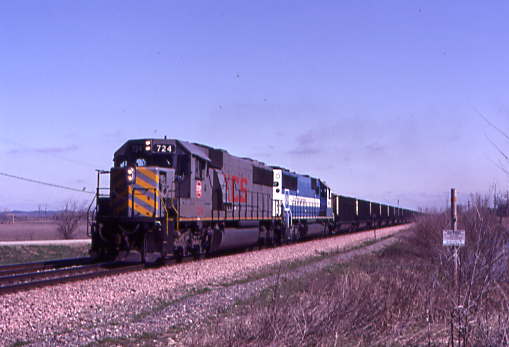
Kansas City Southern 724 East with an Oakway SD60 in second, with a long coal train at Rushville.
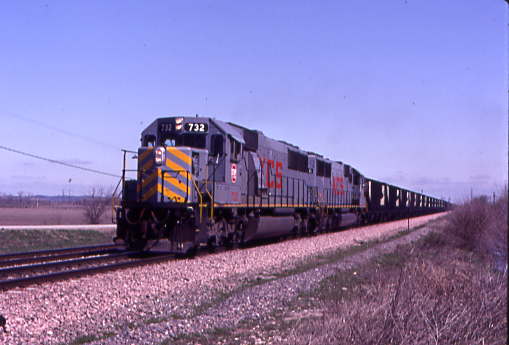
Behind him came Kansas City Southern 732 East and we followed him south.
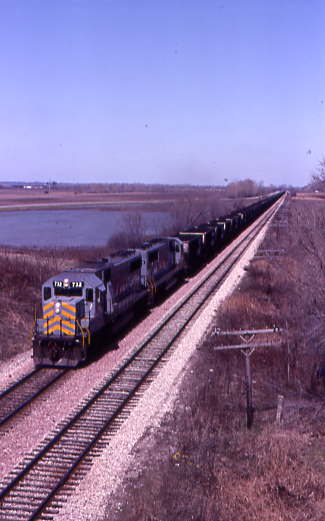
Kansas City Southern 732 East at Iatan, Missouri.
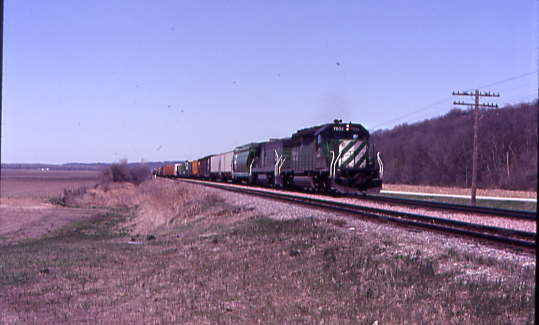
Burlington Northern 7033 East. From here the two of drove southwest of Kansas City for more action on the joint Burlington Northern/Union Pacific line we were at a couple of days ago.
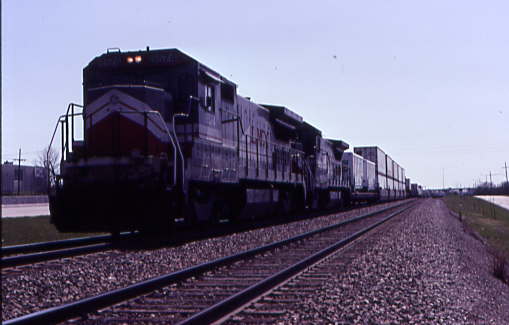
Burlington Northern 8574 West led by Locomotive Management Services 8574 at Lenexa, Kansas.
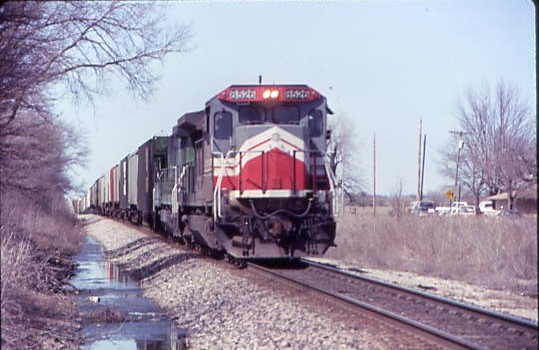
Burlington Northern 8526 East led by Locomotive Management Services 8526 at Bonita.
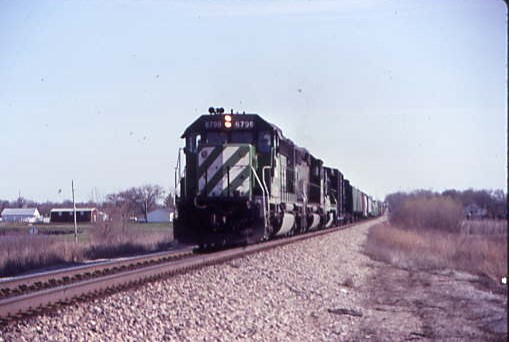
Burlington Northern 6795 West.
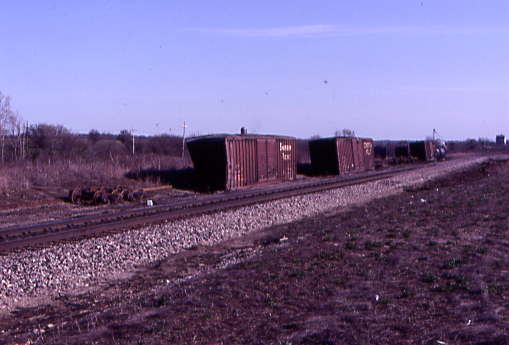
Wrecks happen and here is the remains of one at Springhill.
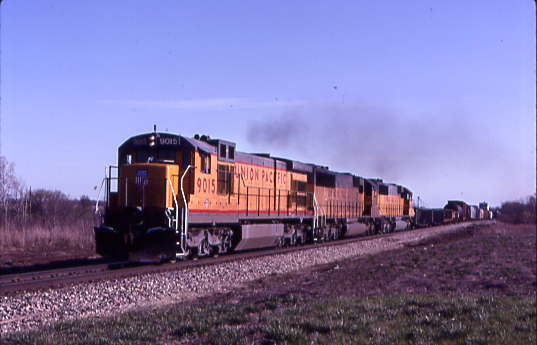
Union Pacific 9015 West.
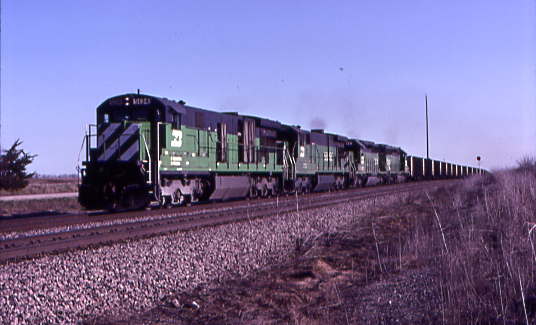
Burlington Northern 5134 West at Bonita.
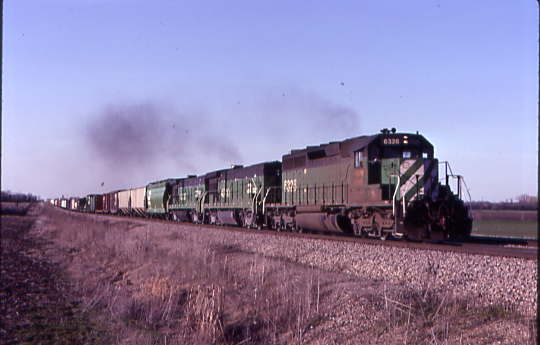
Burlington Northern 6326 East.
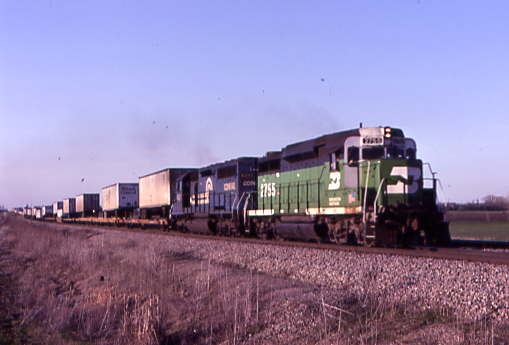
Burlington Northern 2755 East.
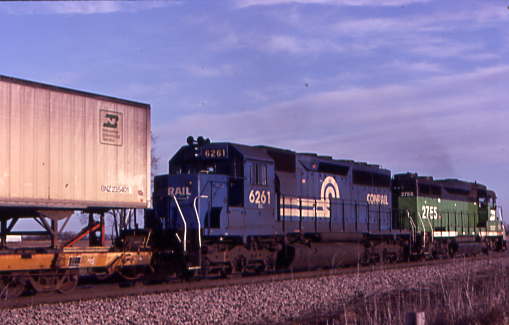
Along for the ride on Burlington Northern 2755 East was Conrail SD40-2 6261.
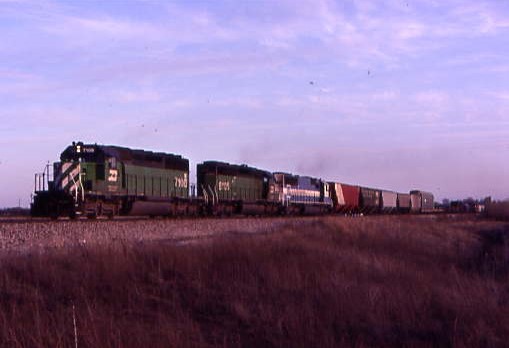
Burlington Northern 7108 West.
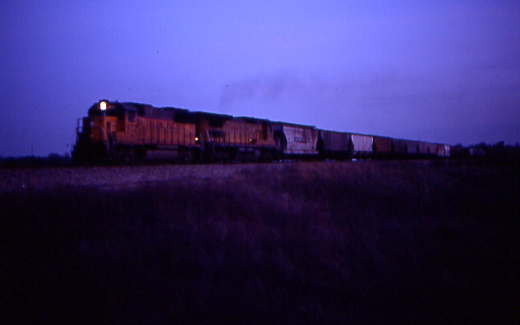
Behind him right after sunset was Union Pacific 972 West, after which we called it a day.
4/15/1993 Our last full day in Kansas City had us stopping at Knoche Yard.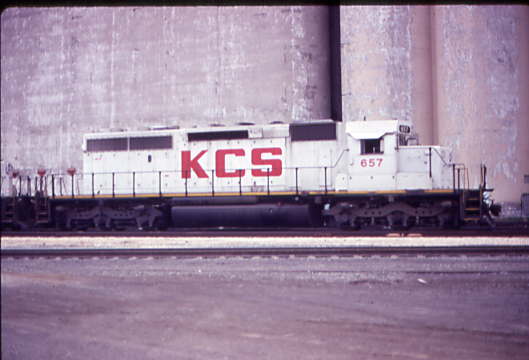
Kansas City Southern SD40-2 657 built by Electro-Motive Division in 1974.
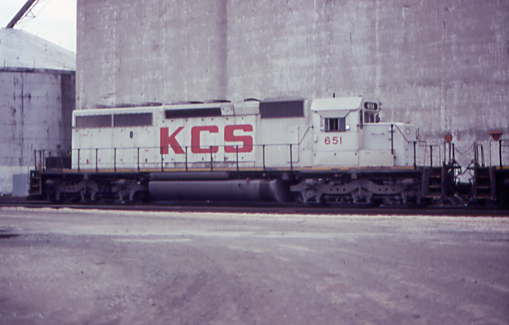
Also here was Kansas City Southern SD40-2 651 built by Electro-Motive Division in 1974. We then moved to Southwest Junction.
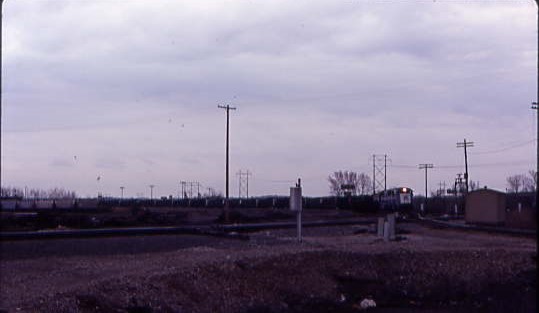
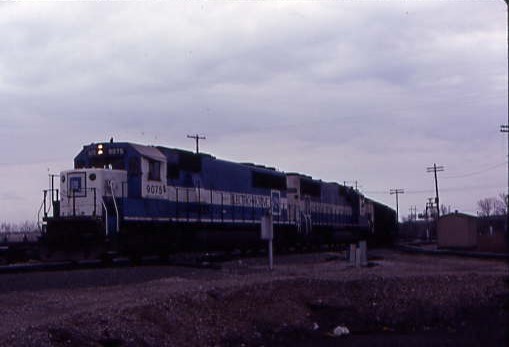
Kansas City Southern 9075 East, led by an Oakway SD60, passed through and we went on a short chase, exiting the freeway at Gregory Boulevard.
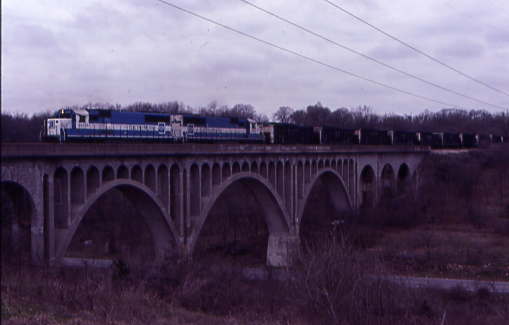
Kansas City Southern 9075 East crossing the Gregory Boulevard viaduct. From here we went to the West Bottoms.
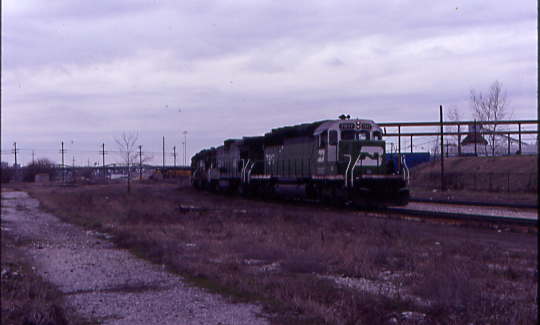
Burlington Northern 7817 east at Chicago Junction.
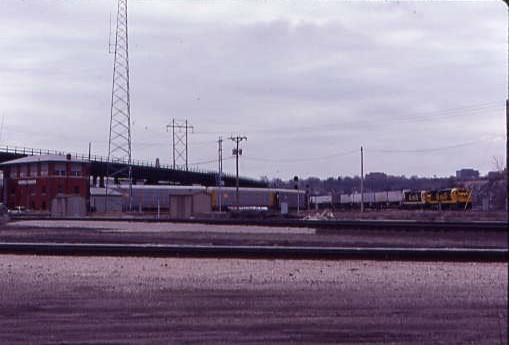
Santa Fe 9542 West at Santa Fe Junction, Kansas.
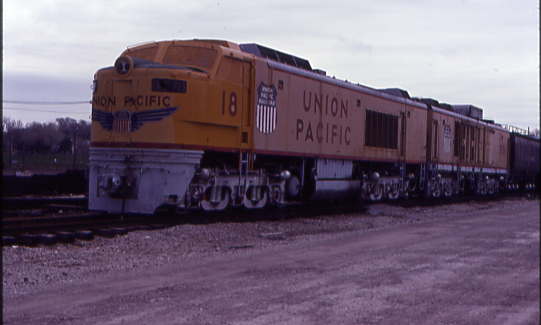
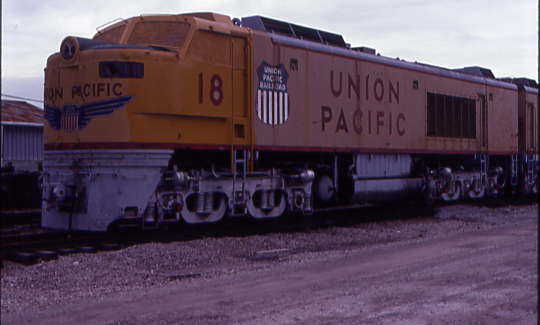
Union Pacific GTE 8500 18A, built by General Electric in 1960. This giant three-unit gas-electric turbine is the most powerful locomotive that ever saw service in the United States. It is one of 30 locomotives of this type and had 8,500 horsepower, more than four times as powerful as typical diesel-electric locomotives of the time and nearly twice as powerful as today’s high-horsepower diesels. It was the 1930s when railroads began looking at turbine-driven locomotives as a way to increase fuel economy. Turbines used at power plants were very efficient, but finding a way to mount a turbine on a locomotive proved problematic. General Electric built a turbine locomotive for the Union Pacific Railroad in 1939 but its complexity made it unreliable and it was deemed a failure. After World War II, the UP revisited the idea. It asked General Electric to build on its experience designing gas turbine airplane engines and construct a gas-powered turbine locomotive.
A prototype built in 1948 was judged successful, so three orders of gas turbines were built between 1952 and 1961. These culminated in the three-unit, 8,500 hp locomotives like UP 18. The turbines were essentially jet engines on rails, and when in operation they sounded like jet airliners. They used fuel at a prodigious rate, though the poor grade of oil that they burned helped offset the cost somewhat. They also used nearly as much fuel at idle as at full throttle, meaning that the railroad had to keep them in constant use while fired up. Over time, as oil prices climbed and reliability problems increased, the turbines fell out of favor with the UP. The railroad ended up retiring them all by 1970, and sold nearly all for scrap.
This was stored in the yard but would be delivered to the Illinois Railway Museum later this year.
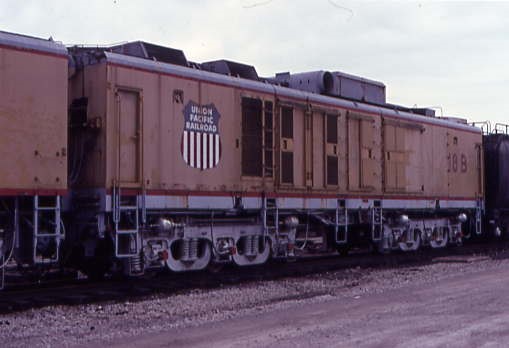
Union Pacific 907853 is the fuel tender, built by American Locomotive Company in 1937, for Union Pacific gas turbine 18. The tender itself was originally built for use with a steam locomotive but was rebuilt in 1957 to be used with one of the UP turbines. At various times in its career it was assigned to turbines 13 and 27 and was put into storage around 1970 and in 1972 as rebuilt as a water car numbered 907853. In this guise it was used in steam excursion service, including use in the Expo 74 steam trip to Spokane in 1974 and a trip behind Southern Pacific 4449 from Birmingham, Alabama to Portland, Oregon in 1977. It was retired in 1984 and acquired by IRM in 1992 to be displayed with Union Pacific 18.
Bill and I drove back into Kansas and went up a hill overlooking Santa Fe Junction.
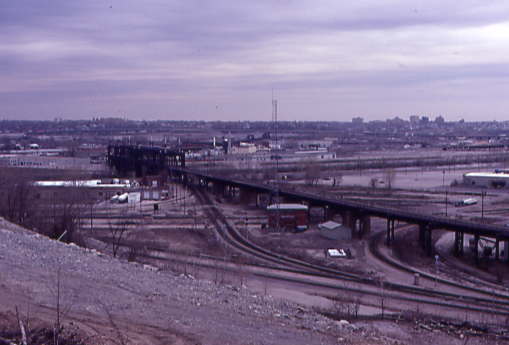
Santa Fe Junction.
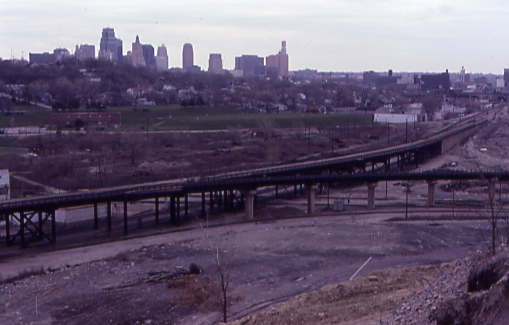
State Line Junction.
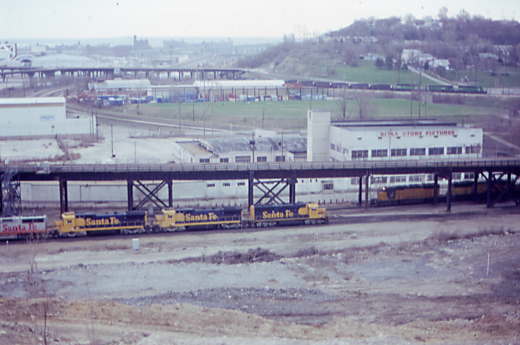
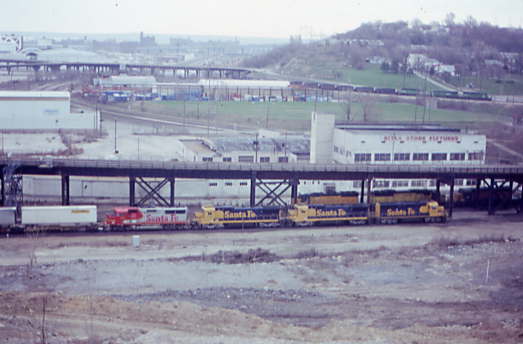
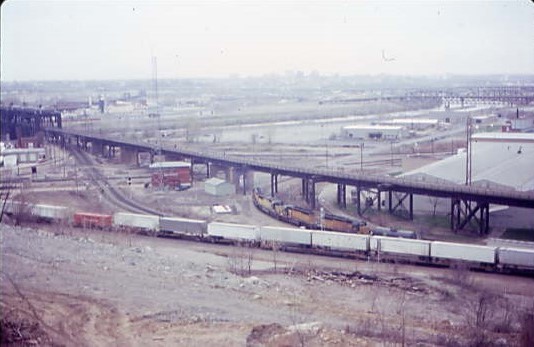
Chicago and North Western 6831 West and Santa Fe 4022 East with a Burlington Northern coal train at State Line Junction. After those trains, we drove over to Bonner Springs as the weather started to turn bad.
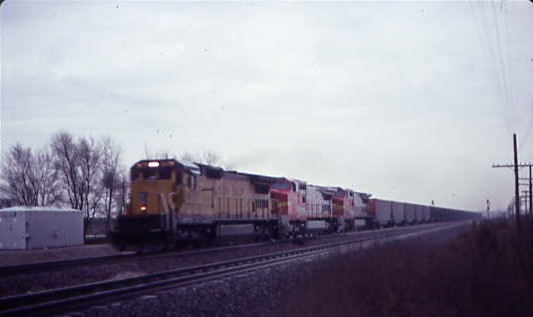
Union Pacific 9177 West at Bonner Springs.
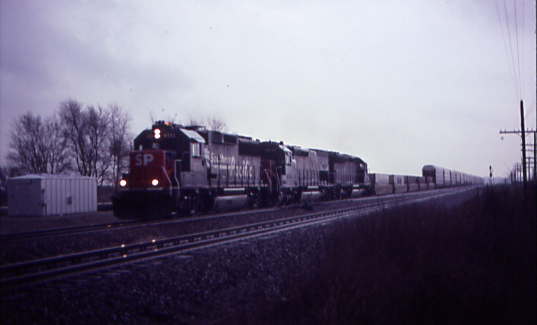
Southern Pacific 9751 West.
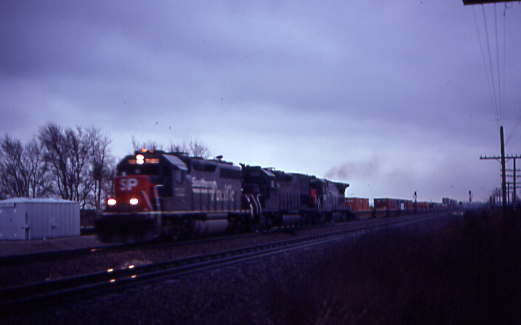
Southern Pacific 7022 West during a downpour. We heard on the scanner that a hailstorm was coming so quickly sought refuge under a bridge and waited out the storm. Bill returned me to Amtrak before he returned the rental car as the storm continued to rage.
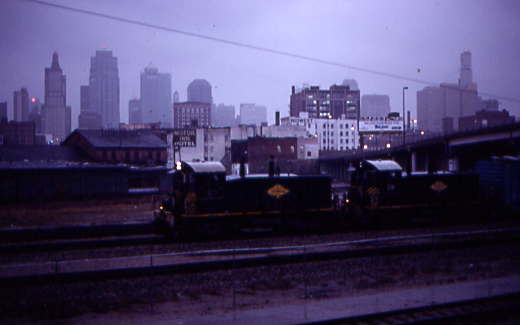
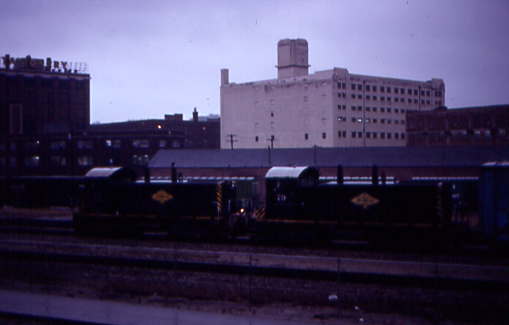
Kansas City Terminal SW1200's passed the Union Station in the heaviest thunderstorm I had experienced which produced great amounts of rain. To end the day, we saw a film at Crowne Centre.
The Southwest Chief 3 4/15/1993We boarded the late Chief at 1:00 AM and I fell right to sleep then awoke as daylight began with us in western Kansas and Dodge City. We sped west, stopping only for moments in Garden City, Kansas and Lamar, Colorado and I sat in the lounge car enjoying the bright sunny morning. La Junta allowed a chance to stretch my legs and a choice of a morning newspaper. We then split the semaphore signals at 90 mph which brought us to the Burlington Northern crossing in Trinidad, the Chief's next stop and upon departure began the most difficult portion of the Southwest Chief's route, the crossing of Raton Pass. We started the climb up the twisting and turning tracks up to the Summit Tunnel and I have always loved Raton Pass because of the steep grade and being able to constantly see both ends of the train. After stopping at Raton, we sped off south to Las Vegas, then over Glorieta Pass, through Apache Canyon and stopped at Lamy. The afternoon skies were darkening as we arrived in Albuquerque to change crews and service the train, then we were off into the sunset and a long night.
4/16/1993 This trip was uneventful as I had a good night's sleep and a sunrise on the east side of Cajon Pass, where I awoke to discover we were an hour-and-a-half late. The trip down the Pass was fast and after a station stop at San Bernardino, it was a quick journey down the Second District for Pomona, Pasadena and Los Angeles. At Los Angeles, we missed San Diegan Train 572, thus missing that connection to home and waited for Train 774 for the quick ride to Santa Ana, where I drove Bill home.
| RETURN TO THE MAIN PAGE |