




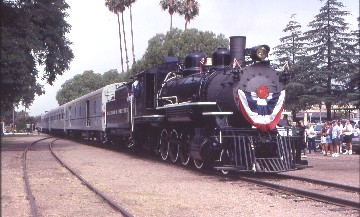
The Fillmore and Western was hosting a Rail Festival over Independence Day weekend and my friend Bruce Fenton and I decided to attend as we had never been here before.
Fillmore and Western Railway HistoryThe Fillmore and Western Railroad is part of a company called Short Line Enterprises which was founded in 1967 and their train equipment has been used in many movies over the years. In 1985, the company moved its operation to the Newhall Ranch to be closer to Hollywood and prospered at that location until 1990 when they lost their track lease. They searched all over Southern California for a new location for their operations and the need for a railroad line to continue doing business. They finally settled on the former Southern Pacific Santa Paula Branch in Ventura County which was ideal as it was located in a rural area and the City of Fillmore was unique in that they had great enthusiasm for the vintage train operation, which led to the redevelopment of the 1920's Central Business District. It was a case where a business and a municipality works hand-in-hand. We need more of this in our world!
The Fillmore and Western Railway is a railroad owned by the Fillmore and Western Railway Company. The company operates on track owned by the Ventura County Transportation Commission. The majority of F&W rolling stock was acquired from three major studios: 20th Century Fox, Paramount, Warner Bros and MGM. The rolling stock and right-of-way are frequently used for the filming of television series, motion pictures and commercials and as a locale for private and commercial still photography. Visitors to Fillmore often see filming activity as well as sets and support equipment at the company's rail yard and along the tracks between Santa Paula and Piru.
The F&W has been used in more than 400 movie, television and commercial shots. Movies shot on the railroad include "Throw Momma from the Train", "Three Amigos", "Seabiscuit", "Get Smart", "Rails & Ties" and "Race to Witch Mountain". Television series "CSI", "NCIS Los Angeles" and "Criminal Minds" have used the railroad for location shooting. The railway also featured in the documentary series "Mystery Diners" as "itself".
The railroad also operates a year-round tourist train and offers numerous special events, including the Railroad Days Festival, the Pumpkinliner, Christmas Tree Trains, the North Pole Express and the Day Out with Thomas. The normal schedule involves weekend excursions, dinner trains, murder mystery trains, barbecue trains and shopping excursions to nearby Santa Paula.
The track is a standard gauge railroad constructed in 1887 by Southern Pacific Railroad through the Santa Clara River Valley in Ventura County, California. This line was originally part of the Southern Pacific's main line between San Francisco and Los Angeles before a shorter route was built through the Santa Susana Mountains in 1904. State Route 126 follows roughly the same route from Ventura to Santa Clarita. The track was used extensively by Southern Pacific as late as the 1950s to haul citrus from packing houses at the communities along the Santa Clara River. In 1989, the branch line that connects at its west end to the Union Pacific at Montalvo in Ventura was purchased from Southern Pacific by the Ventura County Transportation Commission. The eastern end of the line now terminates in Piru as storm damage in 1979 severed the eastern end of the line to Saugus in Los Angeles County.
Our Visit and Ride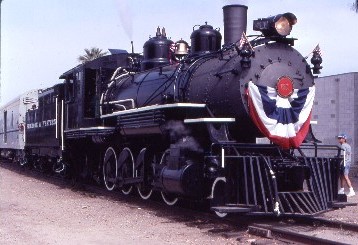
After looking around at the museum's equipment, the passenger train arrived at the boarding area led by Fillmore and Western 2-8-0 51, ex. move from Loveland, Colorado 1983, exx. Boulder Scientific Company 51 1963, nee Great Western Railway Company 51 built by Baldwin in 1906, with two former Chicago and North Western F7As on the rear. Today's excursion was going to Sespe, about six miles west of Fillmore. The F7s would pull the train west to Sespe and the steam engine would lead it back.
Bruce and I, along with everyone else, boarded the train and with two toots of the 100's horn, the train started west, moving slowly across Central Avenue, which would make a good movie set due to its historical atmosphere. We passed the former packing house and rolled along crossing Sespe Creek on a truss bridge.
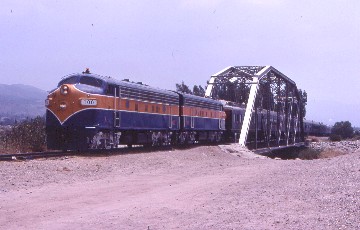
This stream has several branches and moments later, our train crossed another bridge over the rushing water then proceeded through the orange groves that were once very prevalent in Orange County. In fact when my family moved into our house in 1959, we had an orange grove across the street until the housing tract was constructed in 1967. My early train riding was through orange groves all the way across the future city of Irvine. Santa Ana Canyon was still full of orange groves when I rode the re-routed Desert Wind with Jeff Hartmann in 1980.
One is lucky to find an orange grove in Orange County any more, so it was no surprise that I enjoyed my journey through these in Ventura County.
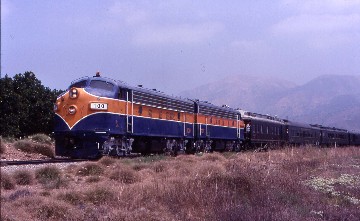
We crossed Snow Creek, as well as some smaller creeks as our journey through the groves went on, then traversed Boulder Creek before we reached Sespe where we paused briefly then started the return journey.
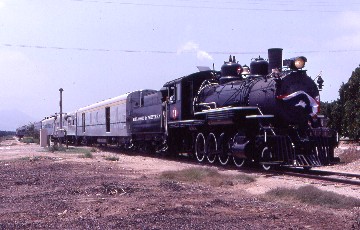
Now we savoured the chugging sounds of Great Western 51 and its whistle, as well as watching the plume of smoke rise from the engine.
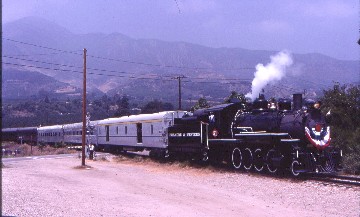
A beautiful scene as the steam engine curved ahead of the train and out of the Sespe Creek bridges.
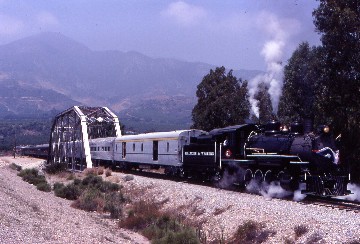
We steamed by the packing house and back into Fillmore.
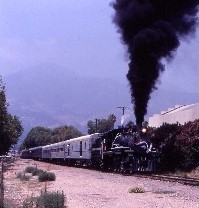
Upon our return, Bruce and I had some lunch while the next train boarded then went to the west bridge to set up and start our photography and chasing of the next two trains. After a very satisfying day of steam, we returned home to Santa Ana.
Fillmore and Western 7/29/1995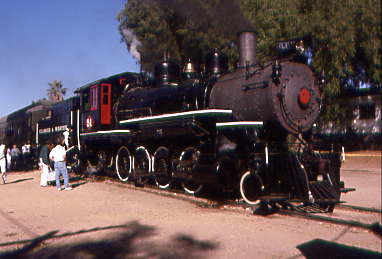
Jeff Hartmann picked me up and we drove to Fillmore via Moorpark to ride to Santa Paula, then purchased our tickets and looked around until boarding time. Great Western 2-8-0 51 was again on the point of the train. We departed at 11:00 AM and followed my previous trip out to Sespe then continued onto new trackage before crossing Highway 126 with the Santa Clara River to our south. People driving on the highway did a double take as they were not expecting to see a train. We ran west until Keith where we crossed the road again then arrived at Santa Paula, stopping at the old wooden station so the crew could change ends.
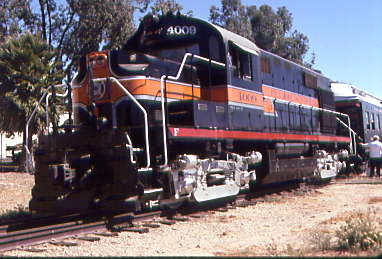
Fillmore and Western RS32 4009, ex. Southern Pacific 7309, nee Southern Pacific 4009, built by American Locomotive Company in 1962. I really enjoyed another trip through the orange groves then after a few more photographs, we drove home.
Fillmore and Western 3/24/2000I drove to the Amtrak station in Santa Ana to ride San Diegan Train 769 to Moorpark and had a relaxing ride with cute young woman talking to me about my train travels. Jeff Hartmann was waiting for me as he drove up from his home in Long Beach, then drove us over the hills to Fillmore where we parked.
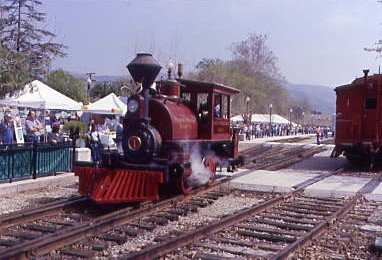
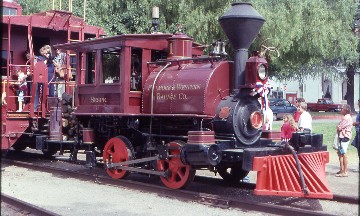
Fillmore and Western 0-4-0 "Sespe", acquired by Stan Gardner and Bill Odem in 1967, ex. Chadwell O'Connor 1952, exx. Lorane Valley Lumber 1 1946, exxx. J.M. Chambers and Son 1 1923, exxxx. J.H. Chambers Lumber Company 1 1912, exxxxx. Skelly Lumber company 1 1905, exxxxxx. Rogue River Valley Railway 1, nee Honeyman, DeHart and Company 1 built by H.K. Porter in 1891.
We purchased our ticket for the trip to Willoughby before we boarded our train pulled by Fillmore and Western F7A 101 on the point and Ventura County S-6 1059 on the rear.
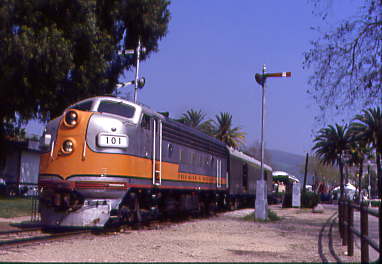
We proceeded west across Sespe Creek and out into the orange groves to a place known as Wliloughby.
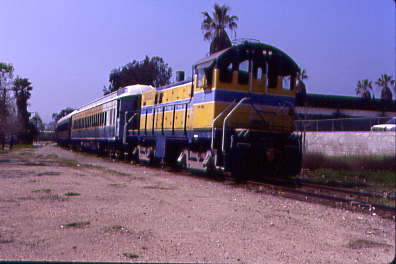
We returned to Fillmore with Fillmore and Western S-6 1059, ex. Ventura County 9, exx. Southern Pacific 1226, nee Southern Pacific 1059, built by American Locomotive Company in 1956 leading.
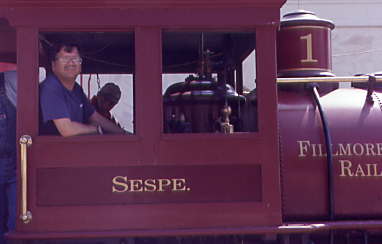
Jeff then had an opportunity to run the Sespe and after this photograph, I went out to the signal to wait for him to pass. Once Jeff had finished, we looked around a bit more before departing so I could get back to Moorpark to catch San Diegan 784 home, which ended another great visit to the Fillmore and Western Railway.
| RETURN TO THE MAIN PAGE |