




I detrained from the Ocean and walked down the station platform to the door of the depot then checked into the adjacent Hotel Nova Scotia, for my two night stay.
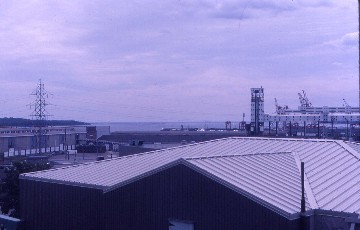
The room included a mini-bar and a great view overlooking the station, Halifax harbour and the Atlantic Ocean beyond. I called home to Santa Ana to learn the earthquake was located in Landers near Joshua Tree National Park, nowhere near Los Angeles and in fact, my brother Duane said it was just a rocking motion that caused no damage. We both laughed at how newspapers could lead one to a conclusion that had nothing to do with reality. After that, I decided to retire in a non-movable bed for a well-deserved restful night of sleep.
7/2/1991 The next morning I arose and had a good breakfast before I walked to the Citadel, a fort that was built on the top of a hill affording a great view of the harbour and surrounding lands. As I stood and looked out at the view, my mind kept returning to the Jethro Tull song "Rocks on the Road" and how much train travel has in common with that song, such as "Tired plumbing wakes me in the morning. Shower runs hot, runs cold playing with me." Ian Anderson always makes or breaks my day. Walking back to the hotel, I noticed the stores were closed in observance of the Canada Day holiday which was yesterday. I stopped to get some lunch before returning to the hotel the long way via the train platforms, allowing me to view the RDC's in storage. Before the VIA Rail cutbacks, they operated all over New Brunswick and Nova Scotia, but today they rest awaiting an uncertain future.
I went back to my room for an episode of "Guiding Light" the only soap opera I watch, before going across the street to the platform to watch the Ocean depart on its journey to Montreal. As it did so, it seemed funny to see my sleeping car leave without me and was like watching a dear friend leave with the feeling of sadness in my heart. Back in the lobby, I attended the hotel's High Tea, which was quite an experience, before going to the hotel's dining room to have my first lobster dinner, from which I walked out full and satisfied. I returned to my room, watched a very tardy Atlantic arrive before spending my final night in Halifax with the television and the mini-bar.
7/3/91 I slept in before having a nice quiet breakfast and going for a good walk on an overcast morning then watched another episode of "Guiding Light" before checking out. Waiting in the station's lobby, I reflected on the eastward journey, everyone I had met and all that I had seen. I thought about the Quebec separatism issue and remembered the variety of comments from passengers, such as people in British Columbia feel that they are across the mountains and a long way from Ottawa and feel closer to the northwest United States than to the rest of Canada. If Quebec goes, fine, maybe the rest of Canada would pay more attention to British Columbia. The prairie provinces of Alberta, Saskatchewan and Manitoba feel there is no border with the United States since we farm, they farm, same economies, same language, same religion and same culture, and as one Alberta wheat farmer put it ""We do not have anything in common with Quebec, so let them go" A dentist from Toronto, Ontario stated that we could be our own country if they go. We have everything that they have but more.
We all know what Quebec wants, although it was fifty-fifty between staying in Canada and leaving, from the people I talked to there. The maritime provinces of New Brunswick and Nova Scotia is where you find people scared on the subject. "Keep Canada together" was said by many, and I could see their point. If Quebec leaves Canada, they would be cut off from the rest of the country and being economically poor, they do not see much of a future in Canada if the breakup happens. "Would Maine be willing to expand to take us over?" seemed to be the question on everyone's mind. These views were just from a few of the great many Canadian people and such discussions helped pass the time on my transcontinental Canadian trip during the thunderstorm.
The Atlantic VIA 11 7/3/1991Inaugurated by the Canadian Pacific Railway as a "limited stop" service on September 25, 1955, The Atlantic Limited used numbers 41/42 (westbound/eastbound) and took the schedule and equipment for what were previously numbered trains between Montreal, Quebec (Windsor Station) and Saint John, New Brunswick (Union Station). The service operated overnight using the CPR's former International Railway of Maine line which formed the direct route between Saint John and Montreal. Although this was CPR's first named passenger train to the Maritimes, daily passenger service had been offered since 1889.
The Atlantic Limited saw the first major change to its route around 1970 when the Saint John Union Station was demolished and CPR's Mill Street yard redeveloped to accommodate the Saint John Throughway and associated urban redevelopment. A new passenger station was built on the city's west side in the former city of Lancaster where new rail yards were developed. During the 1970s, CPR operated the service at minimal levels with usually a single 1800-class E8 locomotive (one of only three, later two, operated in Canada, both by CPR) and a baggage, coach, diner and sleeper car. Some of the stainless steel Budd Company cars originally ordered for The Canadian also made their way onto this train and there was infrequent availability of a dome car as well.
While The Atlantic Limited name was only used officially after 1955 on the Montreal-Saint John service, the name, or a variation of it, has possibly seen use for a service which operated on CPR and CPR-subsidiary Soo Line between Minneapolis, Minnesota, via Sault Ste. Marie, Ottawa, Ontario and Montreal, Quebec, to Saint John, New Brunswick, beginning in 1889 following the completion of the line to Saint John. It is possible that the name "Atlantic Limited" was officially used on the Soo Line portion between Minneapolis-Sault Ste. Marie, although only numbered trains officially existed east of Montreal between 1889 and 1955. An extension to the Minneapolis-Montreal-Saint John service operated between Montreal and Boston, Massachusetts (in partnership with the Boston and Maine Railroad), possibly using the name Atlantic Express.
In 1978, VIA Rail was created out of a Canadian National Railway subsidiary to become Canada's national passenger rail service. In October of that year, VIA negotiated the take-over of CPR passenger service, although routes, equipment and schedules did not change until the summer of 1979. Thus for the first few months after VIA was created, the company included The Atlantic Limited in its timetable and the service continued to operate using the same CPR equipment and crews. In the summer of 1979, this was changed with the name The Atlantic Limited shortened to the bilingually appropriate Atlantic/Atlantique.
At the same time, service was extended effective October 1979 with a new eastern terminus at Halifax, Nova Scotia and the 1970s-era CPR passenger station in Saint John was closed in lieu of a new station in that city's downtown. The extension of the train to Halifax was made possible by VIA's decision to not continue a CN train named the Scotian, thus the Atlantic assumed that train's numbers of 11/12 (westbound/eastbound) and equipment. Under VIA, the Atlantic became a well-used train, given the shorter route (by 150 miles) over the Ocean, and the fact that the Atlantic served the cities of Saint John and Sherbrooke, in addition to a number of smaller towns and villages in between.
However increased patronage of the Atlantic did not meet VIA targets, although some might say it did not cross as much politically crucial territory in Quebec as the Ocean. Thus in the VIA budget cuts by the Trudeau government in 1981, the Atlantic was terminated in lieu of Budd RDC service between Halifax-Moncton-Saint John-Fredericton. During this time, Fredericton saw its first passenger trains since the early 1960's when Rail Diesel Cars were instituted from Halifax via Moncton and Saint John to replace the Atlantic's connections. Southwestern New Brunswickers were incensed at the cutting of the Atlantic's route, one which had seen daily passenger rail service in both directions between Saint John and Montreal since the International Railway of Maine opened in 1889. Community leaders along the route, led by rookie Saint John mayor Elsie Wayne, quickly rallied local populations to lobby the federal government. After several years and a personal promise by Brian Mulroney that his government would reinstate VIA service on the route, the Progressive Conservative Party won election in 1984 and that December, it was announced that the Atlantic would be returning to the rails.
In August 1985, the train was reinstated on its former route between Halifax and Montreal, although VIA made some changes to its operations in the Maritimes to accommodate the Atlantic. The Ocean service was actually downgraded to just a Montreal-Moncton train with a platform connection to them through Atlantic. This lasted until the 1989 budget cuts to VIA, which saw service on both routes reduced to three days a week in each direction (alternating days) beginning on January 15, 1990. From 1990 until December 16, 1994, the Atlantic operated consistently on its three days a week service which saw it share an equipment pool with the Ocean.
Route when operated by Canadian Pacific RailwayThe route taken by The Atlantic Limited operated entirely on CPR trackage and passed through a scenic portion of eastern Canada and northern New England including the Island of Montreal and the city's skyline and suburbs, the Richelieu River valley, the hills of the Eastern Townships, the Appalachian Mountains of western and central Maine, the level plateau and forests of eastern Maine, and the forests and mixed farmland in the Saint John River valley. The route taken by the Atlantic Limited between Saint John and Montreal is the most direct rail link between the two cities. In the final mid-20th century peak level of passenger service, connections with Bangor & Aroostook trains were available in Greenville, Maine and with the Aroostook Flyer in Brownville Junction.
Route when operated by VIA RailFollowing the assumption of service by VIA Rail in 1979 until discontinuance in 1981 and restoration of service in 1985 until discontinuance in 1994, the Atlantic followed a somewhat different route, with the most obvious change being the extension over Canadian National trackage east of Saint John to Halifax. There was a subtle change between Montreal and Lennoxville too, where VIA wished to consolidate its trains at the former Canadian National Central Station in Montreal. Leaving Montreal, the Atlantic followed the route of the Ocean on CN trackage through Saint-Hyacinthe, where it turned south and followed the Saint-François River valley into the Eastern Townships to Sherbrooke where it regained CP tracks. From Sherbrooke to Saint John, the Atlantic followed the same route as its predecessor The Atlantic Limited. East of Saint John, the train regained CN tracks and followed a similarly scenic route through the Kennebecasis River valley and its mixed farmland to Moncton and then followed the same route as the Ocean crossing the Tantramar Marshes, the Wentworth Valley, the edge of Cobequid Bay and mixed farmland through central Nova Scotia to Halifax.
My Journey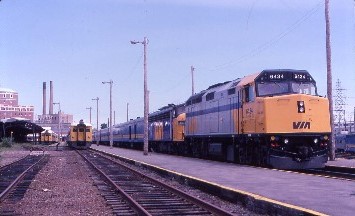
As previously explained, VIA had two routes that ran between Montreal and Halifax: the Ocean, which I rode eastbound, is the all-Canadian route that travels up and over Maine, and the Atlantic, which cuts directly across upper Maine and is an international train. Amtrak does not serve Maine so this was my opportunity to ride a train in that state. While this route did survive the VIA cutbacks of a couple of years ago, there was serious talk of Canadian Pacific selling off this route, thereby ending passenger service. As such, I was excited about the journey ahead.
The Atlantic's consist was almost a carbon copy of the Ocean and still steam-heated. I boarded my sleeper "Chateau Dollard" and after my ticket was taken, went back to the Park Car to have my farewell-to-Halifax drink as we departed for Montreal. Since the route is the same as that of the Ocean as far as Moncton, I spent the next four hours exploring the train and meeting my fellow passengers, who had many questions after they learned I had travelled all the way across Canada, and gave them very detailed answers. The conversations then turned to train travel in America and they were happy to have someone well-versed in Amtrak travel. The discussion and passing scenery made the time go by quickly and we were soon arriving in Moncton for a servicing stop.
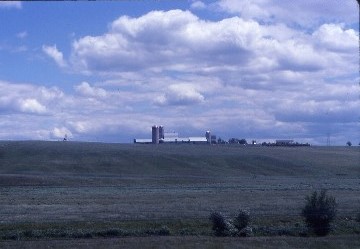
It was another beautiful warm New Brunswick afternoon then upon the "All Aboard", I went to the dining car for a meal of Atlantic Coast salmon while the train passed through the countryside of dairies, farms and forests. Just as my fish arrived, we crossed the Petitcodiac River and by the time we arrived at Sussex, I was paying for another wonderful VIA Rail meal then returned to the Park Car and decided to ride in the dome for the rest of the evening. The train departed Sussex and travelled through more forests with some interesting homes seen within the trees then we followed the twisting course of the Kennebecasis River and passed another covered bridge with two churches. This river flowed into the bay with the river's name and some very nice-looking homes along its shores. The train passed through Rothesay before arriving at the very modern station of Saint John.
Upon departure, the train crossed the St. John River and underneath the bridge, something strange was happening. There were rapids with the water following up the river called Reversing Falls, which is caused by the high tide that occurs on the way to the Bay of Fundy creates a higher-than-normal water level than on the river, thus rapids going up the river. That meant that the only time boats can pass under is between the tidal flows and there is a lot of boat activity during those non-tidal periods, both during the day and night. At low tide, the water flows down the rapids out to the bay.
We ran along the edge of St. John River's Grand Bay, past the Moosehead Beer Brewery before climbing towards the setting sun and I had chosen the front seat of the dome so I could watching the train make its way into the first Canadian sunset of the trip, since I was travelling westbound and therefore always chasing the sun. When the sun set, I returned to my room while we stopped at Fredericton Junction and McAdam, our last stop in New Brunswick and I really enjoy sitting in the darkness of my room so I can see out into the night. We crossed into the United States and I was now aboard a train in the State of Maine, and a VIA Rail train at that. Once we left the border, I walked to the vestibule and noticed a plastic clip that the Canadian Customs agents had put on the door so they know no one entered or exited the train during its passage across Maine. Through passengers were then left alone as the train crossed the state and only those passengers boarding or detraining in Maine were checked by US Customs officials.
I went back to my room and turned in for the night, sleeping mostly in the State of Maine and never seeing the United States as we passed through its northeast tip. Most importantly, I never saw any of Maine in daylight.
7/4/1991 Independence Day in the United States found me awakening to the farmlands of Quebec in Canada. We arrived at Sainte Hyacinthe and upon consulting my timetable, realized that we were running an hour late, thus making for some good news as I would be spending less time in French-speaking Montreal. By the time I was up and dressed, the train had arrived at Saint Lambert.
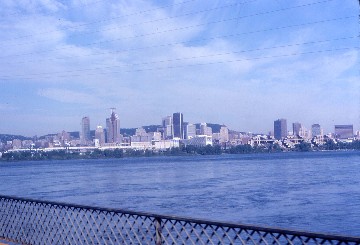
We crossed the Victoria Bridge over the St. Lawrence River before reversing into Central Station, ending my journey in the Atlantic and Maritime provinces.
Montreal 7/4/1991My first order of business was to get some breakfast, so I went to McDonald's hoping to have hot cakes and sausage. The menu, naturally, was in French and while I knew "milk" was "lait", did not know what hotcakes or sausage was. A girl behind the counter motioned me over and she whispered very softly that she could get fired for speaking English but asked me what I wanted. I whispered back my request just as the manager came towards us, so I smiled and two minutes later, out came a tray with my breakfast on it. I mouthed a thank you to her and she smiled broadly then returned to her duties. Following breakfast, I spent some time looking around a book store before buying the current issues of Railfan and Railroad and Hockey News. I found the gate for the 12:15 PM departure of the Meridian for Toronto and waited for boarding time.
The Meridian VIA 61 7/4/1991I sat on the opposite side of the train to gain a different perspective of the route and countryside then found a Toronto Star newspaper on the seat next to me and upon reading the sports section, had an idea. The Toronto Blue Jays were home playing the Minnesota Twins at 7:30 PM and since the Skydome was within walking distance of Union Station, if I could get a ticket, that is how I would spend my evening. We departed on time and I caught up reading the newspaper then my magazines and occasionally glanced out of the window. We stopped at Dorval before making our high-speed run at 95 miles an hour to Kingston in these LRC cars, during which the service cart made its rounds with another roast beef sandwich along with a mix drink.
In no time, we stopped at Kingston, where half the passengers detrained to be replaced by new passengers. I listened to Jethro Tull's "Catfish Rising" tape with headphones while the train sped down VIA's corridor to Toronto then we ran non-stop to Oshawa, where a group from Montreal detrained. The service cart made two more rounds between Kingston and Guildwood before our on-time arrival at Toronto Union Station.
Toronto 7/4/1991I stored my luggage in a locker before walking from the station over the tracks to the base of the CN Tower and the ticket office for the Skydome, then asked for a single seat ticket and received one along the third base line behind the dugout on the lower level. I walked around the outside of the Skydome, past the hotel built into it, and then all the rest of the way around it then the doors finally opened. I walked inside and found my seat when I noticed an almost gear-like connection in the floor behind my seat so investigated and believed that was the mechanism by which the seats were moved from a baseball setup to a football arrangement, since Skydome is also the home of Canadian Football League's Toronto Argonauts.
I then heard a greeting and a question of what I was looking at so intensely from a man in a uniform who just happened to be the Assistant Director of Operations. We talked for a few minutes about the ballpark and my cross-Canada journey, then he asked if I would like an unofficial tour, to which I immediately responded in the affirmative. He first took me down on the field so I could get the visiting team's perspective, which I must say was incredible. We walked around the edge of the entire field before returning to the stands where we went upstairs to the control room for closing the dome's roof, before ending up in the Hard Rock Café where he bought me a drink. He then escorted me back to my seat, where I thanked him and he wished me a safe and wonderful trip on the rest of my rail adventure.
I watched the game between the Blue Jays and the Minnesota Twins, not caring who won or lost, so I finally enjoyed a baseball game for just the fun of it. Both national anthems were sung and I must say I prefer "O Canada" than our "Star-Spangled Banner" because it is so much easier to sing. The main difference was that during the seventh inning stretch, "Take Me Out To The Ballgame" was not sung. Instead, they sang "OK Blue Jays" written by Jack Lenz and Tony Kosinec and originally performed by Keith Hampshire and "The Bat Boys" in 1983. Thirty women dressed up in tight-fitting baseball uniforms encouraged everyone to rise up and dance. It was a wonderful experience and something every baseball fan should enjoy at least once. I left in the eighth inning with the Twins ahead by one runs (the Twins won 1-0) since I had a train to catch so gave myself an hour to get back to the station and retrieve my luggage. That whole process took only fifteen minutes, so being a sleeping car passenger, I waited in VIA Rail's First Class lounge and enjoyed a soft drink before boarding the Canadian twenty minutes later for the return trip to Vancouver.
The Canadian VIA 1 7/4/1991I found my room in the "Chateau Riguad", although this time I was in the third car from the rear on this twenty-one car train and received my wish, an all-electric set of equipment, complete with shower in my sleeping car. I felt lucky and blessed to have this equipment set going west instead of what I had travelling eastbound. We departed Toronto on time, proceeding east from Union Station on the same route I had arrived from Montreal before turning north then west to Canadian National's McMillan Yard, where we reversed onto the Newmarket Subdivision at Snyder so as to be in the correct direction to travel to Newmarket and points west. Once we were moving forward, I decided to call it a night and fall fast asleep.
7/5/1991 Waking up the next morning just as the Canadian made its stop at Sudbury Junction, I had my first proper shower on a VIA Rail train and felt completely refreshed then was ready for the servicing stop at Capreol.
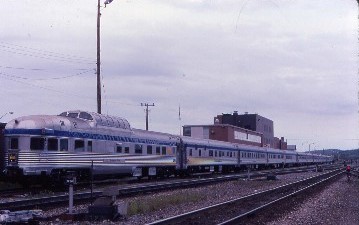
I detrained and photographed the rear of our train while it was serviced and as I walked back to my car, I kept hearing "Thunder Bay" being mentioned by the VIA crews. Since the only Thunder Bay I knew of was on this train's former Canadian Pacific before the VIA cutbacks, I began to wonder if we were going to be rerouted. I returned to my room to consult my CN timetable then went back outside and I asked a carman about what I had heard. He informed me that CN piled up a freight train outside of Sioux Lookout where it ran into a mudslide, so our train would follow its regular route to Longlac then be rerouted to Winnipeg. He asked me to not let on that he had told me this, which I agreed to then he returned to work. I was really excited and felt very lucky that I was going to be riding part of the Canadian's original route, as well as a CN branch line to boot.
Leaving Capreol in a very good mood, I realized that we would be passing through more of the scenery that we had passed through during the night on my eastbound trip. Over the next few miles, the landscape changed from the gentle rolling hills to the very rugged and rock outcrop scenery of the Canadian Shield. We entered the pine forest with many other types of trees mixed and almost every low spot on the shield contains one of the over half a million lakes to be found over its broad expanse.
I went to the dining car and ordered side items of bacon, toast and grapefruit juice paying only $3.50 Canadian and had a very leisurely breakfast just watching the Ontario scenery. We stopped briefly at Laforest, a fitting name since its located in a forest, after which I returned to the Park Car's dome for a morning of riding. Twelve minutes later, we stopped at Key's Cap to unload passengers and a canoe for an outdoor adventure. Similar to BC Rail, VIA will drop you off and pick you up anywhere in the wilderness along their routes. Once everything was unloaded, the train sped off, not stopping at any of the timetable locations, so we skipped McKee's Camp and Felix before stopping at Westree. West of there, we crossed a river on a long trestle with the aspen trees beginning to make an appearance.
The next large lake I saw was Minisinakwa Lake where we crossed the river with the same name west of Gogama. Just to the west of there, we crossed the first paved highway since Capreol, which runs the hundred miles from Sudbury to Timmins, then traversed Mattagami River and returning to the forest and rocks of the Canadian Shield. As we sped west, I sat in the observation area in a rear-facing seat, watching the miles fade into the forest. We did not stop at Foleyet or Elsas, but I did enjoy the view of Lake Kapuskasing. We continued through the forest before crossing Fire River then ten minutes later, stopped right where the tracks crossed the Lower Minnipuka Lake to detrain another party with canoes. For the next half hour, we sped through the downed trees that the thunderstorm destroyed just before our eastbound trip through here and it looked as though it were either wind sheer or a severe downdraft, but from the nature of the mass destruction, I would rule out a tornado.
We arrived at Oba, the junction with the Algoma Central, with no sign of their trains then made a rather quick dash to Hornepayne, after crossing Kabinakagami River before arriving there forty minutes early, giving me a full hour in town. When I returned to the train, our new crew officially announced the detour plans and explained our route to Winnipeg, which I already knew.
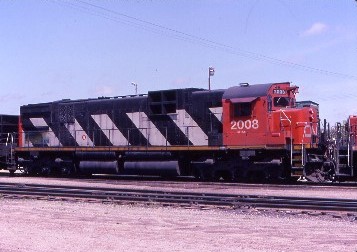
Canadian National C-630M 2008 built by Montreal Locomotive Works in 1968. While we were still in Hornepayne, I studied the CN Prairie Region timetable, looking at the place names on the Kinghorn Subdivision and noticed that the top speed on this branchline was thirty-five miles per hour and its length was 195.5 miles, so it should take us six-and-a-half hours to traverse its route. Since it was 4:30 PM, it should take us a little under two hours to reach Longlac, with Thunder Bay being reached sometime after midnight, and with the late sunset of early July, we should see quite a bit of the branchline in some type of light.
Upon departure, I was sitting in the front seat of the dome for the journey through Hillsport and Caramat at a rather fast pace before we arrived at Longlac, making our passenger stop and transferring anyone going west on the Canadian National line to a bus before pulling down to the junction with the Kinghorn Subdivision. We stopped here as a pilot engineer climbed into the engine and a pilot conductor boarded the front coach since our crew had never operated over this line before.
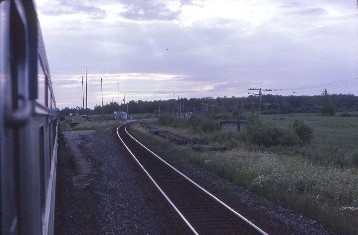
We entered the subdivision starting a journey of a re-route that was not even in my wildest dreams when I had planned this trip and started our detour with Long Lake off to the left and quickly exited rural Long Lac to return to the forest.
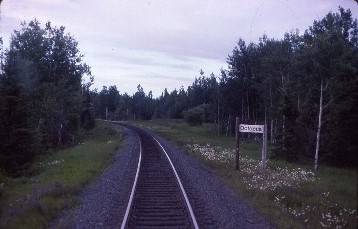
The first place in the timetable was Octopus and I watched the mileposts go by and we came to a station sign that read "CN Octopus" in the middle of the forest. No roads, buildings nor sign of humans, just the sign naming the place as Octopus. We passed the shoreline of Long Lake before continuing down a piece of tangent track with only the line poles, ballast and rails cutting through the forest. High clouds had been floating over and were rapidly cutting down the available light, then we came to our first siding and I found the sign at the middle point called Geraldton, again with no signs of humanity except for the railroad.
We started to see all sorts of wildlife, spotting some elk and moose along the tracks then scared a flock of geese that were on the track. Further on we saw two bears hurrying off into the forest then later came to a stream where the beavers were busy at work as we continued our journey down this line. A passenger saw my CN timetable and he had a map of Ontario, trying to work out where we were. While none of the railway locations were on his map, we crossed a paved highway and worked out that it had to be Ontario Highway 11. We then entered more rugged countryside as we approached Kinghorn, another place in the middle of nowhere, for which this subdivision was named.
With the usable light gone for photography, I went to the dining car for a late meal and had the usual two choices of meat or fish, so tonight I went with the chicken breast, small potatoes and a glass of white wine. It was my only meal with a Toronto-based crew who would detrain tomorrow in Winnipeg, and they provided another excellent VIA dining car experience. By the time I finished, the Canadian was on its way to Thunder Bay under the cover of night and I returned to my room then fell asleep to the sound of the wheels clicking on the jointed rail.
7/6/1991 The next morning I awoke to the sound of the Canadian rolling on the smooth welded rails and immediately realized we were on Canadian Pacific tracks and opened my window shade to a bright July morning. After preparing myself for the day and since I was on the original route of the Canadian in an original Canadian trainset, decided to have a full Canadian breakfast, so ordered pancakes, bacon, sausage and toast, along with grapefruit juice and enjoyed this meal as the train passed through Ignace, but did not stop. I returned to my rear-facing seat in the Park Car as we sped down the well-maintained double tracked main line and off to the right about ten minutes later was Pinafore Lake then at Raleigh, we crossed the Little Wabigoon River before crossing it again about twelve minutes later. The terrain was extremely rocky and jagged then as the train passed through Dinorwic, I saw a lake to the south of the train which curved to the west and according to the conductor, this was Wabigoon Lake, which had a lot of tree-covered islands in its waters and we would follow until it ended at Barritt Bay. Just past Dryden, we crossed the Wabigoon River, the main river of its system on its way to its headwaters.
It felt as though I had been transported back in time, riding the Canadian on the rails of the Canadian Pacific as it was meant to be, across southwestern Ontario and I was seeing what thousands of passengers before me had seen. In reality though, it was 1991 and VIA trains had not travelled this way since the VIA cutbacks when the last Canadians left both Toronto and Vancouver on January 14, 1990. As such, I was living a piece of history with the return of the Canadian to these historic rails of the first line across Canada and I was riding on a natural high.
We crossed Eagle River before coming to Vermilion Bay on Eagle Lake then passed the smaller Edison, Stewart, Clare and Trout Lakes over the next hour as we sped west down the Canadian Pacific main line. The forest was a combination of pine and birch trees with homes interspersed throughout then we arrived at Kenora for a crew change and were surprised to find television cameras. I went to the vestibule and heard one reporter referring to us as the "Ghost of the true Canadian!" The station area was full of people who must have wanted to see a passenger train in town, since there has not been one here since the cutbacks and as we departed, everyone was waving and wearing friendly smiles.
Once out of Kenora, we crossed the Winnipeg River and Lake of the Woods was in view on the left, which stretches down into Minnesota in the United States with the border in the middle of the lake. In fact, there is a bump in the border northward caused by the Red River Indian Reservation located on the west shore of the lake which elected to be in the United States and not Canada, because they felt the Americans treated them better. Their reservation was in the northernmost point of the continental United States. We passed through a tunnel as the tracks separated and further west, the eastbound track plunged into a tunnel, although we did not. I did not expect to see any tunnels on this route but was proven wrong. We then passed several smaller lakes near Ingolf as we passed our first eastbound freight of the day then passed a sign that indicated the Ontario/Manitoba border and with that, the Canadian had finally left Ontario.
The rocks, trees and lakes of the Canadian Shield disappeared and instead, we entered a low marshy countryside before returning to the prairies crossing the Bog River at Whitemouth, where I saw the first of many grain elevators today in Manitoba. We crossed the Whitemouth River as we proceeded north-northwest and travelled in this direction across the flat surface until Molson, where we turned southeast, crossed high over the Canadian National tracks then sped through the towns of Lydiatt, Cloverleaf, Hazelridge and Oakbank. We crossed over the Red River floodway before going through Pine Junction and returning to the Canadian National tracks, which took us down a branch line to our regular route at Beach Junction before we continued into Winnipeg on the normal Canadian route. This ended a once-in-a-lifetime detour over a scenic Canadian National branch line and the Canadian Pacific main line. We arrived in Winnipeg for a shorter two hour stop but I stayed on the train, electing to nap after one of my best train-riding experiences.
With our servicing stop completed, new crew on board, train cleaned and my nap over, we departed Winnipeg on time, mostly thanks to the higher speed running of the Canadian Pacific line. We were actually on the old Canadian route because the Canadian used the Canadian National trackage out to Portage before the cutbacks. Since we were travelling directly into the afternoon sun, I returned to my favourite rear-facing seat to watch the miles fade into the rolling landscape. We arrived at Rivers with the landscape beginning to develop bluffs on the right with the streams flowing to the left. We rode the north rim of the Qu'Appelle Valley, which as prairies go, is far more scenic than the rest of it then crossed some of these streams on high bridges noted on the eastbound trip before traversing the Assiniboine River then entered Saskatchewan, where hunger took over this passenger. I went to the dining car and this night on the menu they had steak, baked potatoes, corn and a dinner roll along with a bottle of wine. I enjoyed my meal as the we passed the potash mines and sailed over the Cut Arm Creek bridge. It was another excellent VIA Rail meal then I returned to my room before our arrival at Melville and the servicing stop there, where I enjoyed a nice evening walk.
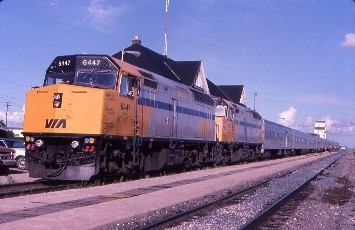
VIA Rail F40PH-2 6447, built by Electro-Motive Division in 1989, leading the westbound Canadian. I returned aboard, put on my headphones then fell asleep as the train travelled across Saskatchewan.
7/7/1991 I awoke west of Edmonton, Alberta and refreshed myself then went to the dining car and ordered bacon, toast and grapefruit juice before spending more time in the dome car to enjoy the morning ride towards the Canadian Rockies. We passed Wabuman Lake on the left followed by the smaller Isle Lake further up the tracks then went through Entwistle before crossing Pembina River. After passing through Evansburg, we ran along Chip Lake then crossed over Lobstick River, Wolf Creek and McLeod River, all on impressive bridges before stopping at Edson, then curved over Sundance Creek and climbed a short divide for the first glimpse of the Canadian Rockies. As the train continued to climb, the view of the mountains improved and we entered the valley of the Athabasca River and came to our next station stop at Hinton. After Entrance, we crossed the Athabasca River then paralleled Brute Lake with the Basche Range to the north and the Miette Range to the south. The lake ended and we followed the river to where it ran out to Jasper Lake then followed that to its headwaters in the U-shaped glaciated valley, along the Athabasca River into Jasper, with its train yard and our next servicing stop.
I went to the store and watched the train have its exterior fully cleaned by a portable window-washing machine during our hour layover. It was a beautiful cloudy and cool July afternoon in a town surrounded by magnificent mountains as we departed Jasper bound for British Columbia, proceeding towards Yellowhead Pass and paralleling the Miette River in between the highest peaks in the Canadian Rockies across the lowest pass of them all. We passed the shore of Yellowhead Lake and the sky had been invaded by clouds, which blocked the views of the those beautiful mountain peaks, then crested the summit of Yellowhead Pass, followed the Fraser River, the same one we would follow in the wee hours of the morning to get us to Vancouver, but the Fraser takes the long way via Prince George, where it rejoins our route at Lytton, British Columbia.
We followed the Fraser River from Moose Lake to Red Pass, where the line to Prince George took off and there was a freight train waiting for us which took the lower grade line from near Jackman to get here. We crossed the Fraser River in order to keep our elevation above the descending valley below then went through a tunnel, crossed Glacier and Snowside Creeks before plunging into another tunnel. I felt lucky to have seen Mount Robson going eastbound as today, it was almost completely hidden by layers of clouds.
We turned to the south where the Premier Range came into view, but only the base of the range could be seen. Near Jackman, the low grade line rejoined the Canadian National mainline as the train continued in the Canadian Rockies to our next stop at Valemount. After about twenty more minutes of travel, the clouds lifted with the Albreda Glacier being seen, after which it was nearly dinner time, so I first went to the dining car to see what was on the menu there and then checked the Skyline Coffee Shop, where they offered the teriyaki chicken breast and I repeated my eastbound meal from Ontario, which was another winning VIA Rail meal. After dinner, I sat up in the dome above the coffee shop and ordered my last drink of this trip from the attendant below. The train stopped at Blue River and I enjoyed the last of the daylight as the clouds had taken over, so I took a few minutes to reflect on this entire Canadian cross- country journey. It was my last night on this train so as I travelled through the canyons and forest, I thought back to the variety of experiences over the past several days. When darkness took complete hold of the night, I walked out of the Skyline car with a warm and happy feeling that I had really accomplished something special, as well as lived a little bit of history. I returned to my roomette for my last night aboard westbound VIA Train 1 and fell asleep and dreamt the night away.
7/8/1991 The next morning, I awoke and prepared myself for the day before returning to the dome for the final miles into Vancouver. The Canadian stopped at Port Coquitlam, the penultimate stop and within the hour, we would be at the end of my trans-Canadian rail journey and I did not want it to end. As the Vancouver skyline came into view, the train pulled onto the wye to turn so it would be facing east, thus I had a reverse view of what I had when we left Vancouver. The train reversed slowly until finally stopping, and with that, my journey was officially over on time. I took my time packing up and was the last passenger to detrain and as I stepped off, stopped to look at the magnificent train then walked to the station gate and looked back for the last time at my friend then walked through the station and out onto the streets of Vancouver.
The Trip Home 7/8/1991 I walked back to the Sandman Inn and received a day room to rest for a few hours and freshen up then rode the Amtrak Thruway bus to Seattle and managed to get a room at the Travelodge, even though the Toronto Blue Jays were in town for a series against the Seattle Mariners at the King Dome.
7/9/1991 I taxied to King Street Station where I boarded the Coast Starlight in coach for the trip to Los Angeles and it was quite hard to get used to the Amtrak dining car staff again after being forever spoilt by VIA Rail.
7/10/1991 The next morning with the Starlight over an hour late, the conductor returned my ticket to me so I could travel down the San Joaquin Valley to save some time getting home. I detrained at Davis and visited with my brother Bruce before boarding the Thruway bus to Stockton via Sacramento then rode the morning San Joaquin Train 712 down the valley to Bakersfield. I took the Thruway bus to Los Angeles and was almost home, catching an on-time San Diegan home to Santa Ana. The Canadian Odyssey had ended and I slept in my own bed for the first time in three weeks.
| RETURN TO THE MAIN PAGE |