




After my first train trip across the United States on Amtrak, I decided to travel from Vancouver to Halifax and return, thereby making a cross-Canada journey. It would take me to parts of that country I have never been to, as well as learning how Canadians feel about the prospect of Quebec seceding from Canada. Located in eastern Canada, Quebec has a unique cultural identity, predominantly speaking French rather than English and the idea of that province separating from Canada has been a contentious topic for decades, with some arguing that it is necessary for preserving Quebec's distinct culture and identity. One of the primary reasons is its distinct French-Canadian culture that many feel was threatened by the predominantly Anglophone rest of Canada.
Additionally, Quebec was founded by the French, and until the 1700s, was a French colony. There has always been a struggle for power between the French and English in Quebec, leading to tensions that continue to this day. Moreover, Quebec has a strong Catholic tradition, while the rest of Canada is predominantly Protestant, which has also contributed to tensions. As such, many separatists argue that the province should be its own independent country, with control over its own affairs, including language, culture and politics. Another reason for Quebec's potential separation from Canada is economic inequality since it is perceived that the province is not receiving an equal share of the resources and benefits from the rest of Canada. Supporters of Quebec's separation argue that by becoming its own country, the province would have more control over its economy and could benefit from its rich natural resources like hydroelectric power.
Politically, the separatist movement in Quebec began in the 1960s, with the rise of the Parti Québécois. The PQ's platform was based on the idea of an independent Quebec, which would allow the province to make its own decisions without interference from the rest of Canada. The PQ was able to win several elections, including a referendum on Quebec independence in 1980. Although the referendum was defeated, it only served to reinforce Quebec’s desire for autonomy and to distance itself from the rest of Canada.
As there was no toll-free number for VIA Rail, the operator of passenger trains in Canada, I went to Pacific Travel Services and over the course of three weeks, was booked on my Canadian dream journey in sleeping cars, the only way to take such a trip. I called Amtrak and reserved space to get me to and from Canada then visited the Automobile Club of Southern California to reserve my hotel rooms. The months passed by quickly and my departure day finally arrived.
San Diegan/Desert Wind 36 6/23/1991I boarded the San Diegan for Los Angeles so I could have my choice of seats, instead of reduced choices at Fullerton. As I had ridden the Desert Wind several times in the past, its route was very familiar and it ran on time and was a nice relaxing trip with a very mellow crowd on their way to Las Vegas. Leaving Sin City, the train settled into its night-time routine and after a good night's sleep, I arrived at my destination of Salt Lake City at 5:30 AM.
Salt Lake City 6/24/1991I detrained and found a restaurant for breakfast then returned to the depot and waited until a decent hour to call Ralph Bowman, the former coach, teacher and good friend of mine from MacArthur Fundamental Intermediate, who had just retired to Salt Lake City. Ralph picked me up and showed me around the city, including some of the places he grew up, with accompanying stories.
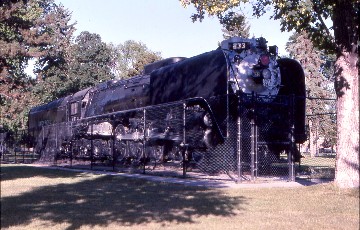
On display at Pioneer Park was Union Pacific 4-8-4 833 built by American Locomotive Company in 1939. Initially assigned to passenger trains, including the Overland Limited, Portland Rose and Pacific Limited, as diesels took over, the 4-8-4s were reassigned. It was retired in 1962 then donated to the City of Salt Lake in 1972.
He then showed me where he lived and allowed me to shower before dropping me off in the late afternoon because he had a prior social engagement. I waited at the former Denver and Rio Grande station until 9:00 PM then was taken by bus to Ogden to board the Pioneer for Seattle and it was an early arrival.
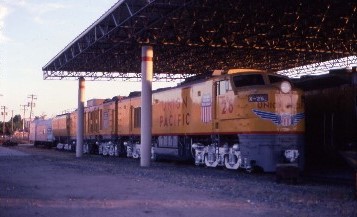
Union Pacific GE GTE 8500 26/26Bb built by General Electric in 1961. The 26 was the twenty-sixth of thirty 8,500 hp third generation GTELs (gas turbine electric locomotives) built between 1958 to 1961. The last gas turbine run was on 26th December 1969 and all the 8500s were out of service by 1970. 26 ran over one million miles during its nine-year service life, hauling heavy freight between Council Bluffs, Iowa, and Ogden. Retired in 1970, 26 was sold for scrap to Continental Leasing Group in 1971. Later shipped to Intercontinental Engineering Co., in Riverside, Missouri, it was gutted of electrical components, the turbine, traction motors and diesel engine for re-use. Donated to the Utah Railroad Museum in 1986, it was moved from Kansas City via Burlington Northern trackage and arrived at Ogden in July 1987.
The Pioneer 25 6/24/1991I boarded the train and off we went into the night, although I decided to stay awake until Pocatello, Idaho, so I would not miss seeing where my brother Bruce used to work. As we arrived early, I detrained there for a quick look around the depot before returning to the train for a nice long rest.
6/25/91 I awoke west of Nampa, Idaho before we crossed the Snake River three times and entered Oregon, crossing the Blue Mountains. We arrived at Pendleton early so everyone had twenty minutes to stretch their legs before a very quick journey down the Columbia River Gorge. Keeping the theme, we arrived early at Portland, then crossed the Columbia River into Washington, followed by an on-time arrival at Seattle. The entire day had been clear and sunny, reminding me of my previous trips on the Pioneer. I rode the Thruway bus to Vancouver, British Columbia, which dropped me off at the Sandman Inn, my hotel for this first night in Canada.
Vancouver 6/26/1991I slept in late, checked out then walked over to Pacific Central Station to pick up my tickets. It was here I was introduced to the GST or Goods and Services tax, a federal tax with some strange rules. If you buy unsalted peanuts, you do not pay GST, but salted peanuts are considered a luxury item, so the seven percent GST is added. If I purchased my tickets, or for that matter, picked them up, 24 hours before departure, I would have had to pay GST, but since I was picking up my tickets under 24 hours, that did not apply. I went to the IMAX Theater at Science World for a couple of film, followed by a round-trip on Skytrain before returning to the station to await boarding of my first VIA Rail train.
The Canadian VIA 2 6/26/1991This transcontinental passenger train is operated by VIA Rail with service between Union Station in Toronto, Ontario and Pacific Central Station in Vancouver, British Columbia. Canadian Pacific introduced this service on April 24, 1955, serving Montreal, Toronto and Vancouver. In 1978, Via Rail Canada acquired the service and, on January 15, 1990, designated the Canadian as its sole transcontinental service between Toronto and Vancouver. The new service replaced the former Super Continental, Canadian National's flagship passenger service and continues to run primarily over CN tracks.
HistoryIn the years following World War II, passenger trains on the CP consisted of a mixture of prewar heavyweight and pre- and post-war lightweight cars, even on its flagship transcontinental The Dominion and its eastern extension, The Atlantic Limited. While these cars were serviceable, American trains of the early 1950s, such as the California Zephyr, had already adopted streamlined all-stainless steel consists featuring domed observation cars. Following an evaluation in 1949 of the dome cars featured on the General Motors / Pullman Standard demonstrator Train of Tomorrow, CP management, including then-Vice President Norris R. Crump, resolved to upgrade its rolling stock.
In 1953, CP placed an order for 155 stainless steel cars with the Budd Company of Red Lion, Pennsylvania that included 18 rear-end dome cars (Park series), 18 Skyline mid-train dome cars, 30 coaches, 18 dining cars and 71 sleeping cars (Manor and Château series). A subsequent order for 18 baggage-crew dormitory cars brought the final to total to 173 cars: sufficient for establishing an entirely-new transcontinental service and partially re-equipping The Dominion. The interior design of these new cars was contracted to the Philadelphia architectural firm Harbeson, Hough, Livingston & Larson (a company known for its industrial designs on other prominent passenger trains such as the Pioneer Zephyr), and the resulting furnishings and pastel-shaded colour schemes were widely acclaimed.
After deciding to name the Park series dome cars after famous Canadian parks, leading Canadian artists, including members of the Group of Seven, were commissioned to paint suitable murals for these cars. When the decision was made to add budget sleeping cars, the Budd order was supplemented by 22 existing heavyweight sleepers that CP refurbished in its own Angus Shops, each fitted-out with Budd-style stainless steel cladding. To complement the new rolling stock, CP ordered General Motors Diesel FP9 locomotives to supplement an existing fleet of FP7s. Although these F-units remained the preferred power for the train, it would occasionally pulled by a variety of motive power, including Montreal Locomotive Works FPA-2s.
Service under CPCP christened its new flagship train The Canadian and running time between Montreal and Vancouver was reduced from about 85 to 71 hours, so that passengers spent only three, rather than four, nights en route. Although CP competitor Canadian National Railways began its own new transcontinental service, the Super Continental, on the same day, CP was able to boast honestly that The Canadian was "The first and only all-stainless steel 'dome' streamliner in Canada" – it was not until 1964 that the CN acquired dome cars from the Milwaukee Road.
The train operated with Montreal and Toronto sections, which ran combined west of Sudbury, Ontario. The Montreal section (also serving Ottawa) was known as train 1 westbound and train 2 eastbound, while the Toronto section was known as train 11 westbound and train 12 eastbound. Matching its streamlined appearance, The Canadian's 71-hour westbound schedule was 16 hours faster than that of The Dominion. Although initially successful, passenger train ridership began to decline in Canada during the 1960's. Facing competition from new jet aircraft and increased automobile usage following construction of the Trans-Canada Highway, the CP cancelled The Dominion in 1966, and petitioned the government to discontinue The Canadian in 1970. Although this petition was denied, CP during the 1970's attempted to remove itself from the passenger service market. The Canadian was operated at reduced levels, with the government funding 80 percent of its losses.
Service under VIA RailVIA Rail, a Federal crown corporation, formally assumed responsibility for CP's passenger services on October 29, 1978, although the VIA identity was not assumed by the trains themselves until the following summer. Following the takeover by VIA, the Canadian became the company's premier transcontinental train, and initially operated over its old CP route. It was supplemented by the former CN Super Continental, which operated over the parallel, but more northerly, CN route. The Canadian continued to be operated in two sections east of Sudbury and provided daily service west to Vancouver and east to Toronto and Montreal.
The Super Continental was discontinued in 1981 due to sharp budget cuts. Since then, the Canadian has VIA Rail's only true transcontinental train. While the Super Continental was brought back in 1985 amid popular demand, it only ran as far east as Winnipeg. In the aftermath of another round of deep budget cuts made to VIA Rail on January 15, 1990, VIA again discontinued the Super Continental, this time permanently. The Canadian was moved from CP trackage to the CN route plied by the Super Continental for its first quarter-century, dropping the Montreal section. The new longer route bypassed Thunder Bay, Regina and Calgary in favour of Saskatoon and Edmonton. This maintained transcontinental service and allowed VIA to operate its government-mandated service to small communities along the line. At the same time, the absence of transportation alternatives along the CP route allowed entrepreneur Peter Armstrong to develop the Rocky Mountaineer excursion service. Moreover, while pre-1990 schedules had daily service on both the CP and CN routes, service following the 1990 cuts was a mere three days per week, reduced further to two times a week in the off-season.
The RouteThe Canadian's eastbound journey begins at Pacific Central Station and uses Burlington Northern's tracks through suburban communities until it reaches the New Westminster Bridge, where trains cross the Fraser River. The Canadian then uses Canadian National tracks through the eastern Fraser Valley. The CN route passes through Painted Canyon, and features CN's 800 foot steel-arched bridge over the Fraser River and the CP mainline at Cisco. The tracks in Painted Canyon are only approximately 200 feet above the Thompson River. On their regular schedules, both east and westbound Canadians travel through the Fraser and Thompson river canyons at night.
From Kamloops North station, the tracks run north and follow the North Thompson River. The icefields of the Albreda Glacier are visible from the route, which is protected by railway slide fences. From Valemount station to Redpass Junction, eastbound and westbound trains routes again diverge. Eastbound trains use CN's Albreda Subdivision through Mount Robson Provincial Park; westbound trains use CN's Robson Subdivision, which is lower in elevation. The Canadian travels past Moose Lake and follows the Fraser to Yellowhead Lake then crosses the Continental Divide of the Americas at Yellowhead Pass, which at 3,718 feet. The pass also marks the boundaries between British Columbia and Alberta, the Pacific and Mountain time zones, the Pacific and Arctic watersheds, and Mount Robson Provincial Park and Jasper National Park. The route passes the Victoria Cross Range above the Miette River and runs through tunnels to reach the Jasper train station, where trains take an extended servicing break./?P>
From Jasper, the train runs along the Athabasca River and descends into the Athabasca Valley, where it has views of nearby mountains and passes Henry House. The Yellowhead Highway (Highway 16) continues to parallel the route then it follows the west shore of Jasper Lake and passes near local sand dunes before continuing northeast and leaves the Canadian Rockies as the terrain opens up into wide plains. The Canadian reverses at a wye to reach Edmonton station in the outskirts of the city, where a long servicing stop is scheduled, then proceeds southeast across the Canadian prairies for nearly 290 miles, making stops in several rural communities before leaving Alberta for Saskatchewan. The Canadian enters Saskatoon from the west and stops at Saskatoon station in the southwestern outskirts of the city before rejoining the CN mainline to enter Manitoba, where it begins to follow the Trans-Canada Highway. It then continues east towards Winnipeg, where the tracks turn north along the Assiniboine River to enter the historic Winnipeg Union Station in the city center, which also serves as the terminus of the Winnipeg–Churchill train.
The Canadian enters Ontario and crosses the rugged Canadian Shield, where it has flag stops in many small communities that are primarily accessed by rail. Between Winnipeg and Capreol, passengers may request to be dropped off or picked up at any location. At Sudbury, the train stops at Sudbury Junction then turns south with eastbound trains using CN's Bala Subdivision, while westbound trains use the CP's Parry Sound Subdivision, which traverses the Parry Sound CPR trestle. Through Parry Sound, all trains make use of separate stations depending on the direction of travel. From Bala, the train continues along CN trackage for approximately 25 miles to Washago, its penultimate eastbound stop. South of Gormley, the route is shared with GO Transit's Richmond Hill line commuter services, which uses separate stations. The Canadian reaches Toronto and follows Don River for its final miles before terminating at Toronto Union Station. Westbound trains leave Union Station either from the east as it came in from (if turned around prior), or from the west via the Newmarket Subdivision, shared by GO Transit's Barrie line, until Snyder Diamond in Vaughan. At this point, the train reverses for about five minutes in order to connect with the York Subdivision. After that, the train heads eastbound towards Thornhill in western Markham to meet up with the Bala Subdivision at Doncaster Diamond and from there, continue northwest leaving the Greater Toronto Area towards Washago and eventually Vancouver.
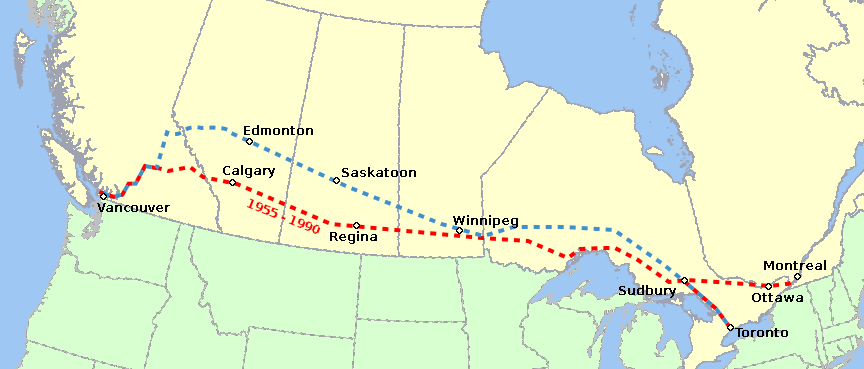
The route of the Canadian.
My JourneyThe sleeping car passengers were boarded first and I was on the rear sleeper, "Bayfield Manor", which was right in front of "Evangeline Park" the dome, observation, lounge and sleeping car. My attendant, who was about the same age as me, led me to Roomette 2, where I found a packet of information about the Canadian and settled in for the three-night trip to Toronto as I watched the coach passengers board our eighteen-car train. My attendant then suggested I go to the rear dome to watch the train's departure. The bartender came up into the dome to take orders and within minutes, returned with a tray of drinks in very nice glasses. Upon our departure, everyone drank a toast to the beginning of a safe and wonderful trip as we left the station with the lit Science World, followed by the skyline of downtown Vancouver. It had to be the most impressive departure I had experienced so far. I took the glass back to the bar and settled my tab then enjoyed the night-time ride in the dome out to Matsqui (Mission City), where I returned to my room before calling it a night on a Canadian train.
6/27/1991 The next morning came with the Canadian in the Rocky Mountains and I went to the dining car for an excellent meal of pancakes and sausage. The car itself was elegant with tablecloths, china and a fresh flower in a vase. The service staff was all smiles and the meal was an excellent way to start my first full day on the Canadian. We stopped at Clearwater, a farming and agricultural community then the valley then began to narrow and about an hour later, we came to our first scenic highlight of the morning as the train entered Little Hell's Gate with the North Thompson River descending through it in a series of spectacular rapids. The train twisted and turned before it passed through a tunnel, where the hillside was rocky and dotted with trees and given the name, must have been a difficult area to build through. We passed a steep waterfall prior to the next valley opening up and minutes later, arrived at Blue River.
I had been in the front seat of "Evangeline Park" dome and planned on staying there the rest of the day. We passed the high Pyramid Falls on the right, a little bigger than many of the smaller ones I saw earlier this morning. We were travelling along the Upper Thompson River and the size was rapidly shrinking as we climbed north. The bar attendant came up to make sure we all saw the Albreda Glacier with its massive snowfields which are located in the series of mountains called the Premier Range, which were living up to their name. The range on the right was the Selwyn Range, another beautiful chain. The train arrived at Valemount, our last stop in British Columbia and from here, the Canadian would cross the Continental Divide into Alberta.
Ahead of the train was Mount Robson, the highest mountain in Canada, at 12,972 feet and was absolutely magnificent on this perfectly clear morning. We proceeded to it then passed along its southern flank before drifting through a snowshed which seemed out of place until I looked back and saw the evidence of avalanches. We next came to the connection with the line from Prince George and Prince Rupert since the Canadian National built a second main line off this route to near Valemount to eliminate a major bottleneck to their freight traffic, and stayed on the higher and shorter of the two lines. The line to Prince Rupert is the line on which VIA Rail's Skeena runs and I hoped to ride that one day.
We passed Moose Lake, with no signs of the namesake creatures, and minutes later, crested Yellowhead Pass and the Continental Divide at 3,718 feet, the lowest railroad crossing of it in either Canada or the continental United States, and it was amazing to me to have a pass this low surrounded by peaks over 10,000 feet. We descended the eastern side of Yellowhead Pass with its slide detector fences en route to our next stop at Jasper. As we neared town, I went to my room for the camera and my sleeping car attendant noted that it was five minutes to Jasper and we had a forty-five minute stop. We arrived in the beautiful Canadian Town of Jasper with brilliant views of the Trident and Victoria Cross Ranges.

I walked to a store then photographed the train in this setting. The town was named for Jasper Hawes, a fur trapper in the early 1800's, and is located in the heart of Jasper National Park. Jasper is also a division point on the Canadian National and a major servicing stop for the Canadian as the interior is cleaned throughout and the windows are washed by an automatic washer. On a station track sat the Skeena, waiting to depart for Prince Rupert later this afternoon. Jasper was always a favourite Canadian town when I was a child as the Super Continental seemed to be always here when we visited. I also liked the Canadian National, on which I would be traveling all the way to Halifax.
We departed and travelled east down the valley of the Athabasca River which we would cross after we paralleled Jasper and Brule Lakes. As we exited Jasper National Park, I walked to the diner and their menu had two entrees, one of which is always fish, a popular meal for Canadians. My salmon was excellent, then afterwards, I returned to my room before going to bed, and we were now running an hour and fifteen minutes late since we had to go into a siding twice during dinner. Therefore, I was asleep as the train reversed down a branch line into Edmonton's downtown station. Edmonton is the home of National Hockey League's Edmonton Oilers and my favourite player, Wayne Gretzky. He played there along with Mark Messier, Jari Kuri, Paul Coffey, Glen Anderson, Grant Fuhr and a cast of others; what a great team they were when they all played together. We departed and after watching the night-time scenery, I called it a night, sleeping soundly aboard the eastbound Canadian.
6/28/1991 Awakening the next morning, I found myself rolling east of Saskatoon, Saskatchewan and the first time I had been in this prairie province. Saskatchewan's main industry is agriculture but they also have the rich mineral potash. Its landscape is flat and if you did not read the names on the grain elevators, you might think that you are in Kansas. We passed a couple of large potash plants then passed Lake Manitou before arriving at Watrous. Leaving town, we crossed Boulder Lake, followed by Peter Lake then ran through the Touchwood Hills, which provided a little diversion to the morning's scenery. Talk about a surprise, when out in the middle of nowhere, we passed a horse track and large buildings.
The conductor walked by and when he saw my notes asked how far I was going, to which I replied Halifax, then he told me that this part of Saskatchewan was settled by the Ukrainians and to look for a mosque-style church in Hubbard and the domed churches in Goodeve. Upon seeing them, I realized that Canada has a much larger diverse population than I had thought, and one of the joys of train traveling is always seeing and learning something new. We arrived at Melville, a forty-five minute servicing stop. Melville is like so many other places I visit which starts out as a name on a timetable, then a map and finally comes to life as I step off the train to become a lasting part of my memory. Word spread on the platform and throughout the train that I was going to Halifax and I had ridden many trains, which started several questions.
This particular trainset was the last steam-heated Canadian as VIA had been rebuilding all of them to head-end power and the new HEP Manor sleeper, unlike the one in which I was riding, had a shower installed where one of the open sections was. Therefore, before we departed, I had a sponge bath since there were no showers on the train. I felt completely refreshed but hoped there would be a HEP set on the westward Canadian in a few days. However, I was riding a true Canadian trainset before the HEP program was complete and glad to be experiencing it in the same way as all passengers who rode the Canadian since its inception in 1955.
Making our way through the Canadian National yards, I saw another domed church to the north before we returned to the agriculturally-dominated landscape as I saw in my room. Another potash plant came into view before we crossed Cutarm Lake on a large trestle. I later learned the nearby Cutarm Creek received its name from a young Indian boy who fell off his horse in the valley and broke his arm ... hence the name Cutarm. We passed the largest potash mine of the day south across the valley before we crossed into Manitoba, my second new Canadian province for the day. Just inside the Keystone Province, we were now on Canadian National's Rivers Subdivision and crossed the Assiniboine River then later crossed the high bridge over Birdstail Creek, followed by Minnewashta Creek on a steel trestle. Built between 1928 and 1929, it measures 18 feet wide by 1,600 feet long and used steel provided by the Manitoba Bridge and Iron Works, completed at a cost about $250,000. It replaced an earlier wooden bridge from late 1915 that, in turn, replaced one destroyed by a tornado in September 1915.
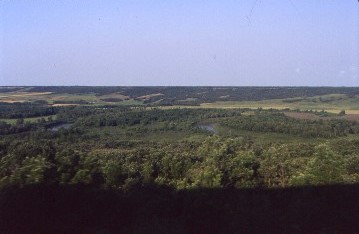
We were travelling along the edge of a mesa top with the Qu'appelle Valley below and our next stop at Rivers, was the first of the many wheat-farming communities in the province. Departing Rivers, we crossed over the Minnedosa River ninety feet over its waters and twenty minutes after meeting a freight train, arrived at Brandon North and the smallest VIA station yet. As its name implies, it is a stop several miles north of the City of Brandon, which is Manitoba's second largest city. Leaving that brief stop, we were travelling on the flattest landscape of the trip as this section used to be an ancient lake. As we approached Portage La Prairie, we crossed the Assiniboine River and stopped after crossing the Canadian Pacific main line, which used to be the route of the Canadian until last year's cutbacks.
My attendant came by to announce dinner was served so I made my way to the dining car for a late afternoon meal and found myself the only hungry passenger on the whole train. The steward seated me, then joined me saying that no passenger should ever eat alone on my car. The waiter took my order then returned and sat with me and our conversation was the differences between Amtrak and VIA's dining car service. He returned to the kitchen and brought me my filet of sole and a bottle of red wine. I had ordered a glass, but this was Canada so they brought me the whole bottle. The chef then joined me at the table and stated that it was rare that he had the opportunity to visit with a frequent train rider and talk shop, then asked how my meal was and was very pleased when I replied that it was excellent and was my first filet of sole. After returning to my room, my attendant thanked me for letting him serve and gave me directions to a restaurant along the banks of the Red River during my three-hour layover in Winnipeg. I thanked him and tipped him twenty dollars for being the second best sleeping car attendant I had ever had. He and the rest of the on-board crew would leave the train in Winnipeg and hand off the through-passengers to a Toronto-based crew. We arrived at Winnipeg on time, thanks to padding in the schedule.
As I detrained at Winnipeg, I heard my name being called and it was the Alberta wheat farmer I had been talking to earlier in the day. I really liked his hat which had a picture of a cow and a moveable tail, which was called an "Accurate Alberta Weather Forecast". If its tail is dry, nice weather; if the tail moves, it is windy; if the tail is wet, then rain; if the tail is stiff, it is below zero degrees Celsius and if you cannot see it, it means there is a snow storm. I really thought it was a clever hat and as we said goodbye, he took it off and gave it to me; I was very surprised and touched by his gesture and once more, the friendliness of a Canadian was shown. I walked down the tunnel and into the lobby, where I found an operating model railroad layout, so enjoyed the surprise of it for a few minutes, not being in any hurry.
I exited the station into the nice warm Manitoba sunshine and followed my sleeping car attendant directions to the letter then returned towards the station and after crossing the Red River, stopped at an outdoor bar along its waters and worked on my California suntan under a Winnipeg sun before I walked along the River Walk to the east of the station where I discovered a railroad exhibit. With now only forty-five minutes to departure, I returned to the train.
We departed on time and I was back in the dome car as the train traversed the Red River before crossing high above the Seine River and I could now understand why the location at the junction of these rivers became the location of Fort Winnipeg. Looking back at the city skyline, Winnipeg is a large city but not too built-up. Thinking of its people, I found them as friendly as any other Canadian city I have visited and I really like the Canadians I have met so far on this cross-Canada journey. We stopped at Transcona, a suburban station for Winnipeg then picked up the speed as we proceeded east into the rich farmlands on a route which was perfectly straight, crossing the Canadian Pacific main line, the former route of the Canadian, which I wished that I had been able to ride. Consulting my timetable, I could see that we had almost crossed Manitoba so decided to remain in the dome for the remaining miles and looked for Winnitoba, which is just inside the border. I located Ophir as the train passed through it and realized we were four minutes away from Winnitoba and minutes from Ontario.
The train sped through Winnitoba, after which I noticed a marker and I had now entered Ontario, a new rail-riding province until just short of Montreal. There was a large change in scenery at the border as we left the prairies of Manitoba for the rocks and trees of the Canadian Shield, over which we will travel for the next twenty-six hours. As we entered Ontario, the sun had finally set after a day of riding across the prairies and I wondered what tomorrow would bring.
6/29/1991 I awoke the next morning at the servicing stop of Armstrong and checking the mileage, the Canadian had travelled 303 miles since we entered Ontario last night. I dressed quickly so I could step off the train into the cool morning air with sunlight warming my face. Reboarding, I was off to the dining car for an excellent breakfast of pancakes, sausage and grapefruit juice and it was surprising how much I enjoyed that with breakfast, and it is something I wished Amtrak would offer on their trains.
We continued east through the rocky landscape and I enjoyed the scenery from my room. My new attendant, who had joined this train at Winnipeg, came by and commented that no matter where I sat today, I would see nothing except trees and that the Canadian Pacific route was much more scenic. I agreed with him, after which we crossed Mud River on a sixty foot trestle which momentarily took my mind off the forest scenery. We made our next stop at the lumber town of Ferland before crossing Jackfish Creek on a high trestle with a view of the northern end of Lake Nipigon, a lake which is sixty miles long and forty miles across at the extremes. We passed a fire lookout tower, a structure I had only seen before on mountain peaks, but I had heard of the wildfires which burnt out of control in the Canadian wilderness and were mostly caused by lightning strikes, so could well understand the purpose this tower served.
We stopped at the flag stop of Nakina to detrain some hunters to this sportsman's paradise. The Canadian would stop anywhere along the route to drop off or pick people up at remote locations since there are few or no roads in many parts of the Canadian Shield. The train returned to the forest, passing small lakes, along with the rocky outcroppings before arriving at Longlac and just to the west of town was the junction with the Canadian National line that goes down to Thunder Bay. Leaving Longlac, we passed the northern end of Long Lake, which is Longlac in French, then returned to the rocks and forest of the Canadian Shield after passing a large mill on the outskirts of Longlac. I decided then to go back and ride in the dome to our next division point to have a different view of the shield. We passed through Caramat without stopping and then for the first time today, went into the siding for a westbound freight, reversing the trend of the freights taking the sidings for us. Returning to the mainline, we sped east through Hillsport, another small town whose mainstay was lumber, before continuing to part the forest until we arrived at our next division point of Hornepayne, a large regional town of over 2,000 people that looked like a normal city with a small railroad yard.
As I detrained, we were met by Canadian National personnel who informed us that because of a storm brewing our train would be held for at least three hours here. There were some very large cumulonimbus clouds across the eastern skyline and we would be turned loose and when it would be ten minutes before we departure, the engineer would blow the horn ten times, then nine for nine minutes, eight for eight, et cetera, and to ensure we were back on the train. A gentleman named John in the room opposite, was going to a store and offered to pick up anything I needed, which I gladly accepted.
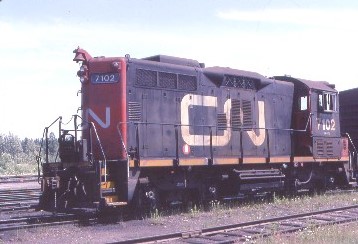
Canadian National SW1200 7102, nee Canadian National 1230, built by General Motors Diesel in 1985. I decided to go into the railway's offices in search of an employee timetable and the girl at the reception desk sent me upstairs to the district superintendent and I explained what I was looking for and he produced a set of timetables covering Toronto to Edmonton. Once more, the friendliness of the Canadian railroader showed why I love these people and this country. My time in Hornepayne was fun and very memorable, then I returned train side to work on my suntan and when John returned, we went into our room and had a drink to toast our success at Hornepayne and our Canadian trip.
After ten minutes of air-filled with the music of the train's horn, we departed to continue our trip across the Canadian Shield. The bedrock of the shield is 500 million to 5 billion years old and covers half of Canada's total land mass. These were some of the oldest rocks in the world and I received a good lesson in Canadian geology during our delay at Hornepayne from a Canadian geologist on the station platform. It was now 6:30 PM and I was hungry so after checking my two choices in the dining car, decided to walk forward to the Skyline dome car to see what was for dinner there. Teriyaki chicken breast with rice sounded good so I ordered it without the rice. When the waiter brought my meal, to which he had tried to add potatoes, but was unable to, it was not just one piece of chicken but two large breasts and he said it was just our way to make sure that you do not walk away hungry. Once more, another Canadian rail employee shone brightly, making for another great Canadian memory.
After my excellent dinner, I bought a drink and sat up in the Skyline's dome for a while, after which we arrived at Oba, the junction with the Algoma Central Railroad, then after about twenty minutes, we crossed Lower Minnipuka Lake and ten minutes later crossed the Fire River. The speed of the train slowed as we reached the destruction area of the thunderstorm and our first encounter was downed trees and railroad line wires. There was a little boy counting the fallen trees and he counted from one to 368, which was the last number he knew. Finally, with a sad look on his face almost in tears asked his mother if he could stop as that was as high as he could count. She replied that was okay but could start over again at one, so he did, and I returned to the solitude of my room and the last night on the Canadian.
6/30/1991 I awoke to another bright and sunny morning and walked to the dining car for my last Canadian breakfast of this train's trip of pancakes, bacon and grapefruit juice. While I was eating, the Canadian made its stop at Parry Sound so I had travelled 852 miles in Ontario, almost the distance across Texas, but still had 426 more rail miles until we reached Quebec sometime this afternoon. Ontario was by far the largest state or province through which I have travelled by rail. I stopped by a vestibule on the way back to my room, opened the top latch and received a face full of very humid air, which made me think of the mechanics of weather and the thunderstorm. I closed the vestibule and returned to the peacefulness of my room then went to the rear dome car for the rest of the trek into Toronto. We were running four hours late, allowing me to see scenery that we would otherwise have passed in the dark, and were travelling past lakes, the first one of the day was Lake Joseph.
The countryside was now rolling hills with tree-cleared farms and dairy pastures as we came to our next station stop at Washago, having finally left the Canadian Shield behind, followed by the crossing of the Trent-Severn Waterway, a system over 240 miles long linking Lake Ontario to Georgian Bay on Lake Huron, which we crossed before arriving at Orillia. Now the environment was becoming more populated as the train approached its destination of Toronto but beforehand, we ran west of Lake Simcoe and as we came into Barrie, one arm of the lake made a nice marina. One thing I noticed about Ontario was how many lakes there are, more than I had experienced on other trains. Barrie itself sits on Kempenfelt Bay of Lake Simcoe. The dome was becoming warm from the intense sunlight and high humidity that was beginning to take over the interior. We made our penultimate stop at Newmarket then were on the final approach to Toronto as the city's skyline came into view. We went by a large chemical plant before going through a maze of railroad junctions prior to passing below the Skydome, home of Major League Baseball's Toronto Blue Jays and the CN Tower, the world's tallest free-standing structure at 1,821 feet. We arrived at Toronto Union Station four hours late after travelling 2,776 miles from Vancouver and my first VIA Rail Canadian train ride was over.
Toronto 6/30/1991As I detrained, I was met by VIA representatives who informed me that since I had missed the connecting La Salle train for Montreal since we were late, I would be taking the Meridian instead and to go down into the station to wait for that train to board. The temperature was in the low ninety degree range with the highest humidity that I had encountered throughout my travels. I was not feeling at all well and was perspiring heavily and knew I needed to replenish my fluids. After finding a convenience store, I bought two Gatorades and within minutes, felt like my old self. I returned to find the queue for the train to Montreal when I heard my name called and from the correct line was a group of people I had met on the Canadian asking me to join them. I answered train questions for the next thirty minutes then we finally boarded the air-conditioned train, thereby liberating us from the hot sticky air of Toronto.
The Meridian VIA 64 6/30/1991I was aboard the 12:50 PM departure, which gave me an opportunity to sample one of VIAs corridor trains and my coach was an LRC, or Light, Rapid and Comfortable, which had nice clean windows and departed on schedule. All of the passengers from the Canadian sat together and once our tickets were taken, went off in search of the lounge car and walked through five cars before we encountered a French Canadian attendant who first spoke to us in French, which none of us understood, then in very rude-sounding English admonished us, saying the only time passengers are permitted to leave their seats is to get off the train or to go the bathroom, and that they serve you at your seat but only if you are nice. That was the first rude French Canadian I had met, but I led the parade back to our seats where we would try to be nice.
The train was travelling down the multiple track main line at a very high rate of speed through the eastern side of Toronto, where we made our first stop at Guildwood in Scarborough. Leaving the station, we passed Frenchman's Bay, followed by the Pickering Nuclear Generating Station with Lake Ontario behind it and the border with the United States in the middle of the lake. We arrived at our next stop of Oshawa, after which we became a limited stop train then sailed by the Darlington Nuclear Power Plant and it dawned on me that Canada uses nuclear power, since I always had assumed, with all the available water, that Canada was all hydroelectric.
From the rear of the train (the direction in which the group of us did not venture), came an attendant with a service cart and she was passing out complimentary meals, which today were roast beef sandwiches, chips and a choice of non-alcoholic drinks. As a meal goes, it was no worse than any deli-made sandwich, but better than the ones available in a store. We sped east through Port Hope then out onto the 1,232 foot Ganaraska River bridge with a nice harbour below. We flew through Cobourg before we lost the view of Lake Ontario and were now travelling across a mainly agricultural with dairy farming area. We continued our rapid pace east, passing through Trenton Junction before crossing the Trent-Severn Waterway for the second time today, actually the east end of it, which, when it was in use, saved having to travel up the Niagara River, the length of Lake Erie and the St. Clair River to Lake Huron. The train's speed was outstanding as the Canadian National dispatcher was keeping everything out of our way so we could maintain our schedule. This was Canadian high-speed corridor railroading at its best and these LRC cars, along with the welded rail, gave a really smooth ride.
We flew non-stop through Belleville where we crossed tracks to run around a freight train and then crossed back over, all very smoothly. The scenery was now rolling hills as we crossed the Napanee River with the waterfalls just to the south of the bridge. About twenty minutes later we stopped at Kingston then quickly resumed speed as we continued through Brockville, with its junction of the line that goes to Ottawa and then on to Montreal. I once read an article in Railfan and Railroad about Brockville and it came across as a hot spot for rail activities. One of the things I remembered was to beware of the high speed trains that do not stop, just like the. From Brockville east, we would follow the St. Lawrence River downstream to Montreal and were now proceeding into a very dark and stormy-looking sky and I wondered if we had caught up with the thunderstorm from Hornepayne. We zipped through Prescott, where the wind was really blowing and I saw the high highway bridge over the St. Lawrence that must lead back into the United States. By the time we reached Cornwall, it was pouring and so dark that the cars had their headlights on at 4:30 PM on a June afternoon. While I had only experienced this a few times, I was enjoying it, especially as I have a degree in geography, but mostly because I was inside a warm and dry train.
We entered Quebec, where the announcements switched from being English and French to just French then arrived at Dorval, a suburban stop located right next to Montreal-Dorval International Airport. A French-only announcement was made that our next stop was Montreal then the clouds broke momentarily as we slipped under a highway overpass and entered the VIA Rail coach yards before the clouds rejoined and we were back in darkness. The skyline of Montreal was dark and in French, it was announced that two-thirds of Montreal had lost power due to a storm. The railroad's signals were out so we slowly crept along through the late afternoon darkness until we went underground to enter Montreal's Central Station.
Montreal 6/30/1991I walked up into the main hall of the station and spotted an ATM so decided to get some more Canadian currency. Even though the screen prompts were in French, the stars to enter one's PIN and the general layout of the menus made it pretty obvious of what buttons I needed to use. The machine gave me my money and I was pleased with myself. Upon learning where I was from, the man behind me told me that it is illegal to have any sign or display in English in Quebec, which was odd to me, since in California, there is a choice of English or Spanish.
I checked to find out about my next train's departure and learned it would be forty-five minutes late because the storm had knocked out the power at the yards and the crews were finishing putting our train together by flashlights, which was taking a lot longer than normal. I walked over to a deli and bought a very good plain roast beef sandwich for dinner then just as I returned to the gate where we were boarding, sleeping car passengers were allowed to board and when I presented my ticket, my attendant, who was French, actually pronounced my surname better than most people do in English. I said, "Si!" and walked downstairs.
The Ocean VIA 14 6/30/1991The Intercolonial Railway of Canada inaugurated the Ocean Limited on July 3, 1904, as a summer-only "limited stop" service to supplement the Maritime Express. In Halifax, it connected with the Dominion Atlantic Railway's luxury train, the Flying Bluenose. During the immigration boom of the early 20th century, the Ocean Limited and other passenger trains on its route saw increased use as they provided key wintertime connections for both the Grand Trunk Railway and Canadian Pacific Railway in moving sponsored immigrants to lands in the Prairie provinces.
In 1918, the IRC was merged into the Canadian National Railways and the Ocean Limited continued its operation much as before. During both the First and Second World Wars, the Ocean Limited provided important service to the port of Halifax. In 1964 the Ocean received former Milwaukee Road Skytop Lounge lounge-sleeping cars, then two years later, CNR dropped the "Limited" from the train's name as part of the company's adoption of bilingual names. Despite the name change, references to the Ocean Limited remain commonplace.
In 1976, CN placed operation of its passenger services under a new division using the marketing slogan "VIA". In April 1978 this division was split off as a separate Crown corporation named VIA Rail Canada, taking with it all CN passenger trains and equipment. The new national passenger rail service did not begin to change train names and operations until 1979, following the October 1978 assumption of all CPR passenger trains and equipment. The Ocean did not get renamed by VIA, and in fact became supplanted on the Halifax–Moncton portion of its route in 1985 by another VIA train, the Atlantic (formerly the Atlantic Limited), which saw its eastern terminus extended to Halifax from Saint John. This train also assumed the train numbers and equipment of the defunct CN passenger train Scotian, which survived only into the first few years of the VIA era.
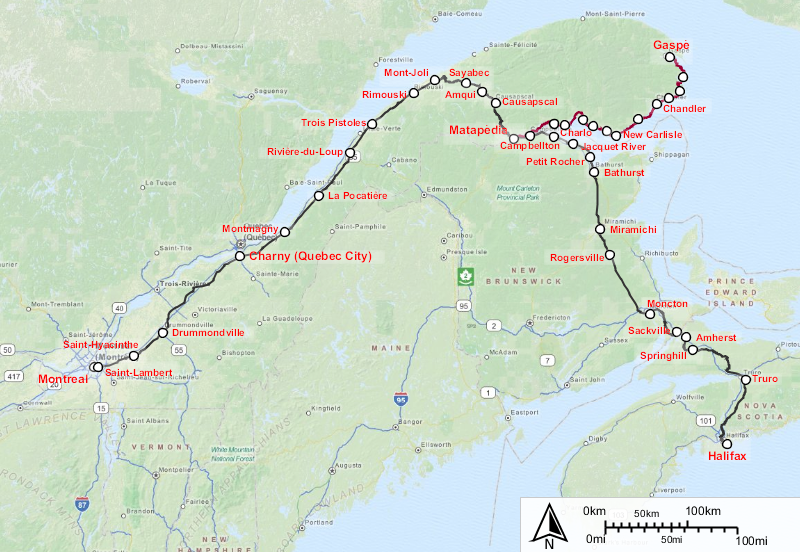
The route of the Ocean.
My JourneyAs I viewed the Ocean for the first time, it looked like a baby Canadian and my room was in the same position in the consist as had been on that train. I entered VIA 8229 "Chateau Viger" and found my roomette number three just as elegant as on the other train, but without a guide. I walked back to the Park Car and up into the dome, found a Canadian National Atlantic timetable. I went downstairs and asked the bar attendant whose it is he replied that as you found it, it is yours. I took my newly-found prize back to my room before returning to the Park Car to get a drink for departure.
We departed Montreal one hour and twenty minutes late due to the storm which had delayed me for the second time and entered the darkening evening sky, going past the Canadian National yards before crossing Victoria bridge over the St. Lawrence River, providing a great night-time view of Montreal's skyline and the site of Expo '67 with its geodesic dome lit up on St Helen's Island. With our arrival at St. Lambert, I decided to return to my room and spent the rest of the evening in solitude, where we stopped at Sainte Hyacinthe and Drummondville. By that point, I called it a night and fell asleep in my roomette.
7/1/1991 While I slept, the train was affected by the storm for the third time and we only made our way across Quebec City where the storm knocked out the railroad's signalling system, thereby meaning we could only travel at ten miles per hour and had to stop at all dark signals and ask for permission to pass each one of them, so for four hours, we proceeded northeast in this manner. I was completely unaware of this until I awoke not knowing where we were. I went up into the dome car and when we arrived at the next station, I saw the sign of Amqui and per the conductor, were now running five hours late. As on the Canadian, the advantage of this is that I would be able to see some of the scenery normally passed through at night, so would see eastern Quebec, all the way across New Brunswick and Nova Scotia to Halifax in daylight.
Leaving Amqui, we crossed Amqui River and a few minutes later, passed Lac-au-Saumon, the first lake of this new morning before arriving at Causapscal. Outside of town, I spotted a covered bridge, the first of three that we passed in this forest then we came upon our last stop in this province, Matapedia, which is a major junction since the Canadian National line to Gaspé leaves the main line here, and is the route of VIA Rail's Chaleur. Additionally, the other junction is of the Matapedia and Restigouche Rivers into Chaleur Bay, the body of water that leads to the Atlantic Ocean.
We crossed the Restigouche River as we departed Matapedia and entered New Brunswick, my next new province through which to travel, and went through a tunnel, which was unexpected, then arrived at Campbellton where the train was serviced. To the left was the high bridge that crosses Chaleur Bay to reach the Gaspé Peninsula. From here, the brief trip along its shoreline was interesting as I always find marine environments. As we continued to the northeast, the Gaspé Peninsula increased in its distance from us as the bay became larger and there were many islands of various sizes. We cut inland and soon arrived at Bathurst, where I decided to go back to my room and reflected on how far I had travelled across Canada and the miles still to go today. We crossed the Nepisiguit River, which flows into the bay of the same name and the landscape was heavily forested all the way to Newcastle. I had an excellent view of the town, whose name reminded me of Newcastle, England, where the Nice with Keith Emerson wrote the Five Bridges Suite and as we arrived at the VIA station, I could not get that song out of my head. We left town and later crossed two rivers, the Miramichi and Southwest Miramichi, before entering a siding for a freight train, then entered Rogersville before continuing our forest trek to our stop at Moncton, our next servicing stop.
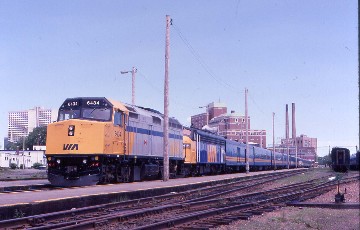
Our train in Moncton. I bought a newspaper which had the headline of "Earthquake Strikes Los Angeles", stating that a 7.5 magnitude quake hit, but nothing about where or what time. Even though I was on the other side of the continent, I thought about home and would call after I arrived at Halifax. Leaving Moncton, the trees had given way to fields with dairy cows and sheep then my sleeping car attendant came to tell me that since we were running four hours late, VIA was offering a free meal in the dining car. I walked forward and had a lunch of North Atlantic cod with steamed potatoes, which passed the time until our next stop at Sackville. Between here and Amherst, we crossed some wet lowlands before entering Nova Scotia by crossing Missaguash River into my final province of the trip, and the last of the new Canadian ones on this cross-Canada journey.
We came to our first Nova Scotia stop of Amherst and I walked forward to the lounge for the coach passengers, then when we reached Springhill Junction, I returned to the Park Car and started walking down the hall along the car's wall under the dome, when I noticed a vehicle was approaching the train on a road that I thought crossed the tracks. The road became closer with the driver speeding up so I knew he was trying to beat the train across the crossing. Suddenly, the train went into full emergency braking and I went flying down the hallway through the air like Superman but luckily, I managed to outstretch my arms because I flew right into the wall, where the hall bends before rolling backwards, stopping even with the entrance with the bar as the train came to a hard stop. The bartender, who had been thrown over the bar, came over to make sure I was all right and said that he saw me flying through the air then heard a loud bang before he went flying up and over. I responded that I was all right and had always wanted to fly but knew I would hate the landings.
I returned to the dome car for the remainder of the journey to Halifax and we crossed Folly Lake 84 feet above the water, another surprise of this trip, before our penultimate stop at Truro, located on the tip of Cobequid Bay, which is the upper reaches of the Bay of Fundy, which has the highest tidal range in the world. The train returned to the rolling landscape as we passed Shubencadie Grand Lake and its nice waterfront housing. As we approached Halifax, we passed Bedford Basin with its many harbourside actives and on the far end was the suspension bridge to Dartmouth. The train cut through the hills before running along Halifax Harbour with its docking facilities and entered the station, passing the line of stored RDC's, and stopping, thereby ending my eastbound cross-Canada journey at the end of the rails at the Halifax Station.
I had come all the way across the North American Continent from the Pacific Ocean to the Atlantic Ocean and fulfilled one of my goals and dreams. Now I would rest a few days before I returned west.