



My parents were planning to go to a National Miniature Conference in Cincinnati, Ohio and during their discussion on how to get there, they asked me about taking the train to Cincinnati and if I would like to accompany them. I decided I would, which led me to plan my most extensive Amtrak trip to date, ending up taking me coast-to coast-across the country, to both the northeast and southwest corners of the Amtrak system. I booked all segments in sleeping cars, so my total rail fare was about $1,000 - $325 for the three region All Aboard America fare and $775 for the sleeping car space. Of that, about half was for the rooms from the West Coast to Chicago and back and in the east, my rooms would be two roomettes and the economy of four slumbercoaches. Meals were always included with your room except for the slumbercoaches.
My brother Jon drove us to the Fullerton station on the day of departure and after a short wait, a headlight appeared down the tracks from the west and signalled the start of my first cross-country train trip.
The Desert Wind 36 7/12/1990We boarded our Superliner sleeping car with me in Room 4 and my parents in Room 6. My attendant showed me the workings of the room and gave me vouchers for my meals before moving on to my parents' room, then I settled into my room for the journey through Santa Ana Canyon and the Inland Empire. At San Bernardino, I went to the lounge side of the dining car for a drink and the ride over Cajon Pass and after Summit, returned to the peace and quiet of my room which is a large advantage of travelling in a sleeping car. At Barstow, I detrained into the very hot desert afternoon during the crew change then returned to my room for the trip across the Mojave Desert to Las Vegas.
I had a 5:00 PM dinner reservation and was seated with a group of black ladies from Toledo, Ohio, who had been attending a church convention in San Diego, who said that meeting was the best time they had in their lives. They were really nice women and we shared a meal, getting to know each other. The steward came to take care of my cheque, recognized me and said that it was nice to see one of our loyal passengers and to make sure I came to the dining car tomorrow and something really special would be made. I walked away from my table feeling really thankful I had met these nice people. We arrived at Las Vegas then I enjoyed the climb north out of the city and the southern end of the Meadow Valley Wash before darkness took hold and I enjoyed the scenery in the dark under a full moon, then made up my room for the first of the eleven nights in a sleeping car.
7/13/1990 I awoke just before Salt Lake City and found we were running thirty minutes early so dressed and detrained upon arrival. With an hour to spare, I walked through the depot to the park where Union Pacific 4-8-4 838 was on display then upon my return, saw our car being put on the rear of the California Zephyr, but there was no sign of the Pioneer. Our dining car staff, led by the steward, came up to sadly inform me that they were going to Seattle and to have a safe trip. I asked the conductor what happened to the Pioneer and he told me that it had been behind a freight train derailment and lost about three hours so instead of holding us in Salt Lake City, they would run via Wyoming and should be in Denver waiting for us when we arrive tonight.
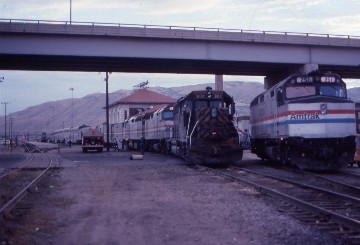
We departed Salt Lake City on schedule and after the yard limits were passed, sped down the Rio Grande main line to Provo while I had breakfast, then went to the lounge car for the climb over Soldier Summit and just after the Gilully Loops, there was a knock on my door and my attendant was there, looking worried and asked if I knew CPR. When I answered in the affirmative, she asked me to help and took me back to Deluxe Bedroom C, where one of the black women, with whom I had dinner last night, was on the floor. I checked for breathing and a pulse and finding neither, started CPR on her. A minute later, the conductor came and after I asked him if he knew CPR, which he did and he took over the chest compressions and I did the breathing. We both did this until we arrived at Helper, when a doctor boarded and pronounced her dead; the conductor and I looked at each other in disbelief. They removed the body from the train and after we answered a sheriff's questions, the California Zephyr departed with me in a very somber mood.
I returned to my room and what had just happened made me think of the power of death. This lady was having the time of her life one day and death took her away the next. I began to realize she was doing something she truly wanted to when she was taken, and I just hoped that when my time comes, I would be that lucky. We departed Helper forty-five minutes late and my sleeping car attendant came to my room, shut the door and thanked me for all I tried to do then broke down in tears in my arms about the loss of her first passenger. I gave her some advice on how to handle it, made a few jokes and told a few stories, which put a smile back on her face so she could return to work and face the remaining passengers. I told her I was always here for her until Chicago, then fixed a drink and drank a toast to her memory. May God now take good and loving care of her!
I returned to the lounge car just as the train was making its way out into the Utah desert and sat staring out at the Book Cliffs until we crossed Green River and was amazed at the shapes I couuld see in those cliffs. This desert was unique as there was nothing to hide the awesome beauty and it was also very peaceful to look at and I needed this serenity on what turned out to be an emotional dark day. We briefly stopped at Thompson, where we picked up a lone passenger then descended to Westwater and almost as if it were magic, my mood changed as I saw the Colorado River, which meant my favourite canyon, out of the many I have travelled through, was next, the wonderful "people free" environment of Ruby Canyon.
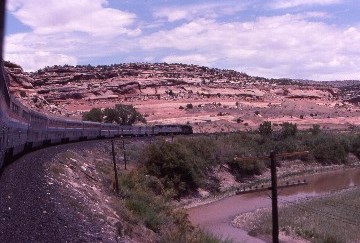
I went back to my room for my camera then went downstairs to open the window and photograph the train, the canyon and the incredible beauty of this place. Upon exiting Ruby Canyon through a tunnel, I decided to go to the dining car for lunch before we arrived at Grand Junction, our next servicing stop, then detrained during our ten minute stop to see if Bob, whom I had met on the Rio Grande Zephyr in 1983, was still working the baggage room. I was told that Bob was in Denver working the baggage room and thought that maybe I would run into him there. I reboarded, but the train sat for another fifteen minutes waiting for a Rio Grande freight to clear, allowing our departure on a clear signal. The train passed through De Beque Canyon, meeting our westbound counterpart at De Beque siding, then we continued through Rifle to our next station stop of Glenwood Springs, where I returned to the lounge car for a river- side seat prior to our arrival.
Glenwood Canyon was passed through with the Interstate Highway construction in full swing and it would be interesting to see what the canyon looks like when the whole project is complete. I went to my room to wait for a dinner reservation and requested 5:00 PM since I prefer to eat early because the dining car never runs out of food during the first seating. Once we reached Dotsero, the junction with the Denver and Rio Grande Western line to Pueblo, we turned north and were now proceeding through Red Rock Canyon before passing through Bond, followed by Gore and Byers Canyons. Upon exiting Byers, the first call for 5:00 PM dinner reservations was made so I went to the dining car for a New York steak and dessert, which was excellently prepared, then returned to the lounge car for some after dinner drinks. We stopped at Granby and Fraser then climbed the last miles to the Moffat Tunnel and after passing through the bore's darkness under the Continental Divide, we descended the Front Range of the Rockies. Once out of the canyons, darkness took hold and a sea of lights turned on out on the plains and became more intense as the darkness of the night grew. On the curves, you could see the lights of our train as it twisted and turned then the lights of Denver now shone brightly and after rounding the Big Ten Curve, we made a beeline for them.
Over the public address system was heard: "Ladies and Gentlemen, next stop is the mile high city of Denver. For our passengers going past Denver, with our late running, we expect to be in Denver only a short time, so if you get off the train in Denver, you must remain in the station until the reboarding announcement is given. Thank you for riding Amtrak." We reversed into Denver Union Station one hour late but there was no Pioneer in sight. Once inside the station, I heard that the Pioneer was delayed and upon receiving a less-than-satisfactory answer to my question of where it was, I called the Union Pacific Dispatching Center and explained who I was and what I was doing. I received a friendly answer that it left Ogden three hours late, the crew died on the law at Rawlins and it should be in Laramie right now. I thanked them and asked when it was scheduled to arrive, receiving the time of 12:30 AM in response. A further thank you and an invitation to call any time I needed to know about Amtrak trains on the Union pacific was given.
I wandered into Grandpa's Depot which has some railroad souvenirs and met a couple whom I had chatted to in the lounge car earlier this evening, then bought a California Zephyr towel from the original California Zephyr and explained the Pioneer's difficulties and the 1:30 AM ETA and the couple suggested we go across the street to Wynkoop Brewery so we did and told stories of our train riding. About midnight, we decided to go back to the train and found the station lobby full of people but I suggested we go outside to the baggage room and were halfway there when I heard my name called and there was Bob. After a few minutes of pleasant conversation, he escorted us back to the train and my sleeping car attendant was waiting for me and welcomed me back, informing me that my bed was made up and thank you for helping me get through this morning. I could not have done it without you. We hugged and I went upstairs and off to bed.
7/14/1990 The next morning, I awoke on new mileage on the Burlington Northern as we entered McCook, Nebraska, the first stop in the Cornhusker State. We should have been here about midnight but at this point, were running six hours late and unless a miracle happened, I would miss my connection in Chicago. That thought quickly faded as I realized I was riding on new trackage, so was going to see as much of the countryside as possible. I walked up to the lounge car and found a very nasty crowd upset about being late. I found the couple from last night and in a loud voice, proclaimed that we were going to get see almost all of Nebraska, something that never happens if we are running on time. People stared at me but I could tell that my words were sinking in as the meanness in their faces turned into smiles and nice conversations returned. Several passengers thanked me for pointing out what they should have realized and I was in the right place once more to help people.
Our train was travelling through the rolling hills of southern Nebraska with each small town having at least one grain elevator, if not two or three. There were wheat fields everywhere in between and after seeing scenic Nebraska in the daylight, I now knew why they pass through here in the middle of the night. During the morning, we stopped in Holdrege and Hastings before arriving in Lincoln, home of the University of Nebraska. The countryside had turned flatter with crops other than wheat. Leaving Lincoln, we passed a Burlington Northern yard and shops before continuing to Omaha and entering town through a canyon under a maze of highway bridges, which led to the Omaha Amtrak station, near the Missouri River. Departing here, lunch was announced and I was number 67 on a waiting list, then we paralleled the west bank of the Missouri River for about thirty minutes before crossing the river and entering Iowa, not what I expected. I assumed that it would be extremely flat, but it was anything but that since there were undulating hills with a river dissecting its way through it. While I still saw a lot of wheat, I started to see corn, for which Iowa is known. We passed through Creston and Osceola then crossed the Des Moines River before arriving at Ottumwa, hometown of Radar O'Reilly of "MASH" fame, played by Gary Burghoff. Continuing east, we stopped at Mount Pleasant and then wound our way to Burlington, our last stop in Iowa.
As we were crossing the Mississippi River and entering Illinois, my name was finally called for lunch and once in the dining car, the steward sat me at a table and he explained that since the Desert Wind's dining car did not go to Denver yesterday, the diner was out of food but at Galesburg, enough Colonel Sanders Kentucky Fried Chicken will be brought on to feed all who have not had lunch. I was asked if I was connecting in Chicago and when I responded that I was, I was told Amtrak service personnel would board at Princeton to assist all connecting passengers. I went back to the lounge car until Galesburg and once we departed there, the call of "42 through 97, your meals are ready!" Everyone received a box with a complimentary three-piece dinner with all the fixings and a soft drink. It actually hit the spot and I left feeling full and returned to my sleeping car to get my parents so they could be first in line to find out what plans were in store so they could reach Cincinnati, and I could continue my journey.
With the arrival in Princeton, all connecting passengers were waiting their turn in the lounge car. My parents went first and were given vouchers, one for taxi cab fare and another for bus fare for the midnight bus to Cincinnati. They walked away happy, at least my mother, since she would arrive in time for the first meeting of her miniature convention the next morning. It was then my turn and I showed a printout out of my schedule and asked if I could take the Broadway Limited to Philadelphia then a corridor train to Washington, DC to resume the rest of my trip. The lady thanked me for thinking of another way to get to Washington, DC and commented that they could not have done it so quickly. I walked back and told my parents of my new plan then my sleeping car attendant stopped by and found one excited passenger. The sun had now set and we travelled the last remaining miles into Chicago under the cover of darkness, arriving at Union Station exactly five hours late, with segment number one completed.
The Broadway Limited 40 7/14/1990I detrained from the Zephyr and on the next track over was the Broadway Limited. I asked one of the coach attendants which car I should board and he said to choose any one you want as they were all going to the same place. I started walking along the train, bypassing Amfleet coaches then saw my car, a heritage coach, with a square box on its side. My memory went into high gear, former Southern Pacific, forty-four seats, seats recline almost flat - perfect! I boarded "Golden Sands" for my unexpected journey to Philadelphia and was the first passenger to board, so connecting passengers were obviously allowed to board first. A few more familiar faces from the Zephyr were seen, followed by the general masses and we departed into the night exactly an hour late.
The conductor came through to collect tickets and stopped me from telling him that he was not supposed to take my ticket as I was instructed by service personnel. He pulled it apart, looked at it and realized his mistake and I asked him to write a note and sign it saying that he mistakenly took it and returned it to me for further passage. He disappeared for a few minutes then returned with some scotch tape and a nice note and apologized for the mix-up, saying that he was doing the job the best he could in a speedy manner. I asked him to always listen to a passenger when they were trying to explain an odd situation and he responded that he wished all his passengers could be as nice.
While the above was occurring, I had not noticed the air conditioner was working extremely well and it was becoming really cold. I had not prepared for an overnight coach trip since I had booked a sleeping car every night of the but then went to the lounge car and saw an Amtrak souvenir blanket, which I purchased and it kept me nice and warm.
7/15/1990 The next morning, the first place I noticed was Beaver Falls, Pennsylvania, the hometown of Joe Namath, the great New York Jets quarterback. We began following the Ohio River, making our way past working and abandoned industries, then past Conrail's rather large Conway Yard before entering Pittsburgh. I saw the Golden Triangle, the triangular-shaped downtown district, which lies at the fork of where the Allegheny and Monongahela Rivers converge to form the Ohio then we crossed the Allegheny River and into Pittsburgh's Amtrak station, the next servicing stop.
We proceeded into an area of heavy coal mining and our next stop at Greensburg was located in the middle of it. After that, we began to cross the Allegheny Mountains by passing through the Packsaddle Gap cut by the Conemaugh River. Our next station stop, Johnstown, was well-known for its famous flood on May 31, 1889, where in a mere ten minutes, every building in town was destroyed and it ranked second in most deaths in a disaster after the Galveston Hurricane of 1900, which registered over 6,000 people killed.
From Johnstown to Altoona was the legendary crossing of the former Pennsylvania Railroad (Conrail) and the Allegheny Mountains. We passed Cresson, where helper engines are kept to assist eastbound trains up the one percent grade to Gallitzin, where trains pass under the summit 2,200 feet above sea level in a long tunnel. That summit marks the watershed divide, with water flowing east into the Atlantic Ocean and water flowing west into the Gulf of Mexico via the Mississippi River. Upon exiting the tunnel, I was ready for the engineering marvel called the Horseshoe Curve.
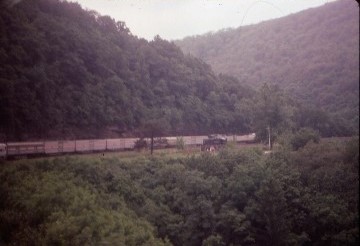
We started into the curve by turning left before the start of the larger sweeping curve to the right. Thanks to the material handling cars, we were long enough for that the whole train was photographable. On display at the Visitor Center was a Pennsylvania Railroad GP9. We finished that sweeping curve then made one more to the left and the highlight of today's trip was over, then we returned to the twisting and turning descent to our next stop at Altoona, where the Pennsylvania Railroad shops were located and the part near the station has become a museum. We continued our descent, next stopping at Tyrone then upon our departure, we travelled along the Susquehanna River and I saw the ill-fated Three Mile Island Nuclear power plant. We turned away from the river, climbing a slight grade to our next station at Lancaster then proceeded into Amish country, so I began to see some horses and buggies and was rewarded for my patience as I counted fifteen before our next stop at Parkesburg where a group of school children detrained. We sped off to our next stop at Paola and it was a few minutes later that the Broadway Limited passed Zoo Tower, Amtrak's yard and into Philadelphia's 30th Street Station. I detrained and went upstairs into the station, with its giant statues guarding the waiting room, to wait for the next corridor train to Washington, DC.
The Bay State 71 7/15/1990I walked down the tunnel to Track 12 and just as I reached track level, the twelve-car, two-engine Bay State arrived. Since this was a high loading platform, all the doors on the Amfleet and former Metroliner cars opened, so all I had to do was walk in, a first for me on Amfleet equipment, and I found a window seat on the right. We departed Philadelphia accelerating to 60 mph immediately through a turnout, then reached 75 mph on a curve and 90 mph on a short piece of tangent track before we rounded a curve and the engineer opened it up to 120 MPH, the fastest I had ever travelled on a train. It was a most impressive show of speed and I was living one of my railroad dreams, riding down the Northeast Corridor at high speed.
We met trains at speed on this multiple-track high-speed main line where all the grade crossings had been removed and most of the line was now fenced. Leaving Philadelphia behind, we sped on to our next and only stop in the state of Delaware at Wilmington, which lasted but a minute. There really was an advantage to high-loading platforms. We were in Delaware for just twenty minutes before we entered Maryland and just south of Perryville, crossed the Susquehanna River for the second time today and it was much larger here at its mouth where it flows into Chesapeake Bay. From here to Baltimore, we crossed three other rivers which empty into Chesapeake Bay, the Bush, Gunpowder and Middle Rivers, then passed the row houses of Baltimore before we arrived at Pennsylvania station.
Departing there, we plunged into the Buffalo and Pittsburgh Railroad tunnels before we resumed our high speed to our next stop of BWI (Baltimore-Washington International Airport), where quite a few passengers in my car detrained and within a minute, we resumed our high-speed journey and zipped through Bowie before braking for our next stop at New Carrollton, which allowed Amtrak passengers to connect with the Washington Metro Subway. After another brief stop, we continued towards our last stop at Washington, DC, passing the Amtrak coach yards, the Ivy City Diesel Terminal and where the Baltimore and Ohio line joins. I realized that if all goes according to plan, I would be arriving at DC on that line in four days. We arrived at Washington Union Station ten minutes early, ending a most interesting detour with the highlights of the Broadway Limited, the Horseshoe Curve and a daylight run down the Northeast Corridor. I would still be able to ride the route of the Cardinal, so the tardiness of the Desert Wind/California Zephyr turned out to be a blessing since I would not have been able to experience any of those had we ran on time on that first segment.
Washington, DC 1 7/15/1990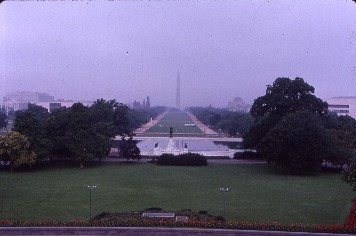
I entered Washington Union Station on a Sunday night and discovered a shopping mall inside the building. However, almost everything was closed but as I was going to be back here two more times on this trip, decided to get a feel for the place, which had a post office, liquor store, automatic teller machine, railroad hobby shop and various other stores. On the lower level was a food court and in the Grand Hall, a restaurant and a bar, which just happened to be opened. I spent nearly an hour having a couple of drinks and enjoying the architecture of this magnificent building. My server suggested I go outside for a night-time view so followed his advice then on the way back to the waiting room, found some lockers which I thought might be useful later on. I walked past gate after gate until I found the one which read "Night Owl" then listened to music on my headphones and did word search puzzles for two hours until I heard the boarding call for sleeping car passengers, then walked through the gate to the waiting train.
The Night Owl 66 7/15/1990One of my goals on this trip was to ride the entire Northeast Corridor and spend a full day in Boston without having spend a night in a hotel there. I studied the schedule and the Night Owl proved to be the answer to both. I boarded former Union Pacific 10-6 sleeper "Pacific Lodge" and had Roomette 1 in the middle of the car, found my room with the bed already made up with a wine and cheese basket plus a split of wine and a packet of writing paper. My attendant came by to tell me he would bring me a continental breakfast in the morning and the lounge was open for sleeping car passengers. We were on our way to BWI before I pulled down the shade and fell asleep and at times during the night, the train reached speeds of 120 mph on its way to New York.
7/16/1990 I awoke in Massachusetts as we were making our final run towards Boston. While I was asleep, the train passed through parts of Maryland, Delaware, Pennsylvania, New Jersey, New York, Connecticut and Rhode Island and was pulled by an electric locomotive from Washington to New Haven and by a diesel the rest of the way to Boston. My breakfast arrived consisting juice, doughnuts and other assorted pastries, then my bed was made up and the room returned to a seating area as we arrived at Route 128, a suburban stop for the greater Boston area, which is really a large park-and-ride lot. We sprinted to our next stop at Back Bay before I enjoyed the entrance into the city of Boston and arrived at South Station on time, ending my ride up the Northeast Corridor.
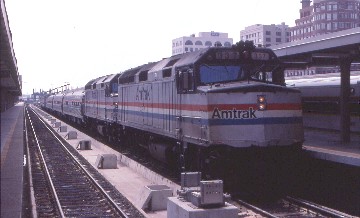
The Night Owl at rest at its final destination of Boston.
Boston 7/16/1990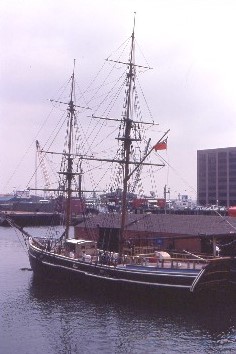
As I detrained, I asked my sleeping car attendant what the best way was to see Boston in a short period of time and he recommended a bus tour because they let you off anywhere you want to look around and you can re-board for no additional charge. He told me to go five blocks north of the station to catch it so I walked through South Station, which was just a head house of the former great station, and out onto the streets of Boston, following his directions and after walking five blocks, I found the Sightseer Bus.
I paid the man $7.00 for what could be a one hour tour, or an all day event if I chose. I boarded the bus and off we went, the first stop being the old North Church ("One if by land and two if by sea!"), then we crossed the North River to Bunker Hill ("Don't fire until you see the white in their eyes!"), then back across the river to Boston Garden, where I saw an open door so I debussed. I walked up to the front door and was met by the security guard and asked if there was any way I could look inside to see where the great Boston Celtics beat the Los Angeles Lakers in what always seemed like a seventh game, as well as the banners the team has won hanging from the ceiling. He replied very positively and said I could stay as long as I wanted. I entered the hallowed Boston Garden, walked out into the middle of the floor and stared up. It was so impressive as all the memories of those great games returned and looked up at all the empty seats, now knowing what the players saw. It was an incredible experience and I walked out, thanking the guard for making a basketball fan's dream come true.
I boarded the next bus, which took me by the Boston Commons, by Harvard and the bar used for the outside shots on the television show "Cheers". The interior did not resemble the television version, but I had a drink anyway, and learned the bar in the show was a block away from South Station, so I knew where I was having lunch. Back on the bus, we went past the Hancock and Prudential buildings before we swung by the waterfront to the Boston Tea Party boat, where I again got off and toured the boat, paying a small price to thrown a phony bag of tea into the harbour. I returned to the bus to the end of its route, then walked back towards South Station finding "Three Cheers" and the bar exactly as it was on "Cheers." I ordered a beer, sat in Norm's seat and ate some buffalo chicken wings, the first time I had tried them.
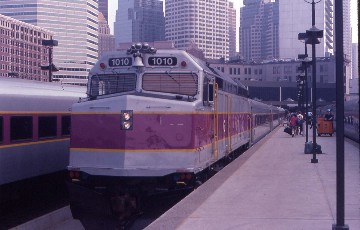
Returning to South Station, I noticed there was a commuter train going to Forest Hills so I bought a ticket and boarded, noticing the cars were similar to the Horizon fleet cars Amtrak has, except the seating was 2-3 rather than the standard coach arrangement. After all, Massachusetts Bay Transportation Authority, commonly known as "T", is a commuter railroad. I was the sole passenger as the train departed, then we stopped at Back Bay before arriving at Forest Hills, which just happened to be on the Northeast Corridor. I enjoyed my twenty minutes there before reboarding on a nice summer New England afternoon and returned to South Station, after letting a couple pieces of Amtrak equipment move across the river before the station, thereby giving me chance for a concentrated view of the Boston skyline standing out against the blue sky. I returned to "Three Cheers" for some more food before ending my Boston experience by returning to South Station to board my next train.
The Lakeshore Limited 449/48 7/16/1990Since the Lakeshore's Boston section dinette only served tray meals, rather than having a dining car, my decision to eat beforehand was a good one. I was riding in a sixty seat long-distance Amfleet coach to Albany, where I switched to my a Slumbercoach, my first experience with that type of accommodation. As the conductor took my ticket, he explained the move I would make in Albany, since my Slumbercoach was on the New York section of the Lakeshore. I went to the lounge car as we departed Boston on time and within minutes, a gentleman joined me, who turned out to be a Conrail engineer and we started talking and he informed me he was based in New York and was dead-heading home and I told him about my trip riding around the United States and California. Since the engineer on our train was a friend of his, at Framingham, he ran to the front to see if I could have a ride across the Berkshire Mountains in the locomotive.
After the station stop, he returned, said it was all set and we would detrain at Pittsfield and ride in the front. The conductor walked by and told me to have my bag at the ready so we would not cause any delay at Pittsfield. I returned to my coach and collected my bags then returned to the lounge car where my new friend pointed out the countryside and since this was his normal run, knew the route off by heart. While we talked, the train stopped at Worcester and Springfield, crossed the Connecticut River and left the valley to start the climb up the Berkshires.
The conductor walked us through the sleeping car then at Pittsfield, detrained, walked past the baggage car and climbed up into the F40PH. The engineer asked if I had ever been in the cab of a locomotive before and I answered in the negative, so he responded that the first one was always the most special and I could not have picked a better run on which to experience. The sun had just set and the headlight was beginning to take effect. I thought to myself that I had never had a cab ride before and on this trip, what was I just about to experience, apart from the great life-long memories. Looking out of the cab, I was in heaven as there was no better view than a forward view from a train. My engineer then asked if I had ever blown a locomotive horn, and again, I answered in the negative. He invited me to do so and at his command, to blow two longs, one short and one long as we crossed a dirt road ahead". I blew the horn and when done he remarked that that was perfect and I was to do the next four, so when I saw the markers, I did just that.
He complimented me by saying that I was a natural and with that, I returned to the fireman's seat as we approached the State Line Tunnel, plunging into it and exiting in New York, where we met an eastbound Conrail freight. We descended the grade, swung off the Conrail Boston-Albany main line and travelled down twelve miles of track before arriving at Albany-Rensselaer, ending my first cab ride. I thanked the engineer and his only request was that I not use his name, and I promised I would honour the request. I climbed off the engine with my bag, ending a wonderful educational experience and was now about to have another new experience, that of a Slumbercoach.
As I walked into the station, I listened to an announcement that the New York section was going to be an hour late so I started to do word search puzzles and by the time I had completed the fourth one, the train had arrived. All the switching was done and I could now board my first Slumbercoach, named "Tonawanda Harbor", in a 16 double-10 single formation in 1961 from New York Central 22-roomette "Tonawanda Harbor" built in 1949. My room featured floor-to-ceiling space, something I learned was unusual in Slumbercoach rooms, but since this was room one, it made sense. I made the bed and unlike the roomette, I still had access to the bathroom. Best of all, the price was right and the Slumbercoach was the best bargain on rails. I celebrated one of the greatest days of travelling in my life, after a fantastic day yesterday, and wondered what tomorrow would bring. I fell fast asleep as the train proceeded west down the Water Level Route of the former New York Central, now Conrail) in an former New York Central Slumbercoach. What could be better?
7/17/1990 The next morning I awoke from a wonderful sleep just as we were leaving Cleveland, Ohio so during the night, I had slept across upstate New York, the northwest corner of Pennsylvania and part of Ohio. I walked the six cars forward to the dining car for a breakfast of hot cakes and sausage then returned to my room to enjoy the view as we paralleled the shore of Lake Erie all the way to Sandusky Bay, the main scenic highlight on this morning's trip. We crossed the bay before arrived at Toledo, running an hour late after waiting for two Conrail freights to clear. During the servicing stop, I went for a good walk and stretch before the westward journey resumed.
Curiosity had been nagging at me regarding what the car behind was so I went to explore and found it to be a crew dormitory-baggage car. I then heard a voice saying that I was not supposed to be here but recognizing it, turned around to see that it was my sleeping car porter from the Sunset Limited on a Deming, New Mexico-to-Los Angeles trip I took a few years ago. As he realized who it was, he remembered that I was the gentleman who wrote the nice letter to Amtrak stating what a good hard worker he was, which helped to get him promoted to Train Chief and this was his regular run. I explained my trip and he offered me a shower, which I gladly accepted after five nights on the road. Afterwards, he returned and said that I could have anything I wanted in the lounge car and it will be charged to his account and it was his way of saying thanks you and that he would always be grateful to me. I thanked him and off he went. It was nice to know an occasional letter does some good for someone and he was the perfect example for Amtrak to promote. I went to the lounge car and I ordered a screwdriver and the Lead Service Attendant gave me a second one go to and wished me an enjoyable and memorable trip. For the third straight day, incredible luck was with me and the streak was still going strong.
We were on a section of railroad that is 68 miles straight without a single curve, one of the longest in the United States. The countryside was flat farmland and the train sped down the double track main line, stopping briefly at Byron before crossing into Indiana and our next stop at Elkhart, where the National New York Central Railroad Museum is located. We then passed through Conrail's Elkhart Yard before we returned to high-speed running across the flat lands of Indiana. West of Elkhart, we encountered three eastbound Conrail freights, one following another, then stopped at South Bend, home of my parent's arch enemy college of Notre Dame, as they are both University of Southern California graduates. The train quickly regained speed and as I finished my last drink as we travelled through Porter, where Amtrak trains to Michigan divert from this route. I returned to my room as we passed the steel mills of Gary, which I remember from the family camper cross-country trip in 1971 as the smoggiest place I had been, and today was is living up to that memory. I glimpsed Lake Michigan before finally receiving a clear view of it in spite of the smog and as we left the Gary area, the air visibility improved.
We made our way to the last stop in Indiana at Hammond-Whiting before riding the final miles to Chicago. The skyline of Chicago stood out against a hazy sky before we passed another steel mill then crossed the Calumet River and entered Illinois. We passed through a Conrail yard and went over the Illinois Central main line, past the homes on the south side, followed by Old Comiskey Park, home of the Chicago White Sox and the new Comiskey Park which was under construction. As we entered Amtrak's Chicago maintenance base, the train pulled around the wye before reversing into Chicago Union Station and my attendant told me to remain in my room for a surprise. We arrived forty-seven minutes, late thus ending my first trip on the Lake Shore Limited.
Chicago 7/17/1990This was the second time during this trip I had been to the Windy City and was going to be able to see some of it, since on the last stop, I just switched trains. I waited patiently in my room for the Train Chief who finally arrived and offered to take my bags, asking if I had any plans. Upon hearing that I did not, he led me to the basement where I was able to store my bags and have a shower for free by just showing my tickets. I dropped off my bags then was given the recommendation of Sears Tower two blocks away and the double-decker bus tour of Chicago.
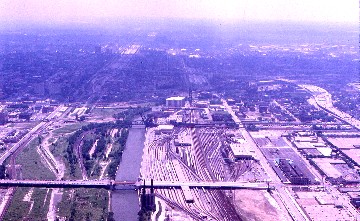
I followed his advice and began walking to Sears Tower, stopping at the Taste of Chicago show before going to the top of the world's highest building. It was not surprising that my favourite side was the one which overlooked Amtrak's maintenance base. After having my fill of the fantastic views, a fifty-two second elevator ride took me back to ground level and I went out into the streets of Chicago and found the double-decker bus tour. Since it was a nice summer afternoon, I opted for the upper level open air seat and we journeyed east towards Lake Michigan, then went south on Lakeshore Drive out to the Museum of History, and Museum of Science and Industry to Soldier Field. We turned around and drove up Lakeshore Drive passing Navy Pier and the wharves on Lake Michigan before we passed the classy waterfront apartment buildings, then circled to the north of downtown Chicago, crossed the Chicago River twice before returning to our point of origin.
I had now seen Chicago from above and at ground level but needing some refreshment, went to a bar across the street which turned out to be a White Sox bar and since pitcher Bobby Thigpen was on my fantasy baseball team, I felt right at home. Returning to Union Station, I showered and felt completely refreshed then gathered my bags and with a forty-five minute wait before departure, went to Amtrak's first class lounge, ordered a soft drink and waited for my next train to Harpers Ferry, West Virginia.
The Capitol Limited 30 7/17/1990The sleeping car passengers boarded first so I walked out to the train, boarding the second sleeping car, "Pine Grove", and located Roomette 3, complete with the customary wine and cheese basket. Departure time came and went and my attendant stopped by to let me know we were waiting on late western trains and asked if I wanted a 5:30 or 7:00 PM dinner reservation. Since it was now 5:25 and we were not going to be moving for a while, I chose the early one, and was nicely surprised to find the dining car tables all had linen and real china, rather than the plastic items on all the other trains. Amtrak was experimenting and if successful, would be expanded to other trains. I had a New York strip, baked potato, corn, dinner rolls and wine, along with ice cream for dessert. Perhaps it was the china, but the meal was one the best steak dinners I had had on Amtrak. We were still sitting in Union Station at the end of my meal and I went to the lounge car then we finally moved an hour and twenty-three minutes late.
This train featured a dome car so I chose the first forward seat on the right, which gave me a completely different view than I had three nights ago. We followed the now-familiar route through Hammond-Whiting, Indiana to Pine Junction where we turned southeast off the route of the Lake Shore Limited, on which I had travelled this morning. In fact, I was on the same trackage of the Broadway Limited to Pittsburgh, just a different train with a different consist. We made our way down the former Pennsylvania Railroad Chicago to New York main line, now a secondary main of Conrail, in what was left of the afternoon sun. The countryside had some rural areas as we escaped the urban grip of Chicago and stopped at Valparaiso in twilight. Darkness took hold as I watched the position signals change from green to red, and I did this through Fort Wayne and out into Ohio. I went to the lounge car then returned to my room and called it a night after another interesting day of traveling by Amtrak around the United States.
7/18/1990 The next morning I arose to find the train somewhere east of Pittsburgh on the former Baltimore and Ohio Railroad, now CSX main line and low clouds were obscuring the ridge line above the valley. I went to the dining car for a breakfast of French Toast as we stopped at Connellsville, Pennsylvania. By this time, I had finished my meal went to the lounge car before returning to the dome car as we reached Confluence. From here, the train followed the Casselman River towards Sand Patch. where the clouds were even lower as we gained elevation and there was barely enough light to take photograph a westbound CSX freight.
The Capitol Limited passed through a few short tunnels, something that is best done in a dome car because at some point you can really see the light at the end of the tunnel. We continued to twist and climb as we passed another CSX freight then at Meyersdale, we lost the Casselman River and followed Little Flaugherty Creek the rest of the way to Sand Patch Summit, 2,258 feet above sea level. We passed through the Sand Patch tunnel and under the watershed boundary, where water flowing east runs into the Potomac River and empties into the Atlantic Ocean, whereas water flowing west does so to the Gulf of Mexico via the Ohio and Mississippi Rivers. From Sand Patch Summit, we descended the steepest part of a two percent grade down the east slope of the Alleghenies and rounded a lesser-known horseshoe curve than the famous one on the route of the Broadway Limited.
We followed Willis Creek down to Hyndman, where there was still a tower and two helper locomotive sets waiting for action then continued downgrade, entering Maryland before the next stop of Cumberland, where CSX had a large yard east of the station. From here, we followed the Potomac River into the valley to the stop in Martinsburg, where a former Baltimore and Ohio roundhouse still stood. I left the dome, packed and enjoyed the last remaining miles in my roomette. As we arrived at Harpers Ferry, West Virginia, my attendant took my bag and placed it on the ground as I detrained then gave the all-clear and I watched my train cross the Potomac River into Maryland and out of sight into a tunnel.
Harpers Ferry, West Virginia 7/18/1990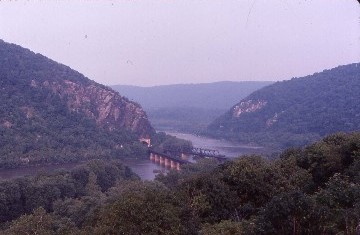
I walked through the empty station and outside to catch a taxi but there were none. Walking around, I discovered that Harpers Ferry is not a town, but a National Historical Site, since it was here that John Brown attempted to seize the town's arsenal in 1859 just before the Civil War. Brown ended his life in the gallows because of his part in the raid.
I had a reservation at the Hilltop House so asked a merchant which road would lead to the hotel and off I went up a steep hill lugging my bag. I checked in and received a room on the second floor overlooking the town and the junction of the Potomac and Shenandoah Rivers, the point where the three states of West Virginia, Maryland and Virginia meet; it was a fantastic view. I freshened up and went to explore the area then hiked across the bridge to the Maryland side and climbed the ridge with the railroad and river far below. I stayed there for two hours with nary a train so it appeared that my lucky streak was over. The view was still spectacular and across the valley was the Hilltop House in its white paint. I returned to the station and seeing the schedules for both MARC and Amtrak trains, thought that I would be able to photograph them if I had an early dinner, so returned to the hotel and ordered a Southern fried chicken dinner which was excellent and watched an eastbound CSX freight. Afterwards, I walked back down the hill and was rewarded with four trains, the first being a MARC commuter train pulled by one of their F-units.
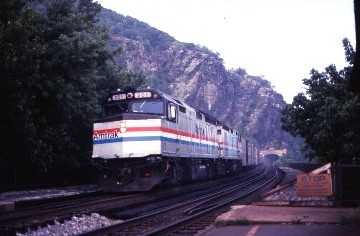
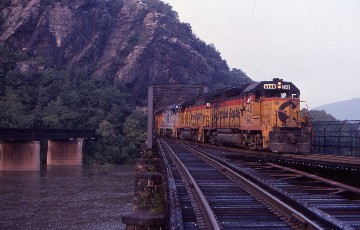
The westbound Capitol Limited, which had Amtrak's prototype Viewliner Sleeper on the rear.
A CSX freight came off the main line and onto the branch along the Shenandoah River.
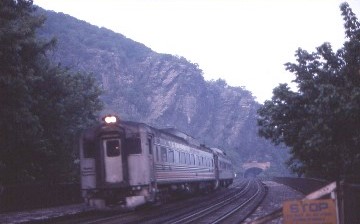
The second MARC commuter train had a pair of RDCs, which was icing on the cake. As the sun was setting and darkness taking over, I walked back up to the Hilltop House then retired for the night in my first non-moveable bed in six nights and heard a passing CSX freight right before I fell asleep.
7/19/1990 The next morning I went downstairs for breakfast and wanted something that Amtrak did not offer so chose a Belgian waffle, sausage, bacon and grapefruit juice, which really hit the spot. I packed up and upon checkout, the clerk asked me to fill out a card and how I found out about this hotel. When I wrote that it was from Passenger Train Journal, she remarked that she now knew why I had an early I walked back down the hill to the station to wait for the eastbound Capitol Limited.
The Capitol Limited 30 7/19/1990The train arrived on schedule and I boarded an Amfleet 60-seat coach, which was two cars back from the only Viewliner prototype dining car. I walked through the lounge to see it and the dining car steward noted that he was closed, but upon learning that I just wanted to look at it, gave me a quick tour, leading me though the car, including the kitchen which proved to be most interesting. I spent the rest of the journey in the dome car and sat down just as the train was passing the distinctive Point of Rocks depot. Down the line at Silver Springs, we paralleled the Washington Metro subway before entering the District of Columbia, where everyone had to exit the dome car before we reached the Northeast Corridor, then passed Amtrak's yard and arrived at Washington Union Station, ending my triangle DC-to-Boston-to-Chicago-to-DC trip. I detrained from the Capitol Limited with some more lifelong memories.
Washington, DC 7/19/1990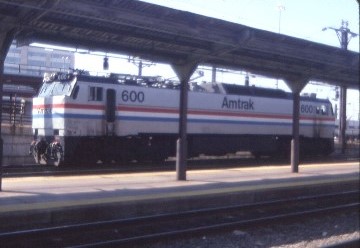
Amtrak E60 600, nee Amtrak 974, built by General Electric in 1976 on an adjacent track as I walked into Washington Union Station with an hour and a half to spare. I kept my bag with me this time and visited the railroad hobby shop, buying some magazines, followed by the station gift shop for some dome post cards then over to the post office to mail them and lastly the food court for lunch, where I enjoyed a roast beef sandwich before returning to the gate to wait for the Silver Star to arrive from New York.
The Silver Star 91 7/19/1990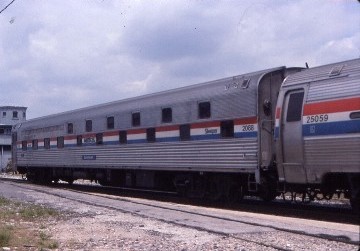
I boarded Amtrak slumbercoach 2092 "Loch Arkaig", ex. Amtrak 2092, exx. Amtrak 2033, exxx. Northern Pacific 335 "Loch Arkaig", nee New York Central 10802, built by Budd Company in 1959 and had Room 4, an upper version and everything worked exactly the same on this car as the car three days ago. We departed on time and plunged into the Capitol Tunnel then upon exiting, I saw the Washington Monument, we passed the Jefferson Monument and in the distance was the Lincoln Monument before we crossed the Potomac River and entered Virginia with a quick view of the Pentagon. We passed through Alexandria's downtown before arriving at the station there and I watched the Virginia countryside. The train picked up speed then went through Lorton, the home terminal for Amtrak's Auto Train and one was being loaded as we sped by on the double track main line of the former Richmond, Fredericksburg and Potomac, now part of CSX. After passing through Quantico, we crossed the Rappahannock River before our next stop at Fredericksburg and it was here I decided to walk the train to see its consist. As I was in the last car, I walked forward through four coaches and the lounge car, followed by the kitchen car along with two cafeteria cars (table cars), the end of the Miami section.
I then entered the Tampa section where there was another lounge, followed by four more coaches, a 10/6 sleeper with a baggage car ahead and two locomotives pulling, making a sixteen car train. I stopped at both the Tampa and Miami lounges then returning to my room, watched the Virginia forest interspersed with farms and a few little towns before our stop in Richmond at Staples Mill, located outside of town. We passed through the CSX yard and a few minutes later, crossed the James River. I had a 5:30 PM dinner reservation so walked up to the kitchen car to get a half-baked chicken, baked potato and drink and paid for it before being escorted to a table in the next car. Comparing this service to the full dining car, I will always take the latter, and as soon as I finished, I was asked to leave. I returned to my Slumbercoach, realizing we had entered North Carolina so I poured myself a drink to celebrate my arrival in this state. We were still passing through the forest as the sun faded from the afternoon sky and darkness took hold and I enjoyed the scenery in my darkened room then with the Silver Star's arrival at Raleigh, the capital of North Carolina, I made up my bed and called it a night while the train sailed southward down the main line.
7/20/1990 The next morning, I awoke in Jacksonville, Florida and throughout the night, we crossed South Carolina and southeast Georgia. My room had no power so I surmised the crew must be cutting out the Tampa section, so I pulled the shade down to fall back asleep and did not re-awaken until Ocala and the Florida version of forest. I began to see citrus groves as we approached the junction of the Tampa line, onto which we curved east but then turned south a few miles later at Auburndale. We stopped at Winterhaven and half an hour later at Sebring then went by the eastern edge of Lake Okeechobee and with every crossing, I looked for alligators. After bridging four waterways, I finally saw a group sunning themselves on the bank of the channel. My existing impression of Florida was that it was all swamps and water, not the more rolling forested lands to the north so this was something I learned. From Okeechobee to West Palm Beach, we raced along 57 without a curve, although there was a large section of 79 miles last night from Hamlet, North Carolina to past Lugoff in South Carolina. After miles of scrub pines and swamps, the train returned to the urban environment and stopped at West Palm Beach, Delray Beach, Fort Lauderdale and Hollywood. We passed the CSX yard, Amtrak's Hialeah maintenance facility before arriving at Miami Station, ending my ride on the Silver Star.
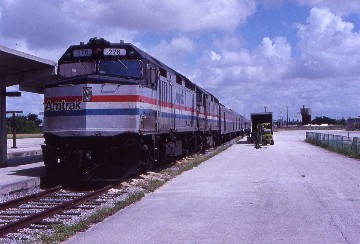
My Silver Star at Miami station, which is in name only since its location is Hialeah, miles from downtown. As such, when I planned this trip, I chose a close hotel which was at the airport.
Miami ie. Hialeah 7/20/1990I took a ten dollar taxi to my hotel then checked in with my room on the sixth floor that overlooked the airport. After refreshing myself, I walked eight blocks to a store and had been warned to be careful, which I was, then returned to the hotel and was watching "The Guiding Light" when a weather statement was came on the screen warning of strong thunderstorms. I opened the curtains to watch the nature show and the sky let loose for about twenty minutes, after which the sun returned and I walked out onto the balcony into a sauna. It was the highest humidity I had ever experienced and when the water evaporated, a fine mist arose, something I had never witnessed.
Whenever I was in a new town, I used to look through the local phone book to get a feel for the place and also to see if maps were included. Scanning the pages, I noticed something called Tri-Rail and there was a stop five blocks away. With the ground now completely dry, I walked to the station and found a Tri-Rail commuter train.
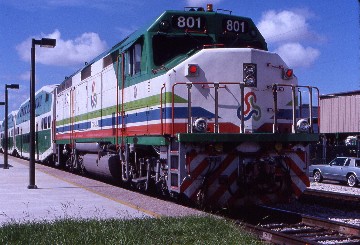
Tri-Rail F40PHL-2 801, a Morrison-Knudsen re-build from Conrail 3230 with parts from Burlington Northern 6630 and 6637, nee Penn Central GP40 230, built by Electro-Motive Division in 1968. I learned from the conductor that this was a brand new service from West Palm Beach to here and he gave me a tour of the equipment during its layover, then handed me a schedule and suggested I ride it if I returned some day. The rest of my stay in Miami was in my hotel room, where I brought myself up-to-date on the news and the weather for the cities in which I was going to be. I then ordered a Prime Rib dinner from room service, the first time I had done that before watching an evening of television and airplane landings before falling asleep.
7/21/1990 The 6:30 AM wakeup call came so I prepared myself for the day, checked out and waited for a taxi and another ten dollar ride back to the station, with a different route this time. I explored the station then found a seat to wait and it occurred to me that I had now been to all four corners of the Amtrak system: San Diego, Seattle, Boston, and now Miami, in clockwise order, although Miami will always be Hialeah.
Silver Meteor 98 7/21/1990When I planned this trip, I noticed the Silver Star had a route between Washington and Miami, while the Silver Meteor had another, so made sure I would travel over both. It was a sunny morning when I boarded Amtrak Slumbercoach 2052 "Dunkirk Harbor", ex. Amtrak 2000, exx. Penn Central 4200, exxxx. New York Central 10810, nee 22 roomette sleeper 10364 "Dunkirk Harbor", built by Budd Company in 1949 and rebuilt in 1961 and 1979. I went to Room 5, the lower version of the design and immediately noticed that my leg space was under Room 4, and this was a west side room, so would have the same scenery on the routes that the two trains shared. The journey back north through Florida's lower east coast and along Lake Okeechobee was almost the same as yesterday apart from the lack of alligators. We stopped at Sebring and Winterhaven before entering Auburndale, where things started to change.
We entered the east leg of the wye to wait for the Tampa section to arrive and initially, the Tampa locomotive cut off and joined our locomotives. Next our baggage car was placed in front of the Tampa section, which dropped its lounge car before they coupled onto us and we returned to get the Tampa lounge car which was placed right behind my Slumbercoach, making a seventeen-car train. I was curious as to why the Tampa lounge car was on the rear so I walked back and learned that it would be cut off at Jacksonville, thus making one round trip per day to Tampa.
The stops now came in quick succession with Orlando, Winter Park and Sanford, each with nice stations surrounded by palm trees; I had seen more palm trees on this route than on any other route. By the way, Sanford was the southern terminus for Amtrak's Auto Train and one of their trains was preparing to leave behind us. North of Sanford, we passed through Orange City, whose name was very sensible since more oranges are grown here than in any other state and Florida is full of orange groves, never having the urban growth of Orange County, California. I miss having an orange grove right across the street as there was when I was a child.
In spite of large number of boarding passengers, the Silver Meteor continued to run on time and we stopped at Deland before crossing the St. John River, then again at Palatka. Once on the move again, we sped north, arriving at Jacksonville, our last stop in Florida. We were scheduled to be here for fifteen minutes, so I was going to detrain, but when I reached the vestibule and felt the heat and the humidity, I had second thoughts, preferring the air- conditioned world of a Slumbercoach to the world outside. The crew removed the Tampa lounge car from its place and I was now in the rear car.
Once underway again, I went to the dining section for my evening meal, going to the kitchen car to order and pick up my food as I did before, but this time, remembered to pick up my dessert then went to pay for it. I handed the steward my American Express card, who said to go and eat and he would bring my card back to me. However, I responded that I did not like leaving my cards with anyone and never out of my presence. His rebuttal was that he had to check all Amex cards to make sure they were valid, although he did not do that with the previous customer. I remarked that I would write a letter to both Amtrak and Amex about this incident, then finished my meal and waited for ten minutes for the steward to bring me my bill. When he returned, he put the bill in front of me, I signed it then had the gall to ask for a tip. That was the last thing I was going to do so instead, wrote his name on my copy of the receipt, then returned to my room and watched the early evening countryside.
We crossed the state line into Georgia and sped towards Savannah through the coastal forest and over streams, arriving there in twilight and proceeded north into the night, then I fell asleep as the Silver Meteor passed through a forest of southern pines and travelled through the southeast corner of Georgia, South Carolina, North Carolina and Virginia.
7/22/1990 The next morning I awoke just as the train was arriving at Alexandria and repeated the views of arriving at Washington, DC. It was overcast with low clouds as we crossed the Potomac River and entered the District of Columbia. As it was Sunday, the streets were empty, making our nation's capital more like a ghost town than the bustling place of our national government. We proceeded into the tunnel and after passing under Capitol Hill, arrived at Washington Union Station for the last time, where I detrained after a nice quick trip from Miami and had seven hours to fill.
Washington, DC 7/22/1990I stored my bags in a locker which I had found on my first stop on this trip then walked out into the early morning drizzle to the United States Capitol Building and stood in front of it with not a single person in sight. I then decided to walk around the building, something I did not have an opportunity to do on my family visit in 1971, and upon completing that, a limousine pulled up and out stepped a very well-dressed man from the back seat. He asked me what I was doing so early on a Sunday morning and I replied that I was on a train trip around the United States and since I had time in between trains, decided to walk over and see our Capitol. He introduced himself, but asked me not to share that information and added that he had some spare time and would show me around. So we walked up the steps to a door where the guard let us in and I started my private tour.
We walked into the House of Representatives and he showed me his desk then invited me to go up to the podium and stand where the Speaker of the House stands. I walked up there, rested my hands on the podium and looked out, with an incredible rush and felt as though I was a part of our government. He then suggested I say something, so I announced: "My fellow Americans, I am a train rider" and we both laughed then walked into the Senate Chambers and repeated the process for a second and equally incredible feeling. While here, I looked up at the balcony where I had been in 1971 on the tour and could not have imagined that 19 years later, I would be here in this position. My guide then needed to go to work so we returned outside and I thanked him profusely for the impromptu tour. He asked me what else I would like to see and upon my response of the Smithsonian to see the steam engine, told his driver to take me there and ensure that I see it.
His driver drove me straight to the Smithsonian and we walked up to the VIP entrance, then he talked to the lady at the desk who called someone and a minute later, a gentleman appeared and asked us to follow him, so we walked through two halls of exhibits and there it was, Southern Railway 4-6-2 1401 built by American Locomotive Company in 1926, looking absolutely beautiful. I was surprised I was invited to climb in and look, but naturally did so, spending a few minutes visually exploring the locomotive's cab and was in heaven. What an experience I was having and I could not have dreamt this in my wildest dreams. I climbed down and thanked everyone on the way back outside and to the car. The driver asked me what time my train was and we decided to go for a quick driving tour around the city.
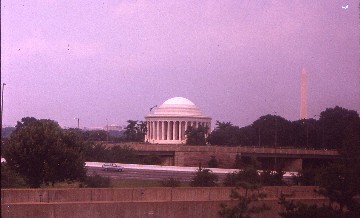
We swung by the Jefferson, Lincoln and Washington Monuments before passing the White House and the Capitol Building then to the station. I thanked him for the ride and wrote a note of thanks to the House Member for everything then entered the station, reflecting on the absolute luck and timing of my visit. I retrieved my bags from the locker then went to the gate to wait for my next train to Chicago and a connection for home.
The Cardinal 51 7/22/1990The train arrived from New York City and I boarded Slumbercoach 2026 "Loch Lomond", nee Northern Pacific 327 built by Budd Company in 1959. I had Room 3, a lower one, and was on the right, thereby having the same view departing Washington, DC that I had on the two Florida trains as far as Alexandria, where we departed the CSX route for the rails of the Southern Railway mainline. We were going to be on the Southern's steel as far as Orange, Virginia, so I would be living a life-long train rider's dream of riding on the Southern Railway. We lost an hour at Alexandria because the head-end power went out and Amtrak sent a crew from DC to fix it, but as soon as we passed Manassas, it went out again, then on for five minutes, off for ten and this was the pattern for the afternoon.
The lady from across the hall engaged me in conversation so I did not really see anything outside except the green hills of Virginia. We walked up to the dinette car as the Cardinal does not have a dining car and she ordered us a couple of drinks. As we continued our conversation, the train left the Southern mainline and swung onto the former Chesapeake and Ohio, now CSX. Once on their rails, I realized that I had now ridden the main lines of all the great eastern railroads on this trip, namely the Pennsylvania, New York Central, Baltimore and Ohio and Chesapeake and Ohio. If I only had ridden a train on the Reading, I would have ridden on all the railroads on a Monopoly board.
When we stopped at Charlottesville, she decided to stay at the table and play cards with another couple, so I went back through a very warm Amfleet car to a heritage coach which had all the vestibule windows open, thereby creating a nice breeze which kept the car cool and my Slumbercoach had the rear door open and the vestibule windows open. I then rode the back of the train as we ascended the C&O main line over the Blue Ridge mountains, climbing up the Appalachians. First we climbed over the ridge that separates Tidewater, Virginia from the Shenandoah Valley, then descended to Waynesboro and crossed the Shenandoah River. Next we commenced the climb out of the Shenandoah Valley for the long and curving trek up the Appalachians and through a couple of tunnels, arriving at Clifton Forge, where the main line from Newport News joined the CSX line from Washington, DC. This is the line that Chesapeake and Ohio coal trains travelled out of the mountains on their way to Tidewater at Newport News, so CSX had a large yard here.
Upon our departure, the conductor came back and noted that I had the best seat on the train, asked me how far I was going and gave me a list of all the tunnels and their lengths. I thanked him for that and asked if he might have an extra employee timetable. As the train really started its climb up to the summit, I looked at the sheets of tunnel names and noticed that every one had a name, rather than a number, which I was used to in the west. While long tunnels such as Cascade, Libby and Moffat are obviously named, smaller ones were just numbered. We entered Mud Tunnel then Kelly Tunnel, which cut through a ridge to put us on the northern slope for the rest of the climb. We next passed through Lake Tunnel as we continued our twisting and turning towards the summit, then rounded a curve and there before us was the summit ridge of the Allegheny Mountains. We plunged into Lewis Tunnel, a 3,061 foot affair and left the Atlantic watershed for that of the Ohio River and entered West Virginia.
After climbing all afternoon, we started our westward descent now twisting and turning down into the valley, where we followed the Greenbrier River to our next stop at White Sulphur Springs, home of the world-famous Greenbrier Resort. Four CSX business cars were on a siding by the depot and it would not surprise me if CSX used this beautiful location to host its business clientele. Leaving White Sulphur Springs behind, we followed the Greenbrier River down through a forested canyon which grew deeper until it joined the New River, into its Gorge with the same name. The New River, unlike what is it name implies, is one of the oldest streams in the world. We arrived at Hinton, a railroading town complete with a coaling tower and turntable; Hinton was to the Chesapeake and Ohio what Altoona was to the Pennsylvania Railroad. Leaving here, we passed a waterfall as the Gorge grew ever deeper and about thirty minutes later, we passed through Prince, a classic old town with another coaling tower and entered the New River Gorge proper. We then plunged into the Stretcher Neck Tunnel as the canyon walls were strewn with rocks before we stopped at Thurmond, then crossed the New River as the railroad split, with our line running down the south side of the river and the other main line staying on the north side. This was the heart of the New River Gorge and a note in my tunnel guide listed Highway 19 across the top of the New River Gorge. The bridge was 378 feet above the river and had a span of 1,700 feet.
As we approached its location, the conductor returned and said that he did not have a spare employee timetable but that we were almost at the Highway 19 bridge, the second highest in the United States after the Royal Gorge bridge in Colorado, adding that each year the bridge is closed on Bridge Day, when people parachute off it down towards the river. Just as he finished talking, the bridge came into sight and someone fell off it attached to a rope. After dropping for seconds, the person reversed direction and came back up. I was informed that this was bungee jumping, the latest craze, and neither the conductor nor I had any desire to try it.
The north side main line rejoined our line after crossing the New River, with my conductor pointing out Lover's Leap, after which we passed Hawk's Nest Dam which, backs up the New River into the Gorge, one of the reasons the river has such a peaceful feel to it in the lower Gorge, while on the river part, it was pretty wild with lots of rapids. The New River Gorge ends with the river's junction with the Kanawha River, thus ending my journey through one of Amtrak's scenic highlights. With the evening turning darker, the last thing visible across the river were the barges that were formerly used for river travel, but now sit forever forlorn. We arrived at our next stop at Charleston and I saw the state capitol, which made me think of how many state capitals I passed through on this trip, which was ten in the twenty-three states travelled through so far. I returned to my room and fell asleep in West Virginia on my last night in a Slumbercoach.
7/23/1990 While I slept, the train passed through northern Kentucky along the south shore of the Ohio River before crossing it at Cincinnati, where my parents boarded the Cardinal in a bedroom in the 10/6 sleeper at the front of the train. We then continued our westward trek across southern Ohio into southern Indiana before arriving at Indianapolis, another state capital, where I peeked out of my window and saw Indianapolis Union Station and once underway again, the Hoosier Dome sports complex. I walked up to sleeper to see if my parents were up, which they were then visited for a few minutes about their time in Cincinnati. My mother's convention went really well and my father even went to Riverfront Stadium to see the Cincinnati Reds play baseball. I told them briefly about my journey and we finished with their interesting story of their bus journey to Cincinnati after we parted company in Chicago.
I returned to my room picking up a breakfast of chocolate doughnuts from the dinette car and travelled through the rolling hills of Southern Indiana on a Conrail line, which took us to our next stop at Crawfordsville and the j junction which led us onto the former Monon line (CSX) to start our trek north. Leaving town, we made our way into the forest and crossed a very pretty stream before arriving at Lafayette, but not the normal way a train enters a town. We crossed under a stone bridge, almost a tunnel, which had drainage problems then went through the back yards of a residential area before running down the middle of 5th Street to the Amtrak station located in a gift shop, one of the most unique Amtrak stations in the whole country.
The reason for this unique entry into Lafayette was that CSX was constructing a new line around downtown to avoid running their freight trains on the city's streets. We departed town but stopped at the CSX yard to change crews then proceeded north as the landscape became flatter and agricultural interests took hold. We passed the Tippecanoe Battlefield State Memorial followed by Brookstone, an active small Indiana town with people everywhere. The next town was Monon before we came to the junction with the line which to Michigan, where we curved to the northwest. We passed through Pleasant Ridge before crossing the Kankakee River and ten minutes later, arrived at Dyer then travelled north through the housing developments and industries to reach Conrail's mainline and re-join the main Amtrak route to Chicago. We stopped at Hammond-Whiting before continuing west, passing all the now-familiar landmarks before reaching the wye and reversing into Chicago Union Station.
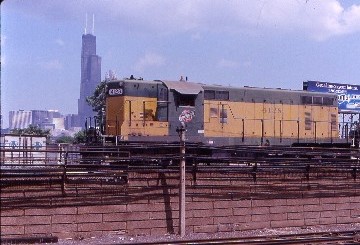
A Chicago and North Western GP9 on the St. Charles Air Line. We arrived one hour and twenty minutes late.
Chicago 7/23/1990For this four-hour visit to Chicago, I stored my bag downstairs, refreshed myself and had an early lunch then picked up some Metra commuter train timetables. Noticing some of their trains departed from North Western station, I walked over there to pick up schedules for future reference and decided that the next time I was here, as long as time permitted, would start riding Metra. I walked back to Union Station, retrieved my bag and went to the First Class passenger lounge to wait for my final Superliner train to take me home to California.
Southwest Chief 3 7/23/1990I boarded Economy Bedroom 3 in the sleeping car "George Pullman", my parents were in Room 5, and we quickly settled in. To my surprise, the sleeping car attendant was the same lady whom I travelled east with on the Desert Wind/ California Zephyr on my first leg of the trip. She asked me about how my journey went after we parted and I told her a couple of very interesting stories before she went about her duties. The dining car steward stopped by and I chose a 5:30 PM dinner reservation, then we departed on time for the 2,247 mile journey down the Santa Fe main line west to California.
After travelling through the industrial areas on the southwest side of the city, we followed the Chicago Sanitary and Ship Canal to Joliet, our first stop. Before arriving there, I went to the dining car to have a New York strip steak dinner with a glass of wine and dessert and by the time I finished, the Southwest Chief was running out in the Illinois countryside. I walked forward to the lounge car and watched the countryside for the reminder of the daylight since this was my first time on the east end of the route and everything was new until we reached La Junta tomorrow morning. We arrived at Streetor and crossed the Vermilion River before entering a massive thunderstorm that lasted until nightfall. I returned to my room for tonight's ride down the Santa Fe double track main line west towards Kansas City and beyond.
7/24/1990 The next morning I awoke just as we arrived at Newton, Kansas and departed an hour-and-a-half late, which I did not mind as it afforded me the opportunity to see more of the countryside. I walked to the dining car for a breakfast of French Toast, bacon and juice then we stopped in Dodge City, the end of the famous cattle drives and wild west town that had both Bat Materson and Wyatt Earp as Sheriff, but today looked like a peaceful modern agricultural town. The countryside consisted of either large farms or cattle ranches as we continued down the single track main line at speeds up to ninety miles an hour. We arrived at Garden City and on the way out of town, I saw locomotives of the Garden City Western Railroad switching cars; a very small short line which serves the needs of its customers. We next passed through miles of fields of sunflowers before we crossed into Colorado, traversed the Arkansas River and fifteen minutes later, arrived in Lamar. Outside of town, we passed the John Martin Dam and later, went by passed Fort Lyon and I spotted Bent's Old Fort then we resumed our rush of speed before arriving at La Junta, the servicing stop where I detrained for some fresh air and realized I had now completed riding the entire route of the Southwest Chief.
A locomotive was added to the point of our train as we departed, then continued to climb while splitting the semaphore signals to our next stop at Trinidad. I was back in the lounge car for the journey over Raton Pass at 7,588 feet and we passed through a mile-and-a-half tunnel after entering New Mexico. This was my third ride over Raton Pass and was as exciting as my first two; the pass allows both ends of the train to be to seen at the same time on many occasions; definitely a unique piece of railroading in North America. We descended the south side of the pass to Raton, New Mexico and I went to the dining car for lunch, enjoying a plain beef burger, chips and a 7-UP as we sped towards Las Vegas, New Mexico, but there was no gambling in this town. I sat in the lounge car as the train passed Wagon Mound and the old Harvey House in Las Vegas, then we passed Starvation Peak and descended around the double horseshoe curve towards the crossing of the Pecos River.
From there, the train climbed Glorieta Pass before descending through Apache Canyon to Lamy and we continued to drop to the Rio Grande River Valley, passed the pueblos to our next servicing stop at Albuquerque, where the train received a well-deserved window cleaning. I detrained and browsed the Indian jewelry sold by the trackside vendors then we departed New Mexico's largest city forty minutes late and I went to the dining car for my final dinner of the trip, another New York Steak, wine and ice cream. I returned to the lounge car, listened to the Indian Guide and watched the mesas change colours in the final light of day, then we crossed the Continental Divide and arrived at Gallup at sunset, where I returned to my room for my final night on the train.
7/25/1990 The next morning, I was up for breakfast as we descended Cajon Pass then travelled through the upper San Gabriel Valley, through the bedroom communities and industries before running down the middle of Interstate 210 to Pasadena. We twisted and turned down the grade, crossed the Arroyo Seco bridge and passed through the backyards before crossing the Los Angeles River and arrived at Los Angeles Union Station one hour and fifteen minutes late.
San Diegan 774 7/25/1990Waiting across the platform from the Southwest Chief was my connecting San Diegan so I stepped off that train directly onto my San Diegan for home. Ten minutes later, we were off on a thirty-six mile ride back to Santa Ana and I detrained. What a trip I had! All the way across the United States, to the eastern corners of the Amtrak system, all the new trains, new places and people I met along with all the life long memories I now have.
| RETURN TO THE MAIN PAGE |