



The Pacific Railroad Society sent me a flyer for their Mojave Circle Trip which my parents, myself and dear friend Jeff Hartmann decided to ride together. Since there was a choice between Amfleet cars and the opportunity to ride in private railroad cars for $15 more, we chose to ride in Bill Hatrick's "Amber Trail". The excursion was scheduled for a Sunday, so we all met and drove to Los Angeles Union Station for the journey to Mojave via Soledad Canyon outbound and return via Cajon Pass. While this was my first chance to ride through Soledad Canyon, Jeff had ridden through it before on the San Joaquin Daylight when he was a child. On the other hand, the ride over Cajon would be Jeff's first, as I had ridden over it five years ago on the Mojave Limited Trip. It was going to be all new for my parents.
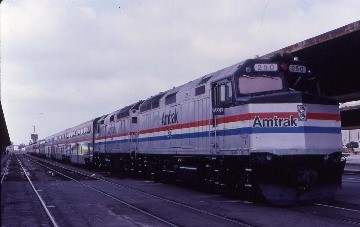
We walked into the station and waited at the gate to board this unique excursion. Our train was two F40PH's, three former Santa Fe Hi-Level cars, Pacific Railroad Society's former Southern Pacific Daylight coach "Shasta Springs", their Pullman car "National Forum", former Union Pacific diner-lounge "Starlight Café", Bill Hatrick's "Amber Trail" and Dave Rohr's former Union Pacific dome-lounge "Native Son".
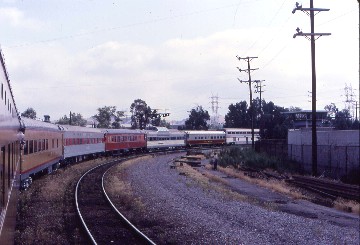
We departed on time and travelled the same way as the Coast Starlight, namely out to Mission Tower and across the Los Angeles River on its eastern bank, then crossed Main Street and went under Broadway Bridge, followed by Santa Fe's Second District bridge before passing under the maze of highway bridges of the Golden State/Pasadena Freeway interchange. We passed Dayton Avenue Tower then paralleled the east side of Southern Pacific's Taylor Yard and under the State Route 110 at the yard's north end to our stop at Glendale. We sprinted north to Burbank and at Burbank Junction, started new mileage as the train entered Southern Pacific's Saugus Line, then travelled through the industrial areas of the San Fernando valley before ducking under Interstate 5. We passed the Los Angeles Water and Power steam plant and the airport used in episodes of the television show "The A Team", followed by passing through Sun Valley, Pacoima and San Fernando before we reached Sylmar with its long siding under both the Interstate 210 and Interstate 5.
After going under the maze of bridges for the junction of the Golden State and Antelope Valley Freeways, the train climbed the short but steep hill to the San Fernando tunnel. This was started on March 27, 1875 and completed on July 14, 1876, with track-laying taking place a short time later. It measured 6,966 feet and was the longest railroad tunnel in the world at the time. We burst back in daylight and proceeded down the canyon to Saugus, passing the former Saugus station now located in a park.
We rounded the large curve to the east with the Santa Clara River to the north then wound along the hill slope past the Saugus Speedway and continued snaking along the hillside to Humphreys as we entered the lower reaches of Soledad Canyon. This line would forever be changed by the six-day rain storm which started on February 27th and dumped 11.06 inches. The real downpour came on March 2nd when 6.03 inches of rain fell and the storm closed the rail lines over Tehachapi, Cajon and Beaumont Passes, destroyed 13 miles of track in Soledad Canyon, as well as five steel bridges. The line was rebuilt on higher ground with only one crossing of the Santa Clara River and several tunnels were bypassed.
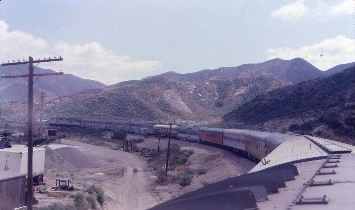
The train proceeded past the bypassed tunnels of a 1945 project to Lang Siding, where on September 5th, 1876, the line between San Francisco and Los Angeles was completed. We passed the huge cement plant before rounding the corner and traversing Santa Clara River and plunging into Tunnel 19. The canyon walls stood tall as we exited and turned north to enter Tunnel 18. We made our way through the former station site of Russ then snaked our way up Soledad Canyon and at select locations to the north, the Vasquez Rocks could be seen. These were the hideout of the notorious bandit Tiburcio Vasquez and his gang, and Vasquez was hung on March 19, 1875.
Our route passed several recreational vehicle parks before going by the Wild Animal Park with its elephants and other animals. We then crossed under Soledad Canyon Road as the canyon opened up a bit and we came upon Ravenna siding then went by a large recreational vehicle park prior to reaching the small community of Acton. We stayed along the stream as the San Gabriel Mountains came into view to the south, ran through the siding of Paris before reaching the top of the grade at Vincent and descended the steep hill, making a wide horseshoe curve near the bottom passing under the Pearblossom Highway.
The excursion train then crossed over the California Aqueduct and the Sierra Highway at grade prior to travelling over the San Andreas Fault and passing Lake Palmdale. We crossed Avenue S, rounded a small "S" curve before going through Palmdale Junction, where the Palmdale Cutoff, on which we would be on the return trip, diverges from. We travelled through Palmdale, crossed Sierra Highway and went by the Lockheed Plant, through Lancaster and Rosamond, then climbed Ansel Hill before descending into Mojave. We went into the yard where the train was wyed on the Oak Creek Branch before being spotted on a yard track, where we were allowed to detrain and to explore the town.
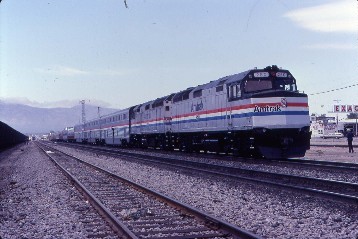
My parents, Jeff and I went to Carls Jr. for lunch before we went our separate ways, although it was cold and windy.
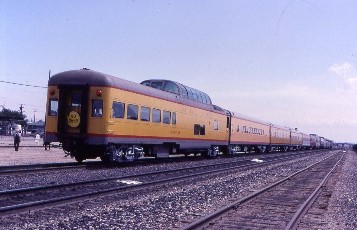
We all returned to the train, which departed on time and I rode in "Amber Trail" until near Palmdale, where I switched to the dome of "Native Son" Dome for the ride over the Palmdale Cutoff. As we neared Cajon Pass, a wall of clouds was spread out in the pass and we went from clear blue sky into gloom and darkness right before Hiland and all the way down the pass. Jeff was really disappointed as we could not see Cajon Pass in its full grandeur as he had done on other trips, whereas I was of the opinion that the clouds really added character. Any trip over Cajon Pass is special and one over the Palmdale Cutoff was really unique no matter the conditions.
We made our way down the grade to West Colton where we turned onto the Sunset Route for the rest of the journey back to Los Angeles, stopping at Pomona near the City of Industry when the train went into emergency. We learned later that the problem was caused by some idiots putting a shopping cart on the track and the train ran over it and the cart was dragged under the train, breaking the air hoses between two of the cars and causing the brakes to be applied. The crew quickly fixed the problem and minutes later, after crossing the San Gabriel River, we ran west down the State Street line back to the Los Angeles River, crossing it at Mission Tower and finishing the excursion at Los Angeles Union Station, ending another fine Pacific Railroad Society trip.
| RETURN TO THE MAIN PAGE |