




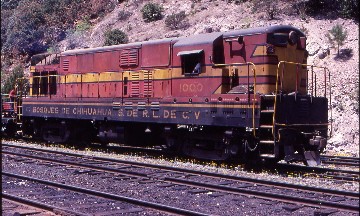
When I was about seventeen, I was looking through my brother Bruce's Trains magazine and in 1974, there was an issue about Fairbanks-Morse locomotives. In the middle of it was a center spread of two diesels in factory demonstration paint scheme on an obscure Mexican logging railroad the Bosques de Chihuahua. I looked in my atlas and could not find any reference to where this railroad was and there was no information in the magazine's Second Section as to its location.
Imagine my surprise in early 1988 when I received a Let's Travel Tours brochure from Ed Nordeck's organization in the mail for excursions both on the Bosques de Chihuahua and Destination Nacozari and I signed up for both. The Bosques trip was either a three-day or ten-day trip which included Copper Canyon. With limited time due to work and coaching McArthur Fundamental Intermediate varsity baseball with Paul Collick, I chose the three-day trip which worked perfectly with the tri-weekly schedule of the Sunset Limited.
Bosques de ChihuahuaThis railroad's full name was Bosques de Chihuahua Sociedad de Responsabilidad Limitada de Capital Variable, a small logging operation in the state of Chihuahua. The approximately 20 mile line ran from a lumber mill at Mesa Del Huracán in Madera Municipality to a connection with the Ferrocarril Chihuahua al Pacífico at an isolated spot in the bottom of a valley called Cumbre (which ironically means "summit"). The distance between endpoints as the crow flies was less than ten miles, so needless to say the Bosques line did a lot of twisting and turning. The line was about to be abandoned.
5/11/1988I rode a San Diegan to Los Angeles and met up with our tour group who were travelling by train. We all were boarded in one coach on the Sunset Limited and departed on time, with every rider being able to have their own set of seats. The train kept to it schedule across every division of the Southern Pacific and it was a very enjoyable and uneventful journey as I met my new travelling companions. We arrived at El Paso, Texas on time on May 12th and a bus picked us up to take us to the Holiday Inn for our one night's stay.
5/13/1988 Following a group breakfast and additional details given about today's trip, we boarded buses to take us to Mexico, crossing the Rio Grande River and entering Mexico and Cuidad Juarez. We travelled down the narrow streets, at one point going nine blocks down a one-way street the wrong way with traffic dodging us. We arrived at the Juarez train station and the Chihuahua Pacific (CHP) mixed train was not yet ready to leave, even though we had a 7:30 AM departure time and the motive power had not been spotted.
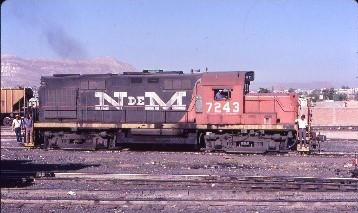
However, I was a happy railfan as switching in the yard was National Railways of Mexico RS11 7243, built by Montreal Locomotive Works in 1963. The overnight train from Mexico City arrived which was followed by the power for our Mixed Train 32.
My experience and reading about trains in Mexico was that trains here may have a published schedule in an employee timetable, but will leave if and when the crew was ready. Since the whole railroad was run by timetable and train orders anyway, it seemed to work fine. This kind of railroading was far different from anything in the United States and far more interesting from my point of view. It was not some dispatcher calling the shots from a few states away but each line's individual employees working together as a team to provide a safe operation.
CHP Mixed Train 32
Our train consisted of CHP GP40-2 1023 built by Electro-Motive Division, twelve freight cars, our Primera air-conditioned coach, our open window coach, two regular coaches for the regular riders, the railroad's pay car, complete with guards and a CHP caboose. We departed an hour and twenty minutes late and were riding the old Mexican Northwestern completed in 1909 between Juarez and La Junta. We passed through South Juarez, some of which was reminiscent of the United States, except the traffic signs and signals giving it away as Mexico, before we made our way through an area of shacks and squatter's settlements on the outskirts of town.
We then went by lines of former box cars that track workers and families lived in then crossed the NdeM main line and proceeded out into the Chihuahua Desert, which was very sandy and had low bushes as we made our way up a slight grade. This was my first mixed train and after about thirty minutes, I wondered if we would stop to pick anything up along the way before Nuevo Casas Grandes. We passed through places including Mesquite, Medanos and Placa KB-490. While there was just a sign or telephone box to these locations, I did see footprints leading away from the tracks at each of those spots.

We turned directly west past Barreal and San Blas, then north of Guzman, I saw the dry lake of Laguna de Guzman. Here we turned south and the scenery became that of basin and range geography, reminding me of Central Nevada. Off in the distance, I saw a herd of free range cattle and I wondered where they got their water. We continued to pass through places in the middle of nowhere such Urrutia and at Sabinal, a surprise as we stopped at a modern-looking platform with a cover to keep the sun off the passengers, which today was a family. We continued the slight climb past Santa Sofia and at San Pedro, there was a station where our crew received new orders. Besides the station there were houses for mainly those railroad workers who work on the tracks and the design of these dwellings were similar to those along the Sonora Baja California Railroad.
We passed a sign further down the rails that read Summit and unless you were paying attention to the terrain, you would have never noticed that we were at the top of a grade and there was no sign. Off in the distance, I saw green and realized we were entering the valley of Nuevo Casas Grandes, whose water source was the Rio Casa Grande. We passed Placa KB-366 and further on, the train stopped at Corralitios. When the engine cut off, a few of us detrained track- side then the locomotive went by us down the siding, picked up two water tank cars and run back by us. We reboarded and off we went south on our way to Victoria, where we had orders to hold the main line and a freight train would pass us in the siding.

All the photographers detrained to wait in the warm sun for the freight train and when it arrived, it was pulled by a single GP40 in the old red CHP paint scheme. Back on board, we entered the green zone of the valley and farmers were out tending their crops with a few ranchers taking care of their sheep. We passed Section Hidalgo and proceeded at the highest speed of the day, soon arriving at Nuevo Casas Grandes, today's destination at kilometer post 332. It was the commercial center for the surrounding agricultural valley. The nearby Piedras Verdes and San Miguel Rivers permit the growing of a variety of vegetables and fruits. Other support comes from the nearby mines and the small railway repair facilities. During the cold winter months, the entire valley is covered with a cloud of black smudge smoke from the orchard heaters, similar to those used in citrus groves in the United States.
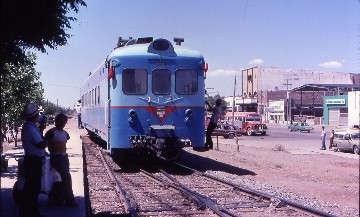
Waiting for us was the northbound diesel-hauled Autovias with a rare GP28 with FM trucks doing the yard switching. We detrained our two cars, which were then cut off and spotted then the GP28 added some cars to the mixed train, followed by another locomotive being added to assist for the journey across the mountain country to the south. When all was ready, both trains departed for their destinations and our group walked over to the shops for a tour, where we saw more Autovias, self-propelled railcars which were having their motors removed so they could become trailers to be hauled by diesels to continue their lives.
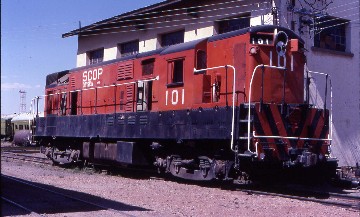
Several locomotives were on hand including CHP H12-44 301, nee CHP 70, built by Fairbanks-Morse in 1955. It was lettered 'SCOP' and numbered '101' for use in a film. The reason I keep coming to Mexico is to see the locomotives here, which were no longer in existence in the United States. After the tour we visited a local store for some Coca-Cola, which tasted a little saltier than the American version, before we rode a bus to the Hacienda Hotel which was to be our base for the next two nights. I relaxed for a while in my room before joining a group dinner prior to retiring for the night.
CHP Special Train 5/14/1988It was a bright sunny morning as I walked through the hotel's courtyard to this morning's group breakfast then after reviewing today's itinerary, we rode the bus to the station to our special CHP train consisting of two GP38 locomotives, two cabooses, our group's two coaches and an open gondola car for fresh air and unobstructed views. We were travelling directly south into the upper reaches of the Casas Grande Valley and we passed Guadalupe, Don Luis, Colonel Madero and Anchondo and upon going through Mata Ortiz, the foundations of the old steam locomotive shops were visible.
South of Mata Ortiz, the valley narrowed into a canyon reminding me of Meadow Valley Wash in Nevada. We started our gradual climb into the Sierra Madre mountain range leaving the desert behind for the higher elevations and timber country, where the vegetation changed as we ascended. One of the reasons I enjoy train travel to the extent I do is the ability to see many different species of trees and plants very close, some almost to my touch. We passed through Rucio, Cuevitas and then Riba, where the grade increased to two percent.
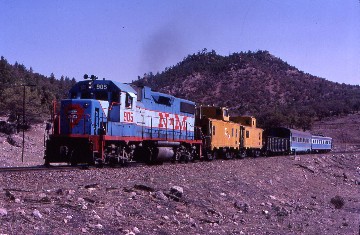
Near Riba, the first photo runby of the day occurred where a fire had burnt away all of the plant growth. I then rode in the cupola of the caboose as the train twisted and turned to Aquaja, site of the second photo runby as the train rounding a nice curve. Afterwards, I rode in the cab of the lead locomotive, 905, and stood behind the engineer who looked back and smiled at me. He then stood up, took my hand to lead me to the engineer's seat, put my right hand on the throttle and I put my left hand on the brake. He patted me on the back and now I was running the train! I saw some range cattle on the track so blew the horn and they ran off then felt the wheels beginning to slip, so I reached for the sander just as he did, turned it on and the problem was solved. He left me alone running the train by myself for about ten minutes, then I decided to return to being a passenger and thanked him in both English and Spanish. I had always wanted to be an engineer and thanks to one very nice CHP engineer, I had my chance so some dreams and fantasies do come true.
I went out to the front porch of the GP38, sat down and hung my feet over the pilot. The train was now really climbing, gaining elevation and was rapidly ascending the side wall of the canyon. Trees were changing into pines as the train negotiated several horseshoe curves and we passed the telegraph shack at Bellavista followed by the passing siding at Caballo. To the right, it was a long way down to the stream and to the left I could not see the top of the ridge line; true mountain railroading completely different from the desert running of yesterday.
As we arrived at Cumbre, we crossed a switch with a line diverging to the left which was the beginning of the Bosques de Chihuahua Railway. We pulled into the yard to await the Bosque train to arrive which allowed us to look around Cumbre, so I first explored the station building then walked down the tracks to the south end of the yard, where I saw an abandoned tunnel. The Mexico Northwestern Railway Company was organized in Canada in 1909 and took control of various rail lines in this area. Construction of the through route from Juarez to Chihuahua was completed in 1910. The line suffered heavy damage during the Mexican Revolution of 1910-1920 as Pancho Villa's forces battled federal troops. The Cumbre Tunnel was destroyed in 1914 with revolutionary forces set a passenger train afire inside. United States General John Pershing used the railway in his pursuit of Pancho Villa in 1916. The property was sold to Mexican interests in 1945 and later came under the jurisdiction of the Chihuahua-Pacific Railway.
The Bosques connection crossed over the new line on a fill with the CHP line through a tunnel. Since the Bosques train had not yet arrived, I decided to climb on the fill then get up on the hillside and photograph our new train approaching Cumbre and two other passengers joined me so we climbed up the hill overlooking the tracks.
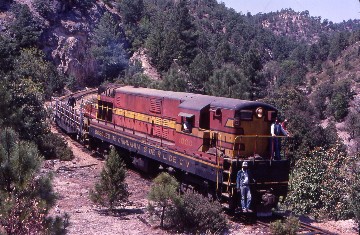
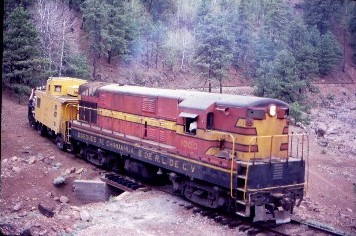
Twenty minutes later, we were rewarded with Bosques FM H16-44 1000 leading a home-made open car with benches. The locomotive was built by Fairbanks-Morse in 1961, after the company had ceased producing locomotives for the American market, but was still turning out an occasional H16-44 for CHP.
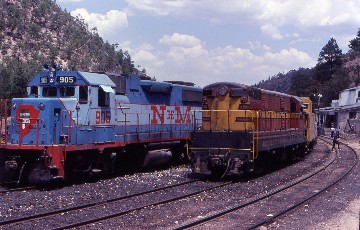
We returned to the yard just as the train arrived and a picture with both trains was staged. Word then came that the northbound was due in about ten minutes so all the photographers got into position.
Bosques de Chihuahua 5/14/1988We boarded our train for the 33 kilometer ride over the Bosques de Chihuahua and were the second passenger train over the line and the last official revenue move. The train was the H12-44 1000, open car "Bosques", the CHP open car and a caboose. We reversed down the Cumbre Yard past the switch before starting forward up their line, passing behind the station, over the CHP tracks and up the side of the canyon, where at its head, we rounded a horseshoe curve to gain altitude. A hard turn to the left, now high above Cumbre and we climbed into the mountains, following a ridge through the heavily-forested slopes and crossing over a divide. We descended on a more gentle grade and it was announced that a runby would take place.
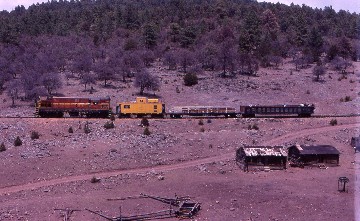
We detrained as the train descended another horseshoe curve and was in the valley below us with everyone photographing to their heart's content. The train retraced its path to pick us up then we travelled to exactly where we had just photographed the train. That was a most interesting way to perform a runby and a special thanks to Bill Farmer who planned it. During the day, clouds had moved in and formed over the mountains then a shower forced everyone to seek cover in the cabooses to protect their camera gear. While rain and Mexico are not commonly thought of as going together, the same is true for pine trees and Mexico. We continued through the rain and just as we arrived at Mesa del Huracan for an hour's layover, the rain ceased.
The lumber mill was closed, which was the reason that the railroad was going out of business. An all-weather highway had just been constructed and trucks were now taking the timber, thereby causing this railroad to be obsolete. I walked into the diesel shop and found H16-44 501 tucked away inside, along with a very nice business car. I learned that SW1 500 was in Madera, so would never be able to photograph the only SW1 that was exported. Outside was a Volkswagen passenger van on railroad wheels, as well as quite a lot of machinery lying around. I then returned to the waiting train as the layover came to an end.
We retraced our route back to Cumbre with two more photo runbys. It was so quiet here that you can hear your heart beating and the FM produced some great sounds. The 33 kilometers went by quickly and all too soon, our round trip over the Bosques de Chihuahua was over as we arrived at Cumbre. The locomotive ran around our train and removed the open car then our locomotives coupled onto our train and off we went into the evening twilight. I went up to the front engine and enjoyed the rest of the journey back to Nuevo Casas Grandes on the front pilot, thinking what a fantastic day it had been. Thanks to the Chihuahua Pacific, Bosques de Chihuahua and Let's Travel Tours for this never-to-be- repeated experience.
The Journey Home 5/15-17/1988Those of us on the three-day trip were bussed back to El Paso from Casas Grandes for the night. At 9:00 AM, we boarded a very nice Mexican bus that took us to Juarez on a different route than the railroad. We sped north and after leaving the river valley, it was nothing but desert. We stopped at a store for some refreshments to accompany our boxed lunches and about an hour later, we first crossed the CHP tracks, followed by the NdeM tracks then turned north for Juarez. We were now on the main highway and in no time we were at the Rio Grande River waiting to enter the United States. The US Customs agent walked on the bus to do a pre-inspection then asked if everyone was an American citizen and upon affirmative responses from all, wished us a great day.
I was dropped off at the Amtrak depot, found my westbound train running on time and boarded, sharing a seat with a man from Mexico who spoke no English. This was not a problem for me and we had an excellent ride back to California together. A quick trip on a San Diegan and I went straight to MacArthur, coaching Varsity baseball with Paul Collick to the first championship in the school's history. A completely different history than I had just experienced.
| RETURN TO THE MAIN PAGE |