




The Nevada Northern Railroad had always fascinated me since it seemed to run from somewhere to nowhere and the pictures of the freight trains always looked as though they ran travelled through some of the loneliest places on Earth. With names such as Cobre, Shafter, Currie Creek, McGill and Ely, those locales could have been out of the old west.
I had long desired to ride all or part of it but when the railroad shut down and ran its last revenue freight train in 1983, I thought I would never have the opportunity. The line was sold to Los Angeles Department of Water and Power and the yard, depot and shops, as well as the equipment, were donated to the White Pine Historical Railroad Foundation. That group announced that they would be running their inaugural steam-powered passenger excursion to Copper Flats, so I talked to Jeff Hartmann, my good and dear friend, who decided we should go. We made our plans and soon the day came.
Nevada Northern Railway HistoryThe Nevada Northern owes its beginnings to the discovery and development of large porphyry copper deposits near Ely early in the 20th century. Two of the region's largest mines (including the Robinson Mine) were purchased in 1902 by Mark Requa, president of the Eureka & Palisade Railroad in central Nevada. Requa then organized the White Pine Copper Company to develop his new properties, and it soon became evident that rail access to the isolated region would be essential to fully exploit the potential of the mines. Originally plans called for extending the narrow-gauge Eureka and Palisade Railroad, which Requa was president of, effectively doubling the length of that line. Subsequent surveys indicated that a standard gauge railroad would be the most cost effective and that the most practical route for such a railroad was northward from Ely, connecting with the Southern Pacific somewhere in the vicinity of Wells.
The Ely-area copper properties were further merged in 1904, forming the Nevada Consolidated Copper Company, and the Nevada Northern Railway was incorporated on June 1, 1905, to build a line connecting the Nevada Consolidated mines and smelter to the national rail network. The task of building the new railroad was contracted to the Utah Construction Company, which began work on September 11, 1905. Construction began at Cobre, where the Nevada Northern connected with the Southern Pacific and proceeded southward. The line was finished a year later, its completion marked by a two-day celebration in Ely. The railroad's symbolic final spike—made of local copper—was driven by Requa in Ely on September 29, 1906, which was designated as Railroad Day. To celebrate the new railway, a ball was held inside the Northern building, which was still under construction at the time.
Additional Ely-area trackage was constructed in 1907–1908 to serve the local mining industry. This trackage, known as the "Ore Line", included a route bypassing Ely to the north and continuing west up Robinson Canyon to the copper mines at Ruth. East of Ely, the Ore Line project saw the construction of the "Hiline", a branch leading to Nevada Consolidated's new copper smelter and concentrator at McGill. The Ore Line immediately became the busiest segment of the Nevada Northern by far, hosting dozens of loaded and empty ore trains daily.
As a subsidiary of Nevada Consolidated, the primary purpose of the Nevada Northern throughout its history was the haulage of copper ores and products. Other freight traffic was also carried, and the railroad operated the daily Steptoe Flyer passenger train between East Ely and Cobre until July 31, 1941, when it was replaced by bus service. Local trains were also operated from Ely to Ruth and McGill for the benefit of mine employees and others until the 1930's, and special school trains carried students to White Pine High School in central Ely.
A series of corporate financial transactions in the 1920's and 1930's brought Nevada Consolidated under the control of the Kennecott Copper Corporation and Nevada Consolidated was merged into Kennecott in 1942. The Nevada Northern thus became a Kennecott subsidiary. Faced with declining ore reserves and low copper prices, Kennecott closed its Ruth-area mines in May 1978, thus ending the ore trains between Ruth and the McGill smelter. The smelter closed on June 20, 1983 and the Nevada Northern suspended all operations immediately thereafter.
Citizens of the town concerned with the economic impacts of the loss of mining and the railroad approached Kennecott with the intent to acquire the railroad and open it as a tourist operation. Though a series of donations, the Nevada Northern Railway Museum was formed and is situated at the East Ely Yards. The site is listed on the United States National Register of Historic Places as the Nevada Northern Railway East Ely Yards and Shops. The rail yards were designated a National Historic Landmark District on September 27, 2006 and was cited as one of the best-preserved early 20th-century railroad yards in the nation, and a key component in the growth of the region's copper mining industry. The property came complete with all of the company records of the Nevada Northern from its inception.
Our Journey5/22/1987 Jeff and I had an interesting drive to Ely, going via Las Vegas and US Highway 93 then we stayed at the Motel 6 south of town. I played the dime slots and won before returning to the room.
5/23/1987 We awoke early and went to breakfast prior to driving to the East Ely Depot, a stone structure built in 1907 at a cost of $17,000. We picked up our tickets then Nevada Northern 4-6-0 40 was brought out of the shops.
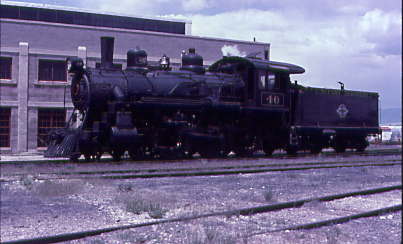
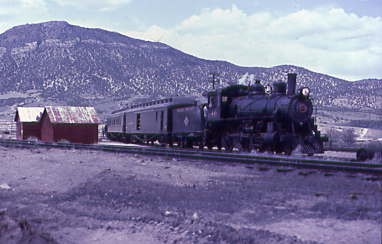
Nevada Northern 40 before it reversed into another stall to be coupled to our train, which consisted of Pullman Coach 5, baggage-railway post office 20 and an open car made out of a flat car with benches. The steam engine was filled with water and fuel before it travelled down the yard leads and reversed in front of the East Ely Depot.
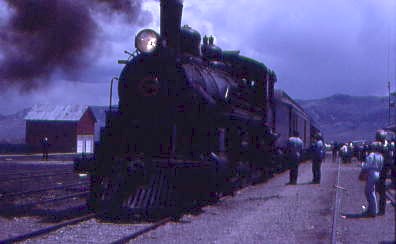
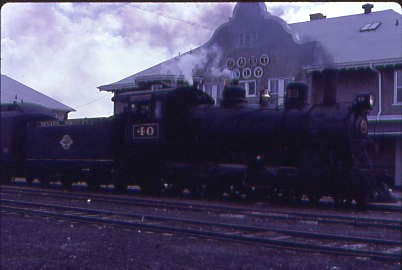
Nevada Northern 2-6-2 40 built by Baldwin in 1910. It operated mainly between Cobre and Ely until passenger services were scrapped in 1941. It was then tried on freight trains, but its large drivers did not provide enough tractive effort to make it viable. So it was retired, except for occasional use on passenger excursions, and was donated to the museum in 1986 along with the rest of the railroad equipment at Ely.
When boarding commenced, Jeff and I climbed aboard going straight into the open car. As noted above, this was the first run of the Ghost Train of East Ely and we were both honoured to be part of history. With everyone aboard this first trip of four today, there was a toot of the whistle and off we went.
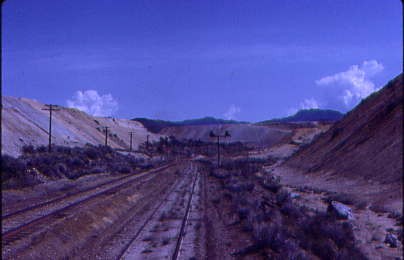
Copper Flats. The train reversed down the yard lead to the junction with the line to Copper Flats before we travelled west and crossed Murry Creek as we climbed on a fill to reach a hillside. At this point, we were above Ely and had a great view of the mountains that surrounded the valley in which the town is located. We passed the former location of Calumet as we circled to the west then made our way to Robinson Canyon, created by Gleason Creek, which goes through US Highway 50. We then entered the tight confines of the canyon, slowly rounded a curve to enter Tunnel 1 which took our train though a spur of rock that projected into the canyon. Upon exiting, there were photographers waiting for us, then we ducked under Highway 50 and ran up the canyon.
Signs of the former mining practices were evident along the route. We went through Lane City before passing a former mining operation left for time to decay then travelled to Keystone, where we crossed Gleason Creek and turned to make our way to Copper Flats. We passed the junction of a former line to South Ruth before climbing the grade and passing the extremely high mine tailings to a junction at Copper Flats.
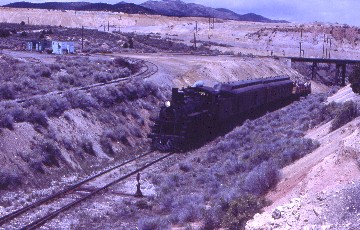
We reversed up a track that led us into the yard at Copper Flats where the train sat for a few minutes.

Copper Flats. Jeff and I explored the train and everywhere looked as though it had just been left yesterday. The "ghosts" of the copper industry were alive and well here and the name "Ghost Train" fitted well.
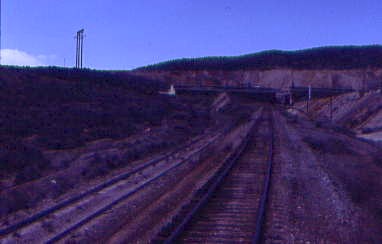
Departing Copper Flats. We went down another track back to the line which brought us here then returned to Ely where the train was wyed before being taken back to the depot, where Jeff and I both detrained very satisfied.
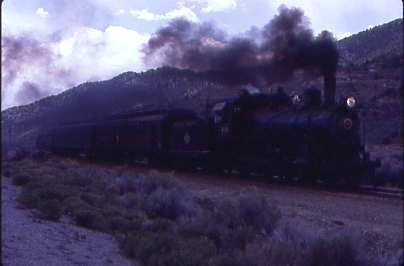
Jeff and I looked around the yard before we went to Calumet to photograph and follow the second train of the day.

Exiting Tunnel 1 in Robinson Canyon.
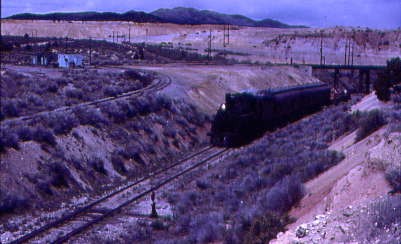
The Ghost Train arriving at Copper Flats.
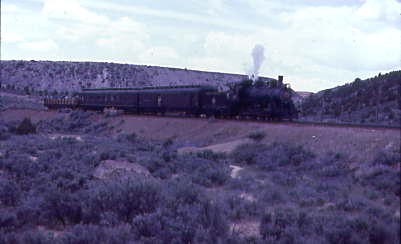
Trip 2 returned back through Ruth.
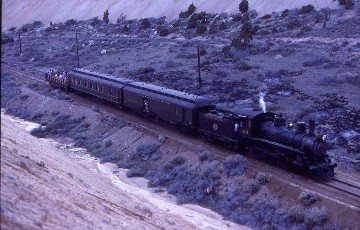
Climbing down the grade.

Entering East Ely yard.
Arriving back at East Ely. We had lunch before going on a most fascinating shop tour.

Nevada Consolidated Copper spreader 360 1918, nee Nevada Northern 360 built by O.F. Jordan in 1910. It was used as a spreader, flanger, scrapper, bank builder and snowplough.


Nevada Northern Railway EMD SD7 401 built by Electro-Motive Division in 1952. It was purchased for general freight service and EMD developed a special paint scheme called the "Desert Warbonnet" which the locomotive still wears. It is the only SD7 purchased brand new by a shortline railroad and was the only diesel locomotive owned by the railroad until 1972. On April 22, 1987, the Los Angeles Department of Water and Power purchased the dormant Nevada Northern Railway from Cobre to McGill Junction (to preclude its abandonment) for proposed coal-fired power plant near Cherry Creek.
In October 1988, the locomotive was moved from Ely to the Intermountain Power Plant near Delta, Utah and was shipped from Salt Lake City to Delta on October 20, 1988. In May 1993, in addition to its Nevada Northern lettering and number, the SD7 was also numbered as P-401, with a LADWP decal. In October 2021, the former Nevada Northern 401 was promised to be returned to the Nevada Northern Railway Museum at East Ely, but the logistics of moving the heavy locomotive from its home in Delta back to its original home in East Ely, has proven to be an expensive operation and a funding challenge. As of June 2025, it remains in Delta.
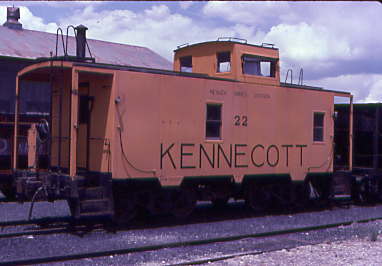
Kennecott Copper Company caboose 22 built by the company in 1955 and used at the Nevada Mines Division.
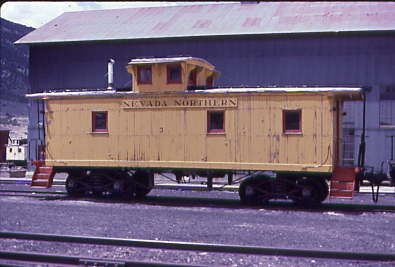
Nevada Northern wood caboose 3, built by Mount Vernon Car Company in 1909. It was initially built with side doors that were later removed.
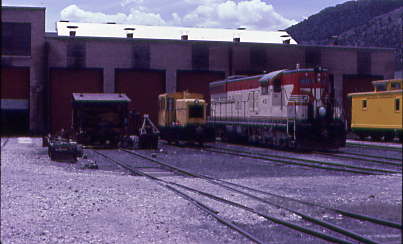
Engine house scene.
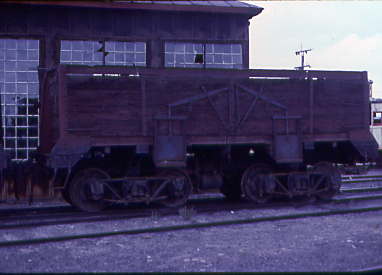
Nevada Northern wooden ore car of unknown origin.
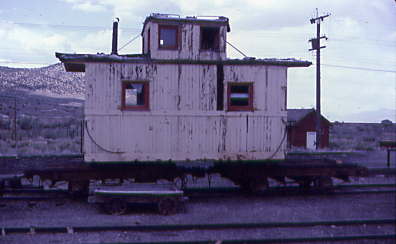
Kennecott Copper bobber caboose 12 built circa 1910 to replace the original 12 destroyed by fire.

Nevada Northern rotary snow plough B built by American Locomotive Company in 1907. It was purchased new under a rush order and its original tender was used for locomotive 80 when it was converted from a tank locomotive. The rotary then used whatever tender was available from locomotives undergoing a rebuild. It last received the tender from locomotive 21 around March 1952, which it still retains. The is one of the last wood-bodied standard gauge rotary ploughs still in existence.

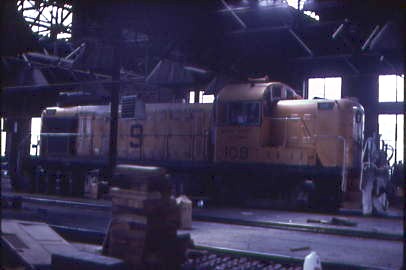
Kennecott Copper Company RS-2 109 built by American Locomotive Company in 1950 and purchased for the company's Ray mines then transferred to Nevada Mines Division in 1970. It was sold to Los Angeles Department of Water and Power then donated to the Museum and placed in excursion service.
That brought our shop tour to a close. Jeff and I made it back to the east portal of the tunnel for the third train of the day returning to town.

The scene from the yard.

Trip 3 in Robinson Canyon.
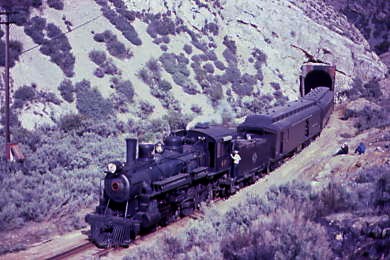
Exiting Tunnel 1 in the canyon.

Ghost Train at Keystone.

After wyeing the train at Copper Flats.
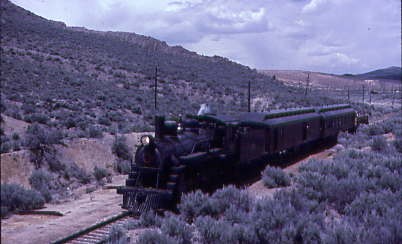
Ghost train at Copper Flats.

Nevada Northern coach 5, nee Pullman-Union Pacific Association sleeping car "Silesia" built by the Pullman-Chicago Works in 1882. It was withdrawn from UP Association use in 1898 and sold to Hotchkiss, Blue & Company in July 1913 then purchased used by Nevada Northern Railway for $1,500 and designated as Coach 03. It was rebuilt in 1917-1918 as chair car 5 with smoking and non-smoking sections, then in 1934, used as an extra coach for the Main Line Passenger train when parlour car "Cobre" was out of service. Originally equipped with a Baker Heater, the car was converted to straight steam heat in 1936.
The non-smoking section has velvet seats, women's restroom and lounge, while the smoking side has leather seats, men's restroom, conductor and equipment lockers. There is mahogany panelling and stained glass windows throughout. It was damaged in an accident on June 17, 1995, repaired and placed back into service then used on the last run of the Steptoe Valley Flyer on July 31, 1941, placed in reserve service and used again for the 50th Anniversary celebrations, starting a second career as an excursion car.
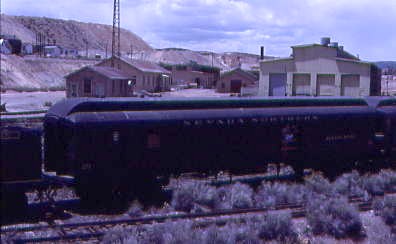
Nevada Northern combine 20 built by American Car and Foundry in 1905. It was purchased secondhand in 1907 from Harlan and Hollingsworth then rebuilt in 1912 with dummy vestibules. The postal compartment is isolated from the rest of the car and retains original fixtures and furnishings. Railings were installed in the baggage doorways in the 1950's to allow them to remain open during excursion service.
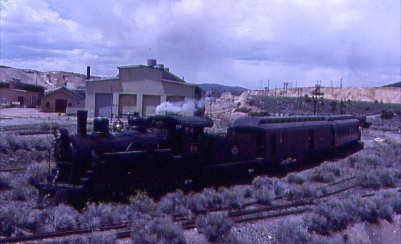
Descending from Copper Flats.
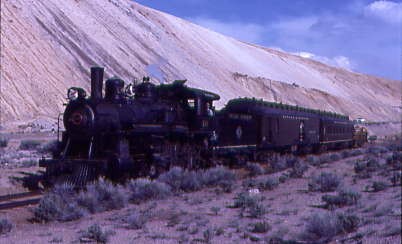
Running back into town above Ely.
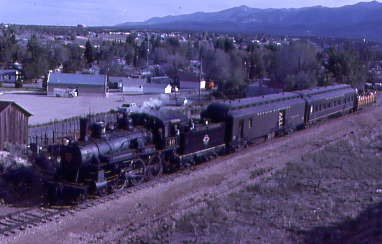
It was extremely quiet at this deserted location known as Copper Flats, with only the wind being heard.

Running high above the town of Ely.
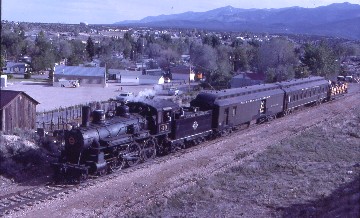
Wyeing at East Ely.

On our return to Ely, we stopped at the White Pine Public Museum for Nevada Northern 2-8-0 93 built by Alco in 1909 for the American Smelters Securities Company, to haul ore trains on the Nevada Northern Railway. It was sold to Nevada Consolidated Copper in May 1920 when the company took over operation of the ore line. The trackage remained the property of the Nevada Northern Railway who provided management for operations by Nevada Consolidated train crews. In 1952, three of the original four locomotives supplied by Alco in 1909 were scrapped, but 93 was kept as back up motive power. In 1961, Kennecott Copper donated the locomotive to the White Pine Public Museum, where it went on open air display. In 1990, after twenty-nine years on display at the White Pine Public Museum, 93 was traded by the White Pine Historical Railroad Foundation, along with all of the museum's railroad equipment, to the Northern Nevada Railway Museum in exchange for the Cherry Creek Depot. The depot building was moved fifty miles south to become part of the White Pine Public Museum complex in Ely.
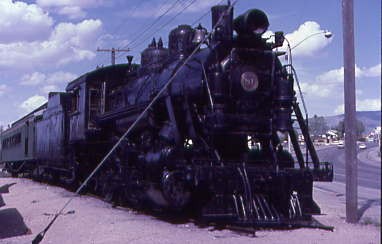
Nevada Northern 2-8-0 81, built by Baldwin in 1917. 81 hauled both freight and passenger trains and wass donated to the White Pine Public Museum in 1960 before returning to Ely in 1990. Jeff and I then went back to the depot to ride the fourth and last excursion of the day.
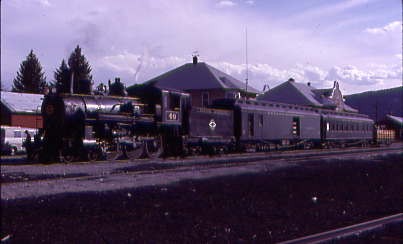
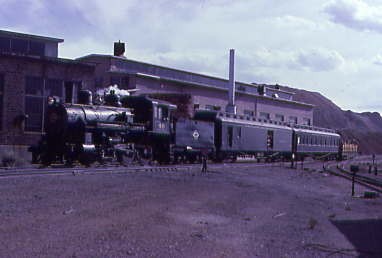
The end of the final run of the day at East Ely station. We followed that last train back and called it a day of train riding and chasing then had dinner before playing a few more dime slots and winning.
5/24/1987 Jeff and I were up early as we were driving all the way back to Santa Ana in one day. We drove to Caliente before deciding to follow the Union Pacific tracks through both Rainbow Canyon and Meadow Valley Wash, which was over fifty miles of dirt roads through the middle of nowhere. Jeff wondering where I was taking him but we did see two freight trains. We made our way down to Las Vegas before stopping at Whiskey Pete's where I spent a few minutes gambling and having a break from driving, then resumed our journey home, ending a very interesting trip to Ely, Nevada and the "Ghost Train of old Ely!"
| RETURN TO THE MAIN PAGE |