




by Chris Guenzler
My parents, Jeff Hartmann and I left Vancouver after our last day at Expo '86 and drove back into the United States down Interstate 5 to Mount Vernon.
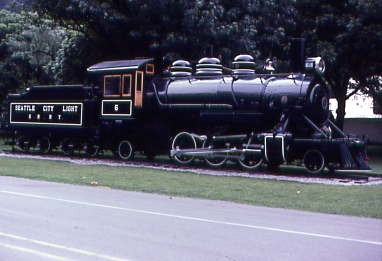
Seattle City Light 2-6-2 6, ex. lease to Skagit River Railway 6 in Concrete, exx. Seattle City Light 6, nee City of Seattle 6 built by Baldwin Locomotive Works in 1928. The Skagit River Railway was organised by Seattle City Light, the public utility providing electrical power to Seattle, to move men and materials from a connection with the Great Northern at Rockport to the Gorge powerhouse and the dam at Newhalem further east on the river. It operated from 1919 to 1954, had a 23 mile steam power section and a nine-mile electrified section with grades up to 4-5 percent.
The steam section had this locomotive as its sole means of motive power. It was bought new, while the electric equipment was used. The railroad found other means to survive after the dam was complete, such as logging, tourists, local needs and maintaining the dam. When the railroad closed, it left the engine in Newhalem Park. In 1973, a group tried their hand at starting a tourist railroad on a portion of the old right-of-way and used this engine, which ran with three former Milwaukee Road coaches and a Plymouth critter locomotive until sometime in the 1980's, when they ran into financial problems with paying for an overhaul for the engine, and shut down. The steam engine was then donated to the City of Newhalem in 1984, where it resides today.
The Skagit River is the second largest river in Washington State. It rises in British Columbia and flows south into the State through the North Cascades National Park, then west through the Skagit River Valley into Puget Sound.
We turned east crossing the Cascades on State Route 20 to State Route 17.
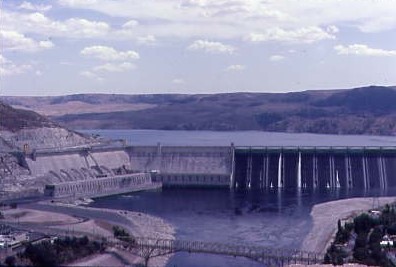
We travelled through Grand Coulee, passing its dam, then onto US Highway 2 before arriving at Spokane late afternoon, finding a place to park the camper for two nights before we went to dinner. We taxied to Amtrak to wait for the westbound Empire Builder and my first ride on this route.
Empire Builder 7 7/24/1986The train arrived on time in the dead of night but passengers are not allowed to board until the train split into two sections, ours for Seattle and the other to Portland. Tomorrow night, I would be on those Portland section cars which were being combined here for my journey to Havre. When all was ready, the four of us boarded the Seattle section with our car attendant giving us a boarding pass with an exact seat number, making it easy to find our seats in the darkened car. The conductor took our tickets as we fell asleep at this late hour.
Waking up in Leavenworth, we went to the lounge car for the crossing of the Cascades across Stevens Pass this early morning and I noted that the hillsides were dotted with homes and barns. Suddenly we passed through our first tunnel of the morning then crossed the east flowing Wenatchee River before plunging into another short tunnel and upon exiting, US Highway 2 was beside us. We passed an eastbound Burlington Northern freight at Merritt then crossed stream after stream with the views of the mountains becoming more and more beautiful. We ascended a steep canyon along a creek with more bridges and another tunnel before we arrived at the siding at Berne to wait for an eastbound freight to clear the next tunnel.
We sat there for fifteen minutes until the freight train came and I later learned we had to wait thirty minutes for fumes to clear from the Cascade Tunnel, our next and longest on the Amtrak system at 7.8 miles. We proceeded into the Cascade Tunnel and for the next eighteen minutes, passed through its darkness. I went downstairs for breakfast then returned to my seat with five minutes to spare and was amazed and impressed with the length of this tunnel, the second longest in North America after Canadian Pacific Railway's 9.1 mile long Mount MacDonald Tunnel in British Columbia. We emerged back into the morning light at Scenic and were now on the Pacific watershed of the Cascades and would follow the Skykomish River to Puget Sound at Everett.
Passing through Scenic, we descended the canyon before crossing the Skykomish River prior to entering a side canyon looping around to the Foss River and crossing it on a high trestle at the mid-point of the loop. The scenery was very rocky with tall trees in this quite beautiful steeply-sided canyon. We passed the waiting helpers at Skykomish with the Cascadia Inn beside the tracks then west of here, we passed Sunset Falls with the cliffs now rising vertically and the 5,991 foot peak of Mount Index looming high above the train. We crossed the Skykomish River again at Index, then bridged the river twice more before passed through Gold Bar. In just a few miles, we left the Cascade Mountains behind as the countryside opened as we travelled through Monroe then twenty minutes later, we passed through a brief tunnel under downtown Everett and arrived at the Everett Amtrak station overlooking Puget Sound.
Departing Everett, we ran at water level along the shore of the Sound, twisting along its shoreline. On this very clear July morning, I could see Mount Olympus, the highest peak on the Olympic Peninsula and the heart of Olympic National Park then out on the sound, I saw a few ocean-going vessels on their way to and from the ports of Seattle or Tacoma. As we arrived at Edmonds, the Washington State Ferries were transporting cars and passengers to Kingston on Olympic Peninsula. We continued our water-level journey passing the large oil refinery at Point Wells, skirted the marinas before crossing the Ballard drawbridge at Salmon Bay, then proceeded through Burlington Northern's Interbay Yard and passed the engine facility before going along Seattle's Waterfront District. We paralleled the route of the Waterfront Trolley and Jeff said that he wanted to ride the Australian streetcars during our layover. We plunged into the tunnel under downtown Seattle and stopped at King Street Station, fifteen minutes late.
Jeff went off to ride the trolley, my parents went to get some breakfast and I looked after the bags, very glad I brought some playing cards along and played Solitaire until all three returned before our second train of this triangle trip.
Coast Starlight 11 7/24/1996We boarded and once the train started its journey, Jeff and I went to the lounge car, starting out on the left side in the hopes of seeing Mount Rainier, which we did. Once we reached Tacoma, we switched sides for the ride along the southern end of Puget Sound and stayed there all the way to Chehalis, where we once again switched sides, this time hoping for and receiving a view of Mount St. Helens. We returned to the right side for Cowlitz River and what the ash flow from the 1980 eruption of Mount St. Helens did to it. South of Kelso-Longview, we joined the Columbia River and after Vancouver, crossed the Columbia River into Oregon and travelled along the waterfront and Portland Terminal Railroad's yards before arriving at Portland Union Station. We all walked into a very nice station to wait for our next train and while we did so, the northbound Coast Starlight and Pioneer came through on the last legs of their journeys to Seattle.
Empire Builder 28/8 7/24/1986After waiting inn line, we were finally allowed to board the Portland section of the Empire Builder and sat across the aisle from each other with my parents having the river side view through the Columbia River Gorge as I knew Jeff and I would be in the Sightseer Lounge Car, and tomorrow I would have the Rockies out of my window in Montana. The conductor passed through after departure and took my parents and Jeff's tickets, which were all for Spokane. He commented about my destination of Havre and I explained I had never been there before and wanted to cross the Rockies in Montana by train.
Jeff and I walked one car forward to the lounge car, which was behind the locomotive and sat in the non-smoking section. We passed along the Willamette River waterfront, sped across Hayden Island and crossed the Columbia River into Washington, then turned onto new trackage of the former Spokane, Portland and Seattle (Burlington Northern) and stopped at Vancouver. Passing through the south side of Vancouver along the river, we went by Chart House, where we had dinner on our drive north, then ducked under Interstate 5 before passing lumber industries east of town until the scenery turned into farms and orchards and entered the Columbia River Gorge.
Across the Columbia River standing out high above everything on this extremely clear Northwest day was Mount Hood, Oregon's most beautiful mountain. The river here was still very wide as the train sped down Burlington Northern's well-maintained mainline then we plunged into our first eastbound tunnel of the afternoon through a rock formation called Cape Horn. Following our lengthy period of darkness, across the river was the 620 foot high Multnomah Falls. On our side of the river, we passed Beacon Rock, the largest rock in the United States, just slightly smaller than the famous rock in Gibraltar, Spain. Looking up its face was a most impressive sight as the train ran below it. We next passed the first of the Columbia River dams, this one Bonneville Dam, which forms a lake 48 miles long back up the Columbia. All dams here have a series of fish ladders to allow the salmon to return to spawn. Past the dam there was a highway bridge called "Bridge of the Gods" over the river.
The vegetation changed from Northwest rainforest into a scarce vegetation zone of an almost desert type landscape. My preference was the North Bank route because it was just the river, the railroad, the two lane highway and cliffs, not the Interstate highway on the South Bank. The cliffs were basalt columns laid down on top of one another and formed an impressive landscape. We rolled out on a fill, separating us from the highway with Horseshoe Lake in between, a scene used in railroad publicity photos over the years.
Across the river was Hood River, Oregon which afforded another good view of Mount Hood, after which we rounded the large bend in the river to our next stop at Bingen-White Salmon, then about twenty minutes east of there, we passed The Dalles Dam with its navigational locks along the shore and as luck had it, there was a boat being raised to continue its journey up the Columbia River. The dam itself had twenty-two generators and sent power to places as far away as Los Angeles. Further east at Wishram, we came to the Fallbridge wye with the railroad bridge over the Columbia River. This line was known as the Inside Gateway and was Great Northern's link to Northern California. James J. Hill, founder of the Great Northern, dreamt of having a line to California and this line became it.
Wishram was our next stop and had a larger railyard than I would have expected for such a small comnunity, but the location near the Inside Gateway explained its size. We passed under the US Highway 97 bridge about ten minutes later then travelled on the relocated tracks around the John Day Dam. The navigational lock here had a lift of 113 feet, making it the highest lock in the world, and the dam had sixteen generating units, so after we passed these three dams, imagine how much electricity they produce together.
With the afternoon sun sinking, we started to travel in the shadows as we turned the river bend towards Pasco, at which point the river began to narrow as the height of the bluffs decreased. Across the river I saw a Union Pacific freight on its way to Hinkle, Oregon and we continued north, but the darkening skies took over and we arrived at Pasco under the cover of darkness. From here to Spokane, the train travelled east over the former Northern Pacific tracks and Jeff and I both decided to get some sleep, so for the next three hours, we were out. Ten minutes before our arrival at Spokane, our coach attendant awoke my parents and Jeff so they would be ready to detrain. I woke up to say goodbye to them and wished them all a safe trip, my parents in the camper and Jeff on the Empire Builder back to Portland, the Coast Starlight and a San Diegan home. We arrived on time, they detrained and I went back to sleep through the joining of the Empire Builder sections, across Idaho and well into Montana.
7/25/1986 It was a bright sunny morning as I awoke at Whitefish and its the Bavarian-style depot. We departed on time and proceeded down the double-tracked main line to Columbia Falls, the site of a large aluminium plant. The railroad turned into a single-track main line here as I made my way towards the lounge car where I found a seat on the right and was ready for Burlington Northern's crossing of Marias Pass. This was discovered in 1853 by Isaac Stevens, the first Governor of Washington Territory, who surveyed a route for a Northern Pacific Railroad and discovered a pass near the sources of Maria's River suitable for a railroad, estimated to be 2,500 feet lower than the south pass of Fremont. By modern measurements, Marias Pass is 2,337 feet lower. During the Survey of 1889, Marias Pass was finally explored and charted by John Frank Stevens, principal engineer of the Great Northern Railway and the location of the pass had been rumoured for decades beforehand, but it took Stevens and a Flathead guide named Coonsah, who had been hiding out with the Blackfoot in Browning, to discover it.
This was the lowest railroad crossing of the Rockies between the Canadian border and the Mexican border, at 5,213 feet above sea level. When I was in my early teens, I bought my first Burlington Northern Motive Power Annual and the photographs in the Mountain section of Marias Pass with helpers, snowsheds and mountain scenery made me want to ride across it. Then, when Railfan and Railroad Magazine covered the Izaak Walton Inn, I knew that I wanted to stay there someday, so put two dreams together.
The train made its way onto a narrow ledge with a high cliff to the left and the Flathead River to the right. I saw the peaks of Glacier National Park for the first time as I looked forward, then we crossed the Flathead River and proceeded to Belton (West Glacier), the west entrance to the park and our next station stop. When the Great Northern advertised the park, they wanted the names to be easy to remember, hence West Glacier is Belton and on the other side of Marias Pass, the next station is East Glacier. Leaving Belton, the train now followed the Middle Fork of the Flathead River, which is also the southern boundary of Glacier National Park and traverses a narrow canyon for several miles with a couple of tunnels along the way. The river had a few sections of rapids and made a lovely setting in this canyon. We exited the canyon and at Nyack, returned to double track then the valley opened and the high peaks of the park could be seen. The Great Northern erected signs stating the name of the peaks and arrows pointing towards them. We passed a wye and station name sign Red Eagle before we ducked under Highway 2 then went by a small lake between us and the highway before we went under the road again, around a big bend in the river and came to the end of the double track at Paola.
Back on single track, the train dove into a long tunnel under US 2 for the last time for a while and passed the tiny community of Pinnacle, where east of here, on a ledge, the railroad returned to double track. We passed the ballast pit where Burlington Northern was busy making a ballast train since the summer months are the time of heavy maintenance. Further east, we passed the yard at Essex, the helper terminal and then the Izaak Walton Inn, where I would be staying tonight. We rounded the corner and rolled past the Amtrak stop at Essex, one of the few flag stops on the Amtrak system, but since there were no passengers detraining or entraining, we continued on, rounded a curve and entered the first snowshed of the morning located high above the Middle Fork of the Flathead River.
We passed over the Sheep Creek Trestle and across the river in the park was Goat Lick, a natural salt deposit, to which mountain goats are partial to, and of course, the Great Northern used a mountain goat as their mascot, naming him "Rocky". The double track ended at West Java and the tracks ran on a ledge high above the river protected by a slide detector fence since the mountain here is very unstable and could not take a double-tracked main line along its base. We passed through some trees then out onto the high bridge at Java over the Flathead River before we crossed over US Highway 2 with the railroad now becoming the southern boundary of Glacier National Park.
We returned to double track at Java East then started through snowshed country. The sheds were built to protect the railroad from both rock and snow slides and since avalanches are always possible in winter, the railroad took every precaution with sheds and fences along the tracks. After passing through the last of the sheds, we rounded a large horseshoe curve at Blacktail to gain elevation on our climb towards the summit. Highway 2, which had been down in the bottom of the valley, was now gaining elevation as the Empire Builder glided through the Marias crossovers and around a corner to where those famous peaks that had been used as a backdrop in many publicity photographs came into view. After a gentle turn to the right, on the right side in the middle of Highway 2 was a statue of John Stevens, who discovered the pass in -40 degree weather. This is the same John Stevens for whom Steven Pass, over which I rode yesterday on the Empire Builder to Seattle, is named after. Just east of here is the summit sign that reads "Summit 5,213 feet."
The peaks gave way to hills as the train started to descend the east side of Marias Pass which was quite tame compared to the west slope. The main difference is that you can see the whole range of peaks that makes up the summit of the Rockies. The peaks had glaciers on them, hence the name Glacier National Park, We rolled to the next siding at Bison to find Burlington Northern's hottest piggyback train cooling its heels waiting for us to pass. The foreground scenery was less impressive than the background scenery, which was awe-inspiring since the trees were stunted in their growth from the extremely powerful wind which comes off the mountains. We wound our way down to our next stop, the log cabin depot at East Glacier, built by the Great Northern, which was instrumental in not only bringing people to the park, but also taking care of them once they arrived.
Leaving East Glacier, we crossed the Two Medicine River on a very high trestle before reaching the long siding at Grizzly, where we rolled by another freight. We were now in the low rolling hills when our crew came on the public address system and stated that that was it for the mountains today. A large sweeping curve brought us into Browning, but the train did not stop here at this time of year so we sped through then crossed another impressive trestle bridge before arriving at Cut Bank. We were now passing through ranch country with a few wheat farms scattered about and the scenery stayed this way until Havre.
Our next stop was Shelby, with its biggest claim to fame being the title fight between Jack Dempsey and Tommy Gibbons on July 4, 1923, which Dempsey won by a decision. From here towards Havre, some of the towns have English or Scottish names such as Dunkirk, Devon, Lothair, Inverness, Hingham and Gildford. We arrived at Havre twenty minutes late, but the departing crew assured the passengers time would be made up by Minot, North Dakota, and I stepped off, ending my first eastbound trip on the Empire Builder.
Havre 7/25/1986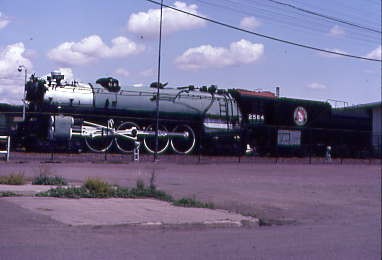
I checked with the Amtrak agent and learnt that the westbound was running forty minutes late. I went outside and saw Great Northern 4-8-4 2584 built by Baldwin in 1930. Such Northerns were assigned to the railroad's Montana division working between Williston, North Dakota and Havre, Montana, and the Spokane division for service between Spokane, and Wenatchee, Washington, hauling the Empire Builder and recently inaugurated Minneapolis-to-Seattle Oriental Limited. The S-2s were bumped from the Empire Builder and Oriental Limited in 1949 when the services were dieselised and relegated to secondary passenger and freight trains . During the 1950's, they were all repainted from their original Cascade Green to a more utilitarian black. 2584 was retired from service by the Great Northern in December 1957 and the following year, it was decided to preserve the locomotive for historical purposes. On 15th May 1964, it went on display at its current location.
I walked downtown to a nice looking café for lunch and when I went to the counter to pay for it, I put a twenty dollar bill on the counter then started to smell something burning. The grill had caught fire so I grabbed a fire extinguisher off the wall and assisted in putting out the fire. While all this was going on, someone stole my bill and the owner was shocked by this and offered to make it up to me, so offered me sixteen dollars worth of candy. I thanked him but declined and she encouraged me to take something, so I chose a Nestlé Crunch Bar, two Kit Kats and three Butterfingers. As I walked out, she tossed me a two pound bag of M&M's and said "May God bless you!" and I had my good deed for the day.
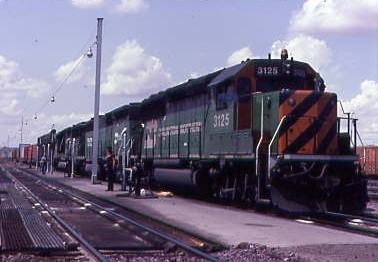
I returned to the station, photographed Burlington Northern 3125 East and talked with the Amtrak agent until the westbound Empire Builder arrived.
Empire Builder 7 7/25/1986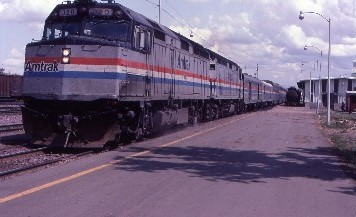
I boarded the Empire Builder, led by Amtrak F40PH 320, for Essex. The conductor took my ticket and since I had two long and late nights on my Empire Builder rides so far, decided to take a nap. I dozed off and awoke near Browning fully recharged and ready for the Rockies for the second time today. The Continental Divide, with its beautiful snow-capped peaks were backlit, but still made an impressive barrier and end to the Great Plains. In Glacier National Park, only the Going-to-the-Sun highway crosses the divide on a steep twisting route which goes over a 10,000 foot pass with the road only open for about four months a year. It takes a great amount of effort to reopen it in late May from the heavy snows of winter.
I walked back to the lounge car to enjoy the late afternoon climb over Marias Pass then we crossed the Two Medicine Bridge again and stopped at East Glacier. The conductor came through and pointed out each of the peaks with the history of their names. My favourite was Triple Divide Peak, the only peak in North America where water runs off it into three different oceans: the Pacific, Atlantic and Arctic. The climb was very rapid with the train passing through Bison and then Summit before starting the westward descent. I sat back and took in the incredible crossing of the Pass and was glad to be making a second crossing of it. The snowsheds came next with the sun now behind the mountains, then we crossed the high bridge at Java followed by the slide zone, at which point I walked back to my seat, collected my bags and met the conductor, who led me downstairs as we passed through the final snowshed. The train stopped and I stepped off onto an asphalt platform with lights and I had arrived in Essex.
Essex/Izaak Walton Inn 7/25/1986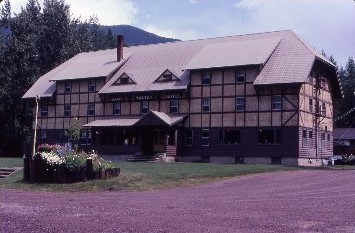
I was met by Larry Vielleux, co-owner of the Inn with wife Lydia, who took me to the hotel by van, where I was checked in and given my trackside room on the second floor. The bathroom was down the hall and I freshened up.
The Izaak Walton Inn symbolizes the difficulty of keeping the United States' northernmost transcontinental railroad open during Rocky Mountain winters. Each winter, sixty Great Northern Railway workers were stationed here to clear the rails of snow between Essex and East Glacier. Originally, their days of fighting snow and frequent avalanches ended with a return to abandoned railcars and wall tents, for Essex had only 150 permanent residents and nowhere for the workers to board. After numerous petitions, the Great Northern built this twenty-nine-bedroom structure in 1939, on its standard pattern for a division hotel. Railroad policy called for only a section house at a location other than division point, but the difficult winter maintenance of Marias Pass required changing the rule. The railroad also realized that the hostelry could serve summertime tourists, when fewer railhands needed lodging. The hotel was named after Sir Izaak Walton, a 16th century English author and sportsman, who has been the patron saint of fishermen for 400 years. Born on August 9, 1593 in Stafford, England, he authored the famous book about fly-fishing, "The Compleat Angler". A local resident who lived in the area in the early days is presumed to have named the hotel after Sir Izaak. This Craftsman-style inn has been in continuous use since its construction and, to this day, serves both railroad workers and tourists.
The rooms at the Izaak Walton Inn have been remodelled to offer modern amenities with a vintage charm and a true feel for Montana and The Inn is considered to offer the finest lodging experience in and around Glacier National Park. The hotel can accommodate up to 147 guests and thirty-three cozy rooms allow you to truly relax and get away.
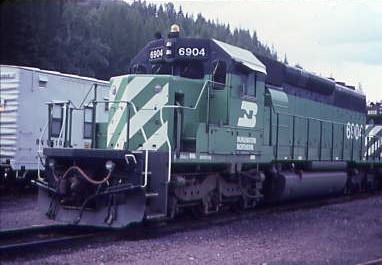
Burlington Northern SD40-2 6904, nee Burlington Northern 6368, built by Electro-Motive Division in 1973, was one of the helper units assigned here.
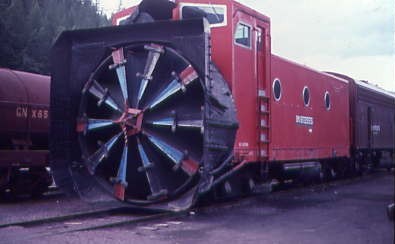
Burlington Northern rotary snow plough 972255, nee Great Northern X-1509 , built by Cooke Locomotive & Machine Works in 1925.
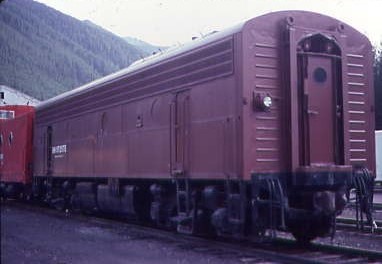
Burlington Northern rotary power Unit 972575, ex. Burlington Northern F9B 833, nee Northern Pacific 7009B, built by Electro-Motive Division in 1955.
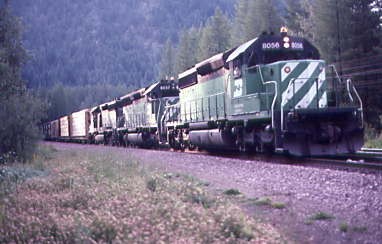
Burlington Northern 8056 West just east of the Essex Snowshed.
7/26/1986
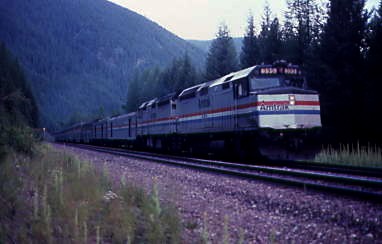
The eastbound Empire Builder before wonderful breakfast with a trackside table. I spend the morning hiking to, through and on top of the first snowshed but noticed black clouds approaching, although I also heard an eastbound freight train.
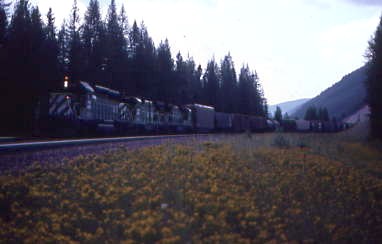
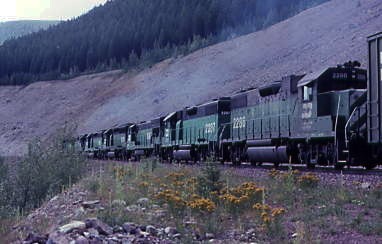
Burlington Northern 8027 West near the switch at West Java.
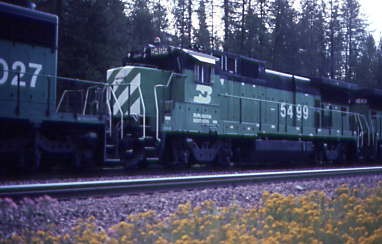
Burlington Northern B32-8 5499, built by General Electric in 1984, was one of two the railroad rostered. It became National Railway Equipment 5499 and is now GECX 5499.
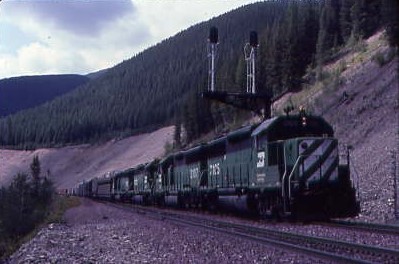
Burlington Northern 3105 West at West Java.
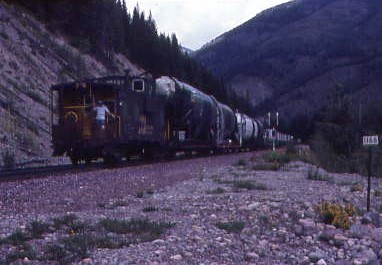
The rear of Burlington Northern 3015 West. Thunder echoed off the peaks and I wondered if the rain would hold off until the train arrived. I did, then the sky let loose so I took shelter under the cover of the snowshed. The shower ended but the sky did not look very friendly so I quickly returned and just reached underneath the porch when a downpour occcured for the next hour.
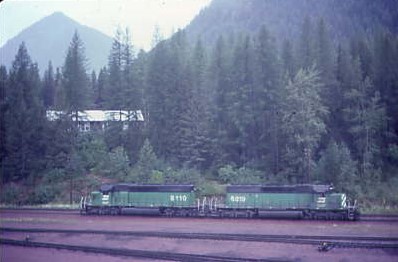
The helpers as seen from Room 27 during the thunderstorm. Once the rain ended, I hiked through the yard and went down along the tracks towards the ballast pits, being rewarded by five freight trains over the next three hours.
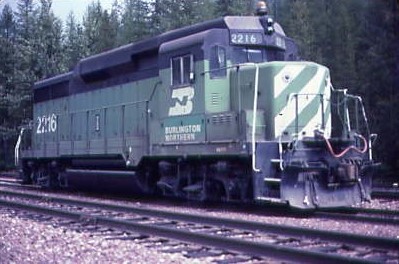
Burlington Northern GP30 2216, nee Great Northern 3016, built by Electro-Motive Division in 1963. It later became Burlington Northern GP39M 2815, then BNSF 2815 and finally Larry's Truck and Electric 2815.
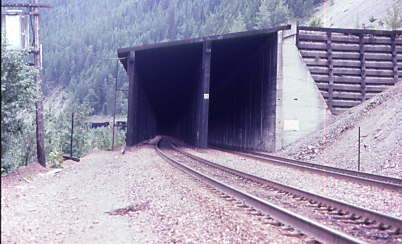
Snowshed 12.
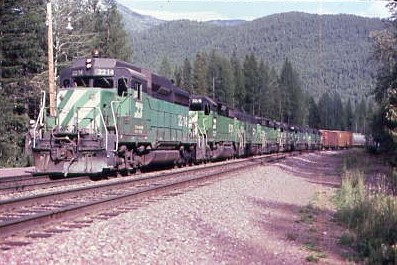
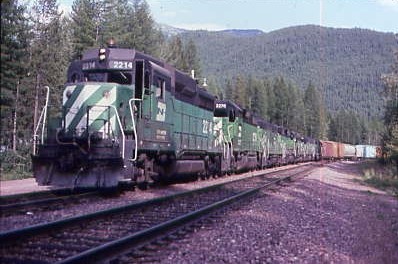
Burlington Northern 2214 West.
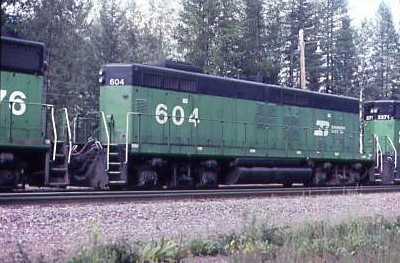
Burlington Northern GP9B 604 1982, ex. Burlington Northern 604, ex. Burlington Northern 1818 1970, ex. Great Northern 1703, nee Great Northern GP9 666, built by Electro-Motive Division in 1954. It later became BNSF 1703 then was retired. It was one of only four GP9bs on the system.
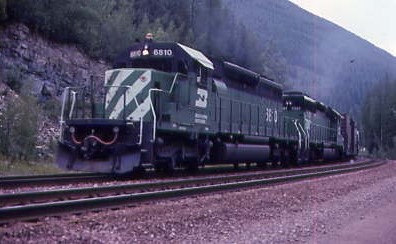
Burlington Northern 6810 East.
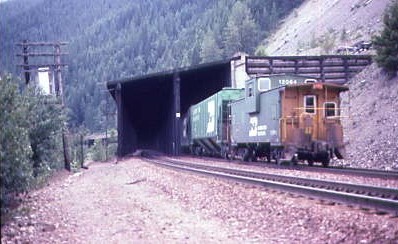
The rear of Burlington Northern 6810 East entering Shed 12.
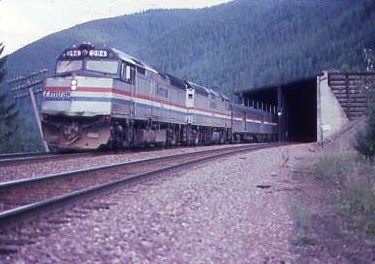
The westbound Amtrak Empire Builder 7 exited Shed 12 as the sun set behind the mountains. The air was so clean, the views beautiful and my walk was at a very relaxed pace with stops to take in my new surroundings.
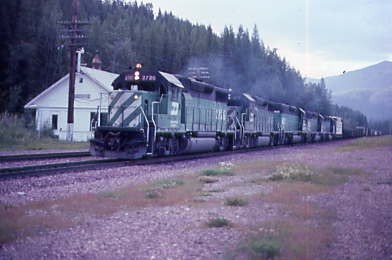
Burlington Northern 2270 East passed the Essex station.
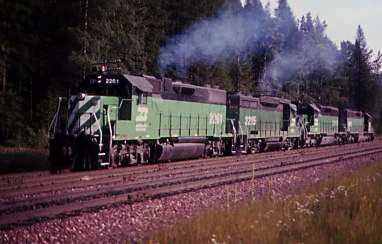
Burlington Northern 2261 on the ballast train. I returned to the Inn for a wonderful fried chicken dinner at my usual trackside table then upon walking out into the lobby, Larry introduced me to Fred from Iowa, who had the Inn's rental car and invited me to go with him tomorrow for a day of photography on Marias Pass. I took him up on it and we went out to catch the Empire Builder passing the old Essex depot in the last low light of the day. With darkness returning, I called it a night.
7/27/1986 Sunshine greeted me as I had breakfast with Fred and we discussed our plans for the day, deciding to follow the eastbound Empire Builder to Browning then wait for a westbound freight which we would chase back to Summit then play the rest of the day by ear.
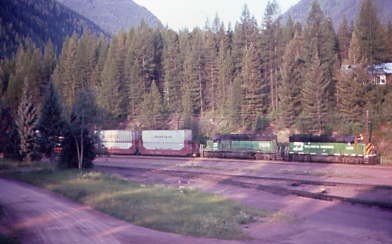
The next morning from my room Burlington Northern 3135 West.
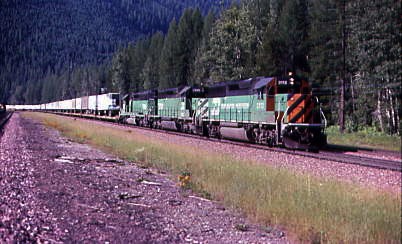
Burlington Northern 3112 West.
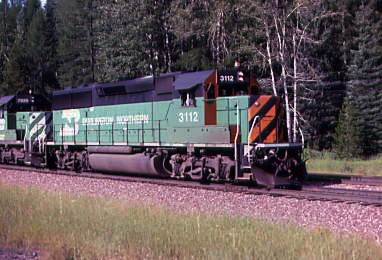
Burlington Northern GP50 3112, built by Electro-Motive Division in 1985. It is now BNSF 3112.
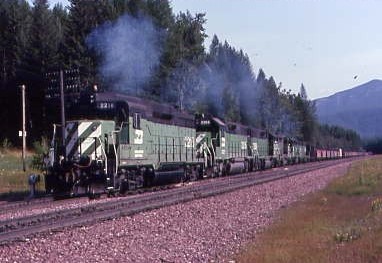
Burlington Northern 2216 leading an eastbound ballast train.
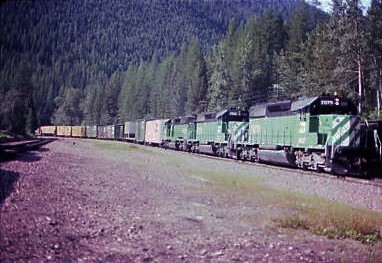
Burlington Northern 7079 West rolled into Essex.
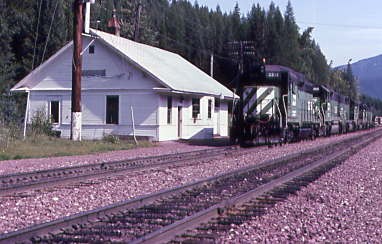
The ballast train in front of the Essex station.
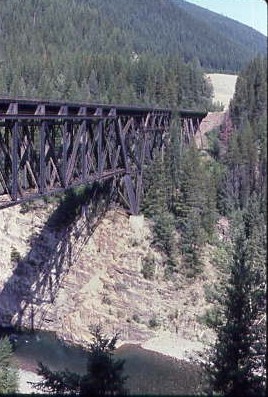
The Java High Bridge.

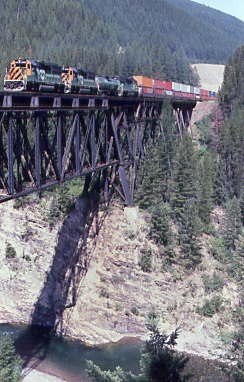
Burlington Northern 3142 East crossed the Java High Bridge.
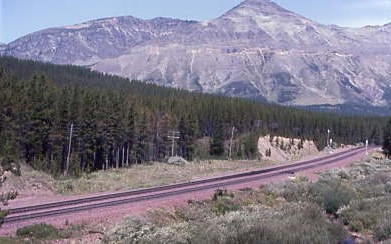
The classic summit view at Marias Pass.
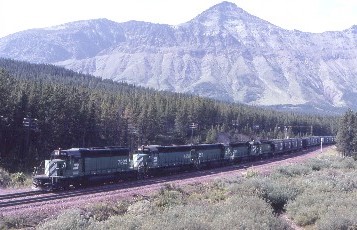
BNSF 7922 West.
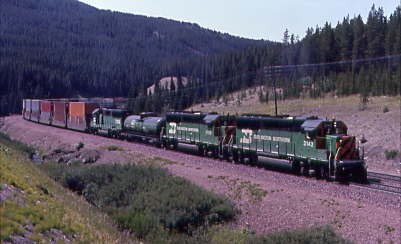
Burlington Northern 3142 East coming into Summit.
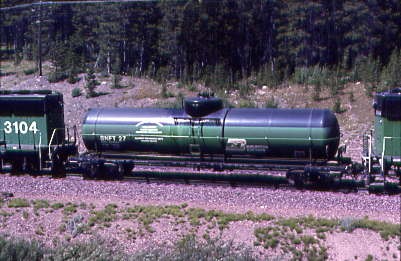
Burlington Northern fuel tender BNFT 27.
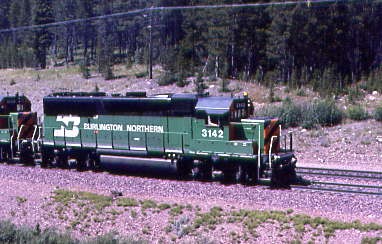
Burlington Northern GP50 3142, built by Electro-Motive Division in 1985. It is now BNSF 3142.
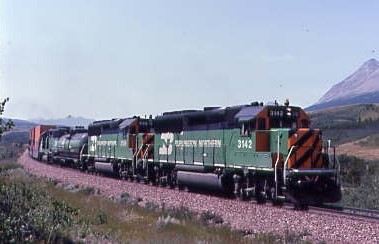
We chased the train and caught it at Bison.
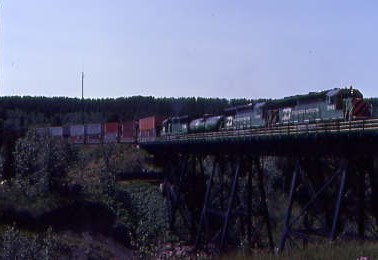
Crossing a bridge at East Glacier.
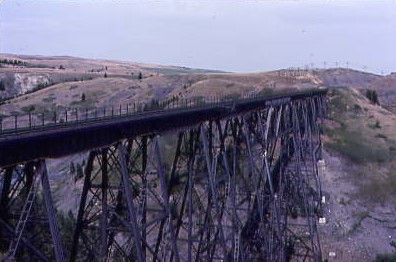
Two Medicine Bridge.
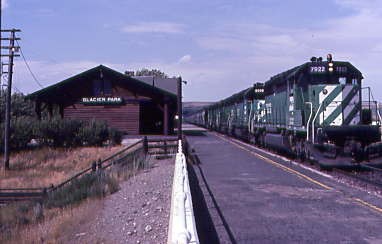
Burlington Northern 7922 West and the East Glacier (Glacier Park) station.
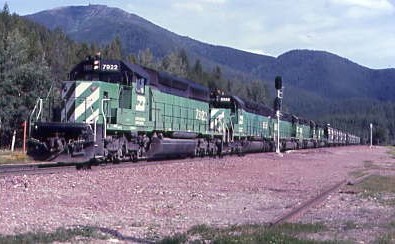
Burlington Northern 7922 West passing through East Java.
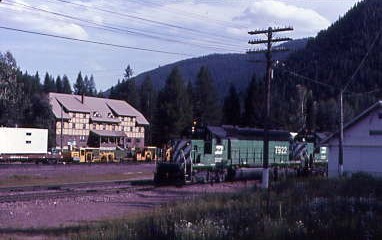
Burlington Northern 7922 West passing the Essex station. The plan worked like a charm and we had a successful day of photography on Marias Pass, after which I had an excellent steak dinner and went to the bar for a last round of drinks before Larry drove me back to the Amtrak platform.
Empire Builder 7/27 7/27/1986
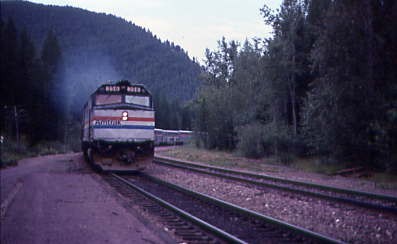
The Empire Builder arrived at the flag stop platform to pick me up for my journey to Vancouver, Washington. The conductor led me upstairs and the other passengers wondered where I had come from and as we passed the Izaak Walton Inn, I pointed to it. I stored my bags and watched the evening scenery pass after my wonderful experience with many special memories. Just after Whitefish I went back to my coach seat and fell into a deep restful slumber.
7/28/1986 The next morning found me on the former Spokane, Portland and Seattle tracks which were rumoured to be closing in the near future between Spokane and Pasco, so I was glad to be riding these rails. I enjoyed the last few miles into Pasco then travelled down the North Bank of the Columbia River in the lounge car for the journey through the Columbia River Gorge.
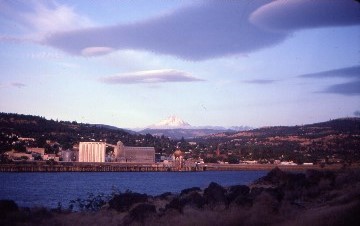
Apart from the lighting, the only difference from the eastbound trip was that Union Pacific on the Oregon side was very busy and there was more barge traffic on the river this morning. After Wishram, the conductor walked through and I asked if I could board the Pioneer in Vancouver instead of Portland as I did not like the way trains were boarded there. He replied that was fine since Amtrak considers Vancouver and Portland to be the same place. It was a good ride the rest of the way through and out of the Gorge, where I detrained at Vancouver's very nice wooden depot. Since we arrived on time, I spent the next hour-and-a-half photographing trains on this active stretch of railroad with both Burlington Northern and Union Pacific trains until my next train arrived.
The Pioneer 26 7/28/1986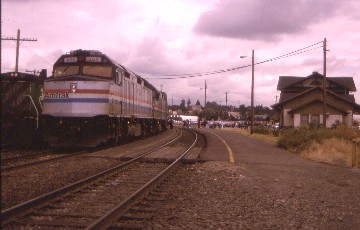
We departed Vancouver and I crossed the Columbia River for the sixth and final time this trip then arrived in Portland early, with my through car filling with passengers going to Pendleton, Oregon. We left Portland on time, travelling east along Interstate 84 and the new Tri-Met MAX light rail system under construction. We ran out to Troutdale but had to wait until a Union Pacific freight train cleared onto the freight-only line into Portland that stays along the Columbia River. We passed Multnomah Falls then stopped at Cascade Locks and Hood River with westbound Burlington Northern freights passing in succession across the river on the North Bank between the stops. Leaving The Dalles, it was lunch time so I ordered my usual hot dogs.
We went underneath the Inside Gateway, with no trains which was par for the course, then continued up the Gorge over the excellent track of the Union Pacific at 79 mph before turning away from the Columbia River and by the Umatila Army Depot, where I saw a military switcher shuffling cars about. Our next stop was at Hinkle, which is in the middle of Union Pacific's huge rail yard, then we travelled up a nice canyon to Pendleton, where the majority of the passengers in my coach detrained. The Pioneer started the climb up the Blue Mountains and a freight train was in every siding, after which our next stop was at La Grande on the opposite side of the mountains, which I enjoyed crossing again. Those passengers left detrained here and our conductor told me that there were fifty people left on board bound for Utah, but since they were spread out over five cars, it was an easy crowd for him to work with.
There was only one seating for dinner which was done at a very leisurely pace and while I was being served my barbecued chicken dinner, we crossed Telocaset Summit then descended to our next stop at Baker. The Pioneer next climbed to the summit at Encina as I finished my delicious dinner then we went around the horseshoe curve at Durkee as the sun set behind the Blue Mountains and we arrived a few minutes later at Huntington in twilight. We crossed the Snake River into Idaho for twenty-four miles before crossing it back into Oregon to our stop at Ontario. East of town, we crossed the Snake River again into Idaho for most of the remainder of the night, and I turned in before Nampa. This was my first train trip where I would not be detraining in Pocatello as my brother Bruce moved to Davis, California and I would be visiting him in three days.
7/29/1986 I awoke early in the morning just as the Pioneer was arriving at Ogden, Utah then we proceeded down the Union Pacific mainline to Salt Lake City in the early morning light, which brought back many memories of those Desert Wind journeys to and from Ogden to see Bruce. We arrived on time in Salt Lake City and while our cars were being switched onto the California Zephyr, I walked over to the park to see Union Pacific 4-8-4 834 on display, then returned to the train to find my car was now the last on this fifteen car train before we left town on time to continue our trip east. The Zephyr made good time to Provo then travelled over the Wasatch Mountains crossing Soldier Summit before descending the grades to Helper then sped across the Utah desert, flying through Thompson, another flag stop, and entering Colorado in Ruby Canyon to start the 232 mile journey along the Colorado River. We stopped at Grand Junction for servicing and this was the beginning of my first eastbound trip over the Rio Grande to Denver, as Grand Junction had always been my turn-around point on trips from Idaho, except the time I rode the Rio Grande Zephyr westbound.
Dubuque Canyon came first then later, a stop at Glenwood Springs. Glenwood Canyon was as beautiful as I remembered, although construction had commenced for Interstate 70 since my last journey through it. We went to Dotsero and started our trek over the Dotsero Cutoff though Red Rock Canyon to Bond, then east of there, the Zephyr negotiated Gore and Byers Canyons before I had Rocky Mountain Trout for dinner as the train stopped at Granby and Winter Park. I returned to the lounge car for our passage through the Moffat Tunnel and then the descent down the Front Range to our on-time arrival in Denver, where I taxied to the Travelodge for a hot shower and a good night's sleep in a stationary location.
California Zephyr 5 7/30/1986I awoke to another bright sunny July morning and after preparing for the day, checked out of the hotel and asked for a taxi. When the lady learnt I was going to Union Station, she advised that I could take a city bus for a dollar which would take me within two blocks of it, so I chose Denver Transit and fifteen minutes later, was back at Union Station and the third person in line to obtain a boarding pass for the California Zephyr. The train arrived from Chicago and twenty minutes later, I found my seat then walked back to the lounge car for the journey up the Front Range of the Rockies and today's ride across the entire Rio Grande Railroad. I stayed there for most of the day until I went to the dining car for a well-prepared steak dinner as the train traversed the Utah desert after dark. I had an evening of nightcaps over Soldier Summit before I was asleep prior to our arrival in Provo and slept through the shuffling of cars at Salt Lake City where this time, my car sat stationary in the station.
7/31/1986 The next morning found the on-schedule California Zephyr west of Lovelock, Nevada and we travelled through the Humboldt River Sink, having followed the Humboldt River most of the way across the state. Our route coincided with the Truckee River just past Fernley and paralleled it to Sparks, Reno and into California to the namesake city of Truckee. At Sparks, the train was given its 500 mile servicing, which allowed for a nice walk trackside, then a full train's worth of passengers boarded in Reno and we entered California. Once we departed Truckee, started our climb over Donner Pass and after going through the Summit Tunnel, I went back to the rear door and spent the journey over Donner Pass watching the scenery, which was incredible and gave me a perfect understanding of the pass and its challenges. Leaving Sacramento, it was a quick trip across the Yolo Bypass to Davis, where I detrained, met my brother Bruce and stayed with his family for the night.
Coast Starlight 11/San Joaquin 708/The Bus/San Diegan 580 8/1/1986This day, I went to work with Bruce, who was the Amtrak agent, then waited for the Coast Starlight and boarded in order to connect to the San Joaquin in Martinez for the journey across the California Delta. It was only a fifty-two minutes ride and we passed the United States Navy Mothball Fleet before going over the drawbridge to Martinez, where I detrained in the bright California sunshine to wait for my next train.
Southbound San Joaquin 708 arrived on time and we were off down the last few miles of Southern Pacific track to Port Chicago, where we switched onto the rails of the Santa Fe. We passed the large US Steel plant at Pittsburg before travelling through Antioch and reaching Knightsen, the start of Delta Country. In this part of the Delta, there was is not a lot of water as the landscape had been reclaimed for farming and the water channeled. At one point, there were channels on both sides of the train and at Middle River, a working drawbridge. We continued east and just before Stockton, came upon a second drawbridge then arrived at the station. Once out of Stockton, we started our race down the San Joaquin Valley and the stops came in rapid succession: Riverbank, Merced, Madera, Fresno, Hanford, Wasco and Bakersfield.
As this was the final day of my trip, I was looking forward to being home. At Bakersfield, I detrained for the non-descriptive bus ride over the Grapevine to Los Angeles Union Station, where I climbed aboard San Diegan 580 for the quick journey to Santa Ana and home. Thus, I had completed my first Canadian train ride, Empire Builder rides and other assorted trains in the Amtrak West region of the All-Aboard America zone.
| RETURN TO THE MAIN PAGE |