



Expo 86, the World's Fair, was hosted by Vancouver, British Columbia from May 2nd to October 13th, 1986. My parents invited me to go and I suggested we ride the British Columbia Railway (BC Rail), to which they were both very amenable. They suggested that perhaps my long-time friend from elementary school days, Jeff Hartmann, would like to join us. Since Jeff had to work, he would meet us in Vancouver by taking Amtrak. When my parents said we would be passing through Spokane on the way back, I proposed a Spokane-Seattle-Portland-Spokane triangle trip, to which they agreed.
Now on a roll, I had the idea to travel home on Amtrak, using a one regional All-Aboard America Fare? That way, I could stay at the Izaak Walton Inn in Essex, Montana, somewhere I always wanted to go, then booked my journey on the Empire Builder, Coast Starlight, Empire Builder, Pioneer, California Zephyr, San Joaquin and San Diegan on the Amtrak portion. I called BC Rail for tickets on their train and was all set for my first Canadian train ride and my first on Amtrak's Empire Builder.
7/15/1986 It seemed as if the day took forever to come, but we finally packed the camper for the three-day drive to Vancouver. This was the first time in years I had travelled in the camper with my parents and it brought back all the memories I had as a child going on vacations with them and how much fun it really was. I really missed riding in the back of the camper and that might have led to my love of riding trains. Since once sits back and lets someone else do the driving with the freedom of being the passenger and being able to move about is similar to riding a train.
7/18/1986 The three of us crossed the border and first drove to the B.C. Ferry terminal at Tsawwassen in Delta to see the ferries then made our way into Vancouver and spent the next two days at Expo 86.

The emblem of the World's Fair.
Expo 86 History1986 marked Vancouver's 100th anniversary. It was also the centennial of Canada's first transcontinental passenger train to arrive on the shores of the Pacific Ocean. With these important milestones in mind, the government of British Columbia and the city of Vancouver toyed with the idea of hosting a World's Fair. The idea was not entirely new. The first proposals for an international fair date back to the 1920s. But the World's Fair of 1936, which would have celebrated Vancouver's 50th birthday, never got off the ground due to economic problems associated with the Great Depression.
The idea of re-establishing a plan for a World's Fair was half-heartedly debated after Seattle's fair in 1962 and Montreal's fair in 1967 but no proposals were viewed to have any realistic merit until 1978. It was on that year, at an impromptu meeting in London's Calvary Club, that two influential members of British Columbia's government first discussed an architect's proposal for Vancouver's centennial celebrations. The proposal included a small international exhibition.
In nearby Washington State, Seattle's fair in 1962 had the distinction of being the only world's fair to make a profit and Spokane hosted a successful World's Fair three years previous. With a stable and strong tourist industry beginning to take hold in Vancouver, the idea of hosting a World's Fair seemed achievable. The wheels were in motion, but if there was to be a fair, all sectors of the government had to act quickly. A bid to host an international exhibition in 1986 had to be submitted to the BIE no later than 1979. In what was perhaps one of the fastest acts of British Columbia's political history, the plan was approved and a bid to host a Specialized Exhibition was submitted to the Bureau of International Exhibitions within a year.
The time between the original bid and the actual event saw many changes to Expo '86's overall plan. However, the theme remained constant throughout the process. The dilemma was to come up with a theme that was, at least in part, unique to the city hosting the fair. During the early planning stages, the one reoccurring theme that kept popping up was transportation. It was clear that the natural geography that gave Vancouver its beauty also made the city a transportation nightmare. In the 1970s, Vancouver was suffering from a range of transportation problems due to growth, the popularity of the automobile and the loss of several public systems. The interurban, a public transit trolley line that linked New Westminster to Vancouver, was long-abandoned. Bridges to North Vancouver rendered the city's ferry system obsolete. However, new transit schemes on old themes were being launched at that time. The sea bus system, based on the old ferry routes, became widely popular after it was introduced in the 1970s and in order to ease automobile congestion, the city was eager to establish a modern rapid transit system along the old interurban tram line.It was also noted that throughout history, Vancouver's economic well-being was intrinsically linked to milestones in transportation. Vancouver's very existence was sparked by the building of a transcontinental railroad 100 years earlier and 100 years before that, the Pacific Northwest was considered one of the most isolated areas of the world. It was one of the last coastlines on the globe to be included on the world map. So, three hundred years after captains in tall ships first mapped its remote shores, Vancouver was to transport millions of people into the city for a grand festival of art, culture and history. The fair, christened "Transpo '86," was to be in itself a transportation milestone.
Originally, the world's fair was to be held on the grounds of the Pacific National Exhibition. The PNE was to receive a facelift, new modern pavilions and a monorail to the downtown core. This idea would sound familiar to the people of Seattle. The original design of Expo 86 was almost a mirror image to the World's Fair of 1962. During this time, Vancouver was negotiating to buy back land on the north shore of False Creek from the Canadian Pacific Railway. A century of heavy industry turned the area into an eyesore, but the south side of False Creek had successfully been developed into housing communities, parks and a public market during the "city beautiful" movement of the 1970s. The same type of urban renewal project was proposed for the north shore along with a 60,000 seat covered stadium.
When the Pacific National Exhibition grounds were deemed too small for a World's Fair, the Transpo '86 organizers set their sights elsewhere. The False Creek area was an ideal setting near the downtown core and close to the proposed rapid transit route. Incorporating the rapid transit system into the World's Fair plan was thought to be a convenient way to garner extra funding from the federal government for both projects. Vancouver's city council was not receptive to the False Creek Plan. They were looking north to the picture perfect setting seen on many postcards, namely Coal/inner harbour which was next door to tourist destinations and the hub of the city. The harbour was also the area where the city council thought legacy structures could best be used afterwards. The "wish list" included a large convention centre, a waterfront park and fountain, and of course, a new cruise ship terminal. But the problem with the inner harbour was land availability. In order to host a fair in that area, extensive land fill projects or a compromise on the size of the fair were in order.
In 1980, the Bureau of International Expositions unanimously voted in favour of Transpo '86 and suggested that the False Creek site was the best alternative of all the proposals. The name "Transpo '86" was changed to "Expo '86" to give the fair a universal appeal. Architect Bruno Freschi was hired to design a conceptual model of a World's fair on the False Creek site. By the early 1980s, several major projects and all levels of government were entwined into the Expo '86 plan. Opposing agendas did not correspond. Cost estimates skyrocketed and land disputes on the proposed rapid transit line erupted. Negotiations over which level of government was obligated to pay for certain projects and potential deficits escalated to such a heated pitch that the Provincial government canceled the World's Fair in 1981. It was a surprise to the public four months later when the Provincial government announced that Expo '86 would go ahead as scheduled and the Federal government agreed not only to build the largest Canada pavilion ever erected but a new cruise ship terminal at Pier BC as well. A lottery was established to help pay for the cost of Expo '86, and a short time later, the first working site model was unveiled to the public.
There was no problem with space on the site, but as the number of international and corporate participants grew, pavilions replaced parklands. Expo planners began to treat the Expo site like a giant jigsaw puzzle in an attempt to keep an aesthetic balance while fitting everyone in. When hosting a Specialized Exposition, the host country provides indoor exhibition space (if required) for the international participants. Traditionally, this exhibition space has been in the form of large structures shared by many countries. But with ample room on the False Creek site, the Expo '86 architects developed a unique way for the international participants to occupy individual pavilions of their choosing. This gave Expo '86 the feeling of a Universal Exposition while maintaining architectural continuity.
Although the international participants could choose to design their own pavilion, most countries opted to use the less expensive Expo '86 module. Each module was approximately 2.5 stories high and had the floor space relative to a third of a city block. The design was such that any number of the square modules could be placed together in a variety of shapes. The self-supporting roof design allowed the interior exhibit area to be uninterrupted by pillars. The participant was only to determine how many modules they wished and which shape they would like the modules placed. It was up to the participant to decorate the structure -- outside and in.
To much fanfare, Prince Charles and Princess Diana officially opened Expo 86 on May 2, 1986. With 54 nations, 12 provinces/states, 14 corporate or specialized pavilions and the largest gathering of entertainment Vancouver had ever seen, the party began. Approximately 50 percent more than the predicted 13.7 million people visited the fair. And shattering Vancouver's reputation as a rain soaked city, 130 of the 172 days were dry.
Information taken from Expo 86 Information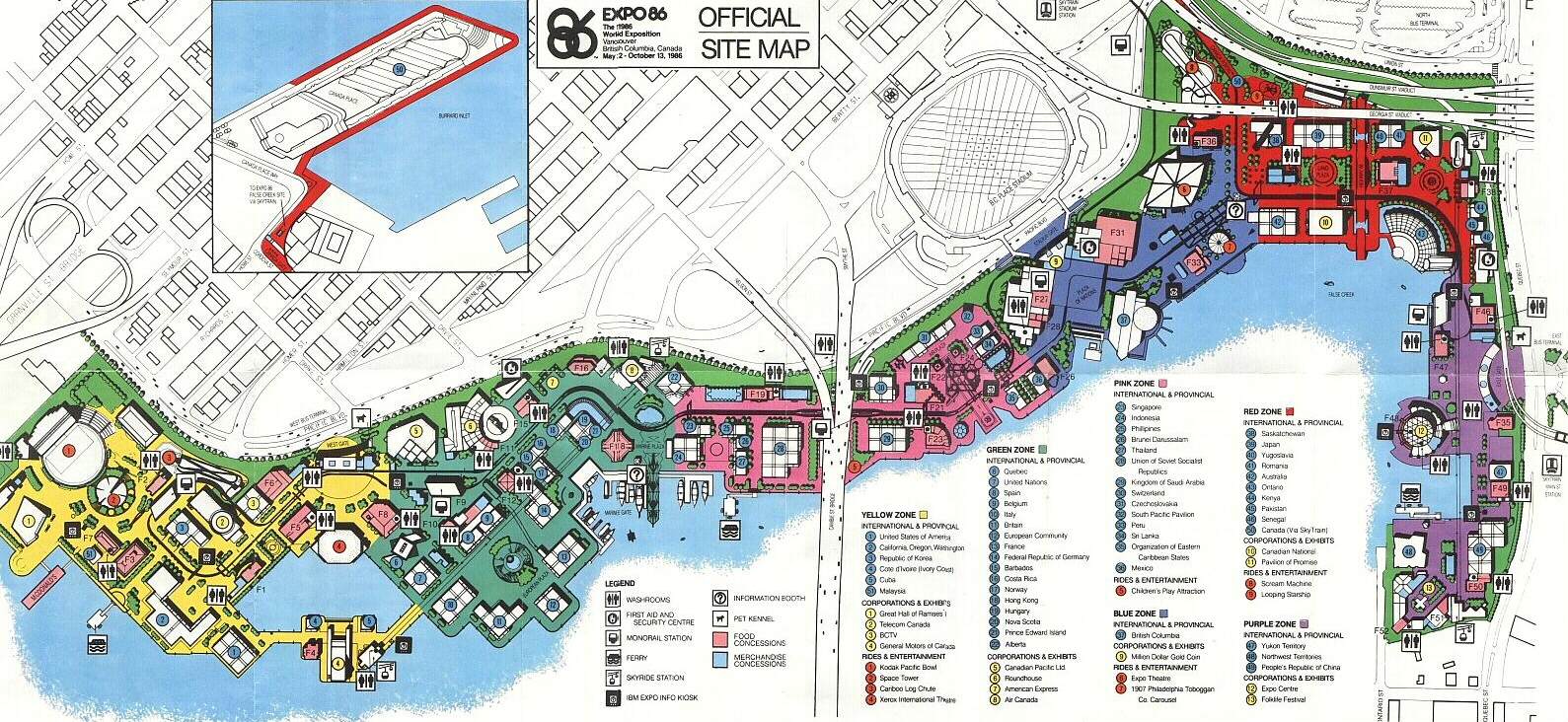
The map of the Expo grounds.
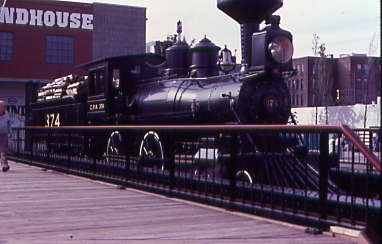
Canadian Pacific 4-4-0 374, built by the railway in 1886, was on display. Canadian Pacific began to design its own locomotives in July 1883 with the hiring of F.R.F. Brown as the company’s second locomotive Superintendent. Canadian Pacific opened new shops in Montreal and the first locomotives were built in 1883. Between May and July 1886, a group of eight 4-4-0 passenger locomotives, constructed and numbered 371-378. These were sent to the Pacific Division to operate on the Cascade section between North Bend and Port Moody, and two of them figured in historical events.
The last spike for the CPR was completed on November 7, 1885 at Craigellachie, located several kilometres to the west of the Eagle Pass summit between Sicamous and Revelstoke. No. 371, hauled the first Pacific Express into Port Moody on July 4, 1886. This was the first scheduled train to cross Canada from sea to sea. No. 374 hauled the first passenger train, carrying 150 passengers, to go beyond Port Moody over the 12 mile extension to Vancouver on May 23rd, 1887, thus finally joining Canada from East to West.
While 371, still essentially in its original form, was scrapped in October 1915, Engine 374 had a different fate. In September 1914, it was selected for a complete rebuilding; it was an almost completely new locomotive, built upon the main frame of the original 1886 locomotive. 374 was given an additional thirty year lease on life and remained in revenue service until July 1945, when it was retired. Then the locomotive was donated to the City of Vancouver as a memento of the original 374. Prior to delivery to the city, Canadian Pacific gave it a cosmetic treatment to make it look "old". The necessity to remove some modern technology to achieve this goal rendered the locomotive permanently inoperative.
After delivery to Vancouver, 374 was made the responsibility of the Park Board for care and custody and was placed on a section of track at Kitsilano Beach. The next 38 years were perhaps the saddest chapter in the life of this engine. It remained in the park largely forgotten and ignored, the victim of rust and vandalism. Although a few volunteers attempted to maintain her, a lack of money, interest and proper shelter took their toll on the engine. In 1963, a vain attempt was made to move into the former aircraft hangar where the Community Music School is now located in Vanier Park. Then in 1981, the West Coast Railway Association and the Canadian Railroad Historical Association began to promote the saving and restoration of the 374, and by 1983 had raised funds for a badly needed cosmetic restoration.
The locomotive was removed from Kitsilano and placed in a warehouse on Granville Island, where teams of dedicated volunteers worked on her for two years. In 1985, the engine was transported to North Vancouver's Versatile Shipyards for final restoration. Additional funds to accomplish this were partially raised through the Heritage Brick Program sponsored by Imperial Oil Limited. On February 13, 1986, 374 was transported to the Expo 86 Roundhouse Site, there, restored to its former glory, it was a fitting tribute to Vancouver's historic transition from "Milltown to Metropolis".
In May 1988, volunteers were allowed access by Concord Pacific Developments to examine, clean and polish 374, to weed between the heritage bricks and set up arrangements for a public opening. During 1988-1990, the public was invited to the Roundhouse Courtyard to view the engine and the Heritage Bricks. As part of its development, Concord Pacific has converted the Drake Street Roundhouse into a Community Centre, giving both the building and surrounding area park land to the Parks Board. The Park Board proposed a new building, the 374 Station Pavilion, at the Roundhouse Community Arts & Recreation Centre in Yaletown. This became a reality in the 1990′s, as 374 found its new home.
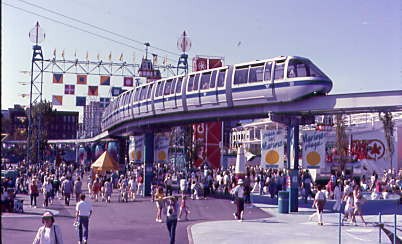
A view of the grounds with the Monorail running overhead. That was the only transportation system that touched every Zone and to allow as many rides as possible, passenger travel was restricted to half way around the 3.47 mile route. After the fair, the city originally planned to keep the monorail as a shuttle service between the beaches of English Bay and Downtown, but after much protest from the surrounding neighbourhoods (who feared that the monorail would make too much noise) the plan was scraped and the monorail was sold. It now shuttles people to and from the parking lot in Alton Towers Amusement Park, England.
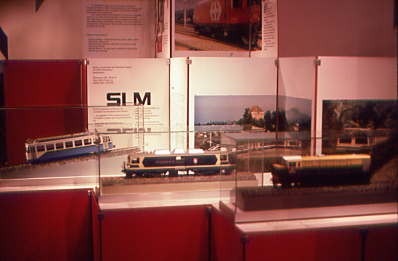
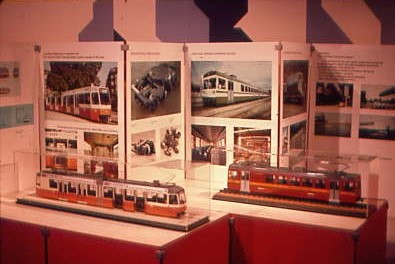
This was my second World's Fair as I had also been to Expo 74 in Spokane, Washington and enjoyed the Swiss exhibit featuring Swiss trains. Here, the Swiss also brought their model trains for all to enjoy.
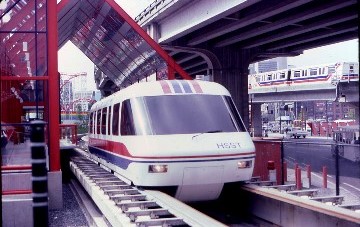
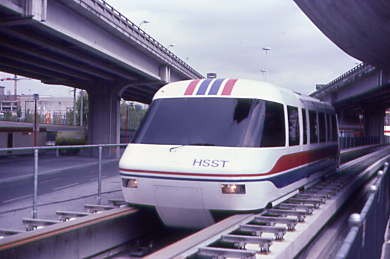
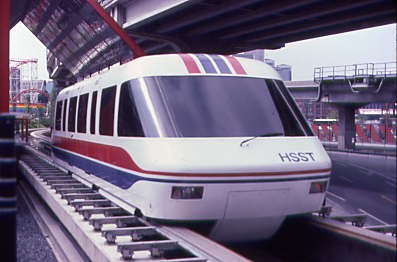
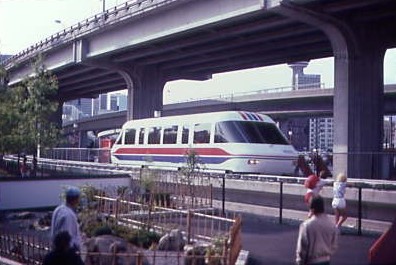
One highlight was riding in the High Speed Surface Transport, an example of Japan's lead in magnetic levitation technology. The train itself floated above the track on electro-magnetic modules. Visitors to the Japan pavilion could experience what future travel may be like by boarding the prototype rail car. Although the train has been clocked at speeds over 300 kilometres per hour, the short 450 metre track only allowed the train to reach a speed of 40 kph. After the far, it was shown at the Aoi Expo in 1987 and is now on static display at Okazaki Minami Park.
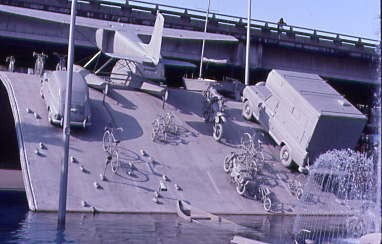
Beginning in False Creek, the 712 foot long Highway 86 rose out of the sea like a giant undulating serpent. The four lane boulevard was loaded with over 200 cars, boats, bicycles, space capsules, airplanes and lunar rovers. Uniformly grey, the surreal structure invited spectators to walk on the highway or use the vehicles for seating. The steel and concrete highway was a commentary on our love-hate relationship with technology in the 1980s. Highway 86 could have been interpreted as leading to either utopia or apocalypse, and because the structure rose from the sea, it could also be perceived as a humorous commentary on Darwin's Theory of Evolution.
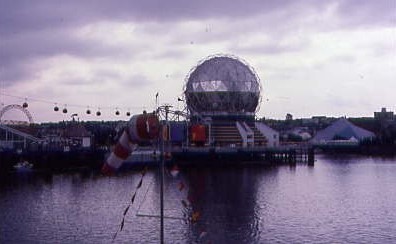
Expo Centre, a Buckminster Fuller–inspired geodesic dome, designed by Expo's chief architect Bruno Freschi. Construction began in 1984 and was completed by early 1985. Afterwards, it was re-purposed as a science centre and opened as such on May 6, 1989, as Science World. The museum was branded as Science World at Telus World of Science under a naming rights agreement with sponsor Telus Corporation from 2005 to 2020 before it reverted to its original name.
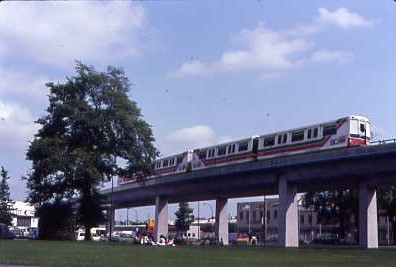
Skytrain was unveiled just prior to Expo 86. Hailed as one of the most advanced rapid transit systems in the world, it was not surprising that part of the route straddled the fair. For fairgoers themselves, Skytrain was the> primary shuttle link between the Canada Pavilion on the North end of Downtown and the main site on the shores of False Creek.
On July 19th, I saw my first Canadian football game at BC Place when the BC Lions hosted the Montreal Alouettes, winning 27-20. Jeff arrived around midnight after travelling on the Coast Starlight to Seattle and taking the Amtrak Thruway bus to Vancouver and his connection worked perfectly. The next day, the four of us drove to the BC Rail station in North Vancouver to begin our first Canadian train ride. See Cariboo Dayliner from North Vancouver to Prince George
A Third Day at Expo 86 7/22/1986My parents, Jeff and I rode the bus to the fair and since I was now familiar with its layout, was able to be a guide for Jeff. I took him to the "Rainbow War", a short film shown at the Canadian Pacific pavilion, the Canadian National pavilion and over to Pacific Central Station before we rode the Japanese HSST train. We spent the whole day at the World's Fair and after three complete days, I had seen almost everything.
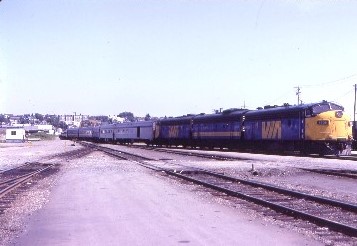
Each day I walked over to VIA Rail's Pacific Central Station, formerly Canadian National, to see the passenger trains.
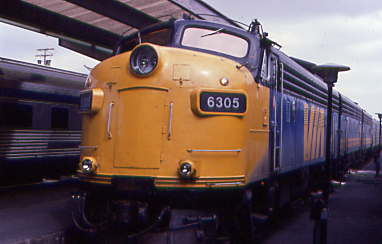
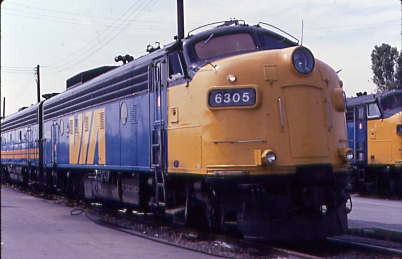
Leading the Canadian from Toronto to Vancouver was VIA Rail FP9 6305, ex. VIA 6508 1984, nee Canadian National 6508, built by General Motors Diesel in 1984. It became Les Trains Touristique St-Laurent 6305 in 1994 for excursion service between Quebec City and Clermont, then Waterloo-St. Jacobs Railway 6508 "Spirit of St. Jacobs" in 2006 before being acquired by the Westcoast Railway Association in 2012. They sold it to Ontario Southland and it is named "James A. Brown", retaining the same number. Information current as of October 2025.
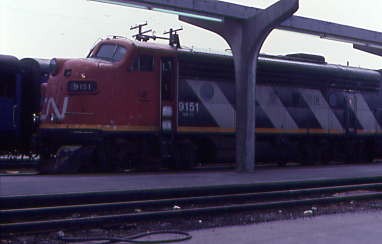
Bringing the Super Continental from Winnipeg was Canadian National F7Au 9151, nee Canadian National 9094 built by General Motors Diesel in 1952. This locomotive was retired two years later and probably scrapped.
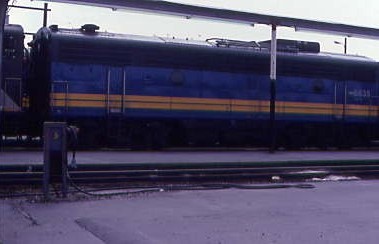
VIA Rail F9B 6635, nee Canadian National 6635, built by General Motors Diesel in 1958. It was retired between 1986 and 1990.
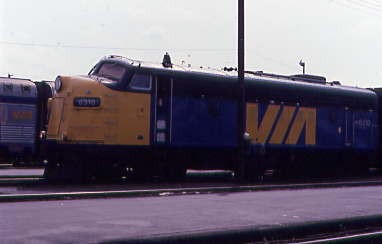
Ready to take the Super Continental east was VIA FP9Au 6310, ex. VIA Rail 6532, nee Canadian National 6532, built by General Motors Diesel in 1954. It was retired after being in a wreck in 1993.
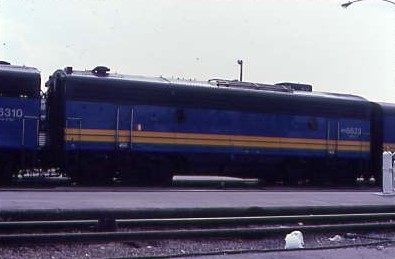
VIA F9B 6623, nee Canadian National 6623, built by General Motors Diesel in 1958. It was retired between 1986 and 1990.
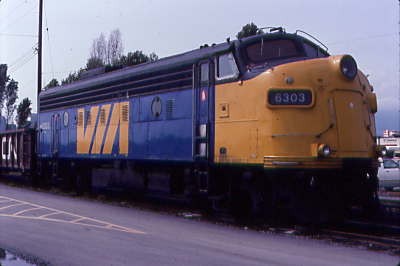
VIA FP9A 6303, ex. VIA 6539, nee Canadian National 6539 built by General Motors Diesel in 1958. It was retired and became Lakeland and Waterways (RailLink) 1400, then Mackenzie Northern 1400 in 2000, then Ontario Southland 1400 in 2012. It was acquired by the VIA Historical Association in 2023 and was restored to its VIA livery in October 2024.
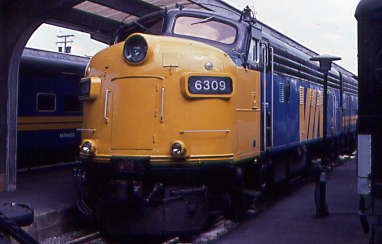
Fresh from leading the westbound Canadian to Vancouver was VIA FP9Au 6309, ex. VIA 6528 1984, nee Canadian National 6528, built by General Motors Diesel in 1957. It was retired in 2000 and is on display in the Angus Pavilion of the Canadian Railway Museum in Delson, Quebec.
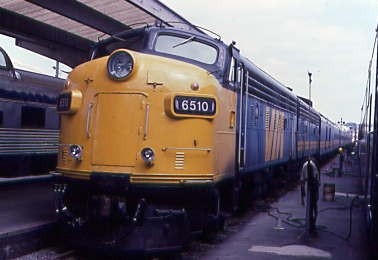
Finished its journey from Winnipeg was VIA FP9A 6510, nee Canadian National 6510, built by General Motors Diesel in 1954. It was retired and is the lead of a four-unit display train at the Kaministiquia River Heritage Park in Thunder Bay, Ontario.
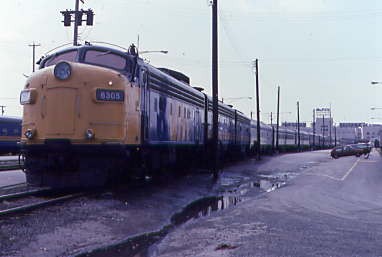
VIA Rail Train 2, the Canadian, was ready for departure later this evening.
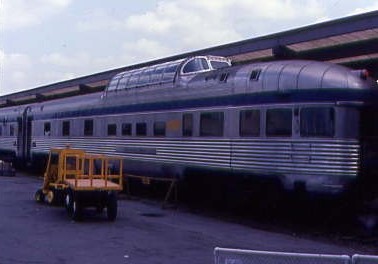
Via Rail sleeper-buffet-lounge-dome-observation car 8715 "Tremblant Park", ex. Canadian Pacific Rail 15515, nee Canadian Pacific 15415, built by Budd Company and AMF Technotransport in 1954, brought up the rear of the Canadian.
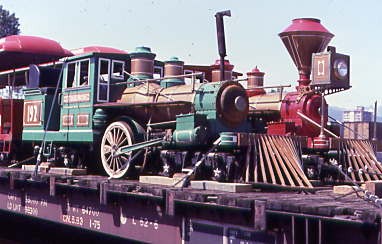
On the right is Virginia and Truckee 22 "Inyo" from Nevada State Railroad Museum in Carson City, Nevada, which had not yet returned home from Steam Expo.
At this point, I would not have though that five years later, I would start riding VIA Rail and complete the whole system in August 2000.
| RETURN TO THE MAIN PAGE |