



In the mail came a flyer advertising a Pacific Railroad Society excursion to Cushenbury on Santa Fe's Lucerne Valley District. The Society is one of the oldest rail enthusiast organizations in the United States, comprised of people from all ages and walks of life who share an interest in railroads. Membership is open to anyone interested in railroads or rail transit. Train travel, history, preservation, equipment restoration and photography are among the interests and activities of the Society, which is run entirely by volunteers.
The history of the Lucerne Valley District goes back only to 1956, when a 29.5 mile branch was built eastward from Hesperia to Cushenbury on the north slopes of the San Bernardino Mountains where Permanente Cement Company built a plant. Near Spur 5, the Pfizer Company built a limestone plant to supply Kaiser Steel in Fontana until it shut down in the late 1980's. Freight service was one train five days a week. The first excursion was Pacific Railroad Society Trip 111 on May 19, 1957, in conjunction with the line's opening. That was followed by Trip 144 on November 11, 1962, Trip 170 on June 12, 1966 and the fourth being today's Trip 373.
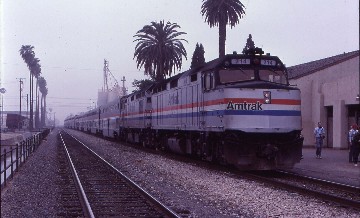
My parents wanted to go to this unusual location and my friend Bruce Fenton was also interested, so we had a foursome. About three days beforehand, I became very sick went to the doctor who put me on pills and liquid medication. However, nothing was going to stop me from going on this trip so the morning of Saturday, May 4th, 1985, I put myself into the best condition I could and the four of us drove to Fullerton to board the Sunset Limited equipment.
The train arrived on time and everyone boarded the former Santa Fe Hi-level coach 3, which was advantageous in that these cars had dutch doors. We settled into our seats for the journey out on the Third District of the Santa Fe to Barstow, a rare route on which to ride a passenger train since Amtrak started with only the westbound Southwest Chief on this route on New Year's Day, a re-routed Desert Wind as I rode in August 1980 or the odd excursion trains over the years. We travelled east and cleared the junction of the Fourth District to San Diego and proceeded through Fullerton before ducking under California Highway 57 to Placentia and out to Atwood along all the locations I had photographed freight trains over the years.
At Atwood, the Olive District joined our line and shortly we came to the end of the double track then entered Santa Ana Canyon as soon as we had crossed Imperial Highway. We passed the first of the track homes to be built here before we passed the orange groves and Esperanza siding. The canyon was still in rural Orange County at this point before the building boom occurred over the next few years. We rounded the horseshoe curve and the dry Santa Ana River was below then passed above the groves with a few located on the slopes above the tracks. We closed in on the canyon walls, running below them out to along the Green River Golf Course, where we passed through a cut onto the high bridge over the Santa Ana River, where there was a mobile home park below in the river's floodplain.
Our train made its way underneath California Highway 91 to Prado Dam siding, where the dam and its "200 Years of Freedom" painted on the face could be seen. It was built in 1941 to solve the flooding problems downsteam in Orange County where the Santa Ana River used to flood and change its course. Ducking under the same freeway again took to Corona and past the old depot then a third time had us cross Temescal Wash and we made our way by Porphyry then paralleled the Arlington Irrigation Canal between the hills to La Sierra. We continued east through Arlington and Casa Blanca before we negotiating the large "S" curve between the hills and by the cemetery into Riverside, stopping at the Santa Fe station for photographs.
Next we traveled to Riverside Junction where Union Pacific joined our route. We went under California Highway 60 and passed the park where the Riverside Live Steamers meet before curving to the north at Highgrove, where the San Jacinto District joined. We next crossed over Interstate 215 before descending down the hill to again cross the Santa Ana River, but on a much lower bridge. Our train travelled through Colton, crossing the Southern Pacific at the former location of Colton Tower, which was removed a few years ago, went under the Interstate 10 bridge and past the former Union Pacific Colton depot. Lytle Creek was crossed just short of Santa Fe's "B" Yard, which we ran through then under Rialto Avenue and curved into San Bernardino's "A" Yard. We went under the Mount Vernon Avenue viaduct with Santa Fe's shop buildings to the north and their beautiful station to the south we curving to the north along the freeway to start the assault on the grades of Cajon Pass.
We climbed out of San Bernardino and proceeded northwest along Cajon Boulevard through Ono and Verdemont with Southern Pacific's Palmdale Cutoff approaching. Pacers were chasing us as the road paralleled the track then they waited where we crossed over Cajon Boulevard. There was a good crowd in Devore to greet us as continued the journey by crossing Cajon Creek Wash and going under Interstate 15. We ran parallel to the Sourthern Pacific line, climbing the pass as the walls of the canyon narrowed the further northwest we went. We passed through Keenbrook before rounding a wide turn into Blu Cut and crossing the San Andreas Fault then cut through the rocks and crossed Swarthout Canyon Road then turned at the rocks, where I had sat as a young Boy Scout to watch trains at the old Cajon Campground. We made our way to Cajon where we were routed around Sullivan's Curve, much to everyone's delight and the photographers, while everywhere on the pass, were really focussed here.
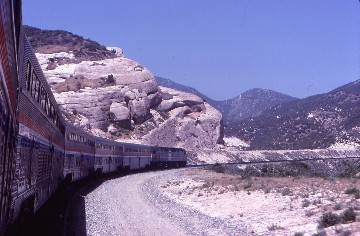
Minutes later, we crossed Highway 138 at grade before crossing Cajon Creek and running below the Mormon Rocks then curved to the east at the Davis Ranch to continue the climb under Interstate 15 over the old Highway 66 bridge, passed Alray siding and entered the Lower Tunnel. We briefly popped back into daylight before entering the Upper Tunnel then running east along the slope. The down, or south, track was very close as we turned to the south where we rejoined the other mainline before rounding a sweeping turn to the east through the deep cut to Summit.
As we arrived, a Union Pacific freight was starting down the down track so I knew we would cross over at Lugo to be on the correct track at Hesperia. We rounded a rather large "S" curve to reach Summit Valley where the train chasers were waiting, then crossed over at Lugo to the south track, went by Hesperia Airport before arriving at Hesperia and ducking under Main Street, then stopping at the switch that led onto the Lucerne Valley District.
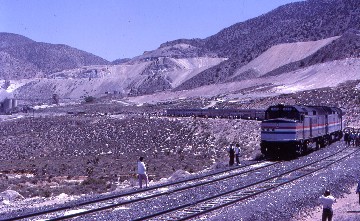
The switch was thrown and the train slowly moved onto new mileage and we pulled forward far enough to clear the mainline before the switch was returned to its previous position. With the crew now back on the train, we departed Hesperia on the Cushenbury Branch at a top speed of 35 mph. We crossed the Mojave River on a low deck bridge before turning to the north for a short distance, passed Spur 1 then turned east once more. My favourite type of desert plant, the Joshua Trees, were in great abundance here then further out, we passed Spur 2. After some straight running, the tracks rounded a small "S" curve to Bass Siding and this part of the line had slight twists and turns to it as we crossed over Arrastre Canyon, Lovelace Canyon and Grapevine Canyon washes.
Lucerne Dry Lake stood out in the valley below and as we climbed, the view of the Lucerne Valley really improved. We crossed Sliver Creek, Dry Canyon Wash, Crystal Creek and Furnace Canyon Washes prior to Spur 5. To the south were the San Bernardino Mountains and to the north across the Lucerne Valley, the Granite and Ord Mountains stood proud. We stayed on the hillside as we crossed Arctic Canyon Wash and Marble Canyon before arriving at Cushenbury with the cement plant standing guard.
The crew ran the locomotives around the train before they let us off for a short look around. Once back on board, we returned the way we came, but a photo runby was done at the Mojave River Bridge. We returned over Cajon Pass down the 3.3 percent grade and at San Bernardino, went the short way, therefore bypassing "B" yard and returning to Fullerton on schedule, ending a most interesting and rare excursion. A special thanks to the Pacific Railroad Society for another excellent trip.
| RETURN TO THE MAIN PAGE |