




The summer of 1985 was an interesting time. It started with my brother Bruce selling his Ford Pinto to my younger brother Duane and needing someone to drive it from Pocatello, Idaho to Santa Ana. I was the perfect choice to accomplish that with an Amtrak journey there and a drive back. My parents then asked me if I wanted to ride the Cumbres and Toltec Scenic Railroad with them for the first time and revisit what was now the Durango and Silverton (formerly Denver and Rio Grande Western) and ride the Silverton train. They wanted to spent some time in Las Vegas so I booked an Amtrak trip using a one-region All Aboard America Fare, first a round trip to Deming, New Mexico on the Sunset Limited, then a one-way trip to Albuquerque where I would meet them. We would ride the two narrow gauge railroads then drive to Pocatello, where I would spend a few days before driving the Pinto to Southern California.
Sunset Limited 2 7/26/1985I rode a usual San Diegan to Los Angeles Union Station, where I transferred to the eastbound Sunset Limited. It was another relaxing trip with an on-time departure and I called it a night east of Apex.
7/27/1985 I awoke about an hour west of Phoenix and enjoyed the early morning as we passed through the Saguaro cacti into town then detrained long enough to get a newspaper before just enjoying the ride the rest of the way to Deming. A large number of freight trains were passed along the way but we ran perfectly on time. I detrained at Deming and walked to the motel for an evening of rest.
7/28/1985 I slept late and enjoyed breakfast before returning trackside to watch a parade of freight trains then walked back to the Deming station, where the on-time westbound Sunset Limited arrived. I boarded and went upstairs into the coach then enjoyed a steak dinner before an impressive sunset and later returned to my coach seat and fell asleep.
7/29/1985 I awoke as the train was almost finished its journey through San Timiteo Canyon then we passed West Colton Yard and arrived at Los Angeles Union Station on time. A quick San Diegan to Santa Ana and I was home for just one night before starting my next rail adventure.
Southwest Chief 3 7/30/1985I was back at the Santa Ana station to wait for San Diegan 583 for the quick journey to Los Angeles then after an across-the-platform transfer to the Southwest Chief, we departed on time and I spent the evening in the lounge car through Pasadena, Pomona and San Bernardino, then up and over Cajon Pass, where I called it a night.
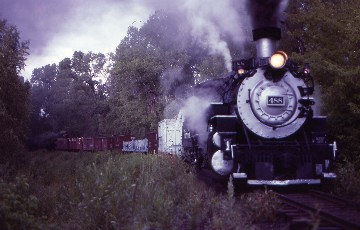
7/31/1985 I awoke in the pine forests west of Flagstaff, where we continued to be on schedule. At Gallup, the Indian Guide provided commentary to Albuquerque, pointing out the interesting locations and telling tribal stories. We arrived in New Mexico's largest city early where my parents met me and we drove north to Santa Fe then turned northwestward to Chama. As we drove through town and passed the railroad's yard on the right, Cumbres and Toltec Scenic 2-8-2 488 was by the coaling tower painted in Rio Grande lettering to pull a special train tomorrow morning. My father drove the camper to a campground beside the Chama River and along the tracks where we spent the night.
Cumbres And Toltec Scenic Railroad 8/1/1985The Cumbres & Toltec Scenic Railroad is a three foot narrow gauge heritage railroad running between Chama, New Mexico and Antonito, Colorado. It runs over the 10,015 foot Cumbres Pass and through Toltec Gorge, from which it takes its name. Trains operate from both endpoints and meet at the midpoint. Today, the railroad is the highest and longest narrow gauge steam railroad in the United States with a track length of 64 miles. The train traverses the border between Colorado and New Mexico, crossing back and forth between the two states 11 times. The Cumbres & Toltec Scenic Railroad has been jointly owned by the States of Colorado and New Mexico since 1970 when it was purchased from the Denver and Rio Grande Western Railway, saving it from the scrap yards. The Cumbres & Toltec Scenic Railroad received the Designation of a National Historic Landmark in 2012 by the United States National Park Service.
HistoryThe railroad line was originally constructed in 1880-1881 by the Denver and Rio Grande Railroad as part of their San Juan Extension stretching from Alamosa, Colorado to Durango, Colorado. The line was constructed with three foot narrow gauge track to match the D&RGW's other lines. The line primarily supported mining operations in the San Juan mountains, mainly around Durango and Silverton. The longest and highest portion of the railroad, known as the Cumbres & Toltec Scenic Railroad, is 64 miles long and was constructed in 1880 in less than 9 months; an engineering miracle even by today's standards, considering the work was all done by hand.
Today's Durango and Silverton Narrow Gauge Railroad was built in 1882 as a branch line off this main. By the late 1950s mining had dwindled substantially and the line was on the verge of abandonment, but an oil boom near Farmington, New Mexico created a traffic surge that kept the line operating for another decade hauling oil and pipe. By the late 1960s the traffic was virtually gone and abandonment was applied for. The States of Colorado and New Mexico purchased the 64 miles of San Juan Extension between Antonito, Colorado and Chama, New Mexico in 1970 and started operating the next year under the name of the Cumbres & Toltec Scenic Railroad.
The Cumbres & Toltec Scenic Railroad continues to operate daily between May and October each year with five fully-restored steam locomotives.
Tourist operationsIn 1970, the states of Colorado and New Mexico jointly purchased the portion of the line from Antonito to Chama along with much of the equipment that operated on the line. This section is the most scenic portion of the line, and a part that loops back and forth between the two states. The Cumbres and Toltec Scenic Railroad Commission was created by an act of Congress as a bi-state entity to oversee the railroad. Over the years, the railroad has been operated by several operators under contract by the commission, including Scenic Railways (1970-1981), Kyle Railways (1982-1996), Cumbres and Toltec Scenic Corporation/George Bartholomew (1997-1999), Rio Grande Railroad Preservation Corporation (2000-2002), Cumbres and Toltec Scenic Management Corporation (2003-2011), American Heritage Railways (2012) and Cumbres and Toltec Operating LLC (2013-).
Tourist train rideTrains depart each morning from both Chama and Antonito. In peak season there are trains every day of the week in either direction. They meet at Osier, the midpoint of the line where lunch is provided. Passengers may continue on their train to the other end or switch trains to return to their original terminal. Through riders have the option of a motor coach return to their original terminal. All seats are reserved. Seats are sometimes available to walk-ups, but this is rare in peak season.
All passenger trains are pulled by historic steam locomotives that originally worked on this line and others of the Denver and Rio Grande Western. Heavy trains out of Chama may have two locomotives as far as Cumbres Pass.
Eastbound from Chama is the steepest portion so the steam engines tend to work hard and give off an acoustic and visual show. The remaining three-quarters of the eastbound trip is downgrade and the locomotives are fairly quiet.
Westbound from Antonito, the grade is much less but the locomotives periodically work harder, especially on the last couple miles to Cumbres Pass. The line passes through Rio Grande and Carson National Forests. Most of the line is bordered by rocky ledges, cliffs and formations of varying types. The train passes along the rim of Toltec Gorge, a spectacular, though brief
highlight. Conifer and aspen trees dominate with periodic mountain meadows. The aspen trees turn a brilliant yellow in the fall making those trips popular. The easternmost quarter shifts to scrubby and arid rolling hills. There are
numerous restored historic structures along the line, including two tunnels, bridges, section houses and water tanks. The Cumbres and Toltec is highly regarded by both railfans and historians due to its relative authenticity and surviving historic fabric. Chama houses one of the most physically complete railroad yards from the steam era in the
United States. Although portions of the roundhouse, warehouses and parking lots have been changed, the railroad yard has the ambiance of pre-1960 railroad operations. The yard tracks contain authentic rolling stock and structures
of the Denver and Rio Grande indigenous to the railroad line. All the steam locomotives at the C&TS were built for and operated their entire careers for the Denver and Rio Grande Western. All 2-8-2 Mikados, these range from the relatively small K-27 "Mudhen", 463, once owned by Gene Autry,
to the large K-37s, originally built as standard gauge locomotives. The mainstays are the venerable K-36 fleet, produced by Baldwin Locomotive Works in 1925. The only two Surviving D&RGW rotary snowplows are onsite and both have
operated for the C&TS. As Denver & Rio Grande Railroad San Juan Extension, the railway was listed on the National Register of Historic Places in 1973. The boundaries of the NRHP listed area were increased in 2007. The C&TS has numerous siding and yards. There are turning wyes at Chama, Cumbres and Bighorn, turning loops at Osier and Antonito and a crossover at Lava. While officially headquartered in Chama, the railroad splits most of its
functions between the termini of the railroad. The Cumbres and Toltec Commission offices are at Antonito, along with the railroad's main car shop where repairs to rolling stock are performed. The center of actual operations for the
railroad is Chama, the site of the locomotive repair shop and the location of most of the historic equipment. I awoke early and while we were having breakfast, I heard the chugging of a steam locomotive approaching and over by the tracks, saw the Rio Grande-lettered 488 pulling its charter train towards the Chama River bridge. I waved
to most of the passengers and as it steamed out of sight, wondered where I would see the train later on. We finished breakfast before packing and driving over to the Chama depot. While my parents found a deli to get some sandwiches
for lunch, I walked into the yard and photographed our train led by 2-8-2 489 before venturing through the yards then walked by the roundhouse, water tower, sand house and the coaling tower, all looking as though they might have been
over 100 years ago. I walked out of the yard back to board the train feeling as though I had just walked out of a time warp. I met my parents and we boarded the train choosing seats inside one of the old-style coaches. Once my ticket was taken, I went to the rear open car to wait for departure and at the scheduled time of 10:00 AM, 489 whistled and off
we went, passing through the yard by the sand house, water tower and coaling tower before passing the campground and crossing the Chama River. We passed the Juke's Tree then crossing New Mexico State Highway 17 and travelled across
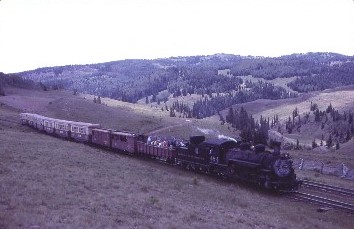
an outwash plain before entering The Narrows, where we started up the four percent grade towards Cumbres Pass. After over a mile of climbing, we left The Narrows and reached Weed City at Lobato siding, MP 339.99, where there were
cattle pens and the site had been used as a movie set in the past. The train then slowed for the high Lobato Trestle, MP 339.75, before climbing away from Wolf Creek by the Lobo Lodge, MP 339.0 as the sky turned dark and the temperature dropped and I was glad of my Union Pacific jacket. 489 was
really working hard on the steep grade, then we paralleled the highway crossing it and running above Wolf Creek. We crossed into Colorado before reaching Cresco, MP 335.10 and its siding and water tower then as we continued to climb,
we passed Hamilton Point, MP 334.50 and crossed the highway a second time before travelling through Coxo at MP 332.20. From here we ran to near MP 332, where we turned back across the valley to climb the slope of Windy Point, MP
331.09 and a fantastic view all the way back to Chama and into New Mexico. We rounded Windy Point with the steam engine working its hardest to pull us up to the summit as the highway quickly climbed to join us and we arrived at
Cumbres Pass, MP 330.60 and stopped in front of the Cumbres Station as the four percent climb had come to an end. Off to the left was the remains of the snowshed over the decaying wye tracks. Once on the move again, we crossed Highway 17 for a third time then curved to the south to travel around Tanglefoot Curve, MP 329.0 and at one point, the opposing tracks were less than a stone's throw away. We crossed Cumbres
Creek before running above it and the highway then turned north into the Los Pinõs Valley and proceeded to the Los Pinõs water tower, MP 325.50, where we took water. Continuing the journey, the sun returned as we rounded
a horseshoe curve crossing the Rio de Los Pinõs and travelled down the east side of the green valley. At the end of the valley, we steamed east staying high above the river and at Cascade Trestle, MP 319.95, we crossed high
above Cascade Creek. Over a mile later, we arrived at Osier, MP 318.40, where we stopped for lunch. Our train had arrived first, so we climbed the grassy hill that overlooked Osier and to the east, I heard the sounds of a steam train approaching and minutes later, the train from Antonio arrived. We had a nice picnic lunch before
our locomotive switched onto the rear of the Antonito train while 2-8-2 484 from that train switched onto the point of the Chama train. We boarded the Antonito-bound train after the Chama-bound one departed. 489 proceeded southeast into the Toltec Gorge and crossed back into New Mexico then as we went deeper into the gorge, we passed the volcanic Conejos Formation at MP 317.0 and reached the Garfield Monument. The idea for the monument
came from a group on an excursion train on September 26, 1881, the day of the funeral for the assassinated President Garfield, who stopped here to view the gorge and later paid for the monument to be built. We went through Toltec
Tunnel 2, also known as Rock Tunnel, at MP 315.0, a 366 foot curving bore then crossed back into Colorado before passing the Toltec section house at MP 313.44 and crossed Toltec Creek. The train then went through Calico Cut, MP
313.20 and less than a mile further, rounded Phantom Curve, MP 312.20, with its tall pinnacles, spires and pedestal rocks before crossing back into New Mexico. We next ventured into Toltec Tunnel 1, also called Mud Tunnel, MP 311.30,
a 349 foot bore and arrived at Toltec siding where we met Rio Grande 488 sitting in the siding with its photographers photographing our train for a change of pace. We wound our way high above the Rio de Los Pinõs to Sublette, MP 306.06, where we stopped to take on water and had the opportunity to look around the section houses. As we departed, the rain started, forcing me inside, and
we travelled around to the east side of the stream Canada Jarosita to a point where we turned north to the head of the Canõn Atencio then rounded another horseshoe curve before a third one at MP 301. We turned east and continued
to Big Horn, MP 299.41, where there was a wye with Bighorn Peak to the south. We crossed back into Colorado before reaching Whiplash Curve, MP 297.0 with good views of the Conejos Valley and Los Mogotos to the north. Between here and
MP 295, we passed the Big Horn section house and crossed the state line of New Mexico/Colorado three times then travelled down a lava-capped mesa to Lava, MP 291.0, which had a water tank and the Lava Loop used for turning snowplough
trains. We proceeded northeast and after MP 390, rounded another horseshoe curve, crossing the state line twice more and a third and final time to enter Colorado. We turned northeast, crossing several small streams, as well as cattle guard then reached the flat valley floor and crossed the Canõn irrigation ditch before going across US Highway 285 and entering Antonito, where we ran
around the balloon track to stop in front of the depot. After a fabulous eight-hour narrow gauge train ride, we boarded a twelve passenger van for the forty-five minute drive back over Cumbres Pass and passed the special Rio Grande
train around Cresco. The three of us returned to the camper and returned to the campground for the night. After breakfast, it was raining as we drove back to the railroad crossing and about twenty minutes later, in a light rain, Cumbres and Toltec Scenic 2-8-2 484 led the eastbound train towards Cumbres Pass. We drove west and lost
the rain about twenty miles west of Chama so had a nice drive to Durango, stopping at the depot to pick up our round trip tickets to Silverton, then drove four miles north to the United Campground, which just happened to have the
Durango and Silverton Railroad running through it. First K-28 476 led a southbound train back from Silverton, followed by K-28 478 pulling the northbound train to Cascade Canyon. About thirty minutes later, K-36 473 with a wedge
snow plough and K-36 481 double-headed the second train back from Silverton. After that excellent action, we drove into Durango where my parents went to Safeway for supplies and I walked over to a liquor store, then we went to the Diamond Circle Melodrama where we had dinner and watched a very good
show. We returned to the campground and I walked over and sat on the train tracks under the light of a full moon before calling it a night. Background
The Durango and Silverton Narrow Gauge Railroad is a narrow-gauge heritage railroad that operates on 45.2 miles of track between Durango and Silverton in Colorado. The railway is a federally-designated National Historic Landmark
and was also designated by the American Society of Civil Engineers as a National Historic Civil Engineering Landmark in 1968. The route was originally opened in 1882 by the Denver and Rio Grande Western Railroad to transport silver and gold ore mined from the San Juan Mountains and was an extension of the line from Antonito to Durango. The last train to
operate into Durango from the east was on December 6, 1968. The states of New Mexico and Colorado purchased 64 miles between Antonito and Chama, New Mexico in 1970 and operates today as the Cumbres and Toltec Scenic Railroad.
Trackage between Chama and Durango was removed by 1971. The line from Durango to Silverton has run continuously since 1881, although it is now a tourist and heritage line hauling passengers and is one of the few places in America which has seen continuous use of steam locomotives. In
March 1981, the Denver and Rio Grande Western Railroad sold the line and the D&SNG was formed. Today, the D&SNG, along with the C&TSRR, are the only two remaining parts of the former D&RGW narrow-gauge network. The railroad has a
total of nine narrow-gauge steam locomotives. Some rolling stock dates back to the 1880s. Trains operate from Durango to the Cascade Wye in the winter months and Durango to Silverton during the summer months. The Durango depot was built in January 1882 and has been preserved
in its original form. After World War II, domestic tourism began to grow across the country and the Silverton branch of the railroad would benefit. Bolstered by national exposure via Hollywood movies being filmed along the line in the late 1940s, the
railroad created The Silverton, a summer-only train service on June 24, 1947. A short time later, the railroad adorned a locomotive and four coaches with a colourful yellow paint scheme and launched modest public promotion. With this
effort, "The Painted Train" officially started a new era of tourism that continues to this day. Freight traffic, however, continued to decline and during the 1950s, The Silverton operated as a mixed train. By the 1960s, a modernized D&RGW did not see the Silverton Branch as worthy to maintain and a petition was filed with governmental agencies to abandon the route. The Interstate Commerce Commission declined to grant the request
due to the continued increase in tourist patronage. Following the ICC's ruling, the railroad reluctantly responded by investing in additional rolling stock, track maintenance and improvements to the Durango depot. The railroad
purchased some of the property around the depot, cleaned up the block extending north to Sixth Street, and facilitated the opening of gift shops and other tourist-friendly businesses. As ridership continued to grow, the D&RGW
operated a second train to Silverton on certain days. Since 1971, the Silverton branch and nearby Cumbres and Toltec Scenic Railroad were the only remnants of the Rio Grande's once extensive narrow-gauge system. During the late 1970s, the D&RGW was actively trying to sell the
Silverton branch, and in 1979, Charles Bradshaw, a Florida citrus grower, offered the railroad a legitimate opportunity to divest itself of the now isolated route. On October 5, 1980, The Silverton made its last run under D&RGW
ownership and after operating a work train the following day, the railroad finally concluded its narrow-gauge train operations, bringing to a close an era that began 110 years earlier with its narrow-gauge railroad from Denver
to Colorado Springs. In June 2018, the railroad shut down for several weeks due to a wildfire, named the "416 Fire", which was fought by two air tankers, six helicopters and some 400 firefighters on the ground. An estimated 54,129 acres of the San
Juan National Forest were burned, with losses estimated at more than $31 million. Given the fire risk from coal cinder-sparked wildfires, the railroad's owner plans to invest several million dollars to replace coal-power with
oil-power for their steam locomotives and acquire two new diesel powered locomotives. The D&SNG was founded by Charles Bradshaw Jr., of Florida, with the intent of purchasing the right-of-way and equipment while expanding the infrastructure and passenger revenue. His plans were fulfilled with the March 25, 1981,
acquisition of the D&RGW's 45-mile Silverton branch and all of its structures and rolling stock. The improvements to the railroad in the 1980s would prove to be the most dramatic growth on the Silverton Branch since the earlier part of the century. Bolstered by the assistance of former Rio Grande operating managers and a
relatively sizeable staff of new employees, Bradshaw's plans were set in motion immediately. Included in the sale were former D&RGW locomotives and rolling stock that had not seen service in Durango for many years. "K-36" and "K-37"
class locomotives were eventually restored to operating condition and these larger class of engines operated to Silverton for the first time ever following bridge and right-of-way improvements to the line. 1880s vintage coaches were
exquisitely restored and new coaches were added to the roster of rolling stock. For the first time in many years, doubleheaded trains and additional scheduled trains were employed to handle the continually growing passenger trade. The Durango yard facilities also saw dramatic improvements. An extension was added to the old roundhouse, a new car shop was built on the site of the original "car barn", and the depot saw extensive repair and internal
modifications. The workforce grew with the railroad, and Durango's tourist image expanded as new businesses and revamping of the old railroad town continued to take shape. The original 1881 Durango roundhouse was completely
destroyed by fire in the winter of 1989 and all six operable locomotives had been inside at the time and were damaged, but not beyond repair. All locomotives were eventually restored to operating condition. A new roundhouse was
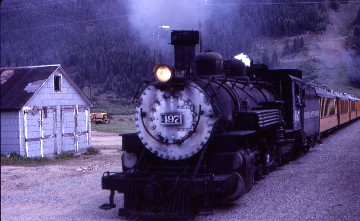
constructed on the same site, opening in early 1990, and its facade made use of bricks salvaged from the original building. In March 1997, Bradshaw sold the D&SNG to First American Railways, Inc. then in July 1998, the railroad was sold again to American Heritage Railways. It was a sunny morning we drove into Durango and parked at the station lot before I waited for K28 473 to pull our train to the platform. After the usual rounds of pictures, the three of us boarded and I immediately went to
the covered open car for the round trip to Silverton. Right on schedule, 473 whistled off and started to move, crossing the busy Colorado Highway 160 and proceeding north through town. Durango was a very interesting town with the
combination of new and old buildings side-by-side. We crossed the Animas River before exiting town then crossed Junction Creek as we ran along the banks of the river, travelled through Animas City before reaching the United
Campground where we stayed last night, where all the campers waved at us. The river meandered as we passed Home Ranch siding and minutes later, passed by a waterfall on the cliff to the west as Fall Creek descended into the Animas River Valley. The mountain crests were now seen to the northeast, while to
the west, Great West Mountain stood guard over the valley below. We continued up the valley to Hermosa Creek before we passed through Hermosa, MP 462.5, where there is also a siding. North of Hermosa, the tracks crossed US Highway
550 as we ran below Missionary Ridge. We passed the 800 foot Pinkerton siding at MP 462.75, built in 1982 after the Durango and Silverton bought the line from the Rio Grande, who owned it when I last rode this line as a child. The
tracks climbed to gain elevation and leave the valley, which had narrowed and we were now following Elbert Creek to lead us up to Rockwood. We ducked under Highway 550 before entering Beaver Canyon Creek and Rockwood, then entered
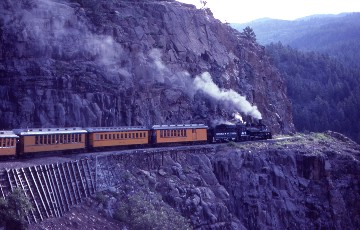
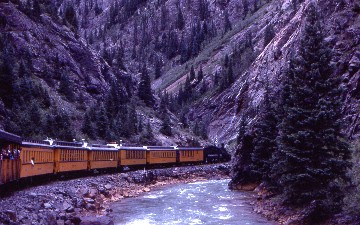
the Rockwood Cut at MP 496.1 and passed the "Entering the Animas River Canyon" Forest Service signpost. The Highline was what I remembered most from my previous trip; the line when built was blasted out of solid rock to create a shelf for the tracks and is 400 feet above the Animas River. There was a permanent slow order on the
railroad and it was the most spectacular location on the whole route. Many cameras were clicking and video cameras whirring during our passage over the ledge and down in the river, a whirlpool could be seen. We crossed the 130 foot
cast iron deck-truss bridge and the scenery was incredible, then we crossed Canyon Creek with the train looking beautiful as it snaked along the river before arriving at Tacoma at MP 472.28 with the Colorado-Ute Electric Association's
Tacoma power plant across the Animas River. Our next location was Ah Wilderness, which could only be reached by the train, on foot or on horseback. We next traversed Tank Creek, MP 474.65 before stopping to take on water there then
continued past the Tall Timber Resort, MP 475.0, with the same restriction to access as Ah Wilderness. Making our way north, we crossed Grasshopper Creek before arriving at Cascade Canyon, MP 477.55, where there was a wye to turn the winter and summer afternoon trains, and we stopped here to let a pair of hikers off since the
railway will drop passengers off anywhere through the Animas River canyon. We crossed the Animas River again before our passage through Teft at MP 477.90 and later, we passed the Needle Mountain signpost where I could see Pigeon Peak
on the left and Turret Peak on the right. A few miles of beauty further, we crossed Needle Creek and if one looked upstream, the high peaks that gave the San Juan Mountains their nickname of the "Alps of America" could be seen.
The train next steamed through the area called the Needleton snow slide as this area experiences that almost every year. Across the river, Needle Creek joined the Animas River and a few miles further, we reached Needleton siding,
MP 484.0 and Needleton water tank, MP 484.4. Looking upriver to the northeast, Mount Garfield and Mount Graystone of the Grenadier Range became visible then we crossed Ruby Creek with No Name Creek, MP 485.40, entering the other
side of the canyon less than a mile later. I walked to the concession car for a Coca-Cola as I was thoroughly enjoying my second time here, even more so than when I was a child. Across the Animas River was the Garfield Slide at MP 487.5 before we passed the Red Young Slide zone, MP 488.4 on our side of the river. We crossed the Animas River again on a two span 222 foot deck girder bridge at MP 489.97
then crossed Elk Creek before we passed through Elk Park at MP 490.70. We next went by the Grenadier Range signpost before Snowflake Creek joined the Animas River to the west. Our train traversed Whitehead Gulch at MP 491.95 before
passing through the snowshed slide, MP 492.5, which was given that name as there once was a snowshed here. Grand Trunk peak became visible to the northwest and a few minutes later, Sultan Creek entered the Animas River from the west.
We ran by the Twin Sister Slide, MP 493.67 before doing the same thing four tenths of a mile later at Cleveland Slide at MP 494.0. We next crossed both Deer Park Creek, MP 494.30 and Kendall Creek, MP 494.63 seconds later to the west
then Cataract Gulch came into the canyon at MP 494.70. We left the narrowest part of the Animas River canyon as Deadwood Gulch, MP 495.10, entered from the northwest. On the west flank of the canyon was Detroit Mine before we crossed the deck bridge over the Animas River, MP 495.25 for the last time. We crossed Mineral Creek, at MP 496.15, a few minutes later then went by the wye at MP 496.30
that the train turn on after our departure from Silverton. The Silverton steamed by the old depot at MP 496.70 then turned left and travelled down 12th Street, stopping at Kendall Street and ending the northbound journey at MP
496.90. We detrained and after the customary photograph, we went for lunch then I walked down to the depot to wait for the second train of the day then re-boarded ours for the return journey to Durango. The trip was very interesting even
with a mid-afternoon downpour so common to these mountains. I kept my camera occupied on the way back and the Highline was again in perfect light. We returned to the United Campground in time to photograph the second train's return from Silverton, as well as the Cascade Canyon train
twice, then spent another nice evening in the camper. The next morning, we drove west into Utah via Colorado 160 and 491 and made our way to Monticello before turning south to Blanding on US Highway 191 then turned west on Utah 95 and Natural Bridges National Monument. After a brief
stop to see the bridges and to have lunch, we continued west and crossed the Colorado River at Glen Canyon National Recreation Area then stayed on Utah 95 to Hanksville, where we turned onto Utah 24 for the journey through Capitol
Reef National Park. We stayed on this road to US 89, which we drove to Gunnison, Utah before re-entering new highway on Utah 28 which we took to the BLM Painted Rock Campground for the night. After a good night's rest, we drove north on Utah 28 to Nephi, ending the new highway mileage, to Interstate 15 north to Pocatello, Idaho. I spent two days with Bruce, Karla, Eric and Adam before leaving at 4:00 AM in the morning
and driving through the worst thunderstorm I had experienced south of Ogden. The Pinto drove well and following an overnight stop in St. George, Utah, I arose early the next morning to avoid the desert heat and returned home to
Santa Ana, giving the car key to my brother Duane, thus ending a narrow gauge railroad adventure.
RETURN TO THE MAIN PAGE