




My brother Bruce asked me to come to Pocatello, Idaho for a visit and asked if I wanted to go to the Sumpter Valley Railroad in McEwen, Oregon and learn how to be a fireman. I was agreeable to the suggestion, so Bruce made my Amtrak reservation and I was all set.
San Diegan 571 and Desert Wind 36 8/21/1984My mother drove me to the Santa Ana station and a few minutes later I was aboard the San Diegan to Los Angeles. I waited in front of the gate before boarding the Desert Wind and we departed on time and went the usual way out to San Bernardino and over Cajon Pass. I stepped off in Barstow for some fresh air on a very humid afternoon with large black clouds to the northeast then we travelled through Afton Canyon and out on the Devil's Playground where the thunderstorm started. Climbing Cima Hill, every wash the train crossed was flooding and above us were great claps of thunder. There was no better place to be than on a train during a storm. I had my dinner from the lounge section of the dining car and at Las Vegas, stepped off, then we departed on schedule and I went to sleep about Rainbow Canyon.
8/22/1984 I awoke about Lakehead, Utah and after preparing for the day, enjoyed the morning ride into Salt Lake City, where we arrived via Grant Tower before reversing into Union Pacific's Salt Lake City depot, where Bruce was waiting for me. We drove to Pocatello but stopped at Tremonton for breakfast then spent the next three nights with Bruce's family and enjoyed my stay.
The Pioneer 25 8/25/1984Bruce and I arose and drove to the Pocatello depot. As he always said, "A train has to stop somewhere in the middle of the night, so it might as well be here!" The Pioneer arrived on time at 12:24 AM and we boarded and found seats to ourselves. I laid down to sleep after the conductor took my ticket and slept well, awakening on the Boise Cutoff. We passed by Morrison-Knudsen with various locomotives sitting outside in many states of rebuilding the continued to Boise and we both went into the dining car for breakfast. The Pioneer proceeded to Nampa while we were eating and crossed the Snake River into Oregon, stopped at Ontario then re-crossed the Snake back into Idaho and stayed on the north side of the river until Nyssa, where we entered Oregon for good. Huntington was a crew change point then we started ascending the grade to Pleasant Valley, passing through the tunnels and going around the horseshoe curve at Oxman then reaching the summit, prior to descending into the Baker Valley. We arrived at the Amshelter, the station for Baker, where we both detrained.
Sumpter Valley Railway 8/25/1984History
The railway was incorporated in 1890 by David Eccles. The three foot narrow gauge railway's purpose was to haul logs to the Oregon Lumber Company sawmill in South Baker City. The sawmill and railroad remained separate corporations of the same owners for the life of the railroad. The builders of the railway also owned the Grande Ronde Lumber Company in Perry, Oregon, and the railway was financed by Mormons in Utah. The line was built over terrain originally considered as part of a railway from Denver, Colorado to the Pacific coast; but the Union Pacific Railroad opted for a different route to avoid bypassing growing communities which might provide an attractive opportunity for competition by the rapidly growing Oregon Railroad and Navigation Company.
Much of the original equipment came from the Utah & Northern Railway in Idaho and Montana. The Union Pacific owned the line and began converting it to standard gauge around 1887. Eccles owned a significant amount of Union Pacific stock, exerting enough influence to acquire the now-unneeded narrow gauge equipment. The first locomotive to arrive was a small 4-4-0 numbered 285; the Sumpter Valley also purchased a number of the U&N's Brooks 2-6-0 locomotives, along with a large number of boxcars and flatcars. In 1906, the railroad also acquired four locomotives from the Tonopah Railway (later the Tonopah & Goldfield Railroad).
By 1891, the line had reached McEwen, 22 miles west of Baker City and the railroad began offering passenger and freight service. To reach uncut forests further west, the company extended the line in stages. It reached Sumpter in 1896 and continued southwestward to Whitney, Tipton, Austin and Bates. By 1910, it arrived in Prairie City, a ranching and mining community along the John Day River in Grant County. The railroad continued to use wood fuel for their locomotives until converting to oil fuel in June, 1940. Diamond-shaped smokestacks were replaced by cabbage-shaped Rushton stacks after 1916.
Ten years later, the railway began losing business to automobiles and trucks, and in 1933 the 20 miles of track between Prairie City and Bates were abandoned. Scheduled passenger service on the remaining line ended in 1937. Freight service remained, however, and in 1939 the railway purchased two 2-6-6-2T "locomotives from the Uintah Railway in Colorado. These engines were converted from coal to oil burners and given tenders from two 2-8-2 locomotives. As traffic declined, the railway sold off the other, unneeded locomotives. In 1947, the railroad ceased all operations except for 1.5 miles of track in the Oregon Lumber Company yard in South Baker City. This last section was abandoned and removed in 1961. The Modern Sumpter Valley RailwayIn 1971, a group of volunteers set out to rebuild the Sumpter Valley Railway. Locomotive 3, a 1915 Heisler-type steam locomotive, was restored to operation in 1976, and the new railway opened for business on July 4, 1976, over a track of less than a mile. The Sumpter Valley Railway Restoration Inc. was created and six miles of track were reinstalled by hand over the next 15 years, to connect the McEwen station with Sumpter, SVR 2-8-2 19, built in 1920, was restored to operating condition in 1996. Sister locomotive 20 is also located at the railroad.
In 2007, the railway opened its reproduction of the original Sumpter Depot, within sight of the Sumpter Valley Dredge State Heritage Area operated by the Oregon Parks and Recreation Department. The railway operates a number of historic Sumpter Valley Railroad and adjoining three foot narrow gauge logging railroad steam locomotives and equipment on the line every summer. In Prairie City at the western end of the original line, the Sumpter Valley Depot Restoration Committee renovated the Sumpter Valley Railway passenger station in the 1970's. The City of Prairie City has used it to house the DeWitt Museum since 1984, whose collections include lanterns, lights and other railway artifacts, and photographs of train wrecks and of life along the rail line.
Our TripWe were picked up by Boise Amtrak agent and Bruce's colleague Joe Beaver and driven on Oregon Highway 7 to the junction of Highway 410 on which we went west. We passed Phillips Lake then turned down the dirt road which took us to the Dredge depot. We went inside and I joined the Sumpter Valley Railroad restoration and signed up to become a fireman then explored the group's equipment, including the original Sumpter Valley Railroad 2-8-2's 19 and 20, which had been in Alaska and returned in 1977.
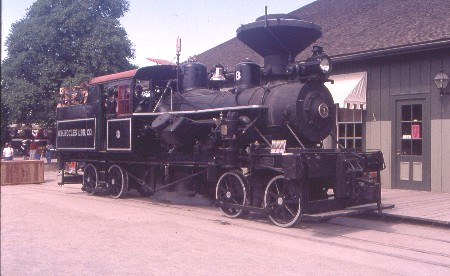
At the engine house was W.H. Eccles Lumber Company wood-burning Heisler 3, ex. Boise Cascade Corporation 3 1960, exx. Hallock and Howard Lumber Company 3 1927, nee W.H. Eccles Lumber Company 3 built in 1915. I was introduced to the crew and it was decided I would just observe on the first run so climbed into the cab and received an explanation of how to fire the Heisler. We went to the wood pile and loaded the tender then filled it with water before reversing to couple onto the two passenger cars. The journey to the end of the line would be to pull the train there and push it back. The passengers boarded and off we went on the first trip of the day.
We proceeded up the Powder River Valley on narrow gauge tracks through the dredge tailings from the gold mining that occurred years earlier and it was obvious that nature was slowly trying to restore this area. I watched the fireman do his job, taking careful note of everything he did while the steam engine swayed back and forth as we slowly made our way down the track. As we neared the Highway 71 grade crossing, I noticed our fireman stoking the fire at a great pace and after we reached the crossing, he stopped, telling me that once on the other side of the crossing, we were now in a National Forest and the engine cannot be stoked while the train was moving.
Every time the engineer sounded the whistle, you could see the boiler pressure drop and we reached the end of the track and he stoked the engine while the train sat. The group's goal was to restore the track into the town of Sumpter. We started to reverse and at the highway crossing, the engineer blew the whistle and the boiler pressure dropped steadily the longer he blew. It then was a mad rush of stoking wood into the firebox, which he did with great style. I had an idea that when it was my turn, I would have wood on the deck ready to be stoked in as soon as we reached the crossing. The Heisler pushed the train back to the depot, which was the end of the first trip and next it was my turn.
Passengers detrained then the next group boarded and I first started to stoke the engine and had a good fire burning. The boiler pressure rose and I blew off the excess steam then we slowly steamed off and made our way down the tangent track. It seemed quite natural to me to be firing this engine and I knew when to stoke the engine and when to inject water. It was a great deal of work firing this engine and needed all my attention. As we neared the grade crossing, I stoked like mad and had a really good fire going then my engineer only tooted to whistle enough to get the cars' attention, thereby not using a lot of my steam pressure. We reached the end of the line stopped, then with the wood on the deck, I stoked the engine and we were ready to go. I had the wood ready for the crossing and when we reversed there, the engineer really blew the whistle and I watched the pressure drop as I feverishly stoked the engine and within minutes, we were running at the perfect boiler pressure.
We made our way back and after the passengers detrained, we went to the wood pile and I loaded the tender which was some of the hardest work I had ever done. My next job was to fill the tender with water, which was much easier, after which we proceeded to the depot for the next run. A new engineer boarded and I was told he loved blowing the whistle. We travelled down the track and I had a really nice fire going then my engineer lived up to his reputation, blowing the whistle freely, which meant I had to work three times as hard, which I did as I was really loving doing this. I stoked three times more wood than on the previous run and really stoked the engine before the grade crossing, which was a good thing as he laid on that whistle and the boiler pressure dropped to the lowest point of the entire experience.
When we came to the end of the line, I barely finished before we started back and after another extended whistle blowing session, I had us to the proper pressure within minutes since by now, I knew if he blew the whistle that I had to stoke as soon as he finished. We made it back and after the passengers detrained, we returned to the wood pile and I re-loaded the tender again.
I was just a passenger in the engine for the final trip of the day and was able to enjoy the ride, watching someone else get worked by the engineers. The engineer had lost his hat on the way out, so on the way back, I was elected to retrieve it. When we approached the spot, I climbed down the Heisler's ladder and stepped off to the ground, timing it perfectly and almost stepping on his hat before I grabbed it, ran back to the ladder and climbed up, much to the delight of the passengers who all cheered me for doing such a good job.
We returned to the Dredge depot where Bruce and I said goodbye to everyone before Joe drove us back to Baker to catch Amtrak.
The Pioneer 26 8/25/1984I was naturally tired when I boarded the through coach on the Pioneer as my destination was Grand Junction. Bruce and I went to have dinner and I enjoyed a steak before some after-dinner drinks then I went to sleep just inside Idaho.
8/26/1984 Bruce detrained at Pocatello and I slept all the way through; in fact I was so tired that I slept through the switching moves in Salt Lake City and did not wake up until after we had left Provo. I enjoyed the climb over Soldier Summit and out into the Utah Desert, where it was raining. We were running two hours late, so I found the conductor and told him I was connecting to Desert Wind Train 36's through car and he said he would call the dispatcher, but would most likely put me off at Thompson to connect there. When we neared Thompson, it was pouring so he said he would not put me off there and I could stay on until we either reached Grand Junction or we met the westbound California Zephyr, when I would be transferred. I thought Ruby Canyon would be a great spot to switch trains.
California Zephyr 5 8/26/1984I switched trains at Grand Junction then had the journey through Ruby Canyon and across the rainy Utah desert, where I had a steak dinner in the dining car. It grew dark as we were on Soldier Summit and I turned in by Provo, still tired from the day before.
Desert Wind 35 8/27/1984Waking up in Rainbow Canyon was a great way to start one's day. We cruised down Meadow Valley Wash then I enjoyed the trip across the California's Mojave Desert and over Cajon Pass before a fast journey over Santa Fe's Second District into Los Angeles, where I connected to a San Diegan for the quick trip to Santa Ana and home sweet home.
| RETURN TO THE MAIN PAGE |