



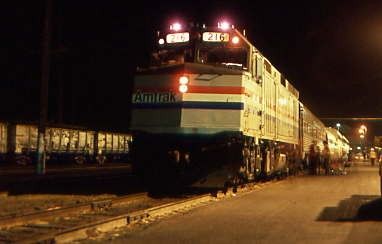
I rode the Desert Wind to Pocatello, Idaho to see my brother Bruce and sister-in-law Karla in January 1981 and had a nice pleasant and uneventful visit with the highlight being watching my beloved Oakland Raiders beat the Philadelphia Eagles in the Super Bowl on a really cold and snowy day. While I was visiting, Bruce suggested that he would prefer to drive to Ogden just once each time I visited and wondered if I was willing to take Greyhound back this time to see what I thought of their service. We made an agreement to try this and upon looking at the Amtrak map in their timetable, a new idea was born. I took Greyhound to Ogden and had a nice Desert Wind ride home to Southern California.
The First Pioneer Train RideI decided to visit Bruce and Karla over Easter and following the agreement with him, Bruce would drive me back to Ogden because I was not going up via the Desert Wind. Rather, I would be taking the Coast Starlight to Portland, overnighting there then taking the Pioneer to Pocatello, where Bruce worked as the Amtrak agent. I went to my local AAA office to obtain a hotel reservation for my night in Portland and six weeks later, stood in front of the mission- style Santa Ana depot waiting for the San Diegan.
San Diegan 571 4/11/1981It was a cloudy and windy morning with occasional rain showers as Train 571 arrive and I boarded the all-Amfleet train, found my seat and we passed through a few very heavy rainshowers but arrived at Los Angeles Union Station on time.
Coast Starlight 14 4/11/1981In the pouring rain, I boarded a Superliner coach on this version of the Coast Starlight; these were new cars and I looked forward to riding in them. We departed on time and after crossing the Los Angeles River, passed Southern Pacific's Taylor Yard before proceeding west through the heavily-urbanized San Fernando Valley then the rocks and tunnels around Chatsworth to exit the valley. These rocks were where Hollywood shot many of the old western films. We entered the fast-growing Simi Valley then moved through a more agricultural landscape to Oxnard. I was enjoying the Superliner Sightseer Lounge Car with its outward-facing seats upstairs and café downstairs. West of Oxnard, we crossed the Santa Paula River prior to reaching Ventura then paralleled the Pacific Ocean. This was Southern Pacific's Coast Route and even on this very rainy day for the next three hours, I had a view of the Pacific except briefly while passing through Santa Barbara.
Today's rain and clouds added a lot to the character of the route and I enjoyed the passage through it all, though the beaches were naturally empty and the ocean was devoid of surfers. I went down to the café for a hot dog, chips and a Coca-Cola before we arrived at Santa Barbara and I met two Australian gentlemen, Paul and Tim, who were travelling around the United States by Amtrak and the Coast Starlight was their first train. We got to know each other and had pleasant discussions while passing the oil refinery, which a Japanese submarine attacked during World War II. As we rounded Point Conception, the talk turned to what they would find in America and they gave me an open invitation to visit Australia. We went through Vandenberg Air Force Base during a downpour which limited visibility to about forty feet and the wind was blowing the rain almost sideways. It really impressed me that the train continued on its path at track speed through all of this weather.
We left the stormy Pacific Ocean, turned up the valley to Casmalia and passed through the coastal hills to the Santa Maria Valley, where the rain stopped and the clouds lifted, then travelled through Guadalupe before passing through the low clouds to reach Grover Beach, prior to cutting through the hills to our next stop at San Luis Obispo, which was drying out in the midday sun. After our on-time departure, we climbed into the verdant hills for the crossing of Cuesta Grade and the Coast Starlight crossed the Steiner Viaduct before rounding the Goldtree Horseshoe Curve, where it really stood out that the Superliner consist was completely different from the low-level version I had ridden last December. The train curved and climbed, gaining altitude before passing through the tunnels and under the summit to reach the headwaters of the streams emptying into the Salinas River. We travelled downgrade to through Santa Margarita to Paso Robles before we trekked the length of the Salinas Valley, otherwise known as the Salad Bowl of America.
After passing through the oil fields and the miles of fields, we arrived at Salinas then after we departed, I went to the dining car for my evening meal. Unlike four months ago, it was not the full menu and the table did not even have a one china on it. Plasticware had replaced silverware and the menu was just three items: chicken, beef or fish, and I was glad I had prime rib on my last ride. The waiter explained it was a consequence of President Carter's attempt to cut Amtrak, since, for the last ten years, Amtrak has been in the hands of the President and Congress for its support and funding. I ordered a steak and baked potato, which arrived on a plastic plate and I broke two plastic forks before I grew accustomed to the techniques of using plastic utensils. Despite the tableware, it was a good meal as we crossed Moss Landing Slough in the last light of the day as the clouds returned.
I returned to my seat and enjoyed an after dinner drink while the train sprinted through Gilroy to San José, then we left there on time and after an hour of night-running, travelled down the street of Jack London Square, through West Oakland Yard to the Oakland depot and our servicing stop. Once completed, we proceeded north, stopped at Richmond then travelled along San Francisco Bay and the Carquinez Straits with the lights from boats on the water and the buildings on the shoreline. I returned to my seat at Martinez and following the crossing of the Straits, curled up across two coach seats to fall asleep. During the night, the train stopped at Davis, Orland, Redding and Dunsmuir and I slept very peacefully.
4/12/1981 I awoke at first light as the train was going through Mount Shasta City, with a magnificent view of the mountain outside my coach's window. I freshened up and had my first Amtrak dining car breakfast of pancakes and bacon, still getting used to using plastic utensils, while we passed Black Butte, then the lava fields and crossed Hotlum Trestle. This afforded an excellent view to the north looking down into the valley with the snow-capped peaks beyond, with the farthest one being in the Oregon this perfectly clear morning. I was back into the lounge car as the Coast Starlight passed through Andesite, named after the abundance of that rock found there, then ascended the last few miles to Grass Lake Summit, where trees returned to the countryside. The train took a lesser grade, but more of a roundabout route to reach the flat untreed valley with its minor agricultural interests before we sprinted across it to Dorris, then went through the Dorris tunnel into Oregon, descending towards the Klamath River for about twenty-five miles then passing Lower Klamath Lake, entering Southern Pacific's yard and stopping at the Klamath Falls depot.
Upon our departure, we passed through the northern part of town before paralleling the shore of Upper Klamath Lake for twenty miles and a very good view of the mountains to the west then travelled across the high plain between the mountain ranges. The train began its ritual meeting of seven freight trains between Klamath Falls and Chemult and went into two siding. At Chemult, a double stop was made before we began the climb up the east slope of the Cascade with the eastern approach being rather gentle and we made good time, passing the beautiful Odell and Crescent Lakes before entering the summit tunnel at Cascade Summit. Emerging from the western portal, the view looking down was into Salt Creek Canyon and we were now descending a 1.7 percent grade along a ridge through snowsheds and tunnels. During the forty-one mile journey to Oakridge, we passed through nineteen tunnels and declined 3,600 feet and between the tunnels, Southern Pacific had passing sidings with names such as Abernathy, Cruzette, Fraser and Fields, all looking down on the canyon below.
The Coast Starlight twisted and turned its way downgrade and after Fields, made a reverse turn in a tunnel to travel down the opposite direction on the middle level. At Salt Creek trestle, we curved once more back in the opposite direction, now proceeding again downgrade along the Salt Creek through Heather and McCredie Springs. We reached Oakridge, where Southern Pacific kept the helper locomotives to be added to freight trains for the tough climb over Cascade Summit. It was an impressive piece of railroading and a lasting tribute to the men who built and operated over it. Leaving Oakridge, we followed the Willamette River west, travelling along the south shore of Lookout Point Reservoir for about twenty miles and the countryside had changed from forest to agricultural to industrial as we passed through Springfield before arrived at Eugene fifteen minutes early.
That allowed me an opportunity to stretch my legs and go into the station then once on our way again, we continued north through Southern Pacific's large Eugene Yard then through the agricultural garden of the Willamette Valley, stopping at Albany and Salem, the state capital. The train sped across the last miles of flatland before following the Willamette River most of the rest of the way into Portland. We travelled past Oregon Falls before reaching Southern Pacific's Brooklyn Yard and an industrial area then crossed the Steel Bridge and stopped at Portland Union Station. I detrained and took a taxi over the upper level of the Steel Bridge to the Travelodge for the night.
The Pioneer 4/13/1981In the 1960s, prior to the creation of Amtrak, two Union Pacific Railroad streamliners provided service to Portland via Boise: the City of Portland from Chicago and the Portland Rose from Kansas City. Amtrak did not retain either train in 1971, preferring the Empire Builder for Chicago–Pacific Northwest service, with the result that train travel between the Pacific Northwest and Denver required either going west to California or east to Chicago. Amtrak sought to fill this gap in 1977 with the introduction of the Pioneer between Seattle and Salt Lake City. The all-coach train operated on a daily 24-hour schedule with connections available in Ogden, Utah with the Chicago–San Francisco San Francisco Zephyr. Meal service was provided in an on-board cafe, one of the then-new Amfleet dinettes. Coaches were reserved except between Portland and Seattle, where the Pioneer supplemented existing corridor service.
In early 1977, Amtrak authorized approximately $500,000 to improve 13 stations along the route in Utah, Idaho and Oregon. Work included installation of passenger shelters, platforms and rehabilitation of existing stations. Regular service began on June 7. The Pioneer began exchanging a Seattle–Chicago through coach with the San Francisco Zephyr on April 26, 1981; this was supplemented by a through sleeping car on October 31, 1982. When the Denver and Rio Grande Western Railroad decided to join Amtrak in 1983, Amtrak renamed the San Francisco Zephyr to California Zephyr, shifted it south to the Moffat Tunnel Route, and changed its interchange point with the Pioneer from Ogden to Salt Lake City, the Pioneer's terminus.
On June 17, 1991, the Pioneer's terminus and California Zephyr interchange point was moved from Salt Lake City to Denver, its route was changed to use the Union Pacific's Overland Route in Wyoming (which had last seen service in 1983), and a bus was added between Salt Lake City and the Pioneer at Ogden. This change was made for two reasons: the combined California Zephyr/Desert Wind/Pioneer consisted of 16 Superliner cars, the longest such train Amtrak had ever operated. Amtrak required at least four EMD F40PH locomotives to haul this behemoth between Chicago and the Moffat Tunnel Route between Denver and Salt Lake City. Splitting the Pioneer in Denver reduced the load along this segment. Secondly, the faster running time over the Overland Route allowed a more reasonable departure time from Seattle. The Pioneer was reduced to thrice-weekly on November 4, 1993.
In January 1997, Amtrak announced that the Pioneer would end May 10, 1997, when a Congressionally-funded mandate to keep it operating expired. States affected were given until March 15 to submit funding proposals to keep the train operating. While visiting Pendleton, Oregon on February 22, Amtrak President Thomas M. Downs said the Pioneer could be converted to a coach-only Chicago–Portland mail-and-express train operating on an all-Union Pacific routing through Iowa and Wyoming (but missing Ogden) if interested states could provide about $4.8 million to fund the existing operation through that October when the new train could start.
By the March 15 deadline, state funding had not been secured even though the requested funding package had been reduced. Instead of seeking $4.8 million, Amtrak asked the Oregon legislature for $2.9 million in loan guarantees, which would have resulted in tri-weekly service between Portland and Salt Lake City through the October startup of a daily mixed train carrying express freight and passengers between Chicago and Portland via Omaha, Cheyenne and Ogden. Oregon refused to provide the loan guarantees because it found Amtrak's collateral (ex-Santa Fe Hi-Level cars) unacceptable. On April 10, Union Pacific told Amtrak that the proposed express train would require $56 million in capital improvements.
On May 10, 1997, the Pioneer made its last run, as did the Desert Wind. The end of the Pioneer severed Wyoming from the national rail network, and also spelled the end of intercity rail service in the more populated portions of Idaho. To maintain service levels in the Seattle–Portland corridor, Amtrak instituted an additional corridor train between the two cities.
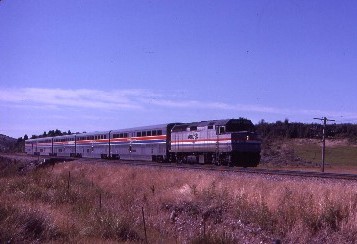
I was back at Portland Union Station the next morning as the Pioneer arrived, consisting of a low-level sleeper, a former Santa Fe Hi-level coach-dorm, a dining car used as half-lounge and half-dining seating, a coach-baggage and a coach. We departed on time and I was in the coach-baggage car, with everyone else's hat checks being for Pendleton, while mine was the only "POC" for Pocatello. I walked back to look into the through coach for Chicago and saw a lot of DEN (Denver) hat checks above the seats. The train crossed the Steel Bridge then beside Interstate 84, still under construction. I was sitting on the left so the Columbia River was outside of my window for the next three-and- a-half hours then once we exited the Portland metropolitan area, Union Pacific's freight main from Seattle joined our route at Troutdale and off we went down that main line, which once hosted the City of Portland and the Portland Rose.
Standing out against the clear Northwest sky across the river in Washington was Mount St. Helens. The eruption on May 18, 1980 (less than a year ago), still amazed me and I wondered how many more peaks in the Cascade Range would come back to life. We entered the south shore of the Columbia River Gorge, sharing the path with Interstate 84 with the forest in this area was similar to a rainforest. We passed Bridal Veil Falls on our side of the river but the north side had all of my attention as there was a westbound Burlington Northern freight with the rock walls behind. We passed Beacon Rock, a huge monolith that could be seen for miles on the Washington shore before arriving at Bonneville Dam, the first of a series on the Columbia River. Our next station was Cascade Locks and while locks are located at every dam that has been built across the river, Cascade Locks was built so boats could navigate around a waterfall on the river before the advent of the dams.
River traffic today was very heavy with many barges and we made our way upstream to the next station at Hood River, where if you know where to look and the weather conditions are favourable, a glimpse of Mount Hood can be had. We passed through a short tunnel and the scenery changed to one of a drier environment, or a rain shadow, with the rock strata becoming more visible and impressive. We passed a large sawmill at Crates before arriving at The Dalles, where Mount Hood was seen again. East of town, we went by The Dalles Dam, which created another large lake on the Columbia River, followed a few miles upriver by passing under Burlington Northern's Inside Gateway bridge on its way to Chemult, Klamath Falls and California.
Across the Columbia River was the Burlington Northern yard at Wishram then we crossed the Deschutes River as the gorge opened and became even more arid. We next travelled on a causeway between the highway, a rather unique location as we approached the John Day Dam and slowly diverged from the river but kept it in sight as we passed the Umatilla Army Depot then arrived at Union Pacific's large Hinkle Yard and stopped a crew change and a few passengers. Departing on time, the Pioneer travelled up the Umatilla Valley and through a tunnel, in the middle of the vast ranch lands, before we arrived at Pendleton. All of the passengers in my car detrained here, except for two people, a woman going to Boise and a man going to Salt Lake City, as well as myself, bound for Pocatello. It was the opposite in the next car as that was packed.
We had already travelled along the scenic wonder of the Columbia River and now in the mid-afternoon, it was time to start the scenic crossing of Oregon's Blue Mountains. The Pioneer travelled up the remainder of the Umatilla Valley and at Huron, passed the Umatilla Indian Reservation and commenced the steep climb over the mountains. There were no highways here, just the railroad and the stream sharing a rather steep-sided canyon wall. The stream was really rushing from all of the winter's snowfall and the canyon walls were covered with pine trees. We passed four Union Pacific freight trains waiting for us in sidings as we twisted and turned to gain elevation, continuing to climb and reaching the summit at Kamela at 4,205 feet. Kamela is the watershed divide, with waters to the west flowing to the Columbia River and those to the east into the Snake River.
From Kamela, the Pioneer descended down a 2.2 percent grade on the eastern slopes of the Blue Mountains and was held to a speed of thirty miles an hour with Interstate 84 sharing the canyon. We reached a section of double track, where two freight trains were waiting and their helpers pushing hard. Experiencing the route and its grades for the first time made me understand why the Blue Mountains were a bottleneck to Union Pacific's freight operations. We arrived at La Grande fifteen minutes early, allowing me to enjoy the fresh air and look around the station.
Upon departure, the train crossed the valley to Union then started its climb up Telocast Hill, a twisting-turning affair that led into the Baker Valley. We arrived in Baker and I made my way to the empty dining car and ordered a steak dinner. Ten minutes later, the waiter brought it, placed it in front of me and just as I was about to take my first bite, the car lifted up, my steak flew off the table and onto the floor as the car landed back on the rails. The Pioneer had gone into full emergency then came to an abrupt stop. Outside the window, the crew was inspecting the train and the waiter came to the table to ask if I was all right, which I was. Seeing the steak on the floor, he said he would bring me a fresh one. I asked what we ran over and his response was a cow, to which I replied that I would like another steak but not as fresh as the one we just ran over. Laughter ensued, after which the conductor announced what had happened and that any time we lost would be made up by Boise. My second steak was much more impressive with a much larger baked potato and a whole basket of rolls. A bottle of wine and dessert was included at no charge. The meal was excellent and my use of plastic utensils had improved dramatically.
Once we were underway again, we climbed out of the Baker Valley to Encina then descended the east slope's 2.2 percent grade and around the horseshoe curve at Oxman. We passed through several tunnels near Durkee before arriving at Huntington for a crew change, then crossed into Idaho over the Snake River before it plunged into Hell's Canyon. Darkness took hold before we re-crossed the Snake River back into Oregon then I called it a night after the train stopped in Nampa and Boise.
4/14/1981 I curled up and slept soundly until the conductor nudged me awake at the Simplot plant at Don to give me a ten minute warning. We passed Union Pacific's Fruit Express repair facility before entering their Pocatello Yard and stopped at the very nice red brick station. I stepped off and was met by Bruce to start another visit to Pocatello for three nights.
Desert Wind 35 4/17/1981 My First Sleeping Car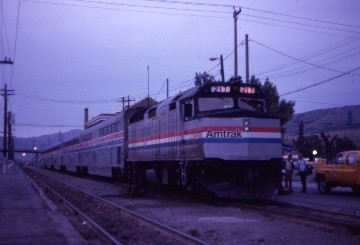
Before I departed, I bought my first sleeping car ticket to go from Ogden to Pomona as Bruce suggested it might be a good idea since the coach section was going to be full and this would give me an opportunity to try a sleeping car. I boarded a Greyhound bus for Ogden, which this time went straight down the freeway over Malad Pass not via Preston and Logan, Utah as I did before and arrived at the bus depot and walked down the three least desirable blocks and was glad to be at Ogden Union Station to await my Desert Wind departure.
I boarded Amtrak 10-6 sleeper 2940 "Pacific View, ex. Amtrak 2640 "Pacific View" 1971, nee Union Pacific 1447 "Pacific View" built by Budd Company in 1950. It became crew dormitory 2502 in December 1997 then was retired in September 2003 and sold to Chris Edwards of Batavia and Ohio Rail Car Company, who sold it to Hocking Valley Scenic Railway in Nelsonville Ohio in December 2019. I found roomette number one in the center of the car and it had a seat on one side and a toilet on the other; the bed came out of the wall behind the seat and took up the length of the room, thereby covering the toilet when the bed was down. Due to that, one had to go to the Amcafé in the next car to use the bathroom there. My attendant stopped by to explain the features of the room before the conductor came to collect my ticket, after which I went to the Amcafé for a few nightcaps and was back in my room as we reversed out of the station on time, once the through cars from the San Francisco Zephyr were attached to the rear.
We reversed to the junction with the Salt Lake line before moving forward bound for Utah's capital city and I had the lights in my room out so I could enjoy the passing nighttime scenery. At Centerville, I pulled the bed down and fell asleep in my first sleeping car bed.
4/18/1981 I awoke to a bright sunny morning with the Desert Wind approaching Las Vegas then had my breakfast of milk and chocolate doughnuts before returning to the peace and quiet of my room after I put the bed away. The only drawback to a sleeping car room was that one's view was limited to the side of the train on which you are located and I thought that if this train had a Superliner Lounge Car, I would be sitting there throughout the daytime and back in my room after dark. I decided to enjoy the rest of the journey in the quiet of my room but was ruing not being able to see the other trains we met and passed that were not on my side.
All in all, as I detrained from the Desert Wind at Pomona, I was the most rested I had ever been after riding that train and my first sleeping car trip was an outstanding success.
| RETURN TO THE MAIN PAGE |