



I was going through some of my father's slides and came across a trip that my family and I took on the California Western in August 1974, then combined a few of my early California Western pictures with his.
California Western Railroad HistoryThe railroad was originally built by the Fort Bragg Redwood Company as the Fort Bragg Railroad in 1885 to carry coast redwood logs from the dense forests at Glenela (Glen Blair) to a newly built lumber mill located 6.6 miles to the west at coastal Fort Bragg, California. Fort Bragg Redwood Company was incorporated into the new Union Lumber Company in 1904; the railroad ownership always rested with the parent lumber company until 1969. On July 1, 1905 the railroad was renamed the California Western Railroad & Navigation Company. In 1904 passenger service was added, and on December 11, 1911, the route was completed to its total length of 40 miles roughly following the Noyo River, to interchange connection with the Northwestern Pacific Railroad in the inland town of Willits.
On December 19, 1947, the railroad name was shortened to the California Western Railroad. Union Lumber and its California Western Railroad came under the ownership of the various lumber producers, including Boise Cascade (1969) and later Georgia-Pacific Corporation. G-P initially leased the CWR's operations to Kyle Railways, but in June 1987, the CWR was sold to the Kyle Railways subsidiary Mendocino Coast Railway. Mendocino Coast Railway continued to operate the CWR under the California Western name.
The train played a vital role during this time in transporting families and workers who set up the various logging camps along the route and in doing so, became an entirely different type of line. It played an important part not only in the area's industrial life, but also in its social and cultural activities. No other logging railroad in America has made the deep impression on American life that was created by the line from Fort Bragg – first by the natural beauty of its route and later, by the distinctiveness of its equipment.
The nickname "Skunk" originated in 1925, when motorcars were introduced (today sometimes referred to as railbuses or railcruisers). These single unit, self-propelled motorcars had gasoline-powered engines for power and pot-bellied stoves burning crude oil to keep the passengers warm. The combination of the fumes created a very pungent odor, and the old timers living along the line said these motorcars were like skunks, "You could smell them before you could see them".
No longer able to make a profit when the G-P mill began to reduce operations and finally closed altogether, Kyle Railways opted to sell the financially-starved CWR. On December 17, 2003, the California Western Railroad was rescued when it was bought by the Sierra Railroad. Today the Skunk Train is owned and operated by Mendocino Railway.
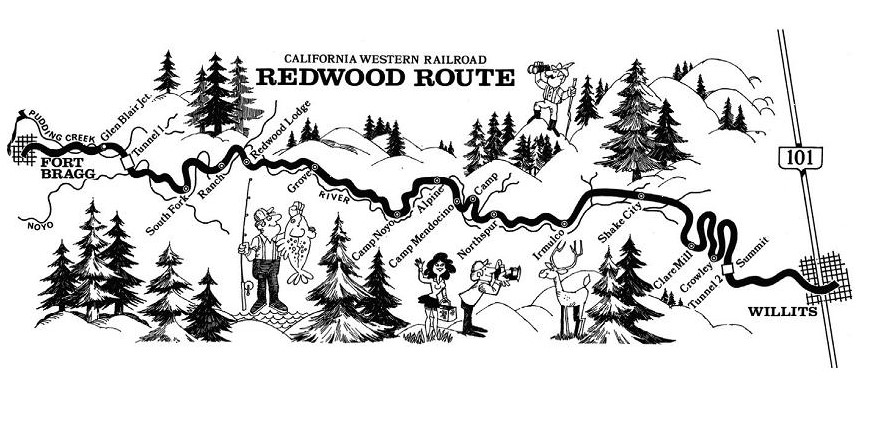
The route map of the California Western.
The Family Visit
This visit to Fort Bragg was part of a month-long vacation in our Ford camper and we stayed in campgrounds each night. The night before, we stayed at Gualala River Redwood Park then drove to Fort Bragg the next morning. Once we parked, I walked across the street to the California Western engine house.
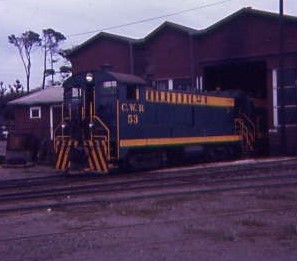
California Western DS4-4-1000 53, ex. Pan American Engineering W8380, nee United States Army W8380, built by Baldwin in 1949. It later was sold to Chris Baldo then in 1995, acquired by Roots of Motive Power in Willits. When in service on the California Western, it was equipped water tanks and sprays for rail lubrication on the sharp curves between Willits and Fort Bragg.
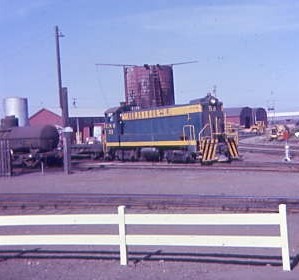
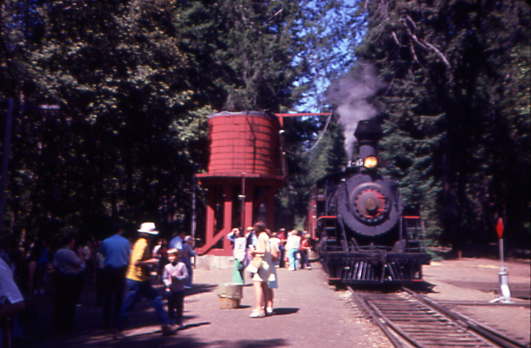
California Western 53 passing the water tower.

California Western 2-8-2 45, ex. Medford Corporation 3 1932, nee Owen-Oregon Lumber Company 3, built by Baldwin in 1924, before coupling to the front of the Super Skunk Train, the railway's name for steam-powered passenger trains, whereas Skunk Train was the name for the diesel-powered ones.

The train is now ready for boarding. My father picked up the tickets and soon we boarded a coach for the round trip to Willits. At 8:00 AM, the train whistled off and crossed California Highway 1, following Pudding Creek out of Fort Bragg to Glen Blair Junction. We passed through the 122 foot Tunnel 1 and upon exiting, crossed Noyo River for the first time. After a few bends in the river, we crossed it again and the redwood trees were tall and beautiful.

Rolling along the north bank of Noyo River. The line twisted and turned while climbing through the redwood forest to gain elevation.
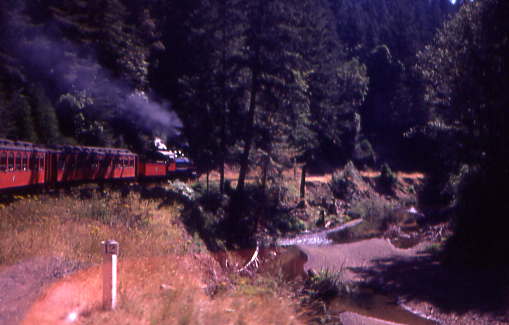

Curving around Noyo River, after which we went through Redwood Lodge and Grove, continuing to parallel the river through Camps Three, Four and Noyo before arriving at Alpine, where I was impressed by the size and stature of the redwood trees Camp Seven was next before we reached Noyo Lodge then arrived at Northspur, where the passengers were allowed to detrain.
The steam engine took water from the tower. We were at an elevation of 322 feet and from here to the Summit, would climb 1,418 feet. Once underway, we continued to follow the streams through Irmulco and onto Shake City at 560 feet then ascended a 2.6 percent grade, passing through Horseshoe Curve and Crowley Loop, where both ends of the train could be seen as we passed through this area. We climbed out of the redwood trees into a zone of grass and oak trees then just before reaching the summit, we passed through the 790 foot Tunnel 2 and once past Summit, the line descended a grade that reached three percent at some points.
Just outside Willits, our route crossed US Highway 101 then the tracks turned north along the Southern Pacific before we reached Willits station, where we went past and turned on the wye and returned to the station, paused for a few minutes then made the journey back to Fort Bragg.
It had been a most wonderful ride aboard the California Western Railroad. Once at our starting point, we drove north on California Highway 1 to US 101 and stayed the night at Richardson Grove State Park.
| RETURN TO THE MAIN PAGE |