



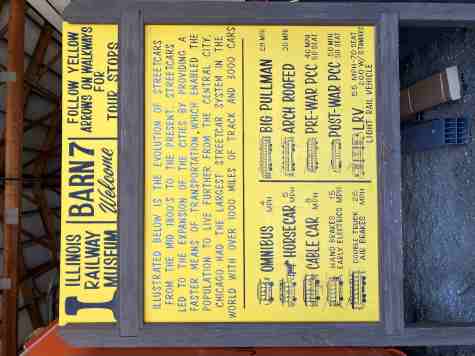
We went into Car Barn 7.
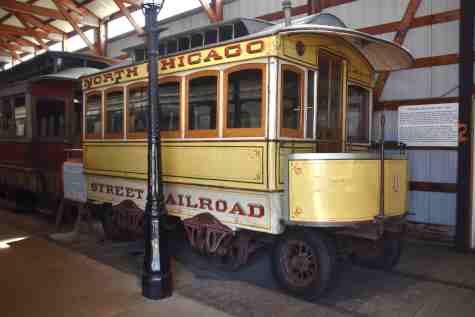
North Chicago Street Railroad horse car 8, built by John Stephenson Car Company in 1859. It is also one of relatively few preserved horse-drawn streetcars anywhere and it is the oldest piece of railway equipment at the museum. In service, one or two horses would haul this car with the driver standing on the front platform. Horse cars were used in Chicago from 1859 until 1906, when the last horse car lines were replaced by electric streetcars.
The horse-drawn streetcar, originating in the mid-1850s, was a natural development of the horse-drawn omnibus; steel wheels and rails reduced friction and provided guidance. But the drawbacks of using horses as motive power were many. Speed was limited to about 6 MPH, and only very small cars could be used.
Street railway service was particularly hard on the horses. Whereas a farmer could afford to let his plow horses rest at the end of each row, a horsecar could not just stop in the middle of a busy street; they had to keep moving. A horse could only work 3 or 4 hours a day, even in teams, so the company needed five to eight times as many horses as cars. A horse that had been used in streetcar service quickly became worn out, and could not be resold except at a very low price. The horses required lots of food, water, hostlers, veterinarians and so forth.
Horses are also subject to infectious diseases. In 1872 an equine epidemic called the Great Epizootic swept North America. In New York alone, 18,000 horses died in a couple of weeks. The railway companies had to hire teams of immigrants to pull the horsecars by hand. A less satisfactory means of urban transportation is hard to imagine.
So the street railway companies were constantly hoping to develop a better system. In the late 1800’s, the development of the cable car and then the electric streetcar permitted the retirement of horses. This car managed to survive, however. It was rebuilt in 1933 for the Century of Progress exhibition to show how much the streetcar had developed.
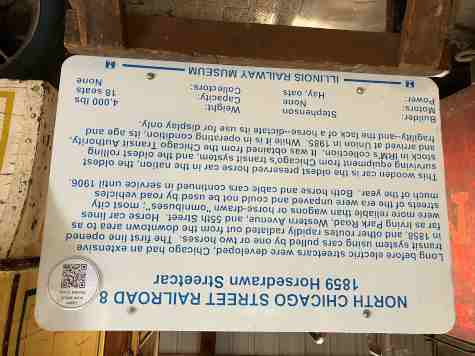
North Chicago Street Railroad 8 story board.
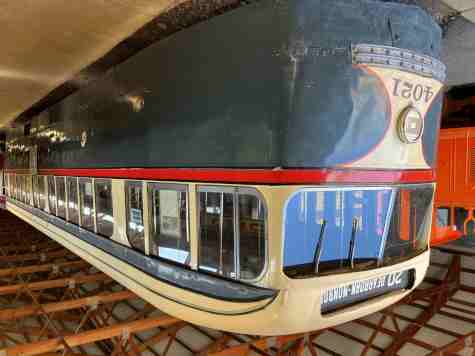
Chicago Surface Lines PCC car 4021, ex. Chicago Transit Authority 4021 1947-1985, nee Chicago Surface Lines 4021, built by St. Louis Car Company in 1936. Nicknamed the Blue Goose, car 4021 and 82 other identical cars were delivered in 1936 in a modernization effort and went into service on the Madison Street line in Chicago. Later the car was rebuilt for one-man operation and re-assigned to the Cottage Grove line. It has been cosmetically restored by museum volunteers to its original colour scheme.
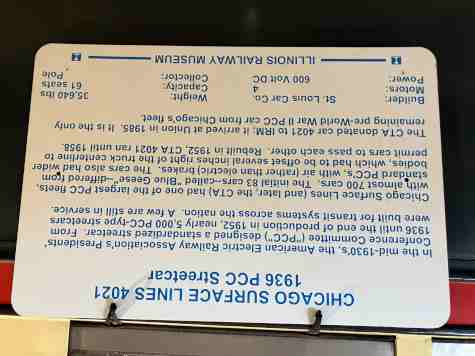
Chicago Surface Lines 4021 story board.
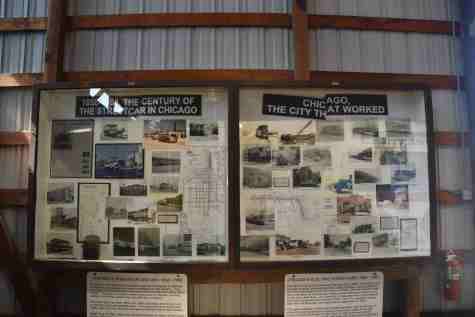
A Century of The Streetcar In Chicago 1858-1958.
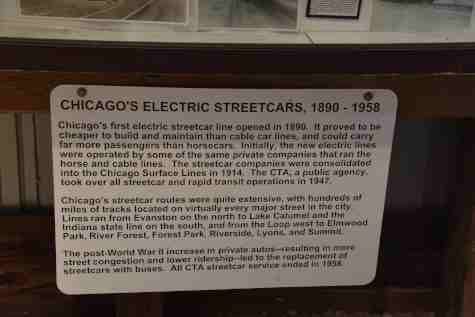
Chicago's Electric Streetcars story board.
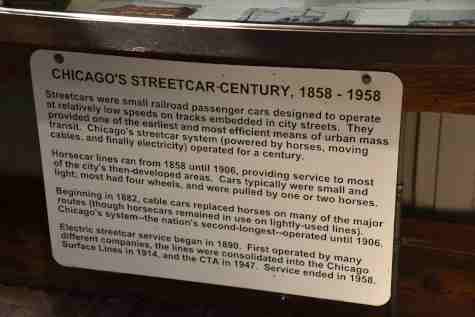
Chicago's Streetcar Century story board.
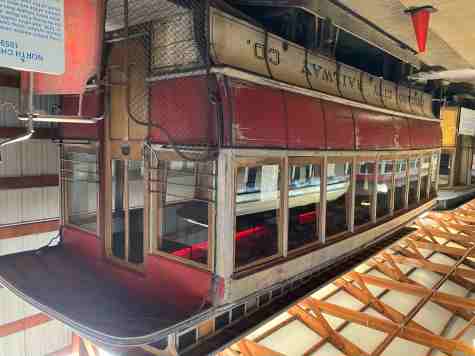
Chicago City Railway cable trailer 209 replica, ex. Chicago Transit Authority 209 1947-1985, nee Chicago Surface Lines 209, built by the railway in 1930 for the Century of Progress exhibition in 1933. It was constructed during the Great Depression using metal components from an original car, possibly a car built by the J.G. Brill Company in 1892.
Cable cars are closely associated today with San Francisco but in 1900 Chicago actually had the largest network of cable car lines in the country. "Grip cars", which gripped the moving cable beneath the street, could haul one or more trailers like this one that helped increase their passenger capacity. Electric streetcars replaced the last Chicago cable cars in 1906.
A central power station transmitted power to the cars via a steel cable running on pulleys under the street. Each car had a grip mechanism that extended down through a slot over the cable conduit; the operator, or gripman, could pull a lever to grip onto the cable, and the car would then move along at about 8 MPH. One of the advantages of the cable car was the almost unlimited power available, so a grip car easily could pull one or more unpowered trailers, such as this one, without loss of speed. But the cable car technology had many drawbacks. The capital expense sunk into constructing the cable system in the streets was immense. Switches, crossings and even curves required extra engineering costs and made operation more difficult.
The cable could not cross a bridge that opened, so three tunnels had to be dug under the Chicago River to allow cable cars into downtown. And to avoid having cable lines cross each other, the cable cars had to run left-handed on State Street and on Wabash in the middle of the Loop. The Loop was originally named after the cable car loops in the middle of the city. But for a short period, roughly 1885 to 1906, Chicago had an extensive cable system, stretching out to Diversey to the north, Pulaski to the west, and 71st to the south. Electric streetcars replaced the last cable cars in the early 1900's when improved electric cars became available.
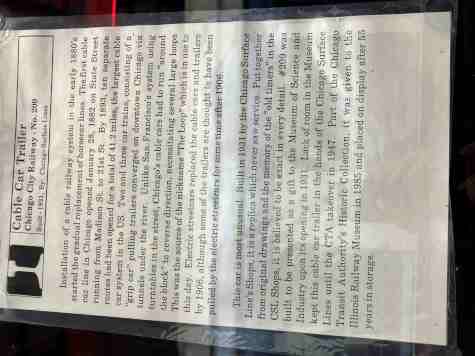
Chicago City Railway 209 history sheet.
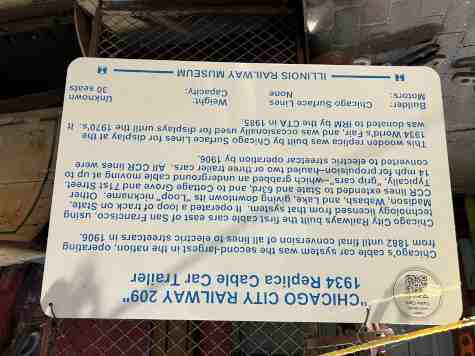
Chicago City Railway 209 story board.
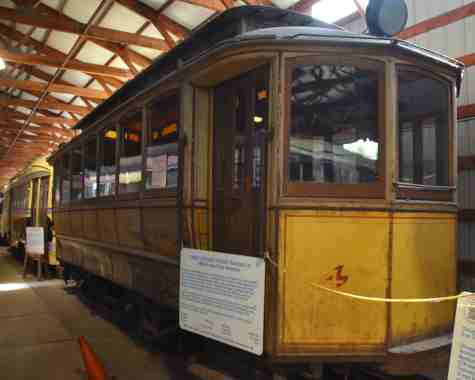
West Chicago Street Railroad double-end single-truck deck-roof car 4, ex. Chicago Transit Authority (painted as West Chicago Street Railroad 4) 1947-1985, exx. Chicago Surface Lines (painted as West Chicago Street Railroad 4) 1933-1947, exxx. Chicago Surface Lines 4022 1914-1933, exxxx. Chicago Railways 4022 1908-1914, exxxxx. Chicago Union Traction 4022 1899, nee history uncertain, possibly North Chicago Street Railroad 922, built by Pullman Company in 1895.
It is the oldest electric car at IRM. It remained in service into the mid-1910s, after which it was stored for potential emergency use, then in the early 1930s the Chicago Surface Lines removed it from storage and restored it for use in parades and other public events. The car came to IRM in 1985 and is in complete but unrestored condition, still wearing its 1930s/1940s paint job.
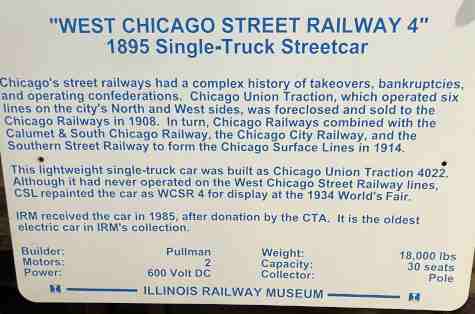
West Chicago Street Railroad 4 story board.
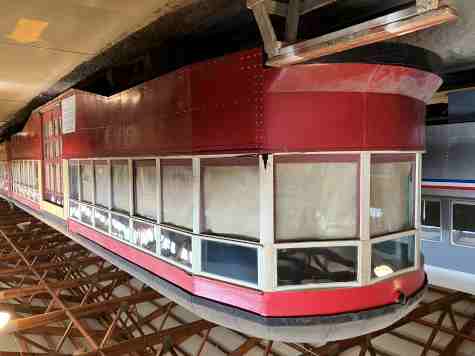
Chicago Surface Lines double-end arch-roof center entrance trailer 9020, ex. Electric Railway Historical Society in Downers Grove, Illinois 1970-1973, exx. Chicago Transit Authority 1947-1970, nee Chicago Surface Lines built by J.G. Brill Car Company in 1921. It the only surviving streetcar trailer from Chicago.
Between the early 1920s and the Great Depression, some rush hour service on the Chicago streetcar system was provided by two-car trains with a standard streetcar towing an unpowered trailer such as car 9020. With falling ridership in 1930, trailers became unnecessary and all were retired. Car 9020 survived as a storeroom until acquired by IRM in 1970. It is largely complete but cannot be used because no streetcars from Chicago were preserved that were equipped for towing trailers.
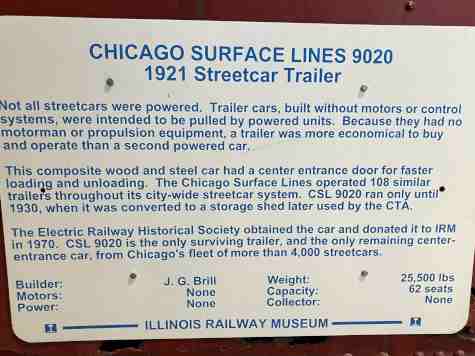
Chicago Surface Lines 9020 story board.
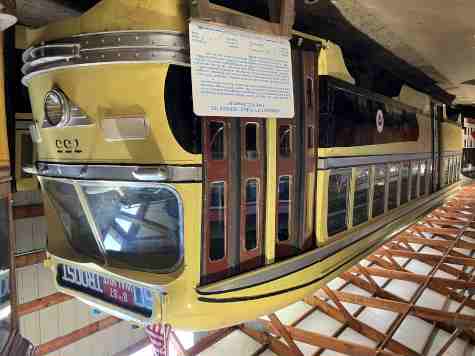
Kansas City Public Service PCC car 755, ex. Southeastern Pennsylvania Transportation Authority 2267 1968-1986, exx. Philadelphia Transportation Company 2267 1954-1968, nee Kansas City Public Service 755, built by St. Louis Car Company in 1946. It is the only streetcar from that city preserved at IRM and while similar to many examples of this supposedly off-the-shelf common design, has some notable features unique to Kansas City such as its windows, as it lacks the small upper "standee windows" of most postwar PCC cars and instead has blue glass shaded glass panes. Those panes were long gone when the car came to IRM, but originals from a different Kansas City PCC were recovered from a small town in Missouri where they had been put to use as the roof in a small greenhouse.
Kansas City Public Service Company emblem.
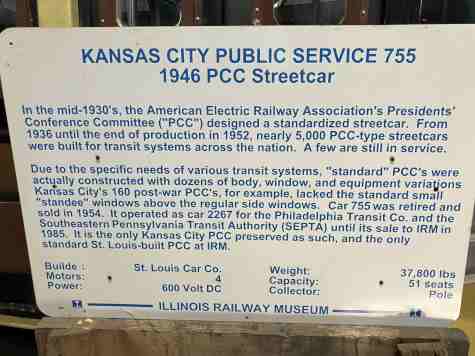
Kansas City Public Service 755 story board.
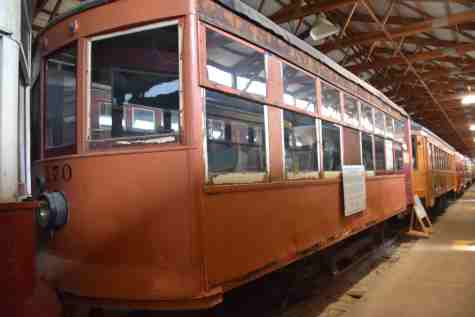
Illinois Terminal Birney car 170, ex. Illinois Terminal 170 1932-1957, exx. Illinois Power and Light 7 1923-1932, nee Galesburg Railway Lighting and Power 7, built by American Car Company in 1921. The Birney was a single-truck, one-man, lightweight streetcar developed after the First World War to help smaller streetcar systems that were trying to control spiraling costs in labor and electricity. Though popular with streetcar lines, Birneys were unpopular with the public due to their rough ride and utilitarian amenities. Car 170 was built for use in Galesburg, Illinois and was later transferred to Alton, where its street railway career ended in 1936. Between then and 1957 it served as an office in the St. Louis subway.
In the years before the First World War, electric streetcars provided the only good way for most people to travel longer distances within a larger city. Few urban dwellers owned horses and, as cities expanded, street railways provided the link that residents needed between their homes and their jobs. But during the 1910s and 1920s two factors combined to threaten the street railway companies: an increase in automobile ownership and competition from jitneys or unlicensed taxis. Together, this competition reduced income enough to threaten to make many streetcar companies unprofitable.
The solution was the Birney car, named for its co-inventor, Charles O. Birney. Illinois Terminal 170 is one of hundreds of Birneys dating to between 1918 and 1931 and is typical of the design.
The Birney incorporated several features that made it more efficient to operate. It was smaller and lighter than many older streetcars, lessening power consumption. Importantly, it was designed to be operated by only one man, unlike older streetcars that needed both a motorman to run the car and a conductor to take fares. To make this one-man operation possible, the Birney also incorporated safety features that would automatically stop the car if the operator became incapacitated.
While Birneys were small and rough-riding, the economy of operation and lowered personnel costs made them very attractive to streetcar companies. Even companies for which the Birney was too small to be useful, like Chicago Surface Lines, utilized its features in larger one-man streetcars or converted older streetcars to one-man operation. Birneys were most common on smaller streetcar systems. But even with the reprieve the Birney granted to these operations, most succumbed during the Great Depression.
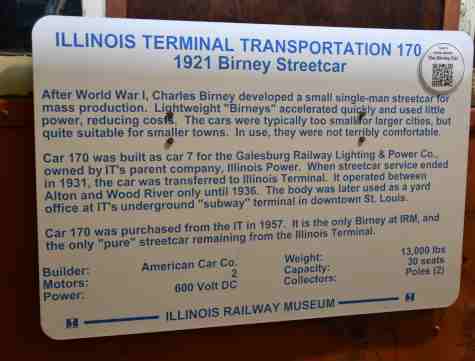
Illinois Terminal 170 story board.
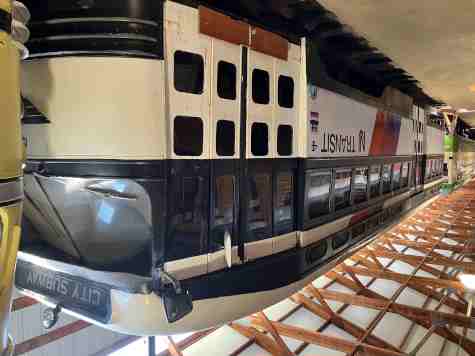
New Jersey Transit PCC Car 4, ex. City of Bayonne, New Jersey 2005-2014, exx. New Jersey Transit 1980-2005, exxx. Transport of New Jersey 1971-1980, exxxx. Public Service Coordinated Transport 1953-1971, nee Twin City Rapid Transit 323, built by St. Louis Car Company in 1946. It remained in service until August 2001, when modern light rail vehicles replaced the PCC cars in Newark. It is the only American streetcar at IRM to have operated into the 21st century in normal daily service.
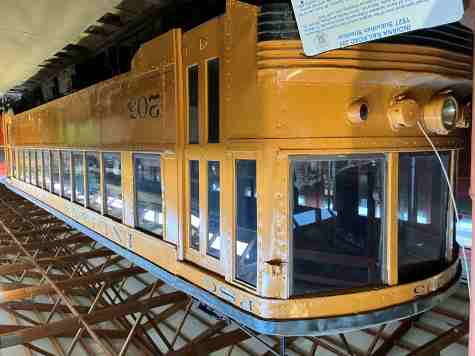
Indiana Railroad suburban car 205, ex. Yakima Electric Railway Museum in Yakima, Washington 1989-1993, exx. privately owned in Snoqualmie 1959-1989, exxx. Portland Traction 4003 1944-1959, exxxx. Portland Electric Power 4003 1940-1944, exxxxx. Indiana Railroad 205 1936-1940, exxxxxx. Indiana Railroad 266 1930-1936, nee Interstate Public Service 266, built by Kuhlman Car Company in 1927.
In 1993, the Yakima Electric Railway Museum was about to scrap the car when IRM stepped in. Museum volunteers loaded car 205 onto a flatbed and trucked it over 2,000 miles to bring it to Union for preservation and a new lease on life.
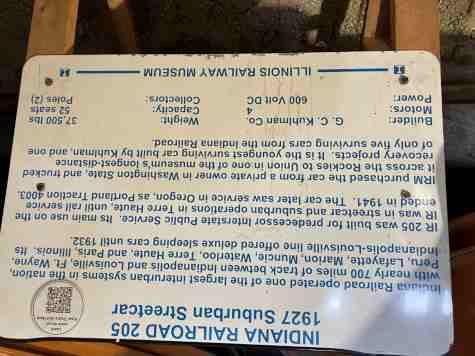
Indiana Railroad 205 story board.
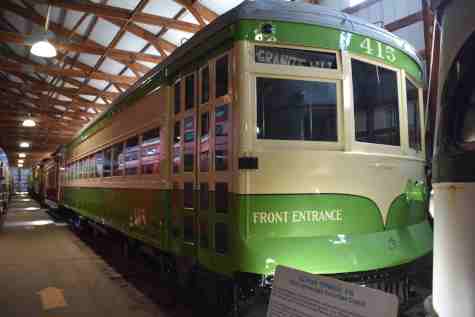
Illinois Terminal lightweight one-man interurban car 415, ex. Illinois Terminal 415 1934-1956, exx. Chicago and Illinois Valley 64 1929-1934, nee Illinois Traction System 64, built by St. Louis Car Company in 1924 and designed for long-distance service along the Illinois Valley between Chicago and Princeton, Illinois. In its later years, it was used in suburban service between St. Louis, Missouri and Granite City, Illinois. In the mid-1930s, it was rebuilt for short-distance suburban service then in 1966, it became the first car to operate at the Illinois Railway Museum.
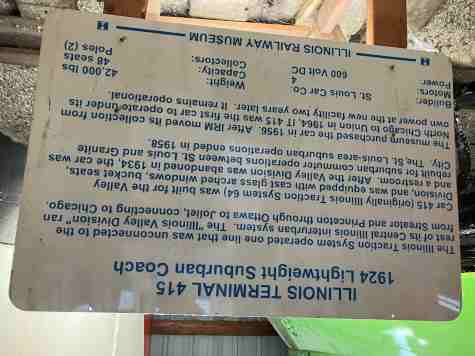
Illinois Terminal 415 story board.
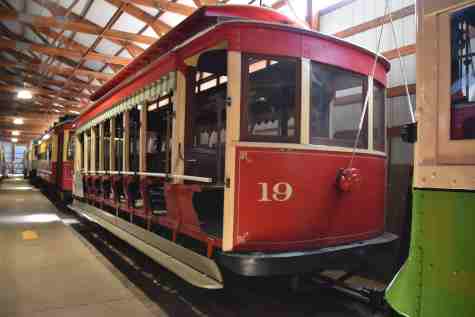
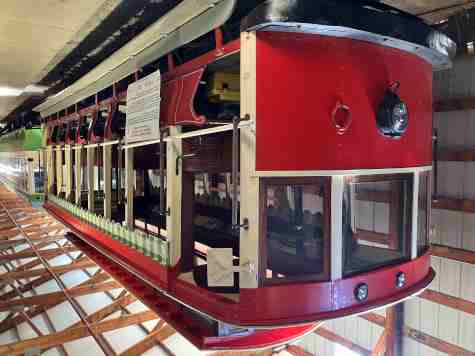
Cooperativa de Transportes Urbanos y Sub-Urbanos 10-bench open car 19, ex. Lake Shore Electric Railway in Cleveland, Ohio, exx. Trolleyville in North Olmsted, Ohio 1961-2006, exxx. Cooperativa de Transportes Urbanos y Sub-Urbanos de Veracruz 1939-1961, nee Compañía de Luz, Fuerza y Tracción de Veracruz, built by J.G. Brill Car Company in 1914.
In the early years of electric railways, between 1890 and 1915, open cars like this one were extremely popular across the United States. On hot summer days, people could ride the streetcar to cool down and escape the heat of the city.
As electric railways expanded and interest developed in leisure travel on streetcars, the streetcar companies looked for ways to capitalize on this market. The answer was the Electric Park. Dozens of streetcar companies all over the country built parks at the outer end of one of their streetcar lines for the purpose of encouraging weekend leisure traffic. Early on, the electric parks – so called because electric railway companies developed and owned them – generally consisted of picnic grounds and bandstands. Later, after 1900, many electric parks gained amusement park rides. Largely because of the electric parks, many electric railways had more riders on weekends than on weekdays.,/p.
The decline of electric parks in the years prior to World War I coincided with the decline of open streetcars like car 19. The proliferation of amusement parks located closer to the city center reduced interest in the older electric parks further away. Open cars fell out of favor with streetcar companies because they could only be used half of the year; during the winter, open cars were useless in colder climates. All of the open cars used by Chicago area electric lines were gone by the Depression, but this car – used year round in sunny Mexico – remained in service in Veracruz until the 1960s.
There were two electric parks in Chicago that survived as well. Ravinia Park north of the city was built by the Chicago and Milwaukee Electric, later the North Shore Line, and survives today as a popular music venue. Dellwood Park in Lockport, just north of Joliet, originated with the Chicago and Joliet Electric and still exists today as a city park.
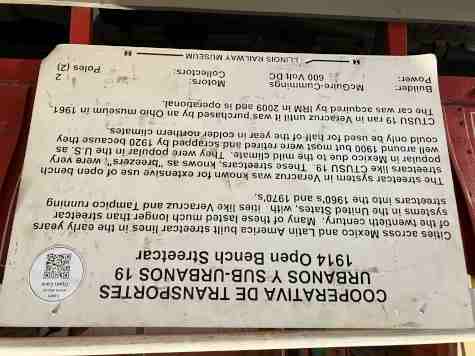
Cooperativa de Transportes Urbanos y Sub-Urbanos 19 story board.
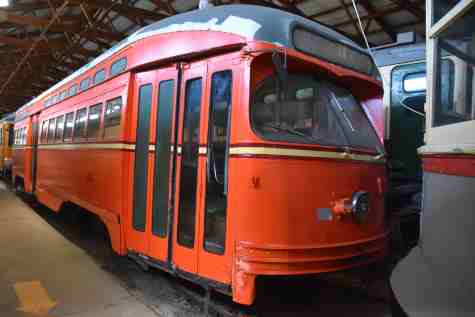
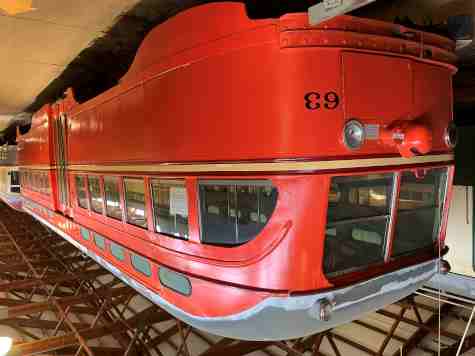
Greater Cleveland Regional Transit Authority PCC Car 63, ex. Lake Shore Electric Railway in Cleveland, Ohio 2006-2009, exx. Trolleyville in North Olmsted, Ohio 1985-2006, exxx. Greater Cleveland Regional Transit Authority 1975-1985, exxxx. Shaker Heights Rapid Transit 1953-1975, nee Twin City Rapid Transit 352, built by St. Louis Car Company in 1947.
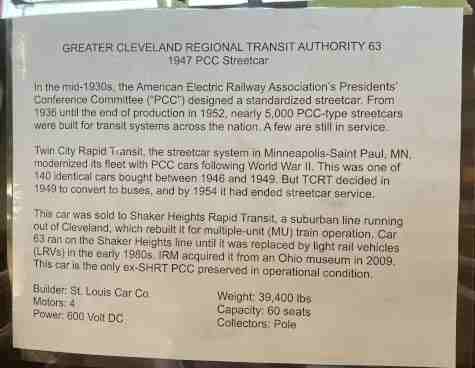
Greater Cleveland Regional Transit Authority 63 story board.
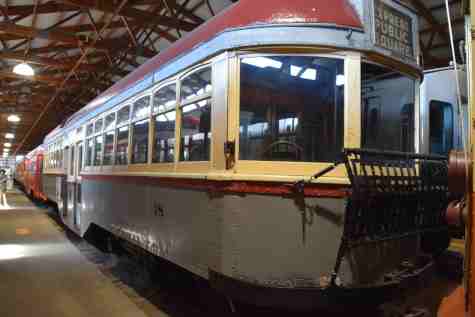
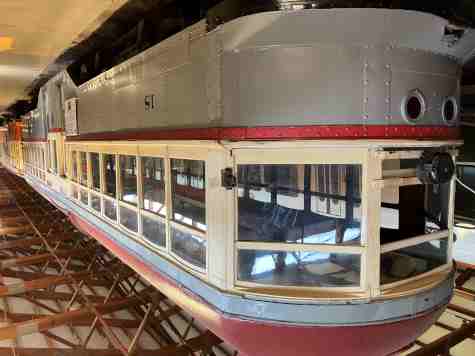
Shaker Heights Rapid Transit center entrance streetcar 18, ex. Greater Cleveland Regional Transit Authority 2009-2013, exx. Lake Shore Electric Railway in Cleveland, Ohio 2006-2009, exxx. Trolleyville in North Olmsted, Ohio 1961-2006, exxxx. Shaker Heights Rapid Transit 18 1944-1961, exxxxx. Cleveland Interurban Railroad 1218 1921-1944, nee Cleveland Railway 1218, built by G.C. Kuhlman Car Company in 1914. The car was acquired by IRM in 2013 and is complete but unrestored.
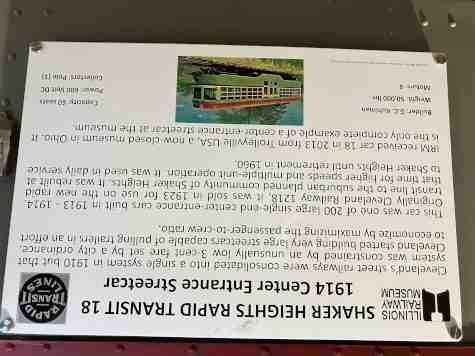
Shaker Heights Rapid Transit 18 story board.
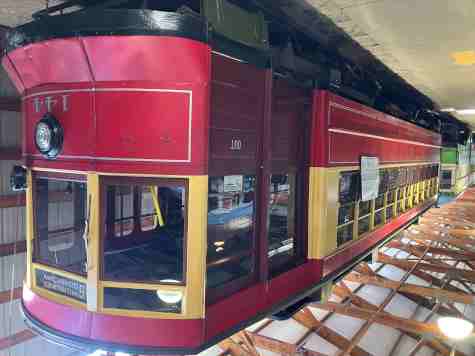
Chicago Surface Lines streetcar 144, ex. Chicago Transit Authority 144, exx. Chicago Surface Lines 144 1914-1947, nee Chicago Railways 144, built by Pullman company in 1908. This is an "Old Pullman", one of 600 identical cars built for Chicago in 1908 and for decades, this type served as the stereotypical Chicago streetcar. It was designed for Pay As You Enter (PAYE) fare collection, with passengers boarding at the rear and paying the conductor stationed on the rear platform. This replaced roving fare collection and was a significant advancement in the first decade of the 20th century. Car 144 ran until retirement in 1954 and IRM purchased it in 1958.
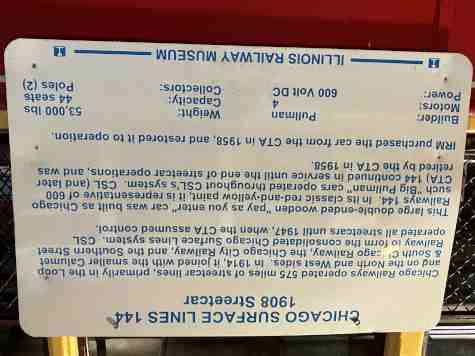
Chicago Surface Lines 144 story board.
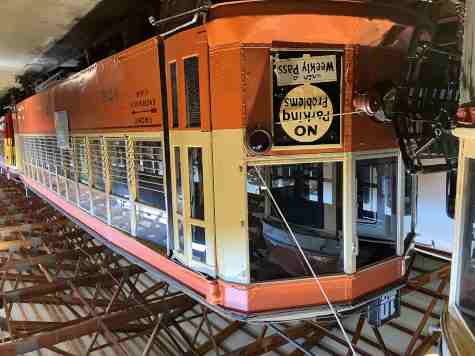
Milwaukee & Suburban Transport streetcar 972, ex. Milwaukee and Suburban Transport 972 1953-1958, exx. Milwaukee Electric Railway and Transport Company 972 1938-1953, nee Milwaukee Electric Railway and Light Company 972, built by St. Louis Car Company in 1927. It is a typical streetcar of that city which replaced older wooden streetcars that were due for retirement. Cars like 972 closed out streetcar service in Milwaukee in 1958. The car has operated at IRM in the past but is currently out of service awaiting structural repair work.
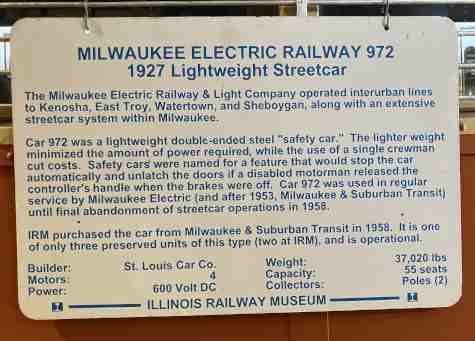
Milwaukee & Suburban Transport 972 story board.
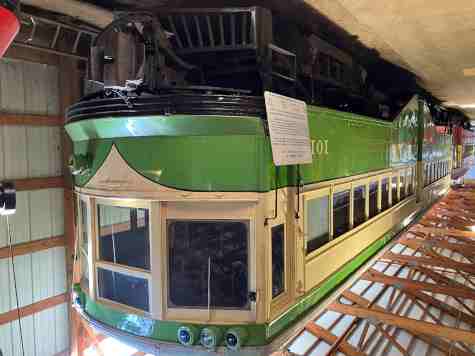
Illinois Terminal center-entrance interurban coach 101, ex. Illinois Terminal 101, nee Alton Granite and St. Louis 61, built by American Car Company in 1917. It operated its entire service life between St. Louis, Missouri and Alton, Illinois. These cars were built for high-speed operation and were known as "Yellowhammers" and "Alton High-speeds". The car has been restored to its appearance in the mid-1950s.
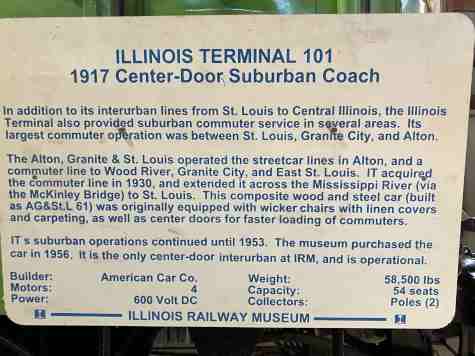
Illinois Terminal 101 story board.
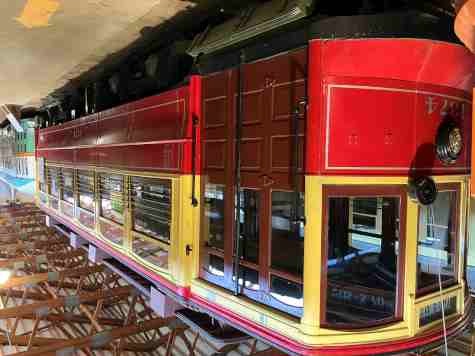
Chicago Surface Lines "Matchbox" streetcar 1374 ex. Electric Railway Historical Society in Downers Grove, Illinois, exx. Chicago Transit Authority AA63 1947-1958, exxx. Chicago Surface Lines 1374 1914-1947, exxxx Chicago Railways 1374 1908-1914, nee Chicago Union Traction 4903, built by St. Louis Car Company in 1925. At one time more, than 300 cars identical to this ran throughout Chicago, mostly on lightly-travelled lines that did not enter the Loop. Car 1374 was converted to a salt spreader in the late 1940s and IRM volunteers spent some 15 years in the 1970s and 1980s restoring it to its condition while in regular operation in Chicago.
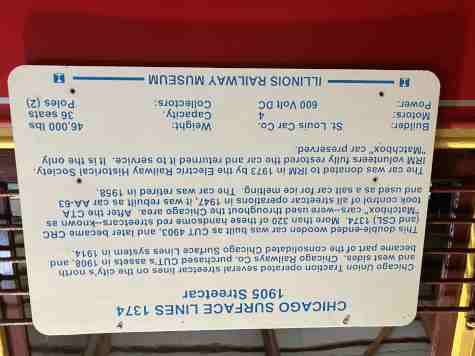
Chicago Surface Lines 1374 story board.
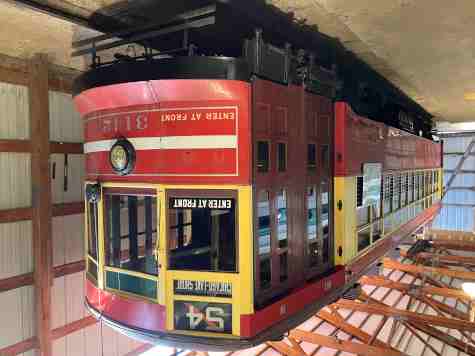
Chicago Transit Authority streetcar 3142, ex. Electric Railway Historical Society in Downers Grove, Ilinois 1958-1973, exx. Chicago Transit Authority 1947-1958, nee Chicago Surface Lines, built by J. G. Brill Company in 1929. It was typical of several hundred arch-roof steel streetcars built for the Chicago streetcar system during the 1920s and one of 169 identical cars built to pull trailers, but car 3142 was never actually fitted with couplers for trailer pulling.
Cars of this type were often known as Broadway-State cars because of their regular use on that line. In the late 1940s, car 3142 was converted for one-man operation and in 1951, was involved in a traffic accident and retired, being converted to a storage locker. This use saved it until it could be set aside for preservation in the late 1950s. IRM volunteers completely restored it to its circa 1950 condition over the course of 15 years in the 1980s and 1990s.
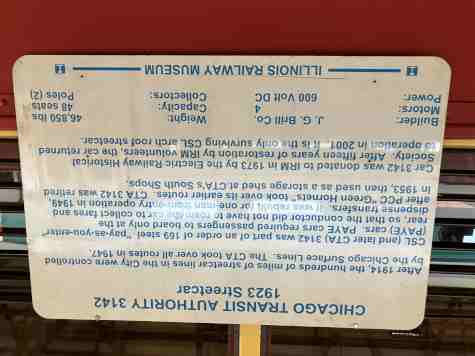
Chicago Transit Authority 3142 story board.
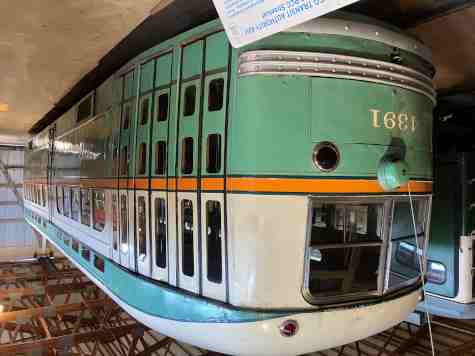
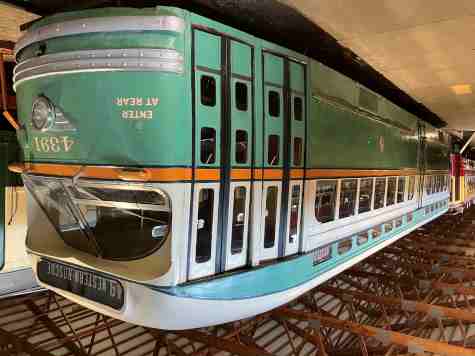
Chicago Transit Authority PCC car 4391, ex. Electric Railway Historical Society 4391 in Downers Grove, Illinois, nee Chicago Transit Authority 4391, built by St. Louis Car Company in 1948 and is the last surviving postwar PCC from Chicago. Nicknamed "Green Hornets", the 600 largely identical PCC cars the Chicago Surface Lines ordered after World War II were intended to modernize the city’s more heavily-trafficked streetcar lines while more lightly-travelled lines would be abandoned or replaced by buses. Instead, the newly-created CTA took over the streetcar system and decided to replace all streetcars with buses. Car 4391 was only ten years old when the CTA retired it and it has operated at IRM since the mid-1970s.
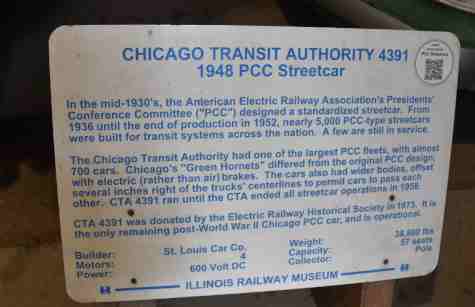
Chicago Transit Authority 4391 story board.
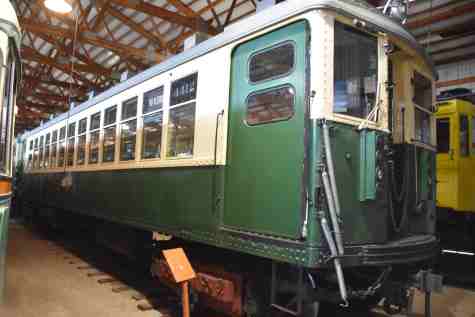
Chicago Transit Authority roof steel "L" rapid transit car 4412, ex. Chicago Transit Authority 4412 1947-1972, nee Chicago Rapid Transit 4412, built by Cincinnati Car Company in 1924 and were similar to the earlier "Baldies" but had wood-and-canvas rooves with trolley poles and cloth seats, to which they owed the nickname "Plushies". Car 4412 ran in Chicago for nearly 50 years and was the first of several 4000-series cars acquired by IRM for preservation.
Chicago Transit Authority emblem.
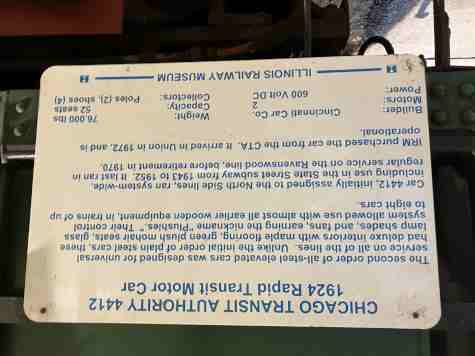
Chicago Transit Authority 4412 story board.
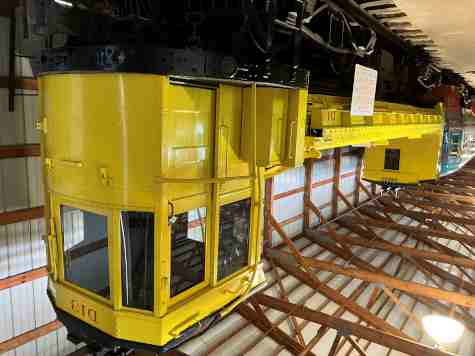
Milwaukee Electric motorized side dump car D13, ex. Wisconsin Electric Railway Historical Society in East Troy, Wisconsin 1982-1988, exx. Municipality of East Troy Railroad 1950-1982, exxx. The Milwaukee Electric Railway & Transport Company 1938-1950, nee Milwaukee Electric Railway & Light Company, built by Differential Car Company in 1920 for hauling gravel and other aggregate.
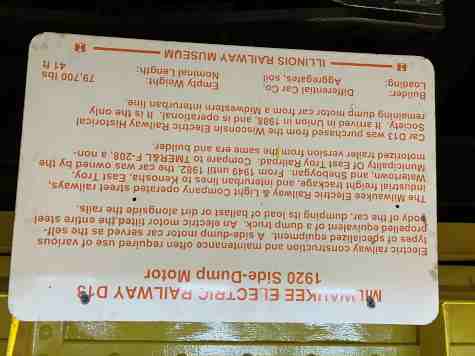
Milwaukee Electric D13 story board.
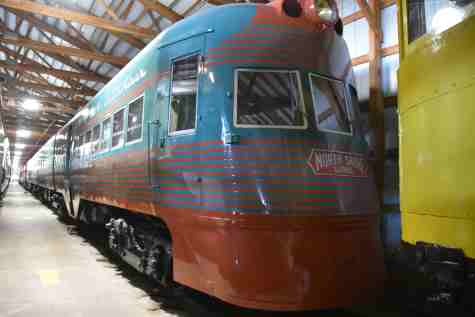
Chicago North Shore & Milwaukee four-section articulated streamliner 801-802, ex. Southeastern Pennsylvania Transportation Authority 801-802 "Valley Forge" 1970-1982, exx. Philadelphia Suburban Transportation 801-802 “Valley Forge” 1963-1970, nee Chicago North Shore and Milwaukee 801-802, built by St. Louis Car Company in 1941. Known as the "Electroliner, this four-car high-speed streamlined train ran in express service between Chicago and Milwaukee, operating over the Chicago elevated, through the streets of Milwaukee, and along the high-speed Skokie Valley Route of the North Shore.
One of the train's four cars is a tavern-lounge where "Electroburgers" and other food and drinks were served. One of only two identical articulated sets built, the "Electroliner" has been completely restored by IRM to its appearance while in service on the North Shore Line.
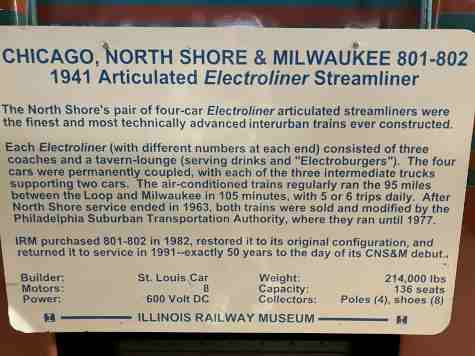
Chicago North Shore & Milwaukee 801-802 story board.
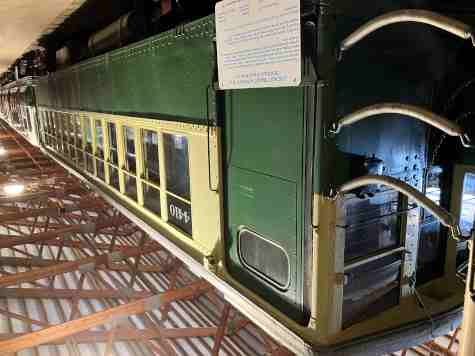
Chicago Transit Authority "L" car 4410, nee Chicago Rapid Transit 4410, built by Cincinnati Car Company in 1924. These cars were similar to the earlier "Baldies" but had wood-and-canvas rooves with trolley poles and cloth seats, to which they owed the nickname "Plushies". Car 4410 ran in Chicago for more than 50 years, in later years on the Evanston line (now the Purple Line).
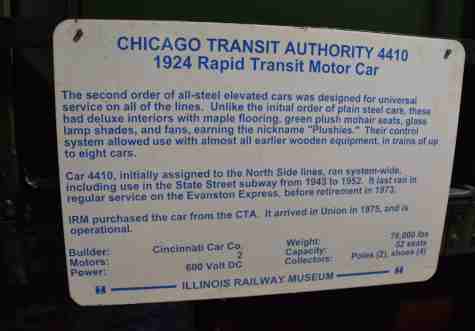
Chicago Transit Authority 4410 story board.
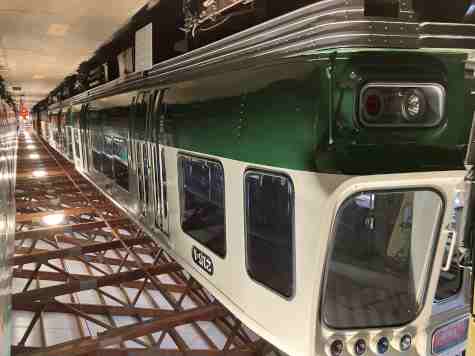
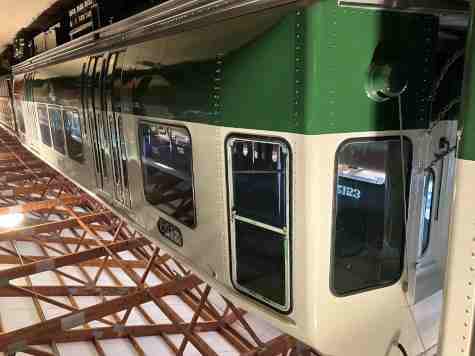
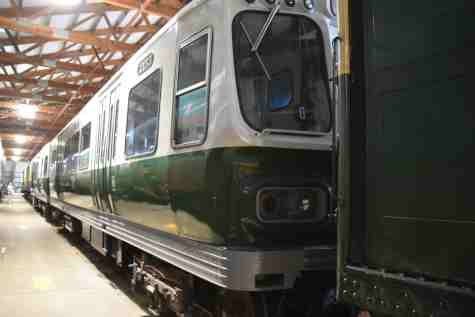
Chicago Transit Authority "L" car 2153 and 2154, built by Pullman Standard in 1964. They were among the first of the so-called "high performance" cars that were built for the CTA between the 1960s and 1990s. This type, known as 2000s, were the first air-conditioned "L" cars in Chicago and were fitted with distinctively formed Fiberglas ends. It is permanently coupled to identical car 2154 to form the only preserved set of 2000s.
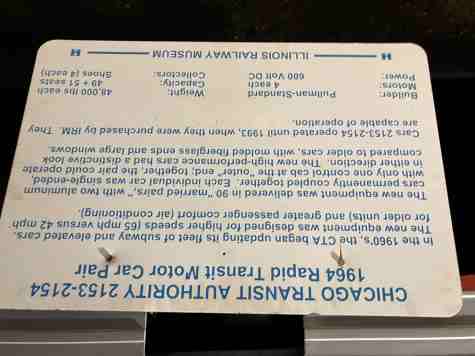
Chicago Transit Authority 2153-2154 story board.
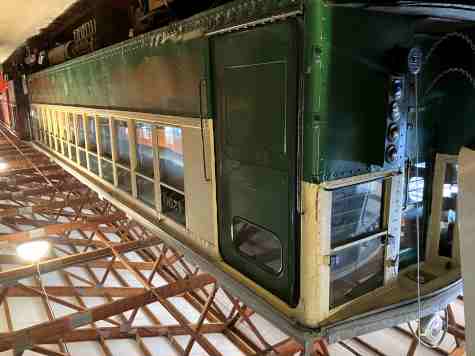
Chicago Transit Authority steel elevated "L car 4290, ex. Chicago Rapid Transit 1924-1947, nee Chicago Elevated Railway, built by Cincinnati Car Company in 1922. It operated for more than 55 years, latterly on the Evanston line (now the Purple Line).
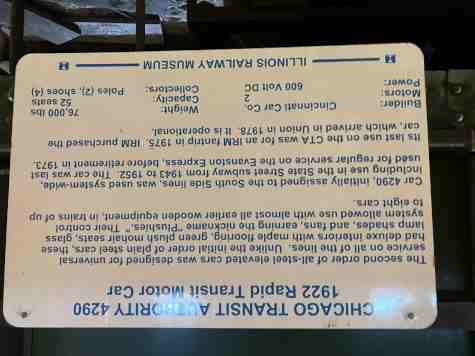
>Chicago Transit Authority 4290 story board.
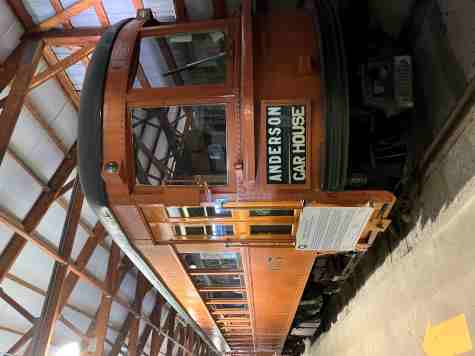
Indiana Railroad interurban car 65, ex. Cedar Rapids & Iowa City 120 1941-1953, nee Indiana Railroad 65, built by Pullman/Pullman-Standard in 1931. It was the first piece of equipment IRM acquired, becoming the museum's "mother car" when purchased for preservation in 1953. When new in 1931, it was among the most modern interurban cars in the world, a lightweight coach designed for high-speed operation across the Indiana Railroad interurban network.
Car 65 was one of the last interurban cars in use when IRR closed out operations in 1941. Museum volunteers have completely restored it to its in-service appearance in Indiana.
Indiana Railroad emblem.
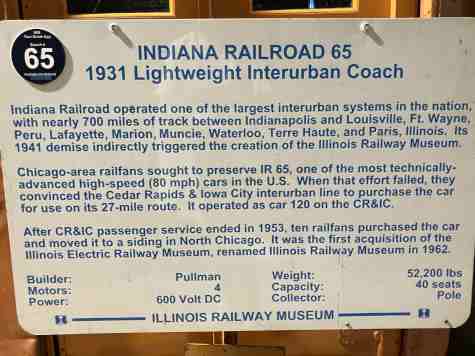
Indiana Railroad 65 story board.
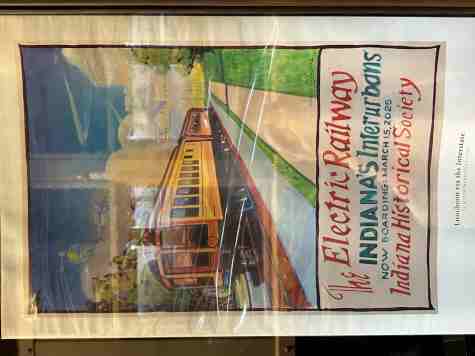
A commemorative painting by Mitch Markovitz to celebrate Indiana Railroad's 95th anniversary.
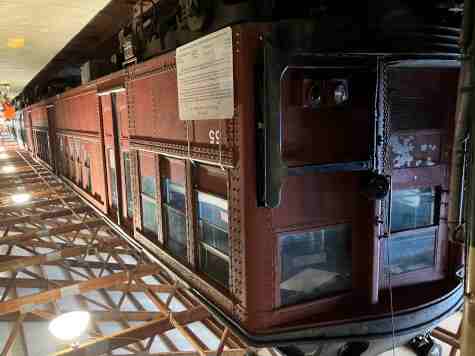
Southeastern Pennsylvania Transportation Authority steel subway car 55, ex. Southeastern Pennsylvania Transportation Authority 1968-1985, nee City of Philadelphia, Pennsylvania, built by J. G. Brill Company in 1927 to a much wider and longer design than Chicago "L" cars, owing to more generous clearances on the Broad Street Subway line. It is the only example of the original fleet of cars for the BSS preserved in operating condition.
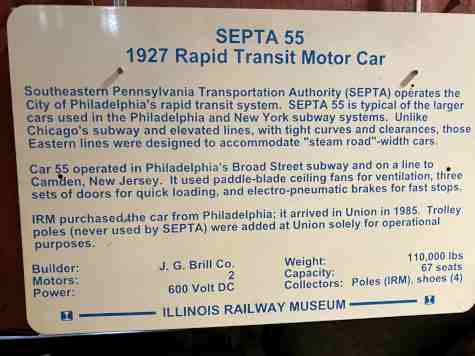
Southeastern Pennsylvania Transportation Authority 55 story board.
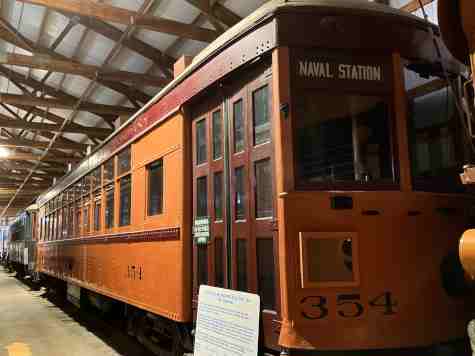
Chicago and Milwaukee Electric streetcar 354, ex. Chicago Hardware Foundry in North Chicago, Illinois 1951-1958, exx. Chicago North Shore and Milwaukee 1946-1951, nee Chicago and Milwaukee Electric, built by St. Louis Car Company in 1928. It was the last surviving streetcar operated by the North Shore Line, known primarily as an interurban railway, but it also operated local streetcar service in Milwaukee, Wisconsin and Waukegan, Ilinois.
Car 354 operated in Milwaukee until about 1942, when it was transferred to Waukegan and during that time, it acquired "Caution – Keep Clear on Curves" signs because cars of this type were so long, they would swing out into traffic on tight curves. In 1947, it was moved back to Milwaukee, where it ran until it was retired in 1951. The car was acquired by the Illinois Railway Museum in 1964 and restored to operating condition by museum volunteers.
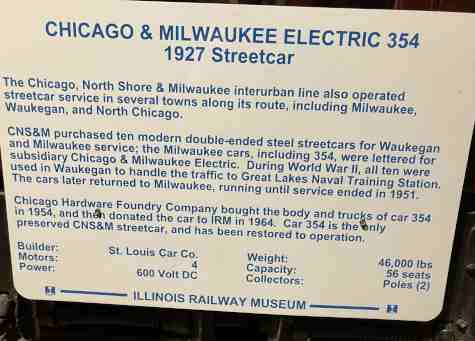
Chicago and Milwaukee Electric 354 story board.
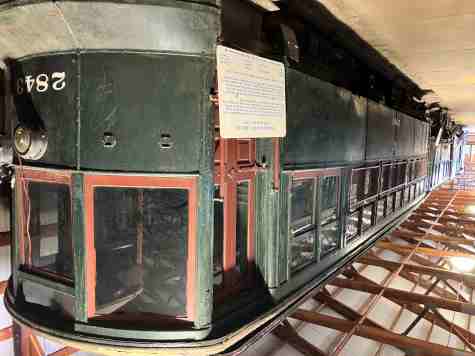
Chicago Surface Lines streetcar 2843, ex. Electric Railway Historical Society in Downers Grove, Ilinois 1958-1973, exx. Chicago Transit Authority AA95 1947-1958, exxx. Chicago Surface Lines 2843 1914-1947, exxxx. Calumet and South Chicago 828, nee South Chicago City Railway 323, built by Jewett Car Company in 1903.
It is the only streetcar of its type preserved and was part of a class of only five cars, the only Jewett-built streetcars run by the Chicago Surface Lines and mainly used on lightly-travelled lines on Chicago's south side. It was also used in operation over the state line to East Chicago, Indiana. The car was converted to a salt spreader in the 1940s and was saved for preservation in the late 1950s. It is displayed intact, except for its seats which were removed in the 1940s, but unrestored.
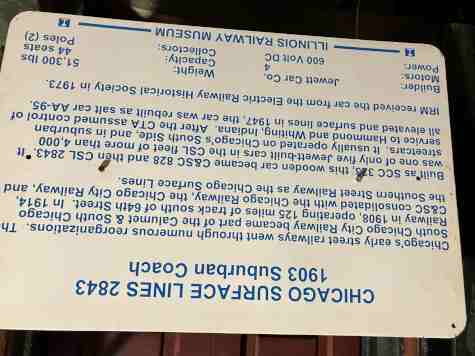
Chicago Surface Lines 2843 story board.
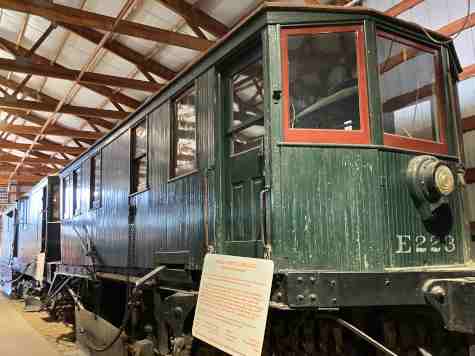
Chicago Surface Lines snow sweeper E223, ex. Chicago Transit Authority E223 1947-1958, exx. Chicago Surface Lines E23, nee Chicago City Railway E23, built by McGuire-Cummings Manufacturing Company in 1908 and designed with large cylindrical brooms at each end which would rotate at high speed and sweep snow off the tracks. It was also fitted with wing ploughs to clear snow off the city street alongside the streetcar tracks. It is the only surviving snow sweeper from the Chicago streetcar system.
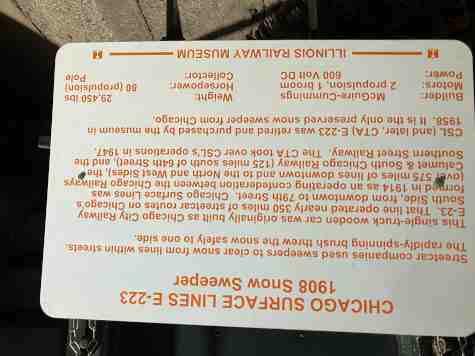
Chicago Surface Lines E223 story board.
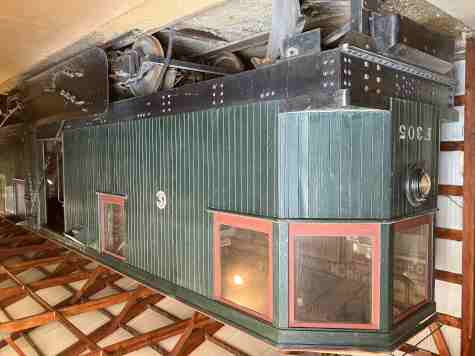
Chicago Surface Lines snow plough F305, ex. Electric Railway Historical Society in Downers Grove, Illinois 1960-1973, exx. Chicago Transit Authority 1947-1960, nee Chicago Surface Lines, built by the railway in 1930 using the frame of an obsolete sprinkler car, a car designed to spray water on dirt streets to reduce dust. As a snow plow, CSL F305 cleared snow from the streetcar tracks and streets in Chicago into the 1950s.
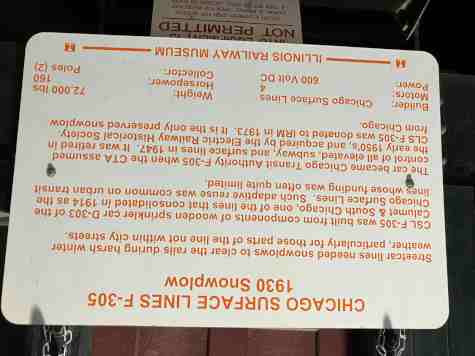
Chicago Surface Lines F305 story board.
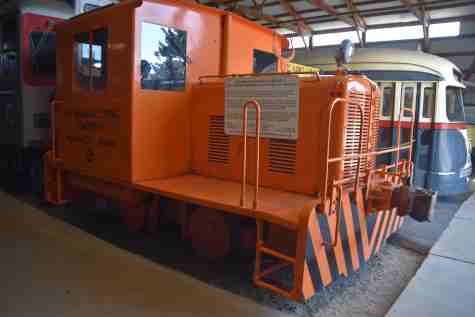
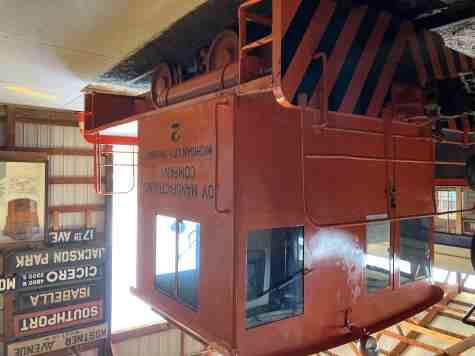
Joy Manufacturing 12DM38 2, built by Whitcomb in 1951 designed for moving one or two freight cars at a time around Joy's manufacturing facility in Michigan City, Indiana. Unlike most of the diesel locomotives at IRM, it does not have electric motors powering the wheels, but rather a mechanical clutch like a truck or automobile.
It is the only engine at IRM built by the Whitcomb Locomotive Company of Rochelle, Illinois. The company started out in 1878 as a Chicago company that specialized in pneumatic mining equipment and knitting machinery. Around 1906, the company built one of the first gasoline-powered mining locomotives ever developed. Soon thereafter it built a new plant in Rochelle to construct mining locomotives. During World War I the company also built a large number of armored trench locomotives. Whitcomb soon expanded into building standard-gauge gas- and diesel-powered locomotives, including large diesel-electric switchers. The Baldwin Locomotive Works took over Whitcomb in 1931 but continued to construct diesel locomotives in Rochelle through World War II. In 1952, not long after the construction of Joy Manufacturing 2, operations at the Rochelle plant ended. Locomotive construction was transferred to the Baldwin plant near Philadelphia and the Whitcomb name stopped being used shortly thereafter.
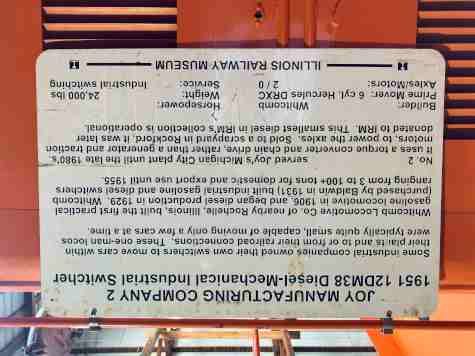
Joy Manufacturing 2 story board.
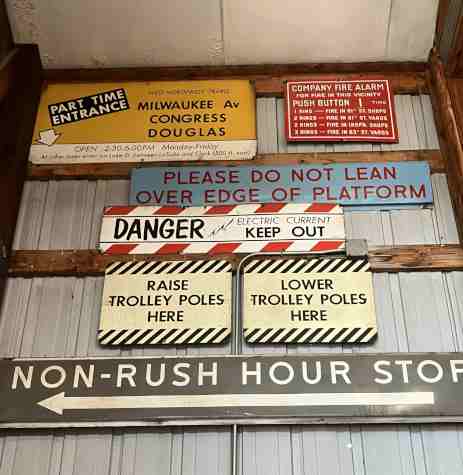
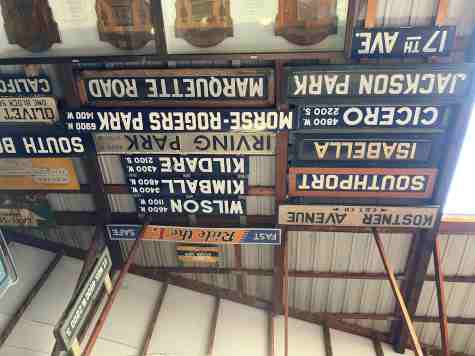
Chicago Transit Authority's "L" signs and station boards. That ends our visit to Car Barn 7.
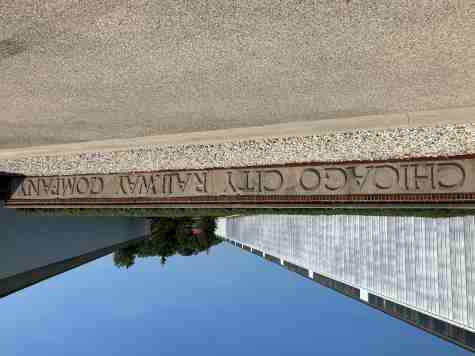
Chicago City Railway Company's limestone entabulature, from their car house at 69th Street and Ashland.
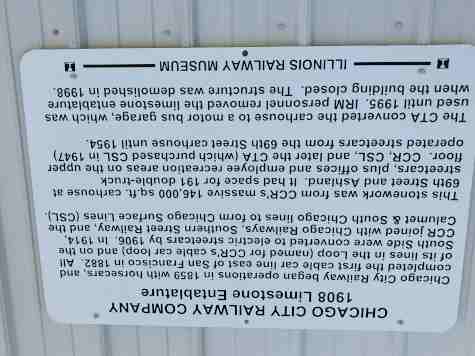
The story board for the entabulature.
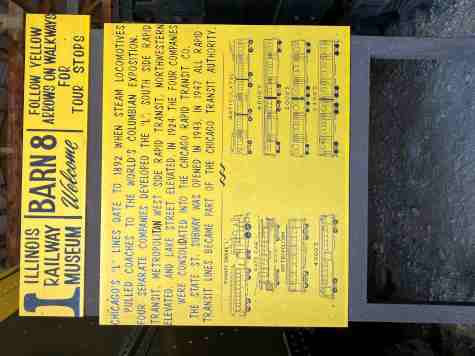
Car Barn Eight.
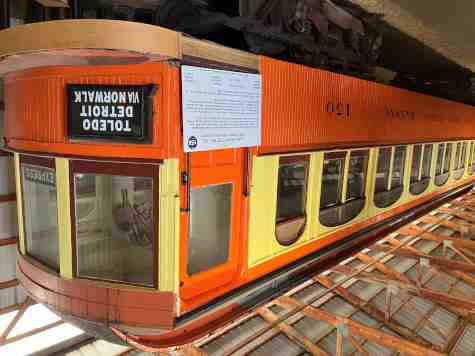
Lake Shore Electric wooden interurban coach 150, ex. Station Square in Pittsburgh, Pennsylvania 1977-2000, exx. privately owned (house) 1938-1977, nee Lake Shore Electric 150, built by Niles Car & Manufacturing Company in 1906. It is a typical car similar to hundreds of others used throughout Indiana and Ohio on the Midwestern interurban network. The railroad retired it in 1938 and sold its body for use as a house. Museum volunteers have repainted car 150 but it but would need extensive reconstruction and replacement of missing mechanical parts in order to operate again. Car 150 is the only Ohio interurban car preserved at IRM as such.
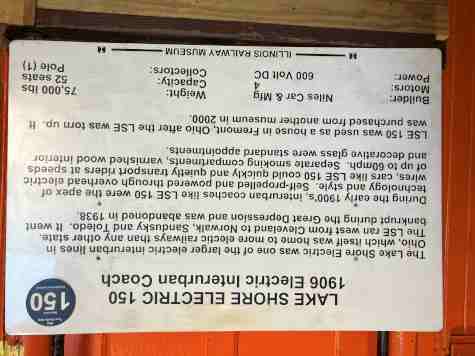
Lake Shore Electric 150 story board.
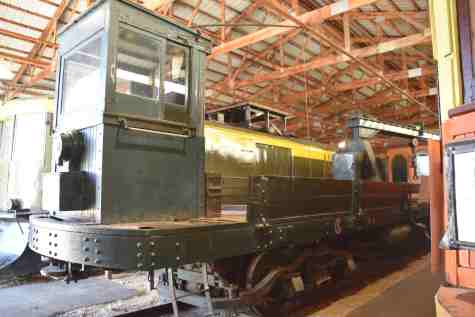
Chicago Surface Lines self-propelled street railway derrick X4, ex. Electric Railway Historical Society in Downers Grove, Illinois 1963-1968, exx. Chicago Transit Authority S344 1958-1963, exxx. Chicago Transit Authority X4, nee Chicago Surface Lines X4, built by company in 1946. It was built using the frame of a disused motorized dump car and used on the streetcar system for transporting and lifting lengths of rail and other heavy items.
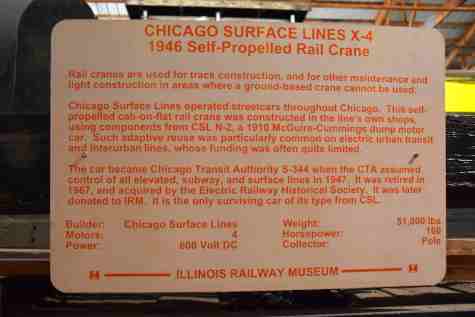
Chicago Surface Lines X4 story board.
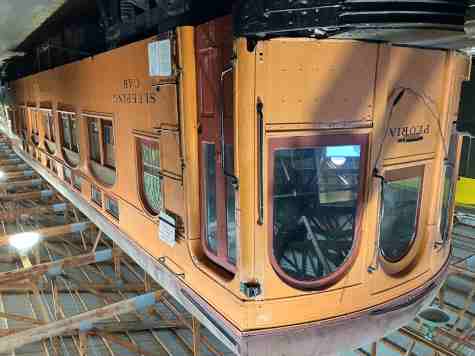
Illinois Terminal arch-roof wood sleeping car 504, ex. privately owned 1960-1966, exx. Illinois Terminal 049 1938-1960, exxx. Illinois Terminal 504 "Peoria" 1928-1938, nee Illinois Traction System #504 "Peoria", built by American
Car and Foundry Company in 1910. is the only interurban sleeping car preserved in the United States. It was built for overnight service between St. Louis and Peoria and in later years, after sleeping car service was curtailed on the
Illinois Terminal, it survived in maintenance-of-way use. It has been preserved in unrestored condition but with several of its original "sections" complete.
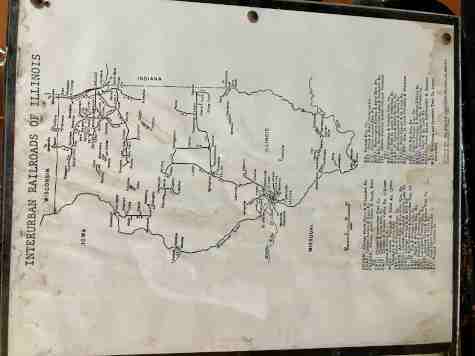
Interurban Railroads of Illinois map.
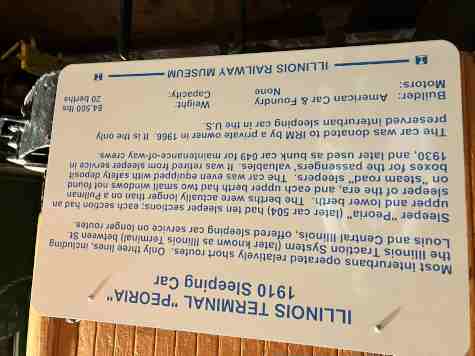
Illinois Terminal 504 story board.
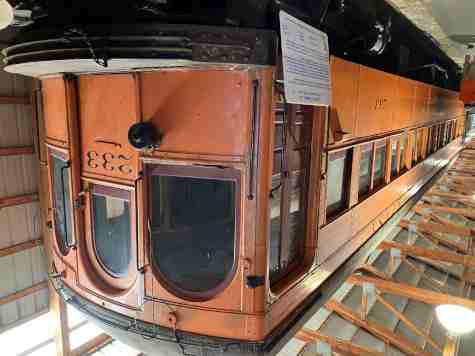
Illinois Terminal interurban office car 233, ex. Illini Railroad Club in Champaign, Ilinois 1956-1968, exx. Illinois Terminal 233 1928-1956, exxx. Illinois Traction System 233, nee Illinois Traction System coach "Missouri", built by St. Louis Car Company in 1906. After only a few years, it was rebuilt as a parlour and office car, fitted with a seating compartment at the front, a large open dining room and a kitchen. The highlight of its career was when it pulled observation trailer 234 in a special train in 1911 carrying President William Howard Taft between St. Louis and Springfield, Ilinois. Often paired with observation car 234 in later years, car 233 was preserved intact (though with its motors removed) and is on public display.
Illinois Terminal Railroad Company emblem.
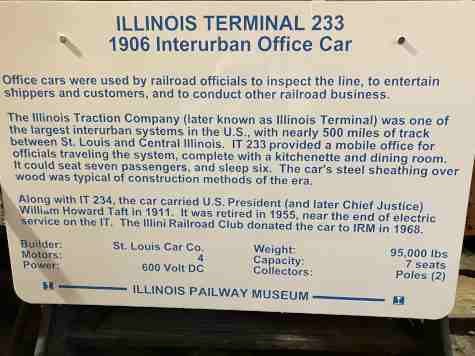
Illinois Terminal 233 story board.
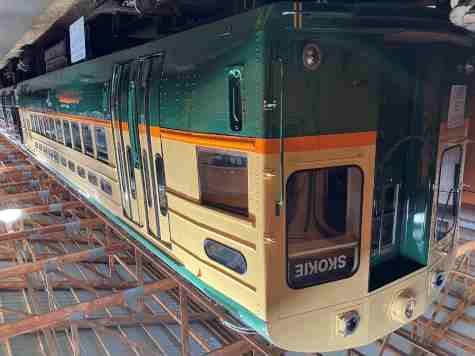
Chicago Transit Authority arch-roof aluminum PCC-type "L" car 30, built by St. Louis Car Company in 1959 using recycled components from retired CTA streetcars. It was one of a series of 50 cars that were the last single-unit "L" cars built for Chicago, all later CTA cars being permanently coupled in pairs. Car 30 has been restored to its 1960s appearance while in service on the Skokie Swift (now the Yellow Line).
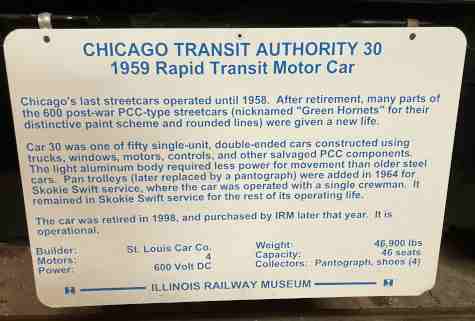
Chicago Transit Authority 30 story board.
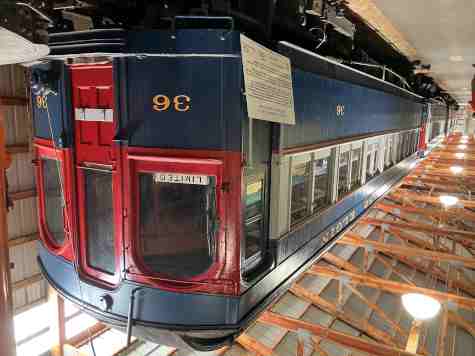
Chicago Aurora and Elgin double-end wood coach 36, ex. Lake Shore Electric Railway in Cleveland, Ohio 2006-2009, exx. Trolleyville USA in North Olmsted, Ohio 1962-2006, exxx. Chicago Aurora and Elgin 306 1922-1962, nee Aurora Elgin and Chicago 306, built by Stephenson in 1902. It is the oldest interurban car preserved at IRM and was part of the CA&E's original order for passenger cars when the railroad opened in 1902. It remained in daily service for nearly 55 years until CA&E passenger service ended in 1957. Car 36 underwent modernization around 1940 but retains its original 1902 interior fixtures and electrical/control equipment. It has been restored to its appearance in the late 1940s.
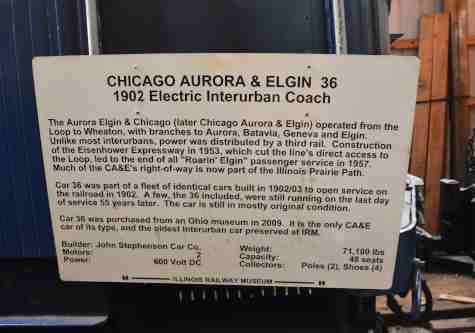
Chicago Aurora and Elgin 36 story board.
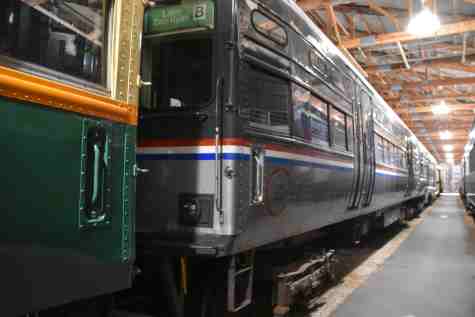
Chicago Transit Authority PCC type "L" car 6655, built by St. Louis Car Company in 1957 using recycled components from retired CTA streetcars. Car 6655 is permanently coupled to identical car 6656 to form a "married pair" set.
For the bicentennial in 1976, the CTA painted several sets of "L" cars in patriotic colors and gave them names commemorating Revolutionary War figures or events. Cars 6655-6656 were named after George Rogers Clark, a Brigadier General in the Continental Army nicknamed the "Conqueror of the Old Northwest" who led a force that captured and defended vast expanses of territory in the Ohio, Wabash, and Mississippi Valleys that had formerly been held by the British.
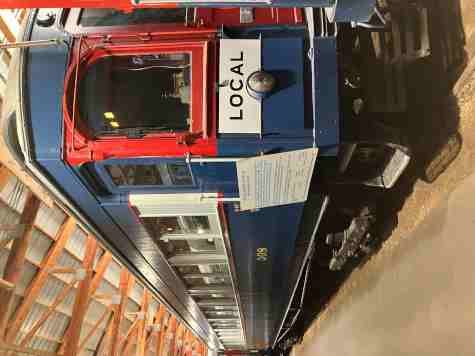
Chicago Aurora and Elgin heavyweight wooden interurban coach 308, ex. Indiana Museum of Transportation and Communication in Noblesville 1962-1996, exx. Chicago Aurora and Elgin 308 1922-1962, nee Aurora Elgin & Chicago 308, built by Niles in 1906. It remained in service for 51 years until the CA&E abandoned passenger service in 1957. It has been completely restored by IRM volunteers to its appearance in the late 1940s.
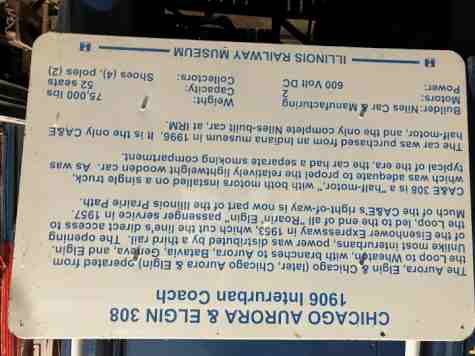
Chicago, Aurora & Elgin 308 story board.
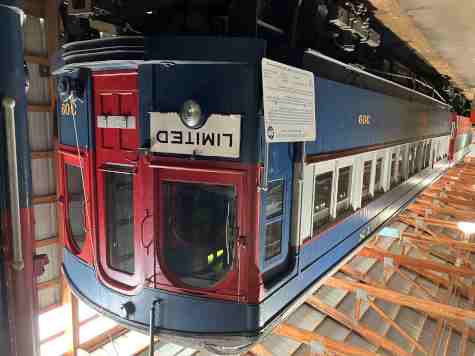
Chicago, Aurora and Elgin wooden interurban coach 309, ex. Chicago Aurora and Elgin 309 1922-1962, nee Aurora Elgin & Chicago 309, built by Hicks Locomotive & Car Works in 1907. It is the only preserved interurban car built by Hicks, a small car builder in Chicago Heights. The car has the distinction of never having left the state of Illinois. In 1971 car 309 suffered a fire which badly damaged its interior, but following the fire, museum volunteers completely restored the car to its appearance in the late 1940s.
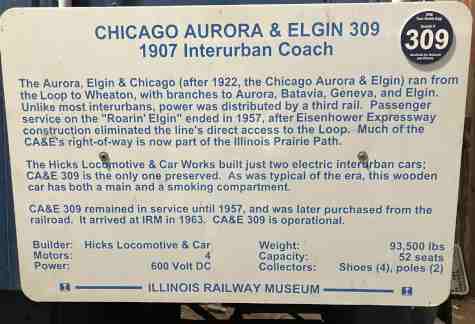
Chicago, Aurora and Elgin 309 story board.
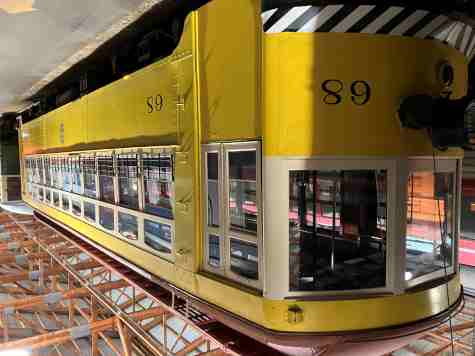
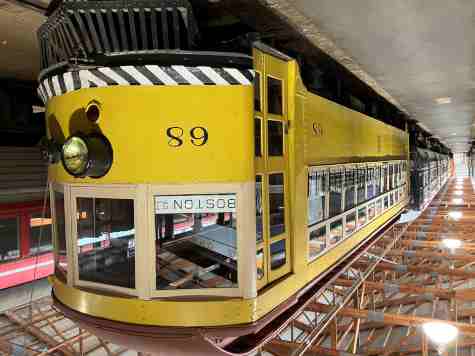
Sand Springs Railway lightweight coach 68, ex. Ozark Mountain Railroad 1966-1967, exx. Tulsa Fairgrounds in Tulsa, Oklahoma 1960-1966, exxxx. Sand Springs Railway 68 1932-1960, nee Cincinnati Lawrenceburg and Aurora 918, built by Cincinnati Car Company in 1918. It is one of the first lightweight interurban cars built and constructed for the Cincinnati Lawrenceburg and Aurora interurban line in Ohio and utilized lightweight steel construction to economize on power use costs, the first order for interurban cars that included this feature. The car has been completely restored by IRM volunteers to its appearance on the Sand Springs in the early 1950s.
Sand Springs Railway emblem.
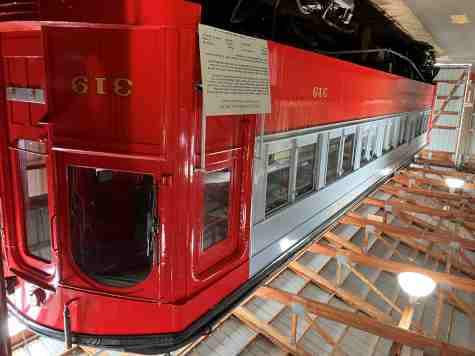
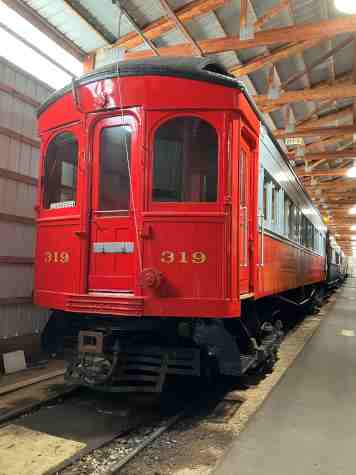
Chicago Aurora and Elgin double-end wood coach 319, ex. Lake Shore Electric Railway in Cleveland, Ohio 2006-2009, exx. Trolleyville USA in North Olmsted, Ohio 1962-2006, exxx. Chicago Aurora and Elgin 319 1922-1962, nee Aurora, Elgin and Chicago 319, built by Jewett Car Company in 1914. It was rebuilt by the CA&E in 1922 with upgraded electrical equipment and its body was modernized around 1950. It has been restored to its appearance at the end of its service life in 1957.
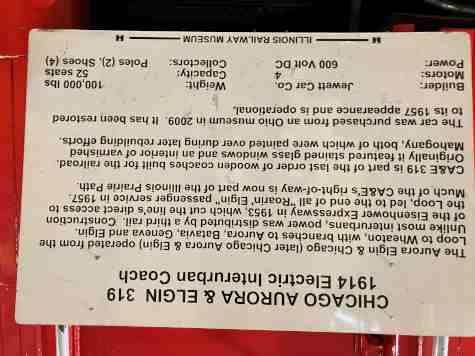
Chicago Aurora & Elgin 319 story board.
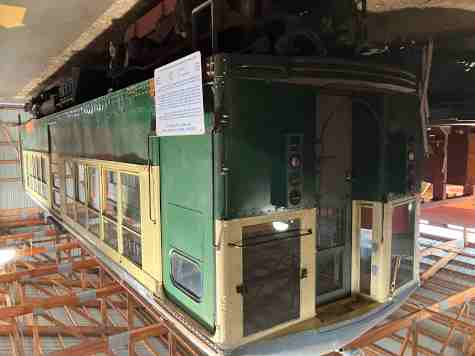
Chicago Transit Authority "L" car 4146, ex. Chicago Transit Authority 1947-1972, exx. Chicago Rapid Transit 1924-1947, nee Chicago Elevated Railway, built by Cincinnati Car Company in 1915. It was one of the earliest motorized 4000-series "L" cars built for the Chicago elevated system and ran for more than 55 years. It was designed with three doors on each side and an unadorned steel roof that led to this type being nicknamed "Baldies".
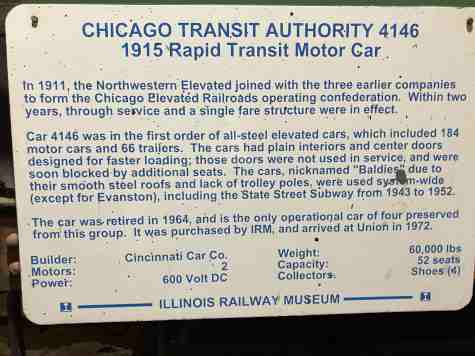
Chicago Transit Authority 4146 story board.
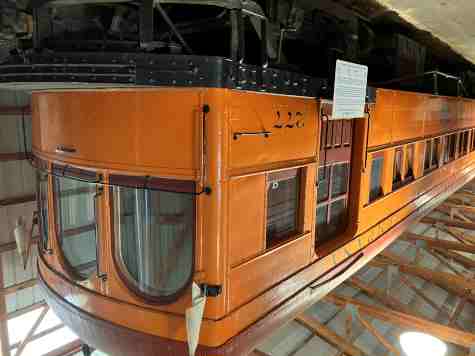
Illinois Terminal baggage/combination 277, ex. Illinois Terminal 277, exx. Illinois Traction System 277 1928-1956, nee Illinois Terminal 277, built by St. Louis Car Company in 1913 and designed to be able to haul several trailers over long distances between St. Louis, Decatur, Bloomington, Peoria and other cities in Illinois. Cars like this were often used to pull trains of coaches, sleeping cars and parlour cars. Car 277 was used until the IT abandoned long-distance passenger service in 1956 and it has been restored to its appearance in the late 1940s.
Car 277 was fitted with antimacassars until quite late in its career, usually printed or embroidered with the railroad's name. In the 19th and early 20th century, Macassar oil was a commonly-used hair oil, but it tended to stain and discolour seatbacks where people rested their heads. The solution was the antimacassar, a piece of white cloth that could easily be removed and washed.
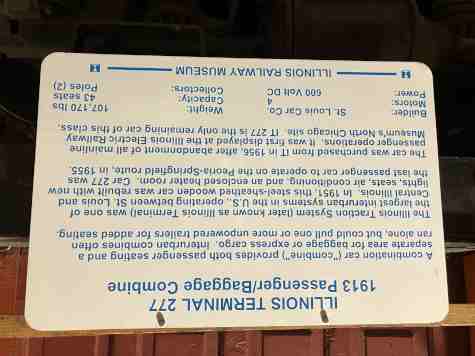
Illinois Terminal 277 story board.
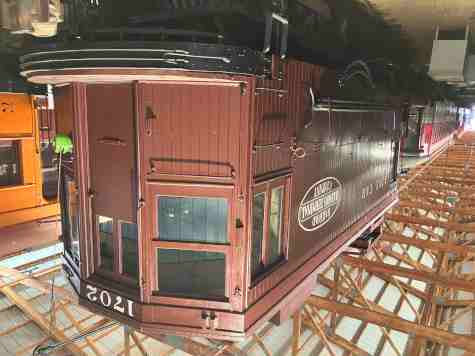
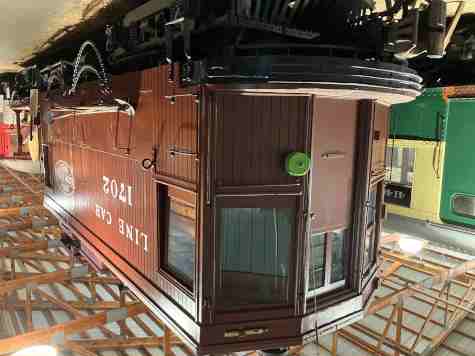
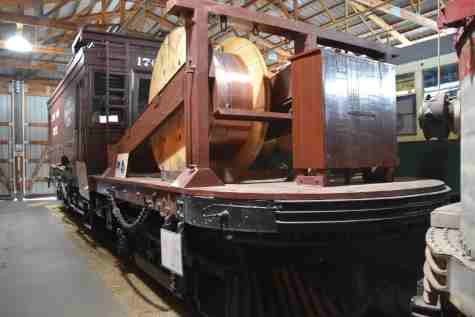
Illinois Terminal overhead line car 1702, ex. Illinois Traction System 1702 1925-1928, nee Illinois Traction System 1507, built by the railway in 1922 using components from a cab-on-flat locomotive constructed in 1906. It has a rooftop platform, for workers maintaining the overhead trolley wire, and features mountings for spools of copper wire. It was used maintaining overhead wire on the Illinois interurban network into the mid-1950s.
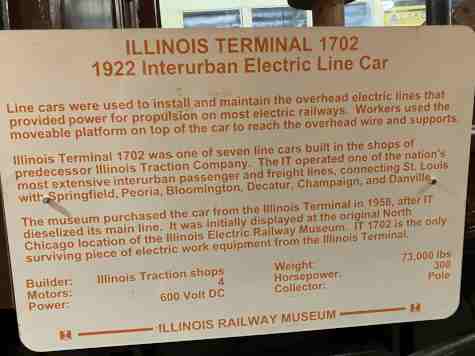
Illinois Terminal 1702 story board.
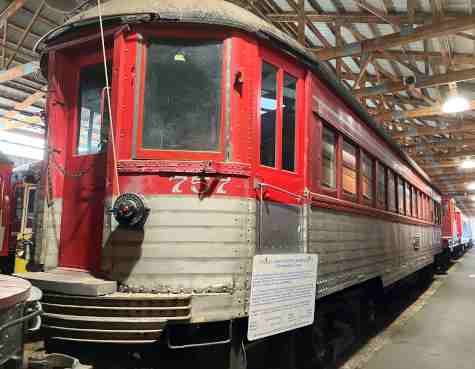
Chicago North Shore and Milwaukee arch-roof steel coach 757, ex. Wisconsin Electric Railway Historical Society in East Troy, Wisconsin c1967-1988, exx. privately owned 1963-c1967, nee Chicago North Shore and Milwaukee 757, built by Standard Steel Car Company in 1929 designed for use between Chicago and Milwaukee. It went through the North Shore's "Silverliner" modernization program in the 1950s which included upgraded seating, interior lighting and a faux- stainless-steel paint scheme. This car was unique in the North Shore fleet because it lacked the usual wooden slats, nicknamed "lobster traps", covering the ends of its roof.
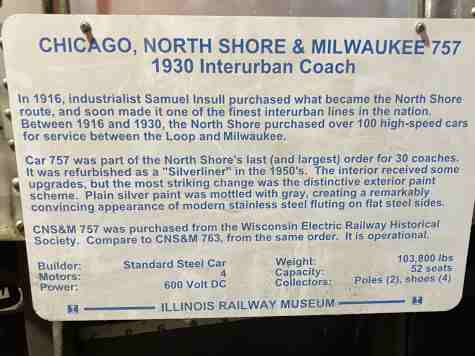
Chicago North Shore and Milwaukee 757 story board.
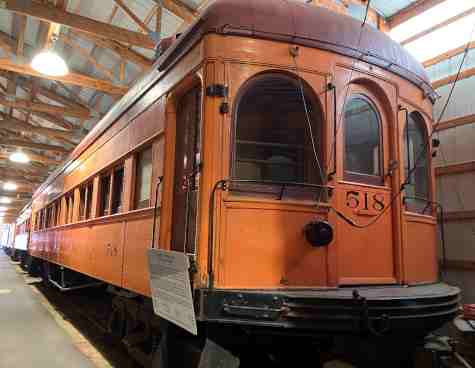
Illinois Terminal coach trailer 518, ex. Illini Railroad Club in Champaign, Illinois 1960-1968, exx. Illinois Terminal Railroad 1928-1960, nee Illinois Traction System, built by the railway in 1911. It is the only preserved coach trailer from the IT, the largest interurban network in Illinois. It has been restored to its appearance in the 1940s and early 1950s, including a fully stained-and-varnished wooden interior. It sees occasional operation on IRM's demonstration railroad.
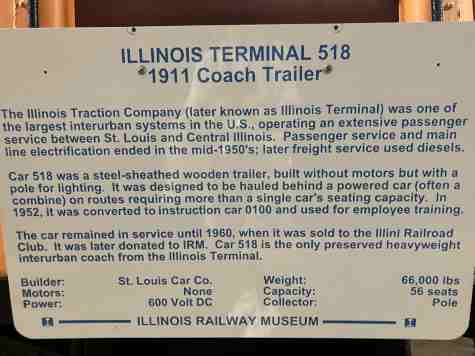
Illinois Terminal 518 story board.
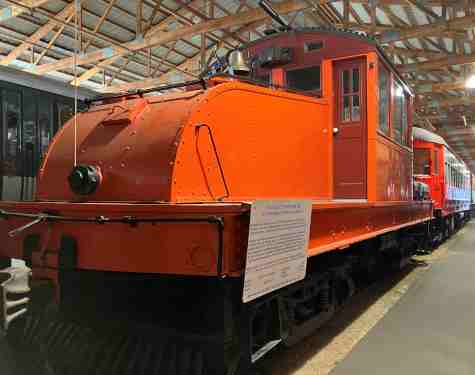
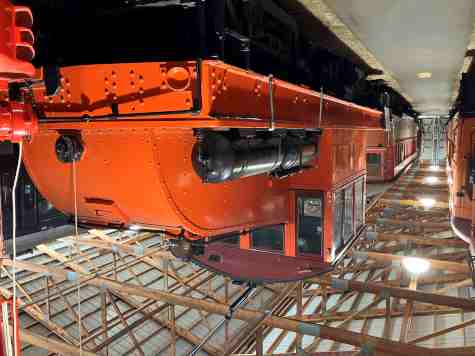
Charles City Western steeplecab locomotive 300, ex. Iowa Terminal 30 1964-1972, nee Charles City Western 300, built by McGuire-Cummings in 1915. It is the only preserved electric locomotive built by the McGuire-Cummings Manufacturing Company of Chicago and was used in freight service on the CCW in central Iowa until retired and sold to IRM in the 1960s. It was completely restored during the 2000s and 2010s.
Charles City Western emblem.
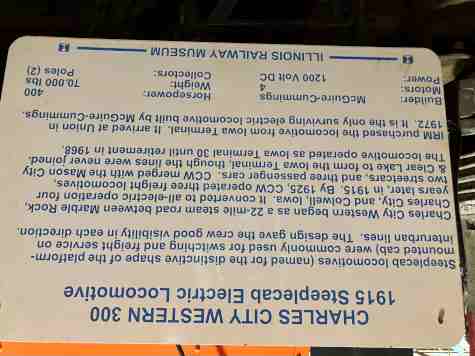
Charles City Western 300 story board.
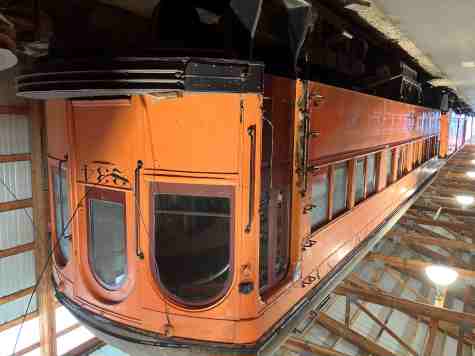
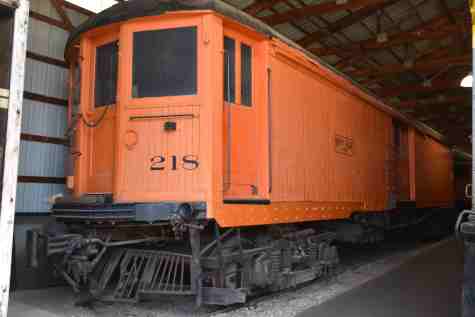
Illinois Terminal interurban observation car 234, ex. Illini Railroad Club in Champaign, Ilinois 1956-1968, exx. Illinois Terminal 234 1936-1956, exxx. Illinois Terminal "Sangamon" 1928-1936, exxxx. Illinois Traction System "Sangamon", nee Illinois Traction System "Champaign", built by Danville Car Company in 1910 with an open rear platform and a parlour seating compartment. The car was used by the IT as a business car and parlour car, with the highlight of its career coming in 1912 when it carried President William Howard Taft over the IT on a special charter. It is the only interurban car built by the Danville Car Company and the only open-platform observation car from a Midwestern interurban line to be preserved.
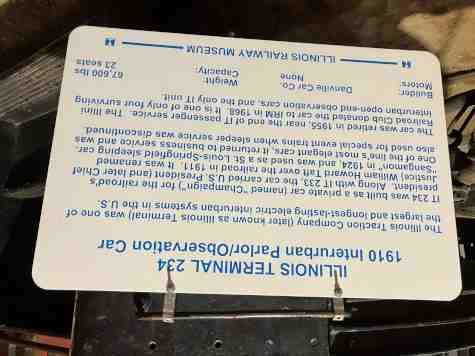
Illinois Terminal 234 story board.
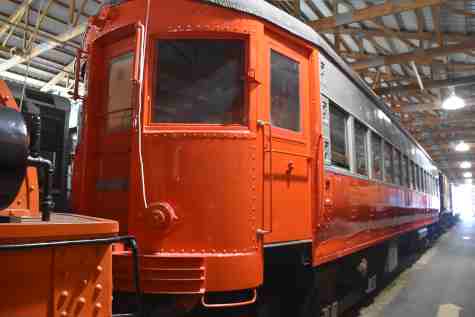
Chicago Aurora and Elgin steel coach 451, ex. Lake Shore Electric Railway in Cleveland, Ohio 2006-2010, exx. Trolleyville USA in North Olmsted, Ohio 1962-2006, nee Chicago Aurora and Elgin 451, built by St. Louis Car Company in 1945. It was the first car in the last order for traditional interurban cars ever placed and while the CA&E ordered ten modern curve-side coaches in 1941, the cars were not completed until 1945 due to World War II. Cars 451-460 featured lightweight design and newer electric control systems but could be used together with the line’s old 1920s steel coaches. Car 451 has been restored to its appearance when new in 1945.
Chicago, North Shore and Milwaukee wood freight motor 229, built by Cincinnati Car Company in 1922 to carry small freight shipments between Chicago and Milwaukee. During the 1950s and early 1960s, it was used as a switcher and locomotive to move cars around the shop complex at Highwood, Illinois.
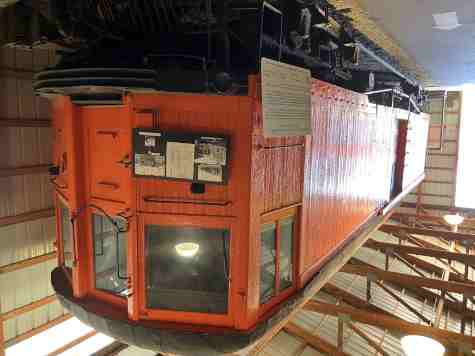
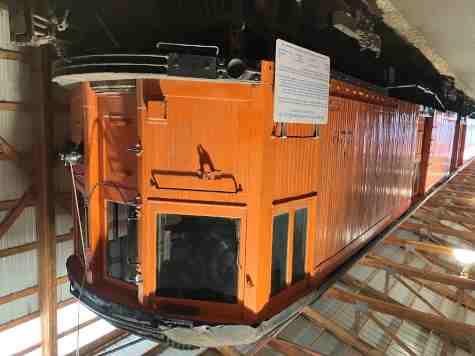
Chicago, North Shore and Milwaukee wood freight motor 218, built by Cincinnati Car Company in 1922 to carry small freight shipments between Chicago and Milwaukee. During the 1950s and early 1960s, car 218 was used as a "sleet cutter" to chip ice from the trolley wire during winter storms. In 1963 and 1964, it was one of very few pieces of equipment to operate at IRM’s original location in North Chicago where it was used as a switching locomotive and drew electric power from a makeshift generator mounted in an old snow sweeper towed behind car 218.
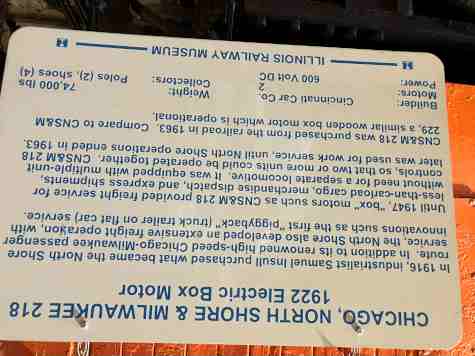
Chicago, North Shore and Milwaukee 218 story board.
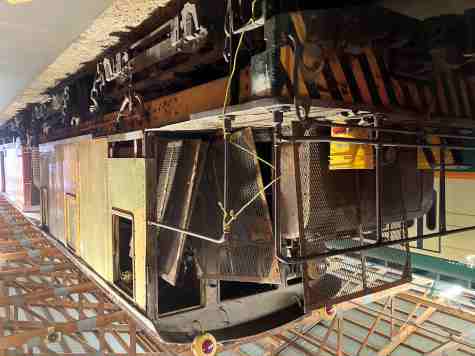
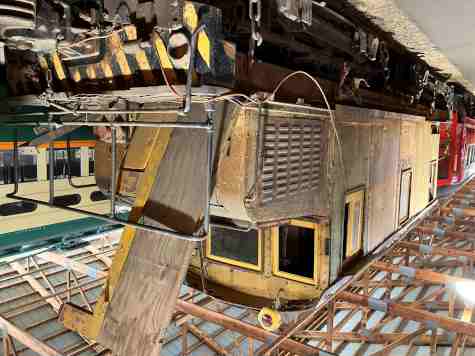
Chicago Transit Authority steeplecab locomotive S105, ex. East Troy Electric Railroad in East Troy, Wisconsin 1997-2007, exx. Toledo Edison 1978-1997, exxx. Chicago Transit Authority 5105 1947-1978, exxxx. Chicago Rapid Transit 1924-1947, nee Chicago Elevated Railway, built by Baldwin Westinghouse in 1925 to haul freight over the North Side Elevated between Evanston and Montrose Avenue. In later years, the CTA also used it for ploughing snow. It was acquired by IRM in 2007 and is currently under restoration.
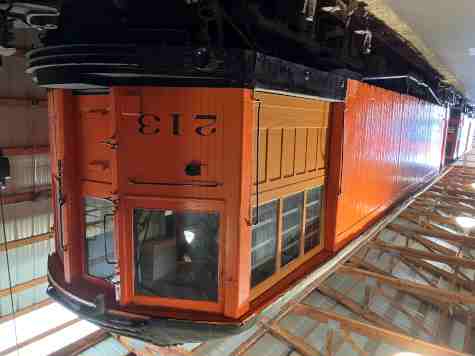
Chicago, North Shore and Milwaukee Line electric freight motor 213, ex. Chicago Hardware Foundry 242 1955-1962, nee Chicago North Shore & Milwaukee 213, built by Cincinnati Car Company in 1919. In 1938, it was rebuilt with a "harrow plow" – similar to an agricultural harrow – and used in the winter to break up snow and ice on the tracks. It was retired in 1955 and acquired by the museum in 1964. Today it is the oldest North Shore Line freight motor (or "Merchandise Despatch car" as the North Shore called them), and the only North Shore freight motor with its baggage doors at the corners instead of the middle, in existence.
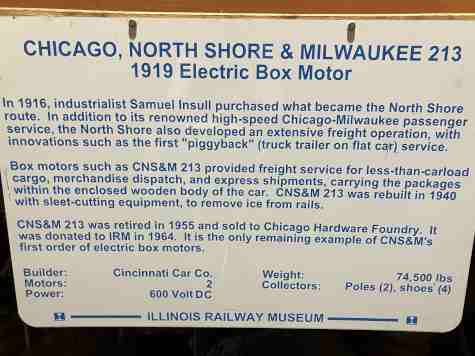
Chicago, North Shore and Milwaukee Line 213 story board.
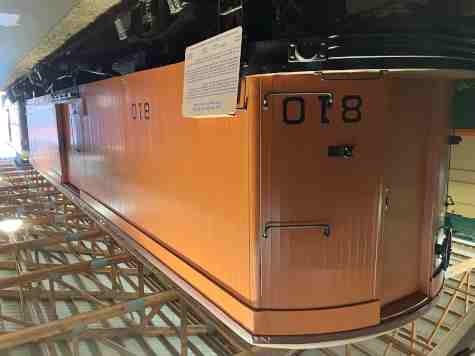
Lake Shore Electric wood freight trailer 1630, ex. privately owned (shed) 1938-1984, exx. Lake Shore Electric 810 1929-1938, nee Michigan Electric 1630, built by Kuhlman Car Company in 1924. Designed as a as a specialized boxcar, it was capable of accommodating the tight turns and close clearances common on electric railways. The railway used it between Cleveland, Toledo and Detroit. It is the only fully restored interurban freight trailer in the country.
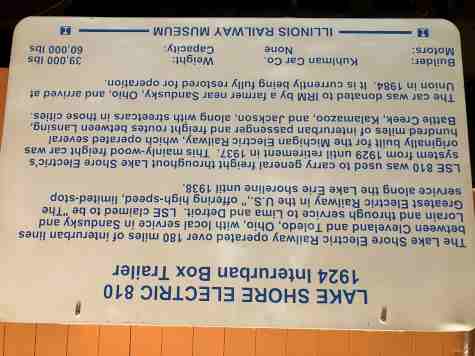
Lake Shore Electric 1630 story board.
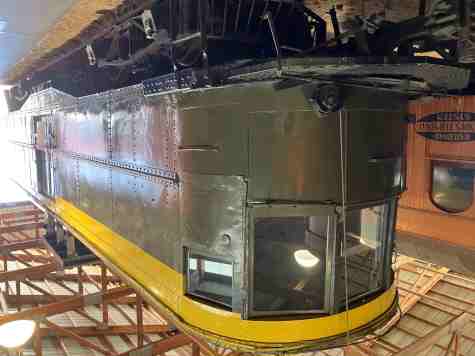
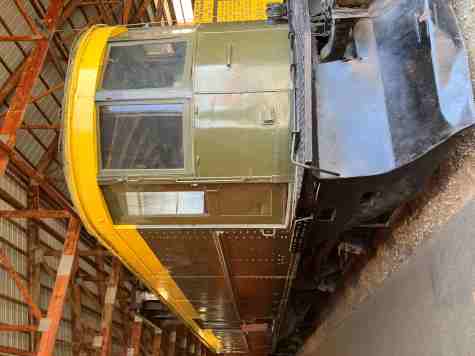
Milwaukee Electric Railway and Light freight motor M15, ex. Municipality of East Troy Railroad 1941-1982, exx. Milwaukee Electric Railway & Transport Company M15, nee Milwaukee Electric Railway & Light Company, built by the company in 1920 to carry small freight shipments and to haul freight trains over the Wisconsin interurban network.
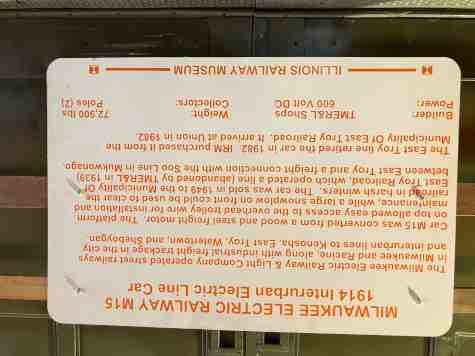
Milwaukee Electric Railway and Light M15 story board. We returned outside for more equipment.