



After visiting two of the car barns, we returned outside and continued to explore this huge museum. Trains were not running today as it was a non-operating day.
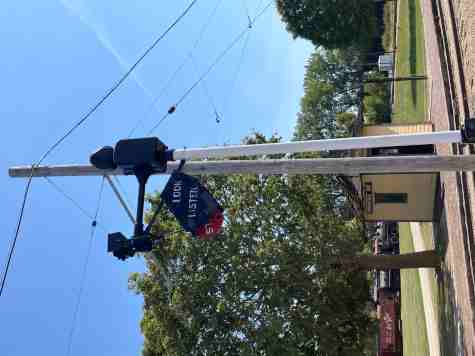
Springfield Avenue lower-quadrant wig-wag crossing signal built by Union Switch and Signal.
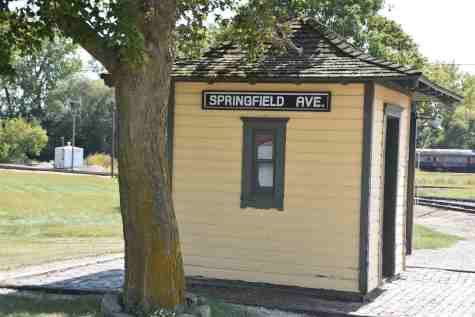
The Springfield Avenue waiting shelter was built in the early 1900s for the Rockford & Interurban electric railway. It was located on the west side of Rockford at about the intersection of Springfield Avenue and State Street, on the interurban line between Rockford and Freeport. It is typical of hundreds of waiting shelters located at flag stops. This shelter was acquired by IRM, restored, and was placed at its currently location along the streetcar line in the 1990s.
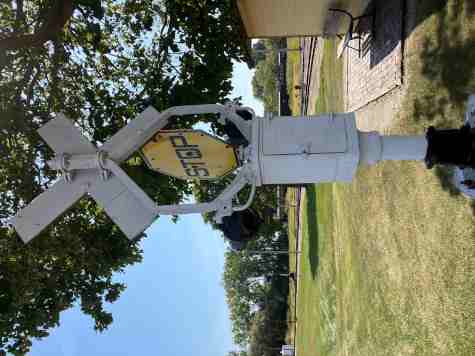
Springfield Avenue Griswold rotating stop sign, built by Griswold Signal Company.
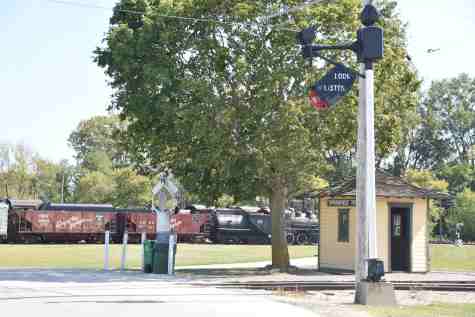
Museum scene.
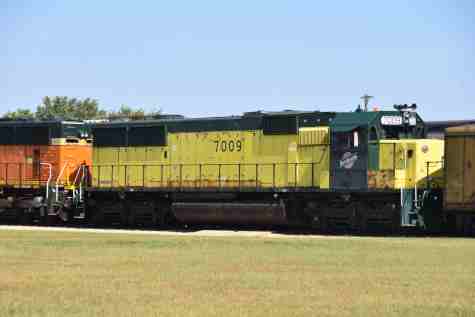
Chicago & North Western SD50 7009, ex. National Railway Equipment 7009 2001-2022, exx. Union Pacific 7009 1995-2001, nee Chicago & North Western 7009, built by Electro-Motive Division in 1989.
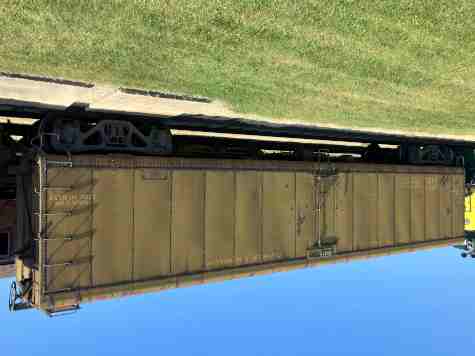
General American Pfaudler milk car 1021, built by General American Transportation in 1947, designed for hauling 8,000 gallons of fresh milk inside large stainless steel tanks. It is fitted with special trucks for express service and is one of the largest bulk milk cars ever built. For a time, it was assigned to the Mars candy-making company, transporting milk to be used in chocolate production. Later, probably in the 1960s, this car was reassigned to transport 140-proof bourbon between Owensboro, Kentucky and Peekskill, New York, for Fleischmann Distilling. This ended in 1970, when liquor was designated a hazardous substance, meaning that cars with internal tanks, such as this one, could not transport it because leaks were unable to be easily detected from outside the car. GPEX 1021 was then briefly assigned to transport vinegar instead before it was retired and donated to IRM.
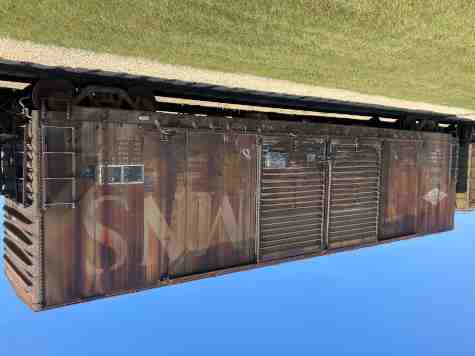
Minneapolis, Northfield and Southern box car 909, built by Gunderson in 1966, with double-width doors for easier loading.
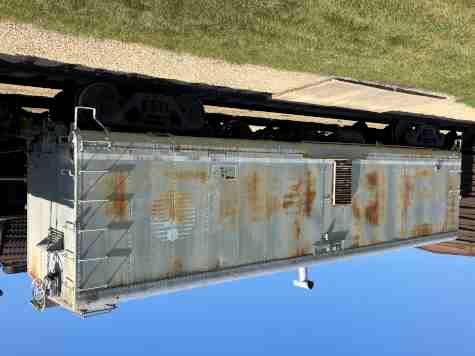
Illinois Central milk car 100641, ex. Illinois Central 100641 ????-1998, exx. Illinois Central Gulf 66178, exxx. Gulf Mobile & Ohio 6617, nee General American Pfaudler 997, built by General American Transportation in 1946. It was designed for hauling 6,000 gallons of fresh milk inside of large stainless steel tanks. The car was purchased in 1971 by the Gulf Mobile & Ohio and modified for use in maintenance-of-way service as water car 66178. In this service it was used to help put out fires along the railroad tracks.
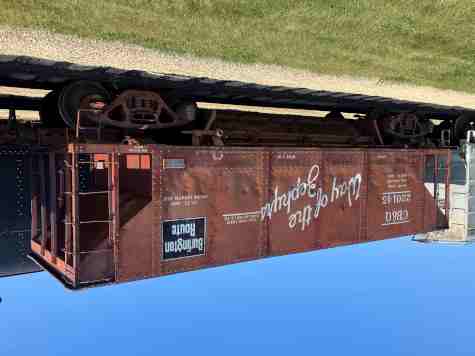
Chicago Burlington and Quincy car ballast 220145, built by American Car & Foundry in 1927, for hauling rock ballast and other aggregate. Very similar to a standard hopper car, ballast cars were designed with doors in the bottom set to dump the car's contents to the side of the tracks.
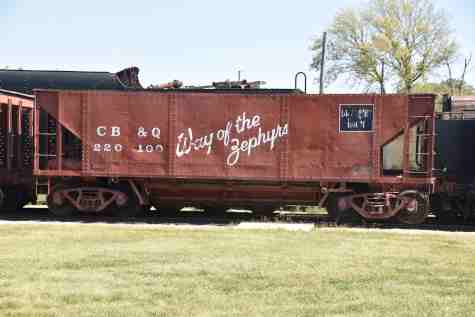
Chicago Burlington and Quincy car ballast 220100, built by American Car & Foundry in 1927, for hauling rock ballast and other aggregate. Very similar to a standard hopper car, ballast cars were designed with doors in the bottom set to dump the car's contents to the side of the tracks.
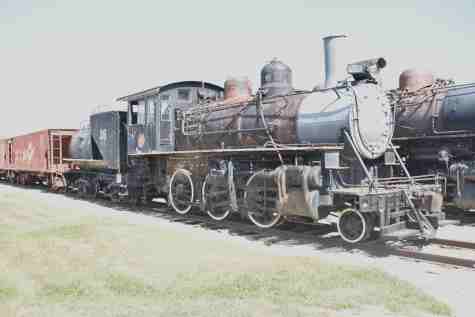
Graysonia Nashville & Ashdown 2-6-0 26, ex. privately owned in Concordia, Kansas 1960-1973, exx. Nebraska-Kansas Railroad 26 1952-1960, exxx. Graysonia Nashville & Ashdown 26 ?-1952, nee Graysonia Nashville & Ashdown 203, built by Baldwin Locomotive Works in 1926.
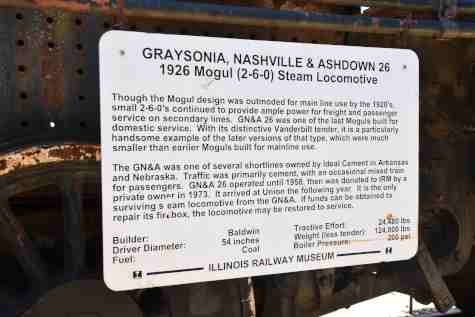
Graysonia Nashville & Ashdown 26 story board.
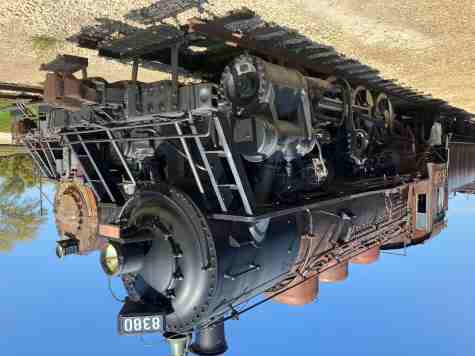
Grand Trunk Western 0-8-0 8380, ex. Northwestern Steel & Wire 80, nee Grand Trunk Western 8380, built by Baldwin Locomotive Works in 1929. In the 1950s it was retired and sold for scrapping but the scrap company instead used it, and several identical engines, for switching their facility. In this capacity it remained in use until 1980, one of the last steam engines in commercial use anywhere in North America.
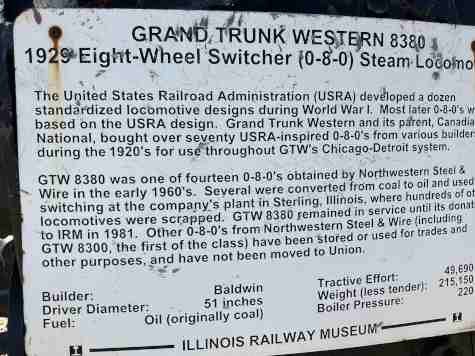
Grand Trunk Western 8380 story board.
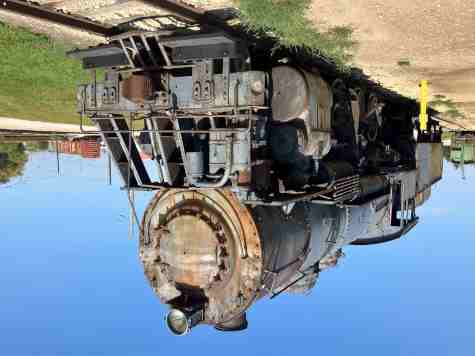
Lake Superior & Ishpeming 2-8-0 35, ex. Marquette & Huron Mountain 35 1963-1985, exx. Lake Superior & Ishpeming 35 1923-1963, nee Lake Superior & Ishpeming 19, built by Baldwin Locomotive Works in 1916.
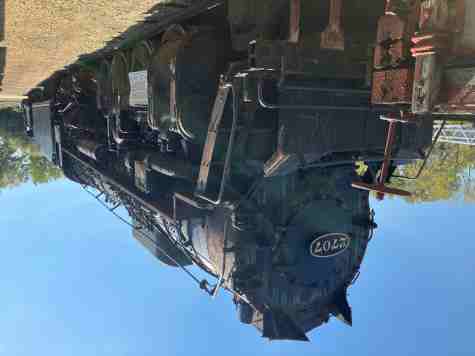
Chesapeake & Ohio 2-8-2 2707, built by American Locomotive Company in 1943. It was an example of a typical "Super Power" locomotive built towards the end of the steam locomotive era.
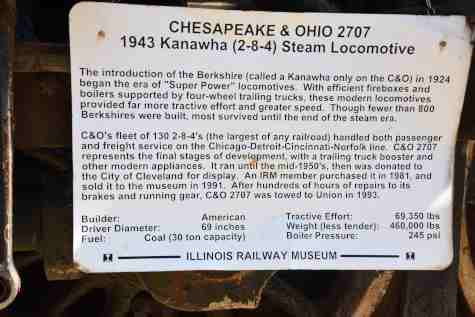
Chesapeake & Ohio 2707 story board.
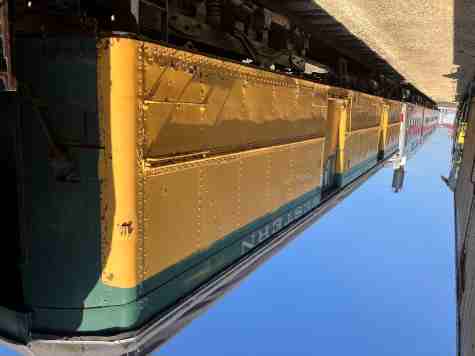
Chicago and North Western baggage car 8728, built by American Car and Foundry in 1923.
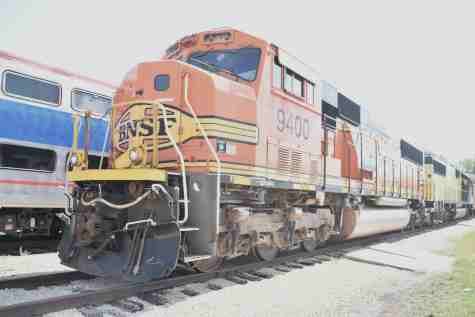
Burlington Northern Santa Fe SD70MAC 9400, nee Burlington Northern 9400, built by Electro-Motive Division in 1993. It was the first production locomotive used in freight service in America to be built with AC traction motors.
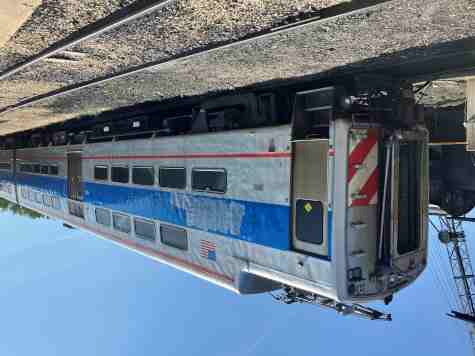
Metra "Highliner" bi-level electric commuter car 1645, ex. Metra 1987-2015, nee Illinois Central Gulf 1645, built by Bombardier in 1979, for use on the Illinois Central commuter line south of Chicago, today known as Metra Electric.
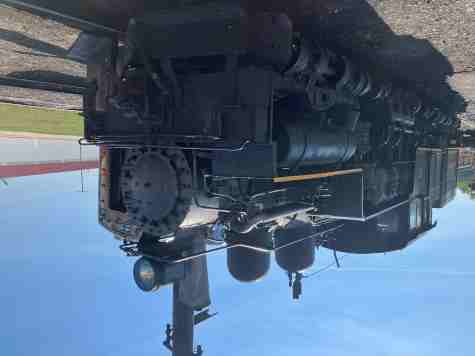
J. Neils Lumber Company three-truck Shay 5, ex. privately owned 1964-1965, exx. Klickitat Log & Lumber Company 5 ?-1964, exxx. St. Regis Paper Company 5 1957-?, J. Neils Lumber Company 5, built by Lima Locomotive Works in 1929. It was designed with three cylinders mounted vertically on the engineer’s side that power a drive shaft running the length of the engine alongside the wheels. This allows all wheels to be powered using bevel gears. Shays were extremely slow but were powerful and could negotiate uneven track and sharp curves, making them popular with logging and mining companies.
The Shay was by far the most common type of geared locomotive. It was invented around 1880 by Ephraim Shay, the owner of a logging company in Maine, who was looking for an effective way to move logs from the forest to the lumber mill. Railroads were being built at a rapid pace at the time, but steam locomotives of the day were not well suited to the low speed, high tractive effort demands that timber haulage required. What Shay needed was to gear the wheels slower than one revolution per piston stroke, which was the natural limit of directly-connected piston locomotives. Such a thing did not exist at the time, so he invented it.
During the ensuing 50 years, various builders constructed over 2,700 Shay locomotives as well as several hundred geared locomotives of slightly different designs. Shays were ideal for lumber and mining work. Their power at low speeds made them capable of hauling heavy trains while their multiple-truck design made them practical for use on poor-quality track. Running drive shafts to all of the wheels also made it possible for Shays to develop higher tractive effort by placing all of their weight onto powered axles.
J. Neils 5 spent its entire service life in the Pacific Northwest, first in Libby, Montana and later in Klickitat, Washington before coming to IRM in 1967. It was the first steam engine to operate at the Museum in 1968 and has operated intermittently since then.
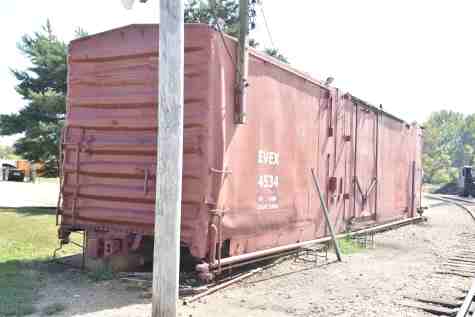
American Colloid Company box car minus trucks 4534, built by Chicago Freight Car Company in 1948. American Colloid is a minerals company that used insulated boxcars like this one to transport products that were sensitive to moisture, such as sand and clay for use in metal casting processes. EVEX 4534 is used by IRM to house maintenance equipment for the museum's operating steam locomotives.
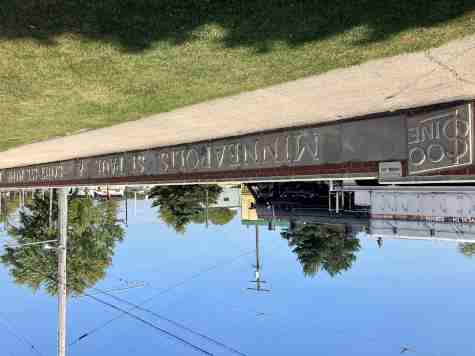
Minneapolis, St. Paul and Sault Ste. Marie limestone entablature, obtained in 1996 from the Soo Line freight house located at Roosevelt and Canal Streets in Chicago, which opened on April 1, 1914. The entire complex, which covered 11 city blocks, was demolished and replaced with a shopping center.
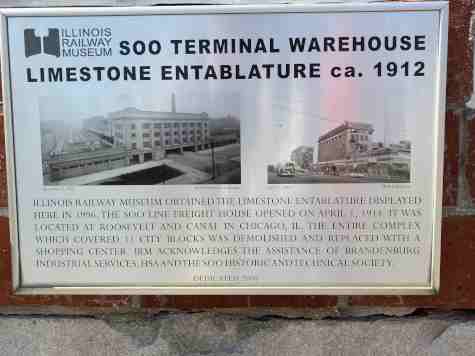
The entablature story board.
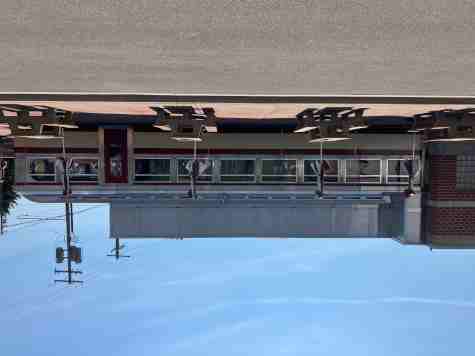
The Central Diner, as it is known as IRM, is a roadside diner built in 1934 by the Jerry O'Mahony Company of Elizabeth, NJ. It was never a railroad car, but was built to imitate the appearance of a railroad coach. It was also designed to be picked up and moved to a new location without damaging the structure. It was located in Salem, Ohio, at the corner of Water and Bowery Streets and was known originally as the Salem DeLuxe Diner (later renamed Joe's Diner). In 1986 it closed and the diner was purchased by the Akron Historical Society. IRM purchased the diner in 1994 and moved it to Union. In 2002 it was installed at its current site at Central Avenue and Depot Street, with a large annex constructed adjacent to it for food service.
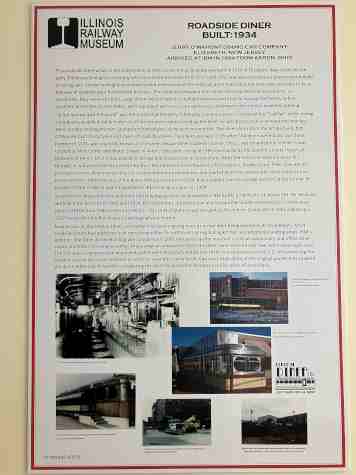
The Central Diner story board.
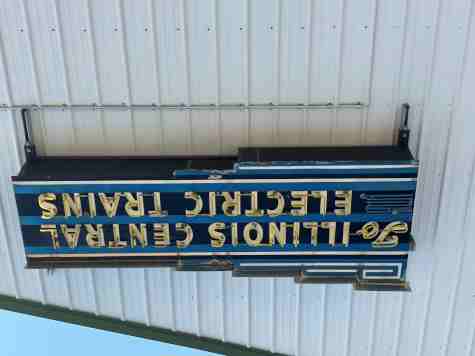
"To Illinois Central Electric Trains" neon sign from Randolph Street Station.
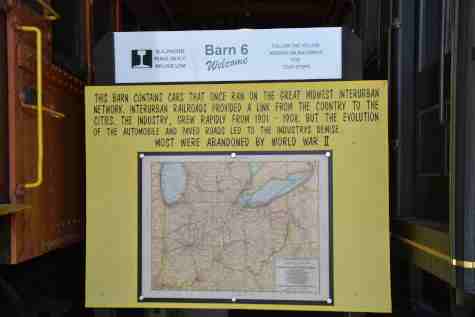
Barn 6, which contains cars that once ran on the great midwest interurban network.
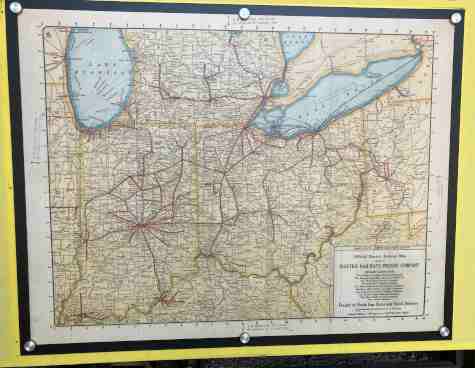
Electric Railways Freight Company Map of 1929.
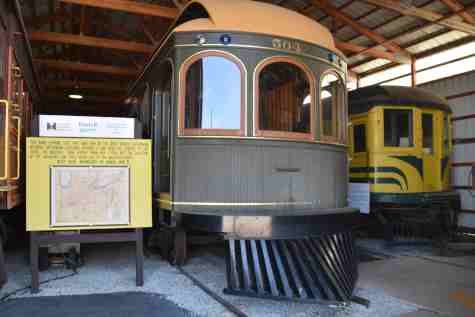
The entrance to Car Barn 6.
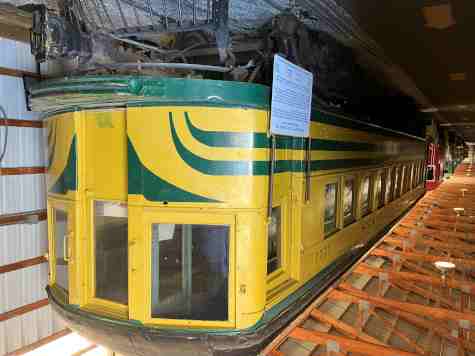
Milwaukee Electric single end/double truck/railroad roof coach 1129, ex. London and Port Stanley 21 1941-1955, exx. Milwaukee Electric Railway & Transport Company 1129 1938-1941, nee Milwaukee Electric Railway & Light Company 1129, built by the company in 1924. It is the last surviving interurban coach operated by Wisconsin's largest interurban system and originally constructed in 1909 as a wooden coach, but it was completely torn down and rebuilt by the Milwaukee Electric as a modern interurban car in 1924. Retaining only its basic wood frame, the car acquired a new roof, interior and steel sheathing. It was acquired by IRM in 1955 as one of the museum's first cars.
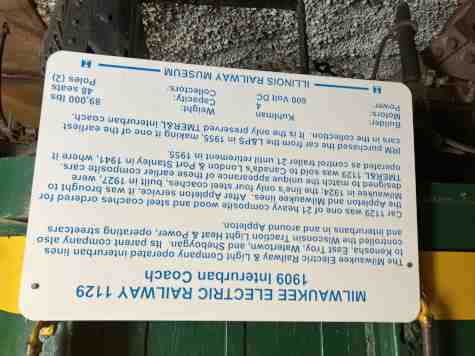
Milwaukee Electric 1129 story board.
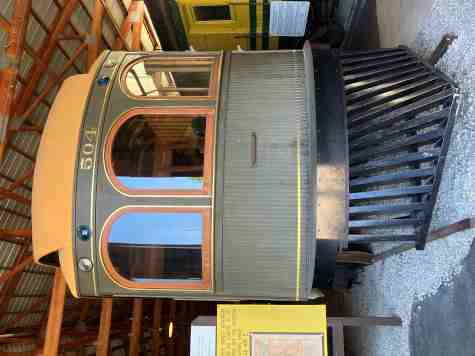
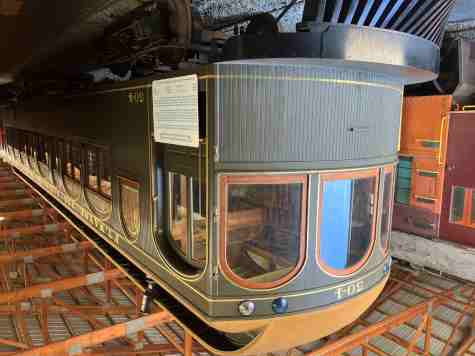
Fort Wayne & Wabash Valley wood-buffet observation car 504 "Talisman", ex. privately owned (house) in Mongo, Indiana 1932-1993, exx. Indiana Railroad 354 1930-1932, exxx. Indiana Service Corporation 354, nee Fort Wayne & Wabash Valley 504 "Talisman", built by Cincinnati Car Company in 1906. It was one of the most opulent interurban cars ever built when constructed and included a baggage compartment, coach seating, buffet for serving snacks and light meals, a parlour seating area and huge curved-glass solarium windows at the rear.
It operated between Fort Wayne and Lafayette for years, later being converted to all coach seating. Rescued by IRM in 1993, its exterior has been completely restored to its appearance when new.
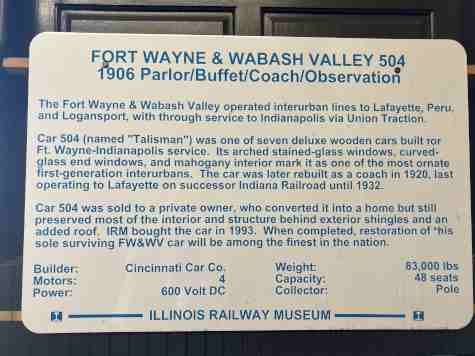
Fort Wayne & Wabash Valley 504 story board.
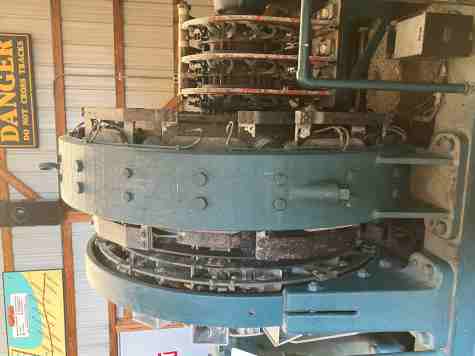
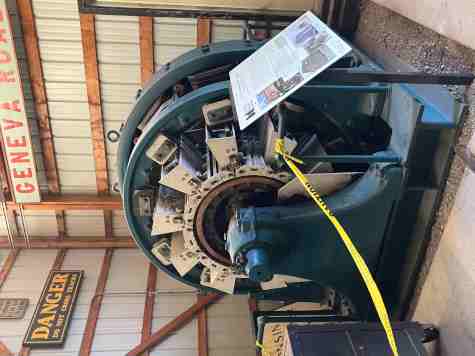
Rotary converter from Chicago, Aurora and Elgin substation in Elmhurst.
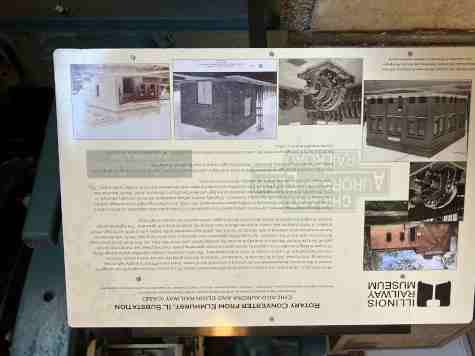
Rotary convertor story board.
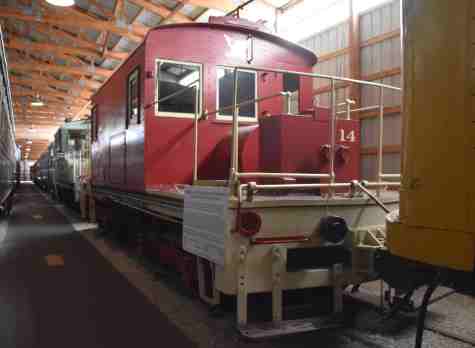
Cornwall Street Railway Light and Power electric freight locomotive 14, ex. Cornwall Transit 14 1971-1972, exx. Cornwall Street Railway Light and Power 14 1956-1971, nee Springfield Terminal 20, built by Baldwin Westinghouse in 1929.
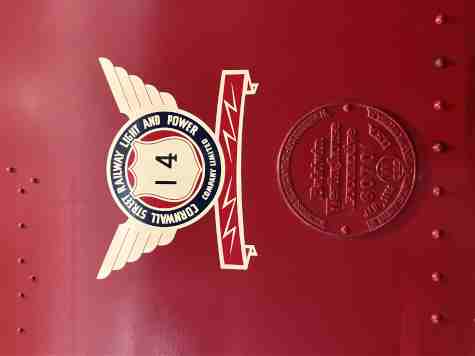
The Cornwall Street Railway emblem and the builder's plate.
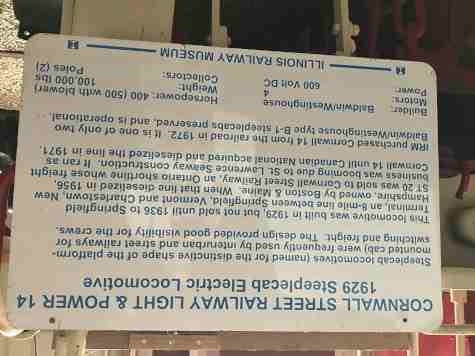
Cornwall Street Railway Light and Power 14 story board.
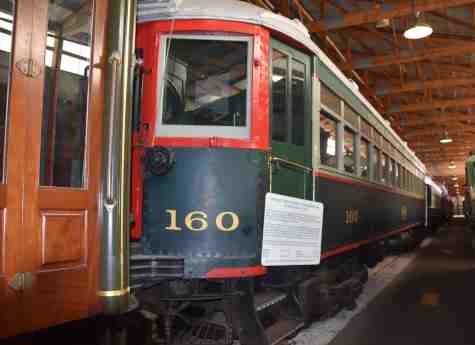
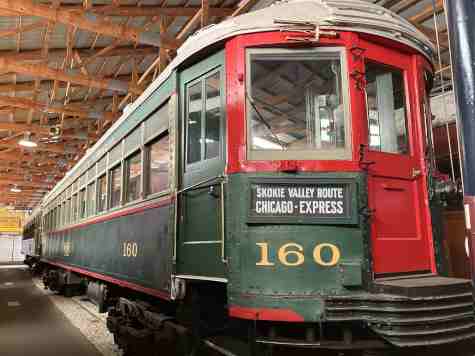
Chicago, North Shore and Milwaukee steel interurban coach 160, nee Chicago and Milwaukee Electric 160, built by J. G. Brill Company in 1915. It is the oldest North Shore passenger car preserved and the only car at IRM from the railroad's first order for steel interurban cars. It saw nearly 50 years of service, remaining in use until the North Shore was abandoned in 1963. It has been restored to its appearance during the 1940s when it was used on the Shore Line between Chicago and Waukegan.
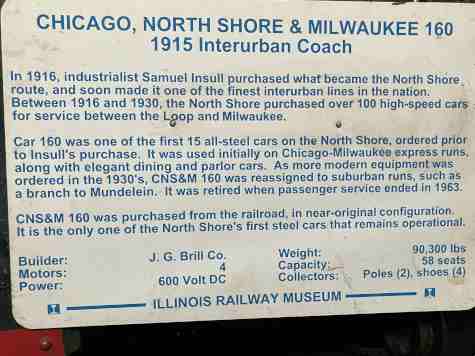
Chicago, North Shore and Milwaukee 160 story board.
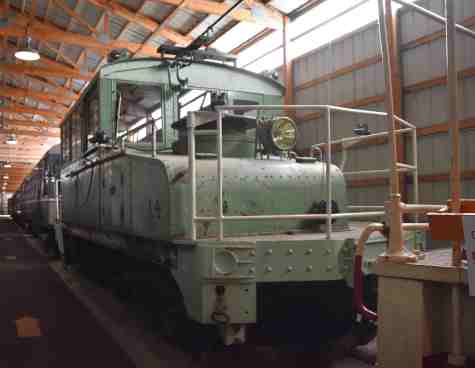
Wisconsin Electric Power steeplecab freight locomotive L4, ex. privately owned in East Troy, Wisconsin 1988-1991, exx. Wisconsin Electric Railway Historical Society in East Troy, Wisconsin 1972-1988, exxx. Wisconsin Electric Power Company 1963-1972, exxxx. Milwaukee Electric Railway and Transport Company 1938-1963, nee Milwaukee Electric Railway & Light Company, built by the company in 1920. At the end of its service life, it was used to switch coal hoppers around the power plant at Port Washington, Wisconsin.
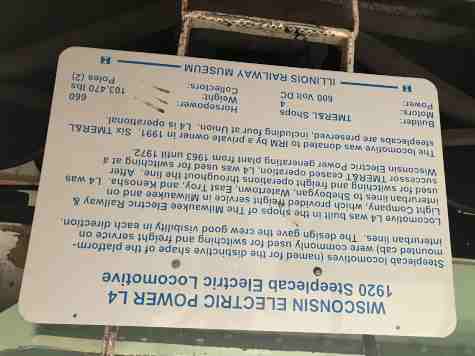
Wisconsin Electric Power L4 story board.
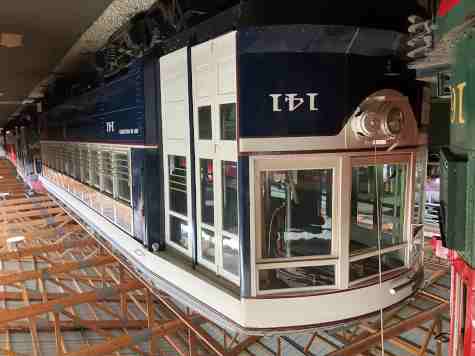
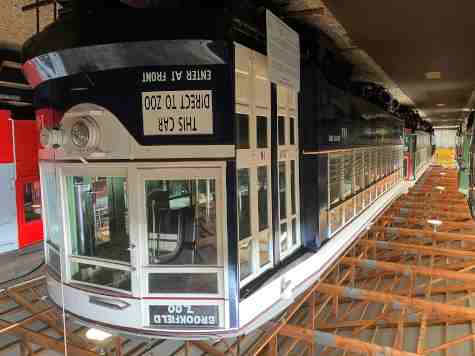
Chicago and West Towns double-end arch-roof car 141, ex. Electric Railway Historical Society in Downers Grove, Illinois 1959-1973, exx. privately owned in Downers Grove (shed) 1948-1959, nee Chicago and West Towns 141, built by McGuire-Cummings Manufacturing Company in 1924. The West Towns operated streetcar lines in the near western suburbs of Chicago including a line which famously ran right past the south entrance to Brookfield Zoo. Car 141 was originally built with the capability to operate in short trains with other streetcars of its type but was rebuilt around 1940 without this capability.
The West Towns had such a marginal electrical distribution system that they chose to heat their streetcars not with electricity but with coal. Car 141 has a coal stove in the middle of the car complete with stovepipe sticking out of the roof.
Chicago and West Towns Railways emblem.
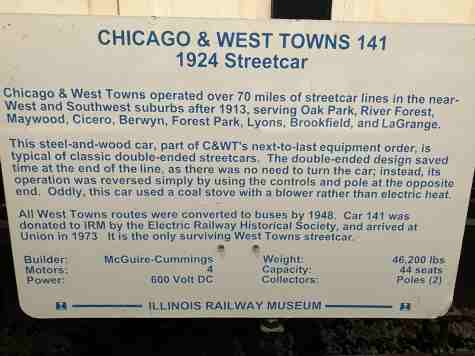
Chicago and West Towns Railways 141 story board.
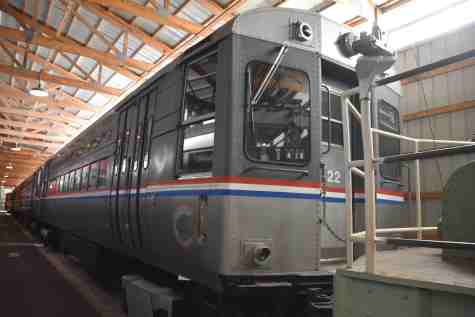
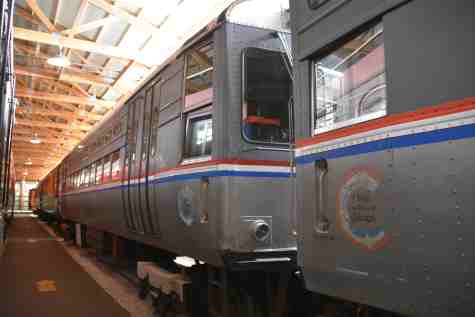
Chicago Transit Authority aluminium PCC-type L car 41, built by St. Louis Car Company in 1959 using recycled components from retired CTA streetcars. It was one of a series of 50 cars that were the last single-unit "L" cars built for Chicago, all later CTA cars being permanently coupled in pairs. Car 41 is restored to its 1990s appearance while in service on the Skokie Swift (now the Yellow Line).
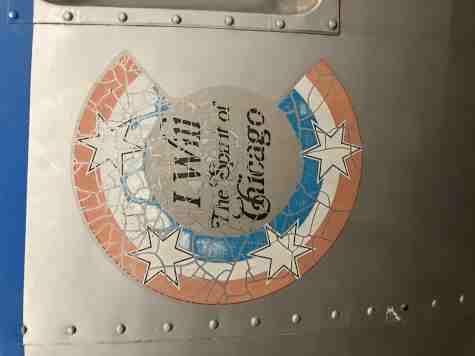
In 1974, the CTA began a program to redecorate a representative number of "L" cars in a patriotic red, white and blue scheme, but the bicentennial scheme clearly was inappropriate for continued widespread use, as it was a complex scheme to apply and it was, by design, only appropriate for a short period around 1976. So, a new, more restrained version was created and adopted for use on all rapid transit cars except the 2200s, which were designed to be left unpainted aluminium. When the 2600-series arrived from Budd/Transit America, they carried a similar but slightly tweaked version of this scheme. The gray/charcoal/red-white-blue stripe scheme was retained, with similar proportions to the 2400s. However, the longitudinal stripe was thinner (like on the 2000s) and, instead of cutting upward at the ends of the car, continued through the front and formed a belt all the way around. The charcoal above the stripe and gray below from the sides was carried through to the front, replacing the large panels of red and blue that had marked "L" cars since 1974. And, for the first time, the CTA herald was replaced by a new logo: a red, white and blue "C" with four white stars with the motto, "I Will/The Spirit of Chicago" inside.
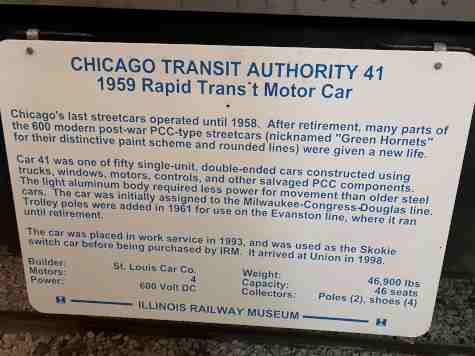
Chicago Transit Authority 41 story board.
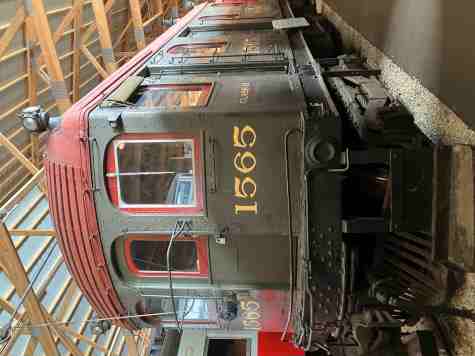
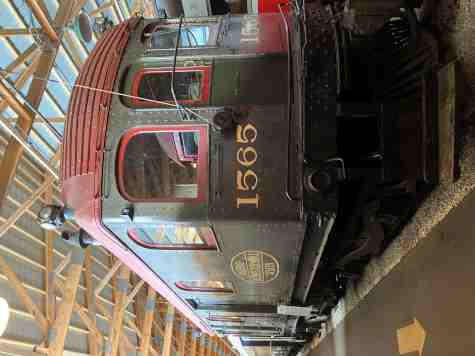
Illinois Terminal class B boxcab freight locomotive 1565, ex. Illinois Power Company 9052 1955-1960, exx. Illinois Terminal 1565 1928-1955, nee Illinois Traction System 1565, built by the company in 1910. Though primarily intended for hauling freight trains, the IT had a large fleet of unpowered coaches, sleeping cars and parlour cars, and locomotives like 1565 were often used for hauling passenger trains.
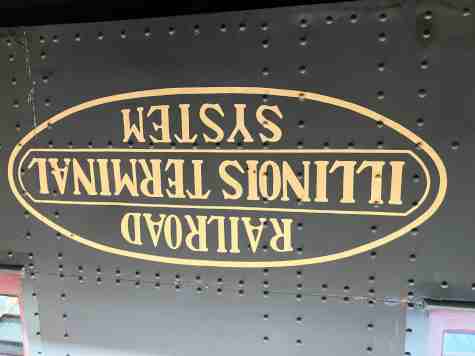
The Illinois Terminal Railroad System emblem.
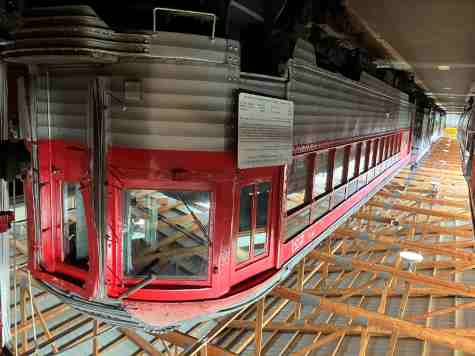
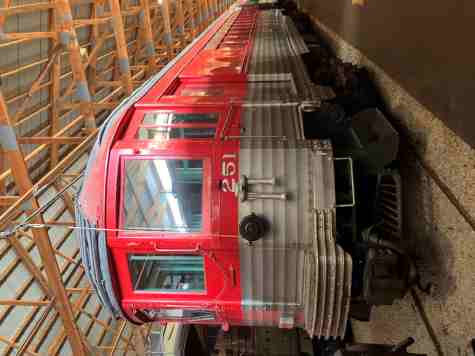
Chicago North Shore and Milwaukee combination passenger-baggage car 251, built by Jewett Car Company in 1917 for high-speed service between Chicago and Milwaukee. Following a wreck, it was put through the railroad's "Silverliner" modernization program, which included upgraded seating and a faux-stainless-steel paint job, the only combine on the railroad to be modernized. It has been completely restored by IRM volunteers to its appearance in the early 1950s.
North Shore Line emblem.
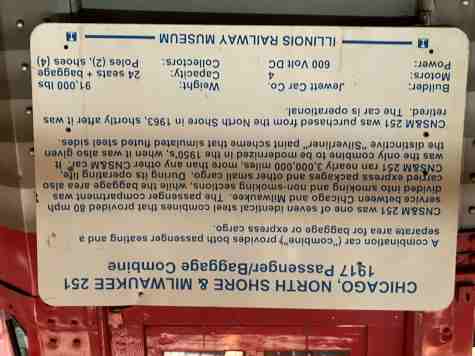
Chicago North Shore and Milwaukee 251 story board.
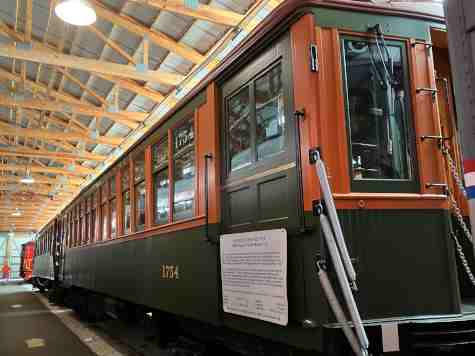
Chicago Elevated Railway wood-bodied "L" car 1754, ex. Chicago Transit Authority S333 1958-1971, exx. Chicago Transit Authority 754 1947-1958, exxx. Chicago Rapid Transit 754 1924-1947, exxxx. Chicago Elevated Railway 754 1913-1924, nee Northwestern Elevated Railroad 754, built by Jewett Car Company in 1906. It is the only preserved rapid transit car built by the Ohio company that specialized in interurban cars, and was one of the earliest "L" cars built with extra-wide doors for reducing dwell time at stations. It was retired in the 1950s and converted to a utility car, a role which it served into the 1970s.
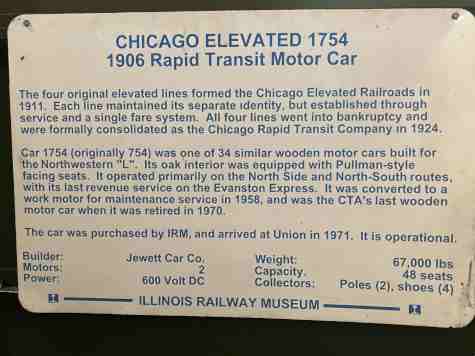
Chicago Elevated Railway 1754 story board.
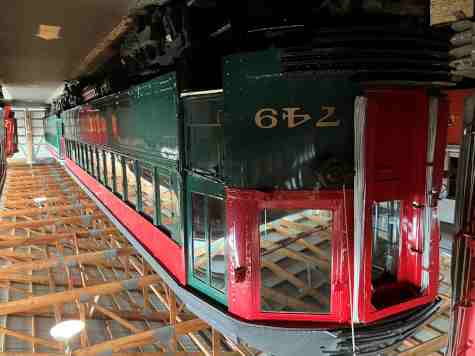
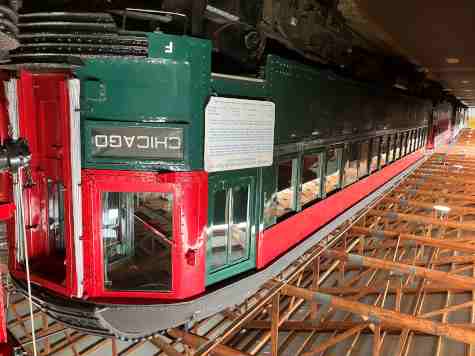
Chicago North Shore and Milwaukee interurban coach 749, built by Pullman/Pullman-Standard in 1928. It is the only car of its series of Pullman-built cars to be preserved and has been completely restored by IRM volunteers to its appearance in the late 1950s.
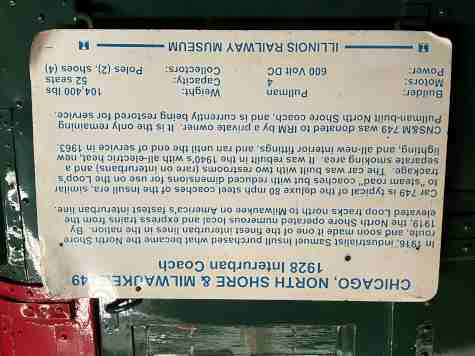
Chicago North Shore and Milwaukee 749 story board.
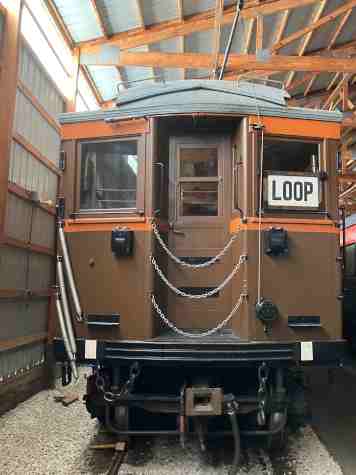
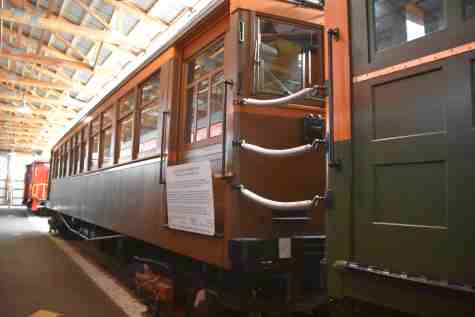
Chicago Rapid Transit wood-bodied "L" car 1797, ex. Chicago Hardware Foundry in North Chicago 1958-1964, exx. Chicago Transit Authority 1947-1958, exxx. Chicago Rapid Transit 1924-1947, exxxx. Chicago Elevated Railroad 1913-1924, nee Northwestern Elevated Railroad 288, built by American Car & Foundry Company in 1907.
It was built as an unpowered trailer but in 1913, was rebuilt as a motorized car. It was badly damaged in a fire in 1938 and rebuilt again, this time with a modernized interior. It is preserved in the unusual prototype livery it received at that time.
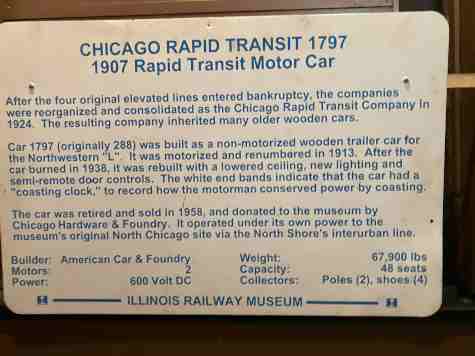
Chicago Rapid Transit 1797 story board.
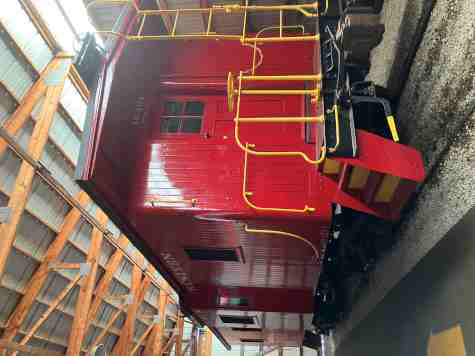
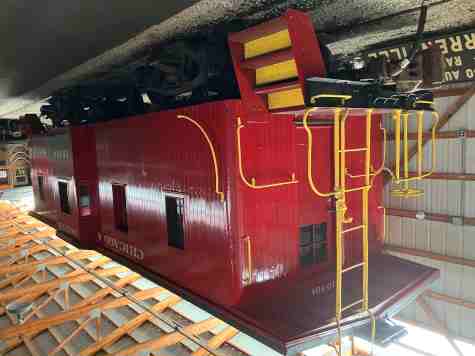
Chicago and North Western wooden bay window caboose 10304, built by American Car and Foundry in 1928.
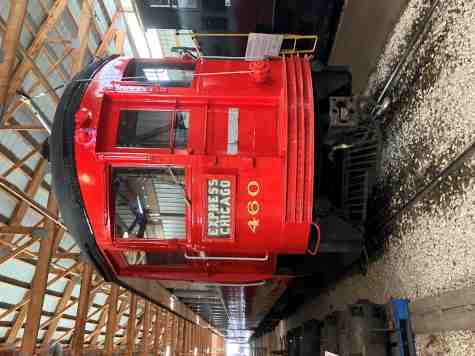
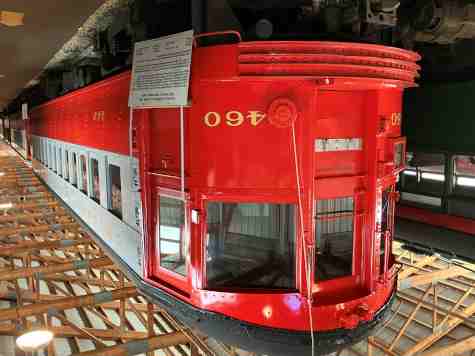
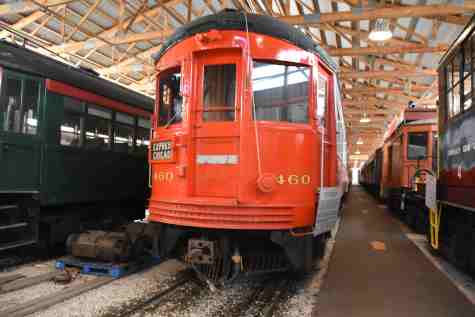
Chicago Aurora and Elgin interurban car 460, ex. Lake Shore Electric Railway in Cleveland, Ohio 2006-2010, exx. Trolleyville USA in North Olmsted, Ohio 1962-2006, nee Chicago Aurora & Elgin 460, built by St. Louis Car Company in 1945. It is the last traditional interurban car built in the United States. The CA&E ordered ten modern curve-side coaches in 1941 but the cars were not completed until 1945 due to World War II. Cars 451-460 featured lightweight design and newer electric control systems, but could be used together with the line's old 1920s steel coaches. Car 460 has been restored to its appearance when the CA&E abandoned passenger service in 1957.
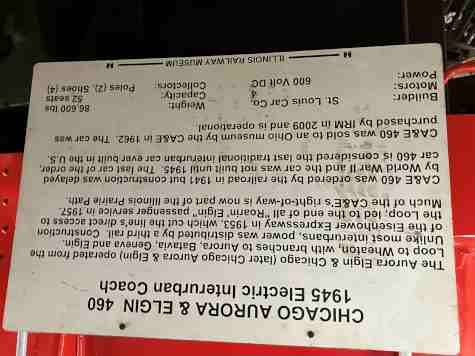
Chicago Aurora and Elgin 460 story board.
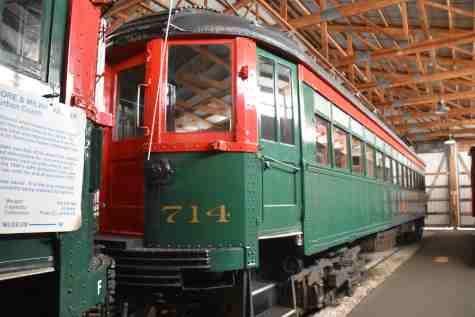
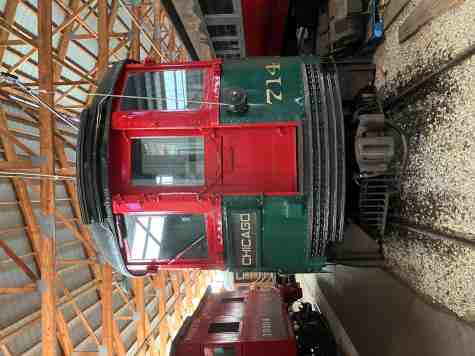
Chicago, North Shore & Milwaukee interurban coach 714, built by Cincinnati Car Company in 1926. It operated until 1963 in daily service, in trains of up to eight cars. Shortly after the railroad abandoned operations, car 714 came to IRM and it has been restored to its 1950s appearance.
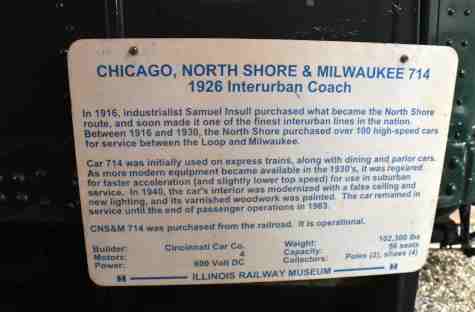
Chicago North Shore & Milwaukee 714 story board.
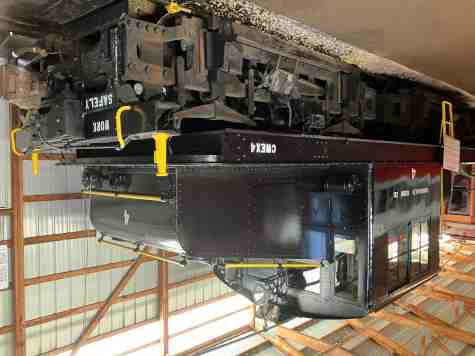
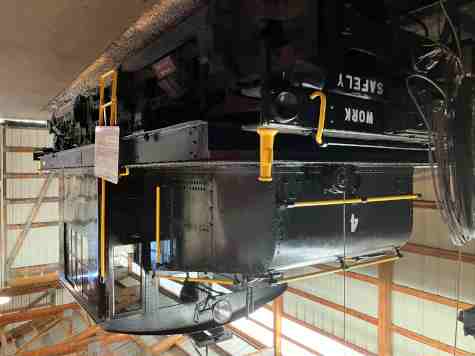
Commonwealth Edison "steeplecab" electric locomotive 4 built by American Locomotive Company and General Electric in 1911. It hauled coal trains around the Northwest Generating Station in Chicago for 50 years until acquired by IRM in 1962.
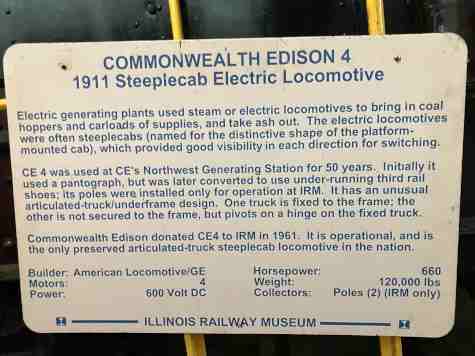
Commonwealth Edison 4 story board.
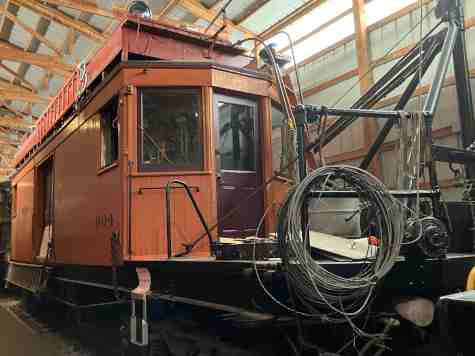
Chicago North Shore & Milwaukee overhead line car 604, nee Chicago and& Milwaukee Electric 604, built by the railroad in 1914. It is the oldest surviving piece of equipment from the North Shore Line. Line cars were unique to electric railways but were ubiquitous, as the extensive network of overhead wires required regular maintenance and repair in order to keep it in good condition. Even the earliest electric railways in the 1880s used overhead wires to power streetcars; the very word "trolley" derives from a troller, a small cart that balanced atop paired wires in one early design for an electric railway system. During the height of the electric railway era in the early 1900s, the vast majority of electric railways used overhead wires to power their trains.
Most lines used simple suspension wires, with the copper contact wire hung directly from support brackets or span wires. Heavier electric lines often used catenary, where the contact wire was suspended from a second support wire that formed a catenary curve. These extensive airborne networks of wires, while fairly hardy, did require adjustment and repair. Electric railways employed linemen, men who would operate the line car to a trouble spot and then stand on the platform atop the line car and work on the wires. Linemen typically did this work with the power on, and 600 volts going through the overhead wires. Line car platforms were made of wood to insulate the linemen and prevent them from being electrocuted. Inside the line car was a small workshop and storage space for parts. Some line cars, like car 604, also had cranes and exterior brackets for carrying large spools of copper wire.
IRM has used this car in its original role for over 50 years.
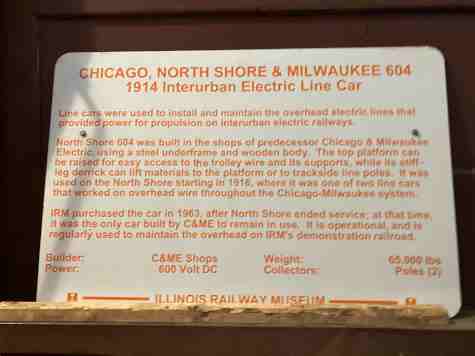
Chicago North Shore & Milwaukee 604 story board.
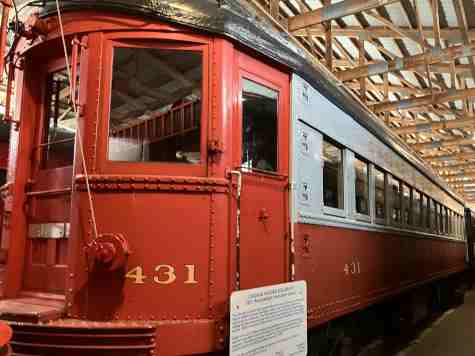
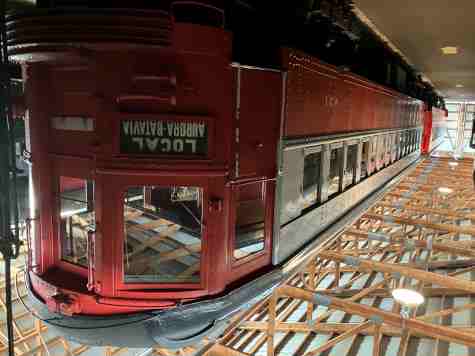
Chicago, Aurora and Elgin heavyweight steel interurban coach 431, built by Cincinnati Car Company in 1927 for high-speed service between Chicago and the Fox River Valley. It has been restored to its appearance in the mid-1950s.
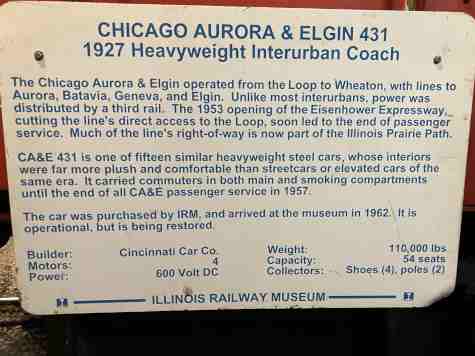
Chicago, Aurora and Elgin 431 story board.
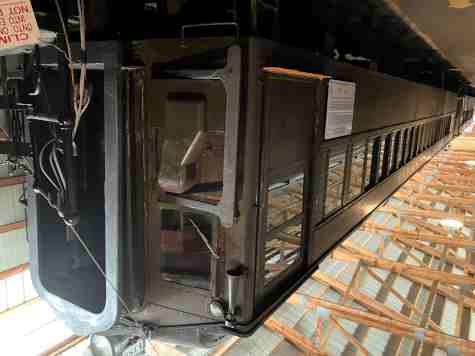
Illinois Central unpowered trailer 1380, built by Pullman/Pullman-Standard in 1926. When new, it replaced aged steam locomotives on the suburban line south of Chicago and was always coupled to a self-propelled motor car to create a two-car motor-trailer set.
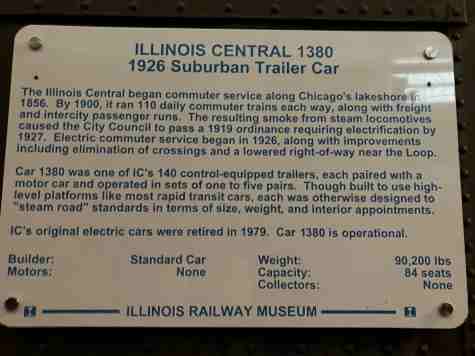
Illinois Central 1380 story board.
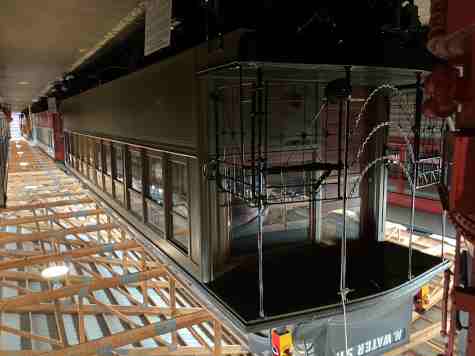
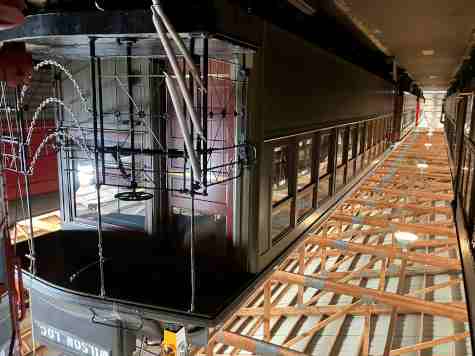
Northwestern Elevated Railroad wood gate car 24, ex. Chicago Transit Authority S111 1954-1958, exx. Chicago Transit Authority 1024 1947-1954, exxx. Chicago Rapid Transit 1024 1924-1947, exxxx. Chicago Elevated Railway 1024 1913-1924, nee Northwestern Elevated Railroad 24, built by Pullman in 1898 with open platforms with gates rather than enclosed ends with doors. It also has longitudinal seating, known as a bowling alley arrangement.
Elevated RailwaysAmong the most iconic features of Chicago is its elevated system, known simply as the ‘L.’ Chicago was a pioneer in elevated railways and boasted the nation's first electrified elevated line as well as the first use of multiple- unit equipment.
The first "L' in Chicago was actually the Intramural Railway, an electrically-powered line that was built on the grounds of the 1893 Columbian Exposition for the purpose of transporting visitors around Jackson Park. Quick to follow was the South Side Rapid Transit, built from the Loop to the south side of the city. The elevated construction allowed for faster transit times than previously possible by avoiding entirely the street traffic below.
The South Side elevated line started out using small steam engines pulling trains of wooden coaches, but by the end of the 19th century the elevated lines in Chicago had become the first in the country to convert to electric operation. The early electric "L" cars, like car 24, were utilitarian for their day. Seating was on wicker benches along the sides of the car, and entry was via an open platform enclosed by metal gates. It was this latter feature that gave these cars their nickname "gate cars". They used an early form of multiple-unit control, designed by General Electric, that enabled trains of self-propelled coaches to operate together.
What started out as a single line from downtown to the south side, operated with trains of austere wooden "gate cars", eventually blossomed into the current CTA "L" system of more than 200 miles. Yet even today's computerized CTA cars trace their lineage directly to the 19th century gate cars. Chicago’s newest "L" cars are also the same length and width as car 24, use the same 600-volt direct current electric power source, and use the same seating arrangement. The line from the CTA’s 19th century origins to the present day is a short one indeed.
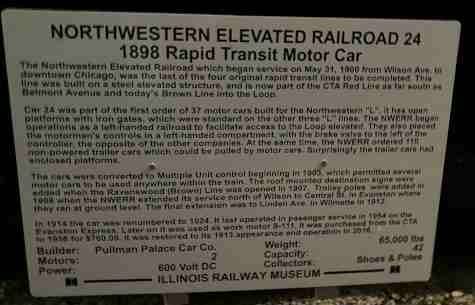
Northwestern Elevated Railroad 24 story board.
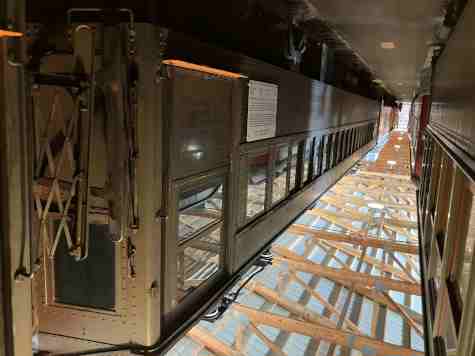
Illinois Central steel commuter coach 1198, built by Pullman/Pullman-Standard in 1926. When new, it replaced aged steam locomotives on the suburban line south of Chicago and was always coupled to an unpowered trailer car to create a two-car motor-trailer set. It the only preserved motor car from the original electrification of the Illinois Central commuter line, today's Metra Electric.
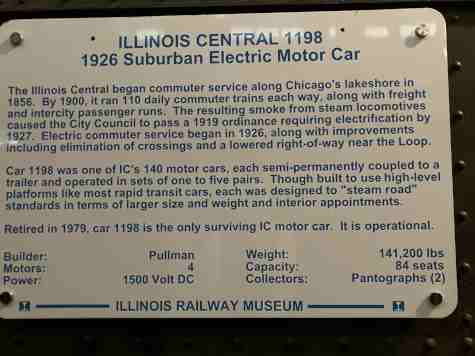
Illinois Central 1198 story board.
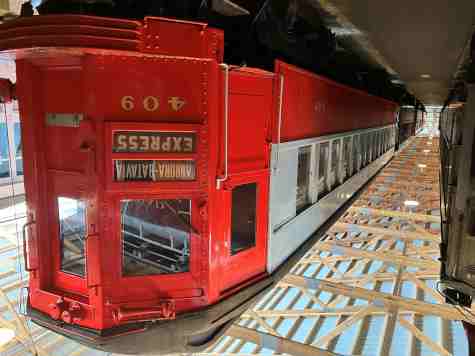
Chicago, Aurora and Elgin steel coach 409, ex. Lake Shore Electric Railway in Cleveland, Ohio 2006-2010, exx. Trolleyville USA in North Olmsted, Ohio, nee Chicago Aurora and Elgin 409, built by Pullman Company in 1923. The car is the only survivor from that railroad's first order for steel interurban cars and was designed for high-speed operation between Chicago and the Fox River Valley. It is restored to its appearance at the end of passenger service on the CA&E in 1957.
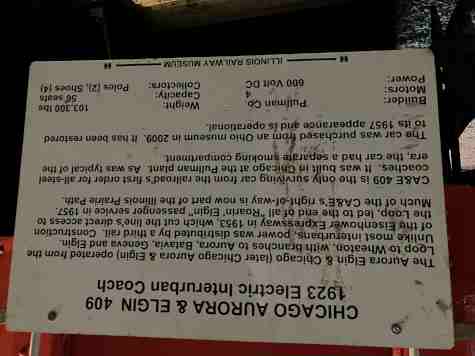
Chicago, Aurora and Elgin 409 story board.
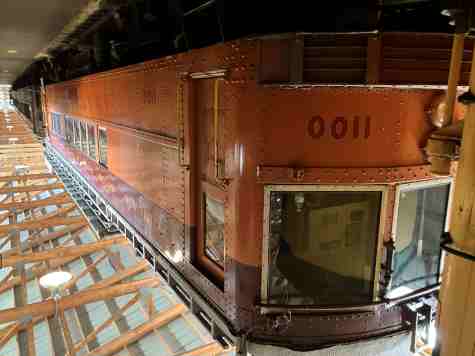
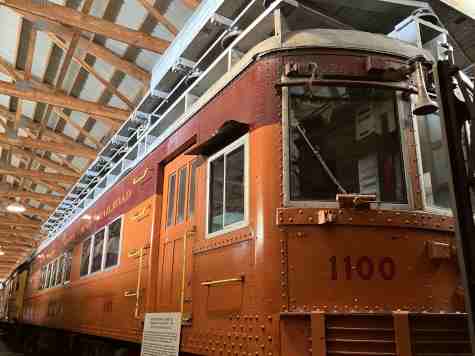
Chicago, South Shore and South Bend overhead line car 1100, ex. Line Car Preservation Partnership in Michigan City, Indiana 2004-2010, exx. Northern Indiana Commuter Transportation District 1100 1990-2004, exxx. Chicago South Shore and South Bend 1100, exxxx. Indiana Railroad 376 1930-1941, nee Indiana Service Corporation 376, built by St Louis Car Company in 1925 with a rooftop platform for workers maintaining the overhead trolley wire, or catenary.
It was originally built as an interurban combine for the Indiana Service Corporation and was rebuilt in 1930 as a Railway Post Office car for carrying mail. It was converted into an overhead line car by the South Shore Line in 1941 and was retired in 2004.
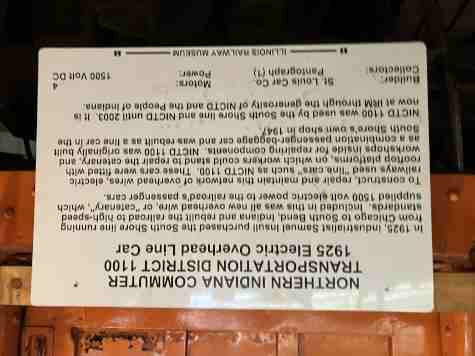
Chicago, South Shore and South Bend 1100 story board.
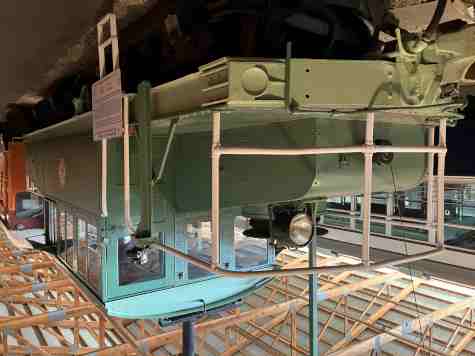
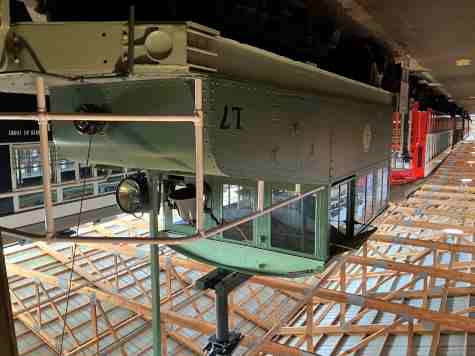
Wisconsin Electric Power steeplecab locomotive L7, ex. Wisconsin Electric Railway Historical Society in East Troy, Wisconsin 1972-1988, exx. Wisconsin Electric Power Company L7 1963-1972, exxx. Milwaukee Electric Railway and Transport Company L7, nee Milwaukee Electric Railway & Light Company L7, built by the company in 1931 in their Cold Spring Shops to haul freight trains on the Wisconsin interurban network. At the end of its service life, it was used to switch coal hoppers around the power plant at Port Washington, Wisconsin.
Wisconsin Electric Power Company emblem.
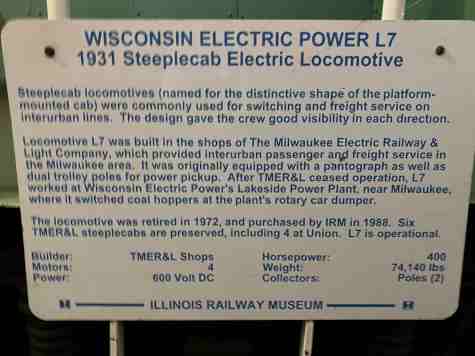
Wisconsin Electric Power L7 story board.
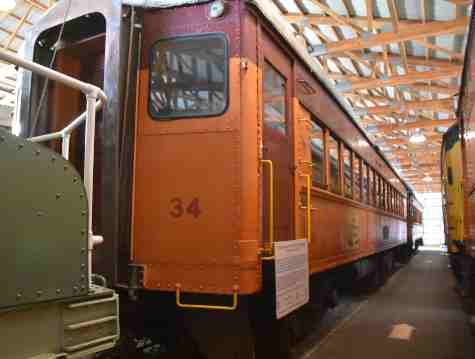
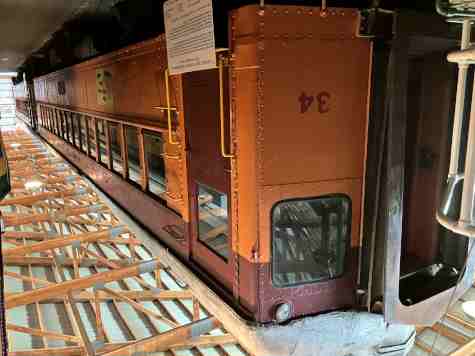
Chicago, South Shore and South Bend line steel coach 34, built by Standard Steel Car Company in 1929 for service between Chicago and South Bend. It saw over 50 years of service, not being retired until 1984.
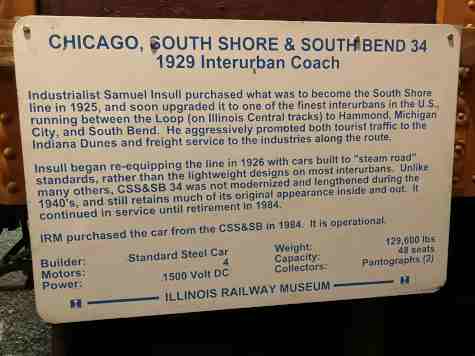
Chicago, South Shore and Suth Bend line 34 story board.
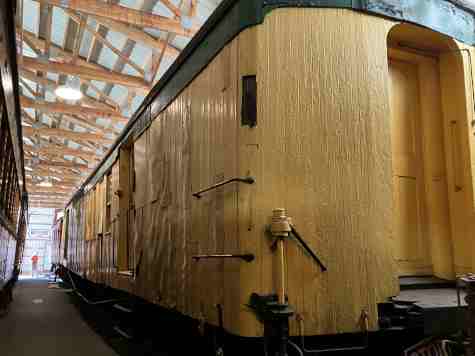
Chicago and North Western combine 4061, ex. Chicago Great Western maintenance-of-way W285, exx. Chicago Great Western 285, nee Chesapeake and Ohio 471, built by Pressed Steel in 1921.
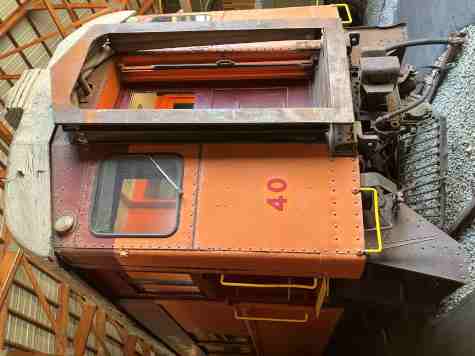
Chicago, South Shore and South Bend interurban coach 40, ex. National Park Service 1984-1988, exx. Chicago South Shore and South Bend 40 1938-1984, nee Chicago South Shore and South Bend 213, built by Standard Steel Car Company in 1929 designed for service between Chicago and South Bend. It was originally built as an unpowered trailer but was motorized and renumbered as car 40 in 1938. It remained in service for more than 50 years.
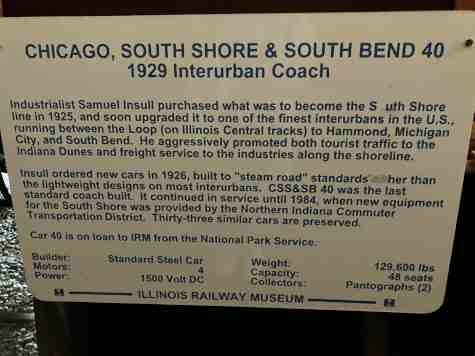
Chicago, South Shore and South Bend 40 story board.
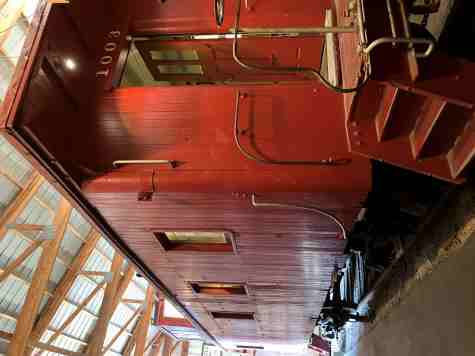
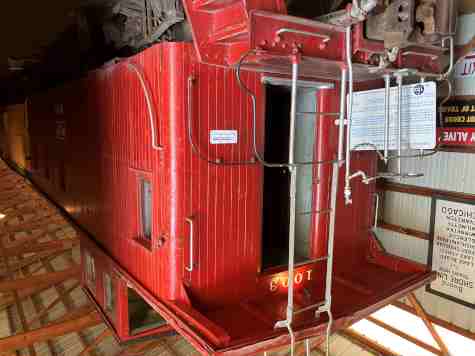
North Shore Line wooden cupola caboose 1003, built by American Car and Foundry in 1926.
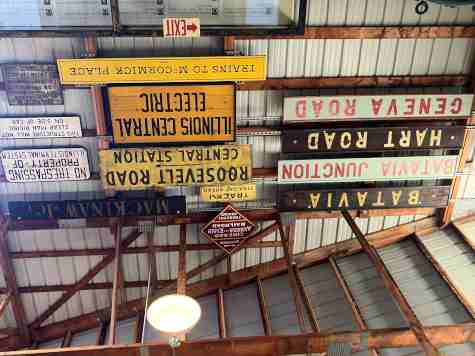
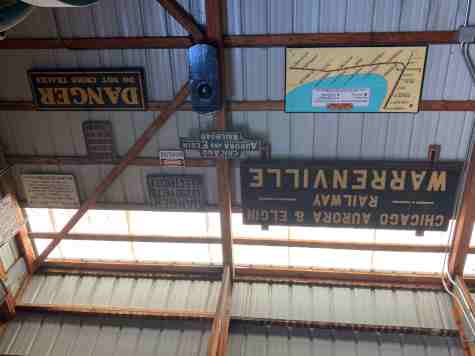
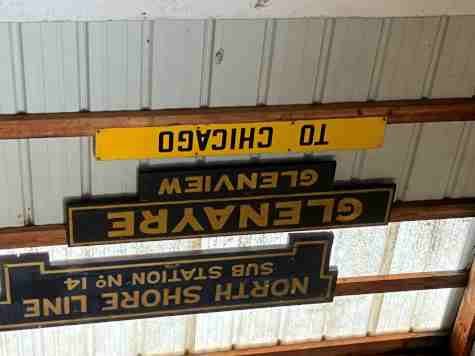
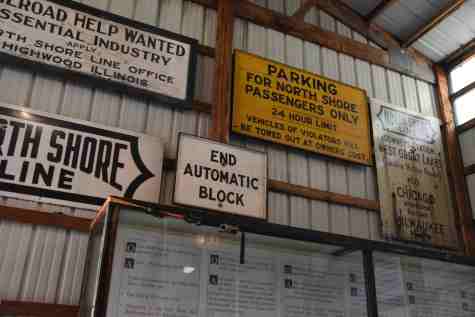
A variety of electric railway signs on the wall as we exited. Lunch was set up at the pavilion, consisting of make-your-own sandwich with potato salad and baked beans, as well as dessert. Fortified, we continued exploring.