



We continued this self-guided tour and entered the world of airships, otherwise known as dirigibles. An airship is any powered, steerable aircraft that it is inflated with a gas that is lighter than air. "Airship" and "dirigible" are interchangeable; a dirigible is any lighter-than-air craft that is powered and steerable, as opposed to free floating like a balloon. The word "dirigible" is often associated with rigid airships but the term does not come from the word "rigid, but from the French verb diriger ("to steer"). Dirigibles include rigid airships (like the Hindenburg), semi-rigid airships (like the Zeppelin NT), and blimps (like the Goodyear blimp).
A zeppelin is a rigid airship manufactured by a particular company, the Luftschiffbau Zeppelin of Germany (the “Zeppelin Airship Construction Company”), founded by Count Ferdinand von Zeppelin, who is considered the father of the rigid airship, but not all rigid airships are "zeppelins". The term zeppelin is often associated with the German airships that conducted bombing raids during World War I, but while most of these ships were built by the Zeppelin Company, not all German WWI airships were zeppelins; the German military also used rigid airships of very different design built by the Schutte-Lanz and Parseval companies.
One of history’s most famous zeppelins was LZ-129 Hindenburg. (“LZ” stands for “Luftschiff Zeppelin” and “129” indicates that Hindenburg was the 129th airship designed by the Zeppelin Company).
While collecting various international china throughout the beginning of the collection, Mr. Christopher became very interested in dirigibles and the luxury that encompassed a trip over the Atlantic. Starting with airmail stamps and maybe a few plates, quickly grew into multiple display cases highlighting the many years of the Zeppelin Company and the eventual takeover by the state. Also, most of our Zeppelin collection was acquired and curated by Scott Townsend and Chris Wolfe, who do a lot of travelling and artifact verification when we purchase things abroad from collectors or auctions. This paragraph courtesy Andrew Miller, Museum Manager.
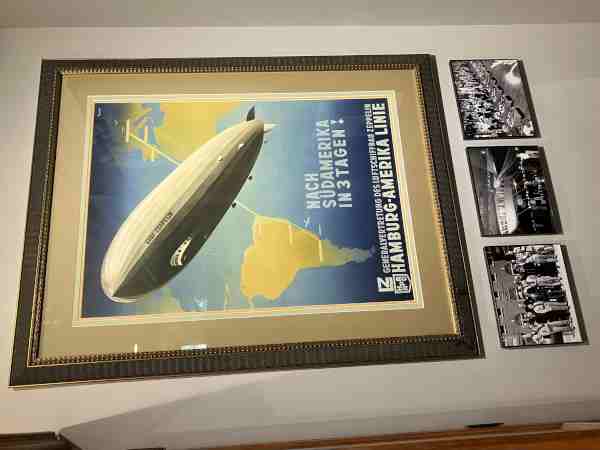
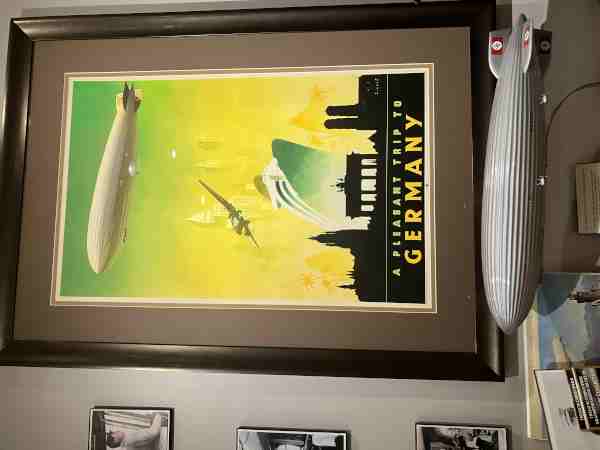
Graf Zeppelin posters.
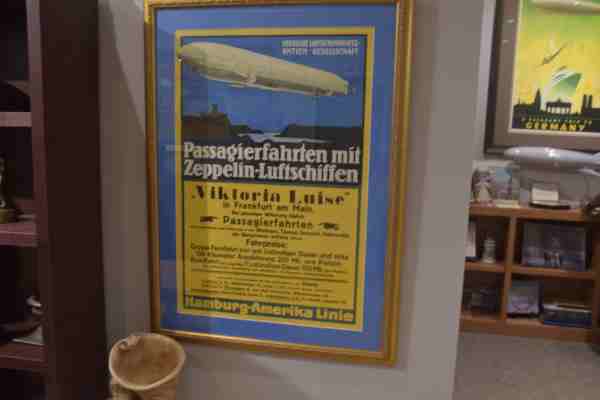
A poster advertising Hamburg American Line, one of the major steamship companies to handle the immigrant trade. Their primary routes from Hamburg, Germany, to New York via Southampton were supplemented by other vessels that called on the ports of Portland, Maine, Baltimore, Boston, Philadelphia, Galveston and New Orleans, in addition to Canadian ports. The Hamburg-American Line lost almost the entirety of its fleet twice due to World Wars One and Two from the sinking of their ships and war reparations.
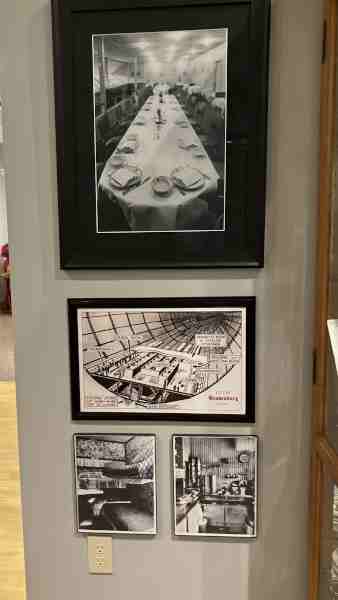
Schematic and pictures inside the Hindenburg.
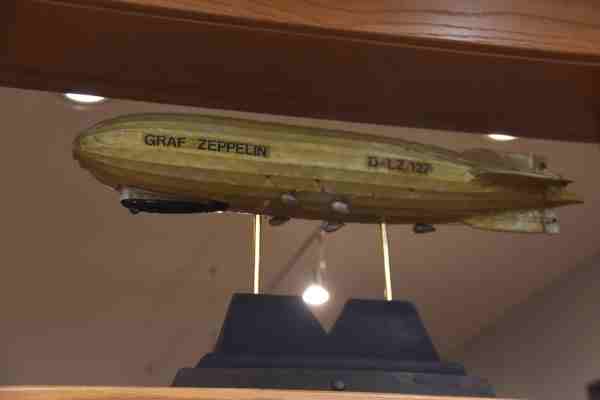
In 1929, Graf Zeppelin made perhaps its most famous flight; a round-the-world voyage covering 21,2500 miles in five legs from Lakehurst to Friedrichshafen, Friedrichshafen to Tokyo, Tokyo to Los Angeles, Los Angeles to Lakehurst, and then Lakehurt to Friedrichshafen again. The flight was partly sponsored by American newspaper publisher William Randolph Hearst, who paid for about half the cost of the flight in return for exclusive media rights in the United States and Britain.
Hearst had insisted that the flight begin and end in America, while the Germans naturally thought the Round-the-World flight of a German ship should begin and end in Germany. As a compromise, there were two official flights; the "American” flight began and ended at Lakehurst, while the "German" flight began and ended at Friedrichshafen.
The Round-the-World flight carried 60 men and one woman, Hearst newspaper reporter Lady Grace Hay-Drummond-Hay, whose presence and reporting greatly increased the public’s interest in the journey. Other passengers included journalists from several countries, American naval officers Charles Rosendahl and Jack C. Richardson, polar explorer and pilot Sir Hubert Wilkins, young American millionaire Bill Leeds, and representatives of Japan and the Soviet Union.
Graf Zeppelin left Friedrichshafen on July 27, 1929 and crossed the Atlantic to Lakehurst, New Jersey, and the “American” flight began on August 7, 1929 with an eastbound crossing back to Germany.
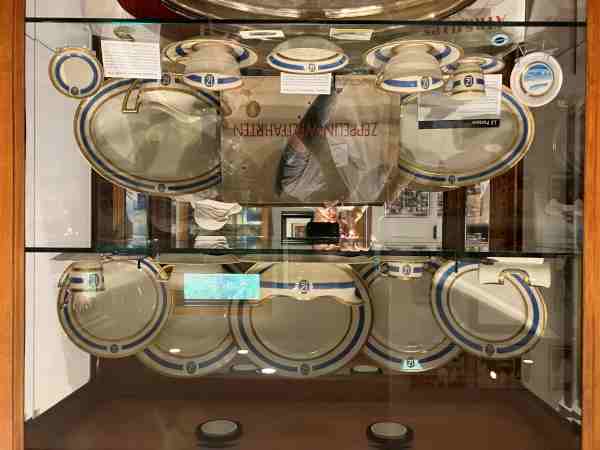
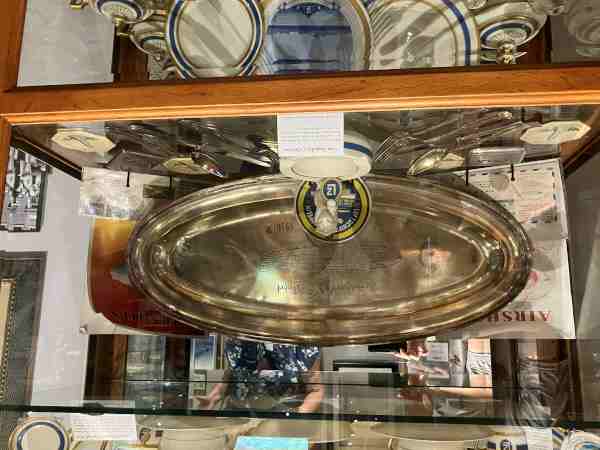
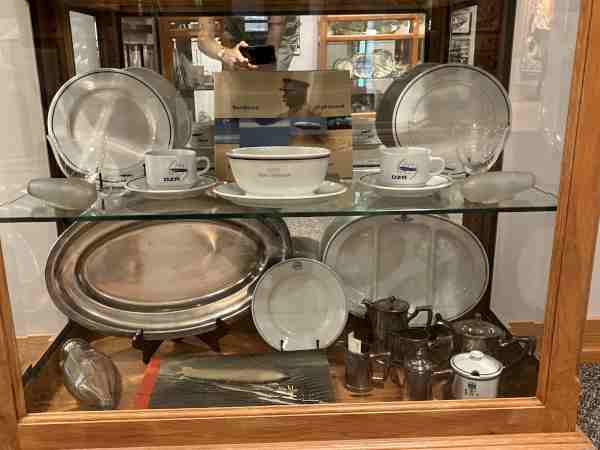
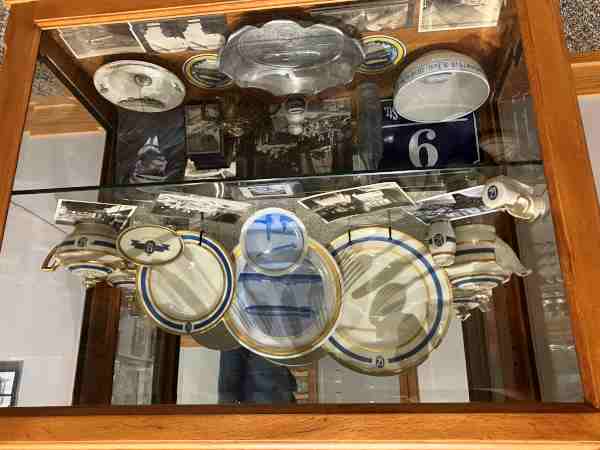
China from Graf Zeppelin and Zeppelin Weltfahrten. LZ-127 was christened “Graf Zeppelin” by the daughter of Ferdinand Graf von Zeppelin on July 8, 1928, which would have been the late count's 90th birthday.
By the time of Graf Zeppelin's last flight, nine years later, the ship had flown over a million miles, on 590 flights, carrying thousands of passengers and hundreds of thousands of pounds of freight and mail, with safety and speed. Graf Zeppelin circled the globe and was famous throughout the world, and inspired an international zeppelin fever in the late 1920s and early 1930s.
Graf Zeppelin made its first flight on September 18, 1928, under the command of Hugo Eckener. The ship lifted off at 3:32 PM and flew a little over three hours before returning to its base in Friedrichshafen.
A series of successful test flights followed, including a 34-1/2 hour endurance flight during which the new German ship was shown off to the residents of Ulm, Nuremberg, Wurzburg, Frankfurt, Wiesbaden, Cologne, Dusseldorf, Bremen, Hugo Eckener’s hometown of Flensburg, Hamburg, Berlin, Leipzig, and Dresden.
Graf Zeppelin made the very first commercial passenger flight across the Atlantic, departing Friedrichshafen at 7:54 AM on October 11, 1928, and landing at Lakehurst, New Jersey on October 15, 1928, after a flight of 111 hours and 44 minutes. The ship carried 40 crew members under the command of Hugo Eckener, and 20 passengers including American naval officer Charles E. Rosendahl and Hearst newspaper reporter Lady Grace Drummond-Hay.
The ship's first transatlantic crossing almost ended in disaster when it encountered a strong squall line on the morning of October 13th. Captain Eckener had uncharacteristically entered the storm at full power — he was known to reduce speed in bad weather — and the ship pitched up violently in the hands of an inexperienced elevatorman; the airships R-38 and USS Shenandoah had broken up under similar circumstances.
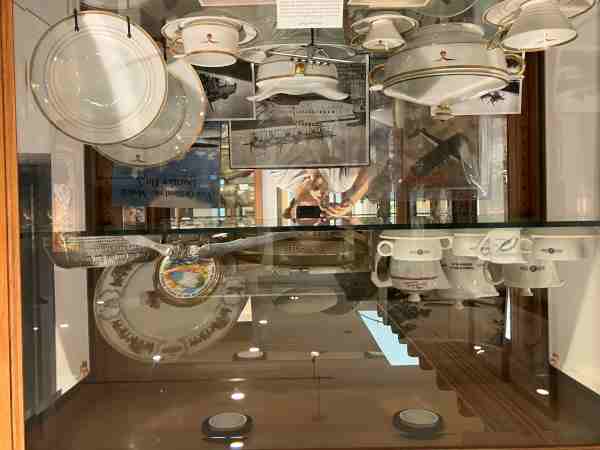
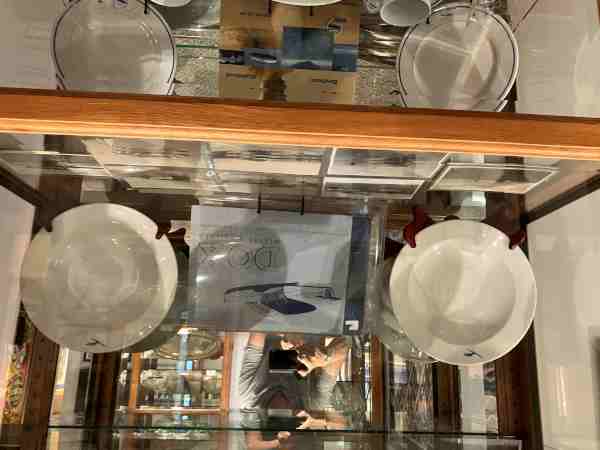
China, photographs and other items relating to Dornier Do X, the largest, heaviest, and most powerful flying boat in the world when it was produced by the Dornier company of Germany in 1929. First conceived by Claude Dornier in 1924, planning started in late 1925 and after over 240,000 work-hours it was completed in June 1929.
During the years between the two World Wars, only the Soviet Tupolev ANT-20 Maksim Gorki landplane of a few years later was physically larger, but at 53 tonnes maximum takeoff weight it was not as heavy as the Do X's 56 tonnes. The Do X was financed by the German Transport Ministry and in order to circumvent conditions of the Treaty of Versailles, which forbade any aircraft exceeding set speed and range limits to be built by Germany after World War I, a specially designed plant was built at Altenrhein, on the Swiss side of Lake Constance.
The type was popular with the public, but a lack of commercial interest and a number of non-fatal accidents prevented more than three examples from being built.
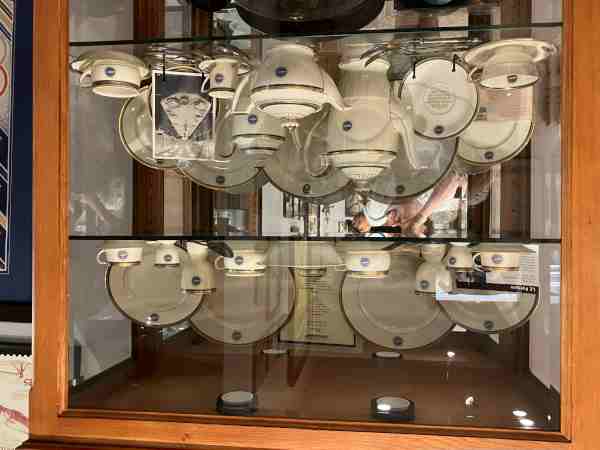
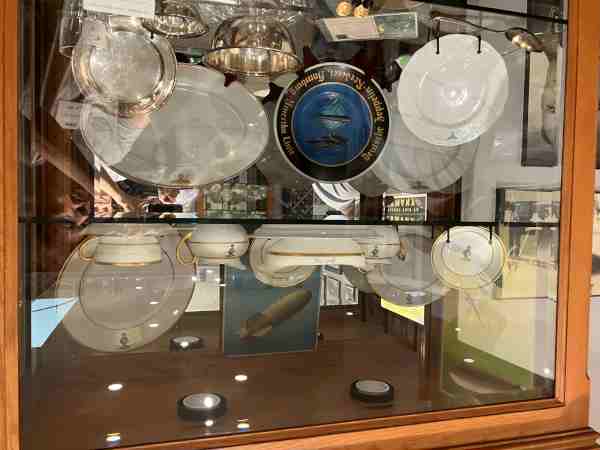
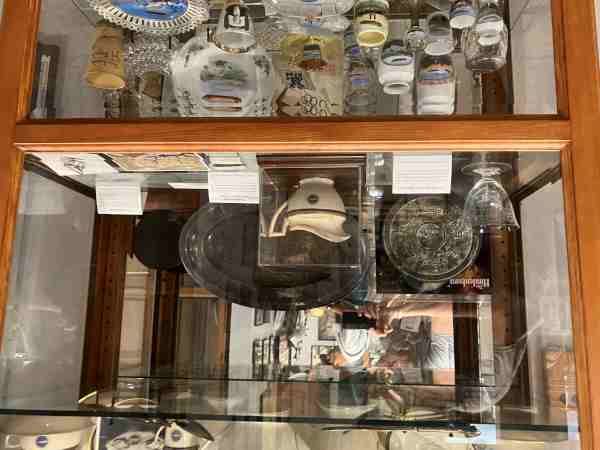
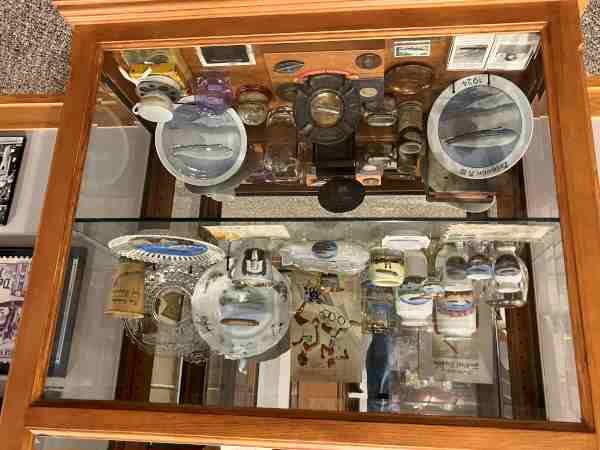
Hindenburg china and other items.
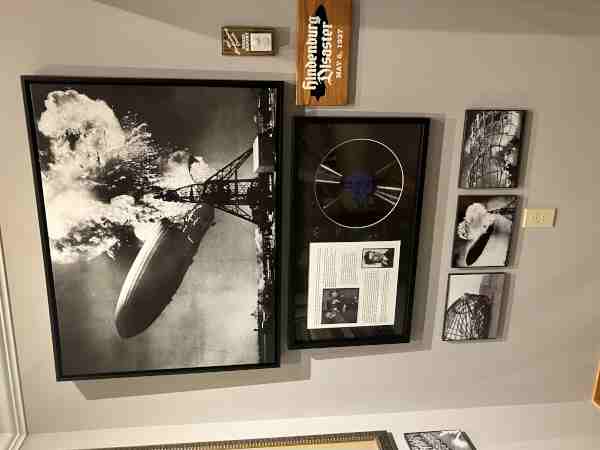
The famous Hindenburg disaster photograph, which occurred on May 6, 1937.
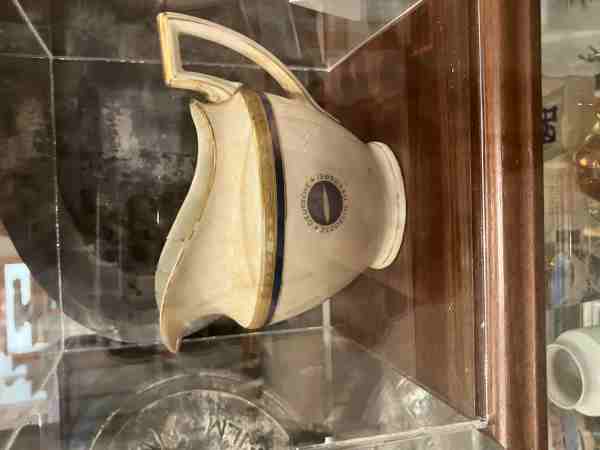
Hindenburg Crash remains cream pitcher and platter. Because the Germans refused to allow any artifacts to be removed from the field, an on-scene volunteer buried the platter in the sand nearby to hide it.
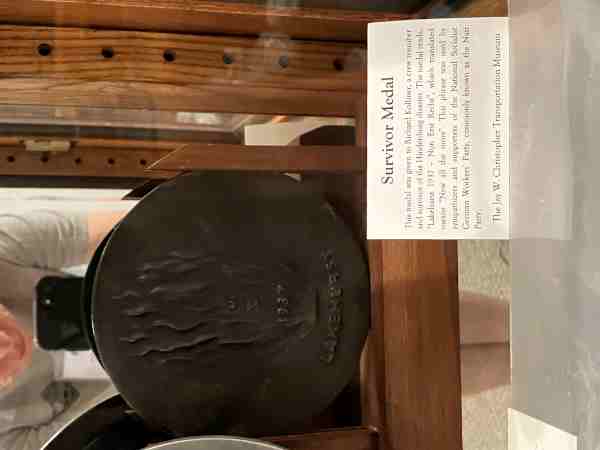
Survivor Medal given to Richard Kollmer, a crew member and survivor of the Hindenburg disaster. The medal reads, "Lakehurst 1937 - Nun Erst Recht" which translated means "Now all the more". This phrase was used by sympathasizers and supporters of the National Socialist German Workers' Party, commonly known as the Nazi Party.
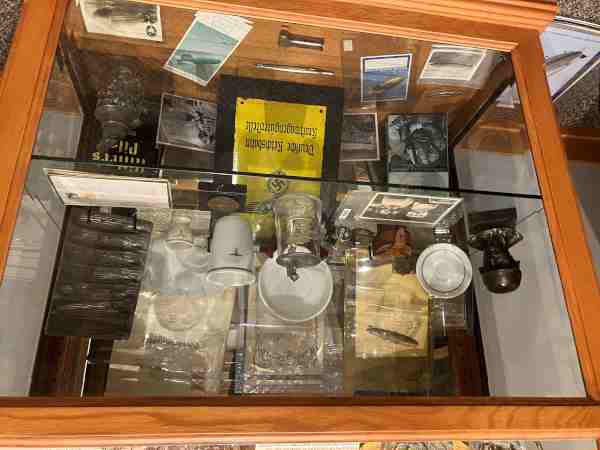
Nazi memorabilia.
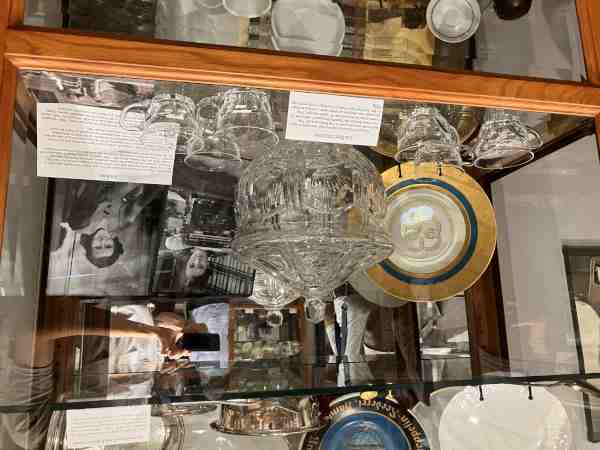
Eva Braun punch bowl and cups.
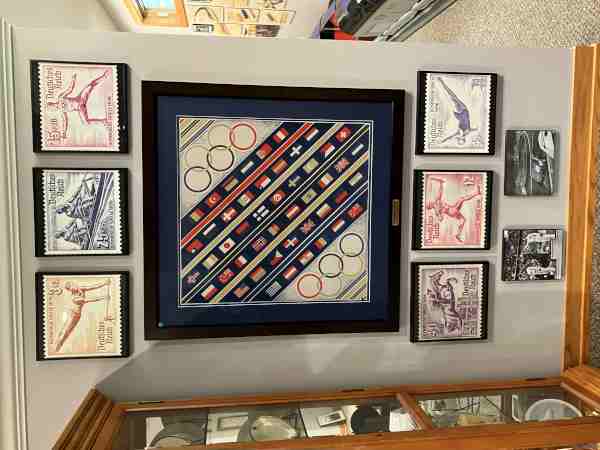
The 1936 Berlin Summer Olympics display. Berlin had previously been chosen to host the 1916 Summer Olympics, which were subsequently cancelled due to the First World War. The 1936 Games had 3,963 athletes from 49 National Olympic Committees (NOCs) participating in a total of 129 events in 19 sports. This was the highest number of nations represented at any Games to date. Athletes from 32 NOCs won medals, of which 21 secured at least one gold medal, and 17 NOCs won no medals. The host NOC, Germany, received a total of 101 medals, 38 of them gold, the most of any nation and a record for a united German team, although East Germany broke that record in 1976, 1980 and 1988.
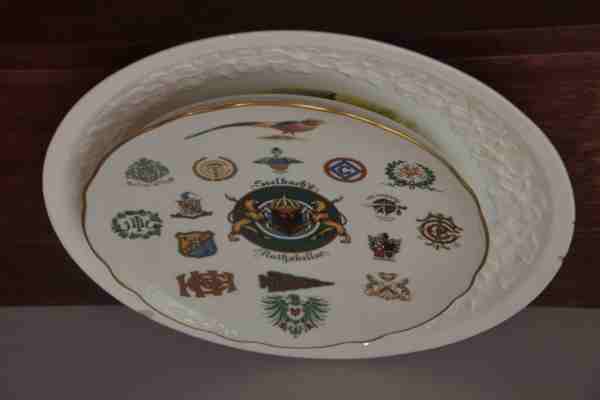
A plate from Seelbach's Rathskeller, the German restaurant in the Seelbach Hilton in Louisville Kentucky. It began as the dream of two Bavarian brothers – Otto and Louis Seelbach – in 1869 when Louis came to Louisville to learn the hotel business.
That ended the German section.
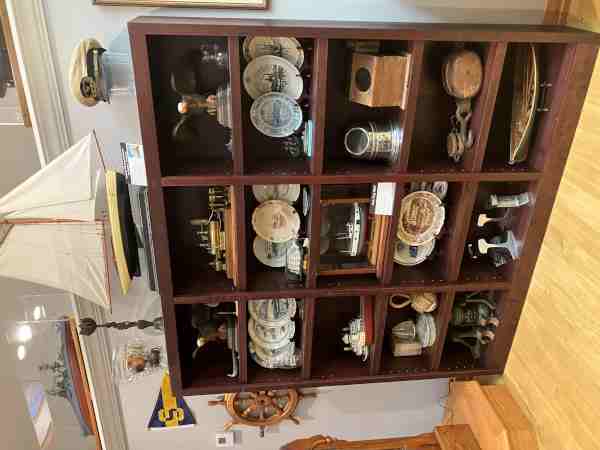
The entry display to the nautical area of the Christopher Transportation Museum.
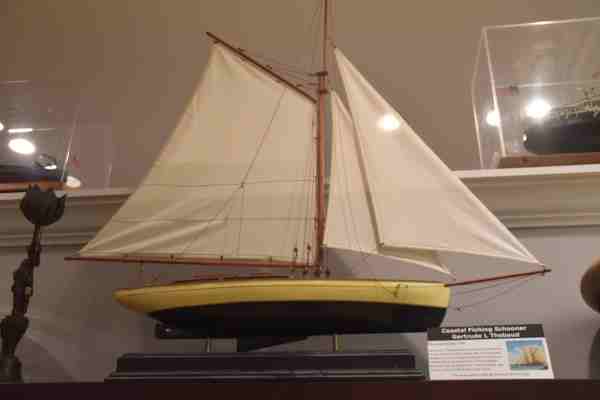
A model of the Coastal Fishing Schooner Gertrude L. Thebaud.
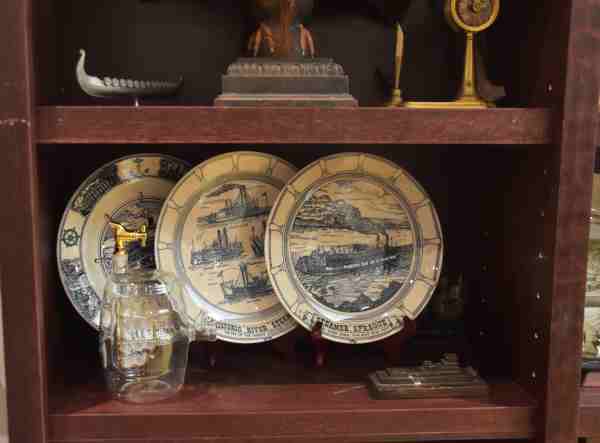
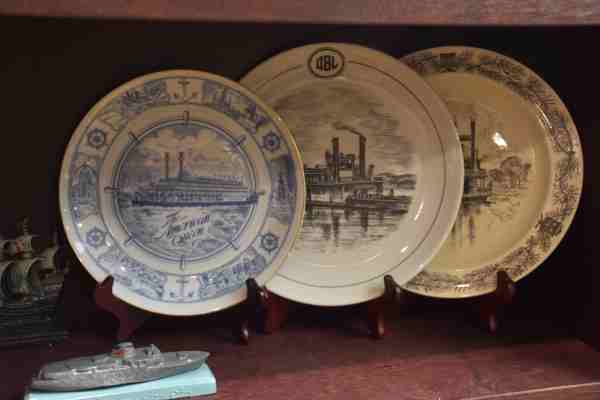
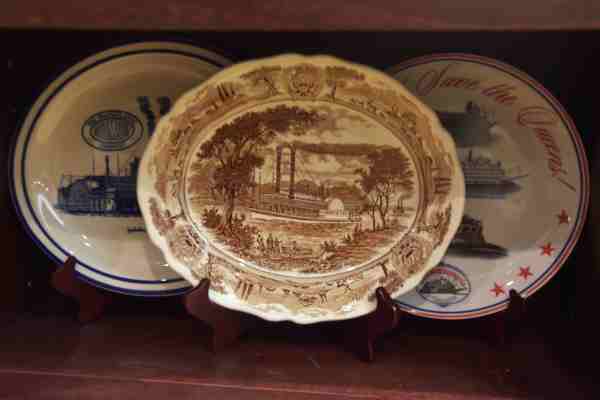
Historic Mississippi River steamers, including the American Queen, Delta Queen and Robert E. Lee.
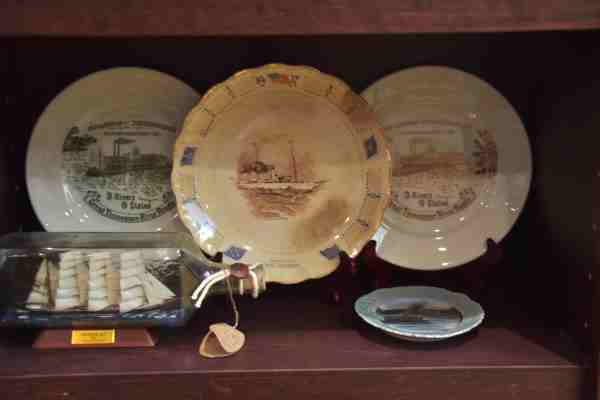
Great Tennessee River Route plates.
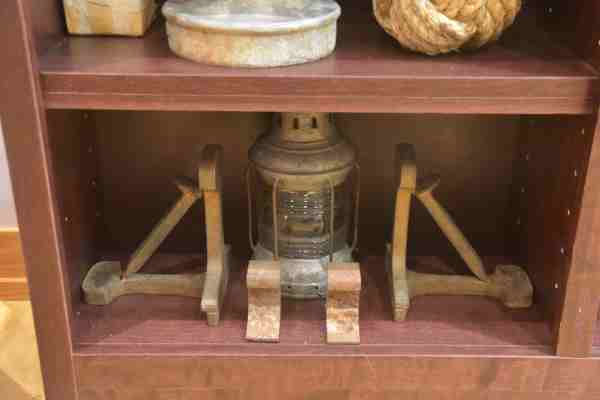
Bookends made from spikes and pieces of track.
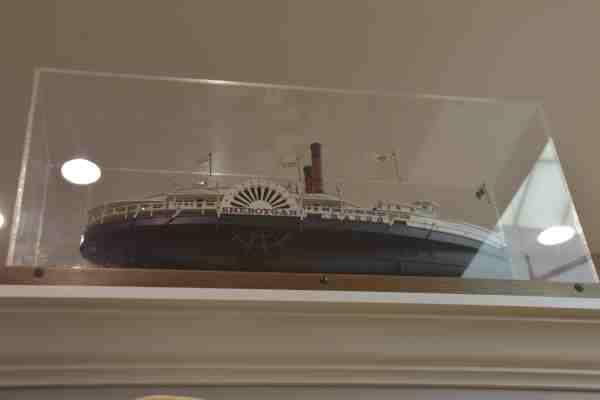
A model of Goodrich Transit Line's sidewheel steamship "Sheboygan".
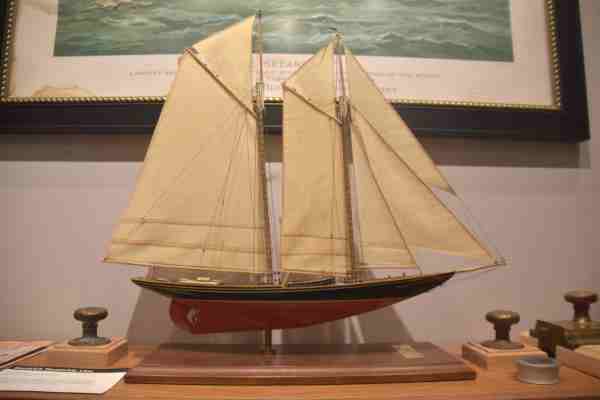
One of the Goodrich Steamship Company's vessels.
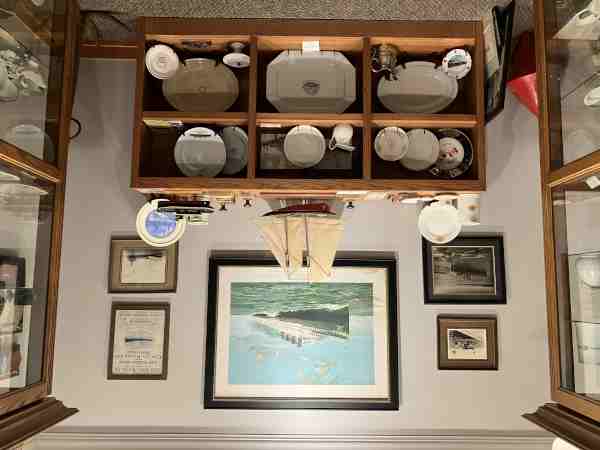
Great Lakes steamships memorabilia and photographs.
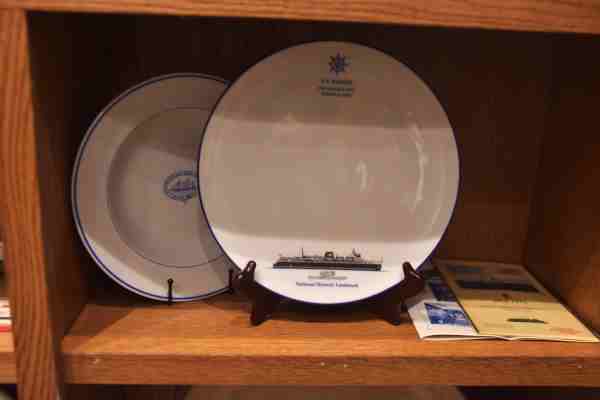
S.S. Badger.
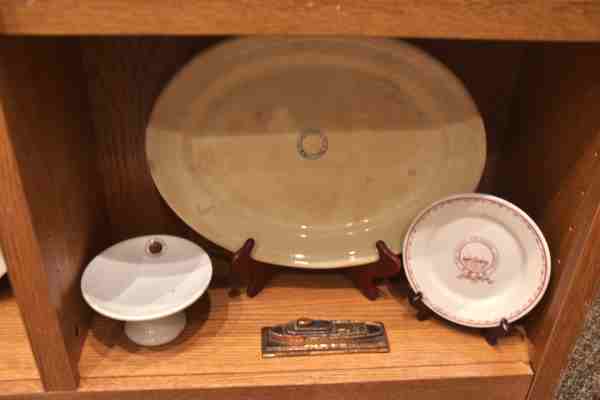
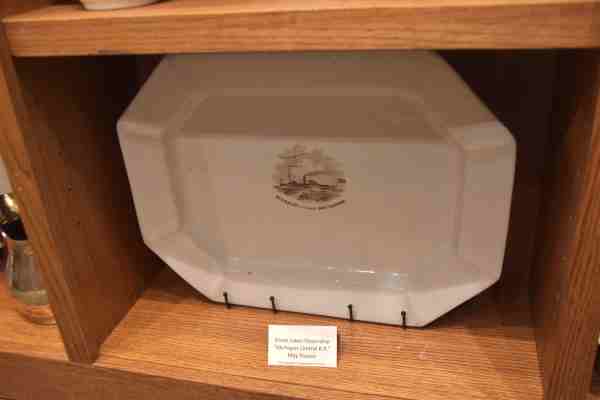
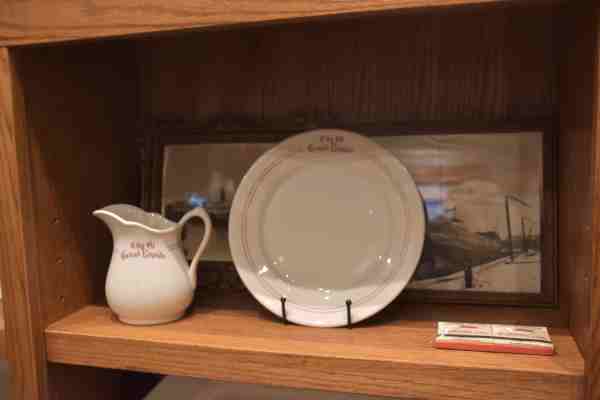
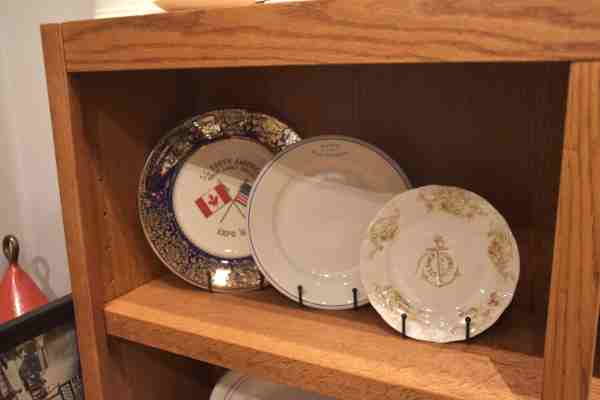
Commemorative steamship plates.
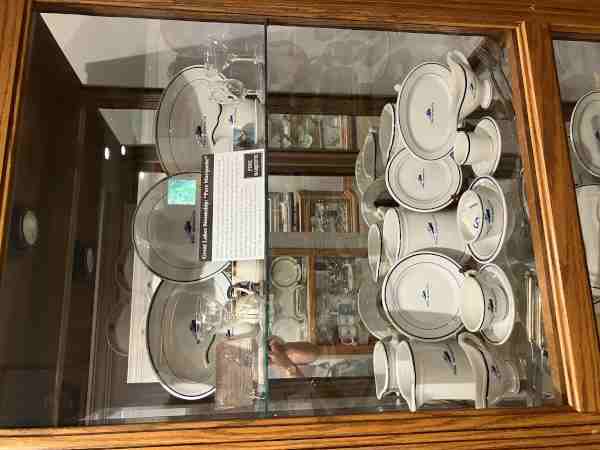
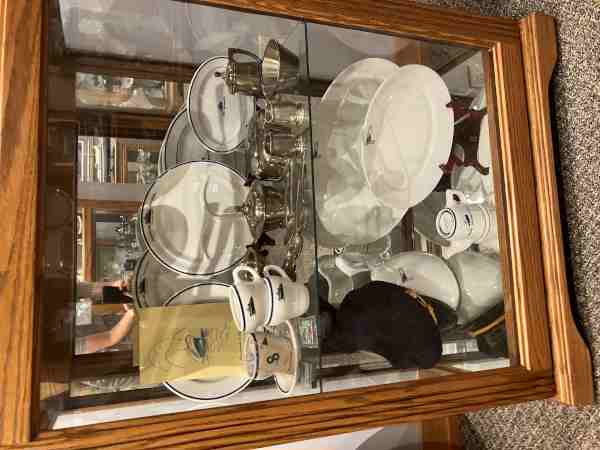
Great Lakes Steamship: Pere Marquette china.
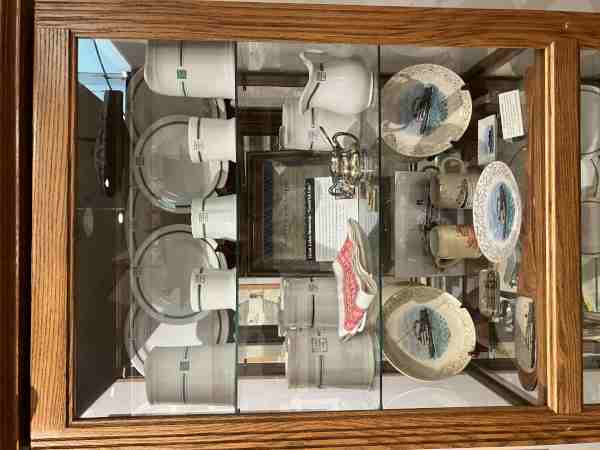
Great Lakes Steamship: Goodrich Line china.
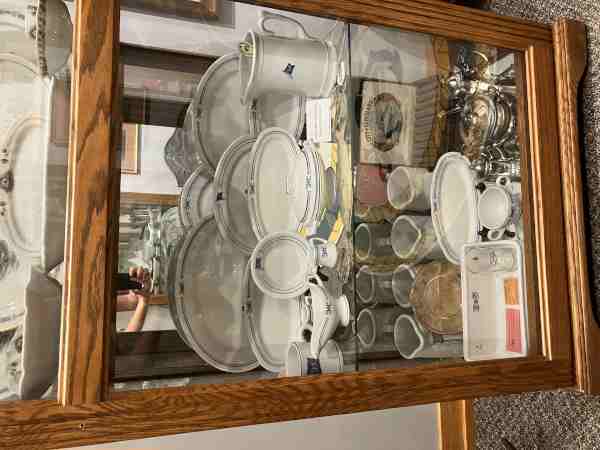
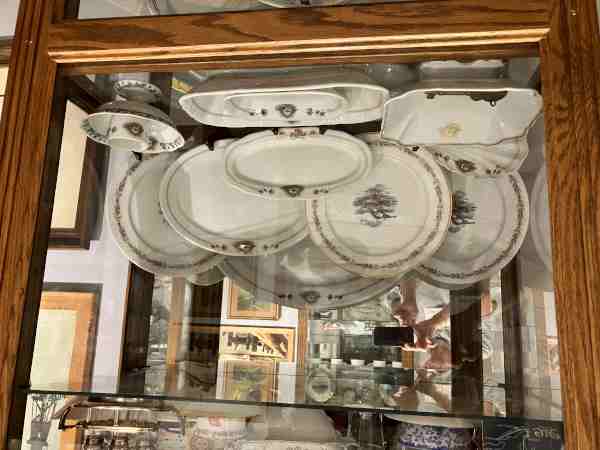
Detroit and Cleveland Navigation Company, often abbreviated as D&C, was a shipping company on the Great Lakes. The main route was between Detroit and Cleveland. Routes also lead to Buffalo, New York with the purchase of the Detroit and Buffalo Steamship Company in 1909. Charters and day-trips were also offered. Most scheduled sailings were overnight sailings, landing in the morning after departure. Each ship was painted with a black hull and white superstructure and white lettering. By 1949, the ships wore all-white paint with blue lettering. The popular line operated from 1868 to 1951 and is often referred to as the owner of many of the Great Lakes' best "floating palaces" and "honeymoon ships".
In its heyday, the D&C Line was among the most well-known shipping companies in business on the Great Lakes, with its vessels being among the largest and most palatial ever seen. Two of them, SS Greater Buffalo and the SS Greater Detroit, were both built in 1923, and were known as the largest side-wheeler passenger ships in the world. Naval architect Frank E. Kirby designed many D&C ships. As ferry and cruise ships, all of the ships of D&C were a success, with various civic groups and companies often chartering each ship on account of their reputations for excellent services and good cuisine. Upon reaching Buffalo, happy honeymoon couples would connect to Niagara Falls. In the late 1930s, the increasing use of the automobile caused passenger numbers to slowly fall.
During World War II, Greater Buffalo was converted into training aircraft carriers for use on the Great Lakes. In the meantime, Greater Detroit and her fleetmates saw an increase in passenger revenues, with the ships being reasonably full as Americans rationed gasoline for the war effort and therefore chose to travel between cites on the D&C liners, among other lines operating then.
By the end of the war, revenues fell again. Greater Detroit and her fleetmates, the City of Cleveland III, City of Detroit III, Western States and the Eastern States, were all that remained. On June 26, 1950, the 390-foot long City of Cleveland III was struck abaft by the Norwegian freighter Ravenfjell, and was severely damaged. Five passengers were killed in the collision, with dozens injured. The two ships survived and returned to their ports, but this incident, along with the dramatic resurgence of the automobile and truck traffic trades, finished the company. The company was formally dissolved in 1951, shortly after their old harbour terminals were condemned by the city of Detroit because of old age, and by 1959, most of the line's remaining ships had been scrapped. Greater Detroit and Eastern States in particular had their wooden upper works set afire before their steel hulls were scrapped at the Steel Company of Canada.
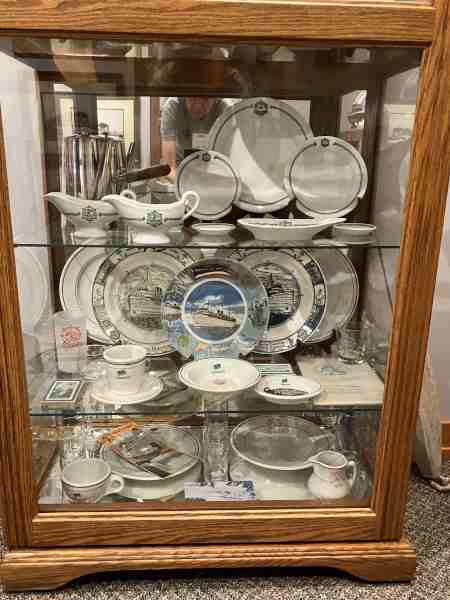
Georgian Bay Line, the popular name of the Chicago, Duluth and Georgian Bay Transit Company. From 1913 until 1967, the Georgian Bay Line provided transit service and cruise voyages to passengers on North America's Great Lakes.
The company was founded by Robert Chenault Davis, who for many years was employed by the Goodrich Line in Chicago. Mr. Davis envisioned a fleet of ships dedicated exclusively to passengers rather than the passenger and freight ships that plied the Great Lakes.
The Georgian Bay Line began operation in 1913 with the SS North American, which was launched on January 16, 1913. Due to a very profitable first season, the company launched the SS South American on February 21, 1914. Built of steel, these ships were almost sister ships. The North American had an overall length of 280 feet while the South American was 321 feet. They carried passengers between Chicago, Mackinac Island, Sault Ste. Marie, Michigan, Duluth, Georgian Bay, Detroit, Cleveland and Buffalo, and sometimes intermediate ports. In the 1940s, the Georgian Bay Line acquired a third vessel, SS Alabama, a refugee from the bankrupt Goodrich Transit Company where Mr. Davis had begun his career. The three ships tied up at the foot of 16th Street in Holland, Michigan, each winter and until they were permanently assigned elsewhere.
Up until World War II vessels like those operated by the Georgian Bay Line were an essential part of the transportation infrastructure of the Great Lakes. The line sold large quantities of point-to-point tickets to revenue passengers who paid publicly tariffed rates to be moved from one port to another. After the war, with increasingly inexpensive motor fuel and reliable, paved roads, point-to-point passenger volume declined and the Georgian Bay Line shifted its emphasis to the cruise ship trade.
Both vessels advertised weeklong cruises through the upper Great Lakes, with the South American traditionally visiting Lake Superior and the North American taking the Lake Michigan run. Mackinac Island, in the Straits of Mackinac, was the division point where the Y-shaped arms of the Georgian Bay Line's service territory came together.
The Georgian Bay Line's long-term viability was compromised by the seasonal nature of Great Lakes cruise trade. The boats were traditionally fitted out each spring in May and mothballed each fall in late September. After the invention of the passenger jet airplane in the 1950s, North American tourists found themselves able to fly to ports in locations, such as the Gulf of Mexico and the Caribbean, where twelve-month cruising was possible. In addition, cruise ships operating in international waters could hire crews from the Third World and did not have to obey U.S. or Canadian labor laws.
The Georgian Bay Line lost money in the 1960s. In 1963, after the GBL retired the North American, the South American and the Greene Line's Delta Queen were the last two long-distance cruise ships sailing under the U.S. flag. Neither vessel could meet modern fire-safety standards. In 1966, citing the danger to passengers of a catastrophic fire, Congress passed a law ordering both passenger vessels to tie up to the docks permanently. A series of temporary exceptions were carved out for the Delta Queen, but not for the South American. In 1967, the final Georgian Bay Line boat made its last trip.
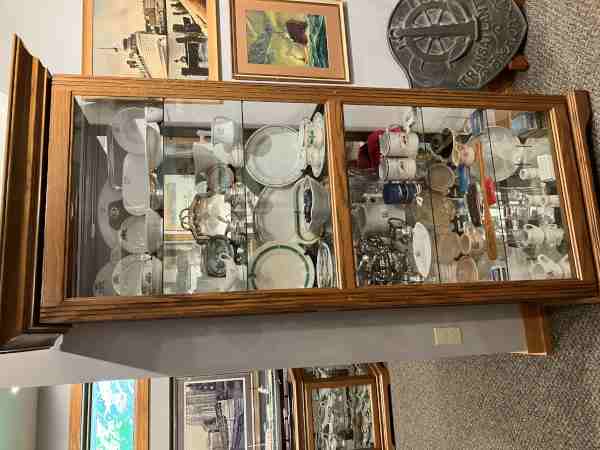
More steamship china, detailed in the following photographs.
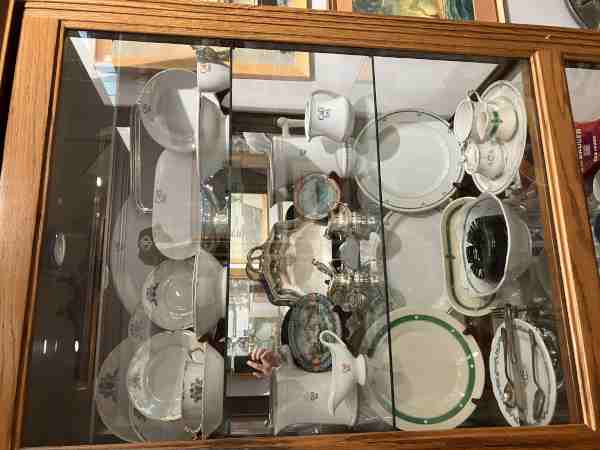
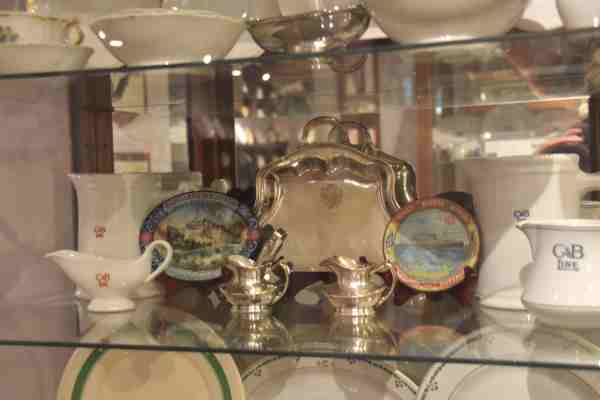
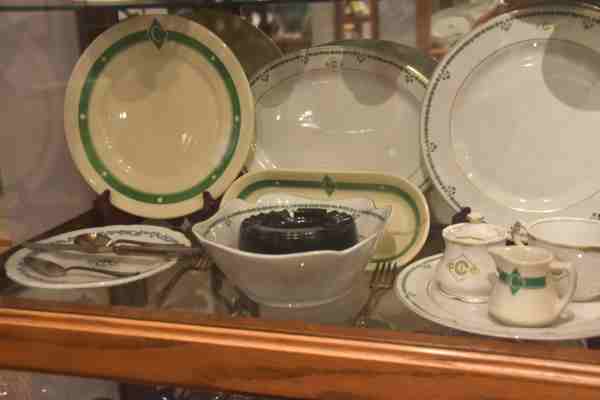
Cleveland and Buffalo (C&B) Line. This was a popular steamship line and later a trucking firm, was established by Morris A. Bradley in 1885 and incorporated in 1892, with Bradley as president.
Passenger and freight service was initiated between Cleveland and Buffalo on the "State of Ohio" and the "State of New York," leaving Cleveland from the foot of St. Clair Ave, and in 1896, the "City of Buffalo" was added. The "City of Erie" replaced the "State of Ohio" in 1898, providing night service from Cleveland to Toledo. In 1914 Cedar Point and Put-in-Bay were added to the C&B route. As passenger service became increasingly popular, the luxurious "SEEANDBEE," a costly sidewheel passenger steamer, began regular trips between Cleveland and Buffalo in 1913. At that time, the C&B and the Detroit & Cleveland (D&C) line obtained a 50-year lease from Cleveland for property at the foot of 9th St. for $55,000.
There the two companies built the E. 9th St. Pier and a new lake terminal, dedicated in 1915; in exchange, the city built a bridge over the E. 9th St. railroad tracks, paved the E. 9th St. approach, and provided a street railway to the pier. he popularity of passenger excursions in the 1920s led the C&B to buy the "City of Detroit II" from the D&C line. Rebuilt as the "Goodtime," it offered excursions and "moonlight rides" on the Cleveland-Cedar Point and Put-in-Bay route. Automotive transportation began to erode the profitability of lake shipping, and in 1930 C&B began tractor-trailer freight service during the winter months to improve its revenue. The destruction of the "City of Buffalo" by fire in 1938, along with the Depression and increasing competition from trucks and railroads, caused the bankruptcy and liquidation of Cleveland & Buffalo Transit Co. in 1939.
The E. 9th St. Pier was transferred to the Lederer Terminal Warehouse Co., and both the "Goodtime" and the "City of Erie" were sold for salvage. Cleveland capital organized a new Cleveland & Buffalo Transit Co. in 1943 and continued the trucking business. The firm grossed about $650,000 a year by 1955, the year it became a wholly owned subsidiary of Forest City Industries, Inc. of Cleveland.
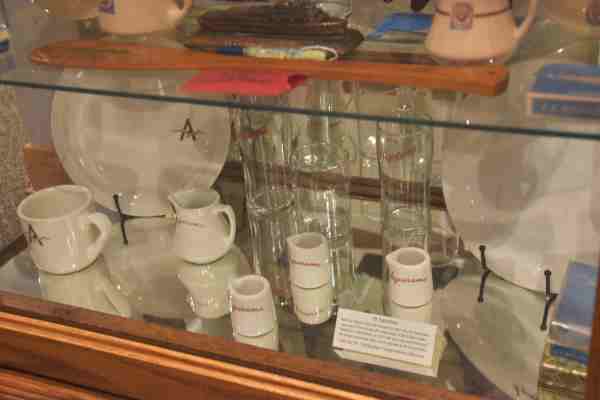
China from the S.S. Aquarama, built as Marine Star, one of five breakbulk cargo ships of the United States Maritime Commission type C4-S-B5 having that C4 design variant. The ship was delivered to the War Shipping Administration for operation in July 1945 just before the end of World War II and was operated until August 1946 by WSA's agent American Hawaiian SS Company. From September 1947 the ship was laid up except for brief periods in the James River.
In 1952 the ship was converted into the largest passenger ship ever to operate in the Great Lakes.
Aquarama began operation in 1956 by touring various Great Lakes ports. In 1957 the Michigan-Ohio Navigation Company, began service from Detroit to Cleveland, carrying automobiles and passengers. Once in service, the ship was able to transport its passengers and their automobiles from Detroit to Cleveland in under six hours.
Although the ship was immensely popular, it never generated enough revenue to be self-supporting; On September 4, 1962, the ship made its last trip, laying up at the Mart Dock in Muskegon, Michigan. Operating the ship from Muskegon, Michigan to Milwaukee as a replacement for the older Milwaukee Clipper was proposed, but $700,000 for dredging so the Aquarama could be accommodated in Milwaukee harbor was needed. As a result, the ship sat idle until 1987 when it was sold to the North Shore Farming Company for around $3 million.
Aquarama was briefly docked at Sarnia, then Windsor before returning to its original name of Marine Star in 1995 and moving under tow to Buffalo. On August 3, 1995, the Marine Star was berthed at the Cargill Pool Elevator where it stayed until it was towed overseas to Aliağa, Turkey for scrap in September 2007.
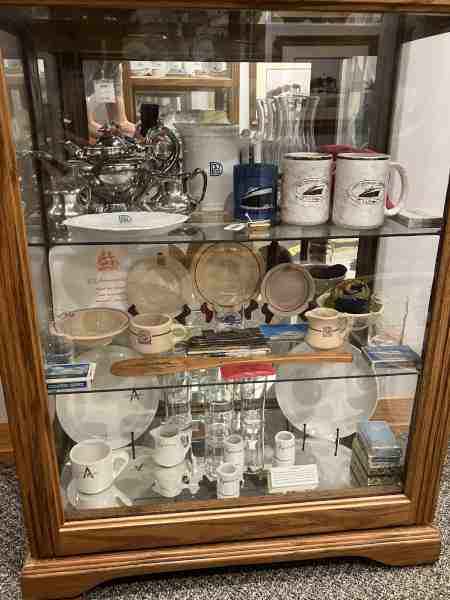
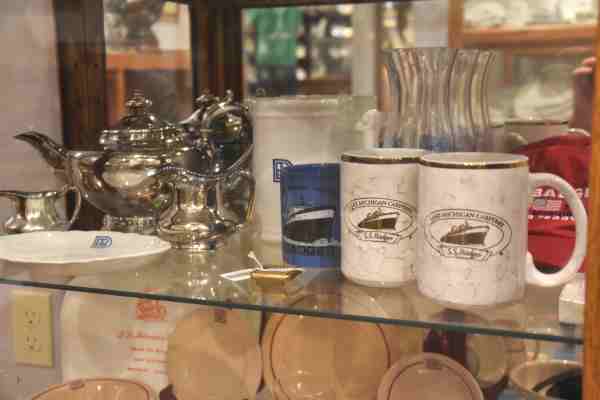
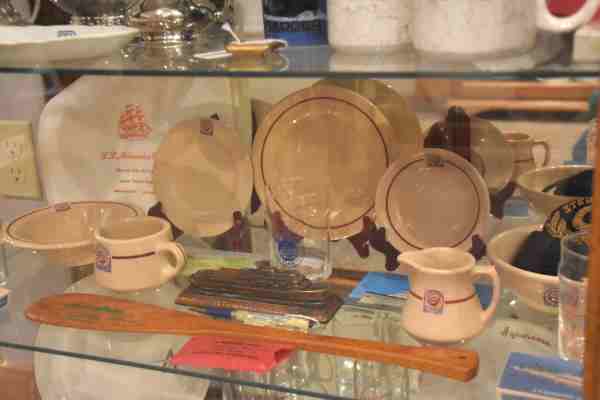
Lake Michigan car ferries.
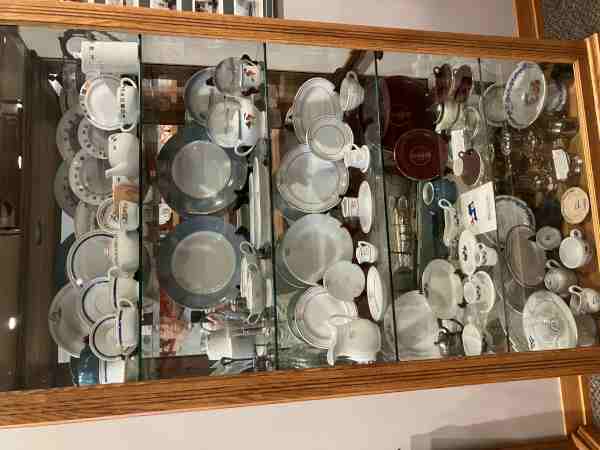
China of M&M Lines, American Export-Isbrandtsen Lines and Ohio Steamship Company.
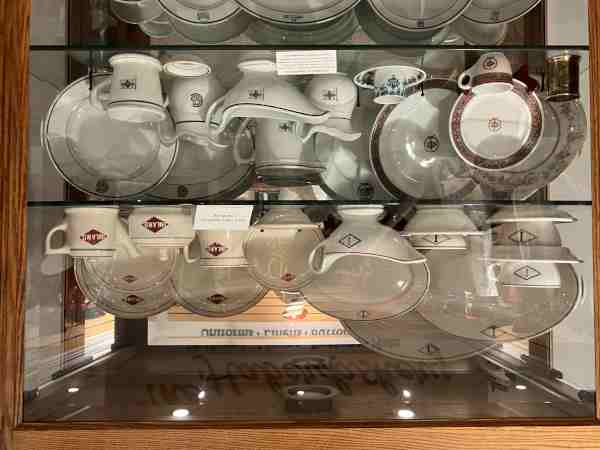
Great Lakes Steamship Inland Line and New England Fuel Transportation Company.
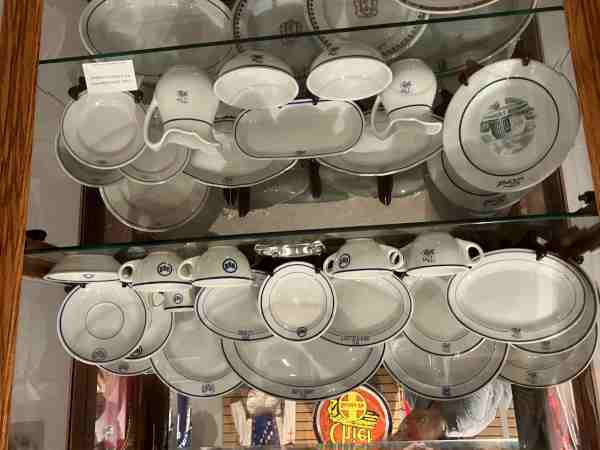
United States Steel and Great Lakes Steamship "Ford Motor Company".
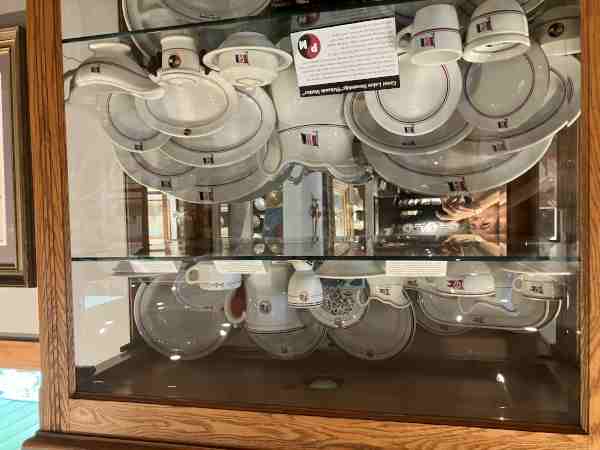
Great Lakes Steamship "Pickands Mather"
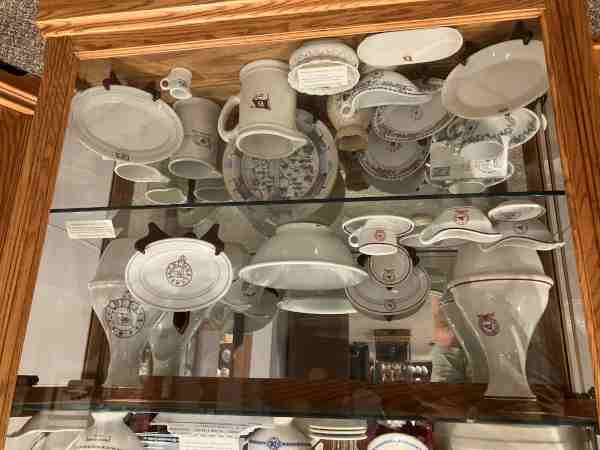
New York and Cuba Mail Company and Boston and Philadelphia Steamship Company.
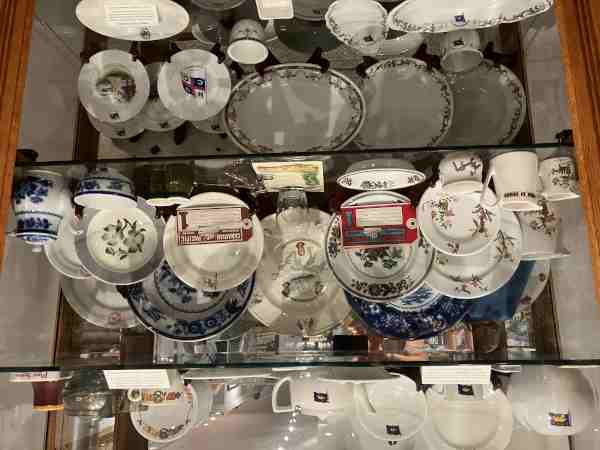
Canadian Pacific Steamships and Northern Navigation Steamship Company.
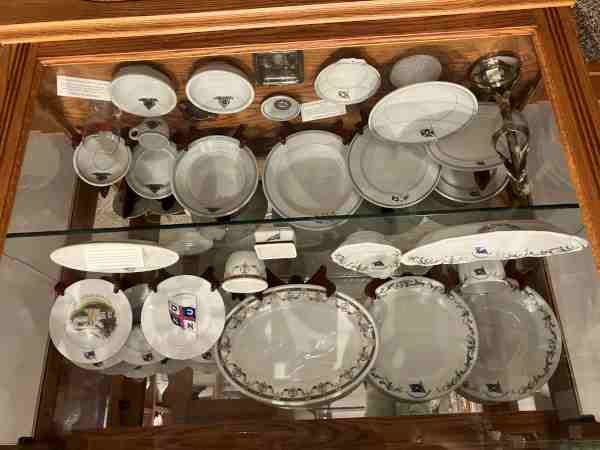
Northern Navigation Steamship Company, North Pacific Steamship Company and Alaska Steamship Company.
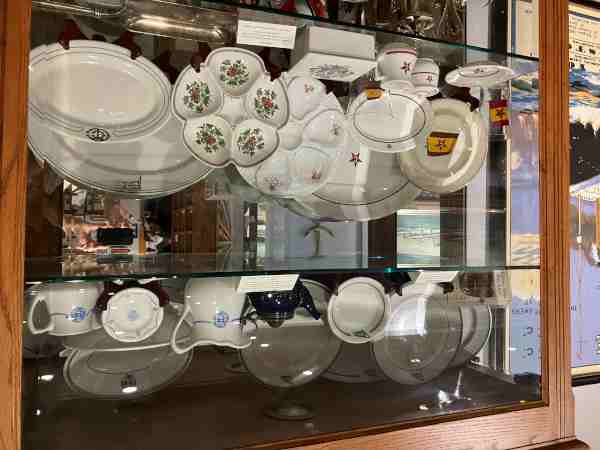
Munson Steamship Line and Allan Lines.
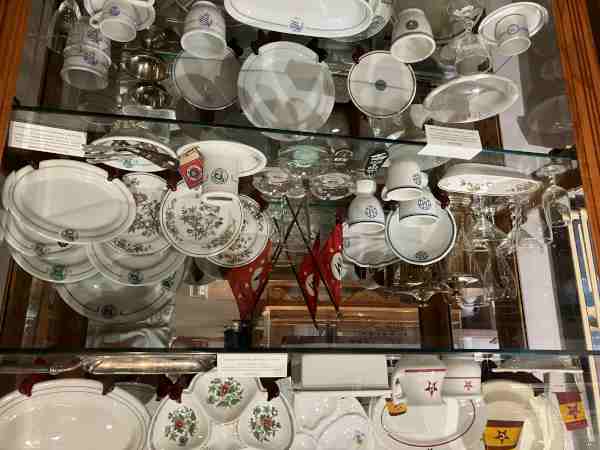
Matson Line and Pacific Steamship Company.
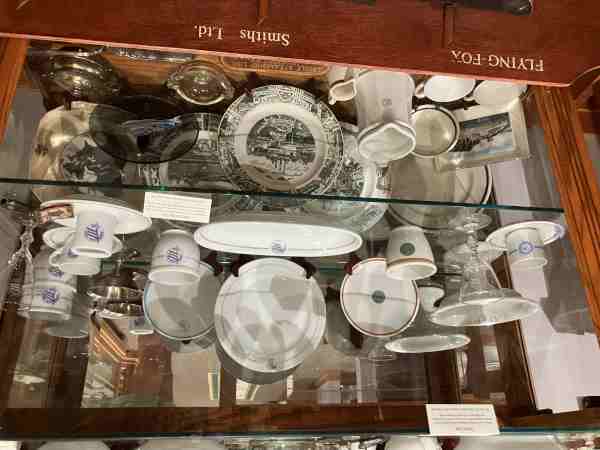
American Mail Line.
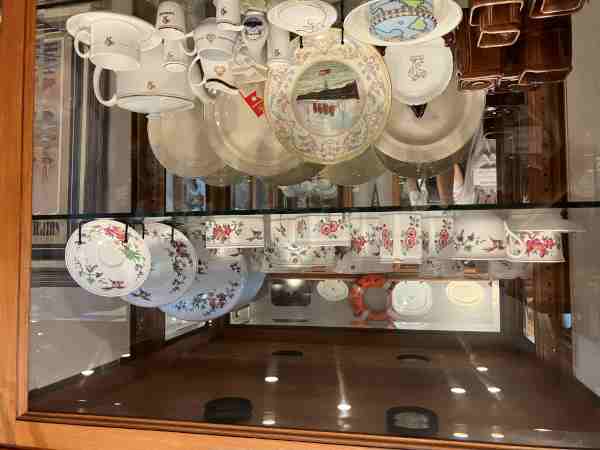
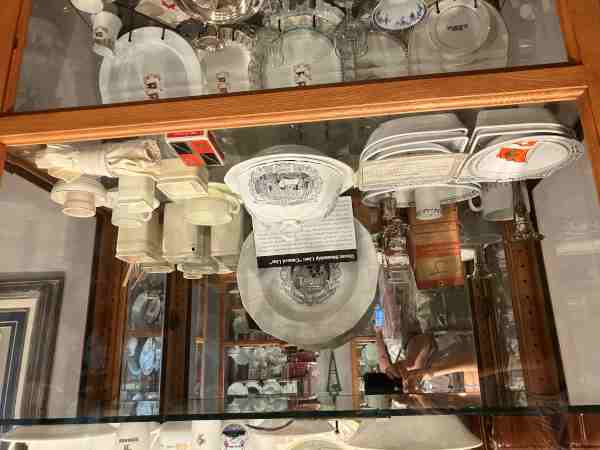
Cunard Line.
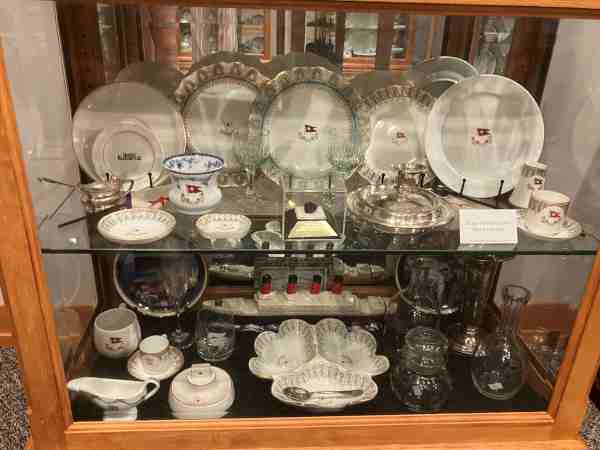
White Star Line.
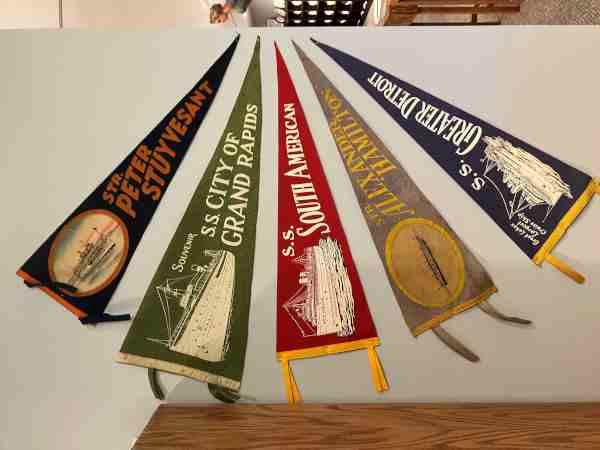
Steamship pennants.
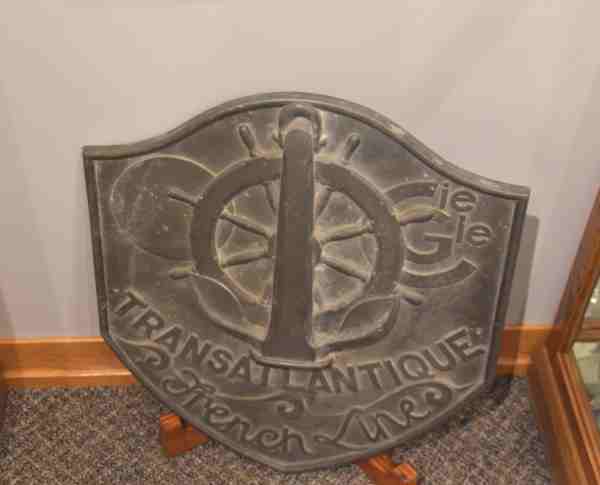
Transatlantique French Line shield.
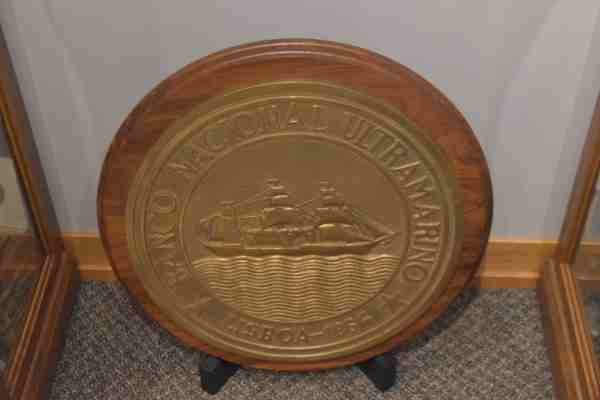
Banco Nacional Ultramarino, Lisboa 1864.
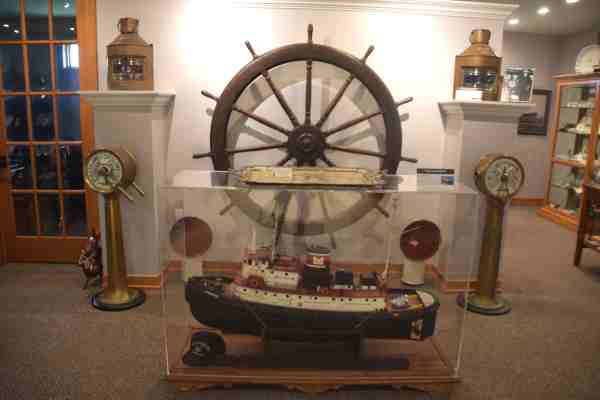
Tug Ludington.
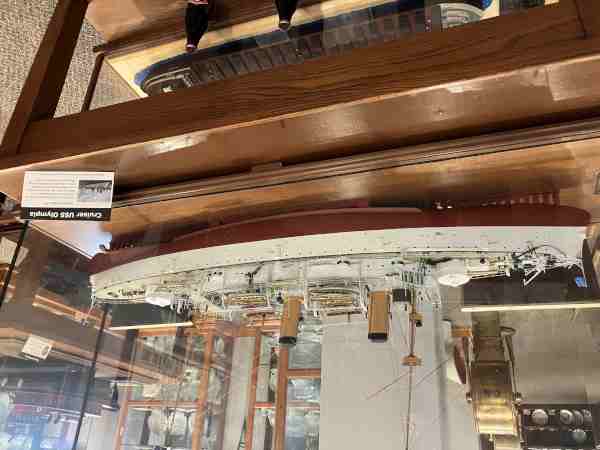
Cruiser U.S.S. Olympia. A nineteenth-century cruiser, she was placed into service in February 1895 and is the oldest steel warship afloat in the world. She has called Philadelphia home since 1922, became a museum in 1957, and has been docked alongside Becuna at Penn’s Landing since 1976.
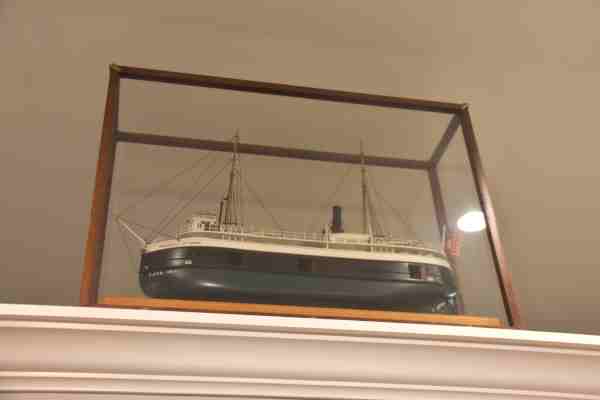
Pere Marquette Line Steamers F. and P. M. Number 1.
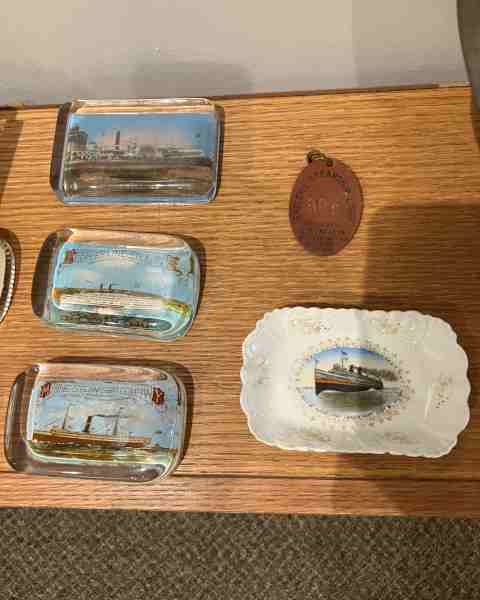
Commemorative steamship trays.
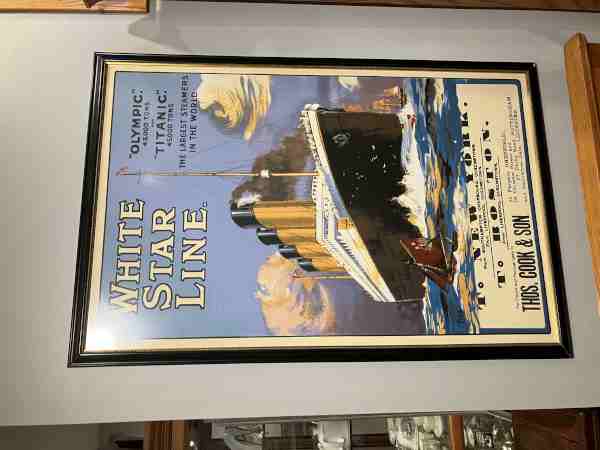
White Star poster.
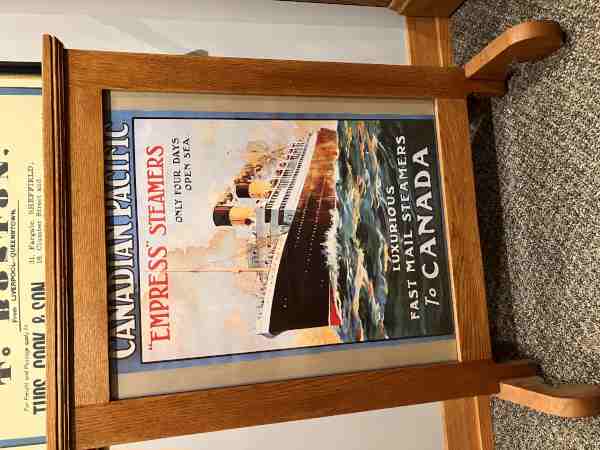
Canadian Pacific Empress Steamers luxurious fast mail to Canada.
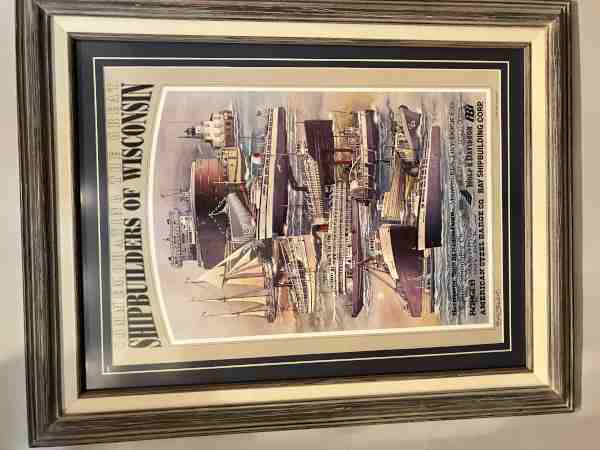
Shipbuilders of Wisconsin poster.
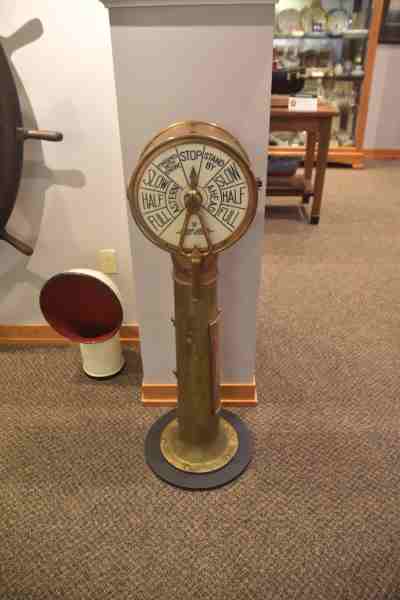
A brass pedestal-mounted marine engine order telegraph, also called an engine room telegraph, used on ships before direct electronic engine controls became common. The bridge officer would move the handle to send engine commands to the engine room, where engineers would acknowledge and carry out the order.
The dial shows the classic commands: stop, stand by, slow, half, full, ahead, astern and finished with engine (used when propulsion was no longer needed). The engineers would receive the command on a matching telegraph in the engine room and move their own handle to the same position, often ringing a bell to acknowledge the order.
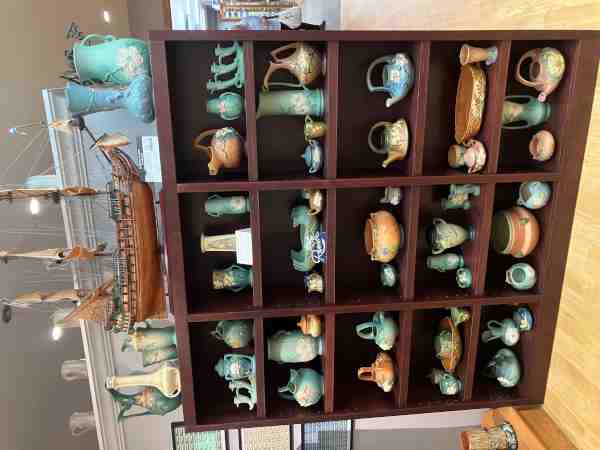
Holland Frigate "Friesland" atop a display cabinet of Roseville Pottery. The company was established in Roseville, Ohio in 1890 and over the years, expanded its production to include a wide range of decorative wares, and by the early 20th century, Roseville had shifted its focus toward producing finely-crafted art pottery in response to the growing Arts and Crafts movement. Many popular patterns and styles helped establish Roseville as a leading American art pottery maker, known for its high-quality craftsmanship and distinctive, nature-inspired designs. Roseville Pottery ceased operations in 1954, largely due to changing consumer tastes and increased competition from mass-produced ceramics. Despite its closure, Roseville pottery remains highly sought after by collectors due to their historical significance, artistic appeal, and the wide variety of shapes and patterns. Collectors prize Roseville for its floral motifs and elegant designs. These factors continue to make Roseville Pottery a staple in the American art pottery collecting world.
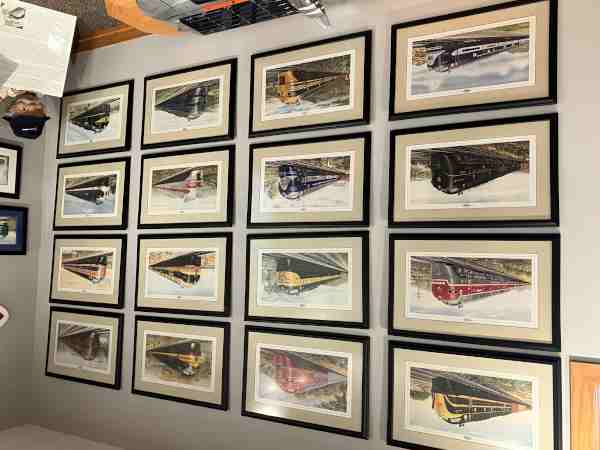
I returned to the main display room and discovered several new additions since our last visit in 2021. A series of Electro-Motive Division publicity photographs featuring E, F and FT locomotives was the beginning of an EMD section.
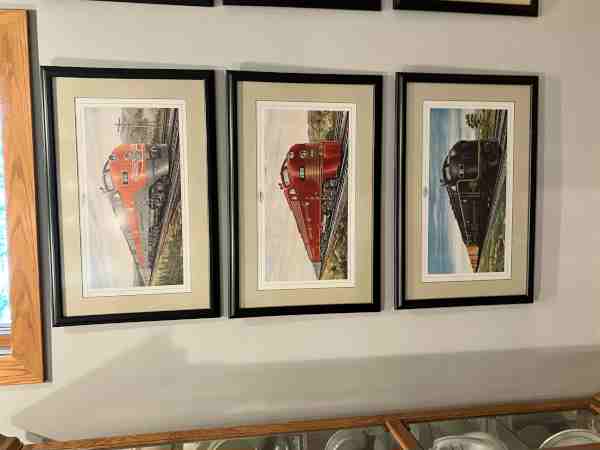
Another three.
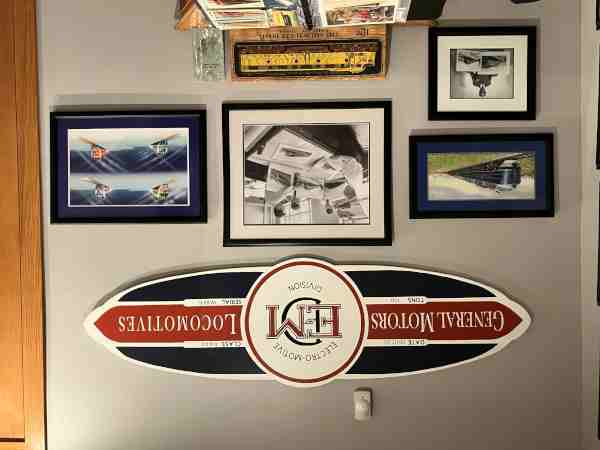
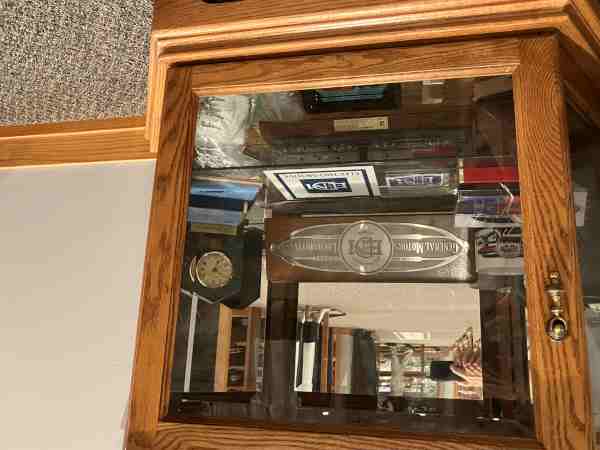
Electro-Motive Division display.
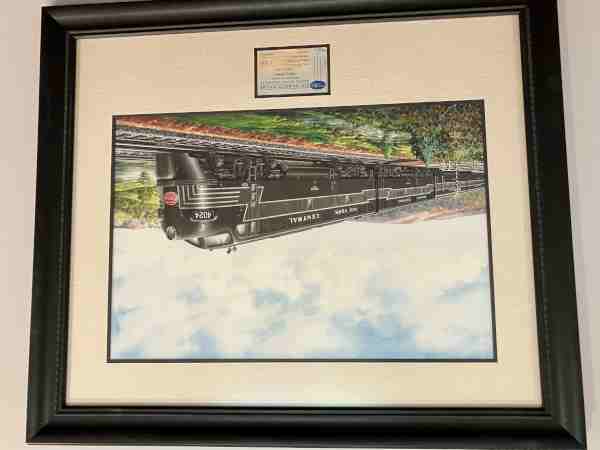
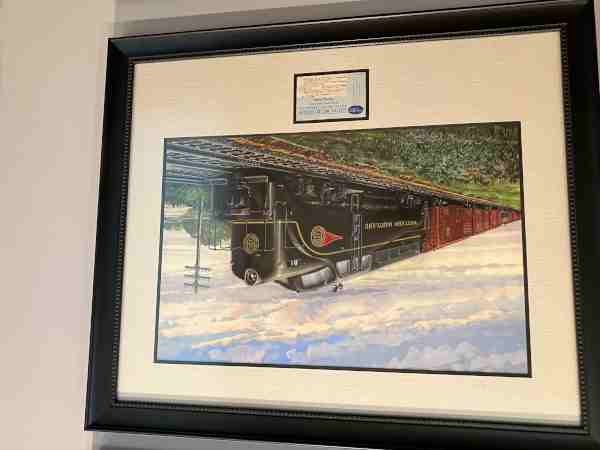
Engineering Department proposals for New York Central and Western Maryland.
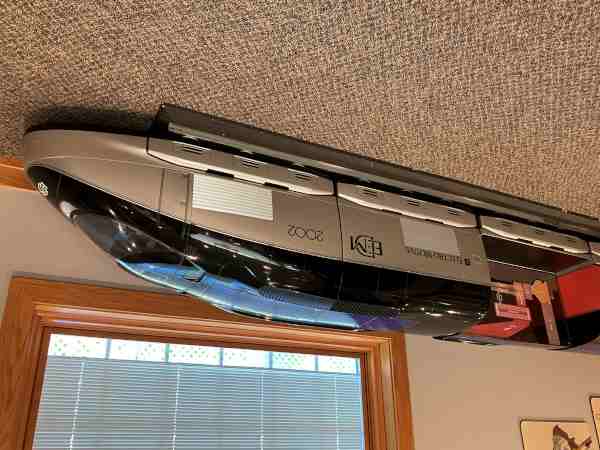
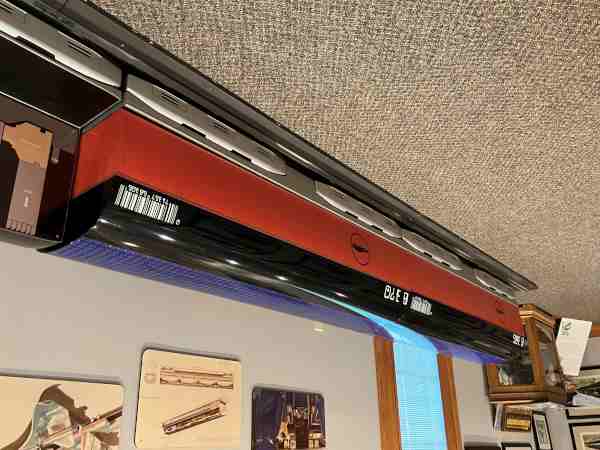
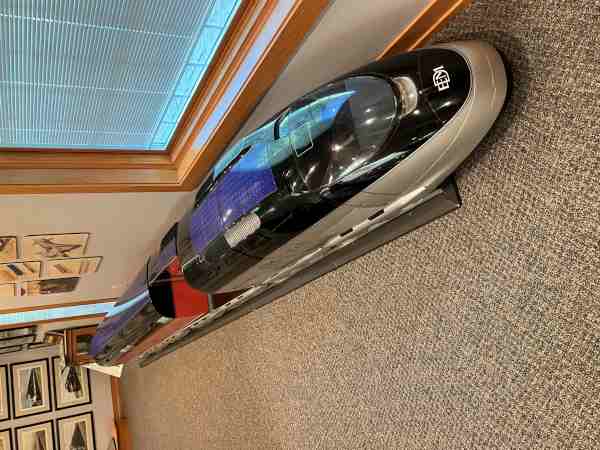
A futuristic EMD train, original purpose unknown.
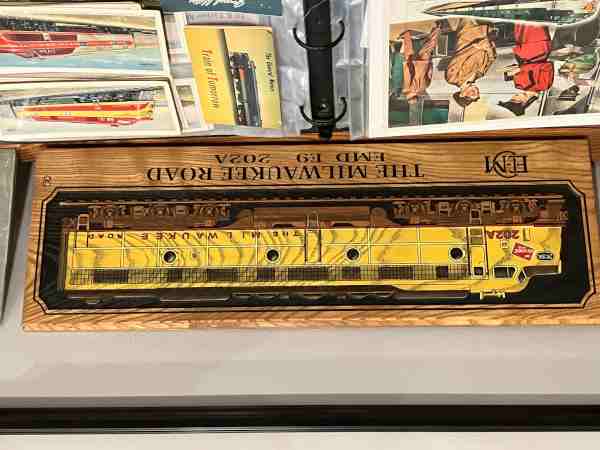
A wooden carving of Milwaukee Road E9A 202A.
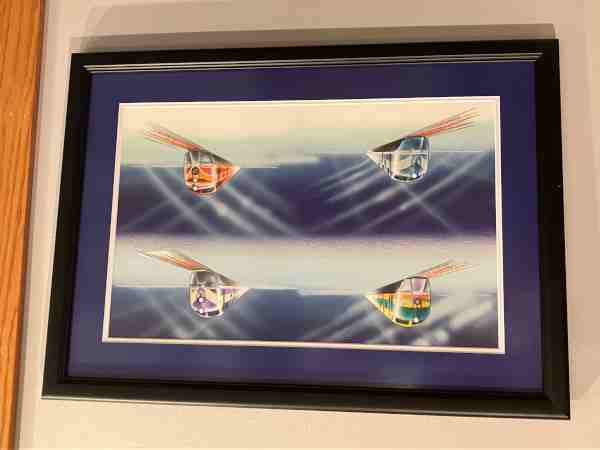
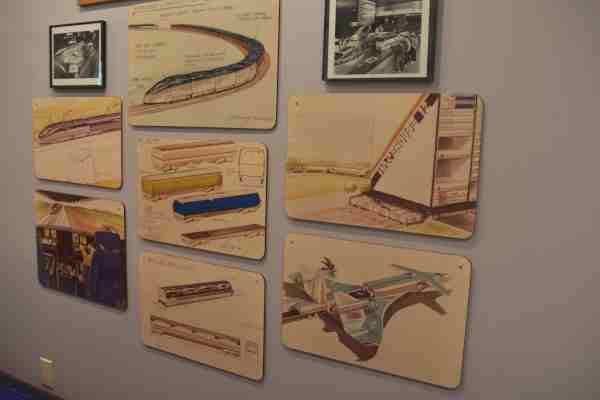
The Electro Motive Division Engineering Department Styling Section designed the sixteen offset lithographs on display as well as many others. It was the EMD Styling Section that created the majority of the diesel train paint schemes from the 1930's to the 1960's, thus creating the era of the streamliner. Trains were fashioned from sleek stainless steel into smooth surfaces with flowing curves, bullet shapes, parallel lines and bold new colours. This new Art Deco design style came from Paris' 1925 International Exhibition of Modern Decoratives and Industrial Arts. American designers were highly influenced and inspired by the movement that revolutionized the design world.
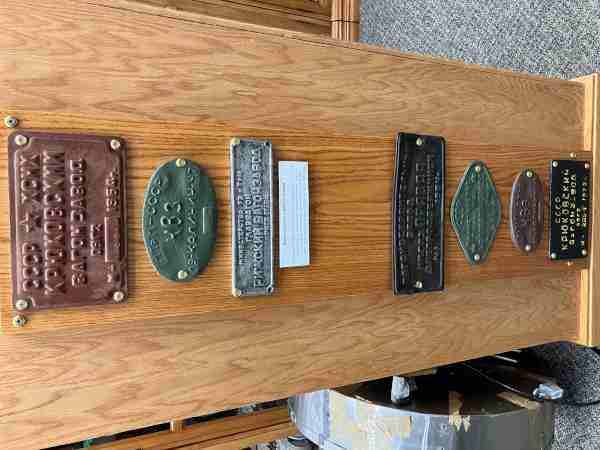
Builder's plates from Russian trains.
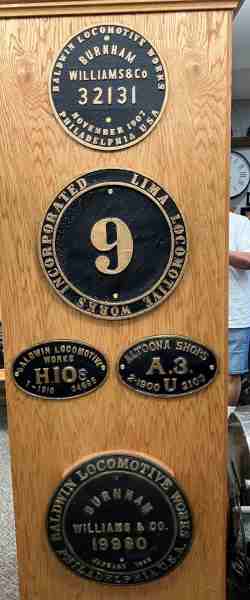
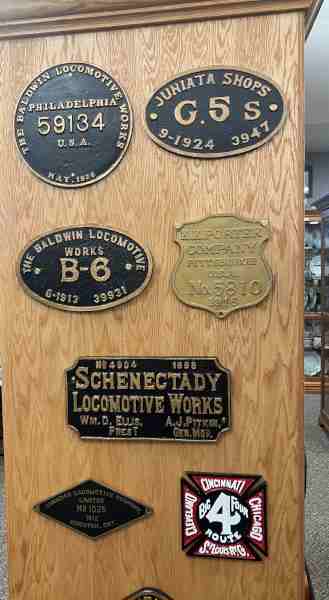
Replica builder's plates from a variety of steam-era companies.
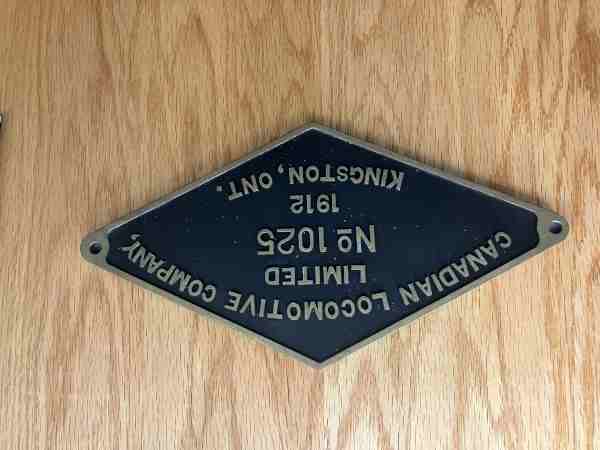
Elizabeth was pleasantly surprised to see this Canadian Locomotive Company builder's plate as CLC was important to Canada, particularly in the steam era. There is naturally not much in the way of CLC-related displays or equipment in the various American museums she has been to and having grown up in Canada (Victoria), has somewhat of an affinity for Canadian railways, although she is of English heritage.
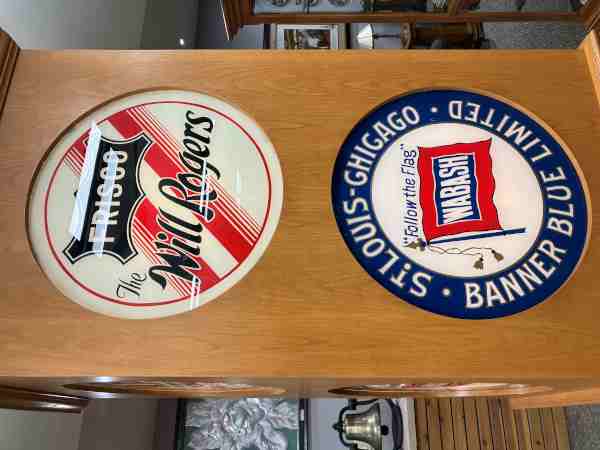
This starts the display of drumheads, namely Frisco the Will Rogers and Wabash St. Louis to Chicao Banner Blue Limited.
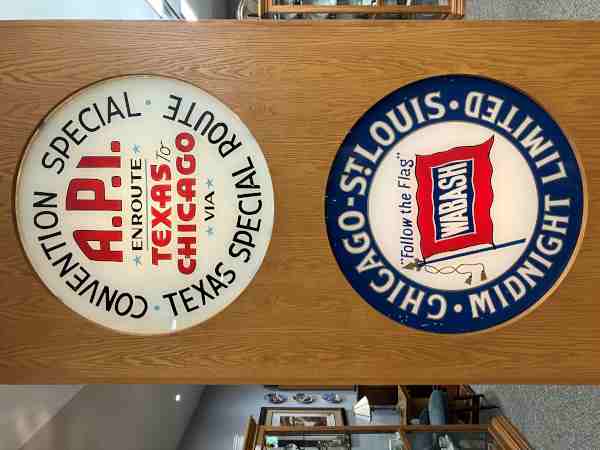
Convention Special Texas to Chicago via the Texas Special Route and Wabash Chicago to St. Louis Midnight Limited.
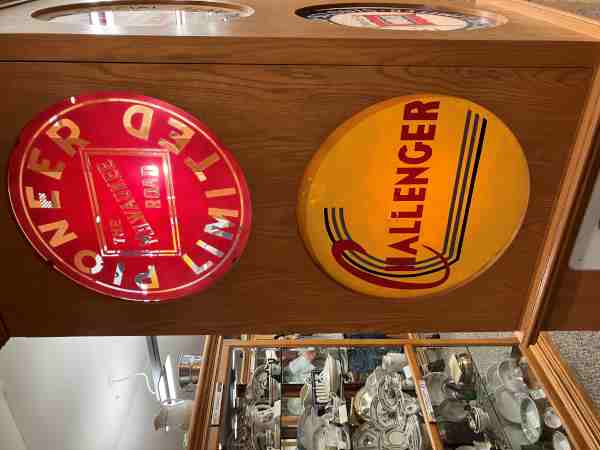
Milwaukee Road Pioneer Limited and Union Pacific Challenger.
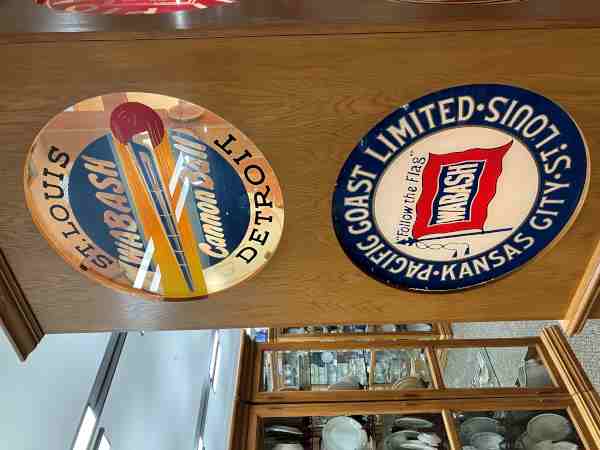
Wabash Cannonball St. Louis to Detroit and Wabash Pacific Coast Limited Kansas City St. Louis.
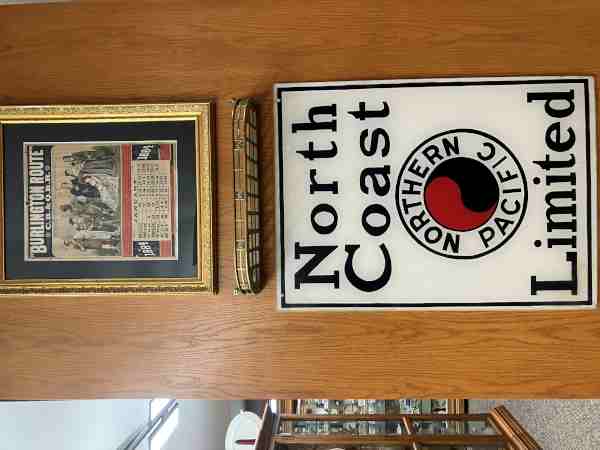
Burlington Route calendar and North Pacific North Coast Limited.
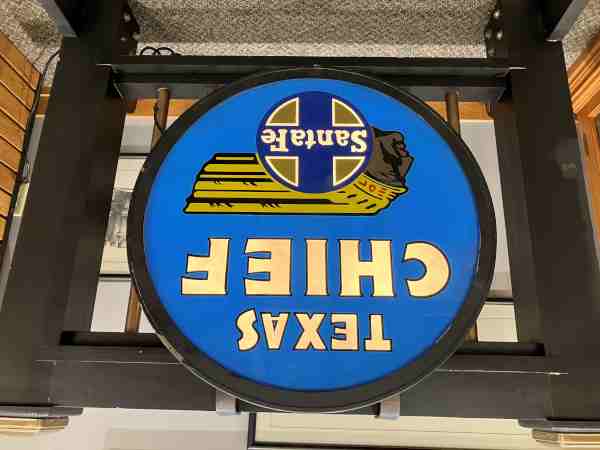
Santa Fe Texas Chief drumhead. Introduced on April 3, 1948, this train competed with the Texas Eagle (Missouri Pacific Railroad) and the Texas Special (Missouri–Kansas–Texas Railroad/St. Louis–San Francisco Railway). The journey from Chicago to Galveston took 26 hours 15 minutes, ten hours faster the previous service on the route. Service to Dallas, Texas began on December 5, 1955 and patronage was strong. The Texas Chief was the first major train outside the Chicago–Los Angeles route to carry the "Chief" moniker popularized by the Chief and Super Chief.
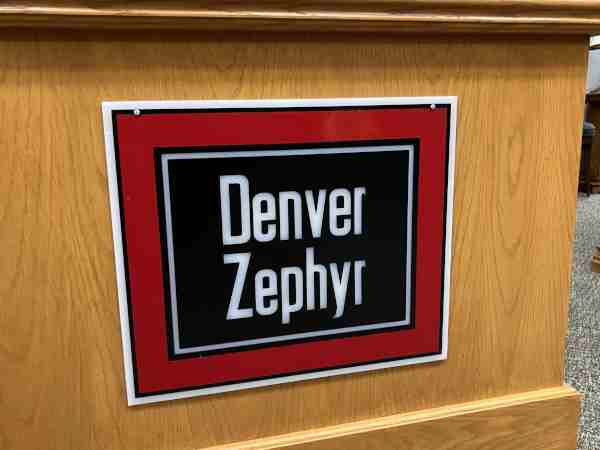
Chicago, Burlington and Quincy Denver Zephyr.
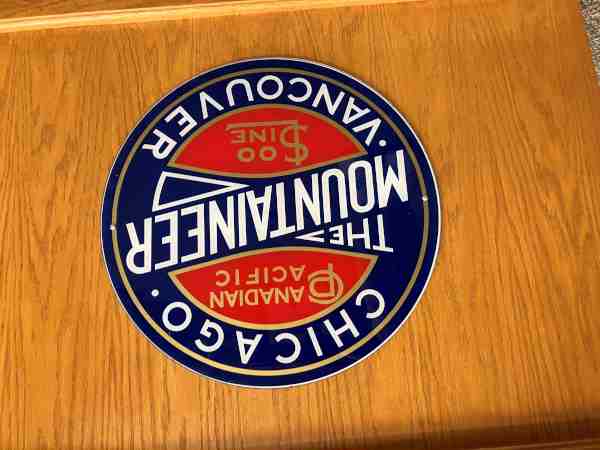
Canadian Pacific and Soo Line's Mountaineer. During the 1920s and 1930s, the Soo Line operated the Soo-Pacific, a summer-only Chicago to Vancouver service with the Canadian Pacific Railway. This later became The Mountaineer, which was then reduced to Minneapolis–St. Paul to Vancouver, before being discontinued in early August 1960. The Mountaineer was a summer-season-only train that carried exclusively sleeping cars but no coaches. During the non-summer months, the train ran as the Soo-Dominion from Minneapolis–St. Paul to Moose Jaw, Saskatchewan, where it was combined into Canadian Pacific's The Dominion transcontinental passenger train. It was cut back to a St. Paul to Portal, North Dakota, run after CP discontinued passenger service to Portal at the end of 1960, before being discontinued entirely in December 1963.
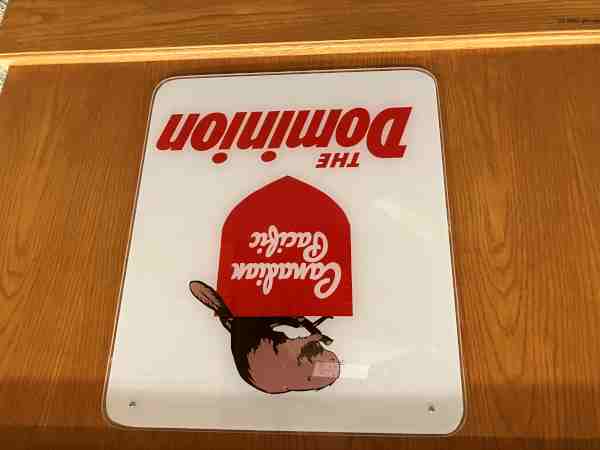
Canadian Pacific's The Dominion, which began as a summer service between Toronto, Ontario and Vancouver, British Columbia, operating in 1931 and 1932. Effective June 23, 1933, it replaced the Imperial Limited as the CPR's main transcontinental service and included a Montreal, Quebec–Sudbury, Ontario section. It remained CPR's flagship train until the introduction of the stainless steel dome streamliner The Canadian on April 24, 1955. In 1960, the train was reconfigured as a "transcontinental local" service on the same route as the Canadian to provide services on shorter trips.
The Dominion had previously carried a large amount of mail and express parcels, which afterward was carried on fast freights as well as on The Canadian. This reduced The Dominion to a typical consist of four coaches and a baggage car. The service was eliminated officially on April 24, 1966, but continued on as the Expo Limited (serving the Montreal World's Fair) for much of 1967.
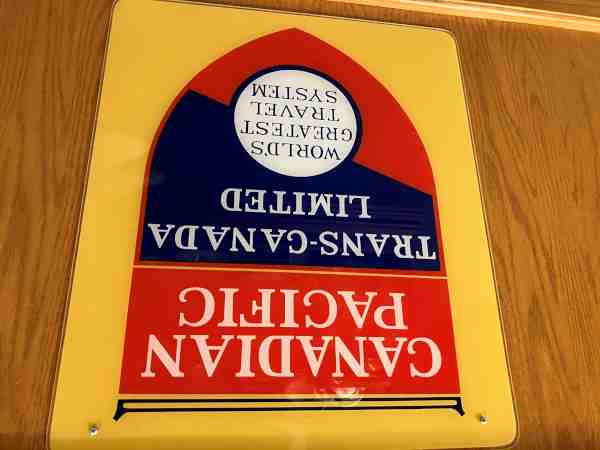
Canadian Pacific Trans Canada Limited, which operated during the summer tourist season between Montreal/Toronto and Vancouver. Starting in 1929, this era ushered in a new growing multi-modalism which necessitated a new look. The shield remained but the beaver went. At this point, Canadian Pacific was known as the "World’s Greatest Travel System". This slogan, used for the railway lines, could be replaced by a symbol within the shield representing each of the other modes of the company.
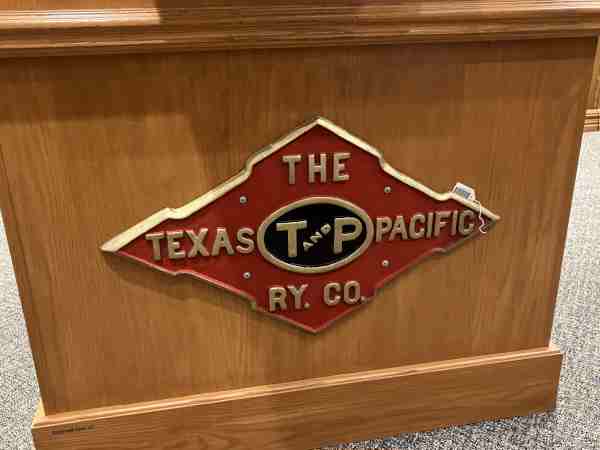
Texas and Pacific Railway Company, which was merged into Missouri Pacific on October 15, 1976, operated six passenger trains throughout its lifetime: Louisiana Eagle from New Orleans–Dallas–Fort Worth, the Southerner from St. Louis (north branch), Memphis, Tennessee (northeast branch), Alexandria, Louisiana (south branch) to El Paso; the Sunshine Special from St. Louis-El Paso and Laredo, Texas; the Texan from St. Louis to San Antonio and Houston; the Texas Eagle from St. Louis to various Texas points (the western section going to El Paso, with connecting Southern Pacific service to Los Angeles; southwestern section to Laredo, with car change for Mexico City; southern section going to Houston; and the Westerner from St. Louis-Dallas–El Paso, with a connection in El Paso for Southern Pacific service to Los Angeles.
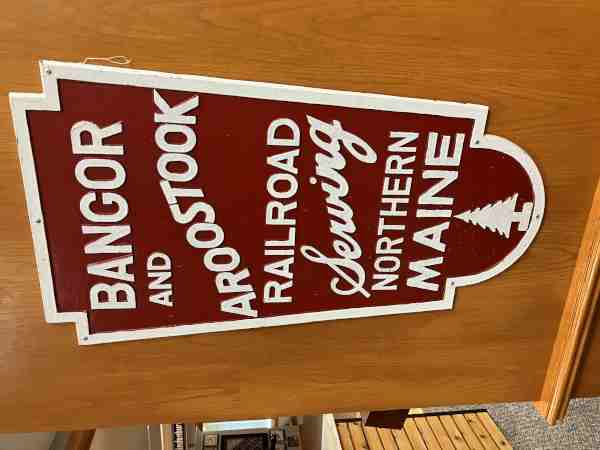
Bangor and Aroostook Railroad serving Northern Maine. Into the 1950s, the Bangor and Aroostook operated an afternoon train, the Aroostook Flyer, on the company's mainline from Bangor (where a connection could be made from the Boston & Maine's Penobscot from Boston), to Brownville, Sherman, Oakfield, Presque Isle, Caribou and concluding in Van Buren (opposite St. Leonard in New Brunswick). A morning train making local stops, the Potatoland, ran from Bangor, using the same route, but after Van Buren continued west to St. Francis.
Service (#9 north/#12 south and also scheduled to meet the Penobscot) operated from Bangor to Derby, leaving the main route heading west to Greenville, whereupon it joined Canadian Pacific trackage to Megantic, Quebec on Lac Mégantic. Greenville served as a transfer point for connecting with east-west Atlantic Limited and other Canadian Pacific Railway service from Montreal to Saint John, New Brunswick via Sherbrooke, Quebec. The company also offered service on an interior branch from Oakfield directly north to Fort Kent, a stop on the route to St. Francis. BAR passenger train service ended in 1961.
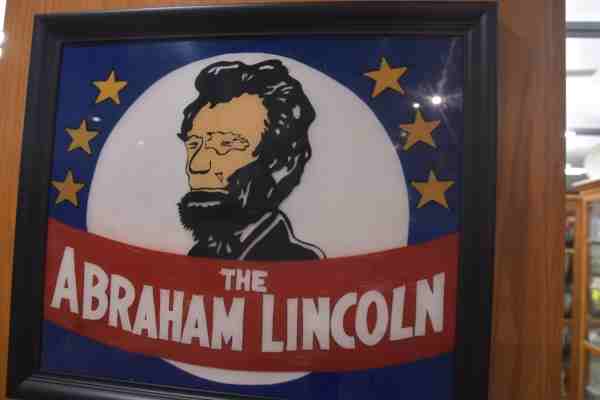
Gulf Mobile and Ohio's Abraham Lincoln, originally a passenger train operated by the Baltimore and Ohio Railroad from 1935 into the 1960s. The Abe Lincoln ran between Chicago and St. Louis on the B&O's subsidiary Alton Railroad. The train later passed to the Gulf, Mobile and Ohio Railroad, and then finally to Amtrak, which retained the name until 1978. Service between Chicago and St. Louis is now known by the umbrella term Lincoln Service. This train was the first streamlined passenger service to travel the 284 miles between Chicago and St. Louis, with Joliet, Bloomington-Normal, Springfield and Alton in between.
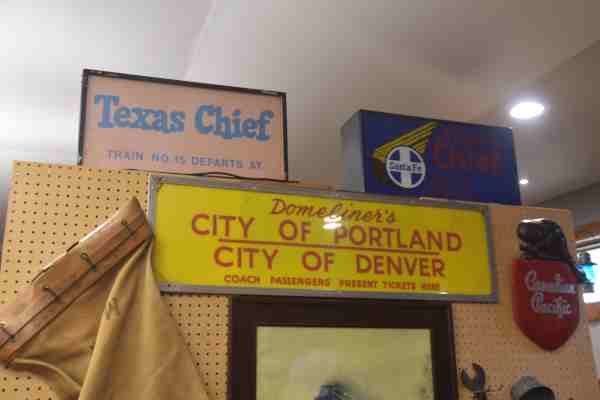
Texas Chief, Super Chief and City of Portland/City of Denver signs from stations.
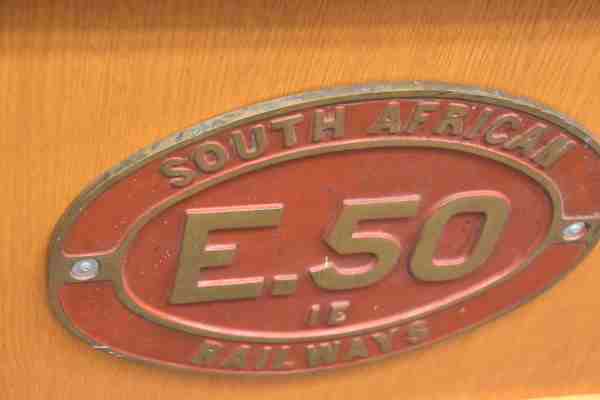
South African Railways E 550 builder's plate.
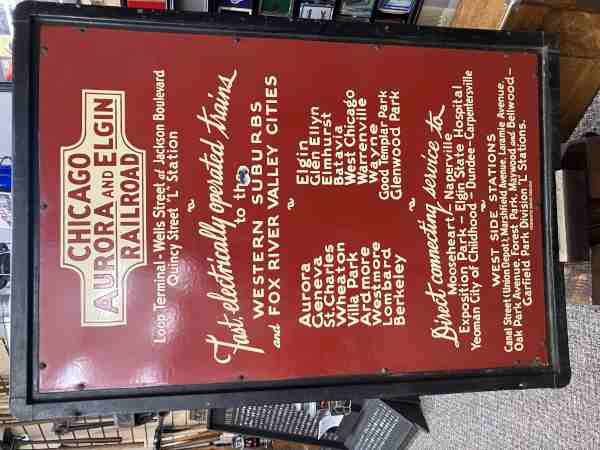
Chicago Aurora and Elgin Railway sign.
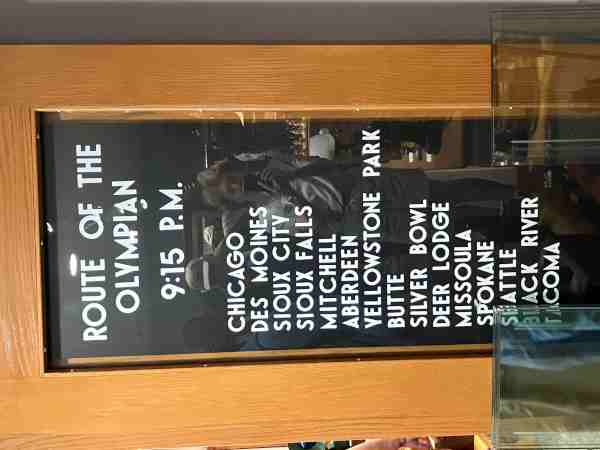
Train board for Milwaukee Road's Route of the Olympian, which operated from 1911 to 1947. Along with its running mate the Columbian, it was the first all-steel train to operate in the Pacific Northwest. The streamlined Olympian Hiawatha operated from 1947 to 1961 and was one of several Milwaukee Road trains to carry the name "Hiawatha". The Olympian Hiawatha was designed by industrial designer Brooks Stevens and included the distinctive glassed-in "Skytop" observation-sleeping cars. It later featured full-length "Super Dome" cars.
In 1909, the Milwaukee Road opened the "Puget Sound extension" from South Dakota to Seattle and Tacoma, completing the last line from Chicago to the coast. The Milwaukee Road ordered cars for two new all-steel luxury trains to run Chicago–Milwaukee–St. Paul–Seattle–Tacoma. The two new trains debuted on May 28, 1911 and the Olympian took 72 hours between Chicago and Seattle, necessitating seven sets of equipment to cover the service. Starting in 1914, the Olympian used the route of the Union Pacific Railroad to serve Spokane, Washington.
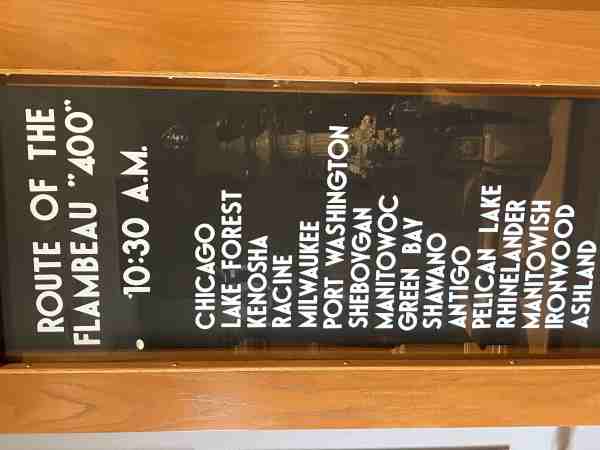
Train board for Chicago and North Western's Flambeau 400, a streamlined passenger train between Chicago, Illinois and Ashland, Wisconsin on Lake Superior, via Green Bay. It was originally a special service in the summer time. Beginning in 1935, the Flambeau transported the new American middle class to its new leisure time in the North Woods of Wisconsin. The Flambeau operated over basically the same route as later trains did except for bypassing Green Bay to run via Hortonville and Eland. By 1937, the route changed to operate via Green Bay. In July 1949, the Flambeau was integrated with the Shoreland 400 and the Valley 400, running as one train between Chicago and Green Bay and as separate trains beyond Green Bay. Northbound trains ran via Fond du Lac and southbound trains via Manitowoc.
In 1950 the train received a new name, Flambeau 400, in reference to the C&NW's popular Twin Cities 400, named for making the approximately 400 mile run from Chicago to Minneapolis, Minnesota in 400 minutes, Flambeau, the French word for a torch. In 1958, the Flambeau 400 and Peninsula 400 received bi-level equipment. Serving the north woods of Wisconsin, it saw heavy tourist traffic, but by May 1968, it was losing thousands of dollars for the North Western. In 1969 the Flambeau became an unnamed Chicago-Green Bay train with seasonal service to Ashland. The last Flambeau 400 rolled out of the North Woods on January 5, 1971. Amtrak did not include Green Bay and Ashland in its initial route structure.
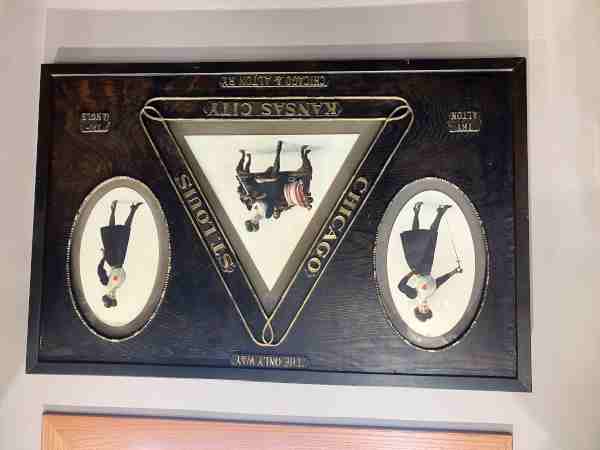
Chicago and Alton Railway "Try Alton, Tri-Angle" promotional marketing.
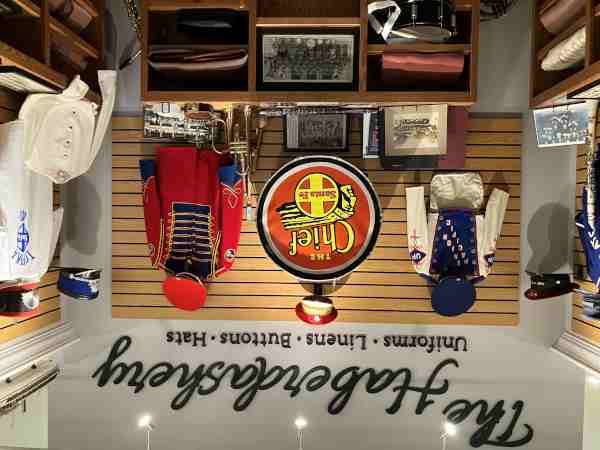
The Haberdashery Uniforms, Linens, Buttons and Hats.
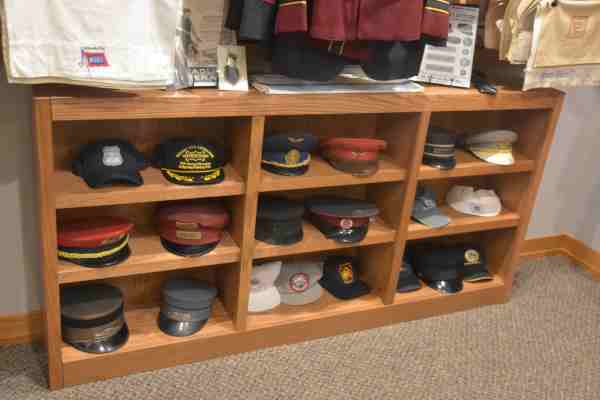
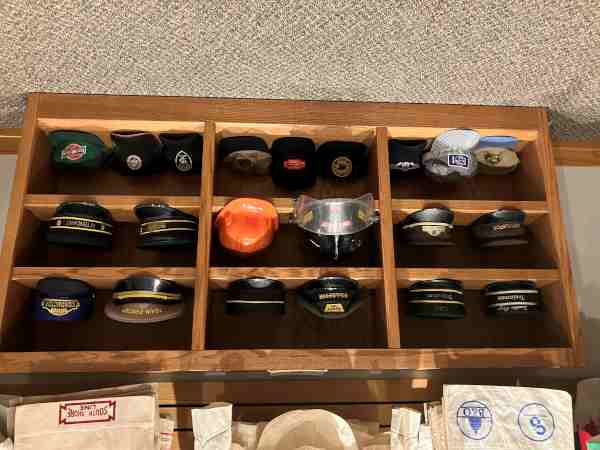
A variety of railroad hats, both for official business and personal use.
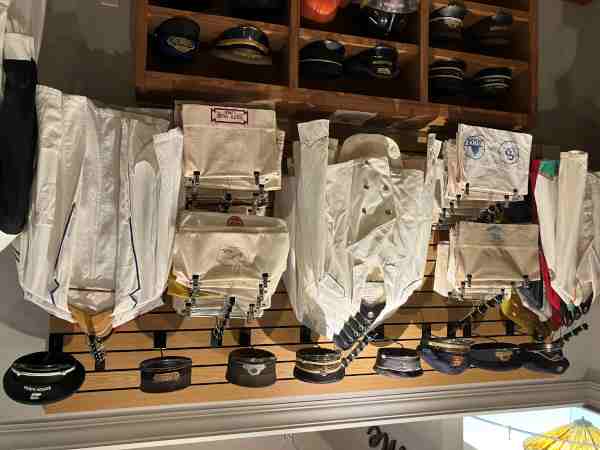
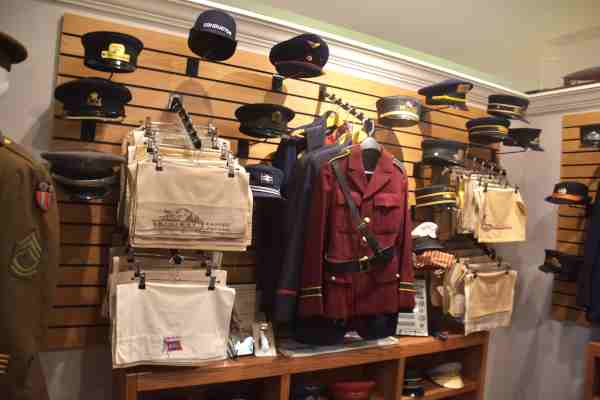
Pullman Porters' uniforms and pillow cases.
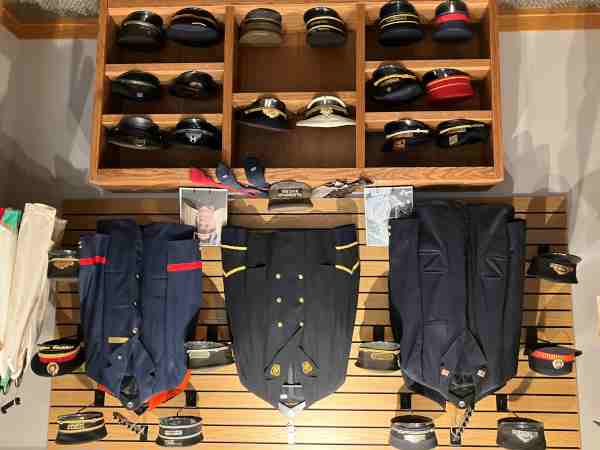
Conductors' hats and uniforms.
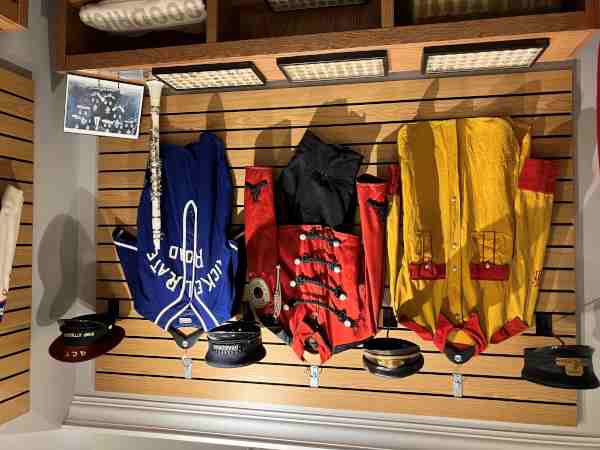
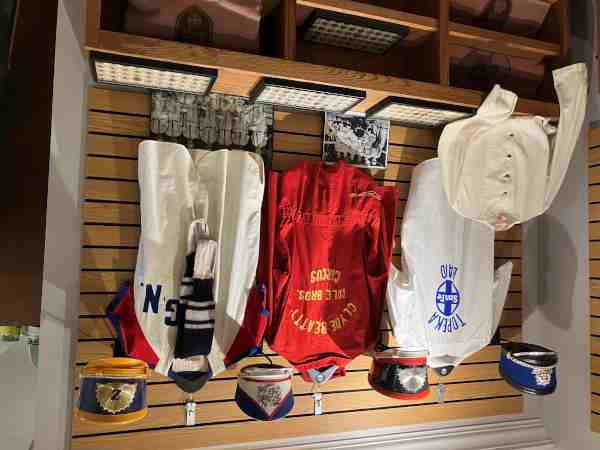
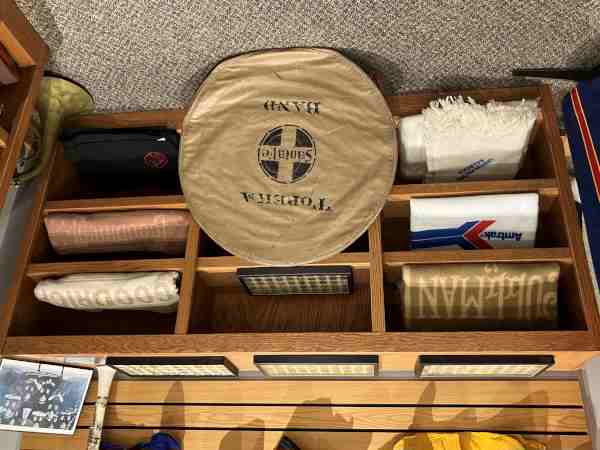
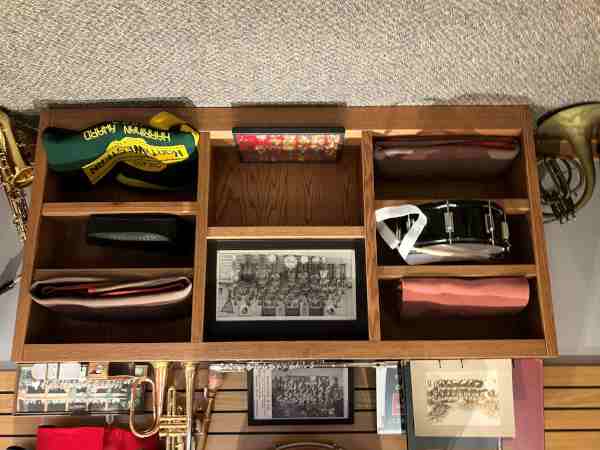
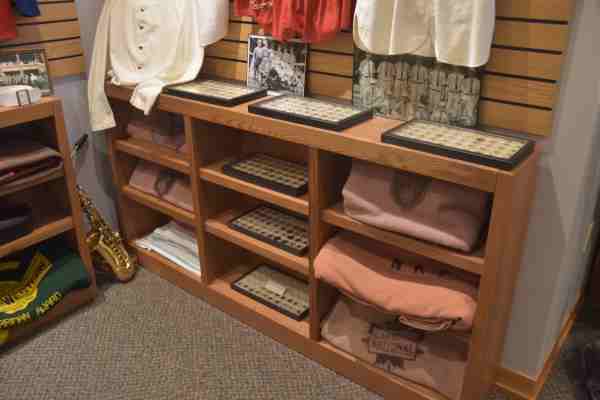
While I have not been to every railroad museum in the country, this is the first display I recall featuring railroad bands. From the February 21, 2024 episode of "Rail Talk", Dave Anderson writes: "In the late 19th and early 20th centuries, before broad adoption of radio and television's advent, industrial bands in America were a thing. Companies, railroads included, sponsored bands, orchestras and choruses to help build camaraderie. A 1929 survey listed 489 industry music groups, more than half of which were bands.
It is not known exactly how many of these bands were organized by railroads, but Anderson's research found nearly a dozen across the network of BNSF predecessor Atchison, Topeka and Santa Fe Railway. By the mid-1960s, most had ceased due to lack of interest, and today the only one with BNSF roots that remains is the Topeka band, which continues to rehearse from the BNSF offices there. Anderson worked for Santa Fe and then BNSF for over 30 years, retiring in 2008 and becoming band director – only its third -- in 2019. He'd started playing trombone with the band in high school, becoming assistant band director in 1974, thanks to his music education degree.
He attributes the band’s staying power in part to Clarence Whitlow, who organized and directed the band for 64 years and worked for Santa Fe in Topeka. Whitlow also enlisted the support of the local railroad management, which over the years would supply uniforms, rehearsal space and travel for when the band played outside of Topeka, for example, Iowa, Oklahoma and Texas for special events.
While the band started as a concert band that marched, frequently participating in parades, state fairs, employee picnics and baseball games, today it plays at retirement homes and summer concerts at Topeka's Gage Park. The repertoire includes traditional band music: standard marches, Broadway show tunes, pop and novelty pieces. At the end of every concert, "Stars & Stripes Forever" is the finale. Over the years hundreds of people have been part of the band – employees, their spouses and children, retirees and now anyone who likes to make music.
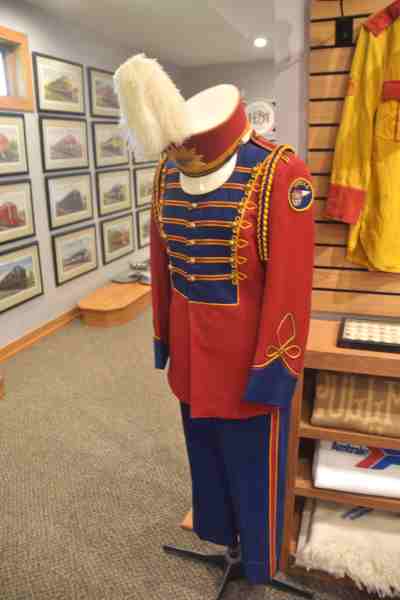
The uniform of the Santa Fe band.
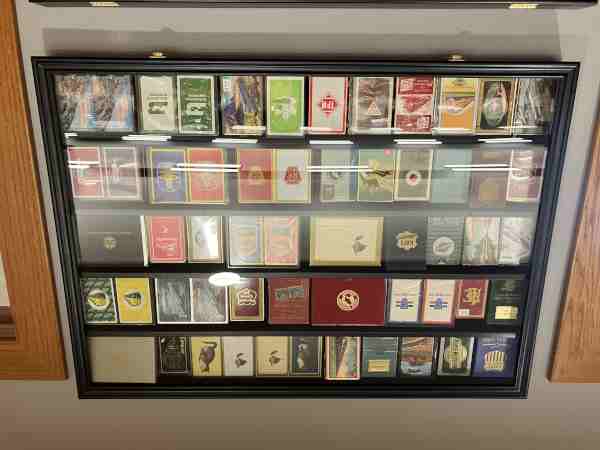
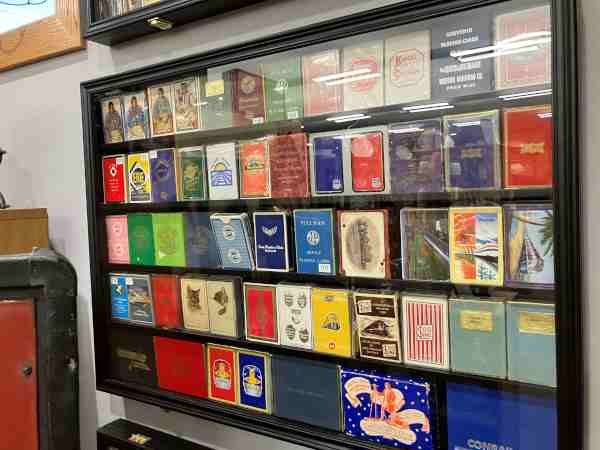
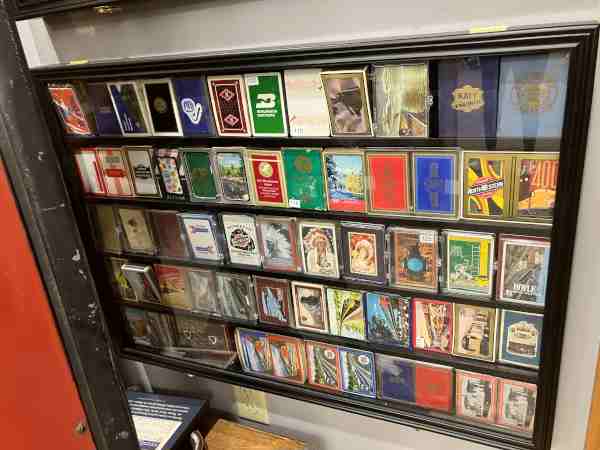
Passenger train playing cards.
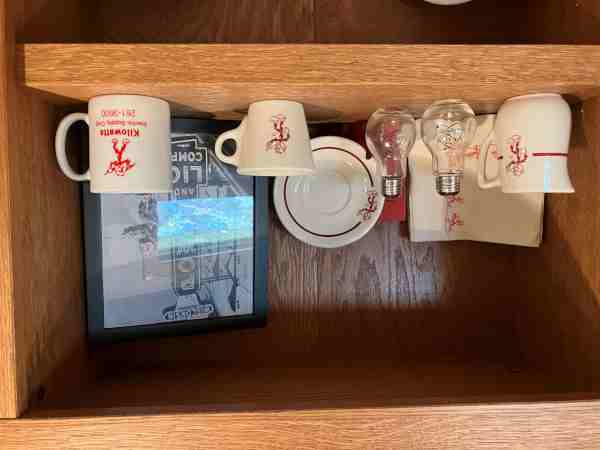
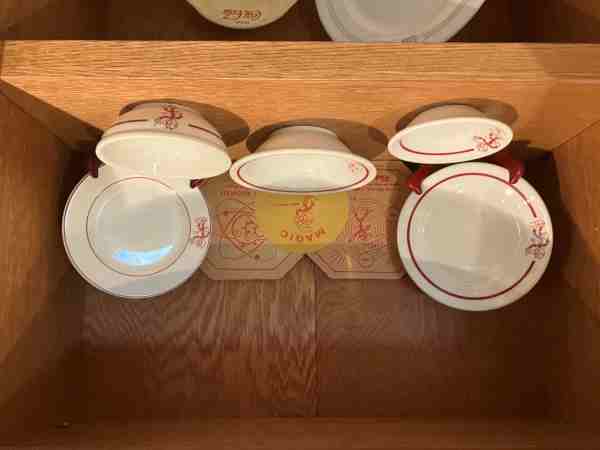
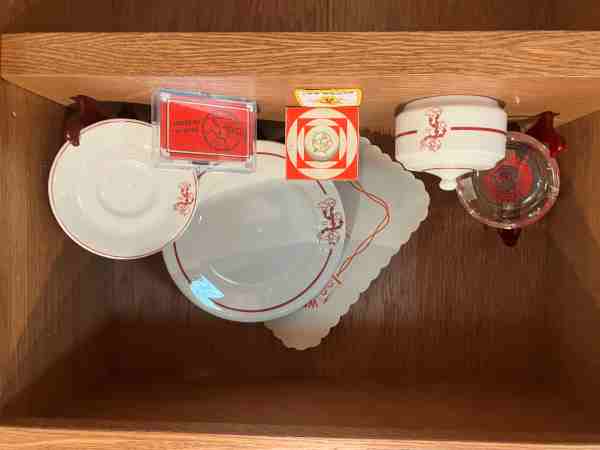
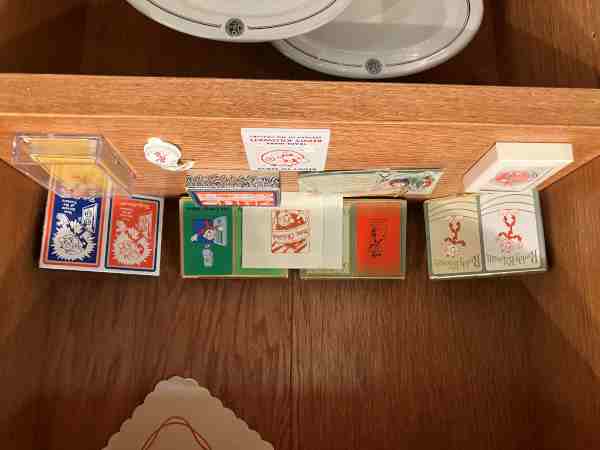
Memorabilia of Ready Kilowatt, a cartoon character that served as a corporate spokesman for electricity generation in the United States and other countries for nearly one hundred years. Reddy Kilowatt made his first published appearance on March 14, 1926 in an advertisement in The Birmingham News for the Alabama Power Company (APC). The character was the brainchild of the company's 40-year-old commercial manager, Ashton B. Collins Sr. Like other electric utilities of the period, APC was seeking to grow consumer demand for electrical power. Commercially viable AC generating stations had begun powering North American streets and homes by the end of the 19th century. By the mid-1920s, electric utilities had succeeded in bringing electricity to virtually all major cities and towns in North America; however, rural areas remained chronically underserved. In 1930, almost 90 percent of farms in the United States were still without access to electric service.
Collins was convinced that the best way to win over new customers, including frugal small business owners and skeptical farmers and rural dwellers, was to give his mostly invisible new commodity a more human face. According to corporate lore, Collins found his inspiration in a dramatic Alabama lightning storm. As he watched the electric discharges strike the ground, he imagined the dancing limbs of a powerful creature, one that could be harnessed in the service of the public. He turned to a colleague, APC engineer Dan Clinton, to create the first drawings of Reddy Kilowatt, an "electrical servant" with lightning bolt arms and legs, wearing safety gloves and shoes. He added a friendly face with a light bulb nose and wall outlets for ears. Reddy's original design had five arms, representing electricity's ability to be everywhere at once.
APC copyrighted the character on March 6, 1926. Over the next few years, Reddy appeared in print advertising for the company. He made his first three-dimensional appearance at the Alabama Electrical Exposition of 1926.
With the impending end of hostilities in the final months of World War II, utility companies began to prepare for a return to a consumer-driven economy, and to respond to 15 years of pent-up demand for new household appliances. Demand for electric power jumped 14 per cent between 1946 and 1947 alone. An important driver was that, even as demand for electrical energy increased, the cost of energy continued to decline. When Reddy was created in the mid-1920s, a kilowatt-hour cost 55 cents (in constant 1992 dollars). By 1947, it had fallen to 19 cents and it would continue to fall over the ensuing two decades. Ashton Collins saw that Reddy Kilowatt could play an important role in promoting electrical use in a period of post-war prosperity, but recognized a need to refine the character's image. As early as 1943, Collins approached the prominent American animator Walt Disney in a bid to adapt Reddy for film. The studio was heavily involved in producing films for the U.S. military at the time and the project did not proceed.
Two years later, Collins approached another noted animator, Walter Lantz, with the idea of starring Reddy on the big screen. Lantz, whose characters like Woody Woodpecker and Andy Panda were well known to theatre-goers of the period, agreed, releasing the short film Reddy Made Magic in March 1946. Lantz and Collins shared producing credits on the film, which was directed by Dick Lundy, a former Disney animator. The screenplay, by Ben Hardaway and Milt Schaffer, featured the story of the creation of electricity as told by Reddy Kilowatt. In conjunction with the film version of Reddy Made Magic, Educational Comics produced a companion comic book with a cover price of five cents and the subtitle The amazing true story of electricity. Reddy's movie voice was provided by Walter Tetley, the prolific voiceover actor whose talents were in demand by producers needing a high-pitched, adolescent sound.
In 1953, Collins incorporated RKS as Reddy Kilowatt, Inc., (RKI) establishing its head office in New York City. The company continued to provide a range of products and services to licensees. In addition to the Proofs Book, RKI produced a handbook with guidelines to assist utilities in using Reddy to their advantage. Around 1942, the Reddy News, a glossy periodical that highlighted successes and best practices of RKI licensees, replaced the Reddy Bulletin.