




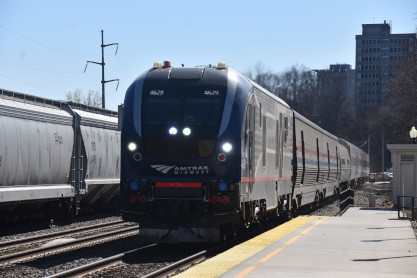
We had not ridden the Missouri River Runner since we moved to Columbia in October 2023 so Elizabeth and I exchanged some of our Amtrak Guest Rewards points for a round-trip from Jefferson City to Kansas City. We chose the last day of February and following our morning preparations, I drove us to the state's capital city and we parked, as directed, in the secure lot to the right of the station trailer.
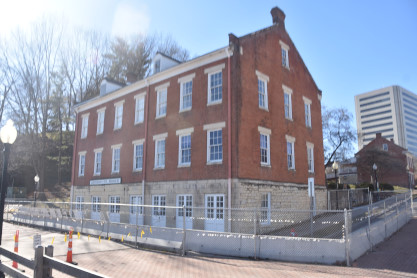
The former Union Hotel, a rectangular three-story Federalist-styled structure on a slope facing the platform on the river side. The lower story is clad in a pale, rusticated stone, with the upper two stories being red brick. Open-gabled dormer windows pierce the longer sides of the gabled roof. The waiting room is located on the ground floor of the historic Union Hotel, part of the Jefferson Landing Historic Site. It is entered from the lower level and occupies the building formerly shared with the Missouri Department of Natural Resources.
It was built in 1890 and Amtrak served the Missouri Pacific depot, two blocks east, from May 1971 until 1984, and the Union Hotel until 2020, when it closed for repairs in October 2019 at the direction of the building's owner, the Missouri Department of Natural Resources. Amtrak was relocated to a temporary facility located along the boarding platform a half-block west.
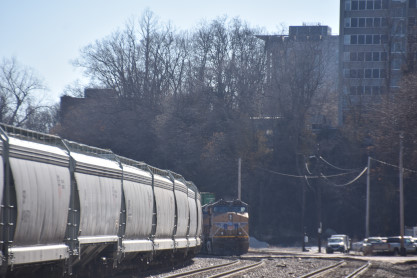
Union Pacific 5278 West was waiting for Amtrak to leave.
A while later, Missouri River Runner Train 311, led by Amtrak SC-44 4626 leading, arrived and we boarded, choosing a pair of seats on the right for the journey west.
The Missouri River Runner is a 283 mile Amtrak route in Missouri between Gateway Transportation Center in St. Louis and Union Station in Kansas City. The eastern half of the route runs largely along the right bank of the Missouri River. First introduced in 1980 as the Kansas City Mule and St. Louis Mule, the Missouri River Runner received its current name in 2009. As of 2023, there are two daily round trips between Kansas City and St. Louis, with one continuing north to Chicago Union Station as a Lincoln Service train; these services fall under the Amtrak Midwest brand.
The Missouri River Runner route was previously served by the Missouri Mules (known as the Kansas City Mule westbound and the St. Louis Mule eastbound) and the Ann Rutledge under the Missouri Service brand. The Missouri Service, in turn, ran along the former main line of the Missouri Pacific Railroad. Several of MoPac's St. Louis–Kansas City trains continued onward to Omaha and Denver. Missouri Pacific was acquired by the Union Pacific Railroad in 1983.
When Amtrak took over nationwide passenger service in 1971, the route became the western leg of the National Limited, which originated in New York. This was the first passenger train on the route to originate at a point east of the Mississippi River. It was the successor of the famed Spirit of St. Louis, which was extended to Kansas City after Amtrak's formation and renamed later in 1971.
When the National Limited was canceled in 1979, the only train serving the St. Louis–Kansas City corridor was the Chicago–Kansas City Ann Rutledge. Missouri officials pressed for the introduction of the Mules in order to maintain and improve service between St. Louis and Kansas City. Over the ensuing years of state subsidy, additional station stops were established at Washington, Hermann, Lee's Summit and Independence.
The Ann Rutledge had previously been part of both the Missouri Service and Illinois Service, but had its eastern terminus cut back to St. Louis in 2006. This gave the St. Louis–Kansas City route two daily round trips on a schedule similar to the last pre-Amtrak MoPac service. The Chicago–St. Louis State House connected once per day with the Ann Rutledge to continue through service from Chicago to Kansas City.
In 1984, Amtrak's Jefferson City depot and ticket office was moved from the former MoPac station to a renovated historic building east of the depot but closer to the Missouri State Capitol. It was hoped the relocated station would allow tourists and others easier access to the state government buildings. Jefferson City is not on an Interstate Highway; the nearest commercial airport is in Columbia. The revived station stop at Hermann was instituted in similar fashion to encourage use of Amtrak for access the city's popular German festivals. Missouri River Runner. In 2008, Amtrak and the Missouri Department of Transportation decided to merge the Mules and Ann Rutledge into a single route. The name of the new route was announced in January 2009 as part of the "Name The Train" contest held by MoDOT. The winning name was submitted by Keith Kohler of Glendale, Missouri; it reflects the fact that the route largely parallels the Missouri River.
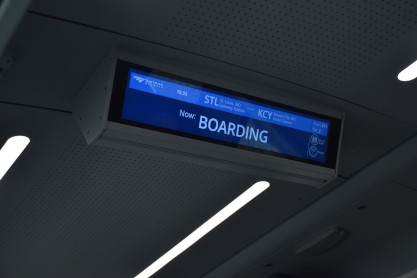
This was our first time in Siemens Venture cars and the digital readout kept passengers informed as to the status and location of the train. Westbound Train 311 St. Louis to Kansas City at 10:33 AM.
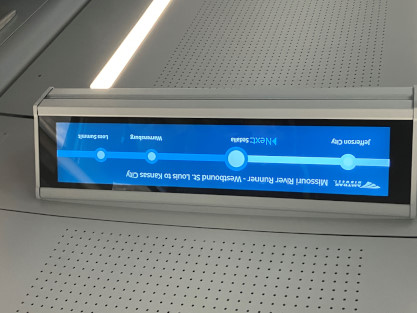
Westbound Missouri River Runner's next stop was Sedalia.
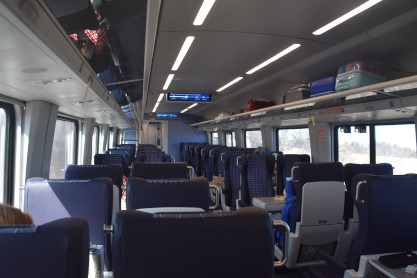
The interior of our coach. We had read of various people's dislike of the seats, and while not as padded and comfortable as a Superliner seat, they were decent for a short-haul journey. However, the back of the seat does not recline, a feature that I disliked.
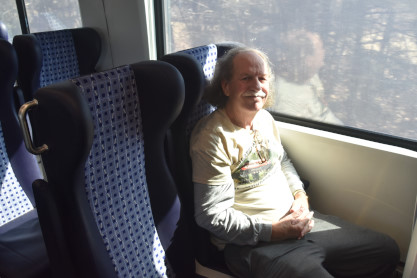
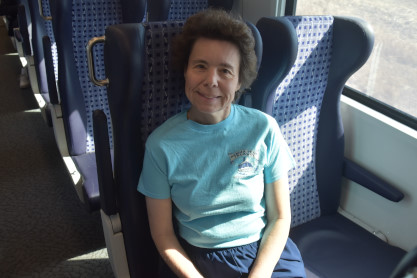
The obligatory pictures of the author and his wife.
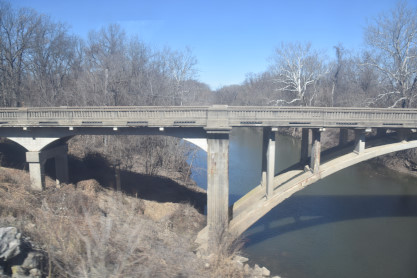
The Lamine River.
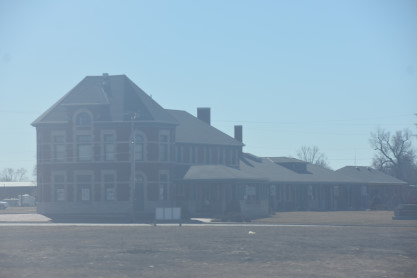
The Sedalia Missouri-Kansas-Texas station built in 1870 as seen through the window.
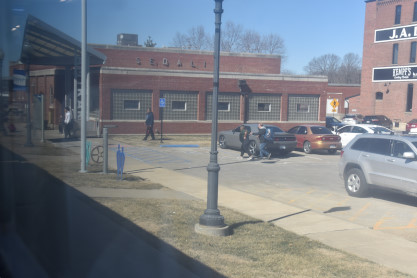
Sedalia Missouri Pacific station built in 1885.
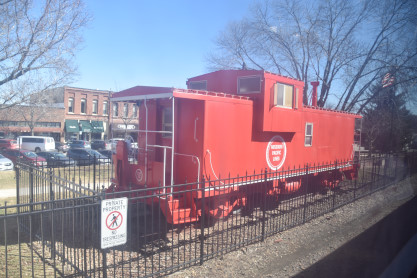
Missouri Pacific caboose 13543, built by International Car in 1973 on display outside the station.
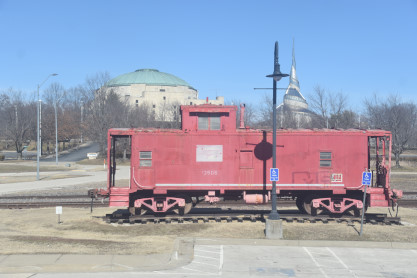
Beside the station in Independence is Missouri Pacific caboose 13506, ex. Chicago and Eastern Illinois 33, nee Elgin Joliet and Eastern 534, painted as Missouri Pacific 13506, built by International Car in 1956.
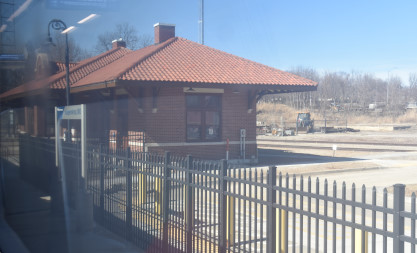
Independence Missouri Pacific station built in 1913, a stop on our route.
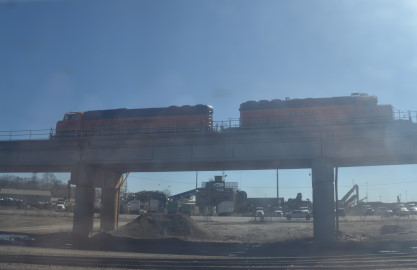
On the flyover as we approached Kansas City, I spotted BNSF SD60M 1452, ex. BNSF 9275, exx. BNSF 8175, nee Burlington Northern 9275 built by Electro-Motive Division in 1991, and BNSF SD40-2 1974, ex. BNSF 6371, exx. Burlington Northern 6371, nee Colorado and Southern 923, built by Electro-Motive Division in 1974. Unfortunately, the sun was at the wrong angle. We then entered Union Station, detrained and walked via the Skywalk to Fritz's Restaurant.
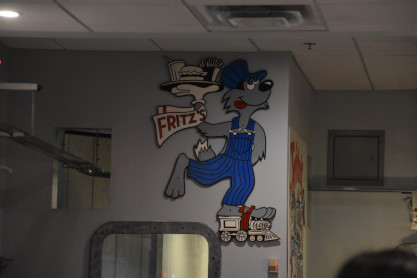
Fritz’s is famous for old-fashioned hamburgers made with 100 percent choice ground beef, grilled onions seared in the meat, toasted buns and always "cooked to order" just the way Fritz's dad served them at his Kansas City, Kansas location, John's Place, dating back to the 1920's. In 1954, a few years after Fritz's return from the Navy, which included an assignment on the USS San Francisco stationed at Pearl Harbor during the attack in 1941, Fritz and Virginia Kropf started their own fifties-style drive-in restaurant at 32nd and Brown Avenue in Kansas City, Kansas. At Fritz’s Railroad Restaurant, you can experience the fun and delight as your meal is delivered directly to your table by our signature overhead train. Kids and adults alike will never forget the excitement of watching food being lowered to surrounding tables by our amazing delivery trains, and the anticipation of their own food delivery.
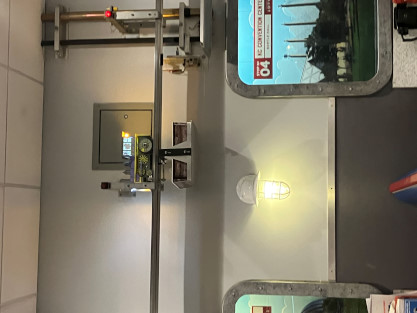
One of the trains that deliver the meals directly to your table. I had a plain hamburger and a chocolate malt while Elizabeth had a cheeseburger and a strawberry shake.
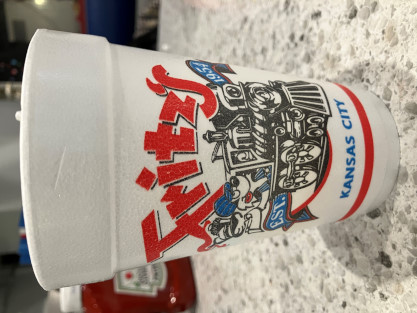
Fritz's emblem on the cup. We brought a souvenir coffee mug then strolled back to the station through the Skywalk.
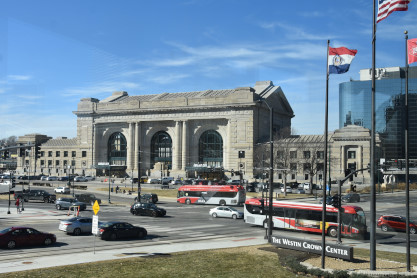
Kansas City Union Station, opened in 1914 to serve Kansas City and the surrounding metropolitan area. It replaced a small Union Depot built in 1878. Union Station served a peak annual traffic of more than 670,000 passengers in 1945 at the end of World War II, but traffic quickly declined in the 1950's, and the station was closed in 1985. In 1996, a public–private partnership undertook a $250 million restoration, funded in part by a sales tax levied in Kansas and Missouri counties of the Kansas City metropolitan area. By 1999, the station had reopened as a suite of attractions, including museums. In 2002, train service returned when Amtrak began public transportation services, and the station became Missouri's second-busiest train station. The refurbished station has theaters, ongoing museum exhibits, and attractions such as Science City, the Irish Museum and Cultural Center, and the Todd Bolender Center for Dance and Creativity. Since 2016, it has been a stop for the KC Streetcar.
On April 8, 1878, Union Depot opened on a narrow triangle of land in Kansas City, Missouri, between Union Avenue and the railroad tracks of the Hannibal and St. Joseph Railroad in what became West Bottoms. Nicknamed the "Jackson County Insane Asylum" by those who thought it was too large. It was the second union station in the country, after the Indianapolis Union Station. Union Depot's architecture was a hybrid of Second Empire and Gothic Revival. The lead architect was Asa Beebe Cross, who "adorned the exterior of the building with intricate towers of varying heights, arched windows framed in stone and rows of dormers projecting from the steeply pitched mansard roof". It had a clock tower above the main entrance that was 125 feet in height. By the 20th century, over 180 trains were passing daily through the station, serving a city population that had tripled. In 1903, the lack of room for expansion and a major flood led the city and the railroads to decide a new station was required.
The decision to build a new station was spearheaded by the Kansas City Terminal Railway, a switching and terminal railroad that was a joint operation of several railroads: Alton; Atchison, Topeka and Santa Fe; Chicago, Burlington and Quincy; Chicago Great Western; Chicago, Milwaukee, St. Paul and Pacific; Chicago, Rock Island and Pacific; Kansas City Southern; Missouri-Kansas-Texas; Missouri Pacific; St. Louis-San Francisco; Union Pacific; and Wabash. The new location was at a valley at 25th Street and Grand Avenue used by the Kansas City Belt Railway. It was south of the central business district, above and away from the floodplain. Architect Jarvis Hunt was a proponent of the City Beautiful movement. The Beaux-Arts architecture design was a main hall for ticketing, and a perpendicular hall extending out above the tracks for passenger waiting. The building encompassed 850,000 square feet and the ceiling in the Grand Hall is 95 feet high. There are three chandeliers weighing 3,500 pounds each, and the Grand Hall clock face is six feet in diameter. The building's scale reflects Kansas City's central location as a hub for both passenger and freight rail traffic.
The Kansas City massacre occurred on June 17, 1933, in front of Union Station, while captured fugitive Frank Nash was to be delivered to prison via train. Four lawmen (including FBI) were murdered by the Kansas City crime family with Thompson submachine guns in an attempt to free Nash, who was also killed in the gun battle. The massacre highlighted the lawlessness of Kansas City under the Pendergast Machine and resulted in the arming of all FBI agents
In 1945, annual passenger traffic peaked at 678,363. The demand for a large train station declined in the 1950s. In 1973, it had 32,842 passengers, all passenger train service was now run by Amtrak, and the building was deteriorating. Kansas City government wanted to preserve and redevelop the building, and, in 1974, made a development deal with Canadian redeveloper Trizec Corporation. Between 1979 and 1986, Trizec constructed two office buildings on surrounding property, but did not redevelop the station. The deteriorating station closed in 1983, except a "bubble" inside the main hall housing Amtrak's operations until 1985, when all passenger operations were moved to a smaller "Amshack" facility adjacent to the old station. In 1988, the city sued Trizec for the failure to develop the station and settled in 1994. For most of this period, the building continued to decay.
In 1996, residents in five counties throughout the Kansas City metropolitan area in both Kansas and Missouri approved the so-called "bistate tax", a 1/8 of a cent sales tax, part of which helped to fund just under half of the $250 million restoration of Union Station. Renovation began in 1997 and was completed in 1999. The remaining money was raised through private donations and federal funding. The renovations enabled Amtrak to move its operations back inside the main building in 2002.
Union Station receives no public funding. Operating costs are funded by general admission and theater ticketing, grants, corporate and private donations, commercial space leases, and facility rental. Union Station Kansas City, Inc., a nonprofit 501(c)(3) organization, manages Union Station and had previously managed the Kansas City Museum.[12] Union Station hosts Science City (opened in 1999), a family-friendly interactive science center with more than 50 hands-on exhibits;[13] the H&R Block City Stage Theater, a live-action venue with productions for all ages; the Regnier Extreme Screen, the largest movie screen in the region at five and half stories tall; two restaurants, including Pierponts, an upscale steak and seafood restaurant, and Harvey's; many shops; the Gottlieb Planetarium, the largest planetarium in the area; and various temporary museum exhibits including Dead Sea Scrolls in 2007, Bodies Revealed in 2008, Dialog in the Dark in 2009, Dinosaurs Unearthed in 2010 and Diana, A Celebration focusing upon Princess Diana in 2011. The Irish Museum and Cultural Center has been located in the station since March 17, 2007.
The old Union Station Powerhouse building was renovated by the Kansas City Ballet. It is the ballet's new home and has been named the Todd Bolender Center for Dance and Creativity since August 2011.
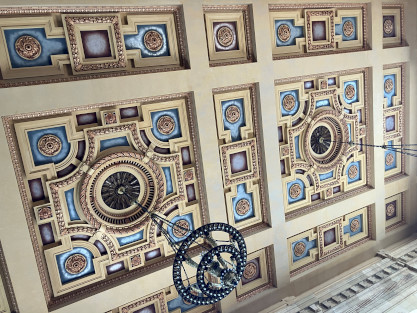
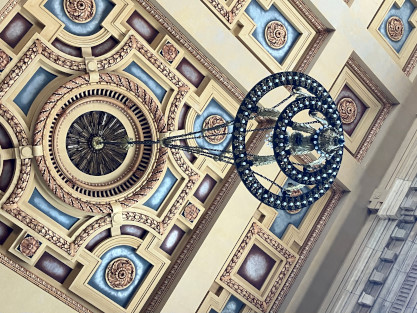
The chandeliers and beautiful ceiling. We then saw the Haverty Railroad Gallery and went to investigate.
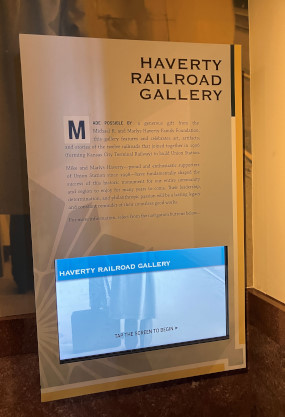
Haverty Railroad Gallery, made possible by a generous gift from the Michael R. and Marlys Haverty Family Foundation, features and celebrates art, artifacts and stories of the twelve railroads that joined together in 1906 (forming Kansas City Terminal Railway) to build Union Station. Mike and Marlys Haverty — proud and enthusiastic supporters of Union Station since 1998 — have fundamentally shaped the success of this historic monument for our entire community and region to enjoy for many years to come. Their leadership, determination and philanthropic passion will be a lasting legacy and constant reminder of their countless good works.
Mike was born in 1944 in Atchison, Kansas and would grow to become a 4th generation railroader for the Missouri Pacific railroad. His great-grandfather started working for the railroad in 1865 building depots and bridges, and his grandfather and father also worked for Missouri Pacific. After graduating in 1967 from Southwestern Louisiana - now the University of Louisiana-Lafayette - Mike entered the Missouri Pacific management training program in St. Louis. He stayed with MoPac until 1970 then moved to the Atchison, Topeka and Santa Fe Railway. In 1995 he was recruited to run the Kansas City Southern Railway. In 2001 he became chairman, president and CEO of Kansas City Southern, a transportation holding company with railroads in the United States, Mexico and Panama. He retired from Kansas City Southern in 2015 after a 20-year career with the Company. Along with his family, Mike has been committed to the long-term success of Union Station since it’s reopening nearly 25 years ago. As a Union Station Board Member since 2001 - and Chairman of the Board from February 2005 to June 2012 - he continues to provide invaluable strategic leadership and support. Additionally, the Haverty Family philanthropy can be experienced across our historic campus to include the Michael R. Haverty Freighthouse Bridge, the Haverty Railroad Gallery, and Haverty Family Yards. All are named to remind Kansas City of the tremendous legacy he has built that will benefit generations to come.
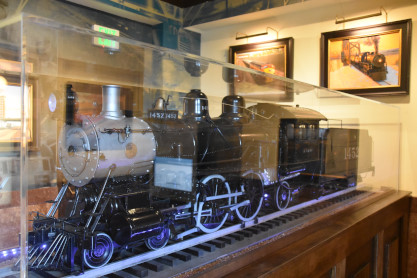
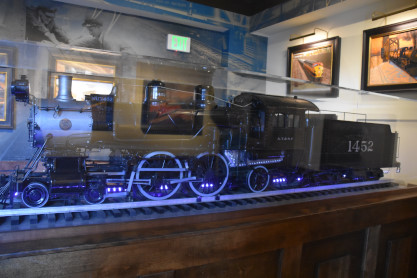
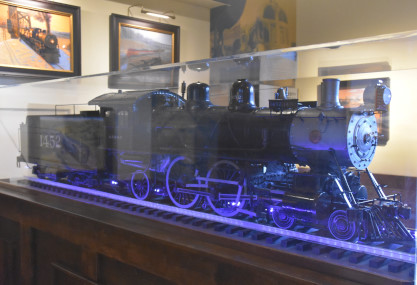
A fully functioning one-eighth scale model of Santa Fe 4-4-2 1425, built in 1915 by apprentices at Santa Fe's shops in San Bernardino, California and presented to John Reed, Santa Fe's President from 1967 to 1978, its Chief Executive Officer from 1968 to 1982 and Chairman of the Board from 1973 to 1983, on his retirement.
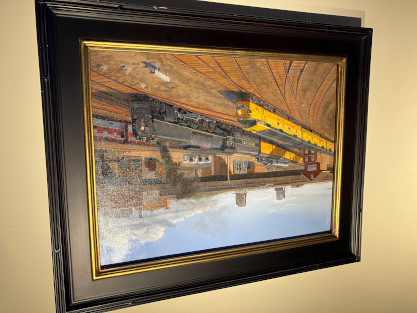
This was one of a series of twelve railway paintings by Richard Allison, an American Realist specializing in marine, railroad and aviation subjects. The former illustrator and editorial cartoonist for Army, Navy and Air Force Times in Washington, D.C., Allison shows deep respect for the historical significance of his subjects and strives for correctness of detail in his paintings. Combining a keen eye with a skilled brush has led to his art being displayed in several major galleries and museums across the country. Allison's work has been exhibited at the Smithsonian National Air and Space Museum in Washington, D.C., the Colorado Springs Fine Art Center, the Wichita Center for the Arts and the Virginia Air and Space Center in Hampton, Virginia to name a few. President Ronald Reagan presented his painting of the battleship New Jersey to the ship during re-commissioning ceremonies in December 1982. The battleship Missouri was the recipient of a similar work of art presented by Missouri Governor John Ashcroft in July 1986.
An avid Plein air painter, Allison brings to his studio paintings sensitivity to light and color that can only be developed from direct observation. The settings for these subjects may be marine, aviation or railroad, but they all incorporate a historical element bathed in a light that is almost palpable. Union Station is honored to have historically accurate paintings of the twelve original railroads that paved the way for the building of Kansas City’s icon.
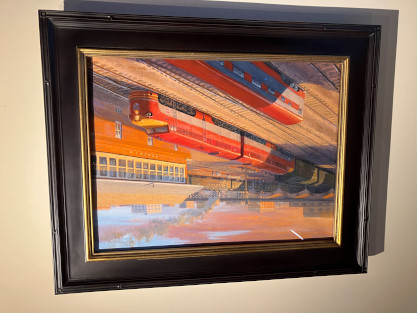
A St. Louis-San Francisco train. The paintings were not named or identified, so captions below are not very detailed.
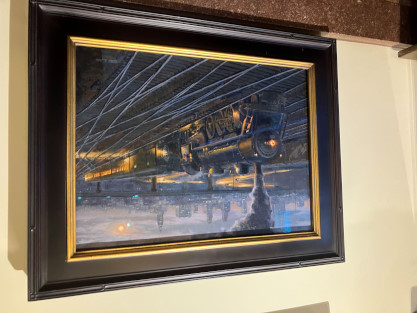
Departing Kansas City.
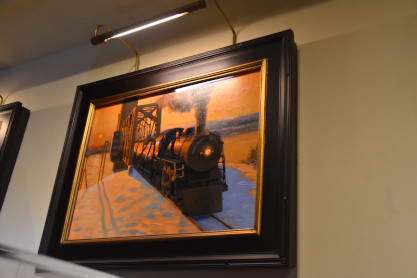
A steam train crossing a river.
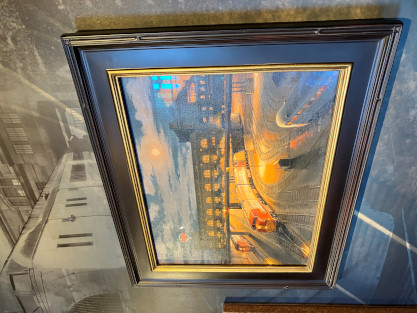
Santa Fe train leaving Kansas City Union Station.
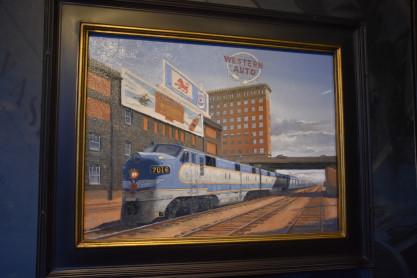
Missouri Pacific passenger train with the instantly-recognizable Western Auto sign.
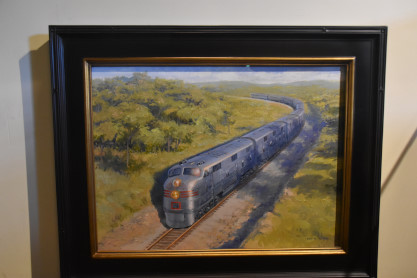
A Burlington Northern passenger train in the country.
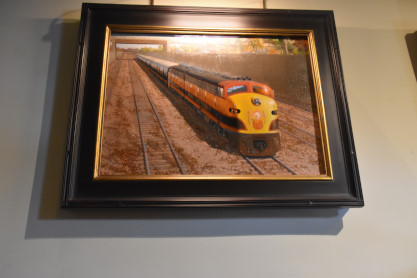
A Kansas City Southern train entering Kansas City.
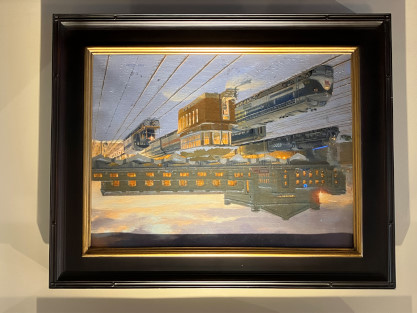
A Wabash passenger train departing Union Station
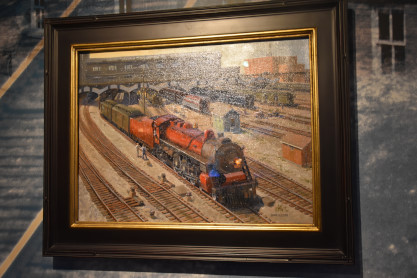
St. Louis and San Francisco steam train departing Union Station.
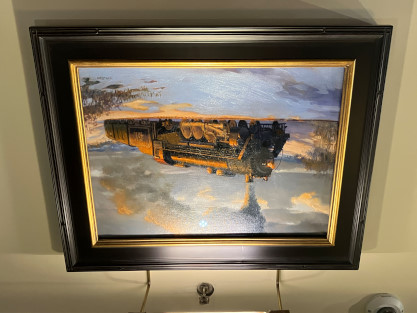
A Chicago, Burlington and Quincy steam-led passenger train.
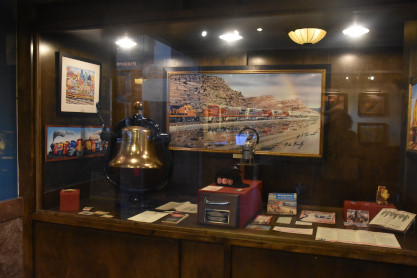
This large glassed display features a Frisco locomotive bell and a Santa Fe painting signed by Mike Haverty and J.B. Hunt, among other artifacts.
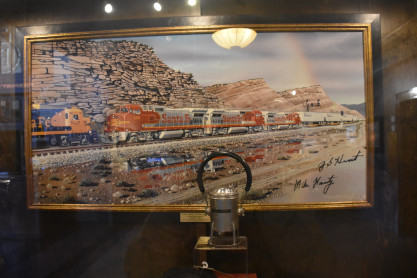
Santa Fe Railway/J.B. Hunt Intermodal Partnership September 1989.
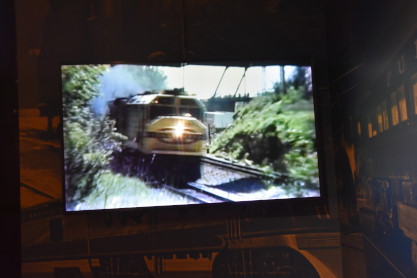
A Kansas City Southern historical video was playing.
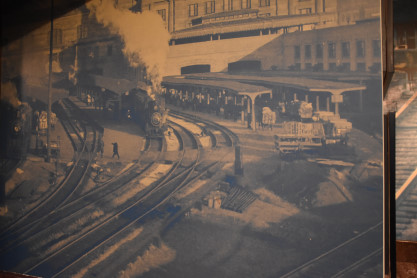
A 1930s-era scene at Union Station.
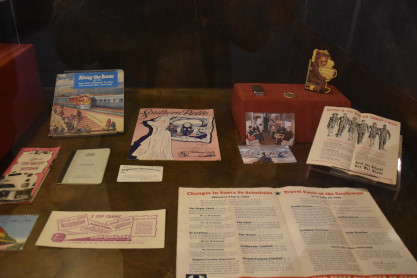
Kansas City Southern and Santa Fe memorabilia.
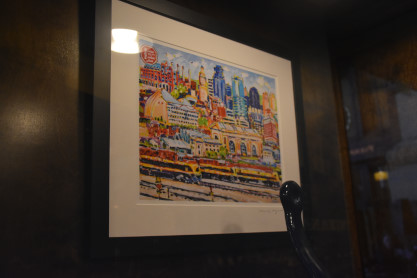
A Kansas City Southern Lines-inspired painting, artist unknown.
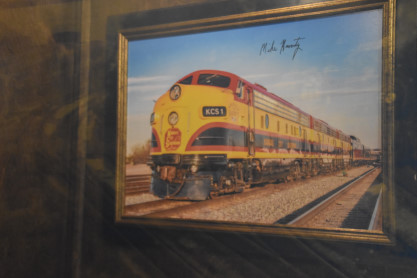
Kansas City Southern business train photograph by Mike Haverty.
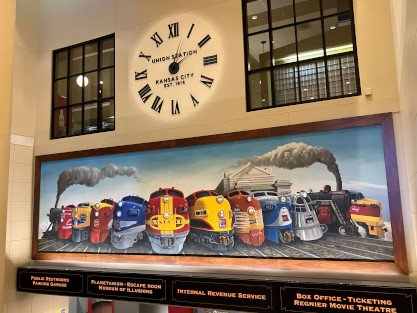
This thirty-foot painting hangs above the stairway leading from thee Grand Hall to the Station's B Level. Titled The Creation of Union Station, it was painted in 2006 by Anthony Benton Gude (the grandson of famous Kansas City artist, Thomas Hart Benton) and depicts locomotives from the twelve railroads that served Kansas City and participated as owners in the construction of Union Station in 1914, having come together in 1906 to form the Kansas City Terminal Railway. They are: Alton Railroad; Atchison, Topeka and Sante Fe Railroad; Chicago, Burlington and Quincy Railroad; Chicago Great Western Railroad; Chicago, Milwaukee, St. Paul and Pacific Railroad; Chicago, Rock Island and Pacific Railroad; Kansas City Southern Railway; Missouri-Kansas-Texas Railroad; Missouri Pacific Railroad; St. Louis-San Francisco Railway; Union Pacific Railroad and Wabash Railroad. In addition to the twelve locomotives, Union Station is visible in the background, and Union Station architect Jarvis Hunt can be seen overlooking his masterpiece from the engine's steam.
We then went outside on the Michael R. Haverty Freight House Bridge. The pictures below of the BNSF Super Bowl Train were taken from the bridge and upon our departure aboard the train, hence the differences in quality.
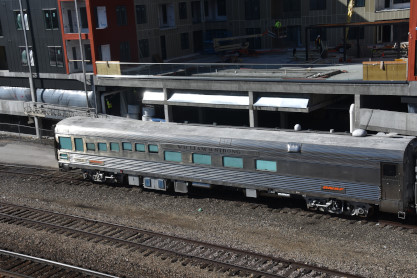
BNSF theater-lounge 32 "William B. Strong", ex. BNA 89 1996, exx. converted to theater-lounge 89 1990, ex. Santa Fe track inspection car 89 "William Barstow Strong", nee Santa Fe coach-bar-lounge 1397, built by Pullman Company in 1940.
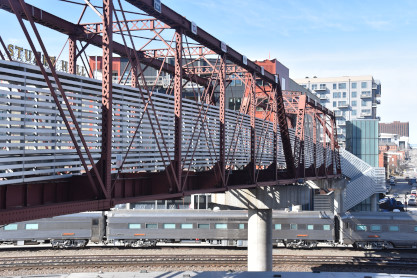
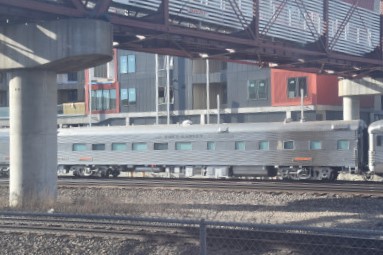
BNSF dining car 11 "Fred Harvey", ex BNA 61, exx. Santa Fe 61, nee Santa Fe 600, built by Pullman Company in 1950.
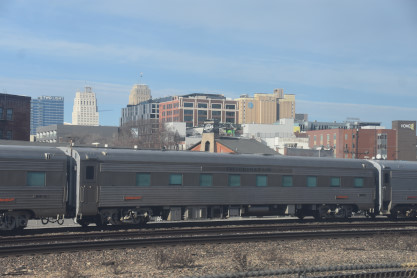
BNSF 6 business car "Topeka", ex. BNA 51, exx. Santa Fe 51, nee Santa Fe 5002, built by the Budd Company in 1957.
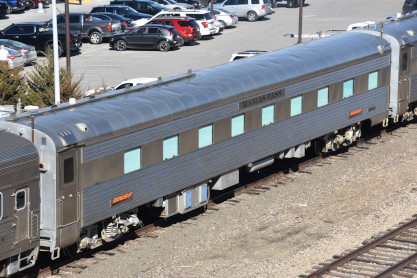
BNSF sleeper 54 "Marias Pass Sleeper", ex. BNA 64 , exx. Santa Fe 64, nee Santa Fe 1820 "Regal Hunt", built by American Car and Foundry in 1950.
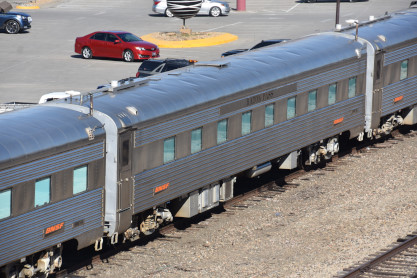
BNSF sleeper 65 "Raton Pass", ex. BNA 65 1996, exx. Santa Fe 65 1973, nee Santa Fe 1823 "Regal Lane", built by American Car and Foundry in 1950.
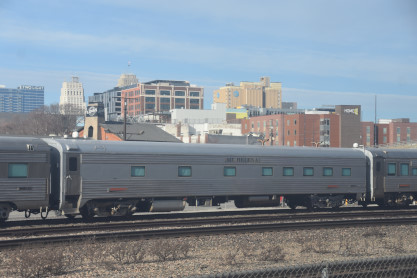
BNSF business car 67 "Trinchera Pass", ex. BNSF "Donner Pass" 1998, exx. BNA 67 1996, exxx. Santa Fe 67, nee Santa Fe sleeper 1825 "Regal Manor", built by American Car and Foundry/Pullman Company in 1950.
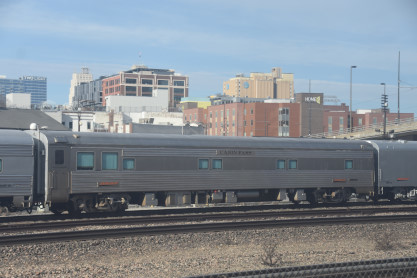
BNSF power generator car/dormitory 50 "Mt. Helena", ex. Burlington Northern sleeper-power car 50 "Stampede Pass", exx. BNA 50, exxx. Northern Pacific 10-6 sleeper 364 "Stampede Pass", nee Southern Pacific 364, built by Pullman- Standard in 1950.
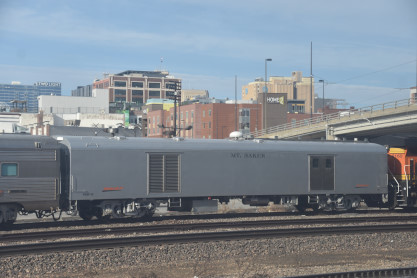
BNSF baggage car 52 "Mount Baker 52", ex. BNSF 77 "Glorieta Pass", exx. BNA 77, exxx. Santa Fe 77, nee Santa Fe 3914, built by Pullman Company in 1962.
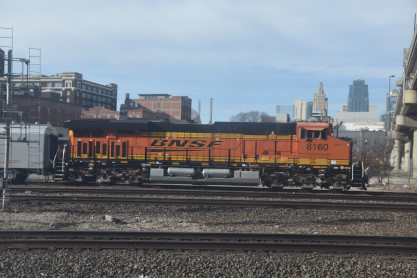
BNSF ES44C4 8160 on the point of the Super Bowl train.
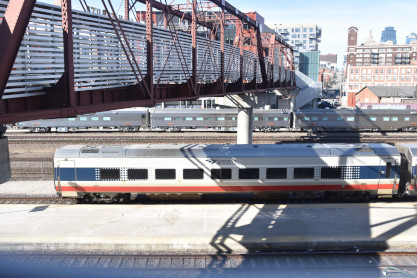
Amtrak Midwest coach 4106 built by Siemens in 2018, the rear of our Missouri River Runner.
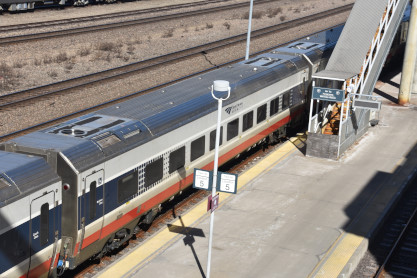
Amtrak Midwest coach 4211 built by Siemens in 2019, the penultimate coach of the train.
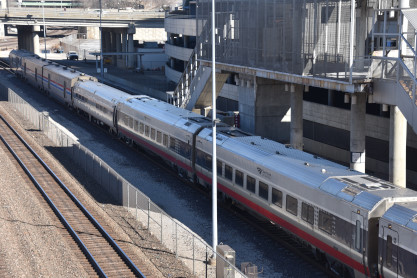
The eastbound Missouri River Runner with two Viewliner baggage cars.
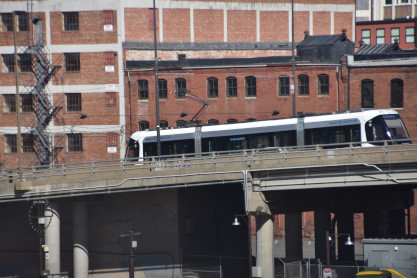
The Kansas City Streetcar on its flyover; we did not have time to ride it this time, although we had done so in September 2023.
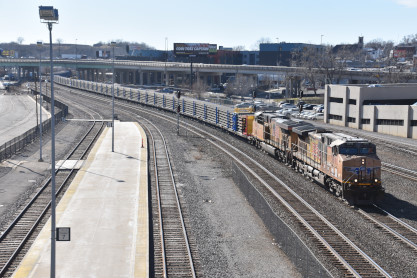
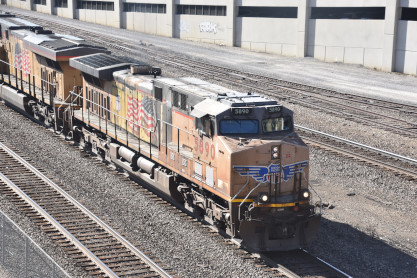
Union Pacific SD90 5890 leading a continously-welded rail train.
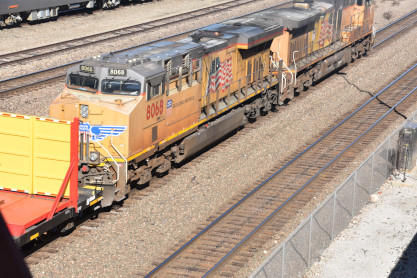
Union Pacific SD90 8068.
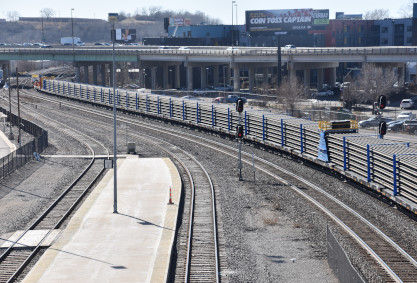
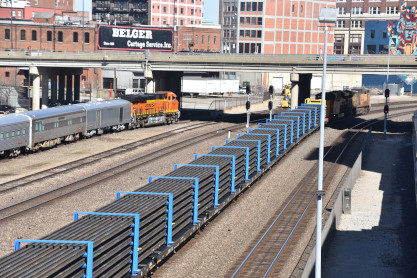
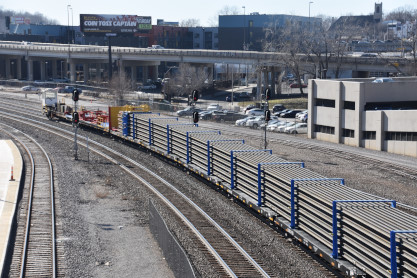
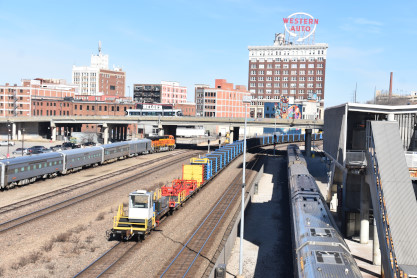
Union Pacific 5890 and its long train.
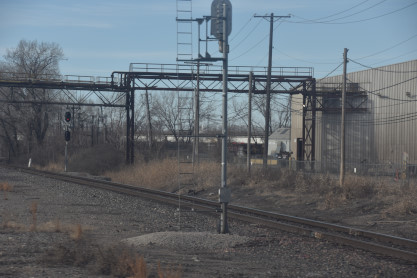
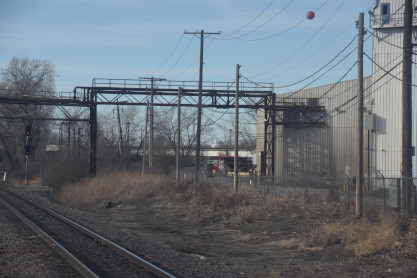
We returned inside and joined the queue to board the Missouri River Runner Train 310. Just after we departed, we crossed Kansas City Terminal Railway's tracks.
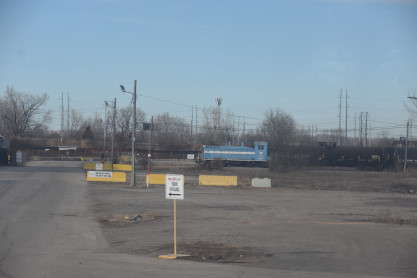
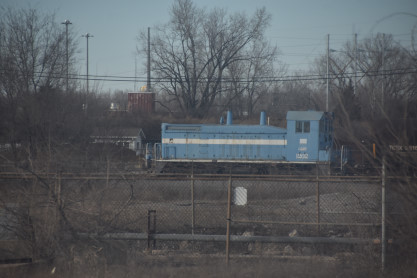
We passed Molycop, a global manufacturing company, whose beginnings were in Australia and spotted Central Illinois Railroad SW1500, ex. DOT Rail Services 1202, nee Illinois Central 9436, built by Electro-Motive Division in 1951.
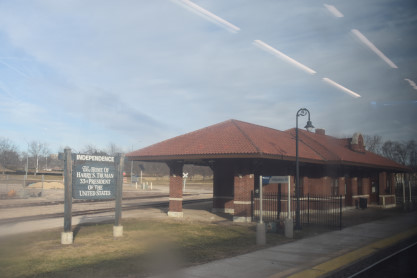
We stopped at the former Missouri Pacific station in Independence, built in 1879, where several passengers boarded.
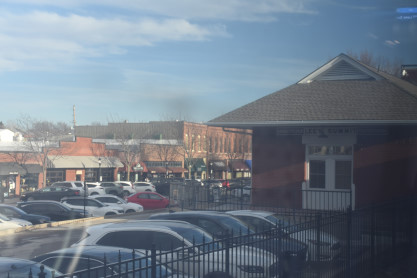
Pleasant Hill is also a stop on the route, at the Missouri Pacific station built in 1903.
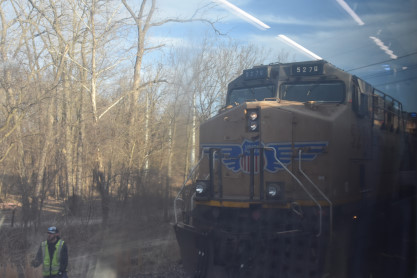
We went into a siding to clear Union Pacific 5276 then stopped in Sedalia and made the beeline back to Jefferson City, where we detrained and Elizabeth drove us back to Columbia, ending a fun day on the Missouri River Runner and Kansas City Union Station.
| RETURN TO THE MAIN PAGE |