




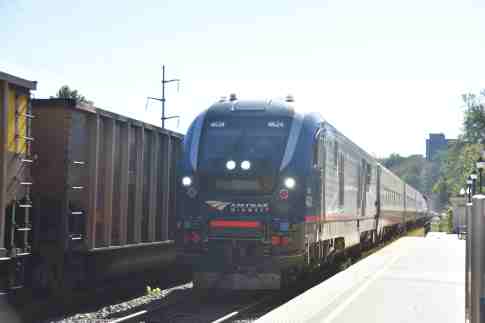
My good friend Jeff Hartmann, whom I have known since childhood and lives in Long Beach, California, decided to visit Elizabeth and I in Columbia. He timed his visit to coordinate with our return from the Union Pacific Historical Society convention, so flew from Long Beach Airport to Dallas-Fort Worth on September 23rd, then connected to Columbia late that afternoon. We picked him up at the Columbia Regional Airport twenty minutes from our home and went to dinner at Shiloh Bar and Grill, the former Missouri-Kansas-Texas station.
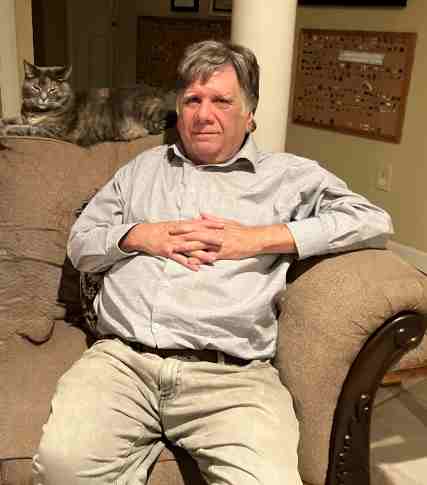
Jeff with our cat Chessie.
9/24/2025 The three of us drove to La Plata and the Chris Guenzler Million Mile Lookout Point. While no trains came by during the time we were here, Jeff had an opportunity to see the building, which had been enclosed since his last visit here in 2007.
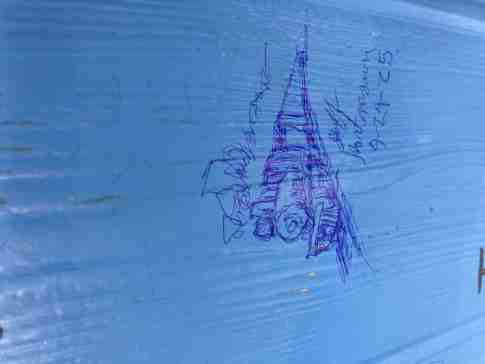
Jeff is a pen-and-ink artist and drew this picture. We then drove to Bevier.
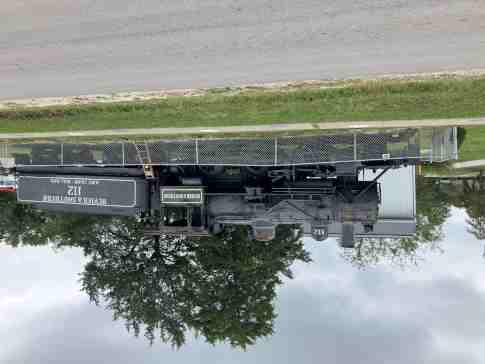
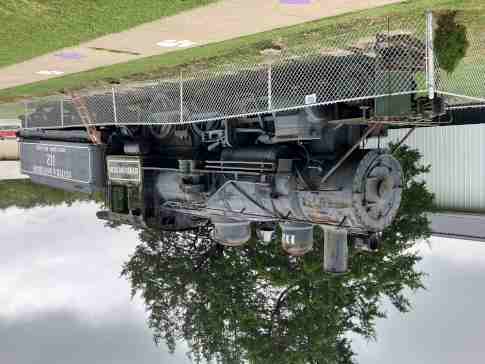
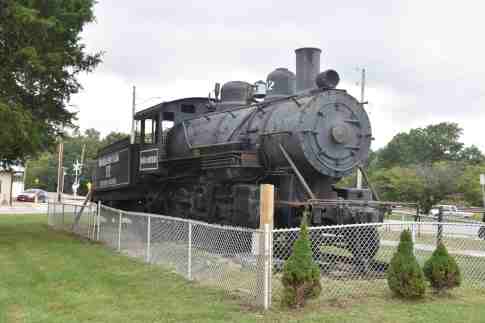
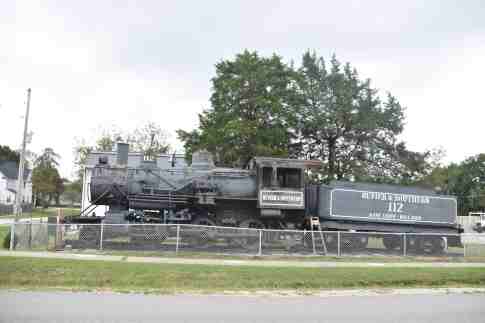
Bevier and Southern 2-6-0 112 built by Baldwin in 1920. The Bevier & Southern Railroad started life in 1914, when the Missouri & Louisiana Railroad divided, with the Missouri portion of railroad becoming the B&S. It hauled coal on a 9.18 mile line from Binkley, Missouri, to a connection with the Chicago, Burlington & Quincy Railroad at Bevier. The line was abandoned in 1982. 112 was donated to the City of Bevier, Missouri, in 1963 having travelled 364,562 miles in service.
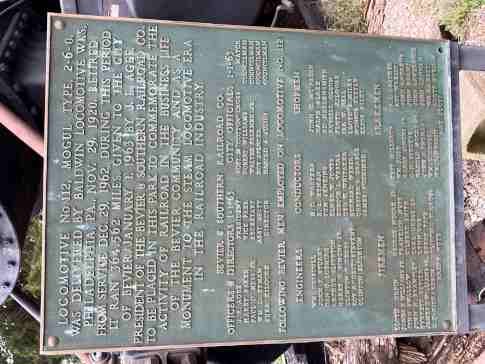
The locomotive and company information plaque. We continued to Clifton Hill.
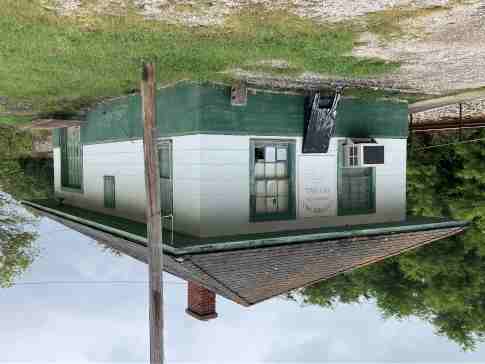
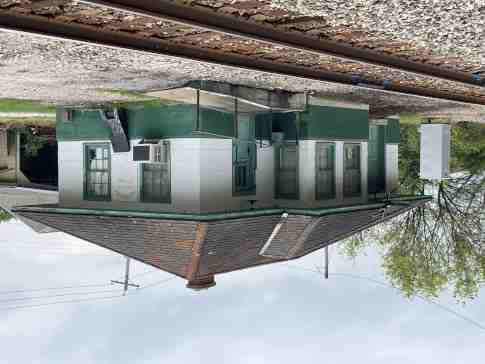
The Wabash station in Clifton Hill, year of construction unknown, which is the city hall.
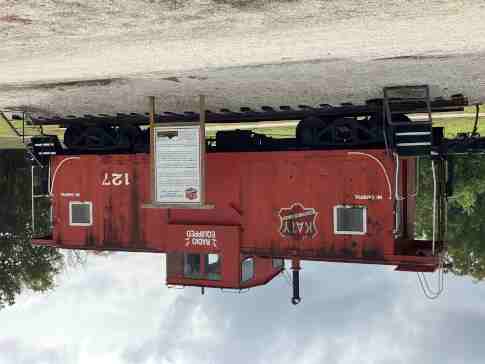
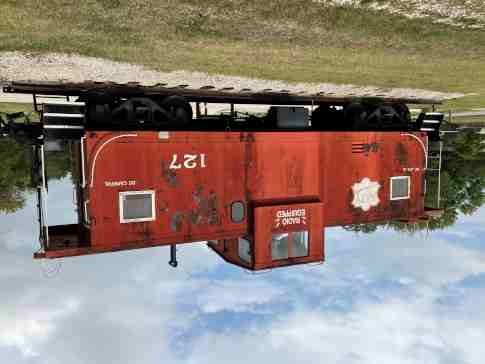
In New Franklin, we found Missouri-Kansas-Texas caboose 127, built by International Car in 1968.
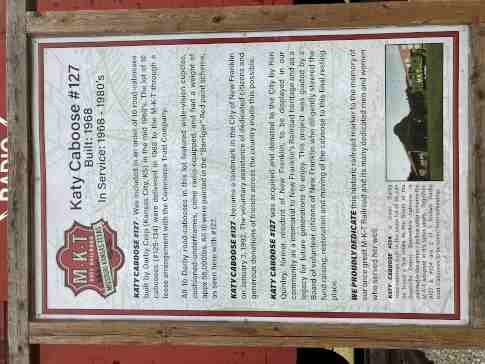
The caboose story board.
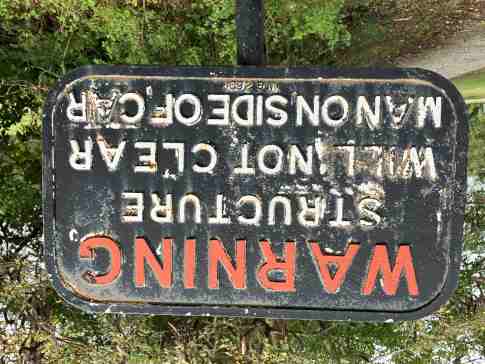
A sign from the olden days. We continued Jeff's tour by visiting Boonville.
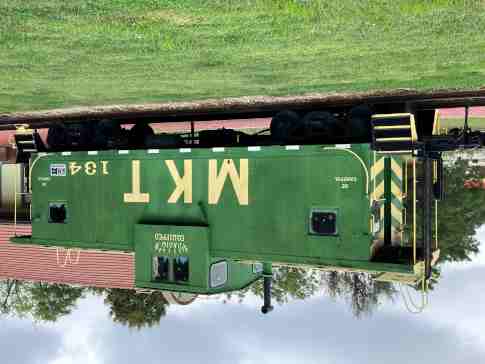
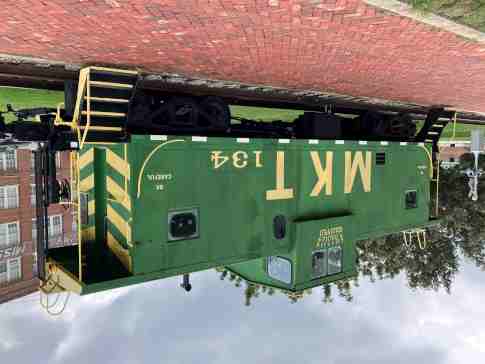
Missouri-Kansas-Texas caboose 134 built by International Car in 1969. This caboose was on the last train that came through Boonville.
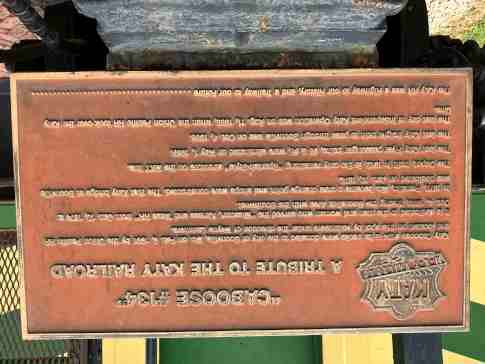
A plaque for the caboose.
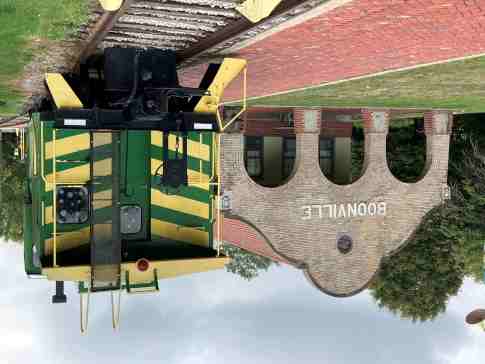
The caboose and the station.
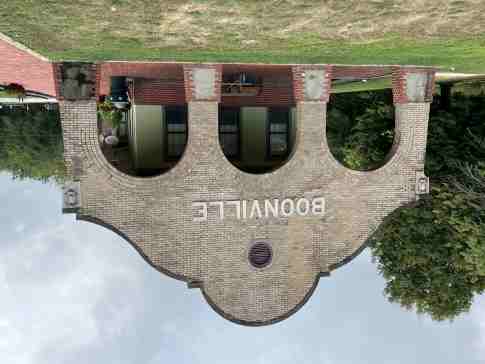
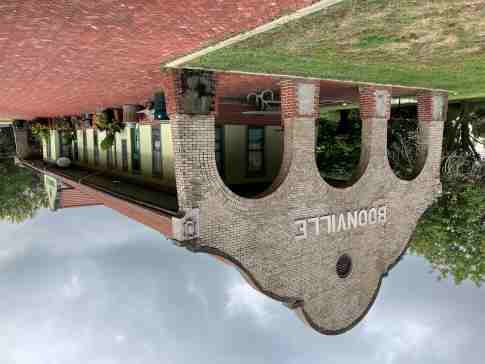
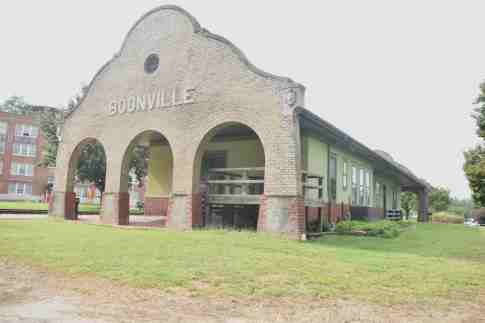
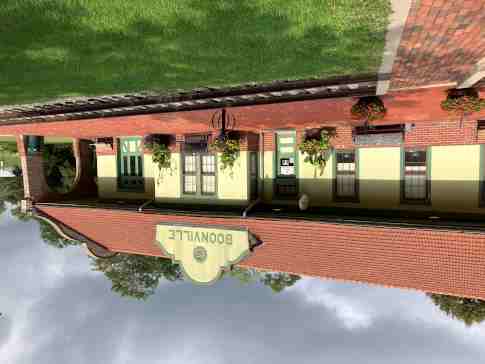
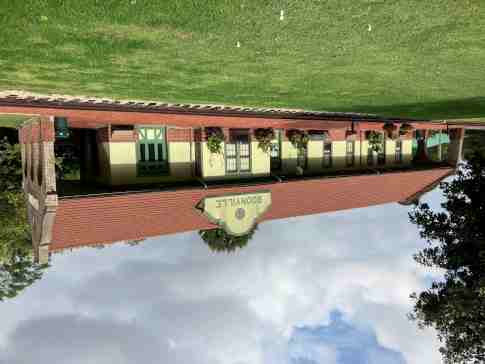
Missouri-Kansas-Texas Boonville station built in 1912, the last station built of five in the Spanish mission style and is the last one standing.
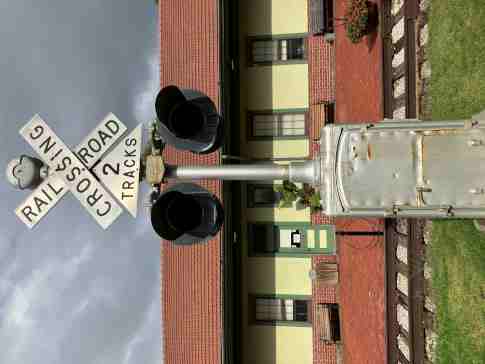
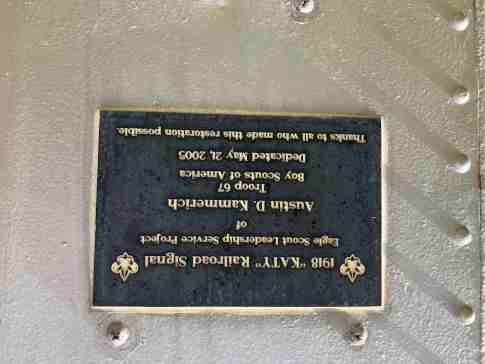
The 1918 crossing signal and the Eagle Scout project plaque.
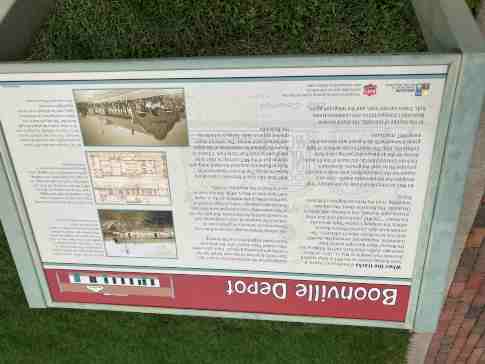
Boonville Depot story board.
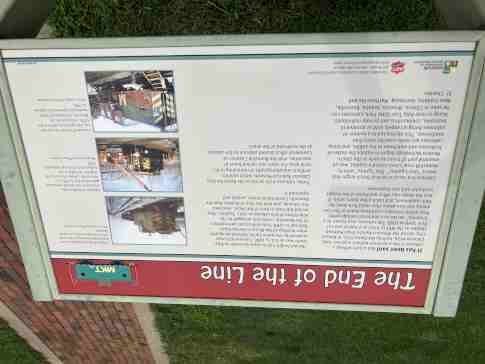
The end of the Line story board.
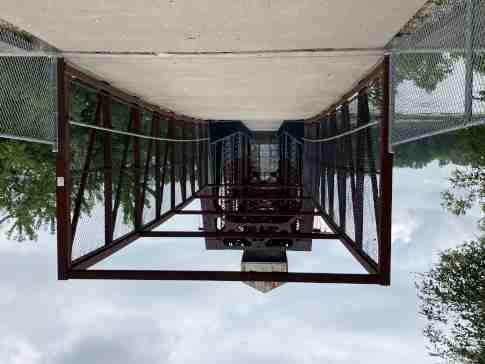
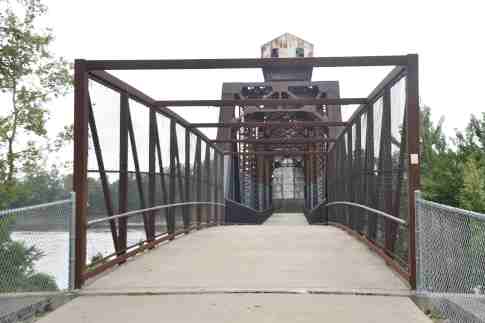
We walked out onto the 1,1615 foot Missouri-Kansas-Texas through truss bridge with lift span built in 1931. In 1992, the bridge was abandoned by Union Pacific but it was not until 2004 that Union Pacific developed a plan to demolish this bridge. By 2005, Union Pacific planned to build a new bridge over the Osage River using the recycled parts from this structure. However, Attorney General Jay Nixon refused to let demolition occur and after a fight including citizens in Cooper County, the Missouri DNR and Jay Nixon, the bridge was spared demolition.
Since then, The Katy Bridge Project has sought to advocate for rehabilitation and reuse of the massive bridge as a trail. The Katy Trail, a nationally recognized rail trail uses the rail bed on either side of this structure. In 2016, the first segment of the Katy Bridge opened to pedestrians. Two more segments will follow, including the full operation of the lift span.
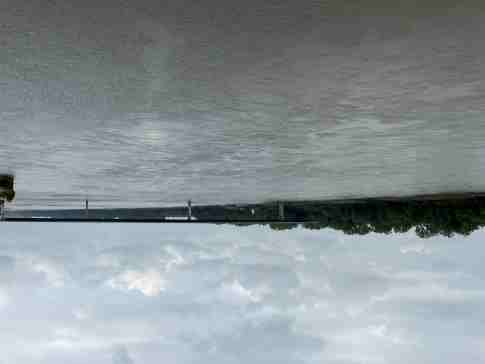
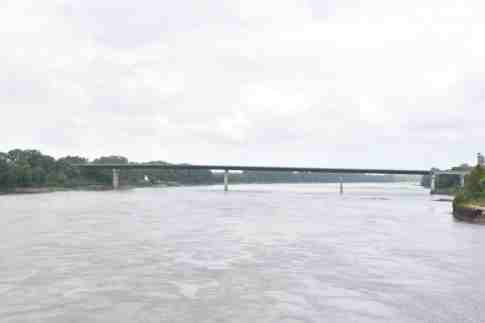
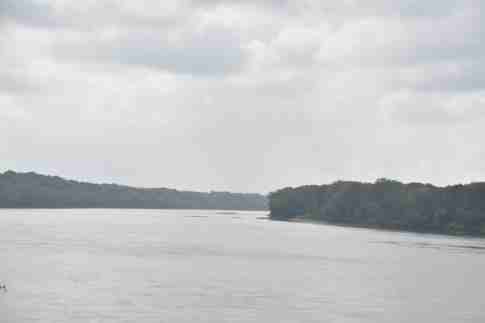
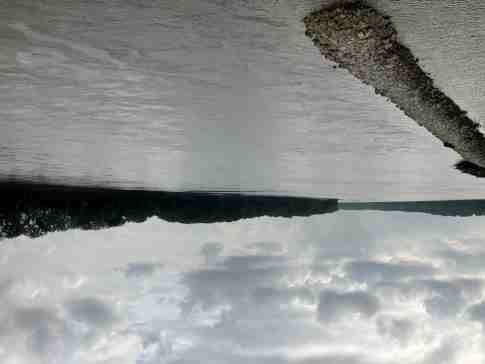
The Missouri River as seen from the bridge.
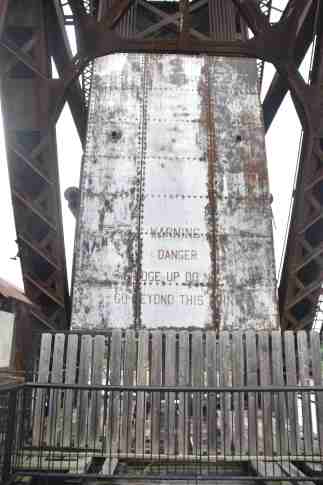
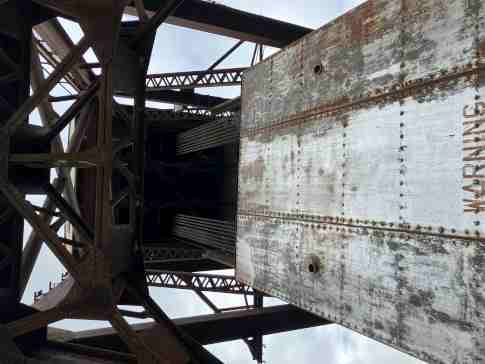
The lift span.
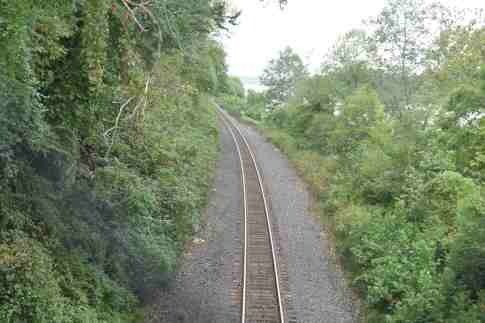
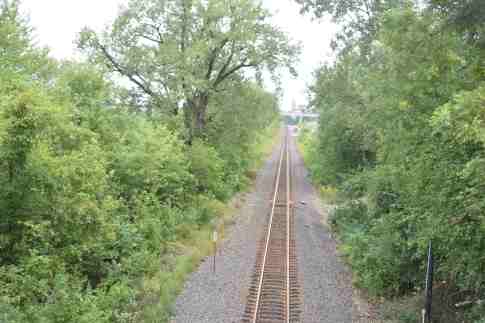
The Union Pacific, formerly Missouri-Kansas-Texas river line, tracks. Elizabeth and I do not visit here too often and have yet to see a train here.
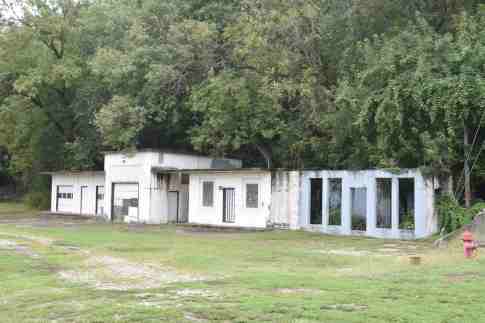
I believe this to be the yard office building. We next took Jeff to Rocheport for another portion of the Katy Trail.
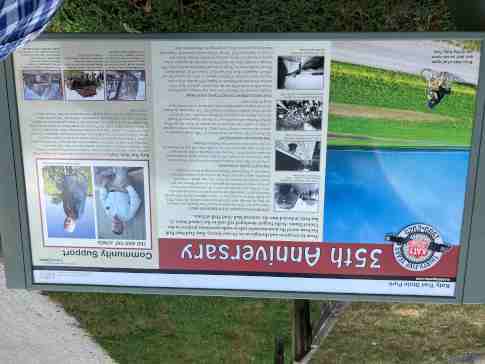
Katy Trail 35th Anniversary information board.
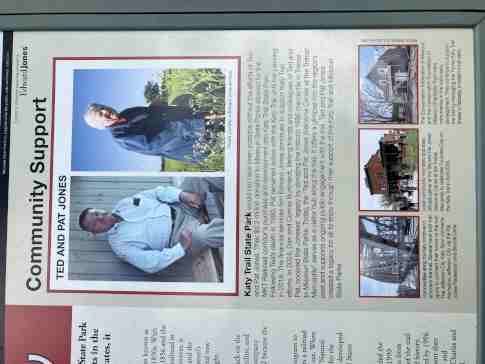
Community Support.
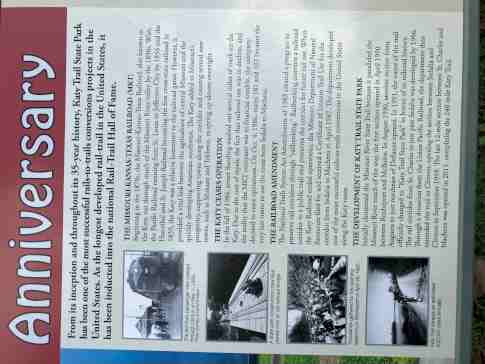
Katy Trail State Park development.
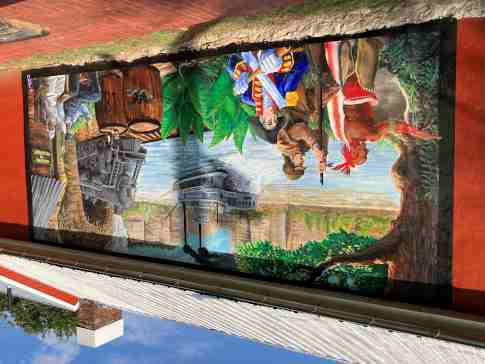
The new bicentennial mural by Columbia artist Joe Schlottach, who has been painting since graduating from Rock Bridge High School, and his murals and illustration work appear throughout homes and businesses around Columbia. The piece celebrates two centuries of Rocheport stories in a spot thousands of trail users pass every year. The project was commissioned by the Friends of Historic Rocheport as the Museum Mural Project and is part of the city’s 200-year anniversary festivities. It was being created with support from the Missouri Arts Council, making this a true community-powered work of public art.
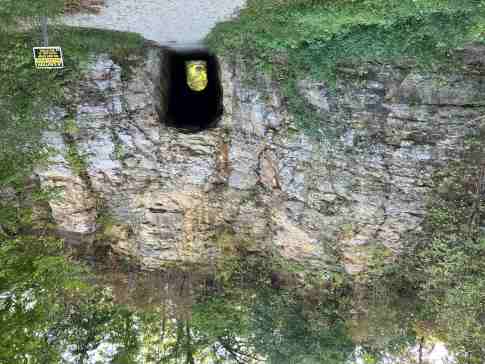
I was feeling a little under the weather so stayed in the car while Elizabeth and Jeff went for a short walk to the only tunnel on the 240 mile Katy Trail.
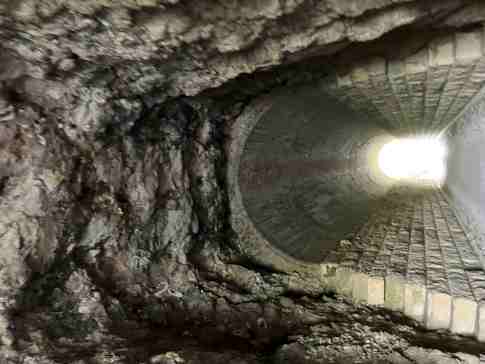
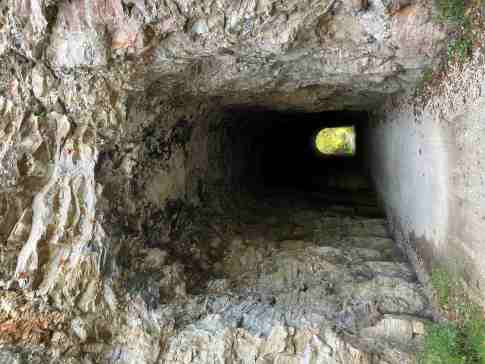
Looking into the tunnel, built in 1892.
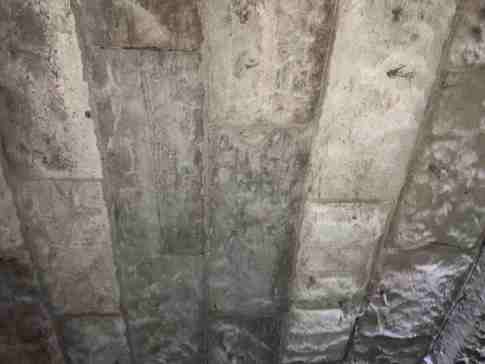
The stone wall.
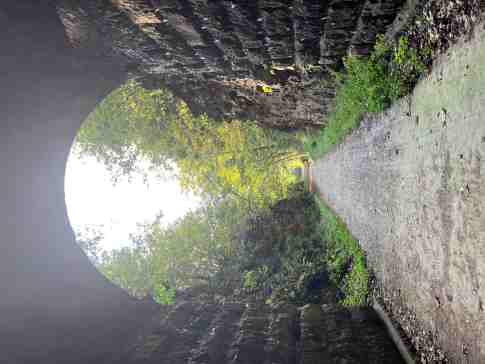
The view as we exited.
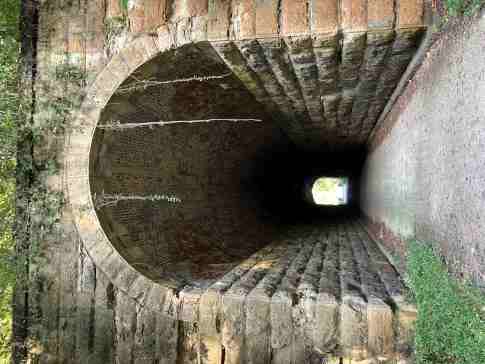
Looking back to where we had just walked.
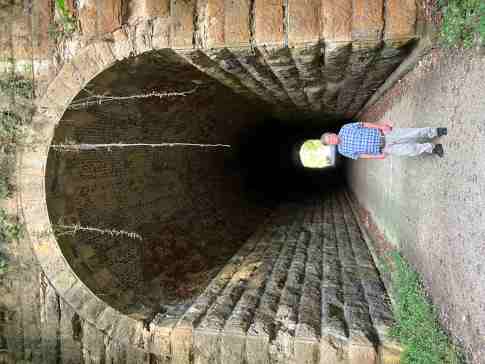
Jeff at the tunnel portal.
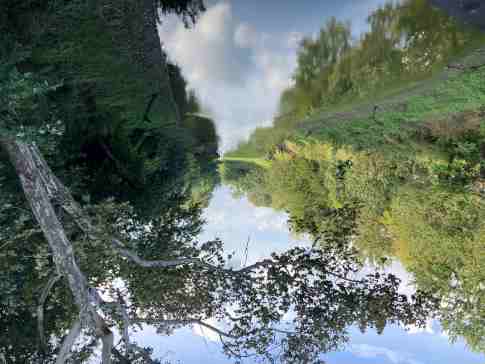
Bonne Femme Creek. We returned home, relaxed then went to Bob Evans for dinner.
9/24.2025 We had breakfast at our house then I drove the three of us to the Amtrak station in Jefferson City for Jeff's first ride on the Missouri River Runner. The schedule worked for a ride to Kansas City, rather than St. Louis.
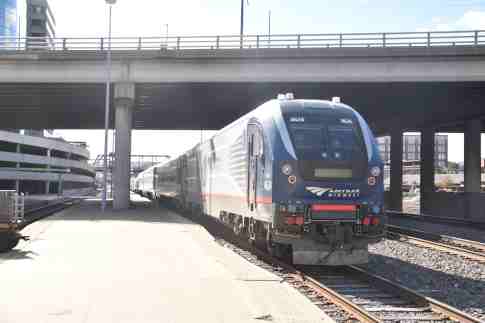
Missouri River Runner Train 311, led by Amtrak SC-44 4624, arrived and we boarded.
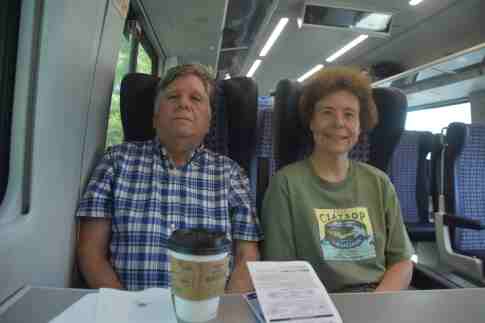
Jeff and Elizabeth sat across from me.
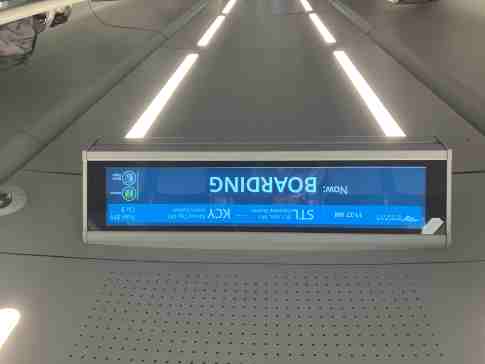
The Missouri River Runner features electronic announcement boards.
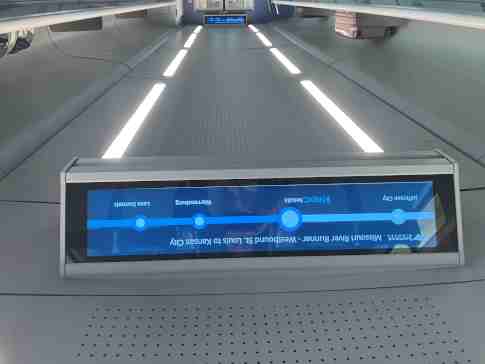
Throughout the journey, the next stop and immediate stations along the line are displayed. Upon arrival at Kansas City Union Station, all passengers had to follow an Amtrak representative into the station as part of the platform and entry into the station was under construction. We then took the Skywalk over to Crown Centre.
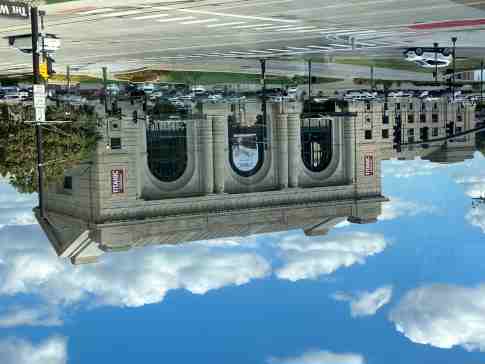
Kansas City Union Station, opened in 1914 to serve Kansas City and the surrounding metropolitan area. It replaced a small Union Depot built in 1878. Union Station served a peak annual traffic of more than 670,000 passengers in 1945 at the end of World War II, but traffic quickly declined in the 1950's, and the station was closed in 1985. In 1996, a public–private partnership undertook a $250 million restoration, funded in part by a sales tax levied in Kansas and Missouri counties of the Kansas City metropolitan area. By 1999, the station had reopened as a suite of attractions, including museums. In 2002, train service returned when Amtrak began public transportation services, and the station became Missouri's second-busiest train station. The refurbished station has theaters, ongoing museum exhibits, and attractions such as Science City, the Irish Museum and Cultural Center, and the Todd Bolender Center for Dance and Creativity. Since 2016, it has been a stop for the KC Streetcar.
On April 8, 1878, Union Depot opened on a narrow triangle of land in Kansas City, Missouri, between Union Avenue and the railroad tracks of the Hannibal and St. Joseph Railroad in what became West Bottoms. Nicknamed the "Jackson County Insane Asylum" by those who thought it was too large. It was the second union station in the country, after the Indianapolis Union Station. Union Depot's architecture was a hybrid of Second Empire and Gothic Revival. The lead architect was Asa Beebe Cross, who "adorned the exterior of the building with intricate towers of varying heights, arched windows framed in stone and rows of dormers projecting from the steeply pitched mansard roof". It had a clock tower above the main entrance that was 125 feet in height. By the 20th century, over 180 trains were passing daily through the station, serving a city population that had tripled. In 1903, the lack of room for expansion and a major flood led the city and the railroads to decide a new station was required.
The decision to build a new station was spearheaded by the Kansas City Terminal Railway, a switching and terminal railroad that was a joint operation of several railroads: Alton; Atchison, Topeka and Santa Fe; Chicago, Burlington and Quincy; Chicago Great Western; Chicago, Milwaukee, St. Paul and Pacific; Chicago, Rock Island and Pacific; Kansas City Southern; Missouri-Kansas-Texas; Missouri Pacific; St. Louis-San Francisco; Union Pacific; and Wabash. The new location was at a valley at 25th Street and Grand Avenue used by the Kansas City Belt Railway. It was south of the central business district, above and away from the floodplain. Architect Jarvis Hunt was a proponent of the City Beautiful movement. The Beaux-Arts architecture design was a main hall for ticketing, and a perpendicular hall extending out above the tracks for passenger waiting. The building encompassed 850,000 square feet and the ceiling in the Grand Hall is 95 feet high. There are three chandeliers weighing 3,500 pounds each, and the Grand Hall clock face is six feet in diameter. The building's scale reflects Kansas City's central location as a hub for both passenger and freight rail traffic.
The Kansas City massacre occurred on June 17, 1933, in front of Union Station, while captured fugitive Frank Nash was to be delivered to prison via train. Four lawmen (including FBI) were murdered by the Kansas City crime family with Thompson submachine guns in an attempt to free Nash, who was also killed in the gun battle. The massacre highlighted the lawlessness of Kansas City under the Pendergast Machine and resulted in the arming of all FBI agents.
In 1945, annual passenger traffic peaked at 678,363. The demand for a large train station declined in the 1950s. In 1973, it had 32,842 passengers, all passenger train service was now run by Amtrak, and the building was deteriorating. Kansas City government wanted to preserve and redevelop the building, and, in 1974, made a development deal with Canadian redeveloper Trizec Corporation. Between 1979 and 1986, Trizec constructed two office buildings on surrounding property, but did not redevelop the station. The deteriorating station closed in 1983, except a "bubble" inside the main hall housing Amtrak's operations until 1985, when all passenger operations were moved to a smaller "Amshack" facility adjacent to the old station. In 1988, the city sued Trizec for the failure to develop the station and settled in 1994. For most of this period, the building continued to decay.
In 1996, residents in five counties throughout the Kansas City metropolitan area in both Kansas and Missouri approved the so-called "bistate tax", a 1/8 of a cent sales tax, part of which helped to fund just under half of the $250 million restoration of Union Station. Renovation began in 1997 and was completed in 1999. The remaining money was raised through private donations and federal funding. The renovations enabled Amtrak to move its operations back inside the main building in 2002.
Union Station receives no public funding. Operating costs are funded by general admission and theater ticketing, grants, corporate and private donations, commercial space leases, and facility rental. Union Station Kansas City, Inc., a nonprofit 501(c)(3) organization, manages Union Station and had previously managed the Kansas City Museum. Union Station hosts Science City (opened in 1999), a family-friendly interactive science center with more than 50 hands-on exhibits; the H&R Block City Stage Theater, a live-action venue with productions for all ages; the Regnier Extreme Screen, the largest movie screen in the region at five and half stories tall; two restaurants, including Pierponts, an upscale steak and seafood restaurant, and Harvey's; many shops; the Gottlieb Planetarium, the largest planetarium in the area; and various temporary museum exhibits including Dead Sea Scrolls in 2007, Bodies Revealed in 2008, Dialog in the Dark in 2009, Dinosaurs Unearthed in 2010 and Diana, A Celebration focusing upon Princess Diana in 2011. The Irish Museum and Cultural Center has been located in the station since March 17, 2007.
The old Union Station Powerhouse building was renovated by the Kansas City Ballet. It is the ballet's new home and has been named the Todd Bolender Center for Dance and Creativity since August 2011.
As it was lunch time, we took Jeff to Fritz’s, famous for old-fashioned hamburgers made with 100 percent choice ground beef, grilled onions seared in the meat, toasted buns and always "cooked to order" just the way Fritz's dad served them at his Kansas City, Kansas location, John's Place, dating back to the 1920's. In 1954, a few years after Fritz's return from the Navy, which included an assignment on the USS San Francisco stationed at Pearl Harbor during the attack in 1941, Fritz and Virginia Kropf started their own fifties-style drive-in restaurant at 32nd and Brown Avenue in Kansas City, Kansas. At Fritz’s Railroad Restaurant, you can experience the fun and delight as your meal is delivered directly to your table by our signature overhead train. Kids and adults alike will never forget the excitement of watching food being lowered to surrounding tables by our amazing delivery trains, and the anticipation of their own food delivery.
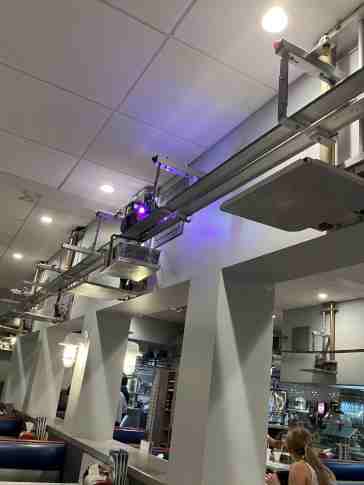
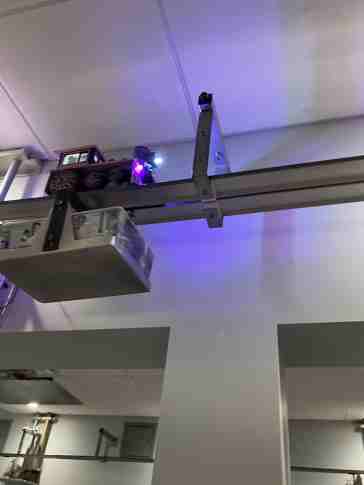
All meals are delivered by this unique overhead train.
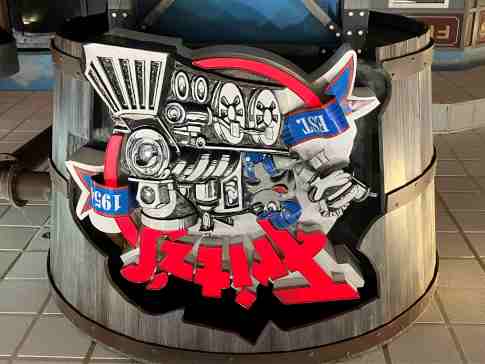
The emblem outside the restaurant.
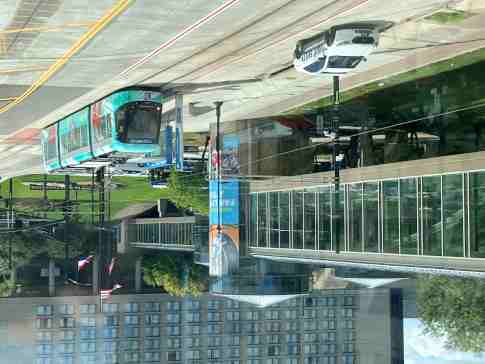
The KC Streetcar as seen from the Skywalk as we returned to Union Station.
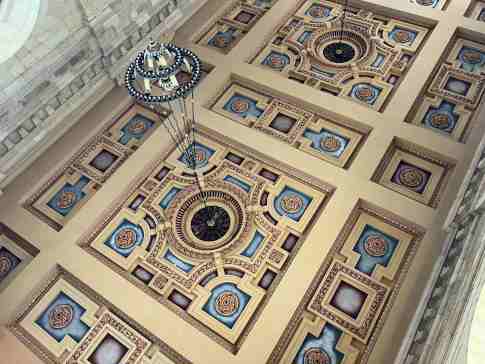
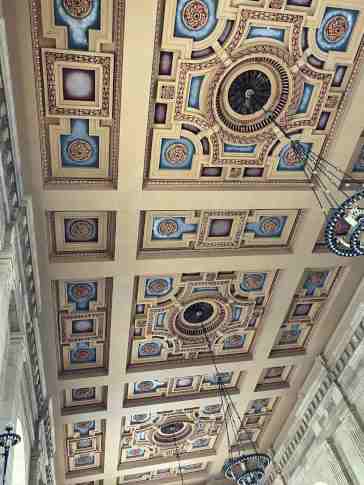
The ceiling of Kansas City Union Station.
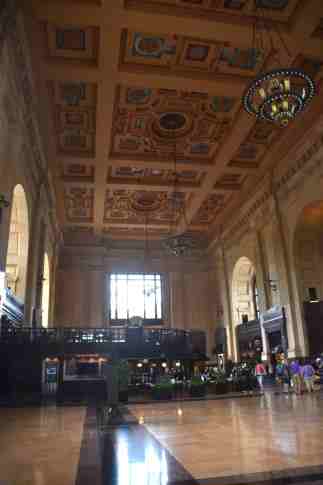
The Grand Hall and restaurant.
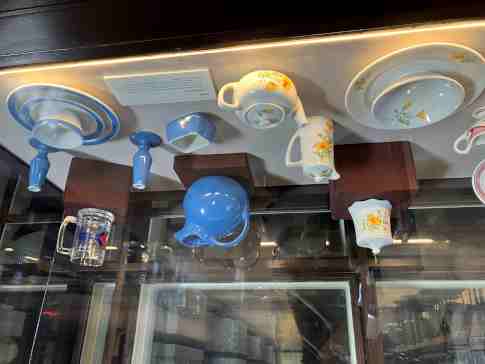
In front of the former Harvey House was a display of railroad china from the Henry Castro collection of rail artifacts.
On the left is California Poppy, a pattern made exclusively for the Santa Fe Railroad both with and without railroad marking on the underside. On the right is the National Pattern. Amtrak service china was used from about 1973 until 1981. Called National, this was a slightly modified design from the first Amtrak service that was made by Walker China. Other china companies produced pieces from different years so for instance a cup might have might have two different designs for this pattern.
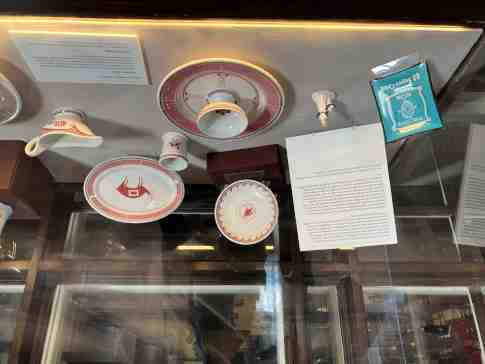
Mimbreno China by Mary Colter, architect for the Fred Harvey Company, designed a china pattern inpsired by the pottery of the Mimbres Indians of Southwest New Mexico. She created 37 different designs for various pieces, mostly stylized animals, birds and fish. The china was produced for the Atchison, Topeka and Santa Fe Railroad from 1936-1971.
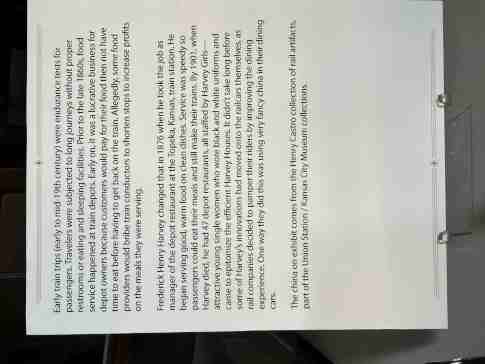
Information on Fred Harvey and his restaurants.
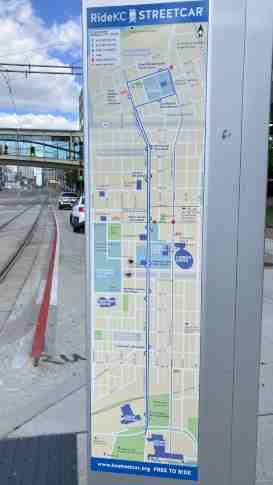
Jeff wanted to ride the KC Streetcar, but I was not feeling too well, so Elizabeth accompanied him. The two of them went across the road and waited a short time for a streetcar to arrive.
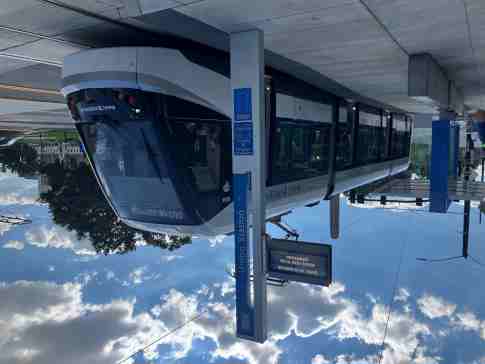
The KC Streetcar at Union Station stop, before the operator changed the sign.
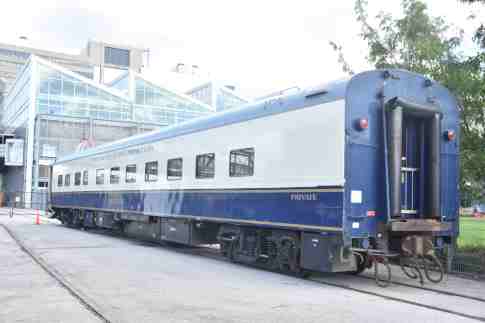
I did go behind the station and found Patrick Henry Creative Promotions sleeper "Santa Fe", ex. GrandLuxe Rail Journeys 800255 "Berlin" 2006, exx. American Orient Express 800255 "Berlin", exxx. American-European Express AE-13 1989, exxxx. Indiana Railway Museum, exxxxx. Amtrak 2263 1971, exxxxxx. Union Pacific 1504 1969, nee Union Pacific 11 double-bedroom sleeper "Placid Lake" built by Pullman Company in 1956.
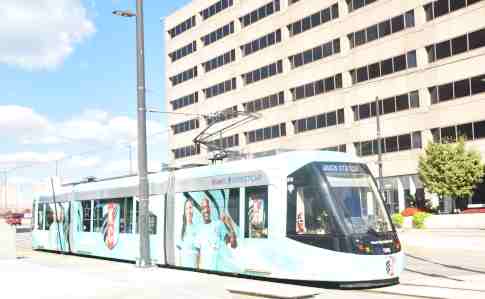
Another KC Streetcar beside the station.
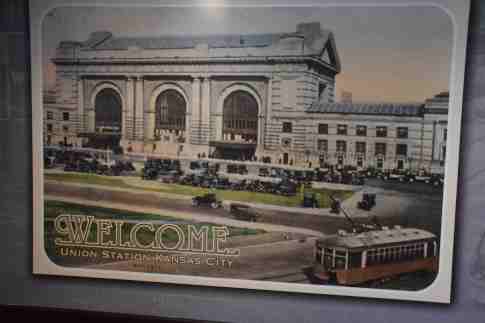
One of the historical photographs of the large display on the upper floor of the station before the Skywalk.
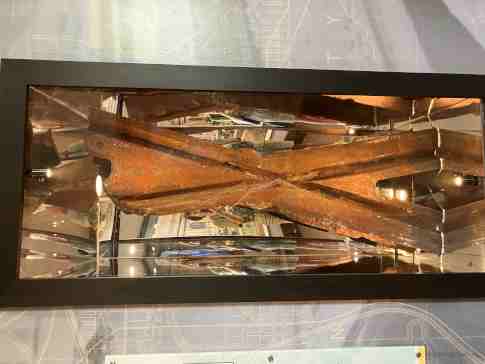
Part of the display are some artifacts, including this, a piece of cable car track, unearthed in 1973.
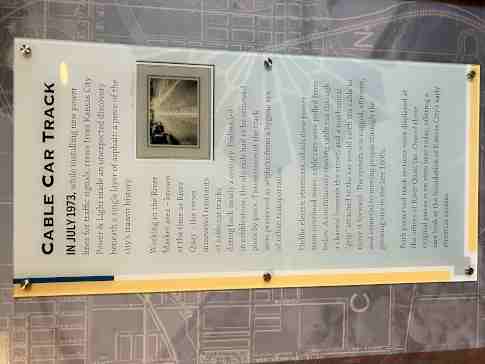
Cable car track information board. It was then almost time to board our train for home so we joined the queue.
Amtrak 4624 as we boarded.
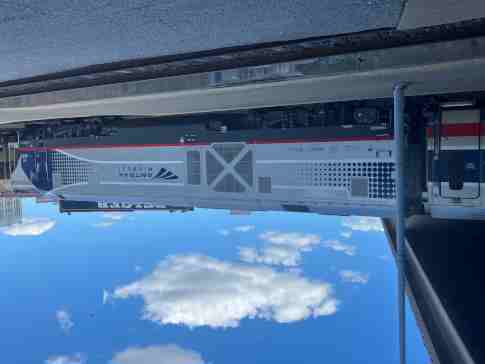
The eastbound Missouri River Runner Train 310.
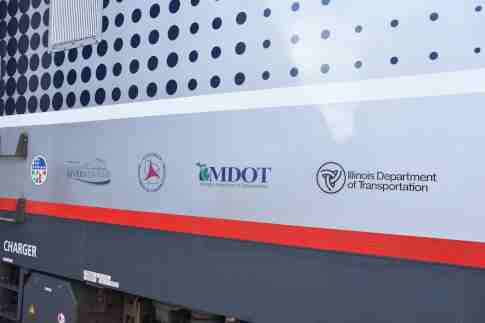
The emblems of the agencies that make the Missouri River Runner service possible.
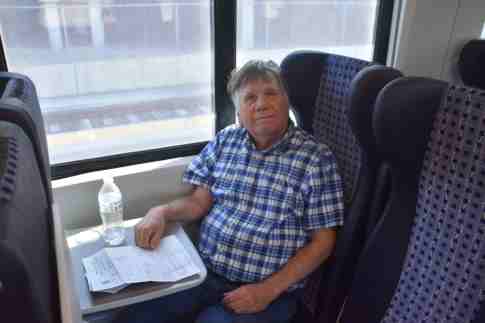
Jeff enjoying his afternoon train ride.
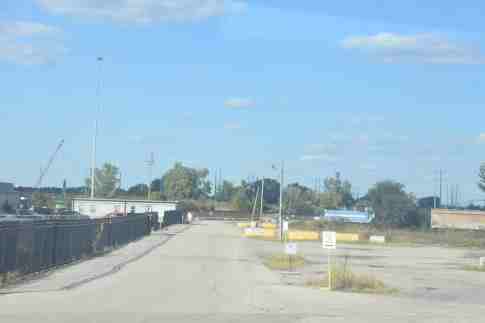
We passed Molycop, a global manufacturing company, whose beginnings were in Australia and spotted Central Illinois Railroad SW1500, ex. DOT Rail Services 1202, nee Illinois Central 9436, built by Electro-Motive Division in 1951.
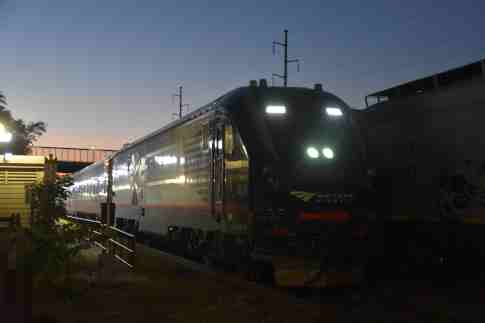
The sun had set by the time we returned to Jefferson City and Elizabeth drove us to Perkins for dinner but they had closed early today so we returned to Columbia and went to International House of Pancakes then came home.
9/26/2025 Cracker Barrel is a chain that does not serve southern California and therefore, Jeff had never been to one. So we went to our local Cracker Barrel for a hearty breakfast, then I drove to the Columbia Regional Airport so Jeff could fly home to Long Beach via Dallas-Fort Worth.
It had been wonderful to spend some time with Jeff and for him to see our house, the area in which we live and visit Kansas City.
| RETURN TO THE MAIN PAGE |