




All photographs by Elizabeth Guenzler.
The annual banquet and awards took place in the ballroom of the Doubletree Hotel in Durango. Elizabeth and I sat with other members of the Canadian Council, specifically Stephen Yakimets from Edmonton and Peter Murphy and his wife Sandra, from Delson, Quebec. There were a couple of other delegates and it was a great honour for Alan Harper to ask if he could sit at our table. His son John joined us afterwards.
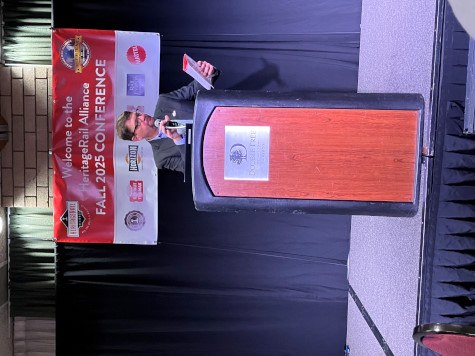
Terry Koller, Heritage Rail Alliance President, welcoming all of us to the banquet.
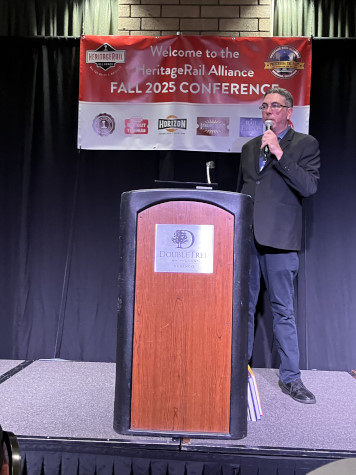
Otto Vondrack, Managing Editor of Railfan and Railroad Magazine, published by White River Productions, one of the conference sponsors, took his turn at the podium.
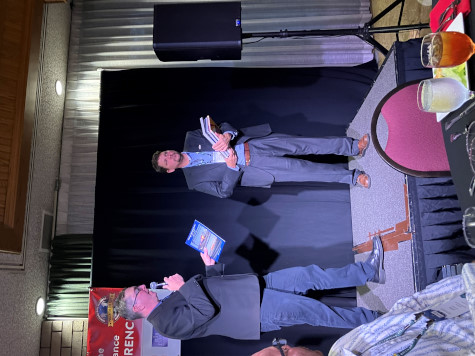
Door prizes were next, with Terry and Otto presenting several White River Production books to the 2025 scholarship recipients, the delegate who had travelled the furthest, the youngest, et cetera.
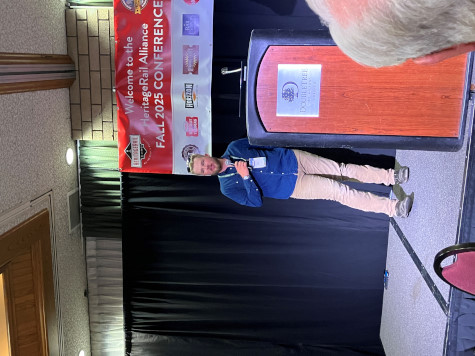
Russell Heerdt, who usually leads the Durango and Silverton charters, gave a brief speech, giving thanks to all involved who made the conference a success, especially as he was unable to play a large role during the excursions as he was a new father.
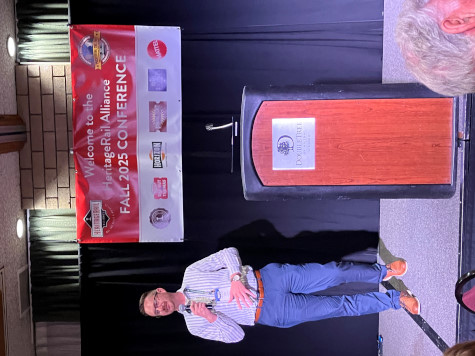
John Harper, son of American Heritage Railways' President Alan Harper, and Vice-President and General Manager of AHR, then thanked everyone, including the Durango and Silverton Railroad, for a very successful conference. Everyone partook in the meal, which was salad and a choice of three entrees (roasted Atlantic salmon, pan-roasted chicken breast and vegetable pasta).
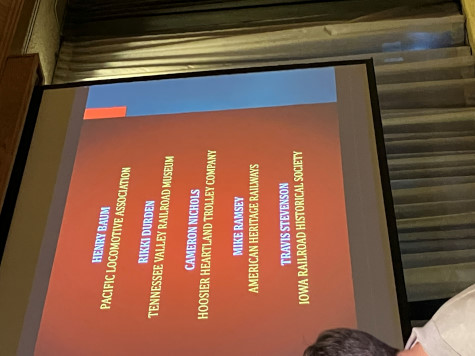
After a satisfying meal and dessert, the new and returning board members were named.
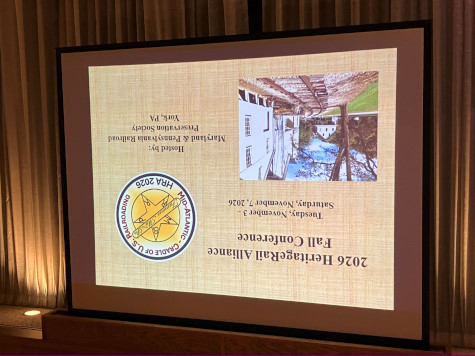
It was announced that there was not going to be a spring 2026 conference (rather than an internal symposium), but the 2026 conference would be in York, Pennsylvania in November.
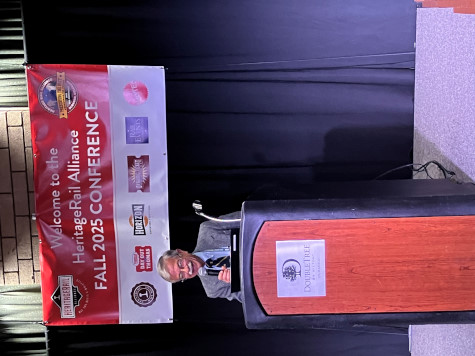
Craig Sansonetti, President of the Ma and Pa Heritage Village, provided an overview of next year's conference location.
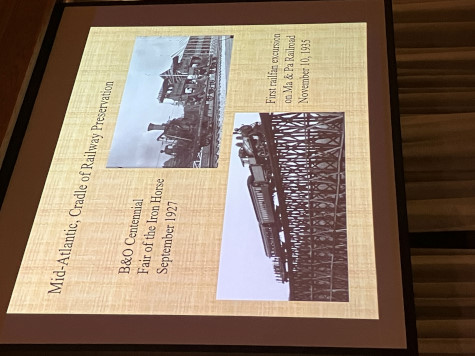
The Mid-Atlantic is known as the Cradle of Railway Preservation.
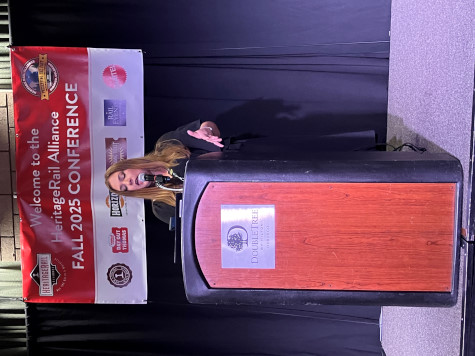
Kristen Fredrikson of the Pennsylvania Trolley Museum, and a Board member, discussing scholarships.
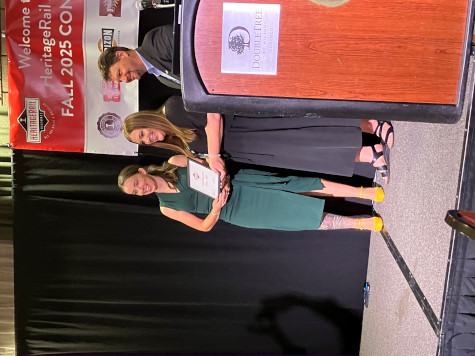
Bethan Maher from the Mount Rainier Scenic Railroad, winner of the Jim Wrinn Memorial Scholarship.
The next part of the evening was 2025 Railway Preservation Accomplishments.
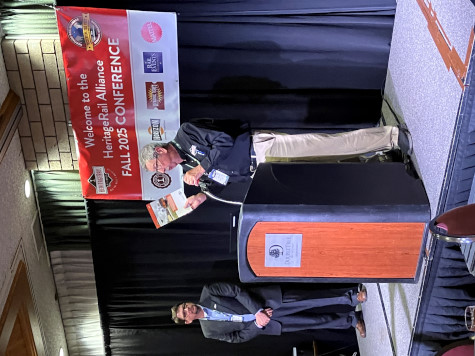
Terry Koller looks on as Aaron Isaacs, editor of the HRA Magazine (and Minnesota Transportation Museum archivist and curator), starts his presentation highlighting restoration projects, preservation or new excursion trains that have been in the news since the 2024 conference. Note: the descriptions below are taken from the individual organization's websites or social media postings to provide context.
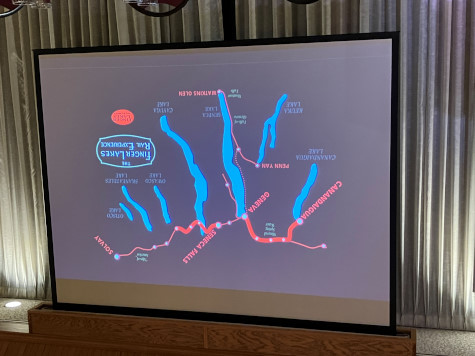
Finger Lakes Railway -- The resumption of seasonal tourist rail excursions throughout its six-county regional service area began on July 4th, 2025. Scheduled weekend operations over different segments of a 167-mile cluster of scenic lines, employ a distinctive five-car trainset of restored classic 1940s-era equipment formerly used on the New York Central System’s streamlined "20th Century Limited".
The new "FLX Rail Experience" train will include deluxe coach, premium and first-class accommodations to facilitate family outings, brunch dining, wine tastings and evening relaxation. Round trips range in length from one to two-and-a-half hours, variously departing from Canandaigua, Geneva and Seneca Falls. Weekday opportunities to charter a train for large-group occasions can also be arranged to avoid interference with regular freight operations.
To sharpen focus on promoting tourism and supporting local businesses, FGLK will act as host railroad for excursion service conducted by the professional organization operating highly successful tourist rail operations across the U.S.
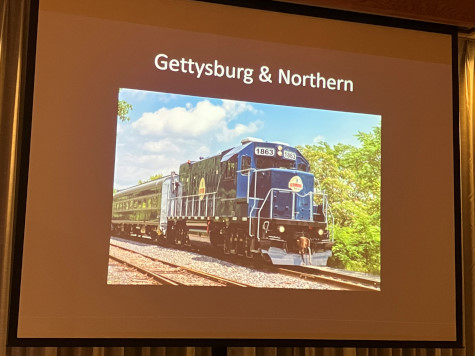
Gettysburg Railway -- Embark on a journey through history and the picturesque countryside of Adams County, Pennsylvania, with Gettysburg Railway. Patriot Rail Excursions invites you to board our new excursion train, departing from and returning to the charming historic 1884 Gettysburg train depot, conveniently located near the southeast entrance to Gettysburg College.
Step aboard 1950 era Budd built railroad passenger cars, now meticulously transformed into today's luxury passenger cars, transporting you back in time. As you travel, immerse yourself in captivating storytelling about significant leaders of the battle, and discover historical points of interest along the route. Enjoy the stunning countryside views as you journey along the railroad.
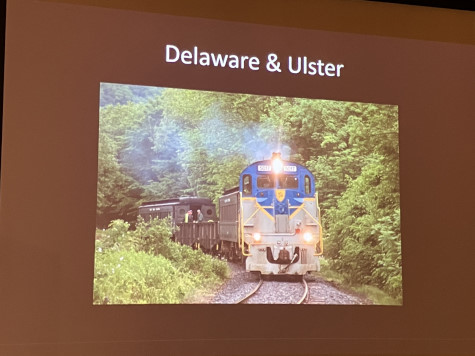
Delaware and Ulster -- The Ulster and Delaware Railroad Company was a Class I railroad located in New York State, headquartered in Rondout and founded in 1866. It was often advertised as "The Only All-Rail Route To the Catskill Mountains". At its greatest extent, the U&D ran from Kingston Point on the Hudson River through the heart of the Catskill Mountains to its western terminus at Oneonta, passing through four counties (Ulster, Delaware, Schoharie and Otsego), with branches to Kaaterskill and Hunter in Greene County. The U&D connected with six other railroads: the West Shore, Wallkill and O&W in Kingston, the D&N in Arkville, the Cooperstown & Charlotte Valley in West Davenport, and the D&H in Oneonta.
Although a small railroad, it was big in stature, as it went through many favoured tourist hot-spots. Many elegant hotels kept business going, some of which were sponsored or built by the railroad. Besides the passenger business, there were also plenty of farms and creameries (most of them in Delaware County) as well as businesses shipping coal, stone, ice and various wood products.
A section of the railroad from Highmount to Roxbury was saved by the Catskill Revitalization Corp. CRC began running trains from its purchase into 2020 when the railroad ceased operation due to Covid-19 and much needed restoration. In 2025, CRC partnered with a contractor the Delaware & Ulster Railroad LLC. to resume tourist operations and now the railroad operates primarily in the summer and autumn, with events stretching into the winter.
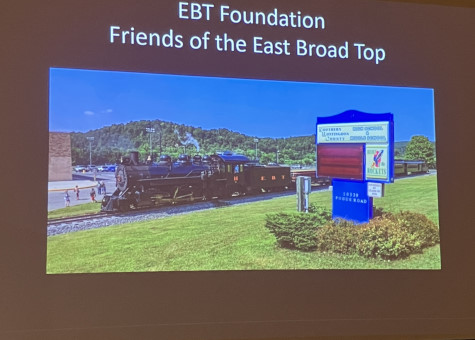
EBT Foundation and Friends of the East Broad Top -- Our first priority was to rebuild track between Rockhill Furnace and the Colgate picnic grove, where the railroad operated from 1960 to 2011. This work was mostly completed by the fall of 2021 and regular passenger service resumed immediately afterward. We will offer train rides, primarily powered by the EBT's own historic steam locomotives, along the railroad's scenic mainline — the oldest extant narrow-gauge line in the country. We're also seeking financial support to reopen the line to the historic towns of Three Springs, Saltillo, Robertsdale and beyond.
We also plan to return the historic, and equally important, EBT shop complex to replicate the original operating condition. We know visitors will be intrigued to tour this unique and expansive facility, where they can see demonstrations of the belt-drive system, the individual machines, and the processes the antique power distribution system made possible (such as replacing side sheets on hopper cars).
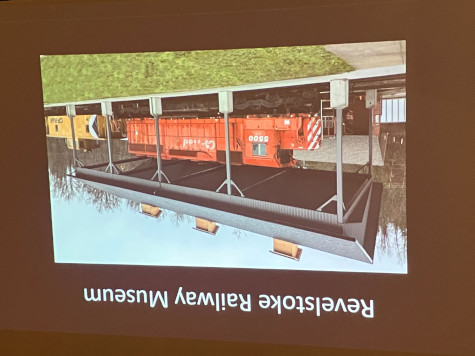
Revelstoke Railway Museum -- Established in 1988, the Revelstoke Heritage Railway Society began construction of the museum in 1992, opening its doors to the public in 1993. Discover Canada's railway heritage in one of Canada's premiere railway museums, showcasing the history of the Canadian Pacific Railway in the Columbia Mountains, and the role the railway and its workers have played in building Canada as a nation.
The museum had undertaken a restoration of the first SD40 built in Canada and a substantial overhead shelter has been constructed to ensure its protection.
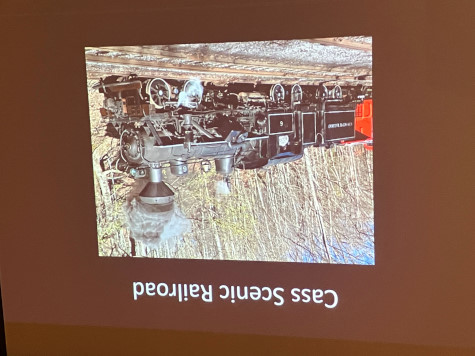
Cass Scenic Railroad -- This Heisler was returned to operation on May 3, 2025 as the only operating three-truck Heisler in the country. It was built for Bostonia Coal and Clay Products in Pennsylvania in 1929 then acquired by Meadow River Lumber in 1939. It was retired from regular service when diesel-electrics went into operation in 1957 and was the last geared steam locomotive used by Meadow River Lumber. It made its passenger debut in May 1968 then entered regular service to Whittaker in May 1969. Because of her speed in comparison to the Shays, it served as power for off-line events but was rendered out-of-service with a boiler problem discovered in May 1995 and became the first subject of a Division of Natural Resources boiler replacement program. The new boiler was delivered to Cass in December 1999 and the locomotive was returned to service in May 2004. It was loaned to the Durbin & Greenbrier Valley Railroad from 2016 to 2022 and taken out of service in early 2023.
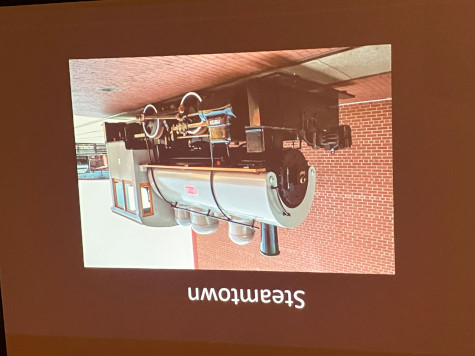
Steamtown -- Bullard Machine 0-4-0T 2, built by H.K. Porter in 1937. At 15 tons, it is one of the smallest standard gauge locomotives built and was designed for one-man operation. The locomotive operated in plant and yard use by the Bullard Company in Bridgeport, Connecticut. It was purchased by Nelson Blount in l963 from American Machinery Corporation. In June 2025, the locomotive was cosmetically restored and made its public debut in July.
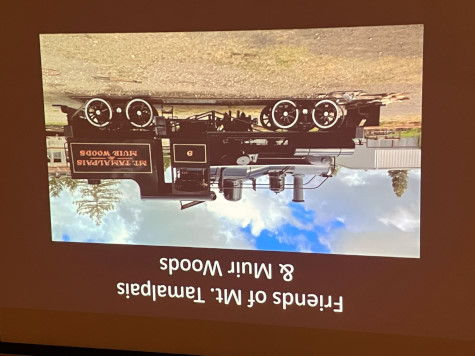
Friends of Mount Tamalpais and Muir Woods 9 -- In the spring of 1921, the Mount Tamalpais and Muir Woods Railway of Mill Valley, California took delivery of a brand new, Heisler locomotive from its manufacturer back in Erie, Pennsylvania. This steam powered locomotive was designated "Number 9" and put to work taking tourists up and down Mt. Tam on the "Crookedest Railroad in the World". In 1924, the engine was sold. It spent the next 26 years working for lumber companies in Siskiyou and Humboldt counties. In 1953 the Pacific Lumber Company bought the retired locomotive for display next to its new museum in Scotia, California. The display celebrated both No. 9's logging and tourist history. In 2018, the town decided to dispose of the locomotive and put it up for auction.
Number 9 is the sole piece of original, remaining equipment known to exist from this historic railway. It's historic value to Mt. Tamalpais, Marin County and in fact to the whole country is immeasurable. Recognizing this, a group of citizens banded together and in three weeks formed a limited liability company and secured $54,000 from other, like-minded people. They successfully secured Number 9 for Marin County by edging out the next lowest bidder by only $3,590. In November 2018, the engine was moved with big cranes and a truck and trailer to a temporary location in Sonoma County.
We started restoration work on Engine No. 9 in 2019, With that effort now well underway, we are working hard on securing a future home for this cultural treasure. We are seeking a site that highlights the historic relevance of the locomotive, where it will be safe and protected, and where the engine will be accessible to the public. We welcome the support and input of our Marin County community as we pursue a permanent home for No. 9, where it can be a source of inspiration for future generations. to be displayed at the Depot Plaza, Mill Valley, CA in May and then displayed at the California Railroad Museum during the summer of 2025.
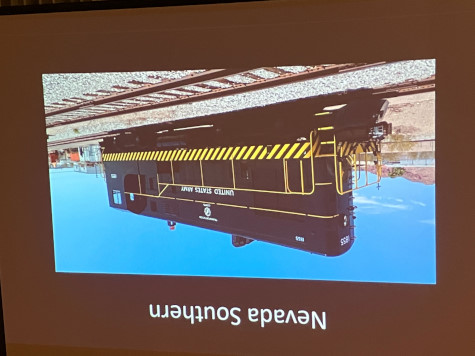
Nevada Southern -- Nevada Southern Railroad Museum 1855 H12-44 1855 was built by Fairbanks-Morse in 1953 and used in service for the government in the Army Transportation Corps. It is unusual because its diesel engine is of opposed piston design and was developed by Fairbanks-Morse for use in diesel submarines. About twenty five were manufactured for the Army Transportation Corps. After nearly four years, 1855 has been returned to operating condition and restored to its 1980s appearance.
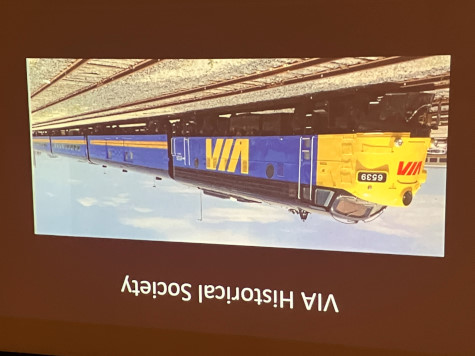
VIA Historical Society -- The VIA Historical Association is excited to announce its first major fundraising campaign to purchase and restore VIA Rail Canada FP9A locomotive 6539 (later numbered 6303) to lead our 2028 VIA 50th Anniversary heritage train. This will be the first time in history that an F-unit locomotive has been restored to operation in VIA colours. The VHA has signed a Memorandum of Understanding with Ontario Southland Railway to purchase OSR 1400, which began life as 6539. As long-time supporters of heritage railway preservation in Canada, OSR places a high value on saving and restoring Canada’s unique and historic railway equipment. OSR has generously offered to donate back almost half the purchase price to the VHA. 6539 was one of 43 FP9A locomotives built by General Motors Diesel in London, Ontario, between 1954 and 1958. Originally built for Canadian National, the FP9A locomotives hauled trains all over Canada. Mostly used for passenger service, FP9A locomotives could also be seen leading priority freight trains.
In VIA service, the FP9A locomotives operated on almost every single route, including Halifax to Montreal; the Quebec City-Windsor Corridor; northern Quebec services; all transcontinental trains including the Canadian and the Super Continental; services to northern Manitoba and Prince Rupert; and even on Ontario Northland rails to Kapuskasing. Transferred to VIA in 1978, 6539 was one of 12 FP9A locomotives remanufactured in the early 1980s by CN's Pointe St. Charles shops in Montreal, becoming VIA FP9ARM 6303 in 1983.
Among the major aspects of this rebuilding was the application of 645-series power assemblies, upgrading the unit's original 567-series engine and increasing horsepower from 1,750 to 1,800. VIA’s first five FP9ARMs (6300-6304) retained their original side-panel configuration, with horizontal and vertical batten strips, after remanufacturing, while later units emerged with welded side panels. This means that the VHA can backdate OSR 1400 very close to its external appearance as VIA 6539, while enjoying the mechanical benefits of its upgraded engine and electrical system.
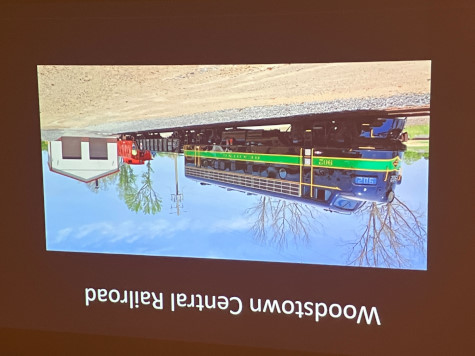
Woodstown Central Railroad-- Returning to passenger service for the first time in fifteen years in Swedesboro, New Jersey was SMS Rail Lines FP7A 902, ex. Philadelphia Chapter National Railway Historical Society 902 1981, exx. South Eastern Pennsylvania Transportation Authority 902 1974, nee Reading 902, built by Electro-Motive Division in 1950.
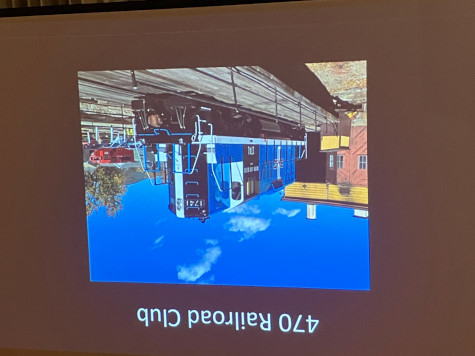
470 Railroad Club -- in 2020, the Maine-based non-profit announced that it had purchased former B&M GP9 1741 from Utah’s Heber Valley Railroad. The GP9 was one of three locomotives the Heber Valley purchased from Pan Am Railways in 2018. While two of the GP9s went west (heritage units 52 and 77), one stayed in New England and eventually was deemed surplus by the Heber Valley. In 2024, a major push was made to get the locomotive back on the main line, to have it in service by the club's annual fall trip to Fabyans, New Hampshire, on the famed Crawford Notch Line.
On October 20, a trial run up the mountain was made on the Conway Scenic Explorer train. The 1741 was paired with CSRR GP35 216 and made a flawless trip to Crawford Notch and return. On November 2, it joined the 470 Club’s two former B&M F7s on a trip from North Conway to Conway and then Conway all the way to Fabyans.
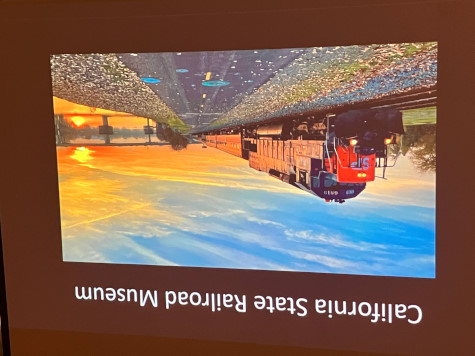
California State Railroad Museum -- Southern Pacific SD45T-2 6819, nee Southern Pacific 9193, built by Electro-Motive Division in 1972. It was rebuilt at SP's Sacramento Shops under the GRIP II Program in August 1987 and was the last tunnel motor to be rebuilt. In addition, 6819 is the only preserved SP tunnel motor that is operational. It was donated to California State Railroad Museum in February 2002 as an example of Southern Pacific landmark SD45T-2 locomotives.
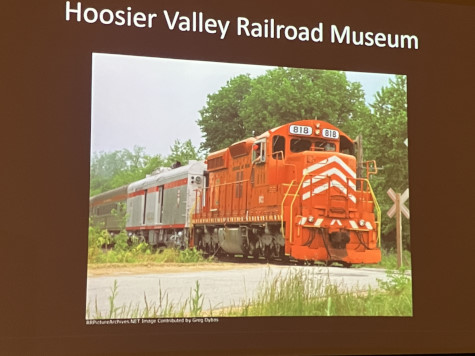
Hoosier Valley Railroad Museum -- SD9 818, nee Duluth, Missabe and Iron Range Railway 172 built by Electro-Motive Division in 1959. It was subsequently rebuilt by the Missabe as an SD-M in 1990, becoming 318 then was transferred to the Elgin, Joliet & Eastern in 1998, becoming their 818. It was sold to Indiana Boxcar and later transferred to the Chesapeake & Indiana Railroad then donated to the Hoosier Valley Railroad Museum in 2021.
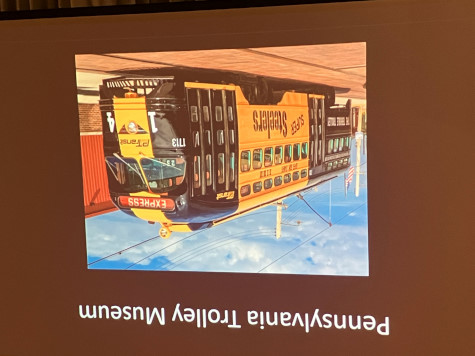
Pennsylvania Trolley Museum -- In the busy years following WWII Pittsburgh Railways Company was still operating many trolleys built before 1930, and as far back as 1914. While they were by then operating 566 PCC cars, still more were needed to further reduce the fleet of old-timers. This was particularly true of two interurban routes to Washington and Charleroi. Early success with a few modified PCCs in these services during 1946-47 resulted in an additional order for 100 PCCs in 1947. Of the 100, the first 25 were specially equipped for the interurban lines. These cars, numbered 1700 to 1724, had a number of features for the interurban lines, the most important of which was a different type of trucks to provide better riding on the open track of the interurbans.
Car 1713 was rolled off a railroad flatcar at PRCo's Millvale Car House on February 22, 1949 and entered service at Tunnel Car House on February 24. When those special 25 cars were split up between three car houses serving the interurban lines, Tunnel got cars 1709-1715. After the last cars ran from Washington and Charleroi in the summer of 1953, car 1713 continued to serve on the shortened versions of the two lines for PRCo and successor Port Authority Transit. In the early 1980s this car was one of many that carried special paint schemes. A young girl named Kim Sever thought that Pittsburgh should have a "terrible" trolley painted in Steelers colors, along the lines of the Terrible Towel. Her grandmother suggested that she write a letter with the recommendation. Nine-year-old Kim sat down and wrote to Mayor Richard Caliguiri who wrote back explaining that he wasn't in charge of the public transit system but that he would pass along her suggestions.
Mayor Caliguiri's response and memo to the Port Authority of Allegheny County (now Pittsburgh Regional Transit or PRT) was dated January 3, 1980. On Port Authority's internal memo about the letter, they indicate that they took action to move forward with the project by January 10, 1980. In just one week, they were working to paint a car in the suggested theme. Lastly, we have a handwritten note saying the car had been painted and was awaiting decals, while that note is not dated, we do know that the Terrible Trolley began running the streets within just a few weeks of the mayor's letter.
PAT riders and trolley fans alike considered 1713's new image as one of the best since it carried the colors and images of the Pittsburgh Steelers football team. This car in that image was revered by the operators as well for its reliability. This image lasted well into the 1980s. As PAT began to acquire a fleet of LRV cars for the upgraded lines to the South Hills, 1713, no long the Steelers car, was among a number of cars retired in late July 1988.
Car 1713 then received the first of three respites when it was chosen with three others for upgrades including train control equipment compatible with the LRV trackage and its new safety systems. Thus repaired, 1713 re-entered service July 27, 1989. As more of the PAT system was upgraded to LRV standards in the 1990s, the need for PCC cars diminished to just a few 4000 series cars for the Drake Line. Early in 1998 a large scale PCC scrapping program began at PAT’s South Hills Village Shop. Initially 1713 was included in the scrap line. Then came respite number two.
This time it was trolley enthusiasts and preservers who saved 1713. On March 26, 1998, 1713 was sold to Penn Ohio Electric Railway Association of Columbus, Ohio. This group had previously acquired two other PRCo PCCs at their storage facility near Ashley, Ohio. A semi-truck loaded 1713 at SHV on May 4, 1998 and took it to Ohio to join the two cars already there. As often is the case with such small-scale preservations, progress was slow and while safely indoors, the cars faced an uncertain future by 2023. This situation was viewed with interest by PTM and set the stage for respite number three.
This time the driver was the universal love for the Steelers in our region and beyond. When word of 1713’s plight reached PTM in March 2023, there arose a groundswell of enthusiasm to save the car from the torch and, if possible, restore it to the 1980s Steelers image. By that time the ownership of 1713 rested with PTM member Edward Miller of Columbus. Ed had been trying for years to find a new home for 1713 and was more than happy to sell the car to PTM. Brownlee Trucking, Inc. agreed to help transport the car from Ohio to the Museum. In addition, the Museum was able to secure an NFL license agreement through the Pittsburgh Steelers and the Eamon Foundation, the charity designated by Myron Cope’s estate as the owner and beneficiary of "The Terrible Towel" trademark.
Car 1713 arrived at PTM on May 31 and was immediately set upon by a group of PTM's younger members. Even before the arrival the gears had been turning on securing all the permissions and donations of services needed to restore 1713 to that special Steelers image. Like our experience with sister car 1711, a lot of work was needed underneath. As in the case with 1711 when restored at Elmira, New York, the entire floor was removed from 1713 so that welding and cutting could be safely done in the PTM shop. The restored car debuted in August 2025.
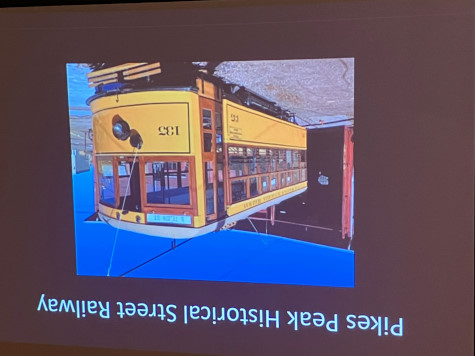
Pikes Peak Historical Street Railway -- Sstreetcar 135, ex. Rocky Mountain Railroad Club 22 1951-1997, nee Fort Collins Municipal Railway 22, built by American Car Company in 1919. Fort Collins stopped streetcar service in 1951; it was the last city to operate Birney Safety cars.
Of over 6,000 Birney cars built, fewer than 100 are known to survive, less than thirty with their original mechanical equipment, electric equipment and seats. This car was delivered to the museum essentially complete except for damaged wood like the floor and roof. Since the last CSIR Birney was number 134, in accordance with standard railroad practice when acquiring equipment from another line, we renumbered the car as CSIR No. 135. Its Fort Collins history should not be forgotten though as the then small college town was the last to operate streetcars in Colorado and the last Birney cars in North America. CSIR 135 is the last streetcar to operate in revenue service in Colorado and the last Birney car to operate in North America when it came in from its last run 10:45 PM on June 30, 1951 with Charlie O’Laughlin as the operator. This streetcar is now on the National Historic Register.
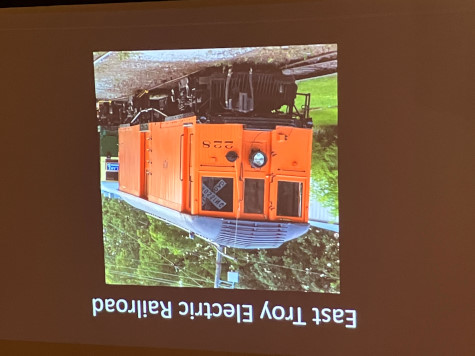
East Troy Electric Railroad -- Chicago North Shore and Milwaukee interurban box motor 223 was built by Cincinnati Car Company in 1916. During the early 20th century, fast electric interurban railroads provided cheap, reliable service between cities and towns across America, predominantly in the upper midwest. The Chicago North Shore and Milwaukee Railroad, also commonly known as the "North Shore Line" was one of these interurban railroads, one which operated between the cities of Milwaukee and Chicago during this time. The North Shore Line ran frequent high-speed passenger trains between downtown Chicago and downtown Milwaukee from 1916 through early 1963. Railroad historian and photographer William Middleton described the North Shore Line as a "super interurban". North Shore Line interurban trains would ride on the elevated rail system in downtown Chicago, squeezing between skyscrapers on tracks owned by the Chicago "L' until reaching the outskirts of the Windy City, where they joined their own tracks, speeding along at over 90 mph through North Chicago, Racine, and Kenosha until reaching Milwaukee.Powerful electric locomotives were used to haul carload freight and Merchandise Despatch cars to haul less-than-carload freight to any station along the line or for transfer to other railroads or steamship lines. The MD cars were essentially self-propelled boxcars (called "box motors") that carried packages, newspapers, milk cans, furniture, beer, and many other items. Small packages could be brought to any North Shore Line station for shipment, and larger items were processed through freight houses, where transfers could be made from trucks. In Chicago alone, there were eight freight houses served by the North Shore Line, and the North Shore also had a contract with the Chicago Tunnel Company, which operated a vast narrow-gauge railway under downtown Chicago. The CTC would bring small packages and shipments to one of the North Shore freight houses, where MD cars would haul the freight north out of the Montrose Freight House in the early morning hours.
"Ferry Truck" service pulled by MD cars was profitable, with the trucks later being driven to their final destinations. A total of 37 merchandise cars, and five similar refrigerated cars, were built by the Cincinnati Car Company for the North Shore Line between 1920 and 1926 and were numbered 203-244. The first 12 cars were built with cargo doors at the ends of each side, while the remaining cars, including car 228, featured wide center cargo doors on each side.
In 1917, Samuel Insull had acquired control and begun a freight service for packages, milk cans, and other less-than-a-car loads. Known as the popular "Merchandise Despatch" (British spelling) service, the railroad charged one-third higher prices but guaranteed overnight shipping. Other competing railroads often took 2-8 days to ship packages between Chicago and Milwaukee, and so the service quickly became highly profitable. With the steamship companies, third- morning service between Milwaukee and Chicago and Michigan was guaranteed when steam railroads took as long as two weeks to complete the same task. In 1926, the North Shore Line began the first "piggyback" service in the country. North Shore trucks were backed onto special flatcars in Chicago, Milwaukee, Racine, or Kenosha, to be unloaded at one of the three other terminals, allowing the NSL to serve even more businesses than it could before. As there were not many good roads between the four cities, this also became highly profitable. The North Shore Line soon began shipping the whole truck to the customer's destination. The "Ferry Truck" (as the North Shore called it) service was the world's first, and many piggyback trains operate daily across the world today./
As the North Shore Line began handling truck trailers in piggyback service, the LCL business decreased and was finally eliminated in 1947, and the Ferry Truck service was also soon eliminated due to faster shipping and new competition brought on by inter-city highways. At that time, the MD cars, which were already being used as locomotives for the piggyback trains, were given a variety of new assignments. These included service as locomotives for shorter freight trains, cabooses, yard switchers, snowplows, tool cars, and sleet cutters. Car 228 became a sleet cutter, which scrapes ice from the overhead trolley line.Due to new interstate highways and a postwar car-centric society, the North Shore Line and almost all of the other interurbans were forced to shut down after losing revenue. The last North Shore train pulled into Milwaukee just before 3:00 am on January 21, 1963.
When the North Shore Line shut down in 1963, nine merchandise cars were initially saved. Sadly, only five survive today. Car 228 was sold to the Indiana Railway Museum. In connection with that museum’s move from Westport to Greensburg, Indiana in 1971, the car was sold to The Wisconsin Electric Railway Historical Society, which opened a trolley museum in East Troy the following year. In 1988, possession passed to the East Troy Railroad Museum, which had assumed operations at East Troy a few years earlier.
The restoration of car 228 was completed in 2024. The car operated under its power for the first time since 1963 on Friday April 19, 2024 at 3:30 pm. Final touches were put on the car the month following.
The East Troy Railroad Museum acquired Car 228 from The Wisconsin Electric Railway Historical Society in 1988. At that time volunteers did preliminary work to restore the car, but did not complete the work. Starting in early 2022, restoration work began again and the car left the maintenance facility under its own power for the first time in over 50 years in April 2024. The car looks practically new and is a showcase of both midwestern interurban and East Troy Railroad Museum history.
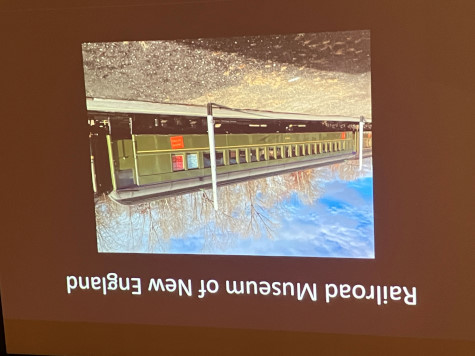
Railroad Museum of New England -- The Railroad Museum of New England expanded its collection of Canadian National Railways coaches with a generous donation from the Bytown Railway Society of Ottawa, Canada in September 2024.
Canadian National 4977, built by Canadian Car & Foundry in 1924, arrived on the afternoon of Friday, September 13th after a careful journey from Ottawa. The coach is in excellent condition, requiring only some minor maintenance and upgrade work, and will join the heritage train service on the Naugatuck Railroad. This coach is similar to seven Canadian National heavyweight coaches and lounges in RMNE's collection, many of which are already in active service on the Naugatuck Railroad. These cars regularly served on trains between Montreal and New England cities before they were replaced by lightweight coaches and transferred to Montreal commuter service.
The Bytown Railway Society acquired 4977 in 1989 and briefly used it for excursion service at the Canada Science and Technology Museum in Ottawa. It then leased the coach to the York Durham Heritage Railway in Uxbridge, Ontario for several years before it was returned to the museum's grounds in 2005. Over a period of 15 years, volunteers with the “Dirty Hands Club” worked to bring new life to 4977, including restoration of the roof, windows, exterior, and paint. This project was completed in October 2023. Unfortunately, with the Canada Science and Technology Museum reducing the space allotted for the Bytown Railway Society’s collection, the group reluctantly decided to find a new home for 4977.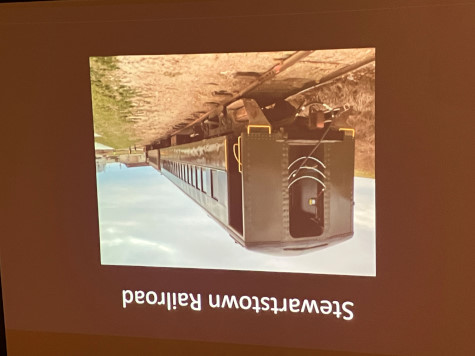
Stewartstown Railroad - In spring 2025, the group celebrated the first official two-coach train since 2004, coach 1158 on the rear.
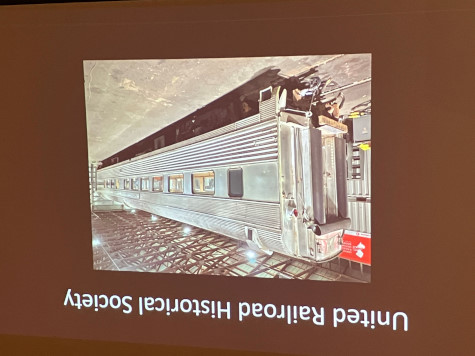
United Railroad Historical Society -- On May 22nd, 2025, it was announced that the organization had officially begun restoration of New York Central Tavern-Lounge 37, a 1947 Budd-built stainless steel lounge car. Once complete, NYC 37 will become the fourth Amtrak-certified car in the organization's growing fleet of operational historic railcars.
The car is currently undergoing a comprehensive renovation at URHS's Boonton Yard. This work includes critical mechanical upgrades and a floor-to-ceiling refresh of the car's interior. The restoration is being undertaken in phases, allowing NYC 37 to return to service in the short term while URHS continues the process of acquiring, rebuilding and installing the necessary components for full Amtrak certification over the coming years. The completed car will feature a new interior inspired by New York Central's classic dining and lounge car designs, configured for table seating during excursions. While operating on short lines, continued restoration work will include rebuilding wheels, trucks, and recreating historically accurate fixtures and furniture.
In 2025, NYC 37 will debut as part of the new Finger Lakes Rail Experience, a heritage tourism partnership between FMW Rail Operations, the Finger Lakes Railway, URHS and other community partners. Upon completion of its Amtrak certification, the car will also become a key feature of URHS's Hudson River Rail Excursions out of New York City, when those trips resume from their temporary hiatus. New York Central 37 is a prime example of postwar American passenger car innovation. Built by the Budd Company in 1947 as part of a lot of 13 Tavern-Lounge cars for the New York Central Railroad, it originally featured a wet-bar tavern section with booths and a lounge area with movable chairs, accommodating up to 47 passengers. As a pool lounge, it served on iconic trains such as the Empire State Express and the New England States. Following its service with New York Central, the car was transferred to Penn Central and eventually to New Jersey Transit, which later donated the car to URHS. It holds a special place in the organization’s history as the first operational car in its collection. Many railfans will remember the car under the number 5450, when it ran lettered as "New Jersey Railroads" and later was dedicated in honor of New Jersey Assemblyman Alex DeCroce. It operated as a first-class car and mobile gift shop on excursions including behind the C&O 614 and during the final run of the U34CH.
This restoration project is made possible through generous support from the Emery Rail Heritage Trust, which awarded URHS a total of $30,000 in grants across 2024 and 2025.
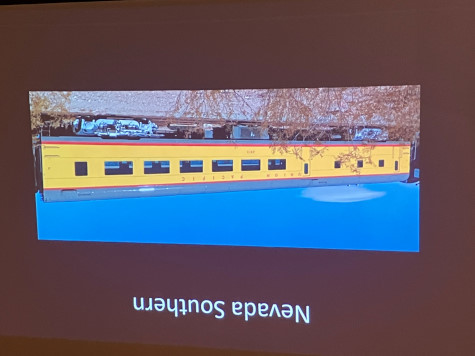
Nevada Southern -- Union Pacific dining car 4813 built by American Car and Foundry in 1949 and retired in December 1971. It was stored at Milford, Utah, until sold to Heber Creeper (Wasatch Railroad and Museum Foundation) at Heber, Utah and used in regular tourist and excursion service until sold to Nevada State Railroad Museum in 1992. It was moved to Boulder City, Nevada during summer 1993 and refurbished in 2004. The year-long restoration project was completed in November 2024.
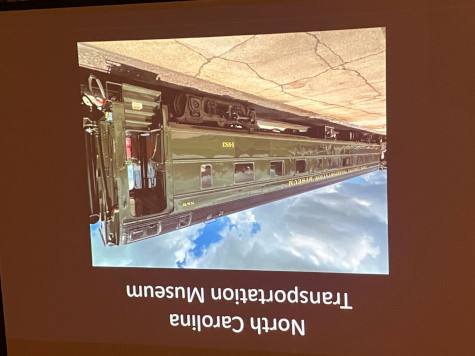
North Carolina Transportation Museum -- On July 24, 2025, it was announced that the museum had restored another treasured piece of its rolling stock collection. Budd Car 1483 originally named Franklin County was built in 1949 for the Norfolk and Western Railway as a sleeping car, configured with 10 roomettes and six double bedrooms. In 1963, it was sold to the Pennsylvania Railroad and transformed by Budd into a 72-seat snack bar coach. The car entered Penn Central's fleet in 1969 following its merger with the New York Central Railroad. Later, it served Maryland commuters through MARC, operating routes between Washington, DC, Baltimore, and neighboring communities. Acquired by North Carolina transportation Museum in 2024, Car 1483 arrived with a blue band that the museum repainted Pullman green. The museum has since completed its restoration by painting the entire car in classic Pullman green, honoring its mid- century legacy with a timeless finish. The current seating capacity is 88 coach seats.
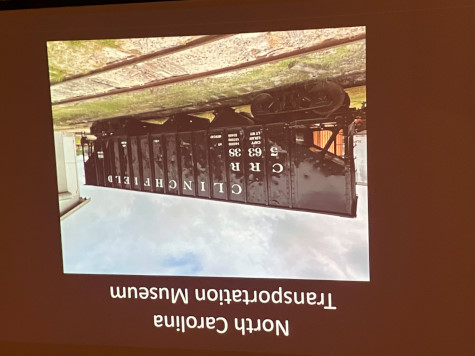
North Carolina Transportation Museum -- The latest freight car to roll out of the N.C. Transportation Museum paint shop is Clinchfield coal hopper No. 56338. The car was donated to North Carolina Transportation Museum by the Watauga Valley Railroad Historical Society and Museum in 2017. The Carolina, Clinchfield & Ohio ( Clinchfield Railroad) was a 277-mile railroad between Elkhorn City, KY, and Spartanburg, SC. The line entered North Carolina south of Erwin, TN, where it followed the Nolichucky and Toe Rivers as it climbed to its highest point at Altapass, NC, just south of Spruce Pine. From there, it descended toward Marion, NC, on a looping route that is still considered an engineering marvel. The Clinchfield remains an important part of the CSX network and is currently being rebuilt following extensive damage caused by Hurricane Helene. As progress continues rebuilding this important line, we unveil one of its historic rail cars that put in thousands of miles traveling the Clinchfield's "Quick Service Short Line Between the Central West & South East".
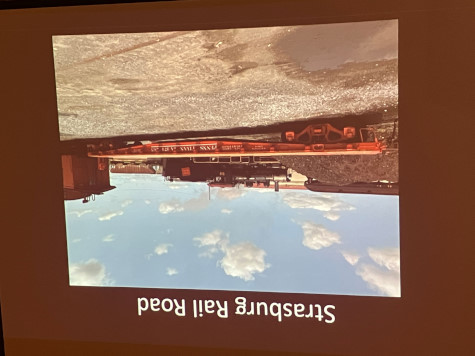
Strasburg Rail Road -- restoration of their Pennsylvania Railroad 50 foot flat car 474265, built by the railroad and General Steel Castings in 1934
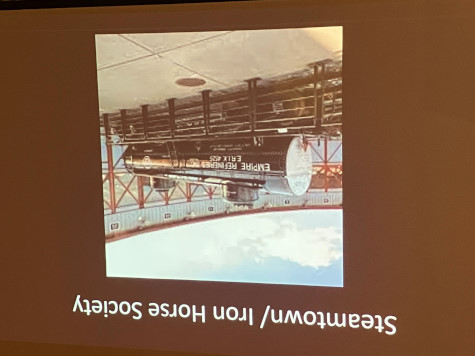
Steamtown/Iron Horse Society -- built in August 1925, this tank car spent nearly five decades hauling oil, chemicals and tallow until it was removed from service in 1973. After years of display outside the old oil house here at the park, 4525. In 2022, it rolled into our locomotive shop for a long-overdue makeover, and after three years, it has been fully restored! A special thanks to the Iron Horse Society for donating the vinyl cutter, ensuring the lettering and final details were completed with precision.
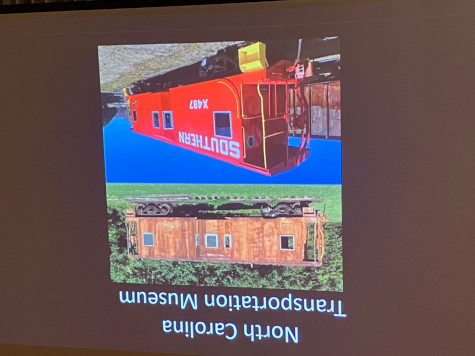
North Carolina Transportation Museum -- In August 2023, the Walnut Cove, NC, Lions Club donated Southern Railway bay window caboose X487, built by Gantt Manufacturing in 1970. With funds donated by Jack and Audrey Harris, a full interior and exterior rehabilitation was completed by contractors and volunteers. Glenn Hudson of Yadkin Chain Upholstery donated his time and materials to reupholster the seats in the car. This bright red caboose is an example of the commitment the museum makes to preserve history and the supporters and partnerships.
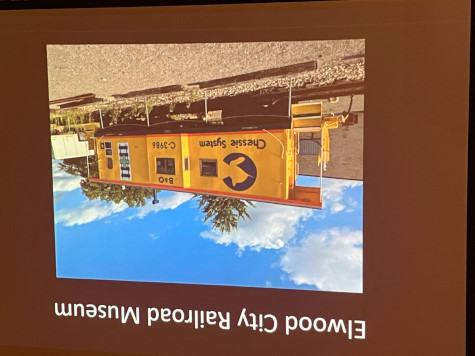
Ellwood City Railroad Museum - Chessie caboose C-3986, nee Baltimore & Ohio class C-27 caboose built in 1978, by Fruit Growers Express in Alexandria, Va. It was originally numbered B&O C-3986, delivered in the yellow, blue and vermilion paint scheme of the Chessie System Railroads complete with Chessie Cat logos. The caboose kept that paint until the late 2000s when it received the current gray scheme applied by CSX Transportation and numbered 900072.
"All Aboard Ellwood" was established by a group of community-focused volunteers with the mission to develop a facility in Ellwood City commemorating the City's industrial and railroad history. In 2022 we became "AAE Incorporated", a 501c(3) non-profit group, and will continue to work toward our goal of creating a cultural hub honoring the hard-working men and women who forged Ellwood City's railroad and industrial past. It is a hard-won legacy that we deeply want to pass on to future generations.
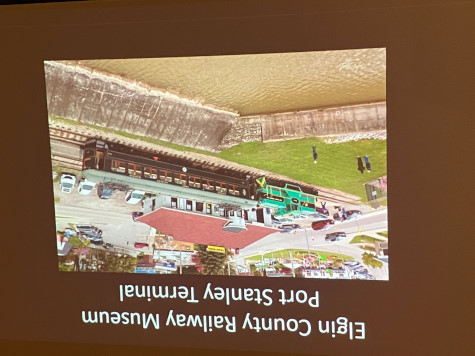
Elgin County Railway Port Stanley Terminal Rail -- Saturday, May 24, 2025, marked an unforgettable moment when the legendary Car 14 returned to the rails for the first time since 1957! This was built by Jewett in 1917. Car 14 was built in Newark, Ohio in 1917. After running until 1957 as a passenger train, it was donated to the Canadian Railway Museum in 1962 by the London Railway Commission.
The entire inside was gutted down to the frame, the flooring was replaced, as well as the ceiling. The seats were re-upholstered, the bathrooms re-finished, all the brass handles and fixtures were re-finished and put back together. Stained glass on the interior was original from before and then the stained glass on the exterior was replaced. The train cost $33,665.70 in 1917 and was the best design money could buy. The L&PS was a prototype for a line envisioned by Sir Adam Beck which would have seen electrified lines across Ontario.
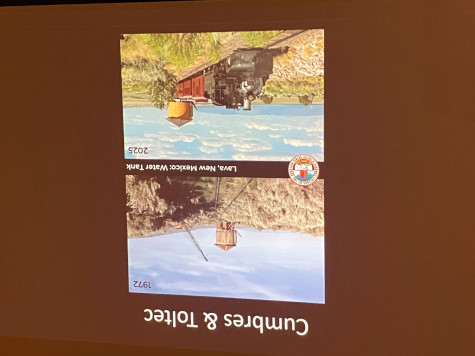
Cumbres and Toltec -- the rebuilding of the water tank at Lava. At a mere eleven miles west of Antonito and just fourteen miles to the next watering hole at Sublette, one might think that a tank at Lava would not be all that necessary. But the thirst of C&TS locomotives is insatiable and the nearly-500-foot climb from Antonito to the rocky plains at Lava can consume a goodly portion of a locomotive's water supply, especially before the 1920s, when the big K-36 and K-37 Class engines came along. It is another 810 foot climb over the next fourteen miles to Sublette. When the Cumbres & Toltec took over 64 miles of the Denver and Rio Grande in 1970, the Lava Tank and the Pump House were part of the deal along with the rest of the structures and right-of-way.
In 1971, an unidentified railfan climbed onto the roof of the Lava Tank, lit a cigarette and waited to take a photo of the passing train. As the train approached, he probably tried to snuff out his smoke on the dry shingles of the ninety-year-old structure and reached for his camera. No one knows the whole story but the result was obvious; the tank caught fire and burned right down to water level about two-thirds full.
Still, the railroad needed a tank at Lava so they "imported" the tank from Antonito, tore the burned tank down to the support columns and set the "new' tank on top, including a 12,000 gallon steel liner with a much smaller capacity than the original tank. The tank was used less and less. When the pump at Rio de Los Pinos failed and the water line up to the tank collapsed and clogged, the tank at Lava became more of a historic piece of the scenery than a required stop for locomotives.
With the rebuild of K-27 Locomotive 463 and the restoration of Locomotive 168 and Locomotive 315 (on loan from the Durango Railroad Historical Society), the C&TS began to offer unique historic charters and other events with these older classes of locomotives. Due to their age, however, they lacked the water capacity of the newer, larger, heavier Class K-36 and K-37s. Once again, water was needed at Lava. The long-term plan was to repair the 400 foot water line and once again refill the smaller locomotive with water from the Rio de Los Piños directly to the Lava Tank. This was completed in July 2025.
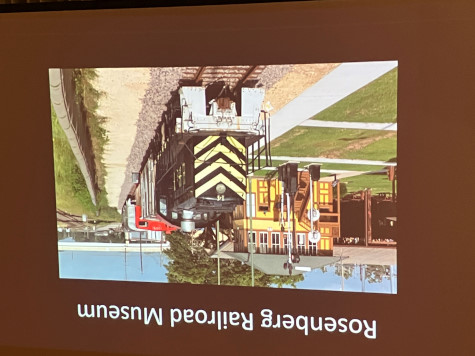
Rosenberg Railroad Museum -- The idea to create the Rosenberg Railroad Museum began in 1992 when a group of citizens formed a committee to establish a museum designed to preserve the railroad history of Fort Bend County. By 1993, committee chairman Judge Larry Wagenbach convinced the Atchison, Topeka, & Santa Fe Railway Company to donate 1.47 acres of land on the west side of 3rd Street and north of Avenue F in downtown Rosenberg which became home to the Rosenberg Railroad Museum.
In July of that year, the railroad museum acquired its first artifacts from an auction at the George Ranch - the largest being the 1879 business car "Quebec". In November, 1993, the museum held its first fundraiser at the former Rosenberg State Bank Building on the corner of Avenue G and 2nd Street in downtown Rosenberg. The Harvey House themed event was attended by actor James Drury, best known as "The Virginian".
In the summer of 1994, the museum prepared a foundation for the rail car and the Quebec arrived at the site in the summer of 1995, ready for restoration to begin.
None of Rosenberg's original railroad buildings had survived, except for Tower 17, and that one was still in service, so there was a need to construct a gallery that would house the exhibits. By the end of 1998, construction began on the reproduction of the Rosenberg Union Depot for use as a museum gallery. The museum building was completed in 2002, and on June 6-8 of that year, a Grand Opening was held, attracting thousands of people from across Fort Bend County.
In 2006, the Houston Children's Museum was undergoing renovations when they decided to sell their railroad caboose. It was purchased that same year and arrived on the RRM campus in 2007. A former Missouri Pacific Caboose, its exterior was repainted in 2018 and the interior was renovated in 2022 to match its original design.
The Houston Area G Gaugers and RRM began planning a Garden Railroad exhibit to depict Fort Bend County in the 1950s. The layout broke ground in the summer of 2014 and the first trains were up and running by Christmas of that year.
Today, the Rosenberg Railroad Museum has grown and improved its grounds and building to over 1.5 acres, 3 buildings, 6 model train layouts and six rail cars. The Museum continues with its mission of education and preservation of Fort Bend County's rich railroad history.
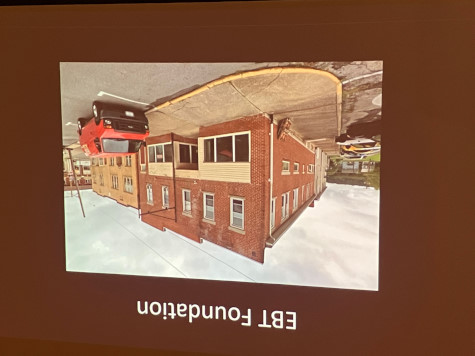
EBT Foundation -- The East Broad Top Railroad Archives and Special Collections Program (the Archives) was established as a joint program by the East Broad Top Foundation and the Friends of the East Broad Top to protect, preserve and provide access to the history, memory, and legacy of the East Broad Top Railroad National Historic Landmark. Since its inception in May 2021, the archives has prioritized materials needed to restore railroad operations and support the EBTF and FEBT. As those materials are processed and digitized, they are available for public access.
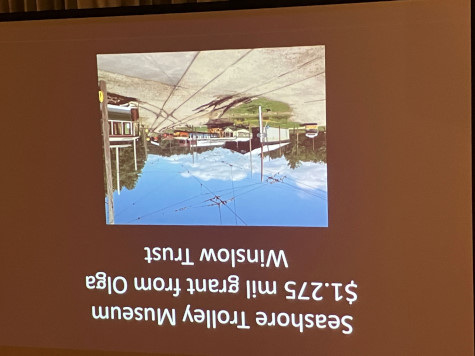
Seashore Trolley Museum -- the recipient of a large bequest. The Seashore Trolley Museum, located in Kennebunkport, Maine is the world's oldest and largest museum of mass transit vehicles. While the main focus of the collection is trolley cars. it also includes rapid transit trains, trolley buses and motor buses. The Museum is owned and operated by the New England Electric Railway Historical Society, a non-profit organization, which also owns the National Streetcar Museum. The events that led to the formation of the museum started in 1939 when a group of railfans learned that the Biddeford and Saco Railroad was purchasing motor buses to replace its fleet of trolley cars. More and more trolley companies were doing this as the technology of buses had developed to the point that they were reliable and economical.
It was then time for the Significant Achievement Award winners.
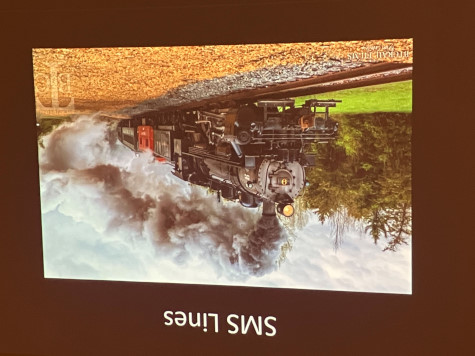
SMS/Woodstown Central for the restoration of 0-6-0 9, ex. New Hope and Ivyland 9 1966, exx. Steam Trains, Inc. 9 1964, exxx. Virginia Blue Ridge 9 1958, exxxx. United States Army 616 1952, nee United States Army 4023, built by American Locomotive Company in 1942. Restoration work began on the switcher in 1992 but did not proceed very far. By 2009, it was at SMS undergoing restoration as time allowed. When Salem County awarded SMS the contract to operate the Salem Branch and SMS decided to get into tourist train service, work accelerated on the 9, with its first test-firing in 2021 and its first movement under its own power in 2023.
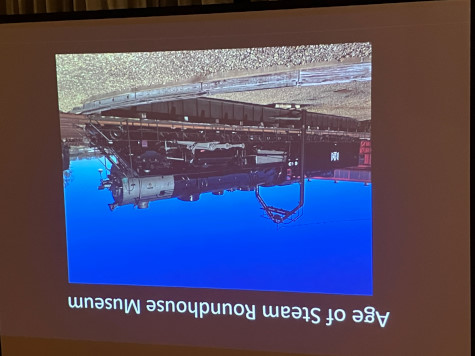
Age of Steam Roundhouse for the rescue and cosmetic restoration of Bessemer & Lake Erie 2-10-4 643. B&LE 643 is a heavy-haul steam locomotive that was designed and built to move iron ore, coal, and other high-density commodities to and from the Great Lakes region. Built in 1944, the 643 saw an early retirement in 1952 due to the increased introduction of diesels to the Bessemer & Lake Erie’s locomotive roster. Fortunately, the 643 and two other smaller steamers were preserved by the B&LE in its roundhouse in Greenville, Pennsylvania.
B&LE 643 will become the largest locomotive in the AoSRM collection. This behemoth is just over 108' long, stands over 16' high, and weighs 450 tons without coal and water. Add 26 tons of coal, and 23,000 gallons of water, and B&LE 643 tops the scales at 572 tons!
AoSRM founder, Jerry Jacobson, nicknamed B&LE 643, "The King", as it is believed to be one of the largest non-articulated steam locomotives in the world. It had been Jerry's life-long desire to acquire this historic iron giant to restore and display with the other 21 steam locomotives in his collection. The Board of Directors and dedicated Staff at the Age of Steam Roundhouse Museum, are deeply grateful to Glenn Campbell and The Steel City Railway Historical Society for saving B&LE 643 in McKees Rocks, Pennsylvania, and for their selflessness, by assuring the locomotive’s long-lived future at the Age of Steam Roundhouse Museum.
The Age of Steam Roundhouse Museum would like to recognize and honour the efforts of the Ernest Stern Family and his son, Rick Stern, of Pittsburgh for their direct and dedicated involvement in the critical phases of restoration of B&LE 643. Their one-time ownership, and financial investment in the 643, are responsible for much of the early work performed that has greatly helped its survival for these many years!
On January 31, 2024, former Bessemer and Lake Erie Railroad steam locomotive 643 arrived at the Age Of Steam Roundhouse Museum. With the arrival of the boiler and running gear, the entire locomotive is all together again and fulfills a lifelong dream of our Founder Jerry Jacobson. On March 29, 2025, the King, cosmetically restored, was proudly put on display to the public during the annual Members Day activities.
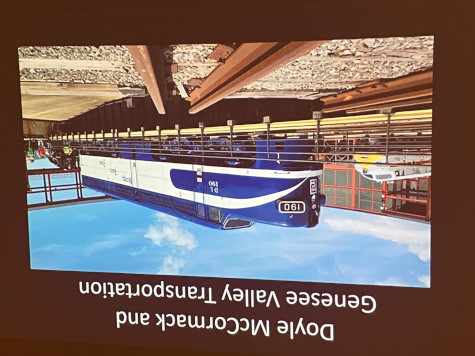
Doyle McCormack and Delaware-Lackawanna Railroad for the Alco PA restoration. July 11, 2025 marked the completion of restoration on PA4 190, the former Santa Fe and Delaware & Hudson locomotive repatriated from Mexico in 2000 and formerly owned by preservationist Doyle McCormack, who began the restoration work. The locomotive now wears Nickel Plate Road’s “Bluebird” scheme and the No. 190 because that was the favored railroad of his boyhood.
Santa Fe 190 was completed by Alco in December 1948, going to Santa Fe as its No. 62L. Renumbered to No. 18, it and three other Santa Fe PA1s were acquired by Delaware & Hudson along with some secondhand passenger cars in 1967 to upgrade the railroad's New York-Albany-Montreal Laurentian and Montreal Limited. (Those trains operated on New York Central/Penn Central between Albany and New York’s Grand Central terminal, using NYC/PC power). Those trains were discontinued in 1971 with the launch of Amtrak, and the locomotives were traded in to General Electric.
But D&H President C. Bruce Sterzing reacquired the locomotives, which operated on occasional excursions until 1974. That year, New York State and Amtrak reached agreement to restore a daily New York-Albany-Montreal train, the Adirondack. D&H supplied the equipment; the state picked up the cost of refurbishing the passenger cars and the locomotives. The PAs went to Morrison-Knudsen in Boise, Idaho, for a rebuild, where their original Alco 244 prime movers were replaced with 251 engines for an upgrade to 2,400 hp. The completed rebuilds were designated as PA4s.
The D&H equipment was replaced by Amtrak's Rohr Turboliners after a year, after which the PAs saw intermittent use in freight service until being stored in May 1977 following Sterzing’s departure from the railroad. They reemerged for their one-year stay on the MBTA, then were sold to an equipment dealer who found a home for them in Mexico. Two of the units were wrecked there by the early 1980s; the other two were retired and reportedly still exist at the National Museum of Mexican Railways in Puebla.
McCormack and the Smithsonian Institution’s Bill Withuhn worked for years to bring the damaged units back to the U.S. The locomotives were included in a cultural exchange agreement between Smithsonian and the government of Mexico signed in March 1999, leading to their shipment from the former Chihuahua Pacific shops in Sonora, Mexico, in October of that year. The two damaged locomotives — little more than shells — arrived in Albany, Oregon, in April 2000, where they began the long road to restoration.
By 2008, the shell of McCormack's unit had largely been restored, and in 2014 it made an appearance at the North Carolina Transportation Museum’s “Streamliners at Spencer” event. McCormack continued work on the project until the locomotive was acquired by GVT.
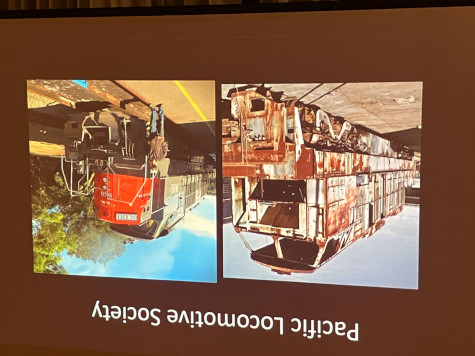
Pacific Railway Society for the restoration of Southern Pacific Kraus Maffei diesel-hydraulic 9010. The 9010 was bought new by the Southern Pacific in 1964 and was part of an order for 15 identical units. They were an experiment in high horsepower diesel hydraulic locomotives that had rather short careers on the SP, being retired by November 1968. The 9010 was converted in 1968 to camera car 8799 and was used to produce film for the locomotive simulator. It was purchased by the California State Railroad Museum in April 1986 and suffered an abortive effort to restore it to its original appearance. It sat noseless and exposed to the elements and thieves in the old S.P. Sacramento yard until acquired by the Pacific Locomotive Association in 2008. It underwent a multi-year restoration, culminating in its completion in 2025.
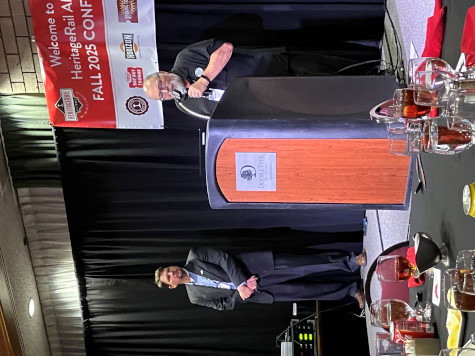
Henry Baum, Head of Public Relations for the Pacific Locomotive Society, dba Niles Canyon Railway, accepting the award.
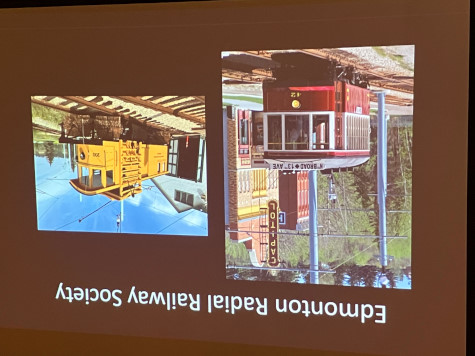
Edmonton Radial Railway Society for the restorations of Regina streetcar 42, ex. Canadian Railway Museum 24 1964-1987, exx. Canadian National 15702 1924-1964, nee Toronto Suburban Railway 24 1913-1924, built by Preston Car and Coach in 1913 and Saskatoon sweeper 200, ex. Western Development Museum 200 1951-1986, exx. Saskatoon Transit System 200 1949-1951, nee Saskatoon Municipal Railway 200 1913-1949, built by Ottawa Car Manufacturing Company in 1907.
Saskatoon 200 is a single truck snow sweeper - and so much more. Purchased second-hand when Saskatoon’s streetcar system was first opening in 1913, Saskatoon 200 was the sole work car in the system, meaning it had to not only sweep snow, but serve as a tow vehicle and an overhead line service car. Saskatoon 200 was an absolute workhorse, and served the city until the end of streetcar service there in 1951. The wing ploughs on each side allowed Saskatoon 200 to push snow away from the tracks as it goes, leaving a wide clear area for passenger cars to run through.
The platform was used for servicing the overhead trolley wire. Being made of wood, workers could have handled live wire without getting electrocuted as the platform insulated them. A work platform being mounted onto a sweeper like this is unique to Saskatoon 200. The brushes are driven by a 40hp streetcar motor; the same size of motor that moves the car. Saskatoon 200 has been a 30-year passion project for ERRS. Purchased from WDM Saskatoon in 1986, ERRS has completely disassembled and rebuilt the car, reconstructing it to a better-than-new state that will let us run it for decades to come. We’ve had longtime members spend their entire ERRS careers working on this car; it is genuinely a huge privilege to finally get to debut the car to the public on June 7, 2025
Edmonton's streetcar era spanned over 40 years; 2 world wars, multiple economic booms and depressions, and Edmonton growing from 20,000 to 160,000 people. Regina Municipal Railway 42 is a rare survivor of Regina’s 1949 streetcar barn fire and a key piece of Regina’s transit history.
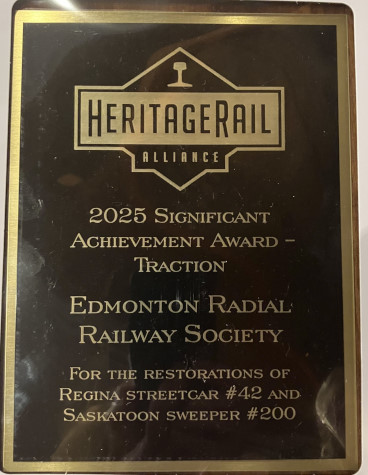
Stephen Yakimets, Board member of the Edmonton Railway Museum, was sitting at our table so it was easy to photograph the plaque.
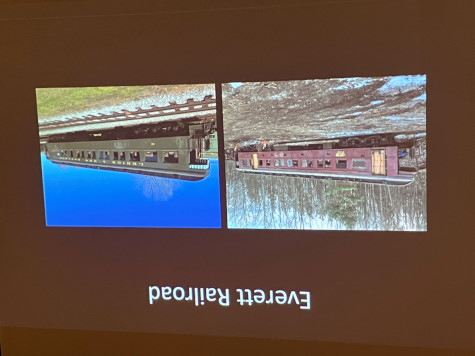
Everett Railroad for the restoration of Lehigh & New England business car 100. The only known surviving passenger car from the Lehigh & New England Railroad was built by American Car & Foundry Company in September 1925, serving the L&NE until the road’s 1961 abandonment, after which the car was used by a contractor who tore up the track.
The 75-foot-long, 60-ton car was sold in 1964 to become part of the "Paoli Local" restaurant at Strafford, Pennsylvania, on the historic Pennsylvania Railroad main line, route of the PRR’s Philadelphia commuter-train fleet of that same name. The owner painted and lettered it in Pennsylvania Railroad livery and gave it the number 605. Several photographs of the car being moved to the restaurant site are on the online archive of the Radnor Historical Society.
Both the interior and exterior were heavily modified with the insides being gutted and two holes having been cut in one side to provide access from and to the restaurant's main building. The business changed names and owners several times. Finally in 1993, the owner no longer needed the car and sold it to Ed Metka, owner of the Vintage Electric Streetcar Company in Windber, Pennsylvania, south of Johnstown. Metka stored the car in a building that was once a freight-car repair shop for the Berwind-White Coal Mining Company, a shipper that once fielded a fleet of hundreds of private-owner hoppers.
Most of Metka's inventory consisted of retired trolley cars that he hoped to market to cities or agencies contemplating a renaissance of streetcar service. He did find some buyers, but many pieces of rolling stock remained, including L&NE 100. The car was moved to the Everett Railroad's headquarters and shop at Duncansville, near Altoona, for evaluation and repairs.
The rear portion of No. 100 is believed to have served as both an observation area and dining room but it was not possible to restore the car's original interior arrangement and furnishings, in part because no floor-plan blueprints were located.
Operating 22 miles of ex-Pennsylvania Railroad branch lines, the Everett Railroad runs diesel-hauled freight trains and seasonal steam-powered passenger trains. It owns two steamers, an Alco-Cooke 2-6-0 engine built in 1920 that burns used motor oil for fuel, and a Baldwin 2-8-0 engine built in 1927 (under restoration) for the carrier’s corporate predecessor, the Huntingdon & Broad Top Mountain Railroad, which was abandoned in 1954.
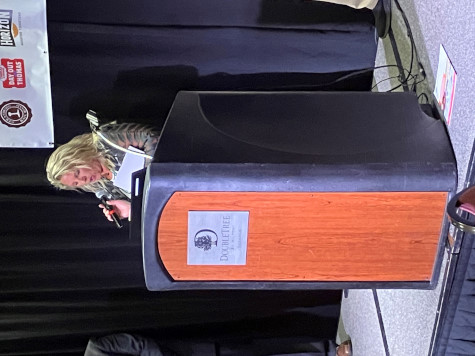
A representative from the Everett Railroad accepting the award.
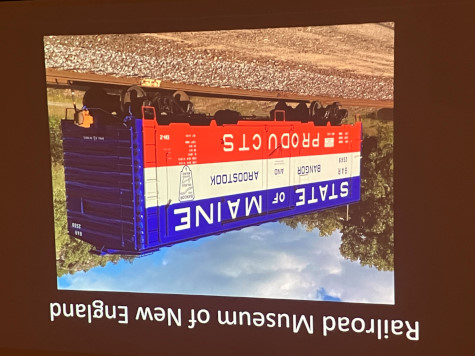
Railroad Museum of New England Railroad for the restoration of Bangor and Aroostook boxcar 2569 to its 1953 as-delivered condition. This included installation of the original under-car heater (needed for potato shipments) and interpretive display labelling explaining the purpose and significance of these iconic State of Maine Products cars. The completed project furthers the Museum’s goals of display and interpretation of New England railroad operations and impact of those operations on the region’s economy.
Part of the Museum's public display of railroad rolling stock at its 1881 Thomaston Station, it will enable the Museum to demonstrate the impact that railroad freight transportation had on the New England region, and how that changed with highway truck competition. Bangor & Aroostook 2569 is an excellent representative of the colorful and well-known State of Maine Products cars in red, white and blue. These cars were featured in many Lionel trainsets through the postwar area so they are widely recognized by those who had a Lionel in the house growing up. Restoration was completed in October 2024.
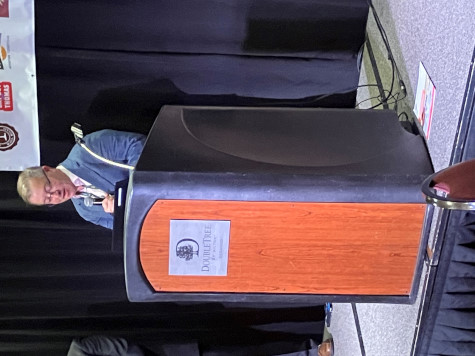
A representative from the Railroad Museum of New England accepting the award.
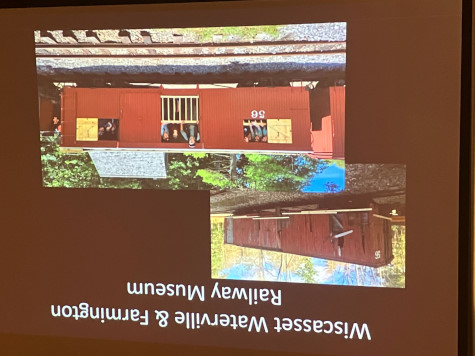
Wiscasset Waterville & Farmington Railway Museum for the restoration of Bridgton & Saco River boxcar 56.
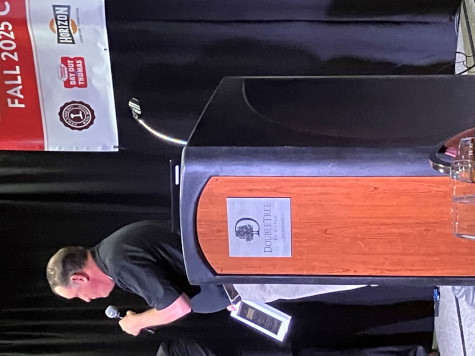
A representative from the Wiscasset, Waterville and Farmington accepting the award.
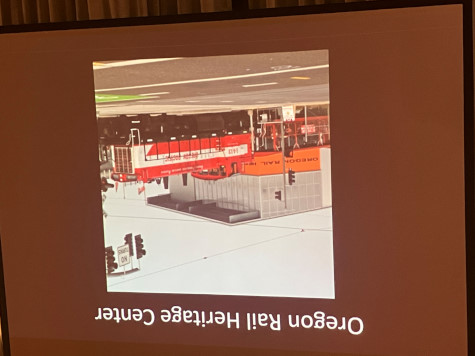
Oregon Rail Heritage Center for buying the 5.5 mile short line Oregon Pacific Railroad for excursion service. The acquisition honours Dick Samuels' remarkable legacy while securing a permanent future for rail excursions, preservation, and education in Oregon. This transformative step enables us to connect with our community in deeper, more impactful ways, bringing history to life through expanded excursions and enriched volunteer opportunities. Most importantly, it ensures that future generations will have the chance to experience and appreciate the rich rail heritage that shaped our region.
The railroad, which dates to construction by the Oregon Water Power & Railway Company in 1904, was revitalized under Samuels between East Portland and Milwaukie, Oregon, offering excursions. The foundation says the acquisition will allow it to offer "more frequent and diverse" excursions. The organization will also need volunteer involvement to support track maintenance, yard support and the increased excursion operations. The foundation, a 501(c)(3) nonprofit organization, operates the Oregon Rail Heritage Center museum in Portland, and raises funds for operations, exhibits and improvements.
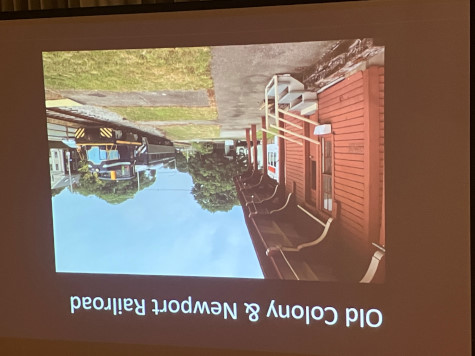
Old Colony & Newport Railroadfor reopening the railroad into Newport, Rhode Island. The Old Colony & Newport Railway is excited to announce its first "Day Tripper" excursion from Meville in Portsmouth, to Newport Station. The trains will depart the station for the 60 minute ride to Middletown and back. There the train will turn around to head to Newport. Passengers will ride in a Budd Rail Diesel car built in the 1950's with views of Narragansett Bay not regularly seen by rail in years.
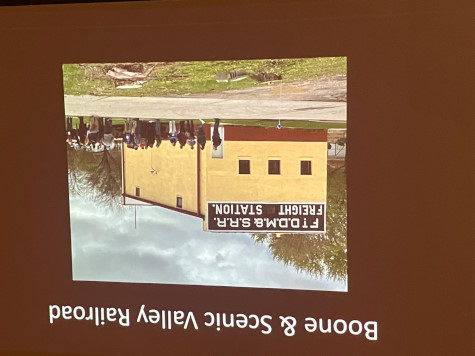
Boone & Scenic Valley Railroad for restoring the Fort Dodge Line freight house and converting it into an archive building.
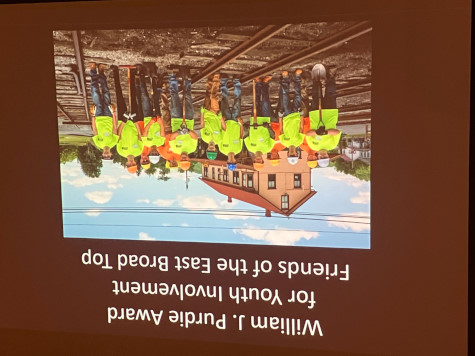
Willie J. Purdie Award to Friends of the East Broad Top for the Young Easties program. This program is for teenage railroad enthusiasts ages 13 to 17 (18 if still in High School) and intended to foster an interest in railroads in general and the East Broad Top in particular, and to encourage future FEBT volunteers and leaders. The program will create a safe and welcoming environment for every participant, and will allow them to have fun, work hard, learn safe working practices and experience new things.
Narrow Gauge Preservation Foundation for its grants to narrow gauge preservation. First established as the Narrow Gauge Trust in 2000, then incorporated as the Narrow Gauge Preservation Foundation in 2002, the Foundation is a non-profit public benefit corporation incorporated in the State of California. Its mission is to establish several interactive exhibits where the public can learn about the rich and significant history of narrow gauge railroading, and to support preservation efforts where possible.
The Foundation's first priority is to establish a number of interactive exhibits where the narrow gauge story can be told using state-of-the-art video, models, pictures, artwork and artifacts in ways that will be meaningful both to enthusiasts and to the general public. An exhibit in Chama, New Mexico, terminus of the Cumbres & Toltec Scenic Railroad, was the first. It opened in May 2011, but closed in 2018. Future exhibit sites may include Golden, Colorado (home of the Colorado Railroad Museum) and Sacramento’s expansive California State Railroad Museum.
Each Exhibit includes interactive video presentations and models, dioramas, photographs, artwork and artifacts of significance to the story being told. A secondary mission is to assist narrow gauge preservation efforts across North America. When resources are available, the Foundation evaluates the soundness and likelihood of success of such efforts, and channels donations to those that qualify.
The Foundation supports the efforts, past and current, of numerous existing museums and preservation organizations, and in no way seeks to compete with them. In fact the Foundation has made grants to several of these organizations to further their work of restoring irreplaceable equipment and structures. In establishing exhibits in rich historic narrow gauge locales, the Foundation seeks to tell a different story in the different way.
During its existence, the Foundation has made donations of over a million dollars to narrow gauge preservation efforts. These include the Cumbres & Toltec Scenic Railway, the Colorado Railroad Museum, Friends of Engine 169, the Southern Pacific Narrow Gauge Railroad Foundation, and the Durango Railroad Historical Society.
One of the unique aspects of the NGPF is the use of matching grants to encourage the receiving parties to reach out to the public for support. Many of our grants require that the receiving agency establish within a set time frame, an equal number of individual new donations from members of the public, which not only shows support for the particular project, but also provides new sources of funding for the organization. As a result of this policy, organizations receiving our grants have reported increased donations. Donations to the Foundation are tax-deductible, acknowledged and appreciated. By donating, you support a variety of worthwhile projects and thereby enhance preservation of Narrow Gauge. To date, the Foundation has spent less than five percent of its funds on administrative costs.
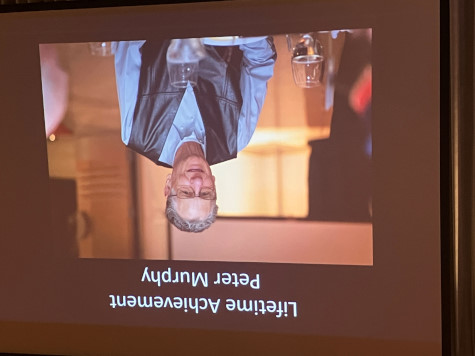
The first of two Lifetime Achievement awards was presented to Peter Murphy, for his long service to the Canadian Railroad Historical Association, his editorship of Canadian Rail Magazine, and his service to Association of Railway Museums/Heritage Rail Alliance.
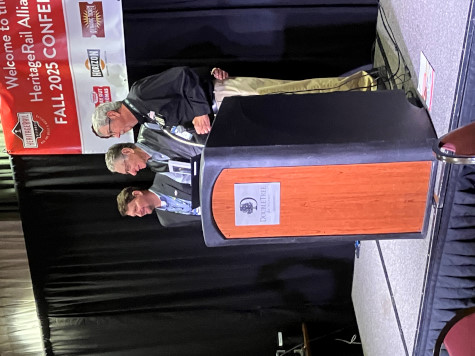
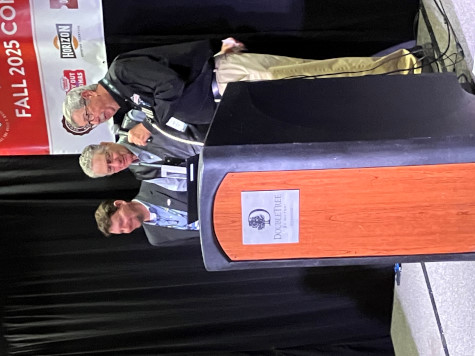
Terry Koller, Peter Murphy and Aaron Isaacs.
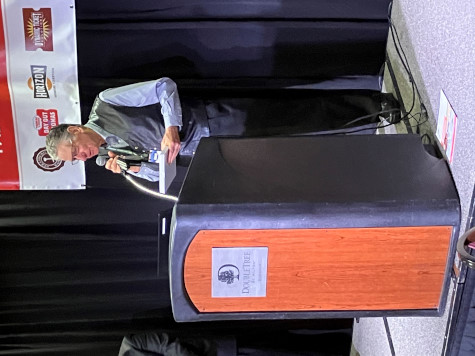
Peter thanking his wife and expressing his appreciation for the recognition.
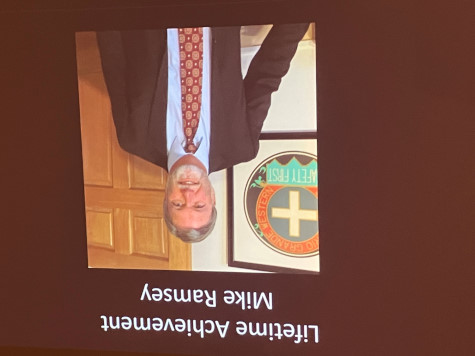
The second Lifetime Achievement Award recipient was Mike Ramsey, for his long service to Colorado rail preservation, and his regulatory work with the Federal Railroad Administration on behalf of heritage railroading.
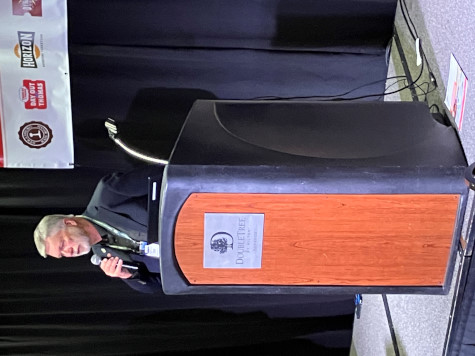
Mike giving his acceptance speech.
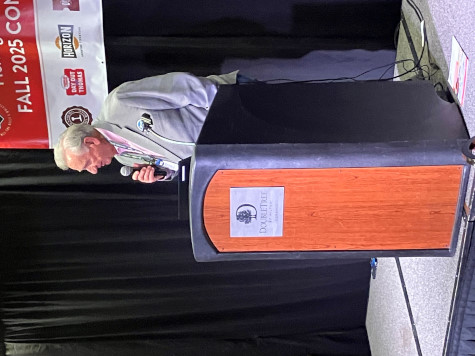
Alan Harper closed the evening, thanking all for attending the conference and the efforts of each organization to preserve the past and empower the future, the theme of the 2025 Heritage Rail Alliance conference.
This concluded the conference, although there was a post-conference excursion on the Cumbres and Toltec Scenic Railroad the next day. Elizabeth and I drove back to the Fairfield Inn for the night.
| RETURN TO THE MAIN PAGE |