





Earlier this year, the 100th anniversary event of the K-36 locomotives at Cumbres and Toltec Scenic was announced. Elizabeth and I discussed attending this and we decided that I would go to that event, while Elizabeth would attend this year's Railroad Station Historical Society Convention in Binghamton, New York. As we are both members of that group and I have covered the 2023 and 2024 conventions, this is full coverage of the 2025 convention, with all photographs by Elizabeth Guenzler.
6/8/2025 She left home and drove to Indianapolis for dinner at the Old Spaghetti Factory. It had been a few years since she had been to one of these establishments and her salad, chicken parmigiana and ice cream with chocolate sauce was delicious. Fortified and happy, she continued the drive to Dayton, Ohio and stayed at the Holiday Inn Express.
6/9/2025 After her usual morning routine, my wife enjoyed breakfast at Cracker Barrel then drove two hours north to Fostoria.
The Iron TriangleRailfans can be seen in and around the Iron Triangle 24/7, 365 in order to watch the sixty plus freight trans that travel through our city on three mainline freight double track routes. Railroads are allowed to have trains three miles long, thus having fewer actual trains.
The three main freight lines are: CSX north/south route, formerly Chesapeake and Ohio, route between Toledo and Columbus/Cincinnati, CSX east/west, formerly Baltimore and Ohio, route between Chicago and the East Coast; and Norfolk Southern north/south, formerly the Nickel Plate Lake Division route from Bellevue and Fort Wayne and Lima.
Before Fostoria became the first location in the world to utilize the life and time-saving invention of centralized traffic control in 1927, trains frequently ran into each other on the tracks due to being off schedule. In single track areas, CTC provided the dispatcher information to advise one train to head to the nearest siding for another approaching train to continue traveling. It has been stated that we tend to take CTC for granted today, but no other railway engineering breakthrough of the 20th century approaches it in importance.
The City of Fostoria held the ribbon-cutting and dedication on November 15, 2013. Over 200 people attended the ceremoney and over $1.1 million was spent to transofmr this five acres into a safe, well-lit and beautiful park.
Some Railway HistoryFostoria is named for Charles Fostoria, the 35th governor of Ohio. Until the larger mergers, Fostoria hosted the Nickel Plate Road, the Baltimore and Ohio and the Chesapeake and Ohio Rwy. The first railroad to come through was Lake Erie & Western in the 1850's which was taken over by the New York Central in 1899 and then Nickel Plate Railroad in 1922. The C&O came through in 1872, originally as the Columbus and Toledo Railroad, then the Hocking Valley Railroad. The B&O reached here the following year in 1873.
In the 1880's, the New York, Chicago, & St. Louis Railway came through, this eventually became the Nickel Plate Road. The NKP line was the southernmost of the two western routes out of Bellevue and made its way over to Lima and parallels Interstate as you near Lima; this is now the Norfolk Southern line which is their Fostoria district between Bellevue, Ohio and Fort Wayne, Indiana. It was originally part of NKP's mainline to Chicago. Six miles west in Arcadia, the line splits with the Lima District line heading south to Lima.
The B&O east-west line is on the mainline to Chicago and is CSX's Willard SubDivision. This is the old "traditional" B&O line that originated in Philadelphia and went through Baltimore and Pittsburgh, now it is CSX's gateway to the entire east coast from Chicago. The former C&O line is CSX's Columbus Subdivision. Northbound coal from Kentucky and West Virginia are sent towards the Toledo docks via Walbridge Yard. North of Fostoria, it is double track, south to Columbia it is mostly single track.
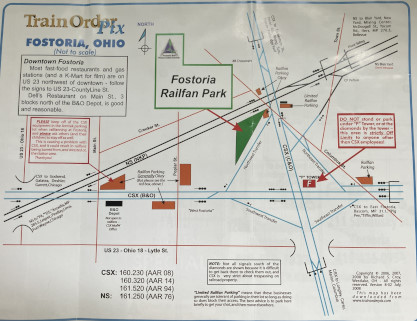
A map of the Iron Triangle.
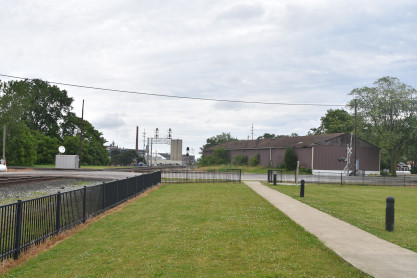
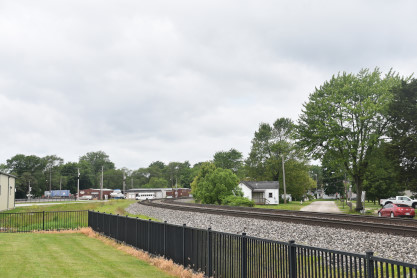
The Norfolk Southern tracks.
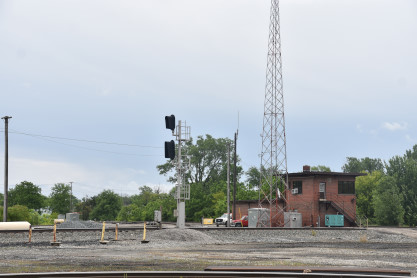
Baltimore and Ohio's F Tower, originally called FS Tower, now CSX, was closed in March 2015 when control was transferred to Indianapolis. It was built by the New York Central and they installed the NX machine in 1948 where the operator would enter the location (push the button), the train entered the board and the operator would choose the exiting route for the train. The four railroads of C&O, B&O, NYC and the NKP all shared the cost in maintaining the tower and used NYC NYC operators early on, then sometime after the merger of the PRR and NYC, the operators were C&O and B&O. The operator faced away from the B&O main, almost in a north direction with his back to the B&O main.
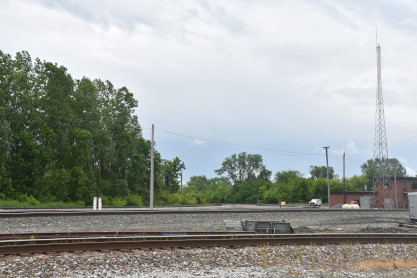
The connecting track from the CSX to Norfolk Southern. While there was a map at the covered shelter, it was difficult for Elizabeth to know what direction the trains were coming from and since the railpark is large, she could not get to the applicable end of the park quickly enough for two trains so just watched them.
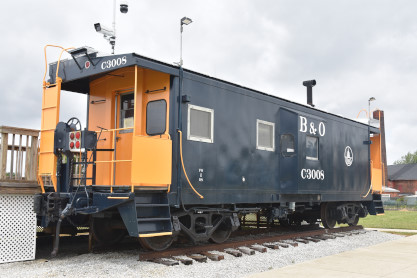
Baltimore and Ohio caboose C3008, later Chessie System 903008, built by International Car in 1968.
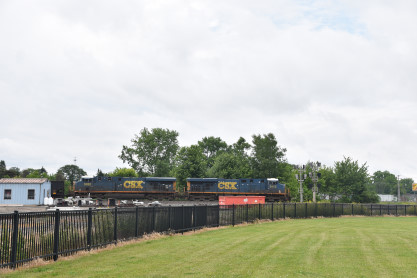
CSX 5415 West was the first train photograhed.

CSX ES44DC 5332, built by General Electric in 2006.

CSXT hopper car 298418 labelled Coke Express. Elizabeth had never seen one of these before and later learnt that they were heavily used for coke trains originating in the Pittsburgh area, specifically from the USS Clairton coke works.


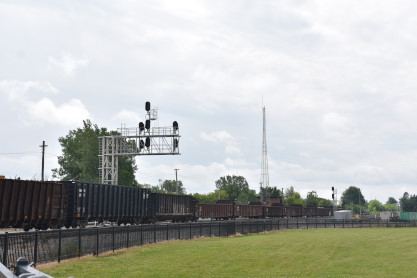
CSX 4715 West on the Nickel Plate Road.

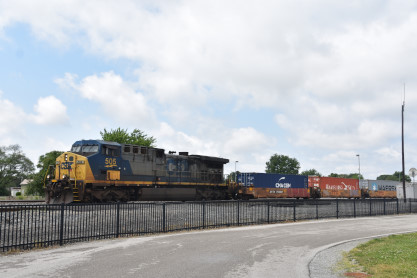
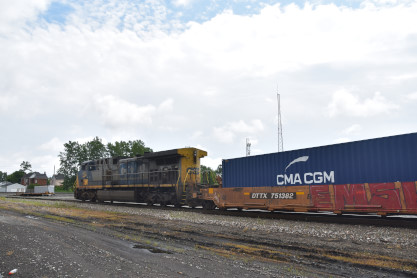
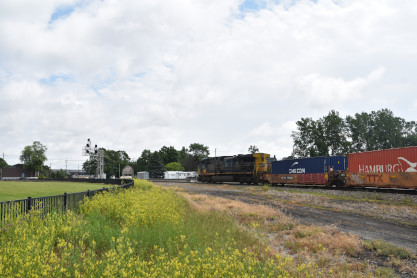
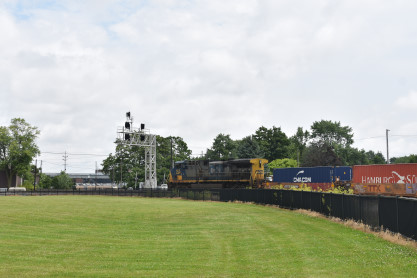
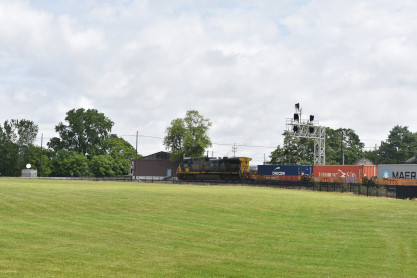

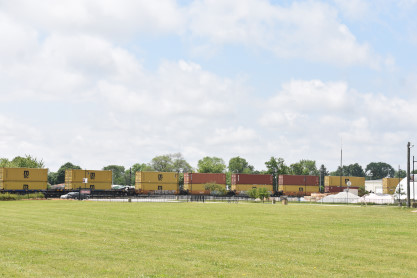
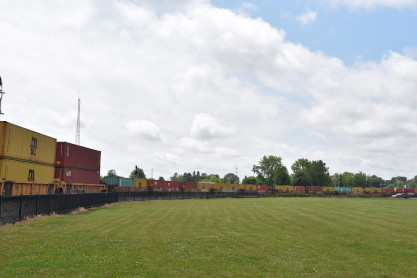
CSX 505 North entering the Norfolk Southern mainline. Elizabeth surmised the containers must have been empty as there was no DPU, but since this was a very long train, she had time to pace/chase it around the grounds.
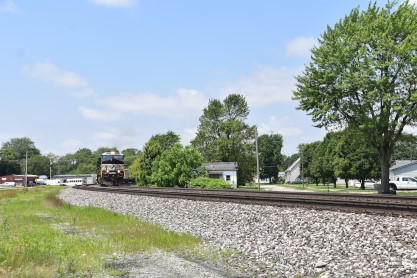
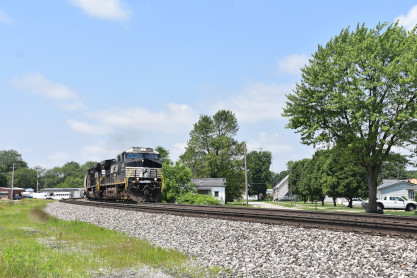

Returning to the shelter area, here came Norfolk Southern 4754 South at Milepost 280.
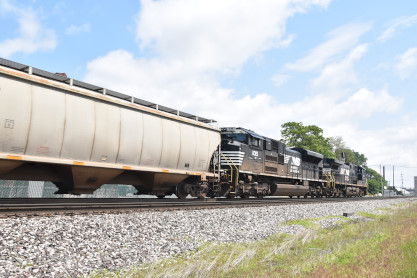
Norfolk Southern SD70ACe 1015, built by Electro-Motive Division in 2011.

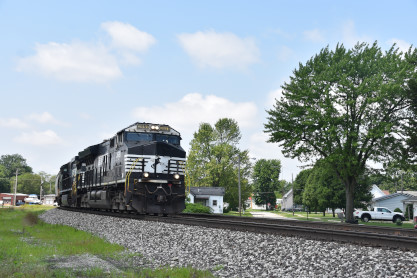
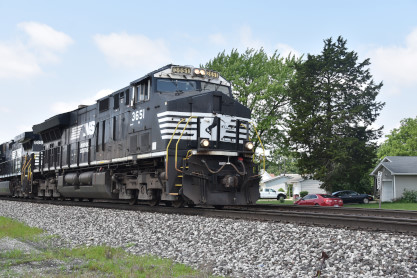

That was followed extremely soon after by Norfolk Southern ETTAC 3651 South.
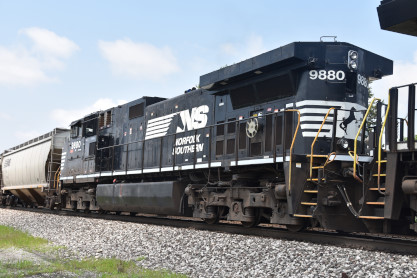
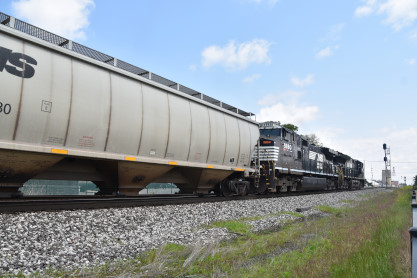
Norfolk Southern D9-4CW 9980, built by General Electric in 2004.
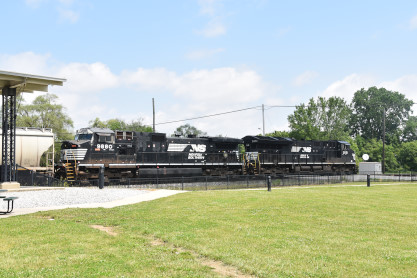
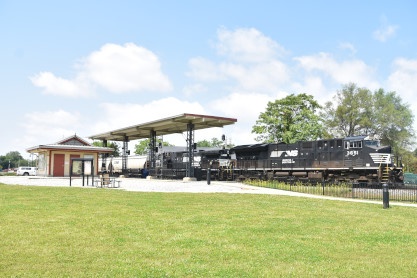
The train stopped briefly waiting for a green signal then started to reverse. With a longish drive ahead, this was the last train here and Elizabeth resumed the drive to Erie, Pennsylvania, encountering torrential rain in Ashtabula, Ohio. She stopped at Bob Evans for dinner where the rain let up a bit then drove the short distance to La Quinta Inn for the night.
6/10/2025 Once she had checked e-mail and the Internet, my wife checked out and had breakfast at the same Bob Evans then drove to Binghamton.
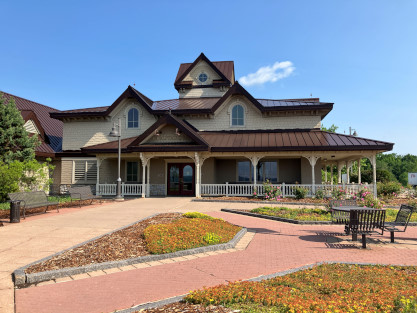
Chautauqua Rest area, a much more ornate building than other rest areas. She arrived in Binghamton mid-afternoon and as there was plenty of time, found the local shopping center and browsed Barnes and Noble before having an early dinner at Subway. Around 5:30 PM, she went to the TRU by Hilton Hotel, the convention accommodation, and picked up her lanyard and convention booklet. After chatting with a few society members, Elizabeth checked into the Quality Inn, caught up on the Internet and relaxed for the evening.
| RETURN TO THE MAIN PAGE |