




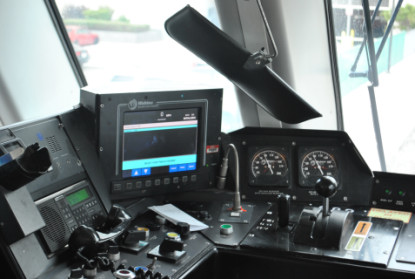
I contacted the North County Transportation District to see if it would be possible to photograph the Positive Train Control in their cab car and received a positive response. So this morning, I went to the station and learnt that Pacific Surfliner 562 was running ten minutes late and the Metrolink machine on the station side was not working. As such, I went over the pedestrian bridge to the machine over there then reported the non-working machine to the agent in the station before going trackside to wait for my late train.
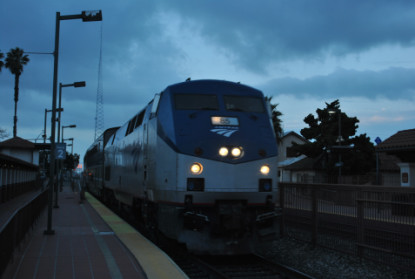
Pacific Surfliner 562 arrived and I boarded the cab car for the journey to Oceanside. We stopped at Irvine before we were stopped at CP Avery for Pacific Surfliner 763, then to San Juan Capistrano, followed by the Pacific Ocean on a cloudy morning.

The Pacific Ocean.
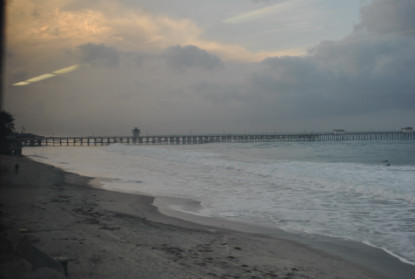
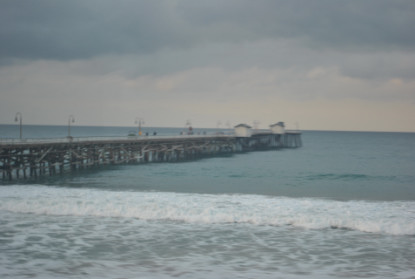
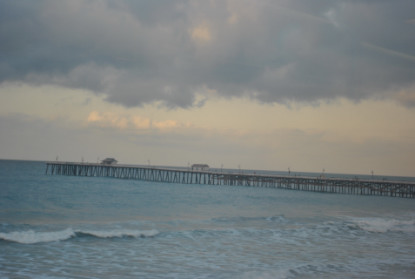
San Clemente Pier. At Oceanside, I thanked my Amtrak crew for a great trip.
Positive Train Control OverviewTrain protection systems are used to control traffic movement by technical means. They are especially needed in cases of high speed transportation, dense traffic with short succession of trains and mixed type traffic at wide differing speeds. So the train protection systems were in practical testing at least since the beginning of the 1930s in Europe.
Stopping a running train is the main goal of any train protection system. This is most easily done with stop order, and without a special order the vehicle is allowed to run. A typical representative for this "negative train control" is Indusi. In contrary to this "easy moving", a PTC restricts the train movement to an explicit allowance and it is stopped after invalidation.
After the decline of railway transit in the United States after World War II, there was also less impetus for investments in train security. Toward the end of the 1980s, a search for solutions re-emerged together with an inventory of technical possibilities.
The main concept of PTC (as defined for North American Class I freight railroads) is that the train receives information about its location and where it is allowed to safely travel, also known as movement authorities. Equipment on board the train then enforces this, preventing unsafe movement. PTC systems may work in either dark territory or signaled territory, and may use GPS navigation to track train movements.
The Federal Railroad Administration has listed among its goals, "To deploy the Nationwide Differential Global Positioning System as a nationwide, uniform, and continuous positioning system, suitable for train control."
Various other benefits are sometimes associated with PTC such as increased fuel efficiency or locomotive diagnostics; these are benefits that can be achieved by having a wireless data system to transmit the information, whether it be for PTC or other applications.
The American Railway Engineering and Maintenance-of-Way Association describes Positive Train Control as having these primary characteristics: train separation or collision avoidance, Line speed enforcement, temporary speed restrictions and rail worker wayside safety.
In the 1990s, Union Pacific Railroad had a partnership project with General Electric to implement a similar system known as "Precision Train Control". This system would have involved moving block operation, which adjusts a "safe zone" around a train based on its speed and location. The similar abbreviations have sometimes caused confusion over the definition of the technology. GE later abandoned the Precision Train Control platform.
HistoryPositive train control (PTC) is a system of functional requirements for monitoring and controlling train movements and is a type of train protection systems. The term stems from Control Engineering. The train is only allowed to move in case of positive movement allowance. It generally improves the safety of railway traffic.
Starting in 1990, the National Transportation Safety Board of the USA counted PTC (then known as positive train separation) among its "Most Wanted List of Transportation Safety Improvements." At the time, the vast majority of rail lines in USA relied on the human crew for complying with all safety rules, and a significant fraction of accidents were attributable to human error, as evidenced in several years of official reports from the FRA.
In September 2008, the USA Congress considered a new rail safety law that set a deadline of December 15, 2015, for implementation of PTC technology across most of the U.S. rail network. The bill, ushered through the legislative process by the Senate Commerce Committee and the House Transportation and Infrastructure Committee, was developed in response to the collision of a Metrolink passenger train and a Union Pacific freight train September 12, 2008, in California, which resulted in the deaths of 25 and injuries to more than 135 passengers.
As the bill neared final passage by Congress, the Association of American Railroads issued a statement in support of the bill. President George W. Bush signed the 315-page Rail Safety Improvement Act of 2008 into law on October 16, 2008. Among its provisions, the law provides funding to help pay for the development of PTC technology, limits the number of hours freight rail crews can work each month, and requires the Department of Transportation to determine work hour limits for passenger train crews.
ImplementationTo implement the law, the FRA published final regulations for PTC systems on January 15, 2010 and proposed amendments to its rules on December 11, 2012. In December 2010, the U.S. Government Accountability Office reported that Amtrak and the major Class I railroads had taken steps to install PTC systems under the law, but commuter rail operators were not on track for the 2015 deadline.
Basic operationA typical PTC system involves two basic components: speed display and control unit on the locomotive and a method to dynamically inform the speed control unit of changing track or signal conditions. Optionally, three additional components may exist: an on-board navigation system and track profile database to enforce fixed speed limits; a bi-directional data link to inform signaling equipment of the train's presence; and centralized systems to directly issue movement authorities to trains.
PTC infrastructureThere are two main PTC implementation methods currently being developed. The first makes use of fixed signaling infrastructure such as coded track circuits and wireless transponders to communicate with the onboard speed control unit. The other makes use of wireless data radios spread out along the line to transmit the dynamic information. The wireless implementation also allows for the train to transmit its location to the signaling system which could enable the use of moving or "virtual" blocks. The wireless implementation is generally cheaper in terms of equipment costs, but is considered to be much less reliable than using "harder" communications channels. For example, the wireless ITCS system on Amtrak's Michigan Line was still not functioning reliably in 2007 after 13 years of development, while the fixed ACSES system has been in daily service on the Northeast Corridor since 2002.
The fixed infrastructure method is proving popular on high-density passenger lines where pulse code cab signaling has already been installed. In some cases, the lack of a reliance on wireless communications is being touted as a benefit. The wireless method has proven most successful on low density, unsignaled dark territory normally controlled via track warrants, where speeds are already low and interruptions in the wireless connection to the train do not tend to compromise safety or train operations.
Some systems, like Amtrak's ACSES, operate with a hybrid technology that uses wireless links to update temporary speed restrictions or pass certain signals, with neither of these systems being critical for train operations.
Locomotive speed control unitThe equipment on board the locomotive must continually calculate the trains' current speed relative to a speed target some distance away governed by a braking curve. If the train risks not being able to slow to the speed target given the braking curve, the brakes are automatically applied and the train is immediately slowed. The speed targets are updated by information regarding fixed and dynamic speed limits determined by the track profile and signaling system.
Most current PTC implementations also use the speed control unit to store a database of track profiles attached to some sort of navigation system. The unit keeps track of the train's position along the rail line and automatically enforces any speed restrictions as well as the maximum authorized speed. Temporary speed restrictions can be updated before the train departs its terminal or via wireless data links. The track data can also be used to calculate braking curves based on the grade profile. The navigation system can use fixed track beacons or differential GPS stations combined with wheel rotation to accurately determine the train's location on the line within a few feet.
Centralized ControlWhile some PTC systems interface directly with the existing signal system, others may maintain a set of vital computer systems at a central location that can keep track of trains and issue movement authorities to them directly via a wireless data network. This is often considered to be a form of Communications Based Train Control and is not a necessary part of PTC.
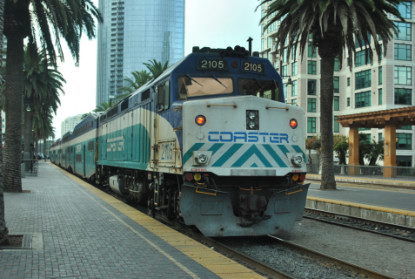
The Coaster TripI went to the Coaster ticket machine, bought my round-trip ticket then walked down to the Coaster on Track 3 and met the crew, to whom I showed the letter, then was told there was good and bad news. The cab car did not have PTC, but the locomotive did. So the crew came up with a plan that management approved, which was for me to take pictures in the locomotive when we returned to Oceanside. So we rode to San Diego through the construction zones which were increasing the single track line to double track in several areas along the route in San Diego County. I boarded the cab car for the non-PTC ride and once in San Diego, detrained.
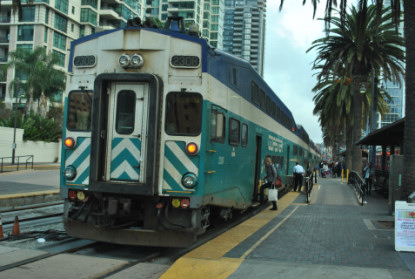
Coaster 630 in San Diego.
PTC Coaster 631 in San Diego. I rode back to Oceanside and received the bad news that no photography was allowed in the locomotive, but derived a new plan. Upon arriving in Oceanside, I went to Burger King for a pair of plain hamburgers then walked to Track 2 and boarded Metrolink 663, choosing a table in the bicycle car where I usually ride.
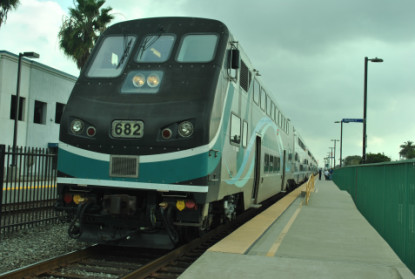
I then detrained for a picture of Metrolink 663, entered the cab car, went upstairs and found the engineer's compartment door open. I did not go inside but took a few pictures from the doorway.
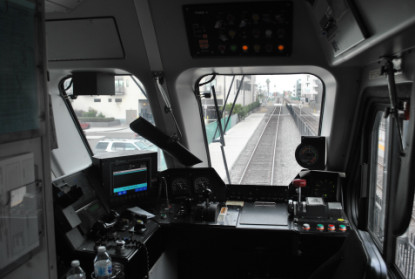
The engineer's compartment of a Rotem cab car.
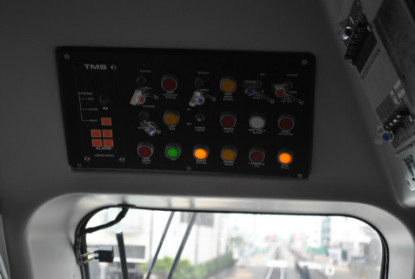
TMS Control Panel which controls and monitors escape route doors and doors in security-relevant areas from a central location. They are ready for remote control of doors or groups of doors and therefore especially suitable to realise airlock systems or access control systems in security-relevant areas. Control panels are frequently used in forensic or psychiatric facilities, where not every single escape route door has an individual emergency push button, and all doors are controlled from a continuously-manned central control room.
The Positive Train Control screen in the Rotem cab car. On Metrolink lines, they show all signals, but the BNSF version shows control points as well. We left Oceanside on time and moved north.
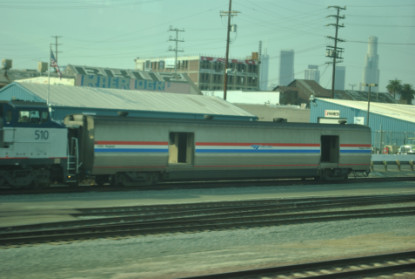
Amtrak Viewliner baggage car 61040 in Los Angeles.
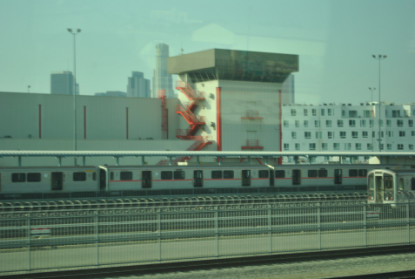
Los Angeles Metro subway cars. We arrived at LAUPT and I detrained then walked over to where Santa Fe 3751 was on display today.
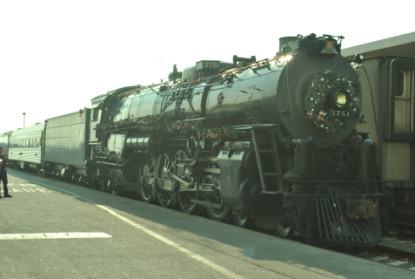
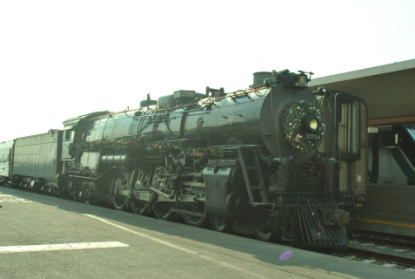
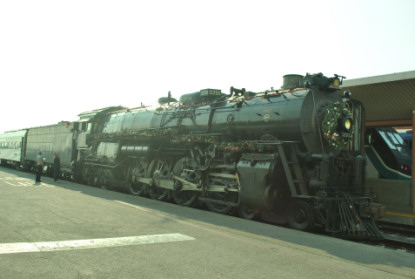
Santa Fe 4-8-4 3751, built by Baldwin in 1927 with a Christmas wreath on its nose.
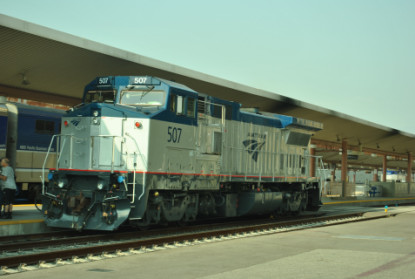
Amtrak B32-8WH 507, built by General Electric in 1991.
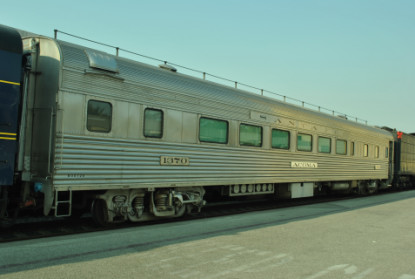
Santa Fe "Acoma", built by Budd Company in 1936 for the new streamlined Santa Fe Super Chief. This all new, extra-fare sleeper car train went into revenue service on May 18, 1937 on a once a week round-trip between Chicago and Los Angeles. As built, it was a lounge/dormitory/barber shop car. The Super Chief was the train of the Hollywood Stars and the rich and famous. The car was purchased in 1995 by John Bond and Ronald Ashcraft of Albuquerque {Southwest Rail Car LLC} who have continued to restore and preserve this car.
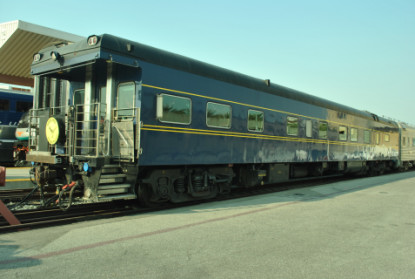
Observation Car "Tioga Pass", built by Canadian National Railway in 1959. Originally numbered 23, and later numbered 93, "Tioga Pass" spent most of its life in Edmonton, Alberta where it served the Vice President of the Mountain Region. In 1992 Canadian National decided to sell the car, and a local businessman in Barstow, California named Rutherford P. "Rudy" Hayes bought it sight unseen because, as he put it, "I always just wanted one." In an epic trip, the car travelled from Edmonton to Barstow in January 1993. Through fierce cold and driving blizzards, the passengers stayed warm inside. Its new owner was like a proud father, pronouncing the car was all he ever thought it would be. Unfortunately, Rudy never got the chance to travel on his new car. He died of a heart attack only months after it was delivered. The car sat, forlorn and neglected in front of the Harvey House train station in Barstow for several years. Aronco Leasing Company and Norman Orfall purchased the car in 1997 from the Hayes estate and completely overhauled it over several years.
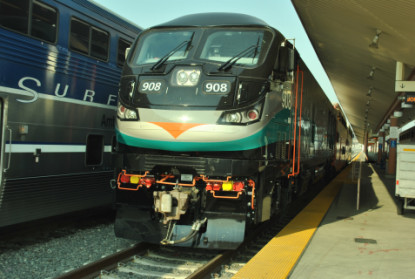
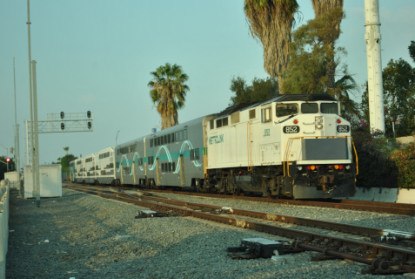
Metrolink F125 908. I next went to Weztel Pretzels in Union Station, returned to Metrolink 664 and rode in the bicycle car for the quick trip to Santa Ana, then went home for just a few minutes before driving over to CP Lincoln to wait for a train at 3:22 PM.
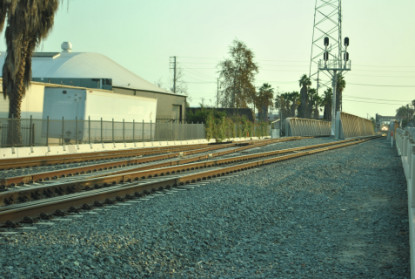
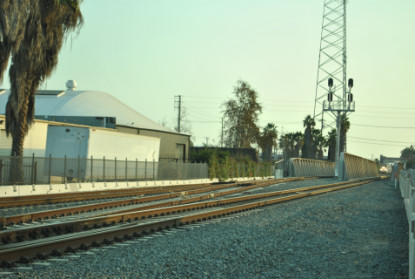
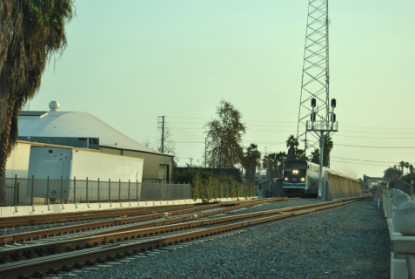
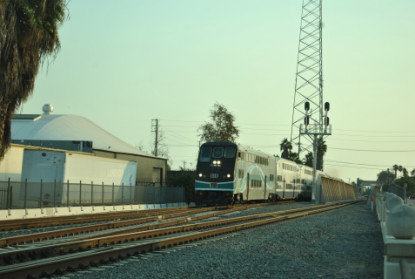
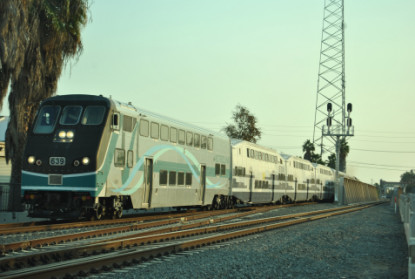
The final Festival of the Lights Train to the Mission Inn of the year at CP Lincoln. I returned home then wrote this travelogue.
| RETURN TO THE MAIN PAGE |