



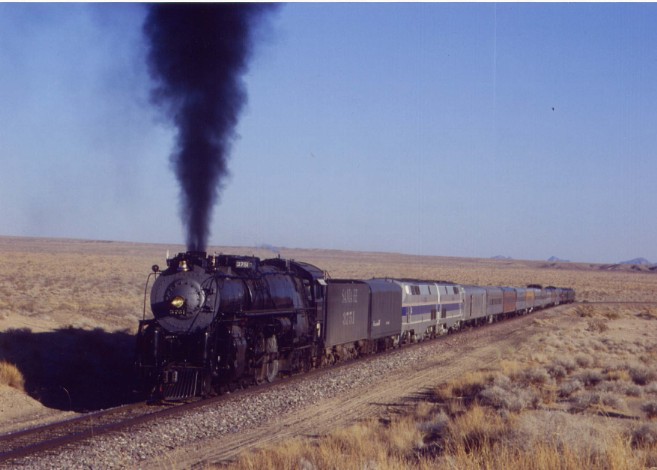
This year's National Railway Historical Society convention was occurring in Williams, Arizona and the talk was that Santa Fe 4-8-4 3751 would pull an excursion train of private cars to and from the event. The return trip would be over the Peavine Line of the Santa Fe and the Arizona and California Railroad, both lines new to me. There would also be a Santa Fe 3751 trip to the Grand Canyon and I later it would be a double-headed move with Grand Canyon 4960.
Bob Riskie, an Amtrak conductor, wanted to ride 3751 east, so I bought a roundtrip ticket as well as one for the journey to the canyon. Once I was confirmed for my tickets, I bought an Amtrak ticket from Los Angeles to Williams Junction for $71.60 then on June 30th, checked Amtrak's Rail Sale page and found the same seat for only $23.60, so made my reservation before taking the tickets to Santa Ana to exchange them. I had reserved a room in Williams for two nights and was set to start another steam train adventure.
Santa Fe 3751 Chase East 8/19/2002Bill Compton and his nephew Brian picked me up and we made our way through traffic to the Metrolink flyover across the former Southern Pacific Sunset Route, now Union Pacific, and the San Gabriel River. The Baldwin Park local came from the City of Industry to work the Metrolink San Bernardino Line industries and I was told to wait for Santa Fe 3751 east before it could start the day's work.
Santa Fe 3751 HistoryBuilt by Baldwin in 1927, Santa Fe 3751 was the first 4-8-4 steam locomotive built for the railroad and was referenced in documentation as type "Heavy Mountain", "New Mountain", or "Mountain 4-wheel trailer". It holds the distinction of being the oldest surviving 4-8-4 type steam locomotive in the world.
When built, tests showed that the new locomotive was twenty percent more efficient and powerful than the 3700 class 4-8-2 Mountain types, which at the time were Santa Fe's most advanced steam locomotives. In 1936, the locomotive was converted to burn oil and was given a larger tender that holds 20,000 US gallons of water and 7,107 US gallons of fuel oil two years later. No. 3751 was also present at the grand opening of Union Passenger Terminal in Los Angeles on May 7, 1939, pulling the Scout, one of Santa Fe's premier passenger trains as it arrived from Chicago. It was the first steam locomotive to bring a passenger train into Union Station.
In 1941, 3751, along with the other 13 locomotives in its class, received major upgrades that included replacing the original 73 inch spoked driving wheels with 80 inch boxpok wheels, a new frame, Timken roller bearings on all axles and more. That same year, it achieved its highest recorded speed at 103 miles per hour. It continued to be a very reliable working locomotive until August 23, 1953, when it pulled the last regularly scheduled steam-powered passenger train on the Santa Fe to run between Los Angeles and San Diego; this was its last run in revenue service before being put into stored at the Redondo Junction and retired from active service. On May 14, 1958, it was placed on display in San Bernardino.
In 1981, the San Bernardino Railroad Historical Society was formed with intentions of restoring and operating 3751. Four years later, it achieved its goal when 3751 was sold to it for one cent with the condition that the SBRHS must restore and operate the locomotive. In 1986, 3751 was moved from its display to California Steel Industries, where it was restored at a cost of $1.50 million. On August 13, 1991, it moved under its own steam for the first time in thirty-eight years. It made its first excursion run on December 27, 1991, running with two Santa Fe EMD FP45s and 16 passenger cars on a four-day trip from Los Angeles via Barstow to Bakersfield. Since then, it has been utilized for a large number of excursions and special trips and for display at many events.
The locomotive is currently owned by the San Bernardino Railroad Historical Society, the same organization that performed the initial 1986 restoration. In August 1992, the 3751 was found on its largest assignment so far, as the engine ran the entire route of Santa Fe's Transcon route between Los Angeles and Chicago with three (and later two) Santa Fe GE Dash 8-40CWs. The engine spent 18 days travelling over 2,300 miles in both directions. This run would include travelling to Topeka, Kansas to attend that year's Topeka Railroad days, where the locomotive was briefly displayed near Union Pacific 4-6-6-4 3985.
On April 22–23, 1995, 3751 was displayed in the Riverside Sunkist Orange Blossom Festival in Riverside. On December 31, 1996 when Atchison, Topeka & Santa Fe merged with Burlington Northern Railroad to form Burlington Northern Santa Fe, the locomotive retained the same number. The excursion was operated again on April 20–21, 1996. In June 1999, the locomotive participated in Railfair '99. On the way to the fair, 3751, along with a BNSF Dash 9-44CW and mixed train of a tool car, ten BNSF boxcars and two passenger cars, from Los Angeles to Sacramento via San Bernardino, Barstow, Bakersfield, and Stockton. On the return trip to Los Angeles, the 3751 pulled another mixed train with several covered hoppers.
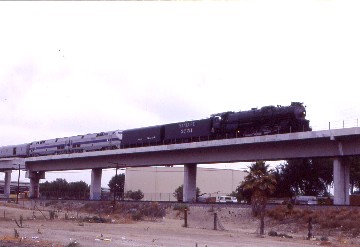
About ten minutes later, Santa Fe 3751 and its train crossed over the flyover on a very cloudy morning. The consist was Santa Fe 4-8-4 3751, auxiliary water car DLMX 4219, Amtrak P42DC 7, Amtrak P42DC 4, "Pony Express" (tool car), "El Capitan", "Powhatan Arrow", "Clinchfield", "Royal Gorge", "Pine Tree State", "Silver Lariat", "Overland Trail", "Colonial Crafts", "Plaza Santa Fe", "Kitchi Gammi Club", "Dover Harbor" and "MKT 403". We returned to the car and drove east via the Pomona Freeway then Interstate 15 to Etawanda Avenue and our next photo location.
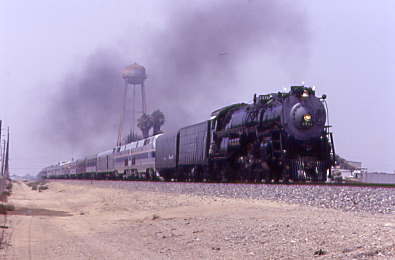
Here the sun came out and Santa Fe 3751 charged by with smoke billowing from its stack. We then proceeded to Cajon Pass and parked at the end of the public road at Cajon. The fire area was closed to vehicles but I had contacted the United States Forest Service and received permission to hike into Sullivan's Curve.
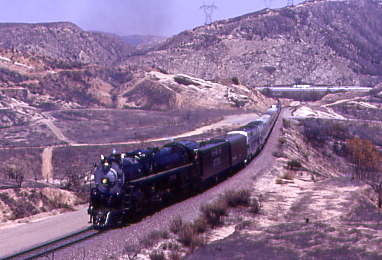
The light was perfect and after a longer-than-expected wait, Santa Fe 3751 and train came chugging up the grade to the curve made so famous by the photographs of Herb Sullivan. It was a great show, after which Bill drove me home.
Pacific Surfliner 581 8/22/2002The train arrived on schedule and after I pointed out two individuals along the tracks ahead to conductor Ron Houston, I boarded Pacific Business Class to Los Angeles. When we crossed the flyover at Redondo Junction without Santa Fe 3751 in the usual layover spot, it dawned on me that this would be only the second time I had ridden behind the steam engine; the first was a California Limited Trip on December 28, 1992 when I rode from Barstow to Bakersfield and went around Tehachapi Loop. We arrived at Los Angeles Union Station on time and I headed into the depot.
Southwest Chief 4 8/22/2002I received my boarding pass without a car number in this post-9/11 world. Coach passengers queued at the red ropes and sleeping car passengers at the blue ropes as the gates had been removed earlier in the year. We were then led single file down the tunnel to Track 11 where I was told to go to car 412. My attendant Dolores took my ticket and gave me my seat assignment, my usual right-hand side full window seat. We departed five minutes late and the regular additions of the mail and express cars were made so it was now a 42-car train leaving the City of Angels. I rode the upper level of the lounge car to Fullerton and when the film "Beautiful Mind" started, I went downstairs where I could hear it better. The film finished at Lugo on the rear of Cajon Pass and I called it a night.
8/23/2002 After I tossed and turned throughout the night, we arrived at Williams Junction about an hour late which I did not mind. Thirty people detrained into two mini buses and we were all taken to the Fray Marcos Hotel at the Grand Canyon. People all could not believe that the Amtrak stop was out in the middle of nowhere.
Williams 8/23/2002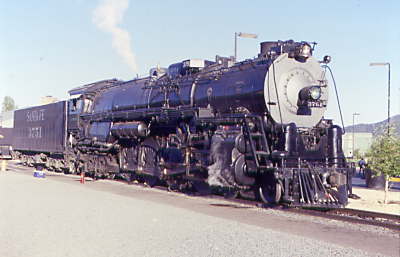
Jerry from Burlingame, Wayne from Cypress and I walked to the Budget Host Inn where there was no one in the office so we walked next door for a hearty breakfast at the Old Smoky Restaurant then returned to the lobby and were given our rooms. Afterwards, the three of us walked to the Grand Canyon Railway depot before I walked over to the Rodeo Road grade crossing and moments later, Grand Canyon 2-8-2 4960 and FPA-4 6173 reversed down to the depot. Rumours were flying as to where Santa Fe 3751 was and the large group at the crossing learned about 9:55 AM that the steam engine had been rented by Goodheart Productions for the day.
That turned everyone's attention to the now-departing Grand Canyon Railway train to the Canyon with Grand Canyon 4960 leading. I was given a ride back to the depot, visited the post office and a Safeway before relaxing for the afternoon. After filling out five postcards on the way back to the post office, I picked up eleven more, as well as some rocks for the greatest science teacher I know, Mrs. Angle, at McFadden Intermediate. Returning to my room, I listened to Yes as I filled out the postcards then listened to the "Gates of Delirium" as I walked back to the post office. Back at the room as I watched "The A-Team", Earl Nickles, a member of the Orange County Railway Historical Society, and the excellent barber on the "Overland Trail", arrived. We walked to the gift shop then by the excursion train before I set up for the return of the Grand Canyon train which came around the curve by the wye in perfect light. Earl and I went to Rod's Steak House for an enjoyable dinner then walked back in the cool night air to the hotel via the station. I called Amtrak and learnt that the westbound Southwest Chief was over three hours late and as I was finishing Santa Fe 3751 returned to the depot with only Earl and I standing on the platform to enjoy its arrival. I visited Safeway before calling it a night.
Convention Event - Santa Fe 3751 to the Grand Canyon 8/24/2002The wakeup call came and following the usual daily preparations, I went to Smoky's for a French Toast breakfast and enjoyed my meal with Earl, then walked over to the train. As I took pictures of Santa Fe 3751 in beautiful light, I met Ron and Ellen Grau, also members of the Orange County Railway Historical Society. While waiting for our excursion to board, I met people from all over the country and the car I chose to ride was former Norfolk and Western "Powhatan Arrow" with seat mate being Paul, grandson of a SOO Line conductor from North Hollywood. I walked to the "Royal Gorge" to buy my Canyon Rails 2002 T-shirt.
We departed Williams at 8:38 AM and passed the coach yard with Grand Canyon Railway 2-8-0 18 on the point of their daily train, waiting for us to leave then rode the vestibule by the Grand Canyon Railway shops, under the BNSF mainline and the first few miles out into the countryside, finishing off a roll of film. I sat back and listened to Santa Fe 3751 work as I met more people from all over the United States and Canada. Later, I walked forward to see who else I knew then as we passed through Willaha, the population soared with about fifty photographers, who all vanished as soon as we passed. I listened to Yes' "Yesshows" as we travelled north to the canyon this morning.
When we arrived at Anita, Santa Fe 3751 dropped us off for a photo runby and as the steam train reversed out of sight, and because of a parked van which the owner would not move, the photo line was moved ahead of the van. Minutes before the train started the photo runby, the line moved again, this time because of a small rise in the landscape to the final location.

Once Santa Fe 3751 started forward, I used my zoom features to capture the great smoking Santa Fe 3751 but just when I switched to my normal lens, it stopped smoking, passing the photo line with a clear stack before smoking it up later. I had never heard so many people complain about a clear stack engine. Steam engines have a clean stack when running normally and these people should be grateful for any photo runbys during a steam excursion, especially these days when insurance is so high. Santa Fe 3751 pulled out of sight to where Grand Canyon 4960 was waiting to be added to the point of our train.
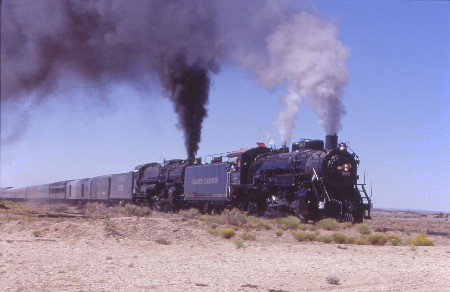
They reversed past us as a doubleheader before performing a very smokey photo runby. I ran into Bob Riskie who rode with my eastbound ticket and we caught up on a variety of items then I rode the vestibule to Apex and down through Coconino Canyon. 4960 was an excellent-sounding steam engine and this was a nice relaxing trip behind 3751 and 4960 to the South Rim of the Grand Canyon. The steam engines cut off and we were pushed straight into the station by the Amtrak diesels, where we all detrained.
Grand Canyon 8/24/2002
The scene once we arrived. While Santa Fe 3751 was being lubricated, I walked up and over the ridge to the Grand Canyon then returning to the station with Santa Fe 3751 still in the same spot, Grand Canyon 4960 soon joined, pulling up in front with most of its tender behind Santa Fe 3751. Next Grand Canyon 18 did the same maneuver behind Grand Canyon 4960 and all three steam engines were lined up in front of the log depot.

Next, they reversed each engine to give the photographers a better vantage point of all three with the station. After everyone had their fill of pictures, the crews re-arranged the engines so the station would be in the pictures as well.
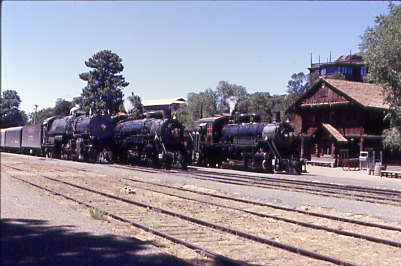
On the left is Santa Fe 4-8-4 3751 built by Baldwin in 1927. In the middle is Grand Canyon Railway 2-8-2 4960, nee Chicago, Burlington and Quincy 4960 built by Baldwin in 1923 and on the right is Grand Canyon Railway 2-8-0 18, nee Lake Superior and Ishpeming 11 built by American Locomotive Company in 1910. What a photo shoot! While all of that was happening, I ran into Steve Sandberg of the Milwaukee Road 261 crew and we caught up on a variety of topics. I walked back to the rim, bought an ice cream cone and met yet another Orange County Railway Historical Society member, Fred Kingdom, who was viewing the canyon with his wife. then returned to the train and with no platform where our cars were, we had to board through "Pine Tree State" and walk through the train to our car and seats.
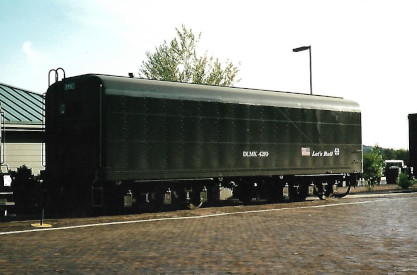
DLMX (Daylight Locomotive Works) auxiliary water tender built by Baldwin in 1942 as a tender to Southern Pacific's 4-8-8-2 cab-forward 4219. It was later used to provide water for the rotary snow ploughs and for fire-fighting service in the remote areas of the railroad. For this convention, it was painted with the phrase "Let’s Roll".
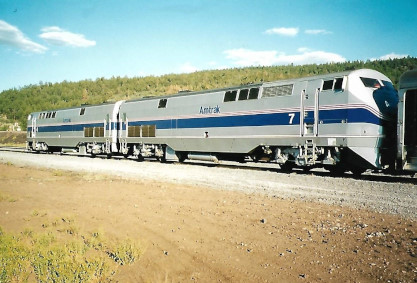
Amtrak P42DC 4 and P42DC 7, built by General Electric in 1996.
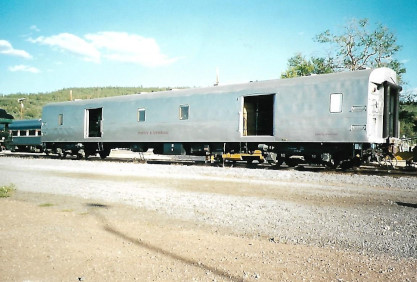
Tool car 'Pony Express", nee Canadian Pacific baggage car 4210 built by Canadian Car and Foundry in 1941. PPCX 800320. It was used to move horses for the Royal Canadian Mounted Police.
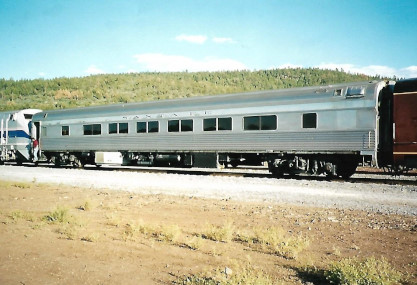
Coach "El Capitan", ex. Amtrak 4705 1981, exx. Amtrak 4816 1971, nee Santa Fe 2822 built by Budd Company in 1953. PPCX 800721.
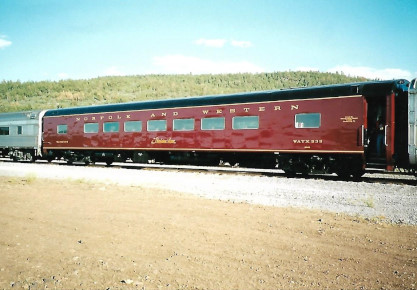
Coach WATX 539 "Powhatan Arrow", ex. Metra 1009, nee Norfolk and Western 539, built by Pullman-Standard in 1949, in Norfolk & Western livery for the Powhatan Arrow, which operated between Cincinnati, Ohio and Norfolk, Virginia. After the N&W passenger service was discontinued in 1971, the car was put into commuter service in Chicago for several years then retired for storage until 1982, when N&W selected 539 for operation in the Norfolk Southern Steam program with N&W 611. In 1992, the Watauga Valley Chapter NRHS received the 539 from Norfolk Southern and completely restored it. PPCX 800403.
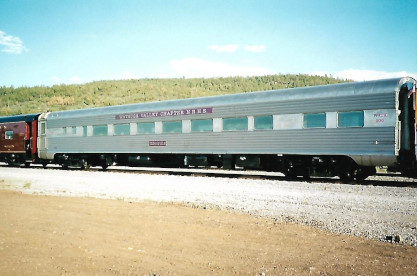
Coach WATX 500 "Clinchfield", ex. Bristol and Northwestern Railroad 800035 1981, exx. storage in 1979, exxx. Amtrak 5474, exxxx. Seaboard Coast Line 5474, exxxx. Seaboard Air Line 6271, nee Florida East Coast 56 seat coach "St. Augustine", built by Pullman-Standard in 1954. It saw service on the Dixie Land route between Chicago and Miami and was also in the consist of the New York-to-Florida train until 1971. It was purchased by Watauga Valley Chapter in 1986, which renovated the interior and upgraded the car. PPCX 800402.
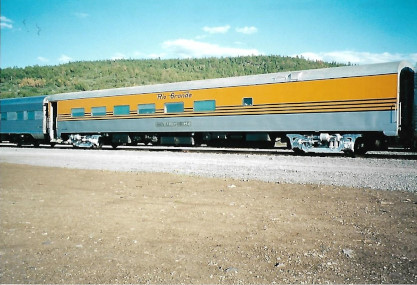
Buffet-lounge 1291 "Royal Gorge", ex. Amtrak 3361 1974, exx. Penn Central 4448 1968, exxx. Pennsylvania Railroad 1148 1967, nee Denver & Rio Grande Western built by Pullman Company in 1950. It has been owned by California Rail Tours since 1985. PPCX 800380.
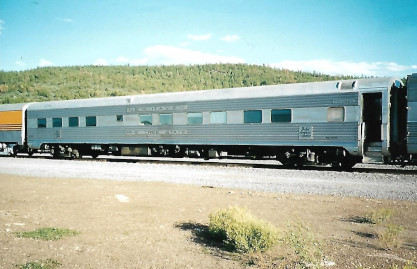
New York, New Haven and Hartford six double bedroom-club lounge 553 "Pine Tree State", ex. Amtrak 3212 1971, exx. Penn Central 4435 1968, built by Pullman-Standard in 1955. It was later owned by the Piedmont Chapter of the National Railway Historical Society. When in passenger service, it was assigned to the Montrealer northbound and the Washingtonian southbound. PPCX 800236.
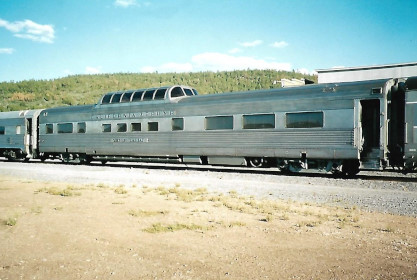
Dome car "Silver Lariat", built by Budd Company in 1948. It ran in service for the original California Zephyr for 22 years until it was discontinued in 1970. Amtrak purchased it in 1971 and used it for long-distance service till 1980, when it was retired upon arrival of Superliners. The present owners, Al Bishop and Burt Hermey, purchased it from Amtrak in 1985. PPCX 800190.
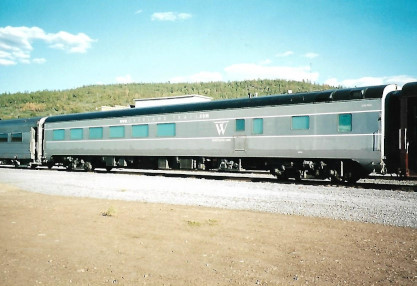
The Overland Trail is a 39 seat club-lounge with barbershop and shower built by the Pullman Standard Car Manufacturing Company for delivery to the Southern Pacific Railroad in December 1949. Numbered Southern Pacific 2981, the car was specifically ordered in October of 1947 for the San Francisco Overland, a train jointly operated by the Southern Pacific, Union Pacific and the Chicago & North Western railroads between Chicago and Oakland (San Francisco).
The 2981 served faithfully, racking up around 5 million miles for the Southern Pacific during its railroad career. However, as the fortunes of passenger trains waned in the 1950's and 1960's, so too did the glory of this stylish railcar, when in October 1966, the beautiful lounge of 2981 was stripped and converted into a dance floor. The Southern Pacific (wanting to keep idled onboard service crews working during the winter), along with the Reno Chamber of Commerce, started the Reno Fun Train (a winter time "gamblers special") which ran between Oakland and Reno, bringing revelers, who otherwise, would not make the drive from the Bay Area over the treacherous Donner Pass, to Reno.
Amtrak was created on May 1st, 1971 to "rescue" the American passenger train which was in a death spiral and no longer any competition to the commercial airlines or the automobile. The 2981 was purchased by Amtrak in 1973 and numbered 3500. She finished her railroad career, still assigned to the Reno Fun Train serving as a bar/dance car into the late 1970's. The car transitioned to private hands after Amtrak retirement and spent a decade as a derelict on various railroad spurs under several owners. Fortunately for the 2981, a new chapter has been written for this glorious car. Once again adorned in authentic railroad colors, she has been given the name Overland Trail and has undergone extensive mechanical, structural and cosmetic restoration to return her to the rails as a classic form of travel, suitable for the stylish and sophisticated, or for those simply wishing to relive a bygone era. PPCX 800633.
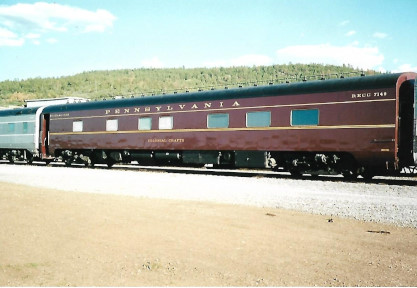
3-1 bar lounge "Colonial Crafts" RECC 7149, ex. Penn Central, nee Pennsylvania Railroad 8412 "Colonial Crafts", built by Pullman Company in 1949. After years of long-distance service, Colonial Crafts diverted to New York-Washington DC corridor to service as extra-fare parlour car. It was retired in 1971 and Bob Brown purchased car from Penn Central and used it as vacation home at museum in Western Pennsylvania. In 1985, it was purchased by Rod and Ellen Fishburn, who restored it to first-class operating condition. PPCX 800061.
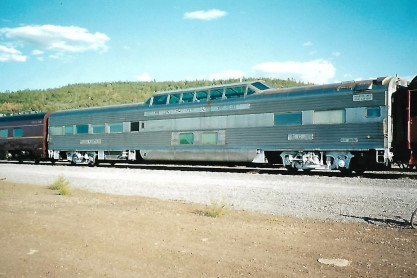
Dome 503 "Plaza Santa Fe", ex. Amtrak 9353 1971, nee Santa Fe Pleasure Dome-Turquoise Dining Room-bar lounge 503 built by Pullman Company in 1950 for the Santa Fe's premier "Super Chief" streamliner. California Rail Tours, who added the car's originally intended "Plaza Santa Fe" name, has owned this dome car since 1986. PPCX 800392.
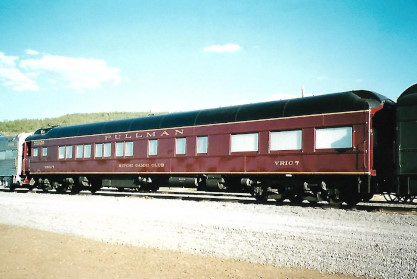
Observation-lounge car "Kitchi Gammi Club", built by Pullman Company in 1923. The car was originally named "Mountain View". In 1937, it returned to its builder for rebuilding into a solarium observation car, as were many Pullman open platform cars at that time. In Calumet shops, the car was given a complete overhaul, which included the addition of air conditioning. Major interior changes were the addition of a buffet kitchen area in the center of the car, a porter's room, and the reduction of the sections from ten to eight. All carpet and upholstery was updated and the car rolled out of the shop with a new plan designation of 4025H, an 8-section buffet lounge observation named "Kitchi Gammi Club". After it rolled out of Calumet shops in 1937, it was assigned to service with the Nickel Plate Railroad, which assigned it to trains 9 and 10, operating between Cleveland and St. Louis and ran on these trains throughout the 1940s and the early 1950s. Normally, it served as the only Pullman space available on these trains.
In 1953, the Nickel Plate purchased the car from the Pullman Company and sent it to Nickel Plate's Calumet shop for conversion into business car 7 (the second Nickel Plate business car with this number). This conversion saw the removal of section 8 and the installation of a closet housing a hot water boiler so the car would have heat when operated on freight trains for inspection purposes. It remained in office car service until the merger with the Norfolk & Western Railway on October 16, 1964. After the merger, it was used on the old Nickel Plate system for a few official occasions, but not to the extent as when the Nickel Plate had it as a company business car.
In 1967, the car was sent to Chicago to replace the Chicago wreck derrick outfit's wooden dining car. The "Kitchi Gammi Club" lost its name and simply became known as N&W 521417, a wreck diner-bunk car. In derrick service, it was once again "remodelled." This time, section 2 was removed and a small foreman's office was installed in its place. Section 7 was also removed and three wash sinks were installed. The original men's bathroom and lounge was converted to a shower. Last but not least, the observation lounge was converted to an eating area with the addition of wooden booths and tabletops. It was a sad finish to a truly historical piece of equipment. The car remained in Chicago until 1988 when it was retired as surplus and shipped to Roanoke for disposition. However, the scrap dealers would never get to use their torches on this car. In 1989, Virginia Rail Investment Corp. purchased "Kitchi Gammi Club" and moved it to Lynchburg for work to determine the soundness and probability of restoration. After complete removal of all the old and outdated equipment underneath and inside the car, it was sandblasted and primed. After careful inspection, the car was found to be in excellent condition and restoration was started. The car moved from Lynchburg to Roanoke, then on to Evansville, Indiana where the majority of the work was accomplished.
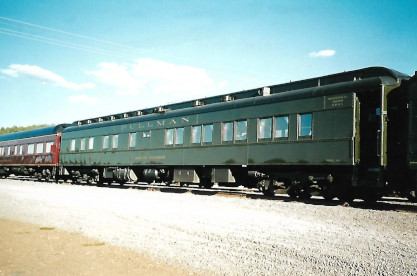
NRHX 001 "Dover Harbor", nee combine baggage-library car "Maple Shade" built by Pullman Company in 1923. It had a 4-section, 12-seat lounge, a barber shop and a baggage area and was painted in the Pennsylvania Railroad's standard colours and operated in service at the head of that railroad's name trains, including the Broadway Limited and the Spirit of St. Louis for eleven years. In March 1934, the Maple Shade was recalled into the Pullman shops and rebuilt into six double bedrooms, a buffet and a lounge and renamed "Dover Harbor" then repainted to the standard Pullman green-and-gold livery that it wears today. Pullman assigned the car to service on the Michigan Central Railroad, a subsidiary of the New York Central Railroad. In 1939, "Dover Harbor" operated with sister cars "Dover Plains" and "Dover Bay" on the westbound Lake Shore Limited and the eastbound Commodore Vanderbilt between New York and Chicago. Later, it saw assignments to the Cleveland Limited in 1994 and the Knickerbocker in 1945 -- both New York Central trains operating between New York and Cleveland. Pullman owned and operated the car until December 31, 1948, at which time ownership transferred to the railroads on which they operated.
In 1953, the exterior was repainted into the New York Central gray livery and the following year, it, along with "Dover Cliff", was assigned to operate between Washington, D.C. and Montreal on the Montrealer and the Washingtonian. These trains were an interline pair operated by the Pennsylvania Railroad, the New York New Haven, and Hartford, the Boston and Maine, the Central Vermont and the Canadian National. In 1955, streamlined lightweight cars "Pine Tree State" and "Nutmeg" State replaced the Dover Series cars on these trains; the "Dover Harbor" however, continued to be frequently used as a backup car. In February 1958, the car was painted in the two-tone gray Pullman pool service colour scheme and two months later, ownership of the Dover Series cars were transferred back to the Pullman Company.
Pullman, having realized the value of the design features of the cars, had negotiated with the various railroads to trade a series of Clover cars (8-section, 5-double bedroom) for the Dover Series cars. "Dover Harbor" remained in service on the Montrealer until it was finally retired to storage on October 18, 1965 at Pullman's Calumet Shops near Chicago. In April 1967, the Pullman Company sold the car to a private individual. After a series of four private owners, the Washington DC Chapter purchased it on November 30, 1979 and it became Amtrak-certified on May 21, 1986. It is now the only heavyweight Pullman revenue car fully operational for private use on Amtrak passenger trains. PPCX 800073.
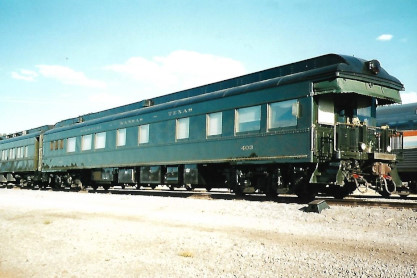
Missouri-Kansas-Texas open-platform business car 403, ex. John Marshall 1988, exx. MKT 864 1981, exxx. Allis Chalmers 1979, exxxx. Saline River and Northern 177, exxxxx. Kansas City Southern 1961-1964, nee Missouri-Kansas-Texas all-steel chair car 403 built by Pullman Company in 1913, one of the first such cars owned by the Katy. It was also built with ice-activated air conditioning. In 1959, it was assigned to General Superintendent R.B. George then when sold to Kansas City Southern, mechanical air conditioning was installed. It was returned to Amtrak standards by 1991 by Texas Southern in San Antonio. PPCX 800393.
NRHS Santa Fe 3751 Back to Williams 8/24/2002We left the Grand Canyon at 2:35 PM to return to Williams with only Santa Fe 3751 leading our train. I listened to John Cougar as we proceeded south through Coconino Canyon and went down the line to MP 41.6, but overshot the photo runby location so we reversed to MP 42 and detrained on a hillside overlooking a long straight track.

Santa Fe 4-8-4 3751 on a solo runby then it reversed out of sight before performing a smokeless runby.
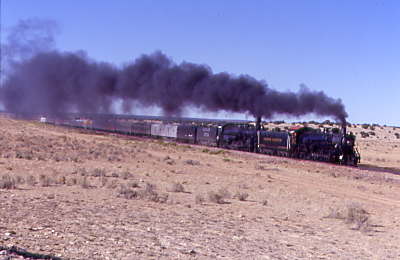
Santa Fe 3751 steamed ahead to MP 44 to join with the waiting Grand Canyon Railway 2-8-0 4960 before they reversed together to perform a double-headed runby. Reversing once more, everyone had a smokey runby which bought clapping from the photo line. We all reboarded and made our way to Willaha, where our special went into the siding so the regular Grand Canyon train could pass. We then detrained and photographed the Grand Canyon 2-8-0 18-hauled train passing our doubleheader. Once they had cleared, our train reversed onto the mainline and performed a double photo runby, which I shot from two different angles.
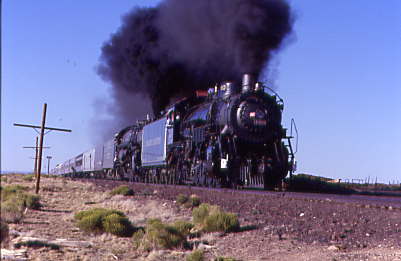
The first photo runby at Willaha.

The second photo runby. On the move again, I signed up for next year's convention in Baltimore and wondered if I could gain some new mileage and baseball stadiums? It would come down to all the planning. 4960 did most of the smoking for the rest of the journey as I sat back and relaxed. We climbed the three percent grade with both engines really talking as they worked. At MP 3, we detrained in the last light of the day for another double-headed runby.
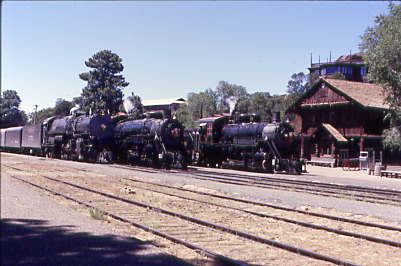
As the sun was setting, they pulled forward to add the Grand Canyon Railway 18 to the point to give us a triple-headed runby. That was done twice and I took pictures with little hope of them coming out well, but how often do you see a triple-headed steam train? This was a first for me and I really loved it. We had a twilight run back into Williams ending a fantastic day of train riding and arrived at the station at 7:47 PM. What a trip! I walked around the front of our triple-header, thanking each of the engine's crews for such a fantastic day then a westbound BNSF freight passed through Williams. I went to Dairy Queen for a sub-par hamburger, but the chocolate shake was excellent, then called home and called it a night.
NRHS Santa Fe 3751 to Parker 8/25/2002Waking up knowing that every mile that you are going to ride today will be new mileage is quite a feeling. I went for an early morning walk before having another filling breakfast at Smoky's then checked out and walked to the train to board. I talked to Dave Rohr of Rail Journeys West before boarding their car Santa Fe 2822 "El Capitan" at 8:10 AM. Just think, I was riding in a Santa Fe coach behind a Santa Fe steam engine down the Peavine Line in 2002. I talked with the other passengers and met Daniel Chazin, another travelogue writer at Trainweb.com.
At 8:30 AM, Santa Fe 3751 started pulling forward and we were underway, riding down the siding before reversing out onto the mainline as BNSF 7862, a welded rail train, was further down the siding. The portion of the Peavine to Ash Fork was the original Santa Fe mainline used until they built the Crookton Line in 1960 and then the line between Ash Fork and Crookton was abandoned. We ducked under Interstate 40 as the line started its twisting and turning along the hillsides through the trees to descend to Ash Fork.
We passed through Sterno and were travelling through a very dry northern Arizona as the monsoonal rains had yet to appear. Was this a sign of an El Niño winter? We ran around a large horseshoe curve at MP 381.5 then negotiated a series of horseshoe and "S" curves for the reduction in elevation before Daze and made are way down more sweeping curves into Ash Fork with its depot still standing. Here we changed our pilot engineers and upon our departure, the grade of the original Santa Fe veered off to the west as we turned south under Interstate 40, which we would not go under again until Pisgah tomorrow in California. We ran through Cruice at MP 3.9 and in a few minutes, crossed Little Hell Canyon, where a large contingency of photographers were waiting.
Hell Canyon ran to the north of us as we turned to travel under the Highway 89 bridge crammed with photographers on our way to Drake, where the former Santa Fe line to Clarkdale took off, which is now operated by the Verde Canyon Railroad. Right after Drake, we crossed the 335 foot long and 150 foot high Hell Canyon bridge, the signature landmark of the Peavine Line then made our way to Abra, where the Santa Fe construction a line relocation to bypass Prescott and the steep grade west of there. Our special train turned west to cross the Williamson Valley then later, south to run along the slope and a few minutes later, crossed Mint Creek before ducking under Highway 5 at Tucker.
The Granite Mountains came into view to the east as we started to climb out of the Verde River drainage area and entered the desert, leaving the trees far behind with the West Spruce Mountains to the east and Martin Mountain to the west. We travelled down the upper reaches of Skull Valley with its large boulders and descended into the town of Skull Valley, where we passed a BNSF freight with two SOO Line engines in the consist. While I was buying another T-shirt, Santa Fe 3751 passed through the town of Kirkland then we traversed Kirkland Creek and the prickly pear cacti made their first appearance. Our train made a large "S" curve to climb out of the valley to Grandview, which lived up to its name with Santa Fe 3751 really working then continued south, rounding more sweeping curves down to Date at MP 109.7, where at the west end, we crossed Date Creek.
On the hillsides a little further down the canyon, the Saguaro cacti were dotting the slopes of the canyon and on one of the boulders, someone had painted a skull. Too bad that was not back in Skull Valley! We left our dirt road photographers at the grade crossing before reaching the short siding at Piedmont. The westbound Grand Canyon Limited went through Congress, where a large group of picture-takers braved the heat then crossed the desert floor before reaching Matthie where Santa Fe 3751 was first walked around the wye then serviced. It is here we left the BNSF for the rails of the Arizona and California and while we sat, we watched as someone tried to get pulled out of the stream bed sand. There was always something to watch on this trip!
We departed Matthie with an Arizona and California pilot aboard at 2:11 PM and the engine chugged on the climb to Divide. To the south were the Vulture Mountains and to the northwest were the Harcurvar Mountains. We passed the abandoned station at Divide and clipped at a good pace of 49 MPH through the desert. A whirlwind caught a few of the passengers' attention and there would be many more of them on this hot August afternoon. Santa Fe 3751 smoked through the Aquila grade crossing as the Harquahala Mountains stood out to the south-southwest. The crew had been throwing old hats and T-shirts out of the window, to mainly children during the day's run, although some beautiful women had their share of items as well. We slowed to 20 MPH through the town of Aquila before resuming speed across the scrub-covered desert floor and over on US Highway 60, there was a large group of chasers trying to pace us. It was announced that we would do a photo runby at MP 44; thank you Arizona and California Railroad!

We detrained into the triple-digit temperatures for a double photo runby. On the first one, Santa Fe 3751 did not smoke all the way through and the pop-off valve went off when it passed our end of the photo line. On runby number two, it almost smoked into my picture frame. We did this all in the town of Wenden, where the local Mexican children must have been thinking, "crazy gringos" since we were all baking in the very hot sun. Water was distributed to everyone on board before we departed. At least we had a photo runby on this westbound journey, whereas the eastbound one had none. You must remember that the Santa Fe 3751 crew has not had too many opportunities to perfect the photo runby over the years; this was only the San Bernardino Railway Historical Society's second public set of trips and I hoped they have many more in the future.
Santa Fe 3751 whistled through Salome, where it was announced that we would do the final photo runbys of the excursion at MP 100 near Parker, and none could be done tomorrow due to the tight new schedule under which we would be operating. We rounded the southwest tip of the Harcurvar Mountains, passed through the cut, which once was a tunnel and railfans were on both sides of the cut and out on one of the hillside spurs. We descended the grade with our diesels in full dynamic braking with the Plomosa Mountains to the west, cruised through Vicksburg, with Highway 72 filled with chasers and pacers of our train, then steamed through McVay with the Buckskin Mountains to the north. Later, as Santa Fe 3751 pulled through Bouse, ahead of the train in the northwest across the Colorado River, were the Whipple Mountains in California. We followed Bouse Wash west until we reached the steep slope down to the floodplain of the Colorado River, where our route turned to the north. Just to the north of MP 100, we stopped for the photo runbys.

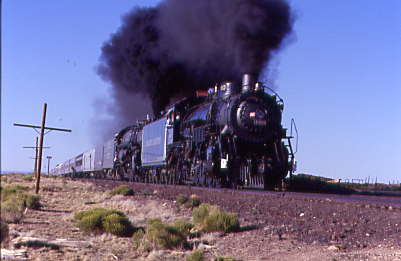

The lighting was perfect, the location was unique and Santa Fe 3751 smoked the best it had ever done on all three of the runbys here. We called these the "Lawrence of Arabia Runbys" as the sand on my knees proved when I dusted them off after the last runby. Everyone clapped after each of the runbys to show their thanks for Santa Fe 3751's excellent performance. The Arizona and California picked this unique spot and deserves our thanks, as does the Grand Canyon Chapter of the National Railway Historical Society for putting on a great convention. When we reboarded, the car hosts handed each passenger a bottle of water and Santa Fe 3751 pulled the train the final miles into Parker, ending an exciting day of my new mileage at 6:26 PM.
Parker, AZ 8/25/2002I walked out to the first bus in the 113 degree heat and saw the Arizona and California eastbound freight train waiting down the tracks to the west for the steam train to clear the mainline. We were taken to the Blue Water Resort and Casino where check-in was very quick. Once I found my room, the shower was quite refreshing and my room overlooked the marina, the Colorado River and the Whipple Mountains in California. On my way to dinner, I played five dollars of quarters and less than four minutes later, I had won $57.50. I took the money and went to our group's buffet dinner, sitting with Ron Grau and Chard Walker, the well-known author and former Santa Fe train operator at Summit. It was an enjoyable meal with good fellowship, after which I returned to my room for a call home and a little television before calling it a night.
NRHS Santa Fe 3751 to Los Angeles 8/26/2002We departed Parker on time but stopped before the Colorado River bridge as one of the cylinder cocks on Santa Fe 3751 would not close. The problem was quickly fixed and we proceeded west, crossing the Colorado River into California with 79 photographers capturing the movement. Their chase was now on as we climbed away from the Colorado River with the Whipple Mountains to the north and the Riverside Mountains to the south. We passed Big River, which I had seen advertisements on television for when I was a child, so finally knew where this was located. We climbed into the wide Vidal Valley and a few minutes later, steamed through Vidal as we crossed US Highway 95 and followed Vidal Wash west to Grommet. To the northwest was Negro Peak of the Mopah Range and the Turtle Mountains were across this broad valley, with the West Riverside Mountains to the south. Santa Fe 3751 slowed to 10 MPH for track work then we crossed the Highway 62 grade crossing, finding all of the chasers awaiting our arrival. We continued our journey with the Colorado River Aqueduct to the north and later, entered Rice Valley, where to the south were the Big Maria Mountains and the Granite Mountains, with the gap between them where the Arizona and California line to Blythe passes through.
We arrived at Rice at MP 140.4, which was nothing more than a ghost town with a water tank and small station being among the last structures standing, then passed the wye for the Blythe line and continued west with the chasers on Highway 62 providing the entertainment until we reached Freda at MP 144.0, where we left the paved highway as our route turned northwest. The Iron Mountains were to the west across the Ward Valley and a few of the chasers braved the very poor dirt roads that followed the tracks through this bleak landscape. Santa Fe 3751 passed the siding at Sablon with the Turtle Mountains to the north and Danby Dry Lake to the west of the tracks on the valley floor. Later, we curved to the west passing through Milligan, with the abandoned Standard Salt Company's plant and various old railroad cars at the south end of the barren Old Woman Mountains before curving northwest again with the Kilbeck Hills to the west. We climbed the grade to Chubbuck with its abandoned foundations before the travelling along the north end of the Kilbeck Hills. Once past them, the Cadiz sand dunes came into view with the Calumet Mountains behind to our west and the Ship Mountains to the north.
I walked back to the "Overland Trail" and Earl Nickles, their barber and good friend, cut my hair during the final new miles to Cadiz. Where else can you get a haircut on a train but on the "Overland Trail" while on the Arizona and California Railroad, on a train be pulled by Santa Fe 3751 in the year 2002? Nowhere! What a neat experience and it was a great way to wrap up my new mileage on the Arizona and California Railroad. We arrived at Cadiz for the steam engine to be serviced and the Cadiz Local was already here waiting for a westbound Arizona and California freight train. The Marble Mountains stood guard to the north and my old friend Amboy Crater was to the west. We could see twenty miles to the west and had three BNSF freight trains pass through while we sat. Santa Fe 3751 finished its servicing and at 12:49 PM, we were moving again and after throwing a switch, entered the BNSF siding at Cadiz. It had been an exciting and unique steam excursion over the Arizona and California.
Santa Fe 3751 crept out of the Cadiz siding out onto the BNSF mainline, ending my new mileage for this trip. We waited for BNSF 5263 West to pass on Track 1 then at 1:33 PM, pulled up to West Cadiz and crossed over to Mainline 1 to resume our westward travel. I rode in the vestibule as we picked up speed racing through Saltus with Bristol Dry Lake to the south and Amboy and the Bristol Mountains to the north. We passed Amboy Crater and it was fun to watch the pacers and chasers on old Route 66. The Bullion Mountains to the south are in the US Marine Corps Air Ground Combat Zone, ie. bombing zone. Santa Fe 3751 cruised through Bagdad and started climbing Ash Hill, curving to East Siberia where we crossed back to Track 2 to take the short way over Ash Hill then crested the summit before descending to Ludlow where we crossed back to Track 1 and passed an eastbound freight on the climb to Lavic.
With the Cady Mountains to the northeast, we crossed back to Track 2 at East Pisgah then ducked under Interstate 40 and raced through Hector at 70 MPH then crossed Troy Dry Lake with the Newberry Mountains to the south and the Calico Mountains far off to the northwest. We blew through Newberry Springs but slowed to Minneola, passed the Solar One Generating Station and Coolwater before speeding through Dagget and passed the USMC Logistic Base at Nebo as we followed the Mojave River into Barstow. The train crossed back over to Mainline 1 at East Barstow before taking the passenger main to the station.
While Santa Fe 3751 was serviced and watered, it was assisted in watering by a steam fire engine. That was funny, a steam-powered tractor with Union Pacific 3985 and now a steam fire engine with Santa Fe 3751. What a summer of steam it has been! I toured both the Railroad Museum and the Route 66 Mother Road Museum, as well as purchasing an SBRHS hat.
Our special train departed at 4:10 PM and at MP 4 on BNSF's Cajon Subdivision, we stopped as were number five on the pecking orders with a rail maintenance vehicle broken down blocking the mainline ahead. We started to move again at 5:15 PM and crossed over to the Mainline 2 at Lenwood. Without delay, Santa Fe 3751 ran through Victorville and Hesperia, where the tracks were lined for people waiting for our steam train. Joe Harper and I exchanged stories with several other passengers laughing along. We then travelled over Cajon Pass via the north track through the tunnels and around Sullivan's Curve with not a single photographer to be seen. At Cajon, we had a hard yellow and slowly descended until we reached Keenbrook, where we crossed back over to Mainline 1 then continued to San Bernardino with people all along the route, which ended our journey over the Cajon Subdivision.
At San Bernardino, a group of passengers tried in vain to make a Metrolink connection so they could get to Los Angeles International Airport faster to make their flight but were stopped by someone trying to use his Amtrak credit card to buy a ticket and having all sorts of problems, forcing them to miss the Metrolink train and return to our steam train for the rest of the journey to Los Angeles. Departure was at 7:22 PM as the sun was setting and we proceeded the long way to Rana, crossed the Union Pacific at Colton, blew through Riverside and crossed over to Track 1 at May. Santa Fe 3751 sped through Corona and Santa Ana Canyon into populated Orange County, where there were tons of people out to watch. We were cheered as Santa Fe 3751 passed the huge crowd at the Fullerton station and flew through La Mirada as well as Santa Fe Springs. Going by the trackside detector there, we set it off for having excessive hot bearings so stopped west of the former Pacific Electric crossing and the crew had to inspect both sides of the entire train, thus delaying us fifteen minutes.
Once on the move again, we steamed through Pico Rivera, Commerce and Hobart Yard as our car hosts held the microphone outside, sending the loud working sounds of Santa Fe 3751 inside our car to everyone's enjoyment. We crossed the flyover across the Los Angeles River and Alameda Corridor where the steam engine's drivers slipped, then ran the final miles along the Amtrak coach yard into Los Angeles Union Station, arriving at 9:27 PM, ending an exciting three-day steam spectacular. After saying goodbye to everyone, I exited the train and walked forward for one final look at Santa Fe 3751.
Pacific Surfliner 794 8/26/2002I boarded this train and we held for the late-running Coast Starlight, but at least it was not as late as the one I was last on. I caught up with Mishi, the conductor, who had some very good news to share with me and departed at 10:35, twenty-five minutes late and made our way towards home as she took my ticket and gave me Alaska Airline Mileage Plan credit while I listened to Olivia Newton John Live and did word fill-in puzzles. Train 794 poked its way to Fullerton at restricted speed then once we reached Metrolink's San Diego Subdivision, we sped through Anaheim, Orange and then Santa Ana, arriving twenty-eight minutes late. My mother waited patiently for me and I went home to bed before starting another trip tomorrow.
Rail Sale and my 700.00.0 Rail MileBack in the days when my brother Bruce was living in Pocatello, Idaho, I would purchase an All-Aboard America Fare (now See America) to visit him then on the same fare go to other locations such as Albuquerque and Deming, New Mexico and El Paso, Texas. I really enjoyed those short little getaway trips and it was more miles for the fare. Rail Sale then came along and a few years later, knowing I would be approaching my 700,000.0 rail mile, I checked Rail Sale and found a ticket each way to Albuquerque for $25.00. Little did I know when I purchased that trip that it would be the one to put me over that 700,000.0 rail mile on the eastbound journey if everything went according to plan.
Pacific Surfliner 581 8/27/2002Up early following that great steam excursion, I rode Pacific Surfliner 568 south to Solana Beach and passed the 699,000.0 rail mile just north of Oceanside then returned to Santa Ana on Pacific Surfliner 569 and spent most of the day typing the story from the last few days before it was time to leave. My mother drove me to the Santa Ana station and I waited on the platform for a few minutes-late Pacific Surfliner 581. Other than a child whose parents had left on the train at Santa Ana, who was taken to Anaheim to be cared for by the agent until the parents drove to claim him, it was a quick and normal trip. We passed Santa Fe 3751 at Redondo Junction on a garden track still releasing steam then were delayed briefly by the Amtrak switcher before entering Los Angeles Union Station just two minutes late.
Southwest Chief 4 8/27/2002I went into the station to pick up my boarding pass then joined the line of coach passengers. It was a repeat of the other night but far less were boarding today, so our train was quite empty. We departed the platform at 6:45 PM and left LAUPT for good at 7:20. After a comical session getting a 7-Up, we rolled the miles to Fullerton and Paul, our lounge car attendant, was the only singing Lead Service Attendant I have had on any of my travels. He has a song for every announcement. I went to the lounge car downstairs to wait for tonight's movie, "The Rookie", which started after the smoke stop at Riverside since there was no smoking lounge on our train. The film was excellent and lasted almost to Barstow then I slept soundly well into the next morning.
8/28/2002 I awoke east of Flagstaff and met Mark, who had been at the NRHS convention and had ridden with me on several other mainline steam trips. After crossing Canyon Diablo, we went to the dining car and were seated at a table waited on by none other than Paul Lamonica, a former San Diegan Lead Service Attendant and a good friend. I had French Toast and it was really good to see Paul again. The sky was cloudy, so maybe some of that monsoonal moisture might fall today. The Southwest Chief was running right on schedule and back at my seat, our Train Chief had to have a long conversation with the smoking passengers in our car to explain when they could detrain to smoke. During my fresh air stop at Gallup, I ventured into the station, adding it to my list of stations that I have been inside then after we crossed the Continental Divide, I napped from west of Grants to west of Dalies. Off the BNSF mainline, we proceeded to Albuquerque and I spotted signal 21.1 and knew I had just 7.0 more miles to go to reach my next plateau so moved to the other side of the car to see the milepost markers and just short of Isleta, the junction with the "Horny Todd Line" to El Paso, I passed the 700,000.0 rail mile mark. Now only 300,000 miles to go for a million. We crossed the Rio Grande River and rolled into Albuquerque, where I would detrain when we arrived early.
Albuquerque 8/28/2002
I checked my bags in for the afternoon before walking the short distance across the street from the Alvarado Transportation Center to the new Century Theater where I saw "XXX" or "Triple X" if you prefer and "Serving Sarah", which I both enjoyed. I walked out to a sky which was trying to rain and noticed that my train had arrived at the station early.
Southwest Chief 3 8/28/2002After retrieving my bags, Manning, another former San Diegan Business Class Attendant, assigned me to a seat in the nearly empty car which had the smoking lounge in it. We left on time and stopped just south of the station to remove some mail from one of the express cars on the rear of the train. There was an open call for dinner and I had a strip pepper steak then west of Grants, the sky became active with downpours and lightning off in the distance. We entered the rain and over on Interstate 40, the westbound lanes were closed due to a rain-associated accident which backed up the traffic and first caught my eye. West of Gallup and very tired, I called it a night.
8/29/2002 Waking up east of Summit. I enjoyed a pancake breakfast as the Southwest Chief descended the fire-damaged Cajon Pass in the morning twilight. On one of the curves, I noticed our baggage car was from the Vermonter, as it was painted for that service. We arrived at San Bernardino over an hour late but I did not care as any ride over Cajon Pass in light is always worth it and there were lots of freight trains this morning. The Chief crossed the Union Pacific at Colton, paused in Riverside and travelled through a fog-shrouded Inland Empire before making its way through Santa Ana Canyon. We arrived at Fullerton at 7:50 AM, one hour and eleven minutes late, where I detrained to go home. With the padding in the schedule, this Southwest Chief would arrive at Los Angeles early.
Pacific Surfliner 568 8/29/2002I crossed the pedestrian bridge to Track 2 and I quickly called home before Train 3 departed and Pacific Surfliner 568 arrived. I boarded Pacific Business Class and finished the story up to here by CP La Palma then relaxed the rest of the way home. We were delayed at CP La Veta for a very late-running Metrolink 607 and then went on to Santa Ana, meeting Pacific Surfliner 765 at CP Lincoln, which was waiting for us. My mother was there to pick me up, ending this 700,000.0 rail mile adventure.
| RETURN TO THE MAIN PAGE |