




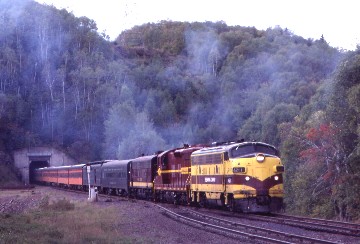
As a fundraiser for the Friends of the 261 for their excursion to Baltimore next year and for the Lake Superior Transportation Museum, the group scheduled a rare mileage and fall colours trip on the shuttered Erie Mining Railroad on September 21 and 22, 2002. Since I had not ridden this railroad, as well as the fact the trees should be peaking, I decided to do this and went to their website to order my ticket and a bus ride from Duluth. Next, I called the Alaska Airlines Mileage Plan partner desk and booked a round trip on Northwest Airlines then telephoned the Best Western for a reservation at their downtown Duluth location. The only other item was a rental car which Mike at AAA in Tustin set up.
Then it was back to work at McFadden Intermediate where my assignment changed before the first period of the school year and I was now working with Mr. Stevens doing 8th Grade Regional Specialty Program. I started coaching junior varsity football with tryouts before choosing my 2002 team and began working on the playbook which I distributed to my players. I was ready for a trip!
To Minneapolis and Beyond 9/20/2002Up extremely early on Day 2,802 of my sobriety, I packed after running a quick errand and breakfast before driving my mother to the airport in our van so she could return home. I checked in to get my boarding pass but was told that when I am ticketed in advance to just go to the gate to obtain the pass. I was still learning this flying game! I was whisked through security to Gate 3 where I waited for Northwest Airlines flight 116 to board and once aboard and taking seat 16A, I sat back and relaxed. We pulled away from the gate at 6:42 AM and was fourth in line for takeoff after the 7:00 AM curfew for takeoff. This flight was continuing to Baltimore, the site of next year's National Railway Historical Society convention, so perhaps I will fly Northwest there. Flight highlights were the Grand Canyon and Lake Powell and we arrived at Minneapolis-St. Paul ten minutes early.
I made my way to Hertz rental car and in less than five minutes, was driving away en route to Duluth. I stopped at A&W in Rush City for lunch before driving the rest of the way then visited the Lake Superior Transportation Museum and toured the collection, using the tripod they provided me after I had sent them an e-mail. That way I should get nice pictures of the engines inside.
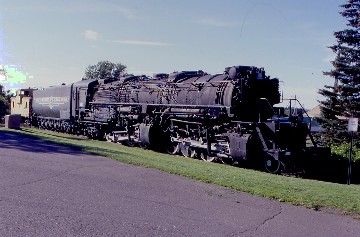
I drove out to Proctor to photograph Duluth, Missabe & Iron Range 2-8-8-4 225 built by Baldwin in 1941. With the approach of World War II, the DM&IR faced some challenging freight requirements. Iron and steel would be crucial to the war effort and the railroad would need locomotives capable of hauling long (115 car plus) trains of 8,750 tons or more on 0.62 percent grades without stalling. Ore trains ran downhill from the Mesabi and Vermillion Ranges to docks in Duluth or Two Harbors, and these trips did not require much of the Yellowstones. It was returning empty ore cars from Duluth up the 2.2 percent grade to the yards in Proctor that used their full pulling power.
During its twenty-one years service, 225 hauled over 44,000,000 tons of iron ore, travelling a total of 694,360 miles. Before retiring in 1961, it also hauled a number of railfan excursions. DM&IR donated 225 to the city of Proctor on 25th March 1963.
I drove back down to Duluth where one of the DM&IR ore trains was unloading on the docks and with the help of another railfan found a public viewing platform then drove out to Two Harbors being able to see the scenery in daylight, since my last visit in May was on the train in the dark. Here I found a wonderful DM&IR station along with both DM&IR 2-8-8-4 229 and Duluth Iron Range 2-6-0 3 on display. Since I photographed DM&IR 2-8-8-4 227 in the museum in Duluth meant that I captured the three remaining DM&IR 2-8-8-4s in existence. I came back to Duluth, checked into the Downtown Best Western before driving to KFC to get dinner then after a little television, called it a night.
Farewell to the Erie Mining Railroad 9/21/2002
The consist of our train was Erie Mining F9A 4211, DM&IR SD18 193 and Soo Line FP7A 2500 with cars from Milwaukee Road 261 and Lake Superior Transportation Museum, making up the fourteen-car train.
Erie Mining Railroad HistoryThe Erie Miming Company was formed in 1940 to research the commercial feasibility of taconite mining. They picked an area in Northern Minnesota near Aurora to build a plant in 1948. Construction of the pellet plant at Hoyt Lakes and the 1,200 foot ore dock, as well as other related buildings at Taconite Harbor, was begun in 1954 and completed in 1957. The railroad was 72.2 miles in length and was difficult to build as the construction involved blasting deep cuts through basaltic rock, grading the high fills on the descent to the dock and the boring of the 1,800 foot Cramer Tunnel. In 1986, LTV Steel acquired 100 percent controlling ownership of the Erie Mining Company and the name was changed to LTV Steel Mining Company.
Ore movements over the line continued until LTV announced the shutdown of the railroad on May 24, 2000. The last road pellet train ran down to Taconite Harbor on January 4, 2001 and returned on January 6th, ending 43 years of service. The trains had hauled well over one billion tons of ore while they were operated 24 hours a day, 365 days a year at the mines, while over nine months a year, over 320 tons were hauled down the mainline to the docks. This will be only the third passenger train ever operated over this railroad in the railroad's history.
The ExcursionOur train proceeded east out of Knox at 10:35 AM and we passed two of the old ore pits which are now lakes before passing the site of Balsam, the former small marshalling yard before traveling 5.7 miles to Dunka Junction where the line to the old Dunka mine took off from the mainline. Further east, we crossed over the Reserve Mining Railroad, now Cliff Northshore Mining, running from Babbitt to Silver Bay to the southeast. The 785 foot siding at Reserve was passed next as we continued east through the miles of roadless forest. We travelled along the southern end of the 100 Mile Swamp and out along it, was the old station site of Muskeg.
My seatmate was Herb Meckola and I was very lucky as he used to work for this railroad. We crossed the North River before coming to Sarto, named for State Road number two, where we stopped to flag the highway where a few chasers waited to photograph our train at one of the few locations along this isolated route.
Once on the move again, the Greenwood River was bridged before the former station stop of Moose then we made our way over the culvert for the Stoney River, went under the Salem Bridge, now a forest service road on the former DM&IR line to Wales, prior to reaching the 7,120 foot siding at Trow, named for project manager C.F. Trowbridge. Further east, we rolled through Murphy, passing the former Erie Mining track maintenance structures before stopping at Minnesota Highway 1 where the smaller trees were displaying their autumn colours. Our train crossed the culvert for the West Branch of the Manitou River and a little way down the tracks at MP 58.6, we crossed 100 feet above the Manitou River then train climbed the short grade to the Cramer Tunnel which was carved in 1956 and is the only true rock tunnel in the State of Minnesota.
Upon emerging from the tunnel, we arrived at Tunnel Siding where we stopped for a photo runby. The train was reversed to a white stake which was then removed for still photos then it reversed into the tunnel prior to running by us with the SD18 smoking up the scene nicely. The 5,400 foot siding here was originally called Cole, but that sounded too much like Trow, so the name was changed to Tunnel. On the move again, we crossed Two Island River, which is an excellent trout stream, so I was told by passengers. The train reached Crest, after which we started down the 2.2 percent grade to Taconite Harbor and made the steady descent in a giant tight "S" curve with the flanges of the wheels of our cars squealing as the dock came into sight. We made the last 180 degree curve at the bottom over North Shore Highway 61 at Taconite Harbor then ran over the spring switch and slowly out onto the ore dock.
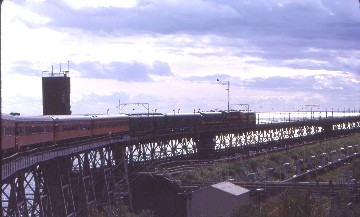
Since the length of our passenger cars were so much longer than the ore cars used by the railroad, we had only one inch worth of clearance on the curve leading onto the dock. Therefore, the train was walked out onto the dock being and the crew was very careful and safe doing this unique train movement. In my over 703,000.0 rail miles, this was a brand new experience for me. The view looking down was incredible, but the panorama of Lake Superior was totally stunning. Once we cleared the ore dock, we curved to the west around the balloon track used for pellet train unloading and returned to the spring switch by crossing over the highway twice and running through a deep rock cut. Taconite Harbor was an incredible rail experience and one I will always remember!
Our train returned up the 2.2 percent grade to Crest as I spent time and was reacquainted with passengers I met on previous trips. We passed through Cramer Tunnel and proceeded back at a greater rate of speed despite the fact that the SD18 was not operating properly and Soo Line FP7A 2500 was not even working, so Erie Mining F9A 4211 pulled the train solo doing an excellent job. I then rode in the vestibule through a cold rain shower followed by a beautifully intense rainbow until MP 20 when I returned to the warmth of the train as the outside temperature continued to fall. I talked with Steve Sandberg of the 261 group and the rest of the trip was relaxing as I continued to talk with Herb. We returned to the LTV plant at Knox at 6:32 PM, thus ending an excellent trip on the former Erie Mining Railroad. A special thanks to the Friends of Milwaukee Road 261 and Lake Superior Transportation Museum for sponsoring the excursion, and to Cliff Northshore Mining for allowing the trip to occur.
I was first back on the bus, which waited for the stragglers, then everyone returned to Duluth as I listened to Jethro Tull's "Bursting Out" from Hoyt Lakes to the Duluth city limits. I walked back to the hotel before calling it a night.
South to Osceola 9/22/2002Following a continental breakfast and checkout, I drove to see the Museum's new arrival, Hallet Dock Company H10-44 HD-11 built by Fairbanks-Morse in 1946, which Soo Line GP30 700 picked up from BNSF yesterday while we were gone. I then drove out to Proctor where I found the DM&IR shops before returning to Interstate 35 and about 60 miles south, came upon strong cold winds blowing from the west. I took Highway 95 across the St. Croix River into Wisconsin, turning south at St. Croix Falls onto Highway 35 through Dresser to Osceola and my next train rides.
Osceola & St. Croix Valley Railway 9/22/2002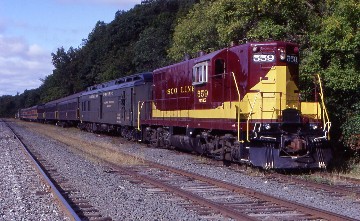
The tracks I was riding today were built by the Soo Line in 1887 from Minneapolis to ultimately Sault Ste. Marie. The first passenger train for the Twin Cities left at 7:00 AM for the two hour and five minute journey on September 10th, 1887 and the last passenger train ran in 1961. The line was sold to the Wisconsin Central, which, in 2001, was bought out by Canadian National. The train consisted of Soo Line GP7 559 (former Rock Island), Northern Pacific triple combine 1102 with a working Railway Post Office car, Rock Island coaches 2608 and 2604, Erie Lackawanna coach 2232, Chicago and North Western coaches 1097 and 1096 (painted as Great Northern), Great Northern coach 1213 and Great Northern first class business car A-11.
The GP7 pulled the train out of the storage track and spotted it at the depot before running around the train to operate high-hood forward to Marine on the St. Croix River. I boarded coach 1096 and with two toots of the horn, we were off and rolling towards Marine. Once out of the yard, we came out from behind the hill with the St. Croix River far below. To the east was the old abandoned Bethema Mineral Springs Bottling house before paralleled the vertical rock with the railroad cut out of the slope. We slowly descended towards our crossing of the river on a long fill, once a wooden trestle, to the welded drawbridge across the St. Croix River into Minnesota at Cedar Bend then continued south through the forests, which were late changing to their autumn colours as we made our away from the river.
After travelling through William O'Brien State Park, we crossed Cough Road on a high fill which the road tunnelled through before arriving at Marine where our locomotive ran around the train for the return journey. I sat on the right and after crossing the St. Croix River back into Wisconsin, I played spot-the-waterfall and found both, with Buttermilk Falls being the larger of the two. There were a lot of springs emanating from the rocks and in the winter, turn into ice floes which are very dangerous to operating trains. We arrived back in Osceola and I toured the business car before detraining.
The 1:00 PM Train to Dresser 9/22/2002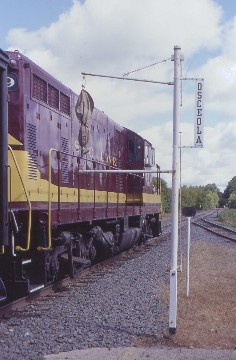
The crew asked if I would like to pick up the mail on this train since Northern Pacific 1102 is a working railway post office car and hanging on the mail stand was a sack of twelve post cards to be picked up on our next trip. Well, I never have caught the mail in my 703,000+ miles of train riding so of course I said "yes!" and would now do what thousands of railroad employees used to do in bygone days, yet I would be doing it in 2002. After receiving instructions in the art of mailbag grabbing and how to operate the hook, I was all set.
At 1:00 PM, the train reversed down half a mile of track to get a running start as the train needed to be travelling at least twenty-five miles an hour to make everything work properly. We started forward and when we reached the depot, I grabbed the hook handle, pulling it in towards me so the hook would be at a ninety degree angle. When the train reached the mail stand, the hook grabbed the bag, which sent it back down the hook to where I grabbed the mail sack then brought it into the RPO car and a group of passengers who watched me work, clapped and cheered. I now had a 100 percent average when it comes to mailbag grabbing. I thanked the RPO crew and walked back to coach 1213 for the rest of the ride to Dresser.
I just did something that no one else in North America, and probably in the rest of the world, was doing at that time and felt really special at that moment. What a unique accomplishment! The journey was through woods then out across the farmlands with businesses and homes scattered about. At Dresser, we were allowed to detrain and I saw the original wooden 1887 depot. I had a really nice relaxing ride back to Osceola and it had been two great trips on the Osceola and St. Croix Valley Railway. If you are in the area, make sure to visit and ride their train!
On My Way Home 9/22/2002I drove Highway 263 across the St. Croix River back into Minnesota, then Highway 95 to 97, back to Interstate 35 to the Twin Cities, where I exited onto Highway 5, filled the rental car then returned it at 3:08 PM. I went through security and had a Burger King hamburger before getting my boarding pass for Northwest Airlines Flight 177 at 5:22 PM, watched some football on Fox and relaxed before boarding my flight. With my music, the flight passed quickly and we arrived at John Wayne Airport twenty minutes early. I waited for my mother and drove home, stopping off at Savon to drop off my film before arriving at home, ending a very unique and interesting trip to Minnesota and Wisconsin.
| RETURN TO THE MAIN PAGE |