



This year's NRHS convention was held in St. Louis, Missouri and sponsored by the St. Louis Chapter. I chose the following events: Union Pacific 3985 excursion to Gorham, Illinois, the visit to the Museum of Transportation and two excursions with St. Louis-San Francisco 1522. Rather than fly or take the train direct to St. Louis, I decided to fly to Chicago and ride Amtrak to New York then to New Orleans before returning to Chicago and getting to St. Louis. One of my reasons for doing this was that I had never ridden the full routes of the Crescent, the Lake Shore Limited or the City of New Orleans.
6/10/2001 I flew on American Airline from Orange County to Chicago O'Hare where I made an easy transfer to Union Station by taking the CTA Blue Line to Clinton Street and walking three blocks to the station. As usual, I ate at Gold Coast, having two Char Dogs, which are the best-tasting hot dogs in my opinion.
Lake Shore Limited 6/10/2001I boarded this train for New York City and rode in an Amfleet 2 coach. We were delayed over an hour waiting for a late California Zephyr before ExpressTrak cars were added, which took another 45 minutes and during this time, there was a structure fire to the west. We finally departed the Windy City and while we were almost a full train, I managed to keep both seats to myself. After Elkhart, Indian, I stretched out across the seats and slept the night away until after Erie, Pennsylvania, where I awoke to a rainy morning.
6/11/2001 The CSX dispatcher then started to hold us for freight trains and we were even passed by Empire Corridor Train 286, which made sense as we made double stops at all the stations. At Rome, New York, I saw petrol for $1.42 a gallon, 60 cents cheaper than back home in Santa Ana. The rain stopped just east of Rome but we had another delay at Albany as the crew cut off a bad-order coach, which also delayed the Boston section as well. The journey down the Hudson River Valley was beautiful as always and thee was one last delay getting into Penn Station.
New York City 6/11/2001I walked the four blocks to the Herald Square Hotel and checked in for a two-night stay then took my first New York subway trip since 1971 and went to Grand Central Station for the first time. I rode Metro North 2775 to Yonkers so I could ride out of the great station and this was my first Metro North train ride, as well as being a safe way to see Harlem.
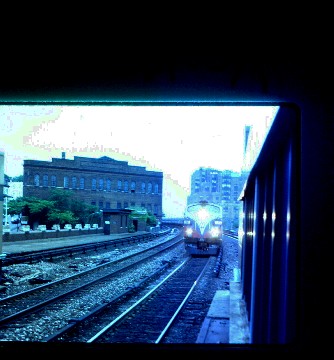
At Yonkers, I did a little railfanning, even catching a pair of Metro North FL9's. I took the mu'ed Metro North 782 back to Grand Central and saw many interesting and odd people on my trip back to the hotel where I called it a night.
New Jersey Transit/Metro North Riding 6/12/2001I awoke to a sunny day as I walked back to Penn Station to a New Jersey Transit ticket machine to buy a ticket to Newark on New Jersey Transit Train 3703.
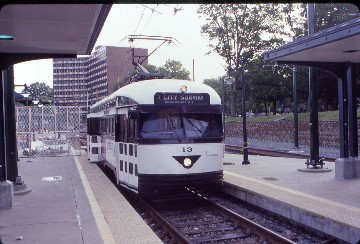
The trip was quick and at Newark's Penn Station, I followed the signs that led me to the subway which was still running with PCC cars. I rode a round trip and photographed the cars that we met on the return.
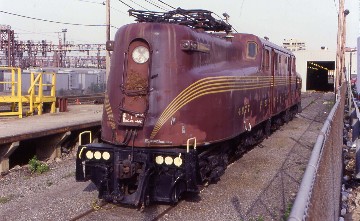
Next I took New Jersey Transit 2502 into Hoboken, where I photographed NJT trains and a GG-1 in Tuscan paint, then rode the joint Metro North/NJT 1 to Port Jervis, New York via the Bergen Line. Once out of New Jersey, the line was quite scenic and now I understood why Ross Rowland ran his High Iron Steam Trips over this line. We crossed over the Hudson Highlands, over a long high bridge and through a tunnel to reach Port Jervis on the shore of the Delaware River. The Erie depot still stood and there was an Erie caboose and turntable on display. I returned to Hoboken on Train 58 which went via the Main Line through Passaic, New Jersey.
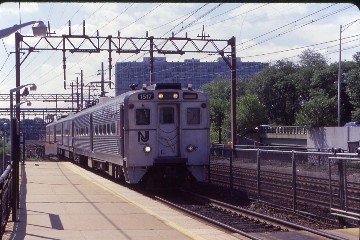
In order to get back to New York City more quickly, I took New Jersey Transit Train 425 to Broad Street station in Newark to wait for New Jersey Transit 6650, a Midtown Direct train which took me back to Penn Station. I dropped the camera off at the hotel before I took the subway to Yankee Stadium, where I watched the Montreal Expos win in the 12th inning on a Mark Shields' disputed home run. The return subway ride was uneventful and I received another good rest at The Herald Square Hotel.
Acela Regional 170 6/13/2001The next morning I was back at Penn Station waiting for Acela Regional 170 to take me to Boston but it took four electric locomotives. As the train arrived and after I boarded, the crew removed the engine that had brought the train from Washington, DC and replaced it. We left New York City an hour late and made it to the approach to the Hell Gate Bridge, where it was discovered that our new locomotive did not have cab signals needed to operate on this section of the Northeast Corridor. We sat and waited for a rescue engine as a southbound Acela Express passed us. We finally were underway and made it to New Haven, where engines 2 and 3 were cut off and the fourth and final engine added. Train 170 had no further delays and I detrained at Back Bay Station and walked to my new hotel in Boston, the Chandler Inn.
Boston 6/13/2001I returned to Back Bay then rode the subway from Copley Square to Kenmore, where I walked to Fenway Park and watched the Boston Red Sox lose to the Florida Marlins 4-2. I had always dreamed about seeing a game at Fenway Park and seeing the Green Monster up close, which I did by sitting in the center field bleachers. Who says that dreams do not come true? The ride back to the hotel was uneventful, and I watched the Los Angeles Lakers win Game 4 of the NBA Finals over the Philadelphia Seventy-Sixers. I enjoyed another good night's rest.
Acela Express 2153 6/14/2001Up early, I took the subway from Back Bay to South Station with no problems and waited to board Acela Express 2153. As I walked out to this new train, I showed the conductor my ticket and he sent me forward. Marty, my excellent Amtrak agent in Santa Ana, had booked me in first class without my knowledge and I was one happy train rider as I boarded. I had a single seat on the inland side of the train and noted that the seats were just the same as the Pacific Surfliner seats, so I felt right at home on the Acela. As the train pulled out, the food service started and did not stop until I detrained at Penn Station in New York, so I enjoyed a French Toast breakfast with all the tea and juice that I wanted then a newspaper was given and later, a hot towel to clean up after breakfast. In addition, the ride was smooth.
After Route 128 and the Canton Viaduct, our engineer opened up the throttle and it was announced that we were travelling at 152 mph, which is a new record for me. After Providence, I walked to inspect the Acela and it was a beautiful train, something Amtrak should take pride in, in the same manner as the employees who work on it. I then just sat back and enjoyed the ride. What a train! All too soon, we were arriving at Penn Station and I had to detrain but was already thinking of when I might return for another ride.
First Long Island Rail Road Trip 6/14/2001I took my luggage upstairs to the First Class Lounge then went down one level to the Long Island Rail Road ticket counter where I bought a round trip to Babylon, in search of Towers or Gates, which there were neither. This was my first ride on the Long Island and I was aboard an eight car multiple unit train. The trip was pleasant and I saw a new part of Long Island that I had not seen before. Jamaica was an impressive place with all of its station trackage. The route also goes through Amityville.
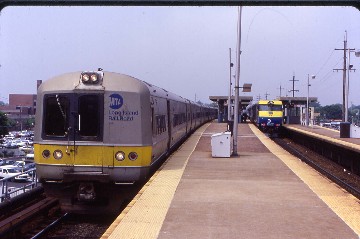
At Babylon, one can make a connection to a train out to Montauk, a line I will ride in the future. The trip back to Penn Station already had me thinking of other trips I could make on this railroad as I am always searching for new routes. I returned to the Metropolitan Lounge where I watched CNN and waiting for my next departure.
The Crescent 19 6/14/2001I rode the escalator down to Track 12 to board the Crescent to New Orleans in a Viewliner Room. My car attendant, Phillip Whitley, was also going to the NRHS convention and we hit it off really well. During the long stop in Philadelphia, he shared pictures he had taken over the years. I had Prime Rib in a rebuilt dining car as we cruised down the Northeast Corridor at speed then later, I turned in after Manassas and slept soundly all the way to Georgia.
6/15/2001 I enjoyed breakfast prior to the stop in Atlanta.
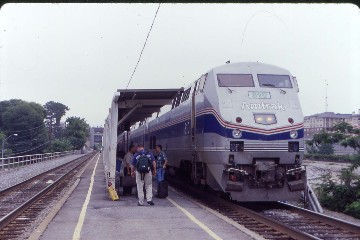
I enjoyed lunch before Birmingham. The in-room films that I enjoyed were "Castaway" and "Miss Congeniality" and the ride was quiet and restful. For dinner, I had a delicious New York strip.
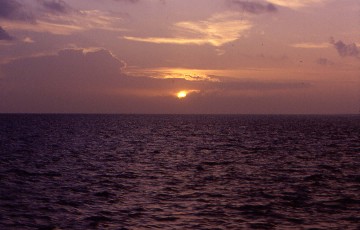
The scenic highlight of the route, a sunset crossing of Lake Pontchartrain. We arrived in New Orleans on time and a quick taxi ride to the Maison Street Quality Inn allowed me to watch the Los Angeles Lakers win the 2001 NBA Championship.
City of New Orleans 58 6/16/2001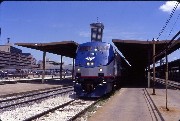
The following day found me back at Union Station as a 14 hour late Train 2, the Sunset Limited, was getting ready to leave. After it departed, I inquired about a room on the City of New Orleans and for $75, I had a room all the way to Chicago. I waited in the Magnolia Room and watched Tiger Woods struggle as he played golf then boarded Room 4 and sat back to enjoy the ride to Chicago. The tour guide's public address announcements went all the way through the train and since I had heard them before, my tape of "Guns and Roses Live" drowned it out. I enjoyed another steak for dinner before venturing back to the lounge car to watch "Miss Congeniality" again.
6/17/2001 I enjoyed another excellent night's rest before an early breakfast followed by a nap most of the way to Chicago.
Chicago 6/17/2001We arrived on time and I stored my bags in a locker then rode out to Forest Park on the CTA Blue line before returning, where I transferred to the Red Line and rode it in its entirety. I detrained at Addison Street on the return to go to Wrigley Field where I saw Sammy Sosa hit a home run and the Chicago Cubs beat the Minnesota Twins 5-4. I returned to Union Station and Gold Coast for a hamburger before taking Metra 1315 to Aurora, where I stayed at the Comfort Inn with a trackside room overlooking the BNSF mainline.
State House 303 6/18/2001I was up early for Metra 1304, an express train into Chicago followed by a MacDonald's breakfast. Amtrak 303 had four private cars on the rear which were bound for St. Louis and the convention. We departed on time but after Joliet, slowed for the first of many slow orders as the tracks were being upgraded for future high speed service. We followed the abandoned right-of-way of the Illinois Terminal Railway then as we neared St. Louis, the Gateway Arch dominated the city's skyline as we approached and entered town via the MacArthur Bridge.
St Louis 6/18/2001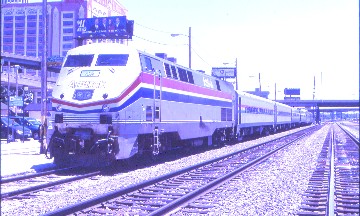
We arrived almost an hour late, and after a quick picture, a man and I walked to the Metro Link light rail line, boarding at Kiel Center and rode one stop to Busch Stadium. We walked around to the east side then one more block to the Millennium Hotel where my room was not yet ready. I picked up my NRHS registration materials, stored my bags and rode the entire Metro Link system, stopping at Union Station. Metro Link is a very nice and well-used system with the eastern part recently opened, which connects the airport with the downtown area and extends well east across the Mississippi River. That night, I went back to Union Station and saw "Tomb Raider" at the theater there.
NRHS Union Pacific 3985 Excursion to Gorham, Illinois 6/19/2001 A New Gateway to the Southwest: The St. Louis Valley RailroadUnion Pacific's Jefferson City Subdivision from Ewing Avenue to Gratiot Street: Leaving Ewing Avenue, we travel on the earliest route mileage built for the first common-carrier railway west of the Mississippi, the Pacific Railroad of Missouri, Missouri Pacific's earliest predecessor, and the oldest corporate constituent of today's Union Pacific system. Established in 1851 as the zenith of St. Louis' fervor to be the commercial mistress of the trans- Mississippi West, the Pacific Railroad began construction on July 4, 1851 near the later site of Union Station. We will pass this site, located near the 14th Street overpass across the tracks, a few minutes after leaving Ewing Avenue.
Terminal Railroad Association of St. Louis from MacArthur Bridge - Gratiot Street to Valley Junction, East St. Louis, Illinois: As we climb up out of the Mill Creek Valley and pass the site of the former Gratiot Tower, we enter trackage cross the MacArthur Bridge over the Mississippi River that, along with the bridge itself and the approaches, is today owned and operated by the Terminal Railroad Association of St. Louis (TRRA). However, until TRRA gained control of the bridge in 1989 in a swap for the TRRA-owned Eads Bridge, it was owned by the City of St. Louis, and operated by the city's municipally-owned railway.
Union Pacific Chester Subdivision - Valley Junction to Gorham: The line was constructed from 1901 to 1903 by the St. Louis Valley Railway, a company organized in 1901 under an Illinois charter to build a railway line down the Mississippi valley from near East St. Louis to a point in or near Cairo, Illinois. One of the two last major routes built from St. Louis as the great era of railroad building in the late 19th century came to an end, the line was backed by the Missouri Pacific through the St. Louis, Iron Mountain & Southern Railway, a company over which Missouri Pacific had virtually complete control. The new St. Louis Valley was conceived as a low-gradient, water-level route for freight that would avoid the Iron Mountain's original main line south from St. Louis to Arkansas and Texas. That line crossed the rugged crest of the Ozarks between St. Louis and Poplar Bluff, Missouri, and had many long, steep grades and considerable curvature to slow heavy freight trains.
The new water-level route down the valley was directed towards the mighty Thebes Bridge, planned to cross the Mississippi at the Thebes Gap, just south of Cape Girardeau. The only point south of St. Louis where the bluffs are close to both banks of the river, Thebes Gap allowed engineers Ralph Modjeski and Alfred Noble to build the huge new bridge without long, expensive approaches over the flood plain, such as we cross coming off the MacArthur Bridge. The result was a fixed-span bridge with low-grade approaches (0.5 percent) and totalling 2,750 feet in length with five alternating through cantilever and anchor systems supported on six concrete piers.
The St. Louis Valley Railway was completed to Thebes on November 1, 1903. The new Thebes Bridge was jointly operated by Missouri Pacific, Cotton Belt, Illinois Central and Chicago & Eastern Illinois, all of which had also reached Thebes. The bridge did not open until May 25, 1905, until then, St. Louis Southwestern (Cotton Belt) allowed the Valley and parent Iron Mountain to use its transfer ferry across the river between Thebes and Gray's Point, Missouri. In return, Iron Mountain granted Cotton Belt trackage rights over the St. Louis Valley for freight service in 1903, and for passenger service in 1904 (an important concession, allowing Cotton Belt to tap the 1904 World's Fair traffic). Before being absorbed into the Union Pacific in the late 1990s, Cotton Belt, itself a subsidiary of the Southern Pacific, continued to use this route and the freight trackage rights as its principal route to Texas and the Southwest.
The opening of the Thebes Gateway, strategically important as it would come to be, and the avoidance of the Ozark grades and curves were not the only reasons that Iron Mountain and parent Missouri Pacific saw to the construction of the Valley. Southern Illinois was experiencing a major boom in coal mining and the company wanted to share in the prospect of lucrative coal traffic. Such traffic was particularly attractive in being so close to a major consuming market such as St. Louis, and in having connections to the new markets to the Southwest via the new Thebes Bridge gateway.
The St. Louis Valley Railway was purchased in May 1903 by the St. Louis, Iron Mountain and Southern, and its corporate existence ended. Iron Mountain, whose close relationship with Missouri Pacific had been forged by legendary investor Jay Gould in the 1880s, became wholly a part of Missouri Pacific in May 1917 when both roads were combined into a new Missouri Pacific Railroad Company as part of bankruptcy reorganization proceedings for both companies. The route built by Iron Mountain through its St. Louis Valley company would remain an important part of Missouri Pacific's system, abundantly fulfilling all of the strategic potential planners, until and continuing after the merger with Union Pacific in 1981.
The above paragraphs taken from the NRHS 2001 Annual Convention Excursion Guide.I arose early and walked the two blocks to the Gateway Arch for my first close look at it. Returning to the hotel, I was on the first bus to the steam train which was waiting at Ewing Avenue. The consist was Union Pacific Challenger 4-6-6-4 3985, water car 809 "Jim Adams", water car 814 "Joe Jordan", tool car "Art Lockman", tool car "Howard Fogg", box car, commissary car "Sherman Hill", coaches "City of Salina" and "Portland Rose", dome-coach "Columbine", coaches "Katy Flyer", "Pony Express" and "Sunshine Special", dome-coach "Challenger", coach "Texas Express" generator car 208 and theater car "Idaho".
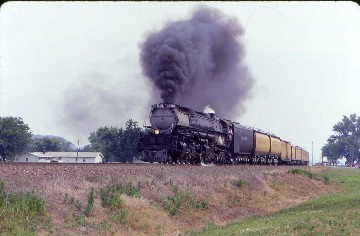
We departed on time at 9:00 and were well-photographed as we proceeded east through town to the MacArthur Bridge and turned south at Valley Junction. Illinois was the sixth state in which I had ridden behind Union Pacific 3985. Once passed Dupo at Milepost 6.2, it was possible to see where the Mississippi River has flooded over the years. At Milepost 22.5, we passed through Valmeyer, a town that was relocated two miles east after the 1993 flood and its old location is a virtual ghost town. North of Chester at Milepost 62.5, we paralleled the river and stopped here for photo runbys.
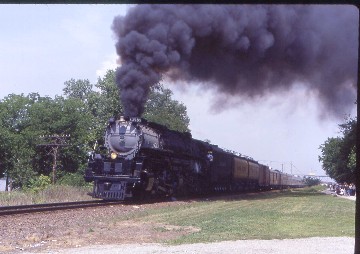
One of the photo runbys at Chester with excellent smoke. From here we ran to Gorham, where passengers were allowed to detrain into the heat and humidity, while I stayed onboard as the train was wyed.
On the return journey, we stopped for a photo runby at Valmeyer in perfect light. The Union Pacific and their train was outstanding and all passengers had an excellent time. We arrived in St. Louis on schedule at 5:30 PM and were bussed straight back to the hotel for a well-deserved rest.
NRHS Wabash, Frisco and Pacific Live Steam Railroad and National Museum of Transportation Trip 6/20/2001Another early start, we were bussed to the Wabash Live Steam Railroad which was built along part of the original Pacific Railroad right-of-way. The story of the Wabash Frisco and Pacific Railroad dates back to 1939, when a group of railway enthusiasts acquired a 12-inch gauge steam locomotive, 171, and the use of a 30 acre estate located on the southeast corner of Brown Road and Natural Bridge. The railroad developed to the point where it had a half mile of track, four steam locomotives, a telegraph system, a telephone communication system between stations, and an electric-pneumatic signal system. Trains were operated by regulation timetables, and train orders governed them just as our standard gauge counterparts.
Because of rising land values adjacent to St. Louis' Lambert Airport, the railroad was forced to move, and its last run was conducted on July 19, 1959. The railroad, and all its equipment, was put into storage for two years while the association looked for a new home. Eventually, the WF&P relocated to Glencoe, Missouri (Wildwood) in 1961, where much of the WF&P was rebuilt on top of and along the recently abandoned Missouri Pacific Railroad right-of-way.
Since that time, we have laid more than a mile of track, built numerous buildings, including the car barn in 1976, and the roundhouse in 1992. We are constantly in the process of rebuilding locomotives, cars, expanding track length, and maintaining all of the facilities necessary for the operation of the railroad.
Our train was double-headed due to wet conditions from the previous night's rain and a third helper was used. The trip was two miles following the Meramec River along a bluff through virgin Missouri forest. The train was wyed at the end of the line and we returned to the bus, which took us to the National Museum of Transportation to view their extensive collection of railroad equipment.
National Museum of TransportationThe National Museum of Transportation is a private, 42-acre transportation museum in the Kirkwood suburb of St. Louis. Founded in 1944, it restores, preserves and displays a wide variety of vehicles spanning 15 decades of American history: cars, boats, aircraft and in particular, locomotives and railroad equipment from around the United States. The museum is also home to a research library of transportation-related memorabilia and documents. At the southwest corner of the property is West Barretts Tunnel. Built in 1853, it is one of a pair of tunnels that were the first to operate west of the Mississippi River. It was added to the National Register of Historic Places in 1978. The museum has its own railway spur to an active main line formerly owned by the Missouri Pacific Railroad, now by the Union Pacific Railroad. This has allowed the museum to take possession of large and unusual pieces of railroad equipment. A miniature railroad operates around a loop of track near the parking lot and a full-sized restored trolley operates Thursday–Sunday from April through October.
The Museum was founded in 1944 by a group of historically-minded citizens who had acquired the mule-drawn streetcar "Bellefontaine". In 1948, the Transport Museum Association incorporated as a non-profit educational organization to better serve the financial and volunteer needs of the Museum. Land was acquired on Barrett Station in St. Louis County, along the right-of-way of the historic Missouri Pacific Railroad, and over the years, the mule-drawn streetcar was joined by hundreds of other significant exhibits. On September 1, 1979, the St. Louis County Department of Parks and Recreation formally assumed the operation and development of the Museum, accepting it as a gift from the original founders in February 1984.
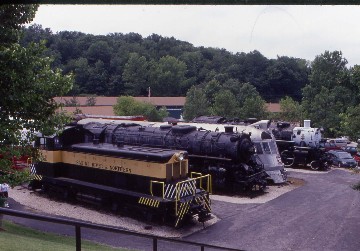
They have 24 steam locomotives, 28 diesel/gas, 10 electric locomotives, 30 passenger cars and 24 freight cars, all of which were very impressive. I rode the streetcar and their miniature train then everyone was returned to the hotel and I took Metro Link to Union Station to photograph the RailCruise America Dinner Train prior to the convention event departure for De Soto. On my way back to the hotel, a good thunderstorm occurred and I used my umbrella for the only time on this trip, walking to Busch Stadium where Sammy Sosa hit a pair of home runs, one being a Grand Slam, as the Chicago Cubs beat the St. Louis Cardinals before I returned to the hotel for the night.
NRHS Frisco 1522 Trip to West Quincy 6/21/2001St. Louis-San Francisco 4-8-2 1522 was built by Baldwin in 1926 as a coal-burner and was converted to oil in the 1930's then retired in 1951.
In 1985, the St Louis Chapter of the NRHS was meeting in the lower meeting room at Boatmen's Bank in Webster Groves. At the October meeting, during the "new business" portion, it was announced that a group had begun restoring Frisco steam locomotive 1522 at the Museum of Transport (MOT). Having done a cosmetic restoration of Norfolk and Western steam locomotive 2156 for the dedication of the recently re-developed St. Louis Union Station, the group had just received permission from the MOT to restore 1522. This was the beginning a 17 year association between the Chapter and the 1522 group. The relationship was to prove very profitable and worthwhile to both groups.
1522's initial restoration to service took 33 months, and in that time interval several Chapter members joined the 1522 group, and vice-versa. Updates on 1522's progress were a monthly event at Chapter meetings. During that time, the 1522 group formed a 501(c)(3) Not-For-Profit-Corporation, the Saint Louis Steam Train Association, typically referred to as the SLSTA. Officers and a Board of Directors were elected. The 1522 was formally leased from St. Louis County by the SLSTA. At the March 4, 1987 Chapter meeting, the Chapter voted to donate $3000 to 1522's restoration.
By May 1988, 1522 was ready to roll. On May 4, the engine moved via Union Pacific from the MOT to St. Louis Union Station for a dedication ceremony on May 7. It would be hard to overstate the significance of 1522's move on Union Pacific. At that time (and continuing to the present) UP has had a policy of no steam but their own. It speaks highly of the reputation of the SLSTA, the MOT, and the Chapter, that UP made this unofficial exception for 1522 for over fifteen years.
In the latter 1980's the Norfolk Southern steam program was very active. The Chapter had chartered trips using NS steam locomotives, but now there was a home-town favorite. A round-trip excursion from St. Louis Union Station to Decatur, Illinois on NS was scheduled for October 22, 1988, using 1522 for motive power. The trip was a success, although it returned quite late. Thus began 15 years of collaboration between the SLSTA and the Chapter in running trips. The schedule for the NS steam excursions for any given year was often put together at the annual meeting of the Railway Passenger Car Alliance held every January. Chapter and SLSTA members became fixtures at these meetings, and it was assumed that the Chapter would do another NS trip with 1522 in 1989. However, since the Decatur trip, the SLSTA had put new brass side rod bearings on 1522. NS said that before offering the Chapter a trip, they would require a break-in trip for 1522 to ensure the engine would perform reliably. The SLSTA responded that they would like the opportunity to do a break-in trip, and when would NS like to do it? NS replied that, despite their requirement for a break-in trip, they would not offer to operate it.
This was a major hurdle to overcome. Why would any railroad offer a shake-down trip to facilitate an excursion on another railroad? Despite moving 1522 from the MOT to Union Station, UP still had the no-steam-but-their-own policy. Burlington Northern at the time was very anti-steam. They had recently refused to move steam for big events in other locations despite much political pressure. In fact, following a Transport Museum Association Board Meeting at the MOT during 1522's restoration, a retired CEO of BN was shown the locomotive under overhaul, and said, "Great job, but it will never run on BN." But, for lack of any alternative, the SLSTA sent a letter dated March 29 to the current BN President requesting a break-in trip. Amazingly, on April 5, BNSF said it would consider the proposal favorably, and a break-in trip was hastily arranged. BN requested no publicity so it was a stealth move. 1522 crew members were only told to come to Union Station on the evening of April 28. The engine moved to the former Frisco Lindenwood Yard, and about 10 PM the 1522 departed under cover of darkness with a 28 car train for Valley Park, Missouri. The train was turned on the wye and returned to Lindenwood where 1522 dropped off the cars. Then 1522 returned to Union Station successfully 'broken in' with no problems. This led to 1522 being approved to power the Chapter's trip to Moberly, Missouri on NS on May 27, 1989. Perhaps, more importantly, it indicated the BN would consider future operations of 1522. But bigger plans were already in the making.
The Chapter had been given the nod to host the 1990 NRHS National Convention, headquartered at St. Louis Union Station. An ambitious gathering of steam locomotives was arranged, including UP 844, NS 1218, Cotton Belt 819, and of course Frisco 1522. Again, the solid relationships among the Chapter, SLSTA, and the railroads paid off. BN approved a round trip with 1522 to Newburg, Missouri, and NS and UP both permitted their passenger equipment to be used off-line on BN. On June 16, 1522 hauled the Newburg trip and most people agree it was the highlight of the Convention. As an extra bonus the following Monday, 1522 was cut in behind the 844 on the UP's outbound Convention trip to Kansas City, with 1522 being set out at the MOT following a run-by at Webster Groves.
The euphoria following the Convention was dampened a few months later, however, when 1522 suffered an overheated pilot truck bearing in October while enroute to the Twin Cities to power an excursion. The engine limped home, and the SLSTA quickly began considering converting the pilot truck axles from solid to roller bearings. One by one the engineering challenges were worked out, but the conversion would require entirely new wheels, axles, bearings, and bearing boxes. This would come at a steep price, but the Chapter rallied for their home-town favorite steamer and in June 1991 voted to donate $8000 to help with the work. The Chapter appointed a Monitoring Committee to keep track of progress on the bearing conversion. At the July 10, 1991 Chapter meeting, several members of the SLSTA and the Monitoring Committee addressed the Chapter, and the Chapter voted to increase the total donation from $8000 to $19,000. Then, at the September 4, 1991 Chapter meeting, the members voted to donate, if needed, an additional $5000 to cover the cost of fuel for a break-in trip. Also, a member of the Chapter Executive Committee was elected to the SLSTA Board.
The bearing conversion took up most of 1991, but by October 1522 completed several break-in trips on BN to validate the new work. Unfortunately the break-in trips occurred too late to schedule any 1991 excursions on NS. It should be noted that Chapter members who owned private rail cars were very generous in allowing their equipment to be used on break-in trips for 1522 as well as public excursions operated by the Chapter. Former Frisco sleeper Cimarron River and lounge Chouteau Club were fixtures on many of these trips.
With 1522 healthy again, NS approved Chapter trips for June 27 and 28, 1992. These trips ran from the NS Luther Yard over to the old Nickel Plate line to Coffeen, Illinois. This Nickel Plate route was now a secondary main line for NS, and maximum speed was limited to 25 MPH. Some thought the low speed might make for a boring trip, but to the delight of the passengers, the leisurely pace was enlivened by no less than seven runbys.
In November 1992, the Chapter hosted excursions on UP on November 7 and 8. Many SLSTA volunteers helped in staffing the trains. This helped SLSTA members learn about the on-board complexities of running excursions and strengthened the SLSTA-Chapter partnership. 1993 dawned with the Chapter being offered another NS trip with 1522, this time from Luther Yard to Centralia, Illinois on June 5 & 6. The Chapter was already committed to operating trips to and from the National Convention in Chicago a few weeks later, but decided there was enough will power in the group to do the NS trip.
NS had no means to turn the train or locomotive in Centralia, so after the passengers detrained, the train proceeded south on the BN to Sesser, Illinois, where it was wyed and returned to Centralia. BN employees and families were allowed to ride the train on the move to Sesser. Once again, good relations with the NS and also BN made this whole trip possible. Perhaps the pinnacle of mutual benefit and cooperation between the Chapter and SLSTA occurred in 1994, when the Chapter operated the first two days of a four day inbound trip to the 1994 NRHS Convention in Atlanta. In a rather non-typical turn of events, the initial request to BN for a trip as far as Birmingham, Alabama originated from the Chapter already in May of 1993, with BN approval coming a few months later. This resulted in the unusual situation where the trip was approved even before the Chapter had committed to operate any segment. In fact, the original assumption was that the route would be down the BN River Subdivision through Cape Girardeau, but there was sentiment within the Chapter to run via Springfield, Missouri, which added another day. BN approved this as well. Moreover, the NS designated the SLSTA as the sponsor of the entire four day inbound trip, regardless of which group was operating the trip and selling tickets. The fact NS would allow their trainset to run off their railroad for four days, three of them on BN, again speaks volumes about those railroads' regard for the Chapter and the SLSTA. The Chapter operated the first two days, from Union Station to Springfield, MO; and Springfield to Memphis. Other groups handled the third and fourth days from Memphis to Birmingham, Alabama and Birmingham to Atlanta.
One complication of the trip was that when the train was operating on NS, that railroad would not permit cars in the train that were not painted Tuscan Red. This meant that SLSTA support cars Firefly and Black Gold could not be in the train past Birmingham. The 1522 crew had to rent a truck to carry support tools and supplies while 1522 operated on the NS. BN also handled the return of 1522 and its support cars from Birmingham to St. Louis via Memphis and Cape Girardeau. The 1994 Convention trips were very lucrative for the Chapter and SLSTA.
The Chapter and 1522 had by this time handled trips under the NS excursion program for seven years, and there seemed to be no reason why this relationship would not continue. But the railfan community was stunned a few months after the Atlanta convention when word came from NS that they would be discontinuing their excursion program. Moving on into 1995, SLSTA personnel assisted Chapter volunteers in reconnecting the track next to the Abbott Shed at the MOT. But no Chapter trips were run with 1522 for several years, although, the 1522 stayed active traveling to various events on BN (now the Burlington Northern Santa Fe (BNSF) after their merger). The lack of a trainset was a big deterrent to any kind of public excursion. However, in response, the Chapter purchased ex-Amtrak coaches Silver Maple and Silver Larch at a major Amtrak auction at Beech Grove, Indiana. A 'road test' of the cars was arranged on 1522's annual shake-down trip on July 5, 1996, and the cars rode well on the round trip to Newburg, Missouri on BNSF.
Unfortunately 1522 had more bearing problems and was out of service for large periods of time in 1997 and 1998. At the June 1998 Chapter meeting, the membership voted to approve up to $15,000 for repairs to 1522. This amount was not given in a lump sum, but was distributed as invoices for work were submitted. But, on the first trip following lengthy repairs, the engine derailed on BNSF in North St. Louis in June of 1999. The resulting damage required much of the work to be done over. Finally in June 2000 the 1522 was ready to roll, with the trailing truck axle and all six axles of the tender converted to roller bearings.
In the meantime, there were suggestions that Amtrak might consider operating steam-powered public excursions, using their operating authority on the railroads. There were challenges, including the fact that Amtrak inspectors had to approve any non-Amtrak coaches, as well as any steam locomotives. In response, the SLSTA invited Amtrak inspectors to observe the 1522's overhaul throughout 1998. Fortunately 1522's support cars Firefly and Black Gold had been rebuilt to Amtrak mechanical standards and certified by Amtrak inspectors. Ultimately the rebuilt 1522 was inspected and approved by Amtrak. A request was made for a trip to Hannibal on BNSF, which was approved. The Chapter put together a train and scheduled trips to Hannibal and West Quincy for September 30 - October 1. This was the first steam-powered excursion operated by Amtrak. Again, the Chapter and SLSTA can be proud of this pioneering achievement.
Everything started out well on the Saturday trip, but as the train headed north along the Mississippi River, word came that there had been a landslide in the St. Louis suburb of Spanish Lake. A southbound BNSF freight had struck the slide and derailed, totally blocking our train's return to St. Louis! Chartered buses were lined up to take the passengers back to St. Louis, and the Sunday trip was cancelled. 1522 and the excursion train were stored in a siding south of Hannibal. On Monday, October 2, a skeleton crew went up to Hannibal and brought the engine and train back to St. Louis. Although the trip interruption and cancellation were a big disappointment, the Chapter and SLSTA handled the situation expertly and professionally.
Connecting Western Gateways: A History of the "K Line"The route of our trip today, which was completed by the St. Louis, Keokuk & Northwestern Railway, also known as the "K Line", figured prominently in the history of railroad development in Missouri and was responsible for much of the growth enjoyed by Hannibal, Missouri. In the middle of the 19th century, railroad fever swept through the gateway towns along the Mississippi River. Each major river city - St. Louis and Hannibal, Missouri, Quincy and Rock Island, Illinois and Burlington, Iowa, aspired to be the Gateway to the West. Local business interests in each of these cities organized railroads on their own or lent financial support to lines which were already under construction and were building in their direction.
Among the first railroads to be chartered was the Hannibal and St. Joseph, by act of the Missouri Legislature in February 1847. Right-of-way surveys and fundraising activities were conducted during the late 1840s, but it was November 3, 1851 before this railroad turned the first shovel of earth for the ground-breaking ceremony in Hannibal. Financing was slow and difficult to obtain. It was 1856 before the road completed its first 15 miles of track from Hannibal to the county seat at Palmyra. The 206-mile railroad celebrated its "golden spike" completion ceremony at Cream Ridge, near St. Joseph, Missouri on February 13, 1859.
The major claim to fame for the Hannibal and St. Joseph was that it carried the first Pony Express mail to St. Joseph in 1860, from whence it was turned over to the intrepid relay riders who carried it to the West Coast. It also pioneered the use of Railway Post Office cars in 1862, in which mail was sorted en route between stations.
The Civil War disrupted and delayed further railroad construction. But during the decade after the war, the Hannibal and St. Joseph expanded, extending lines to Kansas City, Missouri and Atchison, Kansas and a short extension northeast from Palmyra to Quincy, Illinois. Five other railroads converged on Hannibal during that period. Among them was the St. Louis, Keokuk and Northwestern Railway. The K Line was originally organized as the Mississippi Valley Railroad at Hannibal on June 9, 1871. About the same time, Clarksville businessmen incorporated the Clarksville and Western Railroad. In January 1873, the two railroads were consolidated as the Mississippi Valley & Western. Its first segment of road between Keokuk and Quincy, 40 miles, began operation January 1, 1874, followed by an extension from Hannibal to Mark, Missouri (four miles south of West Quincy) which opened for business on March 9, 1874. It operated three trains daily each day between Quincy and Keokuk. The road defaulted on its mortgage, however, and was sold under foreclosure early in 1875. The company emerged from reorganization on July 1, 1875 as the St. Louis, Keokuk and Northwestern Railroad.
On May 29, 1876, the line was completed to Louisiana, Missouri, 25 miles south of Hannibal. It then had 85 miles of line in operation between Keokuk and Louisiana. The next link completed was to Clarksville, 10 miles and thence to Elsberry, 16 miles further. The line was completed to St. Peters, Missouri on August 11, 1879 and opened for business along its entire 135-mile route a month later.
The above paragraphs taken from the NRHS 2001 Annual Convention Excursion Guide.The wake-up call never came and at 7:10 AM, I raced downstairs for the last bus to the Frisco 1522 train at the Amtrak station. When we arrived, it was pouring rain so I took cover under the station's roof and everyone waited for the Kansas City Mule and the Texas Eagle before our train of private cars arrived then reversed into the station. It was a mad dash to get a seat and a chose "Mohave", a former Union Pacific coach.
This train had a consist of St. Louis-San Francisco 4-8-4 1522, tool car "Black Gold" PPXCX 800608, baggage car "Firefly" PPCX 800098, sleeper "Cimarron River" PPCX 800069, coaches "Mohave" PPCX 800651, "Echo Canyon" PPCX 800725, Amtrak 54550, commissary car PPCX 800644, coaches "Clinchfield" PPCX 800402, "Powhatan Arrow" PPCX 800403, New York Central 38 PPCX 800655, lounge cars "Pine Tree State" PPCX 800256, "Dover Harbor" PPCX 800073, "Kitchi Gammi Club" PPCX 800705, "Chouteau Club" 800131, dome cars "Mississippi River" PPCX 800200, "Columbia River" PPCX 800031, "Silver Solarium" PPCX 800335 and Amtrak B32-8WH 511.
We departed 45 minutes late and proceeded out of town passing through the tunnels by the Arch on BNSF's Hannibal Subdivision to West Quincy. The rain continued but did not slow the chasers who were out in force. It was amusing watching the people chase our train and you could tell when we were close to another shower by watching them frantically roll up their windows. We crossed the Missouri River at Milepost 18.8 on the Baltimore through-truss Bellefontaine Bridge built in 1893 and soon the Mississippi River came into view; this line was closed until last week due to flooding.
Frisco 1522 was the loudest steam engine I had heard. The rain stopped at White Rock before we arrived at Hannibal at Milepost 119.7, where everyone could detrain while the engine was serviced. Once on the move again, we continued north to West Quincy where the steam engine and train were turned on the wye and I finally made it to West Quincy. I had ticketed to here on the Illinois Zephyr in 1993 but never made it due to that year's flooding. We started the trip back to St Louis.
There was a double photo runby performed at Ilasco, Missouri, Milepost 116.6, and near sunset, we waited for a freight at Dundee. From there, it was a night-time excursion back to St. Louis, arriving three hours late. Four of the buses had died on the service laws so I repeated my first journey to the hotel, using Metro Link, and I was well asleep before the rest of the group returned after a very fun day and night riding behind Frisco 1522.
NRHS 2001 Convention Meeting Day 6/22/2001Friday was my planned rest day and I slept late, went to a seminar on the Terminal Railroad Association of St. Louis presented by Mr. Larry Thomas then rode Metro Link to Riverfront Station. Walking down a road, I found a Cargill locomotive and a QWest Construction train. I returned to the hotel and attended the Missouri-Kansas-Texas seminar by Mr. Raymond George then went to the Arch since I had a ticket for the 12:45 tram to the top that I bought online. I was allowed to go up early and what an incredible view I had. Everyone who visits St. Louis should go to the top of the Gateway Arch. Once back on the ground, I noticed pools of water and walking to the south end of one, it was indeed what I thought - a reflective pool of the Arch. I returned to Union Station later in the day before going back to Busch Stadium for the St. Louis Cardinals vs. the San Francisco Giants, which including another grand slam by the Giants and a home run by Mark McGwire for the Cardinals then back to the hotel for another full night's sleep.
NRHS Frisco 1522 Excursion to Newburg, Missouri 6/23/2001 The Other Route West: To The Pacific Along the 35th ParallelThe route of today's excursion on BNSF's Cuba Subdivision began its life as the South-West Branch of the Pacific Railroad of Missouri, the first common-carrier railroad west of the Mississippi River. Chartered by the Missouri Legislature on March 3, 1894, to build a railroad from St. Louis to the Kansas border and on to the Pacific coast, it was completed to Kansas City in 1865. Eventually, it built as far as Colorado under the name of Missouri Pacific Railroad. The South-West Branch was included in the Pacific Railroad's charter as a line to reach from St. Louis into the rugged rural areas of southwestern Missouri. More importantly, it was envisioned as a connecting route to the proposed transcontinental railroad route along the desolate 35th parallel through the range and desert areas of the Southwest to California.
Construction of the Pacific Railroad began in St. Louis on July 4th, 1851, when St. Louis mayor Leuther Kennett broke ground just south and east of where Union Station now stands. By the next year, the road was operating passenger service to Cheltenham, five miles to the west. In 1853, the railroad reached Franklin (today known as Pacific), 37 miles southwest of St. Louis. While the Pacific Railroad continued on toward Kansas City, the South-West Branch began building from Franklin in 1855. Numerous financial problems plagued the project and by 1859, only 61 miles of track had been laid on the South-West Branch. Finally in December 1860, the same month that South Carolina seceded from the Union, the railroad reached the new town of Rolla. The first train steamed into town amid great fanfare and expectation on January 1, 18661. However, construction beyond Rolla would not take place until after the Civil War.
The Civil War strained the Pacific Railroad both physically and financially. Considerable fighting took place along the South-West Branch and it suffered heavy damage. During one raid, all the wooden bridges on the line were burned by Confederate troops, including both bridges across the Meramec River west of Franklin. By the end of the war, the Pacific Railroad was bankrupt. In February 1866, the State of Missouri, as largest bond holder, took foreclosure possession of the road, including the South-West Branch. In June 1866, the state sold the South-West Branch to General John C. Fremont, a famous western explorer and Republican candidate for President in 1856. Fremont proposed to continue the South-West Branch to Springfield, Oklahoma City and on to San Francisco. Renaming the company the Southwest Pacific Railroad, Fremont managed to lay twelve miles of track from Rolla to Arlington, Missouri down the rugged grade of Rolla Hill before the road defaulted on the second payment to the state in June 1867.
One year later, on June 15, 1868, the State of Missouri deeded the Southwest Pacific to the new South West Pacific Railroad Company, which in 1870 completed the route from Arlington over Dixon Hill toward Lebanon, and from Lebanon through Springfield to Peirce City (later Pierce City) in the far southwestern corner of the state. In October 1870, the road was sold to the Atlantic and Pacific Railway Company, created by an Act of Congress in 1866 to build via the 35th parallel route from Springfield to the Pacific coast by way of a connection with the Southern Pacific at the Colorado River near Needles, California. In addition to the vast land grants, one of the key assets of the A&P was its promise from the government to settle matters of right-of-way through native American lands, particularly in the new Indian Territory (later Oklahoma) The Franklin-Springfield-Pierce City segment became known as the Missouri Division of the A&P. For its part, the A&P itself in 1871 built westward from Pierce City to the Indian Territory border and continuing in the Territory thirty-seven miles to Vinita.
Like its predecessors, the A&P was also plagued with financial difficulties. On September 8, 1876, with the A&P in bankruptcy since the previous year, the Missouri Division (less then 37 miles in Indian Territory, which remained as the A&P) was sold at auction to the newly-formed St. Louis and San Francisco Railway company. At the same time, the Pacific Railroad, which had also been under the control of the A&P, was sold to a separate entity from St. Louis, which reorganized it as the Missouri Pacific Railroad Company. Thus, both parts of the original Pacific Railroad of Missouri were separated permanently, and the corporate names they would hold for the next century, were established.
With the severing of ties with the Missouri Pacific in 1876, the new SL&SF faced an immediate problem. Since the construction of the Pacific Railroad, the lines from St. Louis to Franklin (Pacific) was used by both the Pacific Railroad and the South-West Branch and its successors. But now the Frisco, as the new SL&SF came to be called, was forced to use the tracks of the Missouri Pacific at high cost. In 1877, Frisco paid 16 percent of its operating costs for the use of the St. Louis-Pacific segment, which was but 11 percent of its system. After Missouri Pacific refused to lower the charge, Frisco built its own line into St. Louis in 1883, paralleling the MP's original line. The line included a tunnel, Frisco's only one in Missouri, to cross the divide between the River Des Peres and Meramec River watersheds. This new line completed construction of what became today's Cuba Subdivision, and is our route today from our departure point to St. Louis to Pacific.
The above paragraphs taken from the NRHS 2001 Annual Convention Excursion Guide.My final full day in St. Louis started early once more and the bus took me to the Amtrak station, where we learned that the Texas Eagle would not be a problem as it was five hours late. The Kansas City Mule departed on time and Frisco 1522 and train reversed passed the depot before pulling into the station. The second mad dash in as many days found me in the same car, "Mohave" while it seemed that everyone was going to the Amtrak Horizon car.
This train had a consist of St. Louis-San Francisco 4-8-4 1522, tool car "Black Gold" PPXCX 800608, baggage car "Firefly" PPCX 800098, sleeper "Cimarron River" PPCX 800069, coaches "Mohave" PPCX 800651, "Echo Canyon" PPCX 800725, Amtrak 54550, commissary car PPCX 800644, coaches "Clinchfield" PPCX 800402, "Powhatan Arrow" PPCX 800403, New York Central 38 PPCX 800655, lounge cars "Pine Tree State" PPCX 800256, "Dover Harbor" PPCX 800073, "Kitchi Gammi Club" PPCX 800705, "Chouteau Club" 800131, dome cars "Mississippi River" PPCX 800200, "Columbia River" PPCX 800031, "Silver Solarium" PPCX 800335 and Amtrak B32-8WH 511.
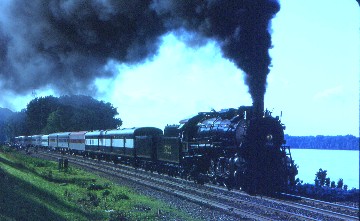
We departed on schedule at 8:00 AM, reversing then pulling forward and slowly moved to Lindenwood Yard before picking up speed. We passed the depot at Webster Groves then crossed the Meramec River four times in the next twenty- eight miles. At Allentown, Milepost 29.5, we passed a Six Flags Over Mid-America Theme Park. At Rook, Milepost 44.0, Frisco 1522 performed a double runby then at Milepost 74.4, we travelled through the town of Bourbon, which used to be one of my favourite drinks back in my drinking days, and at MP 86.8, passed through Cuba, the town which gives this subdivision its name and began as a farming village and shipping point in 1857. At Rolla, Milepost 110.7, we passed sister engine Frisco 4-8-2 1510 on display before descending the west side of Rolla Hill into Newburg. We continued to Bundy Junction, Milepost 121.5, where the train was wyed for the return trip. Passengers were allowed to detrain in Newburg while the servicing of the locomotive took place.
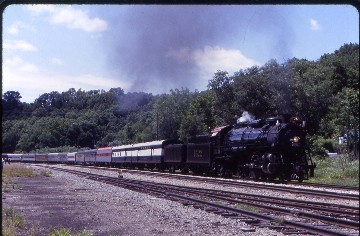
That gave me time for an ice cream cone before the third runby occurred and everyone reboarded. The climb up Rolla Hill was spectacular and the sound of the engine even more incredible as it echoed through the cuts and off the surrounding hills. The vestibules were overflowing with passengers, so much so that an Amtrak official could not make his way through the train and ordered all the top dutch doors to be shut for the reminder of the excursion. We were running so far ahead of schedule that another double photo runby was held in Lindenwood Yard on the shady side, as had been done during the Norfolk Southern steam trips. We still arrived in St. Louis early and with the bus ride back to the hotel, the 2001 NRHS convention ended. I went to bed right away as I had a 4:25 AM train to catch to Chicago.
State House 300 6/24/2001With three missing wake up calls, poor elevator service and a call last night to the front desk advising them of my 3:15 AM departure, one would have thought my bill would be ready. However, that was not the case and the front desk did not even have my last night's stay ready. The only positive about this hotel was its location. I took a taxi back to Amtrak and boarded a Horizon coach, where I slept until Springfield and from there, I just watched the Illinois countryside pass outside my window. The train was subject to many slow orders and arrived in Chicago fifty-five minutes late.
The Journey Home 6/24/2001I went to Gold Coast for a Char steak sandwich before walking back to the CTA Blue Line stop on Clinton for the ride back to O'Hare International Airport to board an American Airlines flight for the most bumpy flight of my aviation career back home to Orange County Airport where my friend and webmaster, Jeff Hartmann, picked me up and took me home.
| RETURN TO THE MAIN PAGE |