




I planned my Spring Break getaway to cover one of the last two VIA Rail routes I had not yet ridden, the Malahat from Victoria to Courtenay on Vancouver Island. I used my Alaska Airlines miles for a room for two on the Coast Starlight to Seattle and coach on Amtrak Cascades to Vancouver. I called VIA Rail for a ticket on their train and they sent it in the mail then chose Pacific Coach Lines to get me to Victoria since they depart from Pacific Central Station where Amtrak Cascades arrives. I picked Swans Inn in Victoria which just happened to overlook both the VIA station and Victoria's Inner Harbour.
With all that set, I looked for someone to travel with and asked a colleague of mine at McFadden Intermediate, Marilyn Myers, friends Anna Mandalin, Jeff Hartmann and then Bill Beale, my one-armed friend from the San Diegans. With a couple of planning dinners with Bill, it was only days before this trip began.
San Diegan 769 4/14/2000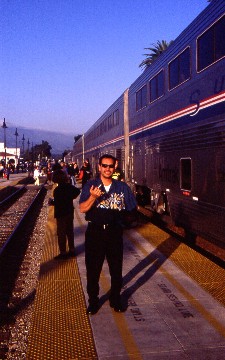
The train of California cars arrived at Santa Ana on time but the sticking brake shoes on the cab car took twenty minutes to repair and I hoped that this was the only delay for this trip. We made our way to Fullerton, where Bill joined me for the quick run to Los Angeles. Arriving there, I saw the Southwest Chief but no Sunset Limited, which I learned was over four hours late. There would not be any coastal views for those unfortunate passengers, just a bus ride and a train ride down the scenic San Joaquin Valley to Martinez for them to connect to our train.
The Coast Starlight 14 4/14/2000I led Bill to the sleeper "Tennessee" and upstairs to Room 5 and he was blown away by the room and when he had his first look at the Pacific Parlour Car, was even more amazed, just as I was on that trip to Eugene with Bruce Fenton in 1997. The Starlight left on time and after Oxnard, we sat down to lunch with a couple from Alaska, sharing conversation as the Pacific Coast rolled. I was glad that I had packed my umbrella as at Santa Barbara, it was pouring rain and during the fresh air stop, I explored the remodelled station. North of Santa Barbara, we sat in the big plush chairs of the Parlour Car as far as Jalama Beach, where we went downstairs to the theater to see Robin Williams in "Bicentennial Man".
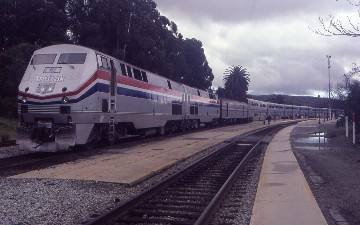
San Luis Obispo was a fresh air stop then it was another enjoyable trip over Cuesta Grade with racing tanks at Camp Roberts when we flew by. For dinner, I had my usual steak with a turtle cake for dessert and Bill had the equally good salmon. We stopped at Salinas, another fresh air pause and I explored the depot followed by more Parlour Car views until Gilroy, where it was back to the theater for the Bond film "The World Is Not Enough!" I stepped off for more fresh air at Oakland before calling it a night at Martinez.
4/15/2000 The next morning I arose at Black Butte and had breakfast on the north flank of Mount Shasta although the peak was hidden by the many clouds but they only added to the beauty looking northwest. I was asked if anyone lives out there and my response was "Population Zero!", unlike the thousands per square mile back home in Santa Ana. We had lost an hour during the night but when we arrived in Klamath Falls, we were only forty minutes late and I knew that by Portland, we should be back on time. Stepping off the train, the cold air felt good and we would not have any colder temperatures during the rest of the trip.
Upper Klamath Lake passed too quickly and we made the quick run to Chemult. I had hoped for snow over Cascade Summit and by Odell Lake, my wish came true as the summit area was still covered and a few new flakes were falling. I enjoyed the descent down the west slope as far as the Salt Creek Bridge, where I napped to almost Springfield then at Eugene, we left someone behind who had been on the train and had to be bussed to Portland, where they took the Amtrak Cascades to their final destination. From Eugene to Seattle, I enjoyed the Pacific Parlour Car with the exception of a walk in Portland and another wonderful dinner. We passed the remains of the imploded Kingdome just before an early arrival at King Street Station in Seattle. It had been an excellent Starlight trip and Bill and I took the first taxi out of the station to the Kings Inn for a well-deserved night's rest.
Amtrak Cascades 760 4/16/2000
Amtrak Cascades, named after the Cascade mountain range that the route parallels, is a 460 mile corridor running from Vancouver, British Columbia through Seattle, Washington and Portland, Oregon to Eugene. Passenger train service between Seattle and Portland was operated as a joint partnership by the Northern Pacific, Great Northern and Union Pacific from 1925 to 1970, with the three railroads cross-honoring tickets on their Seattle-Portland routes. When Great Northern and Northern Pacific were folded into the Burlington Northern in 1970, the reconfigured partnership continued to operate the Seattle-Portland service until the creation of Amtrak in 1971. Service between Vancouver, British Columbia and Seattle was provided via the Great Northern/Burlington Northern International, and between Portland and Eugene by Southern Pacific.
Initial service on the Seattle–Portland portion of the corridor consisted of three daily round trips - one long-distance train running all the way to San Diego, along with two corridor trains inherited from Burlington Northern. There was no corridor service south to Eugene and no service to the Canadian border at all. The trains were unnamed until November 1971, when the two corridor trains were named the Mount Rainier and Puget Sound and the long-distance train became the Coast Starlight.
Passenger rail service to Vancouver, British Columbia, was restarted on July 17, 1972, with the inauguration of the Seattle–Vancouver Pacific International, which operated with a dome car (unusual for short runs). The train was Amtrak's first international service. The next major change to service in the corridor came on June 7, 1977, when Amtrak introduced the long-distance Pioneer between Seattle, Portland and Salt Lake City, Utah. To maintain the same level of service between Seattle and Portland, the Puget Sound was eliminated, and the schedule of the Mount Rainier was shifted.
The corridor expanded south of Portland to Eugene on August 3, 1980, with the addition of the Willamette Valley, which operated with two daily round trips, financially subsidized by the State of Oregon. The Pacific International and Willamette Valley struggled to attract riders and were discontinued in September 1981 and December 1981, respectively. This left three trains on the Seattle–Portland corridor: the regional Mount Rainier and the long-distance Pioneer and Coast Starlight. This level of service would remain unchanged for 13 years.
In 1994, Amtrak began a six-month trial run of modern Talgo equipment over the Seattle–Portland corridor. Amtrak named this service Northwest Talgo, and announced that it would institute a second, conventional train on the corridor (supplementing the Mount Rainier) once the trial concluded. Regular service began on April 1, 1994. Looking toward the future, Amtrak did an exhibition trip from Vancouver through to Eugene. Amtrak replaced the Northwest Talgo with the Mount Adams on October 30. At the same time, the state of Oregon and Amtrak agreed to extend the Mount Rainier to Eugene through June 1995, with Oregon paying two-thirds of the $1.5 million subsidy.
Service to Canada returned on May 26, 1995, when the Mount Baker International began running between Vancouver and Seattle. The State of Washington leased Talgo equipment similar to the demonstrator from 1994. The Mount Rainier was renamed the Cascadia in October 1995; the new name reflected the joint Oregon–Washington operations of the train. A temporary commuter rail service using Amtrak trains was deployed in September 1997 between Union Station in Portland and Vancouver station during a full closure of the Interstate Bridge for repairs. The free trains had ten round trips and drew an average of 1,335 passengers per day; the low ridership was attributed to the isolated location of Vancouver's station.
A third Seattle–Portland corridor train began in the spring of 1998 with leased Talgo equipment, replacing the discontinued long-distance Pioneer. The other Seattle–Portland/Eugene trains began using Talgo trainsets as well, while the Seattle-Vancouver train used conventional equipment. In preparation for the Vancouver route receiving Talgo equipment as well, Amtrak introduced the temporary Pacific Northwest brand for all four trains, dropping individual names, effective with the spring 1998 timetable.
Amtrak announced the new Amtrak Cascades brand in the fall 1998 timetable; the new equipment began operation in December. The full Cascades brand was rolled out on January 12, 1999.

The train manager assigned us to seats on the water side of the Talgo cars, so he thought. They were not, so we enjoyed the inland side view and Bill was just as blown away by the Talgo equipment as he was the Starlight and enjoyed an excellent breakfast in the dining car. I watched "Citizen Kane" for the first time and realized why it won an Oscar. The film ended just before New Westminster, where the drawbridge was open and water traffic always has the right-of-way. Once the bridge was closed, we finished our journey with a near on-time arrival in Vancouver.
Off to Vancouver Island 4/16/2000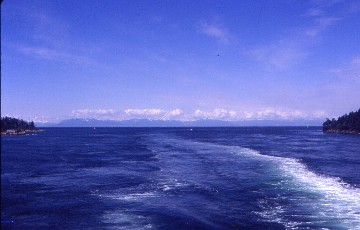
Following Customs, I had my usual magic touch with the automatic teller machine at Pacific Central Station. Bill, on the other hand, did not, so he had to run across the street to another ATM. While Bill was doing that, I picked up my VIA tickets for this summer's trip and had to pay for the Bras d'Or segment. We then bought our bus tickets for the 12:45 PM bus to Victoria and minutes later, boarded, which is the easiest way to travel to Victoria from the train station. Pacific Coach Lines bus made some local stops along the way before boarding BC Ferries at Tsawwassen to Swartz Bay, where it continued its journey by highway to Victoria.
Taking the bus, actually a motor coach, does not bother me anymore and this was good practice for my Quebec City-Sept Iles trip this summer. The ferry crossing was most enjoyable and we had lunch in the Pacific Buffet when we entered the ferry, then I worked on my suntan and enjoyed the views. Once across Georgia Strait and through Active Pass between the Gulf Islands, including Saltspring Island, I saw a sea otter and two bald eagles. Once back on the bus and off the ferry, it was a quick ride to the Victoria bus depot and a short cab ride to Swan's Inn.
Swan's Inn overlooked both the VIA station and the harbour and our room had a downstairs living room with a kitchen and bathroom while upstairs was the bedroom and a sunroof. I went for a long walk to the Canadian Pacific Railway roundhouse on the border of Victoria and Esquimalt, where I found the locomotives and coaches of the future Pacific Wilderness Railway, before returning to the room to watch "Walking with Dinosaurs". Bill ordered room service so a bit later, I did the same thing and had a Portuguese pepper steak. Following an evening walk and postcard writing, I called it a night.
4/17/2000 The next morning as I was enjoying breakfast, the Malahat arrived at the station for its morning run to Courtenay. I would ride the train and Bill would spend his day sightseeing.
The Malahat VIA 199 4/17/2000
History
The history of an island railway, and a functioning island railway in perpetuity, started with the colony of Vancouver Island joining British Columbia in 1866, Canadian Confederation in 1867, and the incorporation of British Columbia into Canada in 1871. The terms of union required that, within two years, the federal government was to start the construction of a railway from the "seaboard of British Columbia", joining the new province and Victoria with the railway system of Canada. On its part, British Columbia was to grant a band of public land of up to 20 miles in width along either side of the railway line to the federal government for it to use in furtherance of the construction of the railway. The Pacific terminus of the railway was not specified, but the proposed plan would have the railway cross the Rockies by the Yellowhead Pass and reach the BC coast at Bute Inlet. It would cross Sonora Island and Quadra Island and reach Vancouver Island by a bridge across Seymour Narrows. Through the influence of then BC Premier Amor de Cosmos, this plan was adopted by Order-in-Council by the federal government on 7 June 1873. Two shipments of rail were even delivered to Victoria from the United Kingdom.
In 1873, Prime Minister of Canada John A. Macdonald had stated that Esquimalt, the site of a naval base, would be the terminus of the "Pacific Railway". However, both the federal government and the Canadian Pacific Railway placed a low priority on construction of an island railway, as it had low traffic potential and would duplicate an existing steamer service. In 1874, British Columbia threatened to withdraw from Confederation, and BC premier Walkem petitioned Queen Victoria for relief from these delays. Prime Minister Alexander Mackenzie and Walkem agreed to accept arbitration of the dispute by the Earl of Carnarvon, the colonial secretary. His award, given 17 November 1874, gave an extension of time for the construction and required that a railway be built from Esquimalt to Nanaimo. Despite the promises of both parties to be bound by his ruling, the federal government bill approving the award failed in the Canadian Senate. British Columbians were indignant, and withdrawal from Confederation was raised again.
Robert Dunsmuir, the Nanaimo coal baron and a member of the provincial legislature, was interested in owning the railway project and in the province's coal reserves. The fact that Dunsmuir was a member of the provincial government making the deal aroused some suspicion about corruption. Dunsmuir and three partners (Charles Crocker, Collis P. Huntington and Leland Stanford of California) incorporated the Esquimalt & Nanaimo Railway (less formally the E&N Railway), with Dunsmuir president and owner of one half of the shares. The company estimated that it would cost $1.5 million to construct. Dunsmuir planned to integrate the railway with the systems being built in Washington and Oregon, with a train ferry link from Victoria.
MacDonald gave British Columbia the choice of Dunsmuir or Lewis M. Clement of San Francisco, chief engineer of the Western Division of the Atlantic and Pacific Railroad, for the contract. Dunsmuir travelled to Ottawa in 1882 with letters of introduction from John Hamilton Gray, one of the Fathers of Confederation, and Joseph Trutch, the first lieutenant governor of British Columbia, both men in favour with Macdonald. After a visit to Ottawa to present himself directly for this project, Dunsmuir went off to Scotland. While in Scotland, Dunsmuir received the news that the provincial government had chosen the Vancouver Land and Railway Company controlled by Clement for the job. Dunsmuir was surprised that Clement would take the contract without a cash grant in addition to the land and commit to building the railway to Seymour Narrows, near Campbell River. When Clement and his company failed to come up with the necessary financial security, Macdonald quickly moved to accept Dunsmuir's terms.
The court ruled that this grant did not entitle the railway to dispossess existing settlers. The company applied for compensation and received a further grant of 86,763 acres between Crown Mountain and Seymour Narrows. In 1883, the British Columbia government signed a contract with Dunsmuir to build a railway between Esquimalt and Nanaimo in exchange for the same grant of land that Clement had negotiated, amounting to 800,000 acres, plus a cash grant of $750,000 from the federal government. Based on an average value of $10 per acre for the land the E&N received, it cost the government $626,660 per mile to build the railway, which when complete was in private hands. The railway was given a massive amount of old-growth forest and proceeds from the land grants helped build Craigdarroch Castle. The grant amounted to almost 10 percent of Vancouver Island and included mineral rights and all known coal deposits. The land grants to the E&N railway from 1884 to 1925 amounted to 20 percent of Vancouver Island.
The company was to receive a grant with the following boundaries (Muir Creek is about four miles west of Sooke: on the south by a straight line drawn from the head of Saanich Inlet to Muir Creek, on the Straits of Fuca; on the west, by a straight line drawn from Muir Creek, aforesaid, to Crown Mountain; on the north, by a straight line drawn from Crown Mountain to Seymour Narrows; and on the east, by the coast line of Vancouver Island to the point of commencement. The grant was facilitated by BC's introduction of the Settlement Act in December 1883, in which surface rights of existing "squatters" were acknowledged and protected.
The last spike was gold and the hammer was silver. On 13 August 1886, the last spike was driven at Cliffside, Shawnigan Lake, twenty-five miles north of Victoria. Construction of the island railway took three-and-a-half years. Prime Minister Macdonald drove the last spike during his only visit to British Columbia. The railway was extended to Dunsmuir's mine at Wellington in 1887, and into Victoria in 1888. It was extended west to Port Alberni in 1911, west to Lake Cowichan in 1912 and north to Courtenay in 1914. The E&N Railway was to have been built all the way to Campbell River, but that plan fell through due to the outbreak of World War I.
The present-day bridge, eleven miles north of Victoria, over Niagara Creek Canyon previously crossed the Fraser River at Cisco and was moved 190 miles to Niagara Creek Canyon circa 1910. The cantilever suspension bridge was pre-fabricated in England in 1883 and shipped to Canada, which replaced the original wooden trestle bridge, damaged in a washout on 12 November 1886.
In 1905, Robert Dunsmuir's son, James Dunsmuir (former BC premier and soon-to-be lieutenant governor) sold the E&N Railway to the Canadian Pacific Railway who built the railroad to Lake Cowichan, Port Alberni, Parksville, Qualicum Beach and Courtenay. At its peak, the railroad had 45 stations on the main line, three stations on the Cowichan line and eight stations on the Port Alberni line.
Between 1905 and 1999, the E&N Railway was owned and operated by the Canadian Pacific Railway. VIA Rail took over operation of CPR's passenger train service, called The Malahat, in 1978 when CPR demarketed its freight operation, claiming that freight traffic was declining. In 1996, CPR reorganized the E&N as an "internal short line" named E&N Railfreight, while the rail barge operations were sold to Seaspan Intermodal. In early 1999, shortline operator RailAmerica purchased the route from Nanaimo to Port Alberni and leased the balance of the line. At that time, approximately 8,500 carloads of forest and paper products, minerals, and chemicals were transported by the Southern Vancouver Island Railway each year. In 1998, CPR sold the middle part of the corridor to RailAmerica but despite the purchase, freight traffic continued to decline and the future of the E&N was still in doubt. RailAmerica sought a sale for its acquisition due to unprofitability and deferred maintenance issues. Restrictions from Canadian Pacific on the lease/sale agreement and major reconstruction of Highway 1 from Victoria to Nanaimo and the new freeway from Nanaimo to Campbell River, led to reduced driving times for the full length of the E&N. This development also affected the privately-owned rail line, which did not have the benefit of the provincial subsidies accorded to its competing highways.
My RideI boarded VIA Rail RDC 6135, nee Canadian Pacific Railway 9072, built by Budd Company in 1957 and chose a right-hand window seat just past the exhaust vents for my ride on beautiful Vancouver Island. We departed Victoria on schedule and immediately crossed an arm of Victoria Harbour on the separate rail portion of the Johnson Street bascule bridge. We passed the roundhouse and the RDC wound its way through Victoria West then started the climb by the time we reached Esquimalt with its harbour and Royal Canadian Navy dry docks. It was so clear that the snow-covered Olympic Range in the Washington stood out across the Strait of Juan de Fuca to the south. Off to the right was Portage Inlet, which is part of the same body of water that we crossed leaving Victoria.
We next passed Langford Lake on the right and following that, the grade grew more difficult toward the summit and ascended to the 529 foot Niagara Trestle, which people had a tendency to bungee jump from. The next bridge was the 462 foot Arbutus Canyon bridge then looking way down at water level was Finlayson Arm of Swartz Bay, part of the same bay where our ferry docked. It was quite a view. At Milepost 15.6, we plunged into a 145 foot tunnel, the only one on the route. Cutting the tunnel had been nothing but hard labour: hand drills, picks and shovels, blasting and mucking out the fractured rock from the openings.
The grade over the Malahat remained challenging and costly for the entire history of the E&N. A steadily ascending grade to the summit reached a maximum at Milepost 13.4 and was 1.74 percent on an 11 degree curve, which was equivalent to 2.18 percent on a tangent track. Southbound trains faced 5.4 miles of 1.483 percent, which on the sharpest curve of 10 degrees, was equivalent to a gradient of 1.88 percent at Milepost 21.6.
We then topped the summit at Malahat at 1,300 feet above sea level then started the seven miles down grade to Shawnigan Lake, with the best view of the lake right after the station stop. Just before Shawnigan, at Milepost 25 at Cliffside, there is a stone monument where the last spike of the Esquimalt and Nanaimo Railway was driven on August 13, 1886. We entered the Cowichan Valley, where dairy farming is the main industry. Near Cowichan, an over one-hundred- year-old church was seen and later to the east, Mount Richards was viewed. A few minutes later, Somenos Lake was passed on the east and further up the line at Chemainus, a historic train was on display with MacMillan Bloedel 2-6-2T 1044 steam locomotive at the main gate of their plant.
At Ladysmith, Comox Railway 2-8-2 11 was visible on the right going north. Of course, there were the almost constant views of the Coast Range on the mainland, the waters of the Strait of Georgia and the Gulf Islands of Thetis or Kuper to the east. The train passed above Ladysmith Harbour before crossing over the watershed divide to the Nanaimo River, which flows into the harbour, on which that namesake city is located. We arrived at the station for a crew change and a visit to the snack truck that visits the station when the Malahat arrives to provide food service.
We departed, passing beautiful Long Lake before running along Nanoose Bay at water level then climbed over another ridge with the mainland Coast Range as an eastern backdrop before bridging the Englishman River and stopping at Parksville, where the freight line to Port Alberni on the west side of Vancouver Island diverges from the mainline. This was originally called McBride Junction and a daily scheduled freight train is run on that line with all cars from the mainland arriving by Seaspan rail ferries at Nanaimo. When the RDCs need to be changed out for maintenance, they have be taken to Nanaimo and taken to Tilbury in Delta to reach the shop in Vancouver via the same ferry system.
The Malahat next crossed the 1,045 foot bridge over French Creek and I had a grand view of Mount Arrowsmith to the west. At Qualicum Beach, there was a large group of people who meet every train then more peaks of the Beaufort Range came into view to the west, but all the trees made my photography bids a lost cause except for one clear shot. Off to the east was Hornby Island, followed shortly later by Denman Island, with that ever-present Coast Range as a backdrop. The Malahat passed Mud, Buckley and Union Bays before travelling above the final bay of the trip, Comox Bay, just prior to arriving in Courtenay, where I finished another VIA route, which only leaves Sudbury to White River on Lake Superior and the new Bras d'Or service to ride this summer.
Courtenay 4/17/2000My power-walking came in handy for the trek to the store for snacks during the twenty-five minute layover. At the store, a cyclist was being arrested for drunk cycling which was my reminder for this day about the fact that I lead a sober life and it seems that wherever and whenever I travel, God gives a reminder of my previous drunken lifestyle. It was my 1,619th day of sobriety and I was alive and happy riding on the Malahat on Vancouver Island.
The Malahat VIA 198 4/17/2000The ride back was relaxing as I wrote about the northbound trip, viewed the great Vancouver Island scenery and listened to Rod Stewart, as well as Deep Purple. Time flies when you are having fun and it seemed as though it was no time the Malahat was back in Nanaimo, where there weree two snack trucks but everyone was flocking to one. I learned there that the two truck drivers were friends and that one would not fully open so not to take away from her friend's business. It was a wonderful, sunny and warm April day and I almost did not want to get back on the train because the sun felt so good, but my good sense kicked in and the Malahat, with me aboard, was off for Victoria.
At Duncan, the train surprised a couple who were making out in the grass across from the station. I gave a brief wave, a thumbs up and with the train's departure, they went back at it. Probably the last thing on their minds was that an RDC full of people would stop right there. Guess they were just caught up in the mood on this clear and beautiful warm April day.
The rest of this beautiful trip I spent in the rear control area before being joined by other passengers for the high bridges of Malahat Pass. As the train passed Esquimalt Harbour, the Olympic Range still stood tall as a backdrop to a most wonderful scene and we arrived in Victoria twenty minutes late. In my haste to detrain, I left my new McFadden jacket aboard but retrieved it the next morning and my jacket made its first solo round trip without me. The Malahat was a very enjoyable and beautiful day's train trip that should be taken by anyone who likes trains and is easiest to take from a hotel since it was right across the street from Swan's Inn.
Back to the Mainland 4/18/2000Bill had a wonderful day of exploring Victoria so after a relaxing evening, saving my jacket and another great breakfast at the hotel, we took an early taxi to the bus station so we could have the front seat and Bill could videotape our return trip. It was a quick journey to the ferry and once on board, I went to the top deck, found a bench and sunned myself for over thirty minutes. I then enjoyed our crossing, had a White Spot burger for lunch and tried the massage chair which was a wonderful relaxing experience. I returned to the bus in time to watch the huge doors open and for our docking, followed by the quick ride to Pacific Central Station. Bill bought his ticket to go to Seattle today so he could visit some relatives and I upgraded my Amtrak Cascades ticket to Business Class for my return on Thursday. We would meet at King Street Station in Seattle on Friday morning so said our goodbyes, only to run into each other again at the store underneath the Skytrain station. We bid our adieus once more and I boarded Skytrain for Waterfront station.
West Coast Express E1 4/8/2000West Coast Express is owned and operated by the region's transit authority, TransLink. Opened in 1995, it provides a link between Metro Vancouver and the Fraser Valley Regional District and is the only commuter railway in Western Canada. Service is provided between downtown Vancouver and the municipalities of Port Moody, Coquitlam, Port Coquitlam, Pitt Meadows, Maple Ridge and Mission. Along its route, several stations interchange with the SkyTrain metropolitan rail system as well as local bus services. Additionally, Waterfront station in Downtown Vancouver provides a connection to the SeaBus passenger ferry.
Service on the West Coast Express began on November 1, 1995, under the management of BC Transit. It was transferred to TransLink on April 1, 1999, the successor to BC Transit's operations in Greater Vancouver. It operates from Monday to Friday (excluding holidays) with five trains per day running from Mission to Vancouver in the morning peak hours (5:25 AM to 7:25 AM) and returning to Mission in the evening peak (3:50 PM to 6:20 PM). A one-way trip takes 75 minutes, which is faster than driving to Downtown Vancouver.
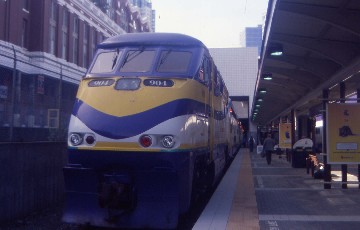
My other new mileage of this trip was a ride on West Coast Express. The train leaves from below the restored Canadian Pacific station and is located at the junction of Skytrain and the Seabus. I bought a ticket from the ticket machine and even received credit for my Skytrain ticket before I boarded the colourfully-painted Bombardier bi-level coaches, identical to the Metrolink cars back home, with the exception of more comfortable seats and that each train has a Cappuccino Car with a vending area located where the restroom usually is. The car filled up with every single seat full before departure.
Train E1 departed Waterfront station on time to start its 41.7 mile trek to Mission City, which is the route the Canadian took into Vancouver when it was a Canadian Pacific Railway train, so I have now ridden from its old starting points in both Vancouver and Montreal. The train followed the south side of the Burrard Inlet as far as Port Moody then travelled along the industrial waterfront until reaching the shoreline for its quick run before ducking under the Upper Narrows Bridge. To the north, the beautiful mountains were almost always in view and it was an absolutely spectacular ride with me being the only one noticing, since everyone else was either sleeping or reading. I guess that people just get used to their natural environment and take it for granted.
We made brief stops at Port Moody and Coquitlam Central before I regained the formerly-ridden Canadian Pacific, which we would follow as far as Mission Junction, then slowed for the drawbridge at Pitt River before stopping at Pitt Meadows, followed by Maple Meadows and Port Haney. The Fraser River joined the train for some north shore running and to the north were the ever-present mountains and to the east, the Cascades with Mount Baker in Washington State in view. At Mission Junction, the route of the Canadian crosses the Fraser River to the Canadian National mainline for the rest of its trip to Toronto, while I enjoyed a mile of brand new trackage to our final stop at Mission City. I detrained before walking the mile to the Mission City Lodge and had an excellent view from my third-story window of the valley, the Fraser River, the Cascades and Mount Baker. I enjoyed the rest of my evening and started my night of sleep.
The Unplanned Return to Vancouver 4/19/2000My plan was to take one of the morning West Coast Express trains back to Vancouver before I spent a night in the city at the Days Inn. The only part of that plan to work was where I stayed that night. My day started with waking up at 4:30 AM with a bad feeling knowing that something had happened. I went back to sleep and when I woke up at 6:30 AM I turned on the television and my feelings proved true. A Canadian Pacific Railway freight train derailed at Maple Meadows, spilling sulphur all over the ground so with the tracks blocked, there would be no West Coast Express service and I was on my own to find a way back to Vancouver.
When my taxi arrived to take me to the station, he suggested that he could take me to Abbotsford to catch a bus from there to Vancouver. As we crossed the Fraser River, I suggested the Skytrain station in Surrey, which would be quicker and at least I would know where I was going. He said that for $60 Canadian, he would take me anywhere that I wanted. The good news was that had the opportunity to see some areas of British Columbia that I would not have seen from the train on the way to Surrey. He did a good job of driving and dropped me off at the Skytrain station a mere forty minutes later.
I bought an all-day Skytrain pass and rode east to King George to be able to put my bags in the front door of the car for the view into the city without having to fight for it if as I would I have had I boarded at Surrey on the way. As I made a quick trip to Waterfront station, I thought how stupid Orange County is for not building a system like this. I detrained and walked the five blocks to Days Inn where I was able to check in, even though it was before 8:30 AM.
Vancouver 4/19/2000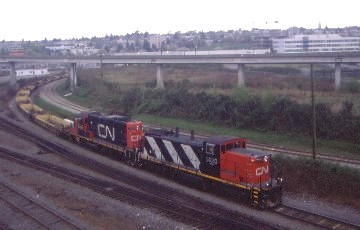
Now that I did not have my luggage, I was free to explore and rode Skytrain out to King George to make up for the mileage lost this morning. When I returned to the Science World station, I walked east on Terminal Street to photograph the morning Amtrak Cascades arrival and as I waited, I was rewarded with two CN GMD1us, the lead being 1420, nee Canadian National 1058 built by Diesel Division-General Motors of Canada in 1959, which I had only photographed from passing trains before. The Cascades arrived then I returned to the hotel to relax for the afternoon and later, went to the Keg Restaurant two blocks away and had a filet mignon with a Keg sundae for dessert. I walked over to Canada Place and saw "Fantasia 2000" at the IMAX Theater then rode Skytrain again and saw the lights of Vancouver as I returned westbound after dark. It was really quite a sight. Walking back to the hotel in a light rain, I felt very satisfied with my day then called it a night.
Vancouver 4/20/2000Sleeping in late, I watched some old time television programs before checking out then walked to Skytrain but first stopped at Pacific Central Station to buy a Canadian commemorative T-shirt that they had run out of last summer and to store my bags for the day. Back on Skytrain, I rode it east to the Columbia stop then walked a mile to watch the Amtrak Cascades crossing the Fraser River. Following a nice walk back, I resumed my eastward journey to King George before going to Waterfront station then ventured to the Gastown District and went to the food court across from the Canadian Pacific station for lunch at A&W. I rode Skytrain back to Science World and walked back to Canada Place for a repeat of "Mysteries of Egypt" and a new program on dolphins on that giant IMAX screen. I stopped by the Rocky Mountaineer office prior to waiting for my next train.
Amtrak Cascades 763 4/20/2000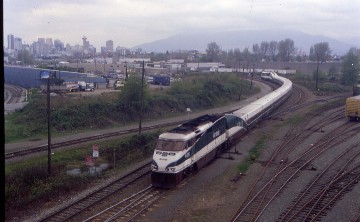
Having upgraded to Business Class made boarding much easier and I was first in line at 4:30 PM to check in, first through pre-Customs and first to board. I had a pre-departure dinner from the bistro car, read today's news and just relaxed before we departed eight minutes late. My seat was 1A, a single seat on the right (Puget Sound) side of the train. We lost more time passing through the Skytrain construction zone for its Millennium Line extension set to open in late 2001 then crossed the Fraser River and were delayed further by following a coal train to Colebrook on its way to Roberts Bank to be loaded onto a ship there.
The views were stunning with Mount Baker to the east, Boundary Bay and islands to the west, the Coast Mountains to the north, the Cascades to the east, Vancouver Island to the west and the Olympic Range to the southwest, all adding up to a most beautiful view from the windows of the Talgo. Passing through White Rock, everyone was waving at the train and once past the Peace Arch at the border, US Customs agents boarded. This time, I was not asked a single question and I must say that the agents do an excellent job at this border crossing. The film was "Anywhere but Here" starring Natalie Portman, who was the Queen in the "Star Wars: The Phantom Menace". It was entertaining as far as Everett, where I enjoyed the views of Puget Sound back to Seattle then took the first taxi out of King Street Station to the Kings Inn for a well-deserved night's rest.
Seattle 4/21/2000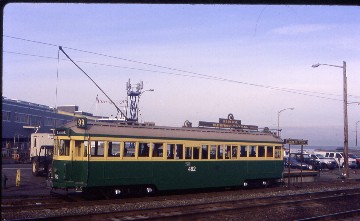
I woke up and after a McDonald's breakfast, rode a taxi back to King Street station to wait for the train toward home and meet Bill. At the top of the hill was Seattle Waterfront Trolley 482.
Coast Starlight 11 4/21/2000
Boarding the Coast Starlight in a sleeper for the first time was so much easier and stress-free than boarding coach. We had Room 4 which was on the same side that we had coming up, so Bill went to our attendant and upon departure, were switched to Room 9, while I was enjoying tea and cinnamon rolls in the Pacific Parlour Car. We departed eight minutes late and at about South Seattle, I returned to the room for a view of Mount Rainier. Bill and I discussed his accident and recovery from the loss of his arm, which was a fascinating story, then I shared my story of my recovery during my stay at Tustin Hospital for my alcoholism. We are two very lucky people. Near Olympia, I went to the dining car, where I was met by the wonderful Patty Martinez, a friend and dining car steward who was working this trip. I ordered the Mt. Shasta steak sandwich and with dessert came a view of Mount St. Helens. After lunch, it was "Led Zeppelin Live" that carried me to Portland.
Portland was very interesting. I detrained and went to see the First Class Lounge and bought Friday's edition of USA Today. As I was walking back onboard to the Parlour Car, I spotted a man carrying a bottle of Coast Starlight wine and his pockets stuffed with miniature liquor bottles. I went into the Parlour Car and saw the spot where the bottle had been, then found the attendant and told him about it. The two of us and two other passengers went in search of that man and he was found and cornered in the transition sleeper and we led him off the train to the conductor, who called Security to have him arrested. It is never boring on the train. Later, I learned that the thief was on parole and this felony was going to send him back to the big house.
The afternoon was spent in 7-Up tasting while the rest of the sleeping car passengers had wine tasting. I walked through the train and returned to good conversations in the Parlour Car. At Eugene, I detrained for a quick phone call to Carol Palmer, a woman I met on the Starlight back in my drinking days and whom I visited in Cottage Grove on my first Pacific Parlour Car trip, then had dinner along Lookout Point Reservoir. On this evening, I ate a Willamette Valley beef tenderloin along with a Turtle cake for dessert then played tour guide for the climb over Cascade Summit, where there was less snow than seven days ago. Due to the cloud cover, it was light enough to see all the way down to Chemult, where it was trying to rain upon our departure, making me realize how blessed I had been on this trip with regard to the weather. The Starlight proceeded south into the night and at Klamath Falls, I enjoyed a nice long walk as we were early then went to bed wondering what tomorrow would bring.
4/22/2000 I awoke prior to Sacramento which gave me an opportunity to run in and see my brother Bruce, the former service manager of the California Corridor. He was back as a ticket agent because he had the good sense to keep paying his union dues while he was in management, so he was able to return to his former trade. It was really good to see him back working behind a ticket counter and is one of the best ticket agents that I know. I am not saying that because he is my brother, but because it is the truth!
We departed fifteen minutes late and lost more time due to a signal malfunction and that took long enough that I ate my breakfast between West Sacramento and Davis. The journey along the Carquinez Straits was enjoyable but by Richmond, the train entered the clouds and mists. Amtrak F40PH 231, the California Lifesaver locomotive, was added at the Oakland coach yards, so we would have additional power for the rest of our trip. I learned that we left a passenger in Emeryville, who had to take a taxi to Oakland to catch the train. For a ten minute ride, I wondered how much it cost?
The Starlight was an hour late as we arrived at Salinas following another steak sandwich lunch then I had a relaxing nap as far as Paso Robles and while all the other sleeping car passengers were having their champagne reception in the Parlour Car, I had a ginger ale reception of my own. The pace of today's train was very relaxing and the descent down Cuesta Grade was made more interesting with my four-night-a-week train riding buddy Christina on Train 14 and when we passed each other, I was downstairs for a wave out of the vestibule window. We arrived in San Luis Obispo only twenty minutes late and it was time for a fresh air break.
I had a nice dinner with a mother and two children from Whittier as the we crossed Vandenberg Air Force Base and rounded Point Conception to travel east along the Santa Barbara Channel with the islands and offshore oil wells keeping guard. From a certain angle, those rigs look as though they are aircraft carriers. It must be what the Persian Gulf looked like during that war. The last fresh air break was in Santa Barbara and we departed on time. Oxnard came next, followed by Simi Valley and after passing through the three tunnels, we gained the San Fernando Valley then crossed the valley to Glendale, before running the last six miles to Los Angeles Union Station on time. Who says the Coast Starlight never runs on time? On this trip, it did it both ways.
San Diegan 786 4/22/2000Bill and I were greeted by Richard and Mishi of the train crew while we all waited for the train to arrive from Goleta. Once on board, Mishi took our final tickets as we made the fast trip to Anaheim, where Bill detrained and we said our final goodbyes. Minutes later, Mishi said goodbye to me as I detrained at Santa Ana, completing an excellent and never-to-be-forgotten journey to Vancouver Island.
| RETURN TO THE MAIN PAGE |